 programming
Similar presentations:








Structures and Records
1.
Structures and Records.Structures. Description of Structure
Picture.
Determination (declaring) data with a
structure type. Methods of work with
structures.
Records. Description of Records.
Determination of record exemplar.
Work with records.
2.
For what purpose are structured data types included inassembly language?
A structured data type is one in which each data
item is a collection of other data items. In a
structured data type, the entire collection uses a
single identifier (name). The purpose of structured
data types is to group related data of various types
for convenient access using the same identifier.
3.
What structured data types do MASM and TASM support?MASM and TASM support the
following structured data types:
arrays;
structures;
associations;
records.
4.
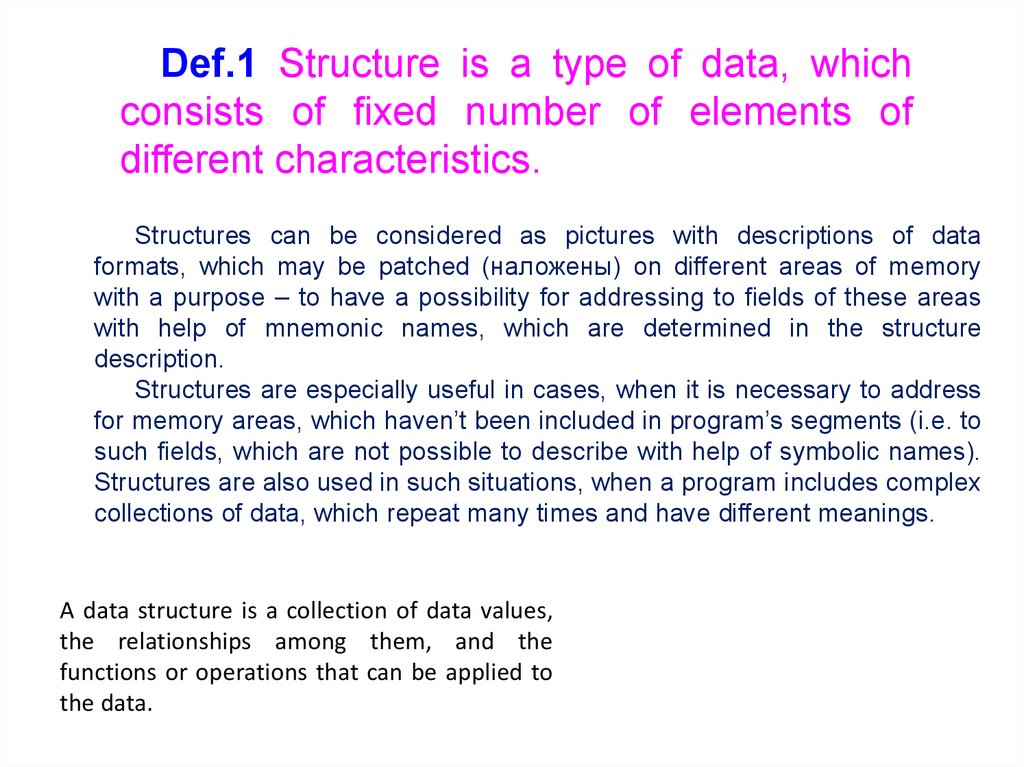
Def.1 Structure is a type of data, whichconsists of fixed number of elements of
different characteristics.
Structures can be considered as pictures with descriptions of data
formats, which may be patched (наложены) on different areas of memory
with a purpose – to have a possibility for addressing to fields of these areas
with help of mnemonic names, which are determined in the structure
description.
Structures are especially useful in cases, when it is necessary to address
for memory areas, which haven’t been included in program’s segments (i.e. to
such fields, which are not possible to describe with help of symbolic names).
Structures are also used in such situations, when a program includes complex
collections of data, which repeat many times and have different meanings.
A data structure is a collection of data values,
the relationships among them, and the
functions or operations that can be applied to
the data.
5.
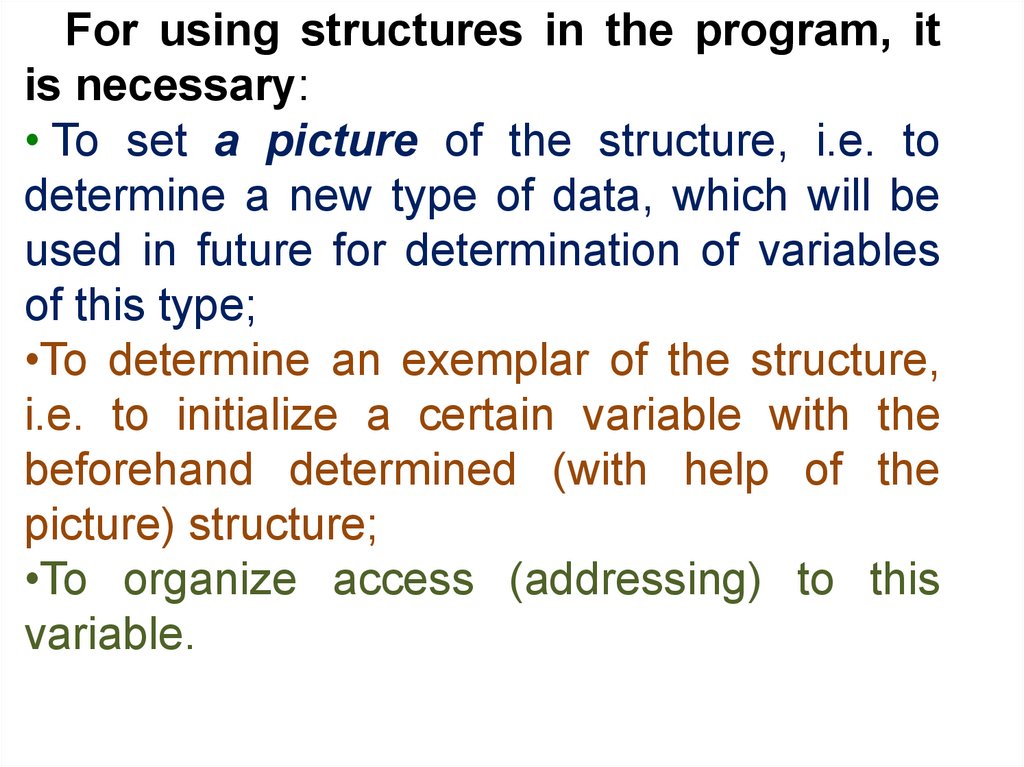
For using structures in the program, itis necessary:
• To set a picture of the structure, i.e. to
determine a new type of data, which will be
used in future for determination of variables
of this type;
•To determine an exemplar of the structure,
i.e. to initialize a certain variable with the
beforehand determined (with help of the
picture) structure;
•To organize access (addressing) to this
variable.
6.
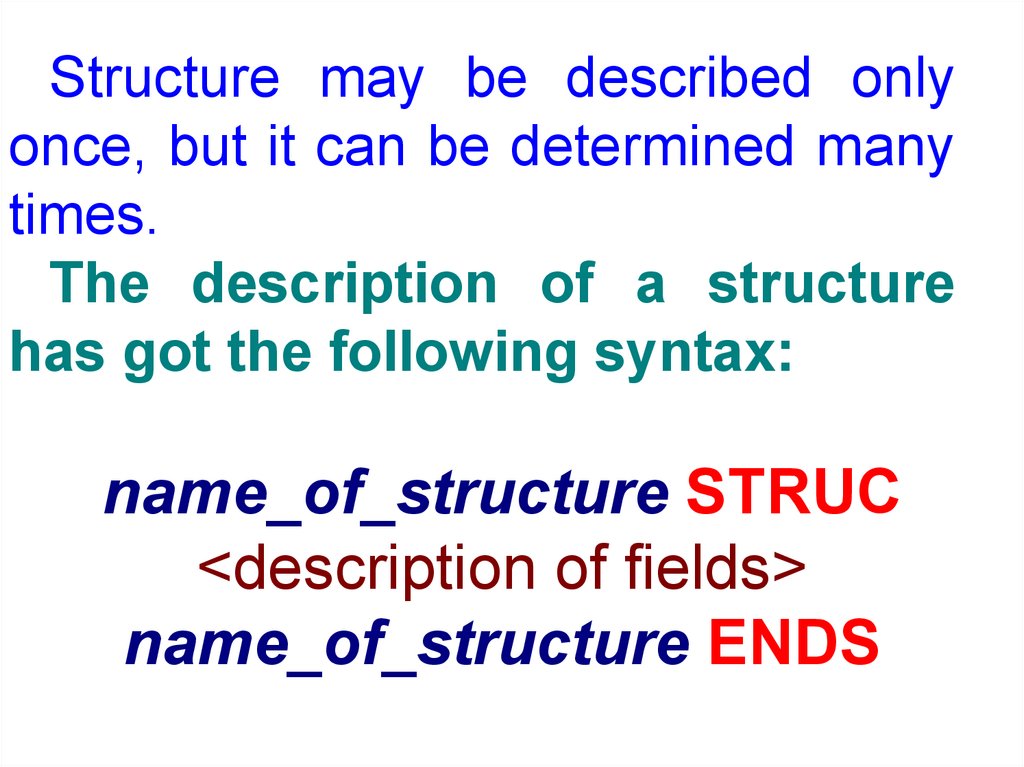
Structure may be described onlyonce, but it can be determined many
times.
The description of a structure
has got the following syntax:
name_of_structure STRUC
<description of fields>
name_of_structure ENDS
7.
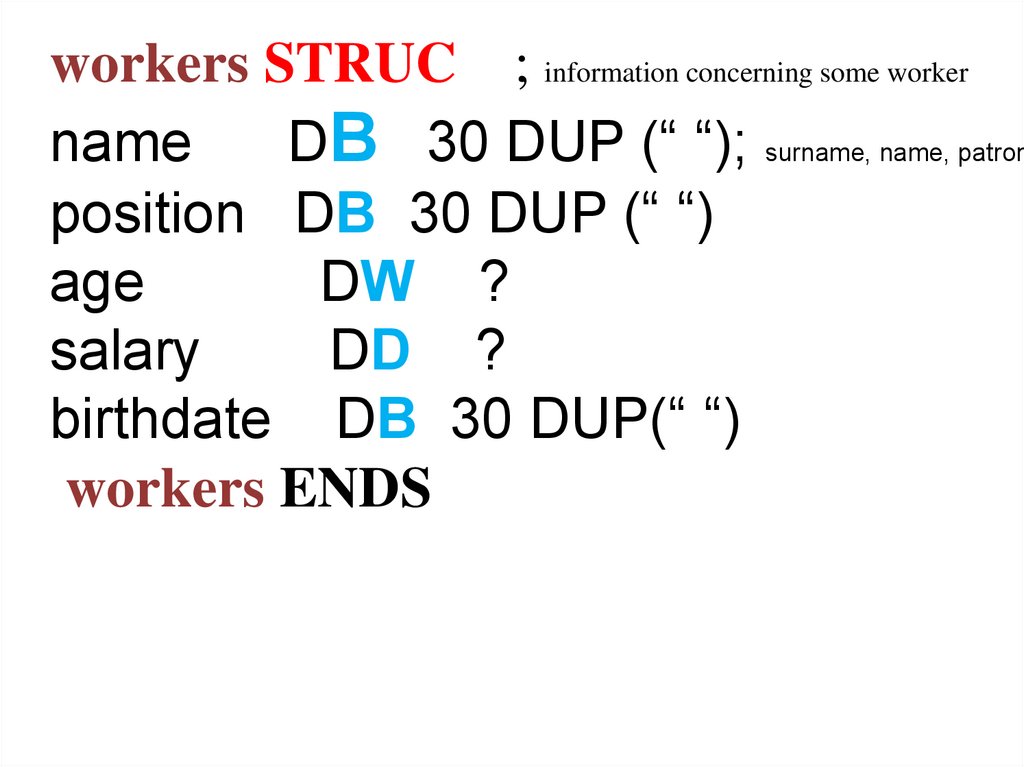
workers STRUC ; information concerning some workername
DB 30 DUP (“ “); surname, name, patron
position DB 30 DUP (“ “)
age
DW ?
salary
DD ?
birthdate DB 30 DUP(“ “)
workers ENDS
8.
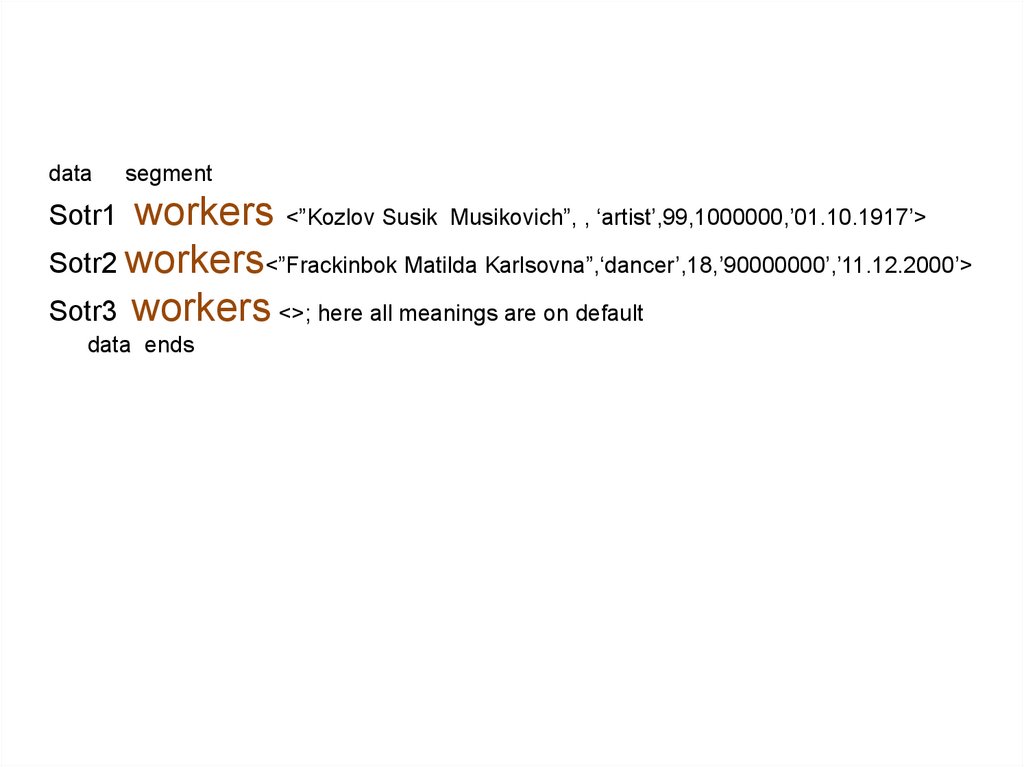
datasegment
workers <”Kozlov Susik Musikovich”, , ‘artist’,99,1000000,’01.10.1917’>
Sotr2 workers<”Frackinbok Matilda Karlsovna”,‘dancer’,18,’90000000’,’11.12.2000’>
Sotr3 workers <>; here all meanings are on default
Sotr1
data ends
9.
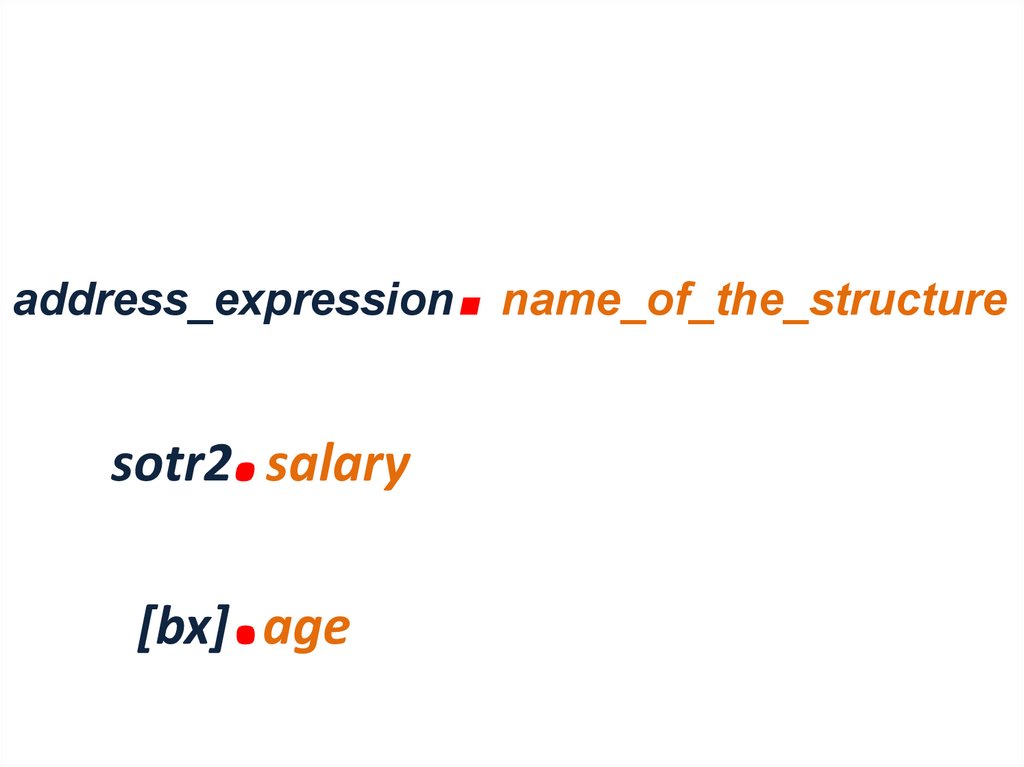
.address_expression
.
[bx].age
sotr2 salary
name_of_the_structure
10.
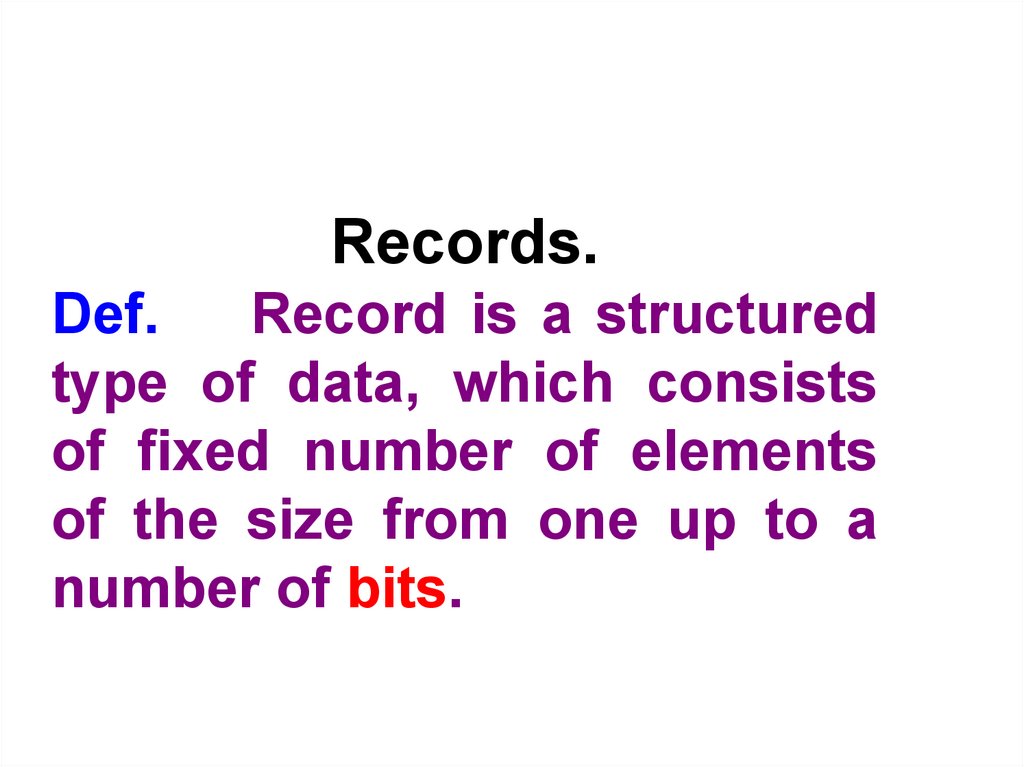
Records.Def.
Record is a structured
type of data, which consists
of fixed number of elements
of the size from one up to a
number of bits.
11.
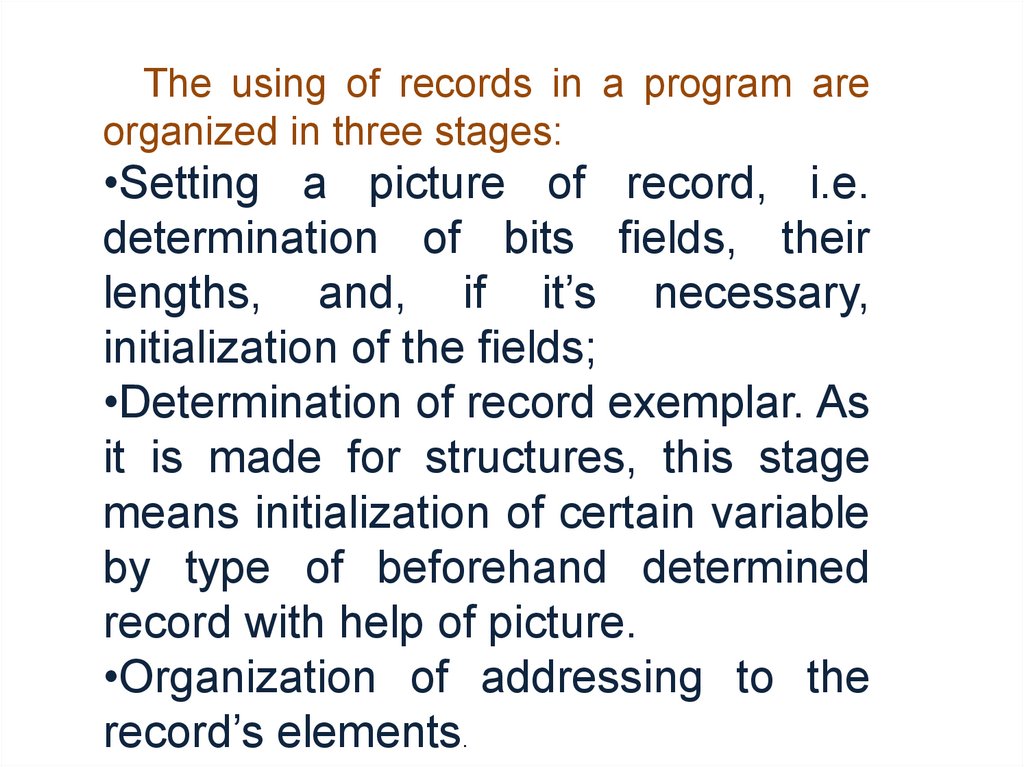
The using of records in a program areorganized in three stages:
•Setting a picture of record, i.e.
determination of bits fields, their
lengths, and, if it’s necessary,
initialization of the fields;
•Determination of record exemplar. As
it is made for structures, this stage
means initialization of certain variable
by type of beforehand determined
record with help of picture.
•Organization of addressing to the
record’s elements.
12.
The using of records in a program areorganized in three stages:
•Determination of record exemplar. As
it is made for structures, this stage
means initialization of certain variable
by type of beforehand determined
record with help of picture.
•Organization of addressing to the
record’s elements.
•Setting a picture of record, i.e.
determination of bits fields, their
lengths, and, if it’s necessary,
initialization of the fields;
13.
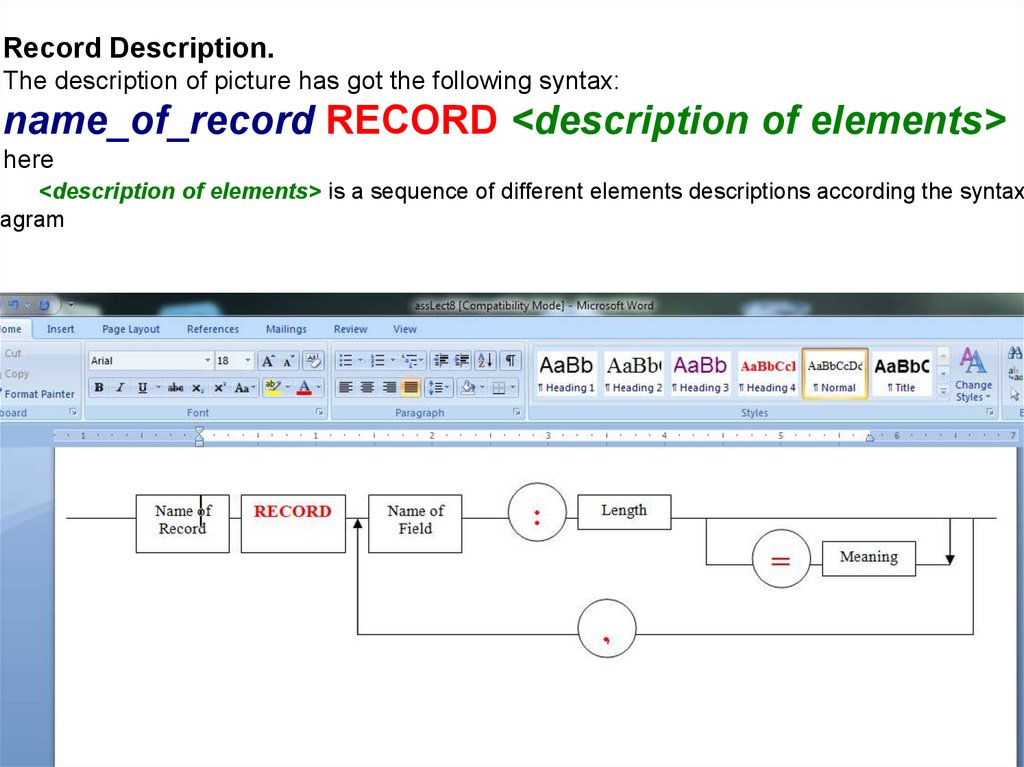
Record Description.The description of picture has got the following syntax:
name_of_record RECORD <description of elements>
here
<description of elements> is a sequence of different elements descriptions according the syntax
iagram
14.
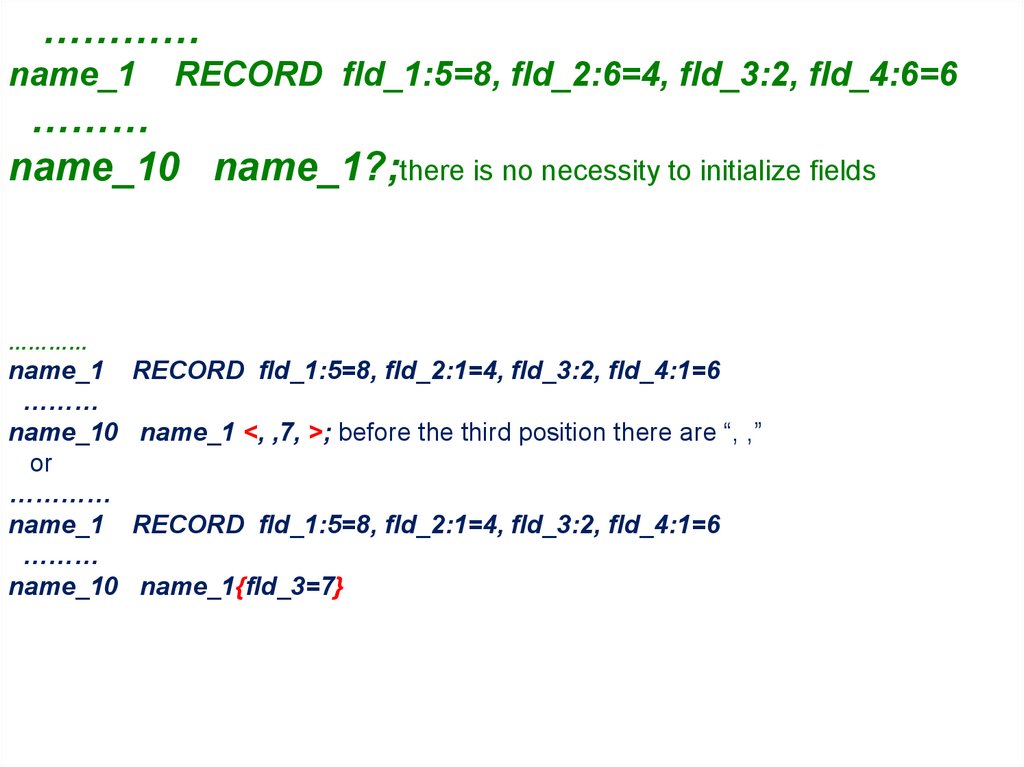
…………name_1
RECORD fld_1:5=8, fld_2:6=4, fld_3:2, fld_4:6=6
………
name_10 name_1?;there is no necessity to initialize fields
…………
name_1
………
name_10
or
…………
name_1
………
name_10
RECORD fld_1:5=8, fld_2:1=4, fld_3:2, fld_4:1=6
name_1 <, ,7, >; before the third position there are “, ,”
RECORD fld_1:5=8, fld_2:1=4, fld_3:2, fld_4:1=6
name_1{fld_3=7}
15.
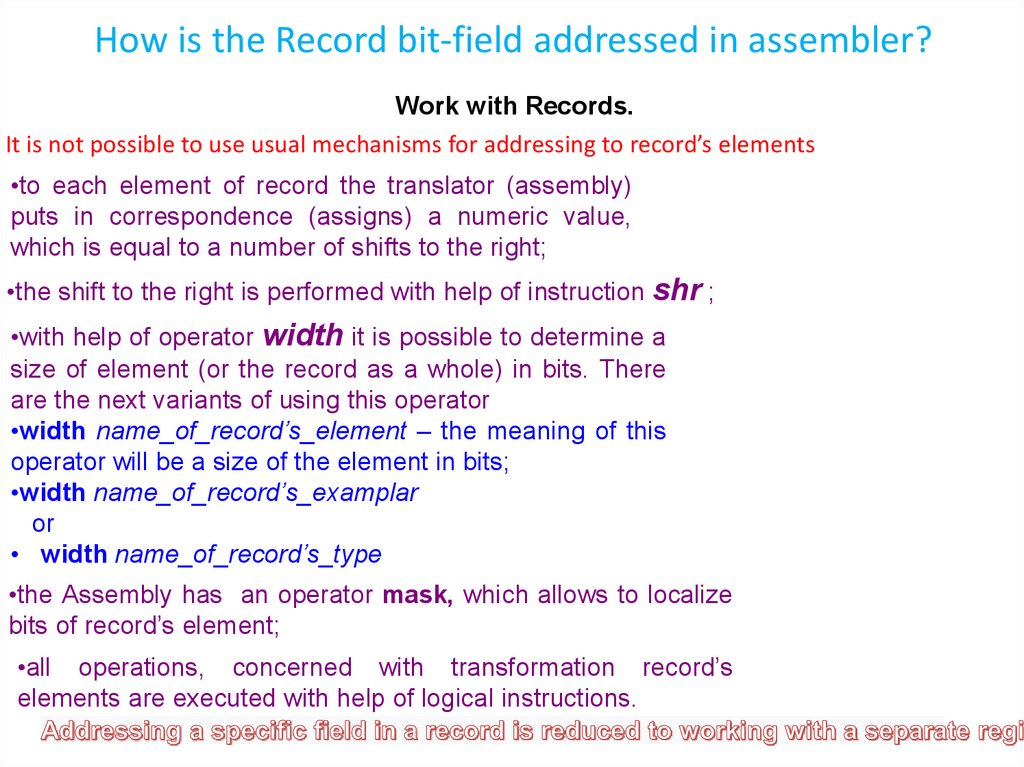
How is the Record bit-field addressed in assembler?Work with Records.
It is not possible to use usual mechanisms for addressing to record’s elements
•to each element of record the translator (assembly)
puts in correspondence (assigns) a numeric value,
which is equal to a number of shifts to the right;
•the shift to the right is performed with help of instruction shr ;
•with help of operator width it is possible to determine a
size of element (or the record as a whole) in bits. There
are the next variants of using this operator
•width name_of_record’s_element – the meaning of this
operator will be a size of the element in bits;
•width name_of_record’s_examplar
or
• width name_of_record’s_type
•the Assembly has an operator mask, which allows to localize
bits of record’s element;
•all operations, concerned with transformation record’s
elements are executed with help of logical instructions.
16.
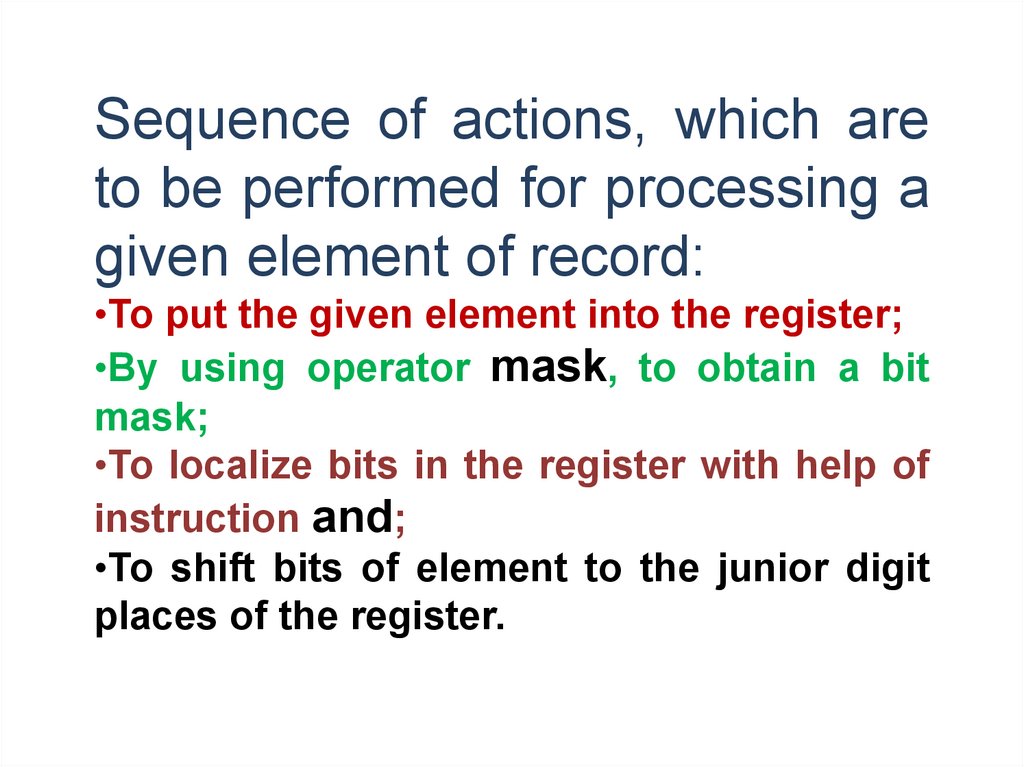
Sequence of actions, which areto be performed for processing a
given element of record:
•To put the given element into the register;
•By using operator mask, to obtain a bit
mask;
•To localize bits in the register with help of
instruction and;
•To shift bits of element to the junior digit
places of the register.