 medicine
Similar presentations:




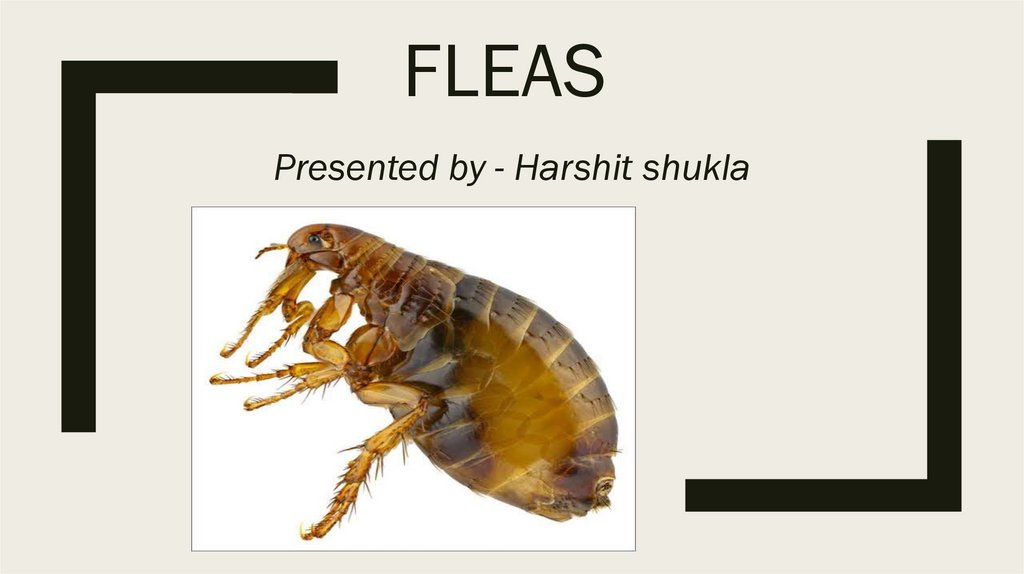
Fleas
1.
FLEASPresented by - Harshit shukla
2.
■ Ridding your home of fleas can be a daunting andcostly endeavor. Unlike most household pests, fleas
bite dogs and cats as well as people. The bites can
cause intense itching and irritation, and a
hypersensitive animal will often require veterinary
assistance.
■ Fleas can also transmit tapeworms and bacterial
infections.
■ The pests are highly prolific – the biting adult stage
might be living on the pet, in addition to hundreds or
thousands of eggs, larvae, and pupae elsewhere in
the home or yard. If early signs of fleas are ignored,
infestations can quickly spiral out of control.
3.
■ Fleas are common external parasites of both dogsand cats. The adults are ravenous blood-feeders,
consuming up to 15 times their body weight in blood
per day. Pets initially become infested when adult
fleas occurring indoors or outdoors jump on the
animal.
■ With the ability to jump vertically up to about 6
inches, the adults can easily hitch a ride onto a
passing dog or cat, or even the shoes and pant legs
of a human.
■ Adult fleas spend most of their time on the dog or
cat, not in the carpet. This is why treatment of the
pet is an essential step in ridding a home of fleas.
4.
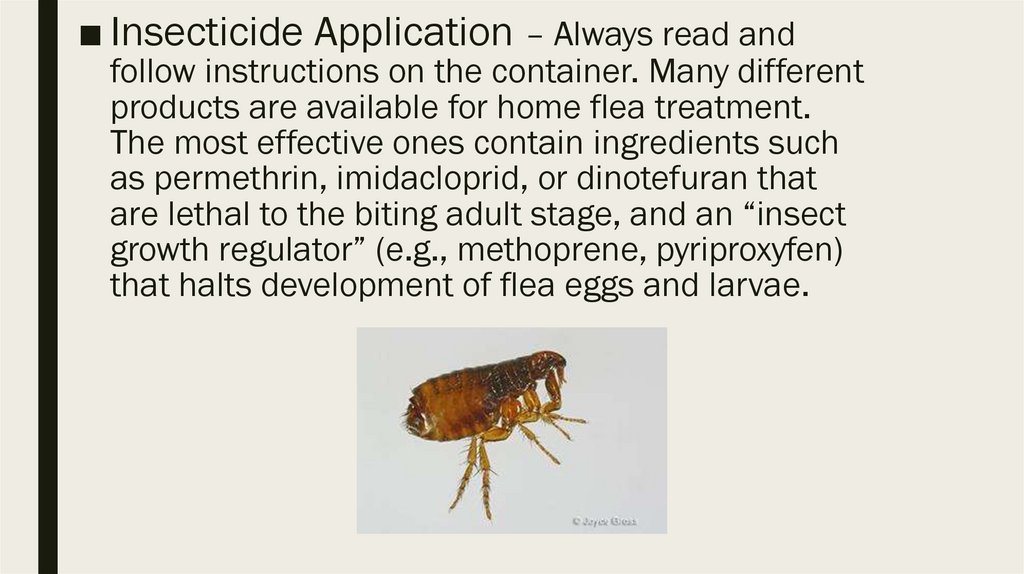
■ Insecticide Application – Always read andfollow instructions on the container. Many different
products are available for home flea treatment.
The most effective ones contain ingredients such
as permethrin, imidacloprid, or dinotefuran that
are lethal to the biting adult stage, and an “insect
growth regulator” (e.g., methoprene, pyriproxyfen)
that halts development of flea eggs and larvae.
5.
■IMPORTANCE – Infestation by fleas may causesevere inflammation of the skin and intense itching.
Although many animals acquire partial immunity
after constant or repeated attacks, individuals
(especially humans) can occasionally become
sensitized after exposure and develop allergies.
■ Species that attack people and livestock include the cat flea
(Ctenocephalides felis), the so-called human flea (Pulex
irritans), the dog flea (Ctenocephalides canis), the sticktight
flea (Echidnophaga gallinacea), and the jigger, or chigoe,
flea (Tunga penetrans). Poultry may be parasitized by the
European chicken flea (Ceratophyllus gallinae) and, in the
United States, by the western chicken flea (Ceratophyllus
niger).