
Similar presentations:


“1984”. Written By George Orwell
1.
“1984”WRITTEN BY GEORGE ORWELL
THIS PROJECT WAS MADE BY DOROFEEV PAVEL
2.
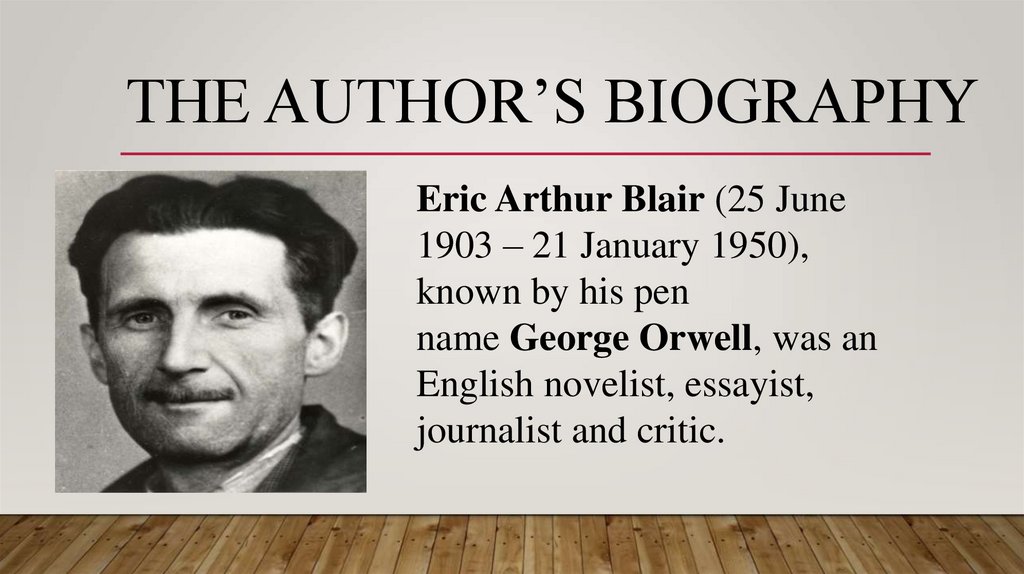
THE AUTHOR’S BIOGRAPHYEric Arthur Blair (25 June
1903 – 21 January 1950),
known by his pen
name George Orwell, was an
English novelist, essayist,
journalist and critic.
3.
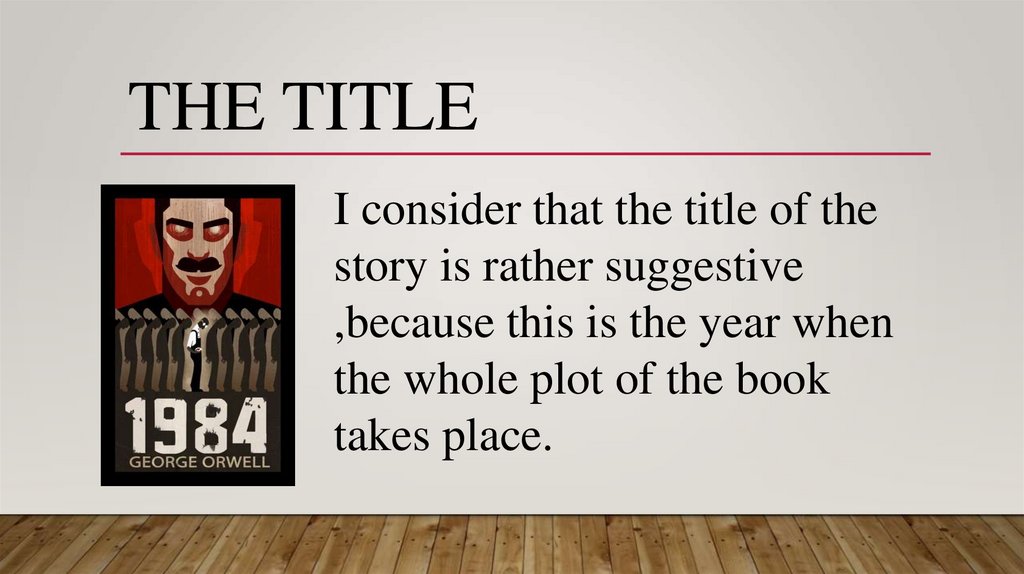
THE TITLEI consider that the title of the
story is rather suggestive
,because this is the year when
the whole plot of the book
takes place.
4.
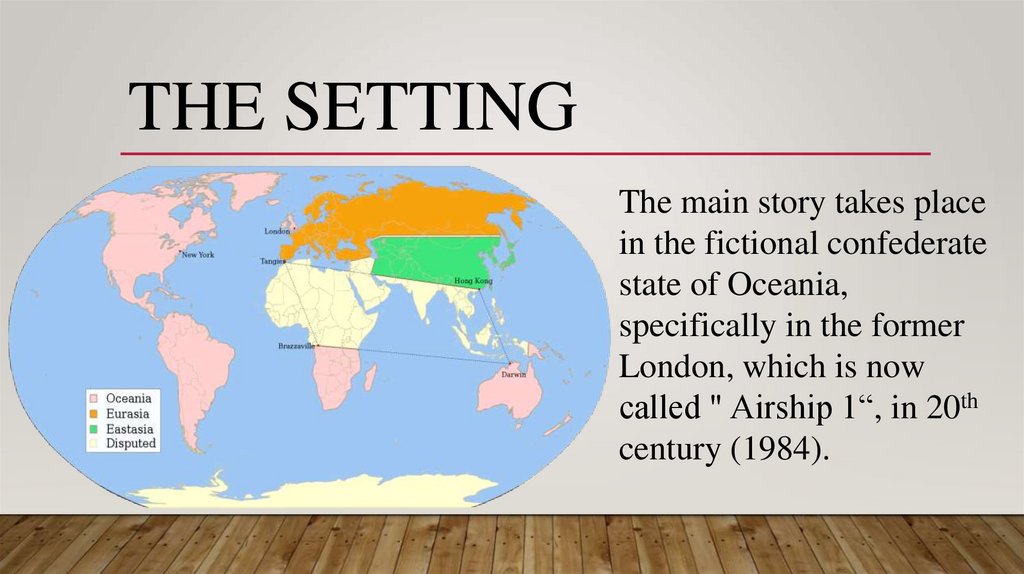
THE SETTINGThe main story takes place
in the fictional confederate
state of Oceania,
specifically in the former
London, which is now
called " Airship 1“, in 20th
century (1984).
5.
THE SUBJECT• The subject of the story may be formulated as an internal
revolution of the main character against the ideology of
totalitarianism of the country in which he lives.
• The following row of thematic vocabulary helps us to gain a
better understanding of the topiс: thoughtcrime, traitor,
rebellion, disobedience, torture, dominion, denunciation,
suspect
6.
THE MESSAGE• The message of the literary work runs as follows: the common
man is powerless against the established system. It can't be broken
alone. This idea is conveyed through the presentation of the main
character’s feelings. At the beginning of the story, his mind is
obsessed with the idea of revolution, but at the end, after “reeducation”, he forgets all his ideals and begins to believe that the
Party is not so bad and it is good to live with it.
7.
THE PLOT8.
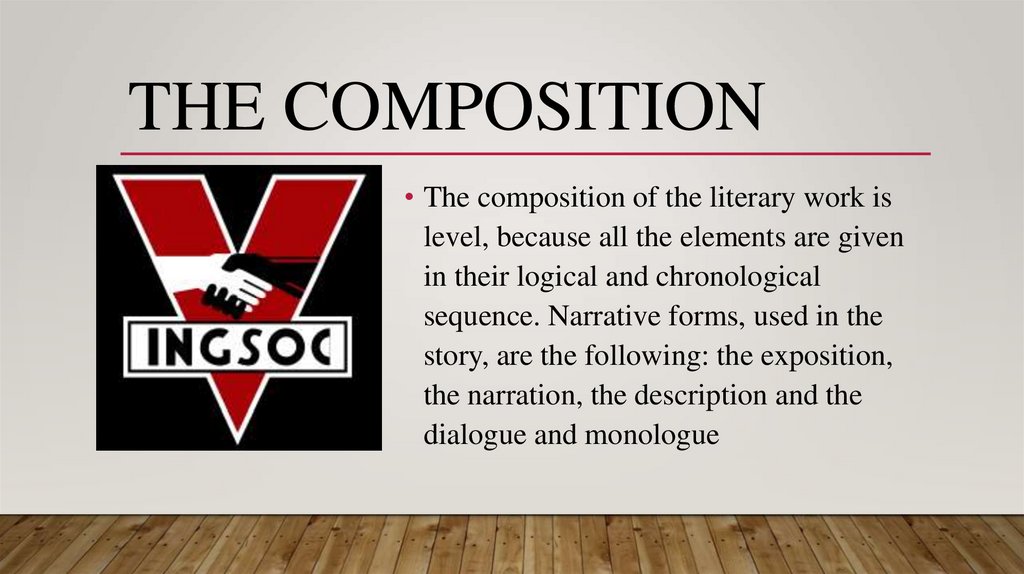
THE COMPOSITION• The composition of the literary work is
level, because all the elements are given
in their logical and chronological
sequence. Narrative forms, used in the
story, are the following: the exposition,
the narration, the description and the
dialogue and monologue
9.
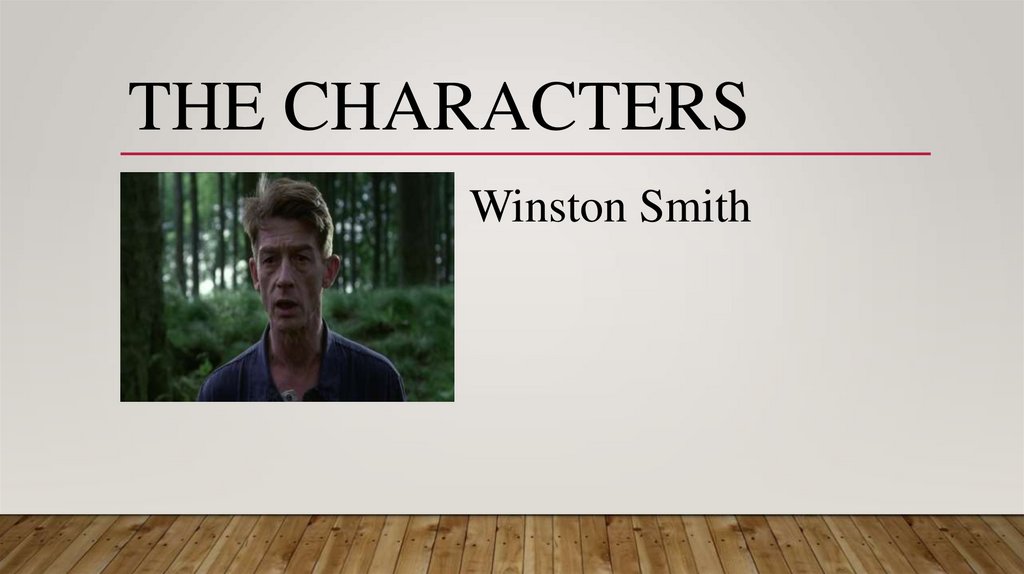
THE CHARACTERSWinston Smith
10.
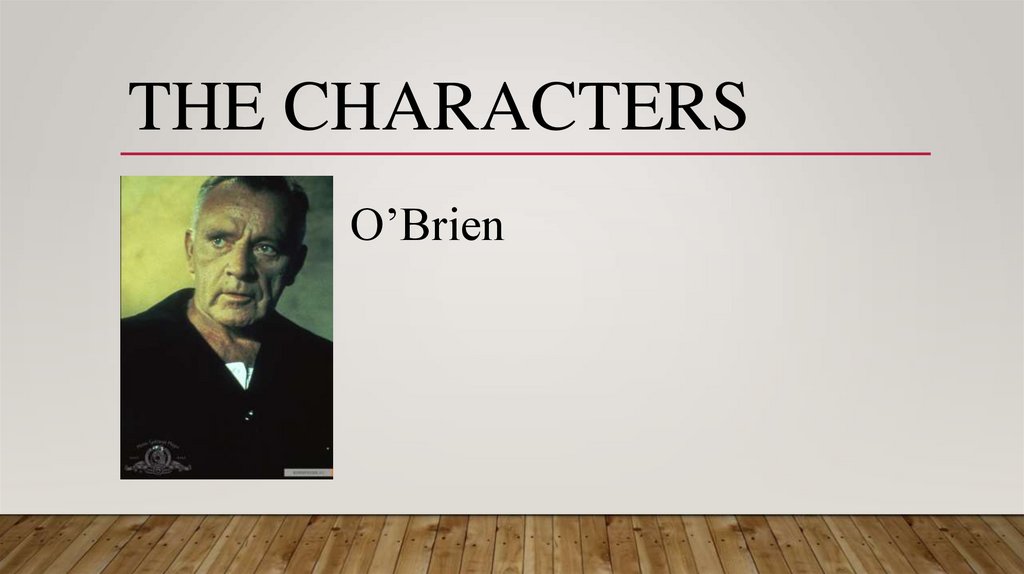
THE CHARACTERSO’Brien
11.
THE CONFLICT• There are some external conflicts in this novel:
• 1) A man against a society(Winston wants to overthrow the Party and
destroy their totalitarianism)
• 2)A man against a values(Winston denies the dogmas of the Party
and despises people who follow the laws of the party)
• 3)A man against a man(O'Brien, the man Winston had hoped and
trusted, had betrayed and mentally broke him)
12.
VOCABULARY• The story is full of emotionally-coloured words, which show the
author’s knowledge for a deep psychological analysis of his characters:
contemptible, vile, sanguine, statuesque, feeble
• There are some international words: hygiene, pajama, telephone
• Phrasal verbs: come back, reach out
• Proper names: London, Oceania, Eurasia
13.
VOCABULARY• Synonyms: archaic – antique, interminable – endless,
intricate – bizarre, stern – harsh
• Antonyms: tremendous – petite, execution – amnesty
• Idioms: come down with, come to terms with, get the
wrong end of the stick
14.
FILM ADAPTATION• In 1984, symbolically, the world saw the film adaptation of the book.
This is the second film adaptation of the novel after the film "1984",
directed by Michael Anderson in 1956.
• Some new scenes were added in the adaptation, such as Winston's
conversation with the Proles (lower class people) about the past.
However, some significant scenes were removed, such as
information about Winston’s wife or explanation of Winston's hatred
of Julia.
15.
16.
CONCLUSION• In conclusion, I would like to say that 1984, despite all its
cruelty, is quite an instructive book. It shows how far human
cruelty can go in controlling others. Although this is a fictional
story, it is possible that the same thing can happen to us.
Personally, I liked the most atypical ending and ambiguous
characters of the main characters.
17.
MY FAVORITE QUOTES• 1) “Who controls the past controls the future. Who controls the present controls the past.”
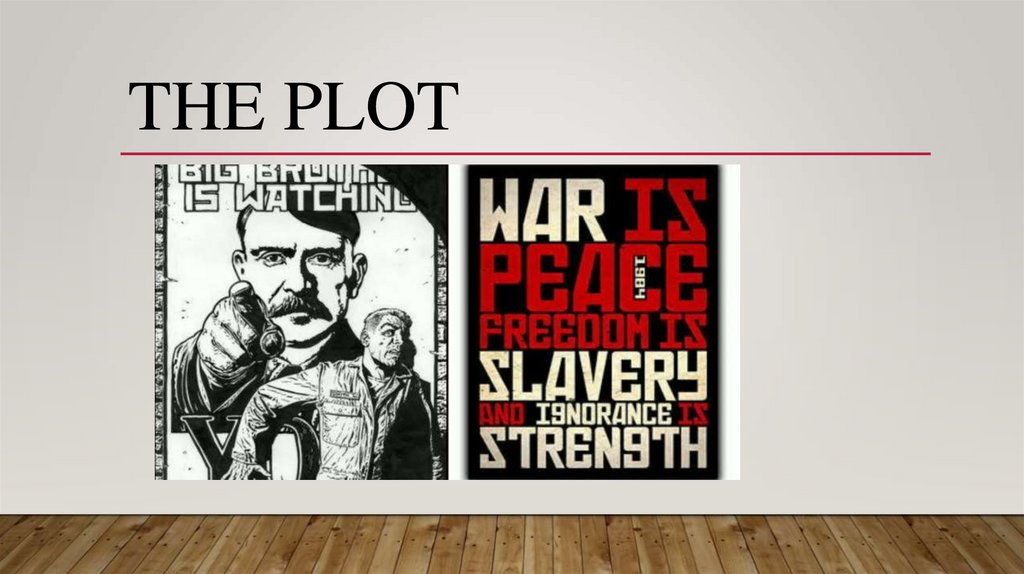
• 2) “War is peace. Freedom is slavery. Ignorance is strength.”
• 3) “If you want to keep a secret, you must also hide it from yourself.”
• 4) “In the face of pain there are no heroes.”
• 5) “Big Brother is Watching You.”
• 6) “Reality exists in the human mind, and nowhere else.”
• 7) “Sanity is not statistical.”
• 8) “If you want a picture of the future, imagine a boot stamping on a human face—for ever.”
• 9) “The choice for mankind lies between freedom and happiness and for the great bulk of mankind, happiness is better.”
• 10) “We do not merely destroy our enemies; we change them.”