 english
Similar presentations:








Passive Voice
1. Passive Voice
2.
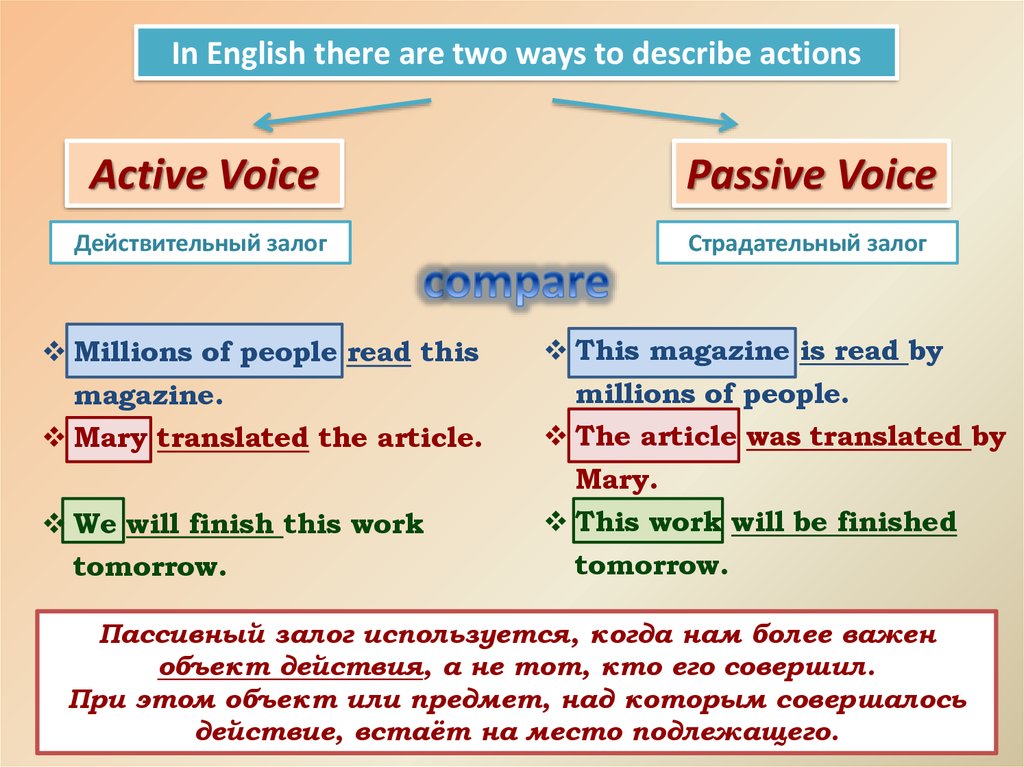
In English there are two ways to describe actionsActive Voice
Passive Voice
Действительный залог
Страдательный залог
Millions of people read this
magazine.
Mary translated the article.
We will finish this work
tomorrow.
This magazine is read by
millions of people.
The article was translated by
Mary.
This work will be finished
tomorrow.
Пассивный залог используется, когда нам более важен
объект действия, а не тот, кто его совершил.
При этом объект или предмет, над которым совершалось
действие, встаёт на место подлежащего.
3.
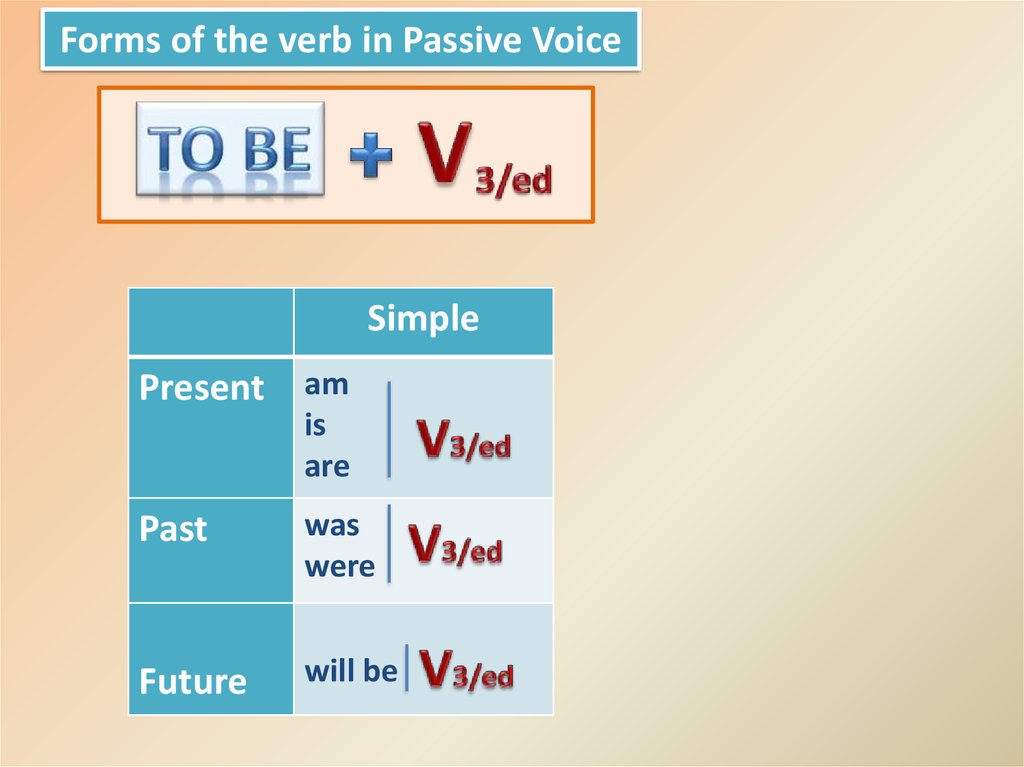
Forms of the verb in Passive VoiceSimple
Present am
is
are
Past
was
were
Future
will be
4.
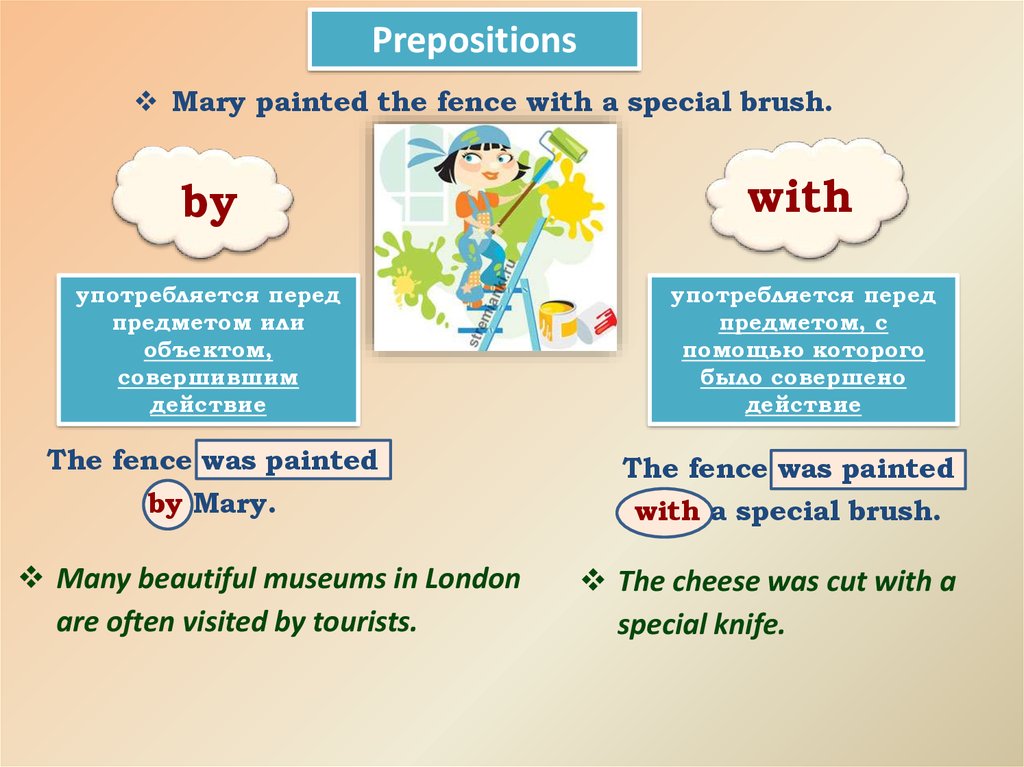
PrepositionsMary painted the fence with a special brush.
by
with
употребляется перед
предметом или
объектом,
совершившим
действие
употребляется перед
предметом, с
помощью которого
было совершено
действие
The fence was painted
by Mary.
Many beautiful museums in London
are often visited by tourists.
The fence was painted
with a special brush.
The cheese was cut with a
special knife.
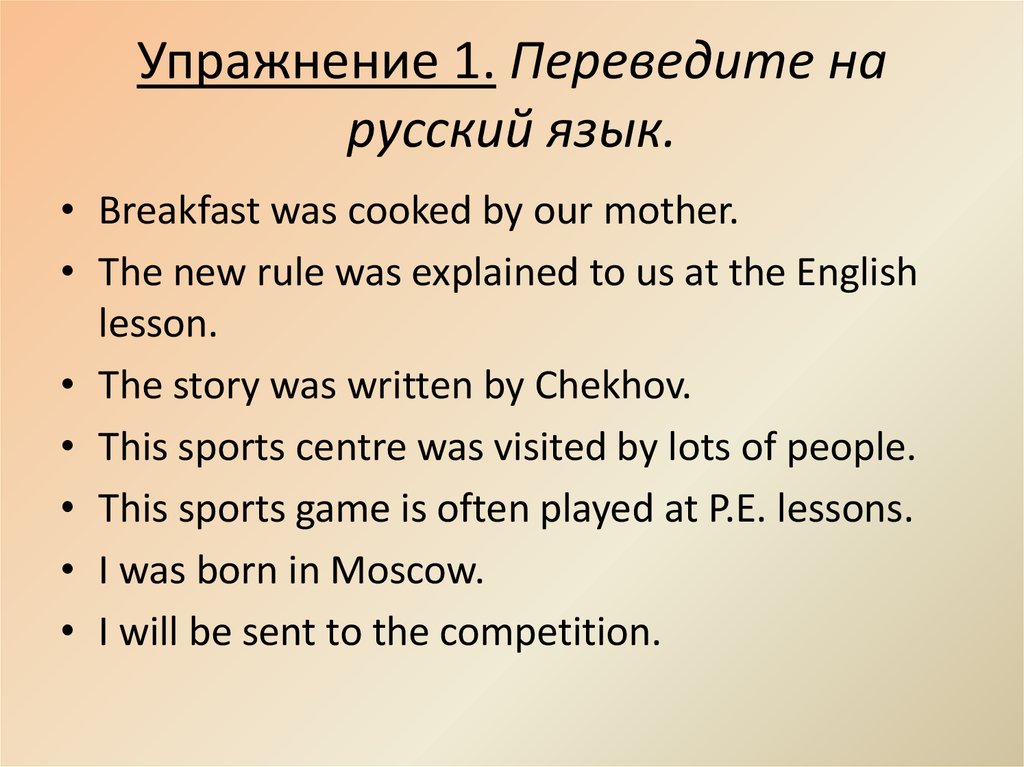
5. Упражнение 1. Переведите на русский язык.
Упражнение 1. Переведите нарусский язык.
• Breakfast was cooked by our mother.
• The new rule was explained to us at the English
lesson.
• The story was written by Chekhov.
• This sports centre was visited by lots of people.
• This sports game is often played at P.E. lessons.
• I was born in Moscow.
• I will be sent to the competition.
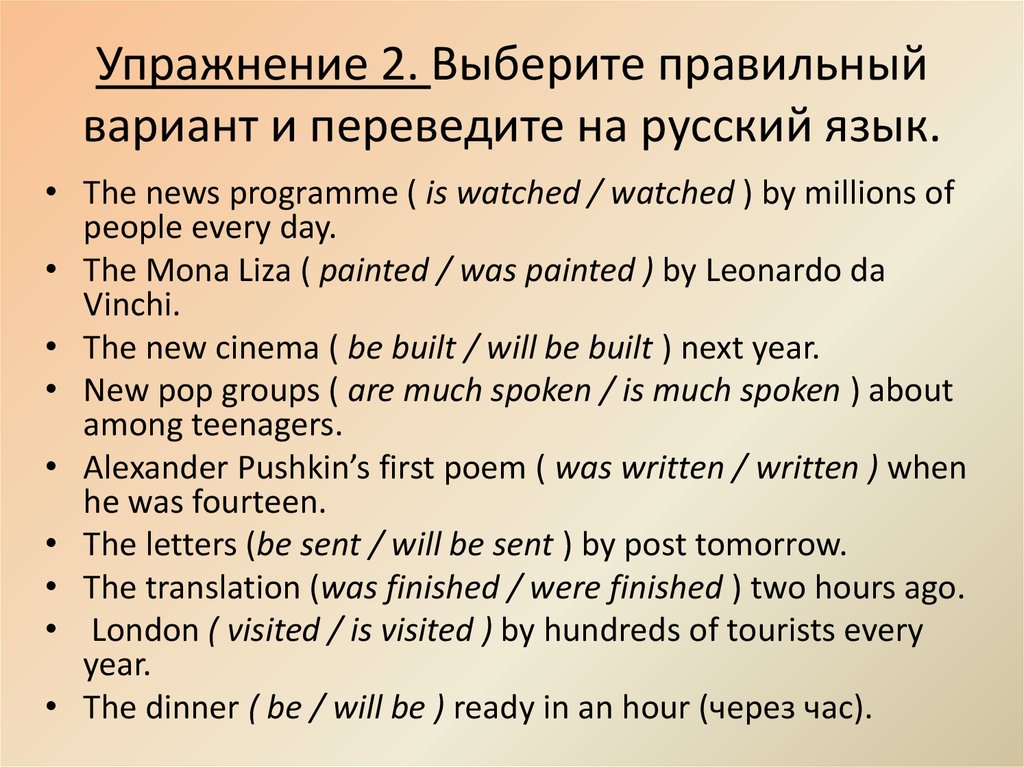
6. Упражнение 2. Выберите правильный вариант и переведите на русский язык.
Упражнение 2. Выберите правильныйвариант и переведите на русский язык.
• The news programme ( is watched / watched ) by millions of
people every day.
• The Mona Liza ( painted / was painted ) by Leonardo da
Vinchi.
• The new cinema ( be built / will be built ) next year.
• New pop groups ( are much spoken / is much spoken ) about
among teenagers.
• Alexander Pushkin’s first poem ( was written / written ) when
he was fourteen.
• The letters (be sent / will be sent ) by post tomorrow.
• The translation (was finished / were finished ) two hours ago.
• London ( visited / is visited ) by hundreds of tourists every
year.
• The dinner ( be / will be ) ready in an hour (через час).
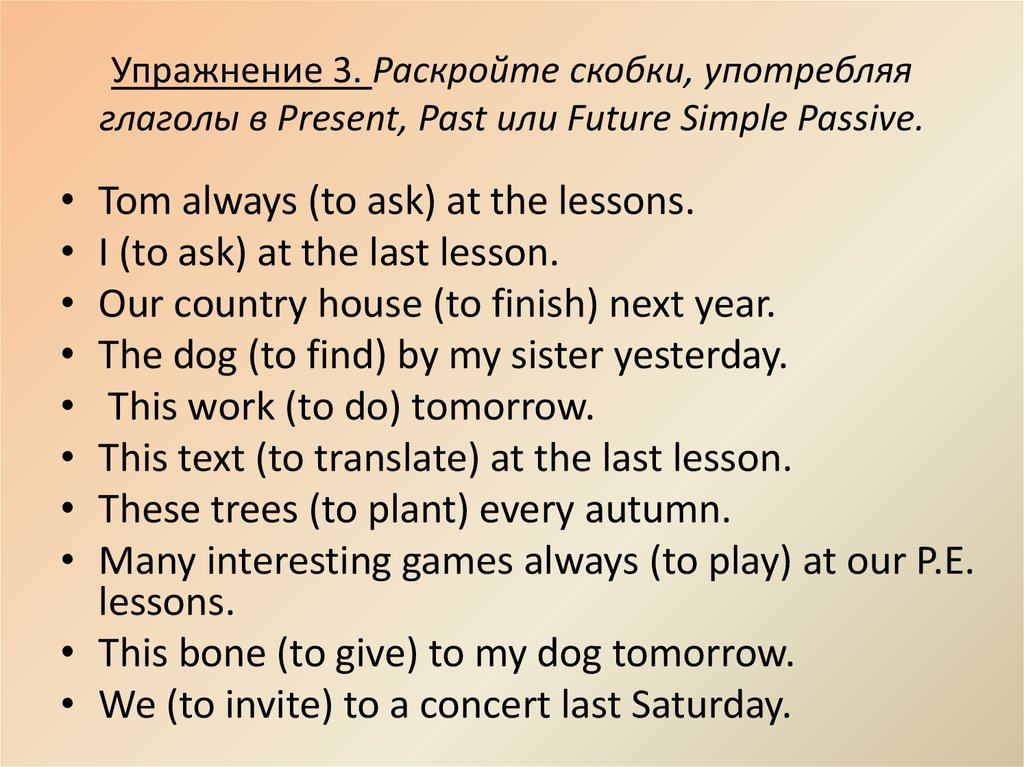
7. Упражнение 3. Раскройте скобки, употребляя глаголы в Present, Past или Future Simple Passive.
Упражнение 3. Раскройте скобки, употребляяглаголы в Present, Past или Future Simple Passive.
Tom always (to ask) at the lessons.
I (to ask) at the last lesson.
Our country house (to finish) next year.
The dog (to find) by my sister yesterday.
This work (to do) tomorrow.
This text (to translate) at the last lesson.
These trees (to plant) every autumn.
Many interesting games always (to play) at our P.E.
lessons.
• This bone (to give) to my dog tomorrow.
• We (to invite) to a concert last Saturday.
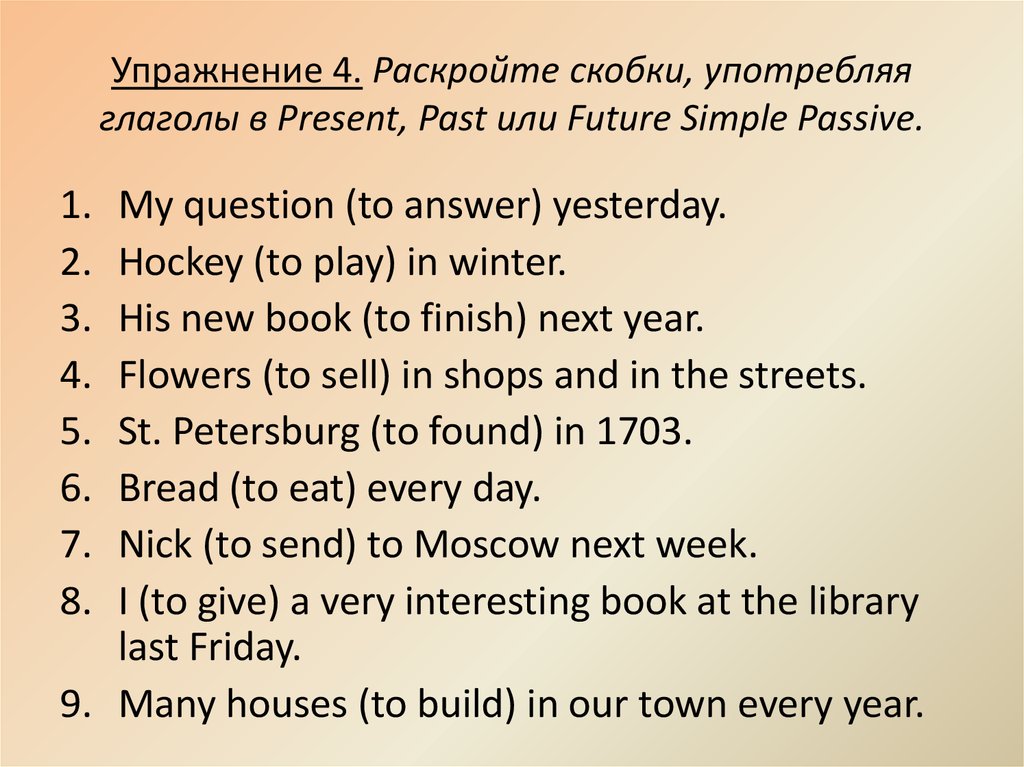
8. Упражнение 4. Раскройте скобки, употребляя глаголы в Present, Past или Future Simple Passive.
Упражнение 4. Раскройте скобки, употребляяглаголы в Present, Past или Future Simple Passive.
1.
2.
3.
4.
5.
6.
7.
8.
My question (to answer) yesterday.
Hockey (to play) in winter.
His new book (to finish) next year.
Flowers (to sell) in shops and in the streets.
St. Petersburg (to found) in 1703.
Bread (to eat) every day.
Nick (to send) to Moscow next week.
I (to give) a very interesting book at the library
last Friday.
9. Many houses (to build) in our town every year.
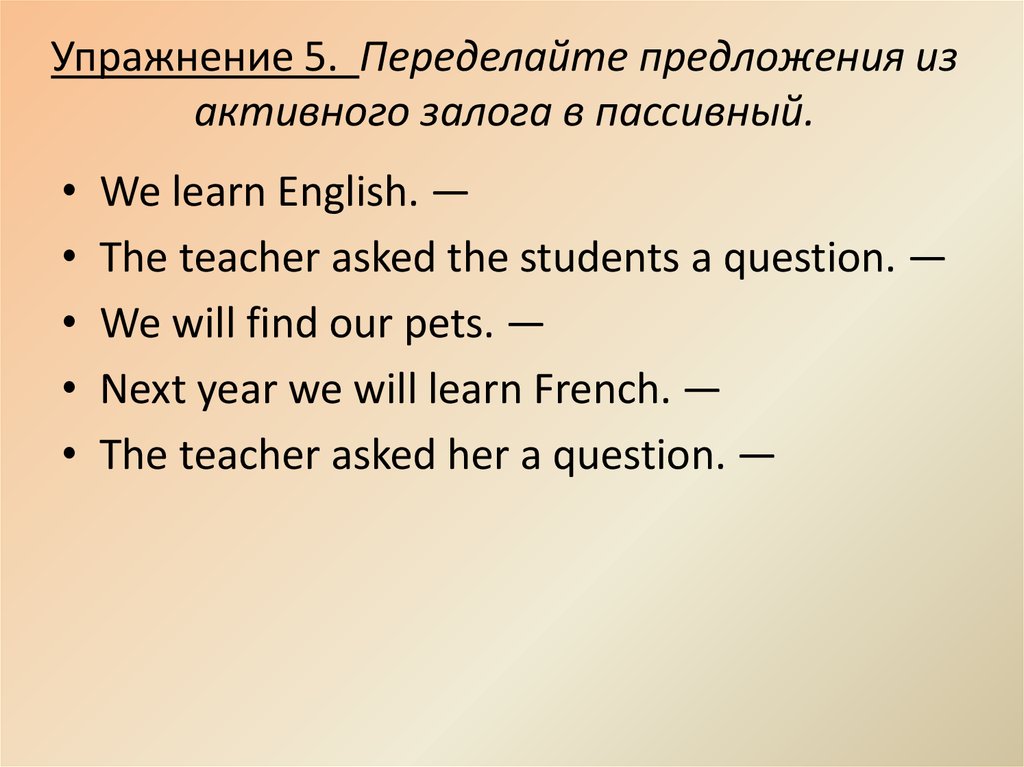
9. Упражнение 5. Переделайте предложения из активного залога в пассивный.
Упражнение 5. Переделайте предложения изактивного залога в пассивный.
We learn English. —
The teacher asked the students a question. —
We will find our pets. —
Next year we will learn French. —
The teacher asked her a question. —