


 policy
Similar presentations:




Military and Non-Military Aspects of Security in the Arctic Region
1.
Presented by: Weinberg AlanaMilitary and Non-Military
Aspects of Security in the
Arctic Region
MOT-b-o-22-2
Supervisor: Korobkina, Irina A.
Candidate of Historical Sciences,
Associate Professor, Department
of World Politics and Foreign
Regional Studies
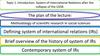
2. Table of contents
Introduction ….................................................................................................................................................................... 31. Legal and Institutional Foundations of Regional Security in the Arctic…............................................................... 14
1.1. Evolution of the International Legal Regime: From the “Sector Theory” to UNCLOS…........................................... 25
1.2. The Arctic Council as a Mechanism of International Cooperation............................................................................... 35
2. Russia’s Role in Ensuring Regional Security in the Arctic ….................................................................................... 39
2.1. Discursive Transformation of Russia’s Contemporary Arctic Policy…....................................................................... 39
2.2. Key Russian Arctic Projects and Their Contribution to Regional Stability….............................................................. 48
3. Strategic Approaches of the US and China to Expanding Influence in the Arctic…................................................54
Conclusion …...................................................................................................................................................................... 62
List of References ….......................................................................................................................................................... 66
3. Relevance
• Climate-driven ice melt is opening new economic and strategic opportunities,transforming the Arctic into a zone of global competition.
• Security challenges now transcend regional boundaries, intensified by growing
activity of non-regional actors.
• Despite geopolitical turbulence and the temporary suspension of Russian
participation, the Arctic Council remains a critical cooperation platform.
• The shifting rhetoric and strategies of Russia, the US, and China require a fresh
assessment of the Arctic security architecture.
• Understanding institutional and legal adaptations is essential for managing risks
and preventing escalation.
4. Research object and subject
Object: The process of forming a regional security system in theArctic.
Subject: Legal and institutional foundations of Arctic security;
Russia’s role in maintaining regional stability; strategic
influence of the US and China in the circumpolar space.
5. Research aim and objectives
The aim of this study is to investigate Russia’s Arctic strategy and analyze the role ofregional and non-regional actors (US, China) in shaping the architecture of Arctic
regional security.
To achieve this, the following objectives are addressed:
• Identify the legal and institutional foundations of Arctic security and trace the
evolution of its international legal regime.
• Examine the transformation of the Arctic Council as a cooperation instrument.
• Assess discursive shifts in the Arctic rhetoric of Russian leadership.
• Analyze the contribution of key Russian Arctic projects to regional stability and
national security.
• Identify the strategic approaches of the US and China to expanding their influence
in the Arctic.
6. Chronological and Geographical scopes
Chronological scope1996 (signing of the Ottawa Declaration establishing the Arctic
Council) to present. Earlier historical periods are referenced to
contextualize the emergence of national security interests.
Geographical scope
The circumpolar region encompassing the territories of the eight Arctic
states, the Arctic Ocean basin, adjacent Atlantic and Pacific maritime
zones, continental shelves, EEZs, and disputed areas.
7. Empirical basis
Group 1: International Legal Instruments Ottawa Declaration (1996), UN Convention on the Law of the Sea(UNCLOS), Agreement on Cooperation on Aeronautical and Maritime Search and Rescue in the Arctic (2011),
Agreement on Cooperation on Marine Oil Pollution Preparedness and Response in the Arctic (2013),Agreement on the
Conservation of Polar Bears (1973),Agreement on Enhancing International Arctic Scientific Cooperation (2017)
Group 2: Official National Strategies & Legislation Russian Presidential Decree No. 645 (2020) / Arctic Strategy to
2035 & 2050, Federal Law No. 284-FZ “On the Arctic Zone of the Russian Federation” (2023),US National Strategy
for the Arctic Region (2024),US Department of Defense Arctic Strategy (2024),China’s Arctic Policy White Paper
(2018),China’s 14th Five-Year Plan (2021–2025)
Group 3: Official Statements & Speeches V. Putin’s addresses at “Arctic: Territory for Dialogue” forums (2013–2025),S.
Lavrov & M. Zakharova briefings on Arctic policy,US Senator Lisa Murkowski & Rep. Randy Fine statements,J.D.
Vance & S. Whitkoff policy remarks,Xi Jinping’s diplomatic addresses on Arctic cooperation,Mao Ning (MFA China)
& Rear Adm. Yin Zhuo strategic comments
Group 4: Media & Analytical Sources, Vedomosti, Kommersant, Interfax,The New York Times, The Washington Post,
Bloomberg, South China Morning Post, Xinhua, China Daily,Arctic Today, High North News,The Arctic Institute,
Arctic Portal, US Office of Ocean and Polar Affairs reports
8. Theoretical and methodological framework
Theoretical Approaches:Post-classical realism: Explains how states balance competition with cooperation to manage
risks, secure resources, and minimize transaction costs.
Neoliberal institutionalism: Highlights complex interdependence and the role of regimes (e.g.,
Arctic Council) in sustaining long-term cooperation despite geopolitical friction.
Methods:
Content analysis (reconstructing policy discourse & rhetoric)
SWOT analysis (evaluating US & Chinese strategic positions)
Structural-functional analysis (examining Arctic Council mechanisms)
Comparative analysis (mapping diverging actor interests)
9. Literature review
Direction 1: Legal Status & International Legal Regime of the Arctic This body of scholarship focuses on the evolutionand application of international law in the circumpolar region. Researchers collectively analyze the transition from the
historical "sector theory" to the contemporary UNCLOS-based framework, examining tensions between national
jurisdiction claims and freedoms of navigation. Representative scholars in this direction include A.N. Vylegzhanin,
I.V. Bunik, A.Y. Makagon, A.V. Dyatlova, and L. Nowlan, whose works collectively clarify how maritime law adapts
to Arctic-specific challenges.
Direction 2: The Arctic Council as a Mechanism of Regional Cooperation & "Soft Security" Scholars in this group
investigate the institutional architecture and functional effectiveness of the Arctic Council. Research collectively
addresses the Council's evolution from an environmental forum to a platform addressing broader security issues,
including emergency response, scientific cooperation, and Indigenous participation. Emphasis is placed on the
Council's role in confidence-building, norm-setting, and managing "soft security" challenges. Key authors such as V.P.
Zhuravel, A.Y. Chistyakov, L.V. Levit, A.V. Demidov, and J. Spence have collectively demonstrated how the
Council sustains dialogue and practical cooperation even amid geopolitical turbulence.
Direction 3: Geopolitics, Securitization & Regional Power Dynamics This research direction explores the Arctic through
the lenses of geopolitical competition and securitization theory. Scholars collectively debate whether the region
remains an exception to global conflict patterns or is increasingly subject to great-power rivalry. Representative
contributions by O.B. Aleksandrov, M. Marsili, P. van Hees, V.N. Konyshev, and A.A. Sergunin collectively map
the spectrum of analytical perspectives—from optimistic institutionalism to cautious realism—on Arctic security
dynamics.
10. Literature review
Direction 4: Russia's Arctic Policy: Strategy, Discourse & Projects This group of studies provides a comprehensiveanalysis of Russia's role as the largest Arctic state. Research collectively examines the evolution of Russian strategic
documents, the discursive construction of Arctic sovereignty, and the implementation of large-scale infrastructure and
resource projects. Scholars assess how Russia balances national interests with international obligations, and how its
policies impact regional stability. Key authors including V.I. Goldin, I.A. Arzhanov, Y.A. Kharlamova, H.
Blakkisrud, and W. Lackenbauer collectively illuminate the dual nature of Russian policy—assertive on sovereignty
yet committed to functional cooperation.
Direction 5: United States Arctic Strategy: Security Priorities & Alliance Politics Scholarship in this direction analyzes
the drivers, constraints, and evolution of US Arctic policy. Research collectively focuses on the interplay between
defense modernization, alliance coordination (NATO, NORAD), climate adaptation, and economic interests. Authors
examine why the Arctic has historically received limited strategic attention and how recent policy shifts address
capability gaps and great-power competition. Representative works by P.I. Sevostyanov, Y.A. Davydova, A.V.
Matyukhin, A. Todorov, and E.T. Bloom collectively highlight the tension between unilateral security measures and
multilateral engagement in US approaches.
Direction 6: China's Arctic Engagement: "Near-Arctic State" Concept & Strategic Interests This research direction
investigates China's growing role as a non-regional actor in Arctic affairs. Scholars collectively analyze the conceptual
foundations of China's "Polar Silk Road," its interpretation of international law in polar regions, and its strategy of
gaining influence through scientific, economic, and diplomatic channels. Key contributions by Wang Ruoxuan, V.V.
Gavrilov, E.V. Kienko, S.V. Popkova, and S.L. Zarubin collectively distinguish between China's commercial,
scientific, and strategic motivations, while evaluating the legitimacy challenges it faces as an external player.
11. Conclusions
Legal & Institutional FoundationsThe international legal regime has evolved from the historical “sector theory” to
a UNCLOS-based framework. Core legally binding agreements (Search &
Rescue, Oil Pollution Response, Scientific Cooperation) remain operational,
demonstrating that normative architecture continues to underpin regional
stability despite geopolitical friction.
Transformation of the Arctic Council
The Arctic Council remains a vital, albeit strained, platform for “soft security.”
Russia’s continued engagement and diplomatic outreach confirm that
institutional dialogue persists even under suspension protocols, reinforcing the
Council’s role as a conflict-prevention and risk-management mechanism.
12. Conclusions
Discursive Shifts in Russian PolicyRussian Arctic rhetoric has shifted from narrowly security-focused narratives to a
comprehensive discourse balancing sovereignty, ecological responsibility, and
multi-domain impact. Official communications increasingly frame the Arctic as a
space for sustainable development and joint governance, legitimizing state
presence through international law and scientific stewardship.
Russian Projects & Contribution to Stability
Large-scale infrastructure and Northern Sea Route (NSR) projects function as
dual-use stabilizers: they enhance economic connectivity while integrating civilian
and military functions (navigation safety, environmental monitoring, research
expeditions). This hybrid approach mitigates escalation risks and transforms
strategic corridors into platforms for practical cooperation.
13. Conclusions
Strategic Approaches of the US & ChinaThe US relies on coalition-building and sovereign presence but faces domestic and
infrastructural constraints. China, as a non-regional actor, compensates for territorial absence
through technological, financial, and scientific integration, though it navigates questions of
legitimacy and logistical dependency. Their divergent strategies create a complex security
environment shaped by normative competition, technological rivalry, and climate-driven
imperatives.
Final Synthesis & Policy Implication
The Russian model of Arctic security synthesizes deterrence with institutional cooperation,
preventing excessive militarization and institutional fragmentation. The future of the region
hinges on aligning national interests with multilateral standards, preserving open dialogue,
and reinforcing governance based on international law, scientific collaboration, and
sustainable development. Without responsible multilateralism, the Arctic risks transitioning
from a zone of managed competition to unregulated confrontation.