




 internet
Similar presentations:







Internet of Things and Green IoT
1. Internet of Things
ByMinhaz Uddin Ahmed, PhD
Department of Computer Engineering
Inha University in Tashkent.
Email: minhaz.ahmed@gmail.com
2. Outline
Sustainability and Green IoTCore Principles of Green IoT
Techniques and Technologies for Green IoT
Applications of Green IoT
Challenges and Opportunities in Green IoT
Practice code Green IoT
3. Sustainability
Sustainability, in the context of the Internet of Things (IoT), refersto the practice of designing, deploying, and utilizing IoT
technologies in a manner that minimizes negative environmental
and societal impacts while maximizing their contributions to
global sustainability. It encompasses the entire lifecycle of IoT
devices, from raw material extraction and manufacturing to
energy consumption during operation and responsible disposal.
4. Green IoT
Green IoT specifically focuses on achieving energy efficiency andreducing the environmental footprint of the IoT ecosystem itself.
This involves adopting energy-efficient hardware and software,
utilizing renewable energy sources, optimizing data processing
and transmission, and promoting the circular economy principles
of reduce, reuse, and recycle.
5. Aspects of smart cities
6.
Smart city applications7. Core Principles of Green IoT
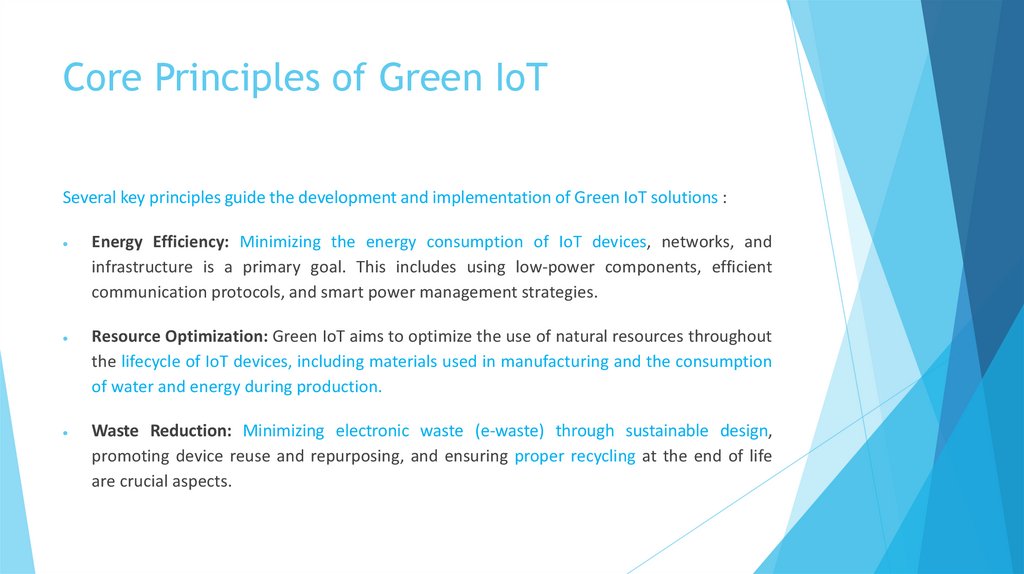
Several key principles guide the development and implementation of Green IoT solutions :Energy Efficiency: Minimizing the energy consumption of IoT devices, networks, and
infrastructure is a primary goal. This includes using low-power components, efficient
communication protocols, and smart power management strategies.
Resource Optimization: Green IoT aims to optimize the use of natural resources throughout
the lifecycle of IoT devices, including materials used in manufacturing and the consumption
of water and energy during production.
Waste Reduction: Minimizing electronic waste (e-waste) through sustainable design,
promoting device reuse and repurposing, and ensuring proper recycling at the end of life
are crucial aspects.
8. Core Principles of Green IoT
Reduced Carbon Footprint: Lowering greenhouse gas emissions associated with theproduction, operation, and disposal of IoT devices and infrastructure is a key
objective.
Environmental Monitoring and Management: Utilizing IoT technologies to monitor
environmental conditions, track resource usage, and enable more efficient
management of natural resources is a significant application of Green IoT.
9. Techniques and Technologies for Green IoT
Various techniques and technologies contribute to achieving sustainability in IoT :Energy Harvesting: Powering IoT devices using ambient energy sources such as solar,
wind, thermal, and kinetic energy can significantly reduce reliance on batteries and the
power grid.
Low-Power Communication Protocols: Utilizing communication protocols like
LoRaWAN, Sigfox, and NB-IoT that are designed for low energy consumption in
wireless data transmission.
10. Techniques and Technologies for Green IoT
Data Compression and Aggregation: Reducing the amount of data transmitted bycompressing or aggregating data at the edge can lower energy usage in
communication.
Edge Computing: Processing data closer to the source (at the edge) rather than in
centralized data centers can minimize data transmission distances and energy
consumption.
Energy-Efficient Hardware and Software Design: Developing hardware components
and software algorithms that are optimized for low power consumption is essential.
This includes using energy-efficient processors, integrated circuits, and optimized
code.
11. Techniques and Technologies for Green IoT
Smart Power Management: Implementing intelligent sleep modes and powerscheduling for IoT devices can significantly reduce energy waste during periods of
inactivity.
Green Cloud Computing: Utilizing energy-efficient data centers, virtualization
techniques, and optimized resource allocation in cloud infrastructure to minimize the
environmental impact of IoT data processing and storage.
12. Techniques and Technologies for Green IoT
Sustainable Materials and Recycling: Using recyclable and biodegradable materials inthe manufacturing of IoT devices and establishing efficient recycling programs for endof-life devices are crucial for reducing e-waste.
Green RFID: Utilizing smaller, more energy-efficient RFID tags and energy-efficient
algorithms for tag estimation.
13. Applications of Green IoT
Green IoT technologies are being applied across various sectors to drive sustainability :Smart Cities: Optimizing energy usage in buildings and infrastructure, improving traffic
flow, managing waste collection efficiently, and monitoring air and water quality.
Smart Agriculture: Implementing precision farming techniques to optimize water and
fertilizer usage, monitor soil conditions and crop health, and reduce waste in
agricultural processes.
14. Applications of Green IoT
Smart Buildings and Homes: Reducing energy consumption through smartthermostats, lighting controls, and automated window opening systems.
Industrial IoT (IIoT): Optimizing energy consumption in manufacturing
processes, enabling predictive maintenance to reduce downtime and waste,
and improving resource efficiency in supply chains.
Environmental Monitoring: Deploying sensors to monitor pollution levels,
track deforestation, and conserve biodiversity.
15. Applications of Green IoT
Smart Water Management: Detecting leaks in water distribution networks, optimizingirrigation schedules, and monitoring water quality.
Renewable Energy Management: Monitoring and optimizing the performance of
renewable energy assets like solar panels and wind turbines, and enabling smart grids
for efficient energy distribution.
Waste Management: Optimizing waste collection routes based on fill levels and
improving recycling processes through smart waste bins and sorting systems.
Healthcare: Remote patient monitoring with energy-efficient devices and smart data
collection to reduce energy consumption in healthcare facilities.
16. Challenges and Opportunities in Green IoT
While Green IoT offers significant potential, there are also challenges to consider :Challenges:
Increased Energy Consumption: The sheer number of IoT devices can lead to a
substantial overall increase in energy consumption if not managed efficiently.
Electronic Waste (E-waste): The rapid obsolescence of IoT devices contributes to the
growing problem of e-waste.
Data Security and Privacy: Ensuring the security and privacy of data collected by a vast
network of connected devices is crucial.
17. Challenges and Opportunities in Green IoT
Infrastructure Complexity: Managing and maintaining large-scale, heterogeneous IoTdeployments can be complex.
Standardization and Interoperability: Lack of standardization across different IoT
platforms and devices can hinder the development and deployment of green
solutions.
Initial Investment Costs: Implementing green IoT technologies may require significant
upfront investments.
Workforce Skill Gap: A shortage of skilled professionals in green IoT design,
development, and deployment can slow down adoption.
18. Opportunities in Green IoT
Opportunities:Significant Energy Savings: Green IoT can enable substantial reductions in
energy consumption across various sectors.
Improved Resource Management: IoT technologies can optimize the use of
water, raw materials, and other resources, leading to greater efficiency and
reduced waste.
Enhanced Environmental Monitoring: IoT provides the tools for real-time and
comprehensive monitoring of environmental conditions, enabling better
decision-making and proactive interventions.
19. Opportunities in Green IoT
Cost Reduction: Optimizing resource usage and reducing waste can lead tosignificant cost savings for businesses and consumers.
Improved Quality of Life: Green IoT can contribute to healthier and more
sustainable living environments in smart cities and homes.
20. Opportunities in Green IoT
Economic Growth and Innovation: The development and deployment ofgreen IoT solutions create new business opportunities and drive innovation in
sustainable technologies.
Contribution to Sustainable Development Goals (SDGs): Green IoT plays a
crucial role in achieving various SDGs related to energy, cities, climate action,
and responsible consumption and production.
21. Green IoT Concepts: practice code
SmartSensor Class:power_source: Simulates different power sources like "battery" and "solar."
Green IoT often emphasizes renewable energy sources to reduce
environmental impact.
energy_consumption_rate: Represents the energy used by the sensor. Low
power consumption is a key aspect of sustainable IoT to extend battery life
and reduce the need for frequent replacements or high energy demands.
consume_energy(): Simulates energy usage. For solar-powered devices, the
net consumption over time should ideally be close to zero.
22. Green IoT Concepts: code
check_power_status(): A simplified way to model battery depletion, leadingto the sensor potentially going offline. This highlights the importance of
energy efficiency for continuous operation.
transmit_data(): Simulates data transmission, which also consumes energy.
Minimizing data transmission frequency and size can contribute to energy
savings.
23. Green IoT Concepts: code
SmartIrrigationSystem Class:Targeted Action: The system uses soil moisture sensors to determine the
actual need for irrigation. This avoids over-watering, a significant waste of
water resources.
Data-Driven Decision Making: Irrigation decisions are based on real-time
sensor data, making the process more efficient and sustainable than timebased schedules.
Reduced Resource Consumption: By only watering when necessary, the system
minimizes water usage, contributing to water conservation.
24. Sustainability and Green IoT: practice code
Resource Efficiency: The smart irrigation system exemplifies resourceefficiency by optimizing water usage based on actual needs.
Energy Efficiency: The SmartSensor class models energy consumption,
highlighting the importance of low-power devices and the use of renewable
energy sources like solar.
25. Sustainability and Green IoT: practice code
Reduced Waste: By preventing over-watering and potentially extending thelifespan of battery-powered devices through efficient operation, the system
contributes to reduced waste.
Environmental Monitoring: While not explicitly a green action, the sensors
themselves can be used to monitor environmental conditions (temperature,
humidity, light), providing data for informed decision-making in other
sustainability efforts.
26. Real-World Green IoT
Lifecycle Assessment: A truly sustainable IoT solution would consider theenvironmental impact of the entire device lifecycle, from manufacturing to
disposal.
Material Selection: Using eco-friendly and recyclable materials in device
production.
Power Harvesting: Implementing more advanced energy harvesting techniques
(e.g., vibration, thermal) to reduce reliance on batteries.
27. Real-World Green IoT
Network Efficiency: Optimizing communication protocols and networktopologies to minimize energy consumption during data transmission.
Edge Computing: Processing data locally on devices to reduce the amount of
data transmitted to the cloud, saving energy.
Circular Economy Principles: Designing devices for repairability, reuse, and
recycling.
28. Practice code (resource management and energy efficiency)
Add a New Sensor Type: Add a new sensor type to the SmartSensor class (e.g.,"wind_speed"). Modify the measure() method to return a random wind speed
value. Create an instance of this new sensor and try adding it to the
irrigation_system. What happens and why?
Simulate Solar Recharge: Enhance the SmartSensor class to include a recharge()
method for solar-powered sensors. This method could simulate the battery level
increasing over time if the power source is "solar." Integrate this into the main
loop.
Analyze Data for Sustainability Insights: After running the simulation for a longer
period, write code to analyze the data_log of the sensors and the irrigation
system. For example, calculate the total water used by the irrigation system or
the average battery lifespan of the battery-powered sensors under different
conditions.
29. Reference
https://docs.aws.amazon.com/greengrass/v2/developerguide/tutorials.htmlhttps://docs.aws.amazon.com/greengrass/v2/developerguide/gettingstarted.html
https://globecom2024.ieee-globecom.org/workshop/ws-14-workshopsustainable-and-intelligent-green-internet-things-6g-and-beyond-6gsiot
https://www.researchgate.net/publication/351696919_Green_IoT_for_EcoFriendly_and_Sustainable_Smart_Cities_Future_Directions_and_Opportunities
)