



 pedagogy
Similar presentations:










KET Speaking Exam Guide
1.
CAMBRIDGE ENGLISH A2 LEVELKET Speaking
Exam Guide
Your Complete Roadmap to Speaking Success at A2 Level
8-10 Minutes
2 Parts
2.
PRESENTATION OVERVIEWWhat You'll Learn Today
01
Understanding the KET Speaking Test
05
Common Topics & Sample Questions
02
Part 1: Personal Questions Breakdown
06
Preparation Strategies & Tips
07
Common Mistakes to Avoid
08
Essential Phrases & Expressions
03
04
Part 2: Collaborative Discussion
Assessment Criteria Explained
3.
INTRODUCTIONWhat is the KET
Speaking Test?
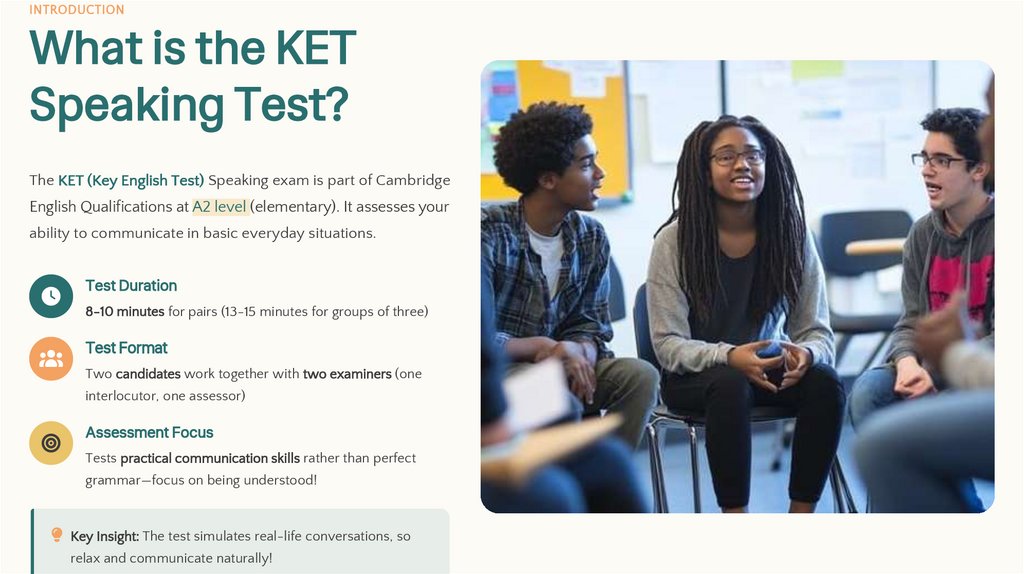
The KET (Key English Test) Speaking exam is part of Cambridge
English Qualifications at A2 level (elementary). It assesses your
ability to communicate in basic everyday situations.
Test Duration
8-10 minutes for pairs (13-15 minutes for groups of three)
Test Format
Two candidates work together with two examiners (one
interlocutor, one assessor)
Assessment Focus
Tests practical communication skills rather than perfect
grammar—focus on being understood!
Key Insight: The test simulates real-life conversations, so
relax and communicate naturally!
4.
TEST STRUCTUREComplete Test Overview
1
Part 1: Personal Questions
3-4 minutes
2
Part 2: Collaborative Discussion
5-6 minutes
Phase 1: Introduction
Phase 1: Picture Discussion
Basic questions about name, where you come from, work/study, where you
Five pictures showing different options—you discuss likes/dislikes with your
live
partner
Phase 2: Topic Questions
Phase 2: Follow-up Questions
Questions about two topics (sports, food, holidays, home, weather,
Examiner asks individual preference questions about the topic
transport)
Interaction: You talk WITH YOUR PARTNER
Interaction: You talk TO THE EXAMINER
Interlocutor's Role
Assessor's Role
Asks all questions, manages the test flow, and marks Global Achievement. This is
Observes and evaluates, takes notes on performance, and marks Grammar,
the examiner you talk to.
Vocabulary, Pronunciation, and Interactive Communication.
5.
PART 1 - PHASE 1Introductory Questions
Common Questions
Top Tips
Prepare answers in advance but don't memorize word-for-
Q: What's your name?
Q: Where do you come from?
word
A: My name's [name]. / I'm [name].
A: I'm from [country/city].
Use complete sentences, not one-word answers
Speak clearly and confidently
Q: Do you work or study?
Q: Where do you live?
A: I'm a student. / I work in/at [place].
A: I live in [city/town/area].
Smile and make eye contact
Avoid: Just saying "Spain" or "Student." Say "I'm from Spain" or
"I'm a student."
Example: Good vs. Poor Answer
❌ Poor Answer:
✓ Good Answer:
Examiner: "Where do you live?"
Examiner: "Where do you live?"
Candidate: "Madrid."
Candidate: "I live in Madrid. It's a big city in Spain."
6.
PART 1 - PHASE 2Topic-Based Questions
How It Works
Sample Questions
1
Examiner introduces Topic 1 (e.g., "Let's talk about sport.")
2
Asks Candidate A 2-3 questions about the topic
3
Asks Candidate B 2-3 different questions on same topic
4
Extended Response: "Tell me something about..." (2-3 sentences)
Topic: Sport
• What sports do you enjoy watching?
• When do you do sport?
• Tell me about a sport you'd like to try.
Topic: Food
• Which meal is your favourite?
5
• How often do you cook?
Repeats process with Topic 2
• Tell me about a place you like going to eat.
Expanding Your Answers
Add Details
Give Reasons
Add Frequency
"I like pizza. My favourite is with cheese and mushrooms."
"I enjoy swimming because it's good exercise and relaxing."
"I play football every weekend with my friends."
7.
PART 2 - PHASE 1Collaborative Discussion
The Task
1
Examiner gives you a booklet with 5 pictures
2
Examiner asks: "Do you like these different [topics]? Say why or why not."
3
You and your partner discuss for 1-2 minutes
4
Examiner may ask: "Do you think... [topic] is expensive/healthy/difficult?"
Example Topics