
 lingvistics
Similar presentations:




The Position of Grammar in the Structure of Language
1. THE POSITION OF GRAMMAR IN THE STRUCTURE OF LANGUAGE
Introduction2. Language as a Many-Sided Phenomenon
Language is a complex, many-sided and manyfunctional phenomenon and therefore not easy to define.Today it is studied by linguists, logicians, philosophers,
psychologists, anthropologists, culturologists and other
specialists.
As it has been justly pointed out, language is "many
things - a system of communication, a medium for
thought, a vehicle for literary expression, a social
institution, a matter for political controversy, a factor in
nation building".
Thus, language has many aspects, or 'faces' and the
definition of language depends largely upon which
aspect comes into the focus of the researcher, upon what
becomes the subject matter of research.
3. Ostensive Definitions: 3 main ways to represent the language
“Ostensive” - based on the subject matter:1) as a result of speech activity of native speakers, presented in various kinds of speech products: literary
texts, newspapers, recorded conversations, interviews, various documents etc.;
2) as a result of linguistic research presented in dictionaries, grammar books, monographs and
dissertations devoted to various aspects of language and aimed at revealing its systemic regularities;
3) as lingual competence of a native speaker, the language in the speaker's mind, i.e. language "in
potentia", not yet realized in speech activity, but ready for such a realization.
4. New Trend to View to the Language: Cognitive Approach
1.language as text
2.
language as system
3.
language as competence
The definitions of language are also directly related to its main functions and its internal systemic
properties.
Viewed from the point of its cognitive function (which is now in the focus of linguistic attention)
language is defined as a means of forming, storing and transmitting information (knowledge).
5. Viewed from the Position of Social Functioning
• Viewed from its social function language is defined as a means ofcommunication.
• It is essential to remember that the aim of any meaningful communication
is to exchange information from which it follows that the two functions of
language
• cognitive and communicative are closely
interrelated - we communicate in order to
exchange thoughts and information.
6. Viewed from the point of its internal properties
• Viewed from the point of itsinternal properties language is
defined as a structured system
of signs and thus it is a part of
semiotics.
• This system of signs was created
by people (and it is one of the
most wonderful creations of
humanity!) to satisfy their need
in communication - one of the
most essential needs of people as
social beings.
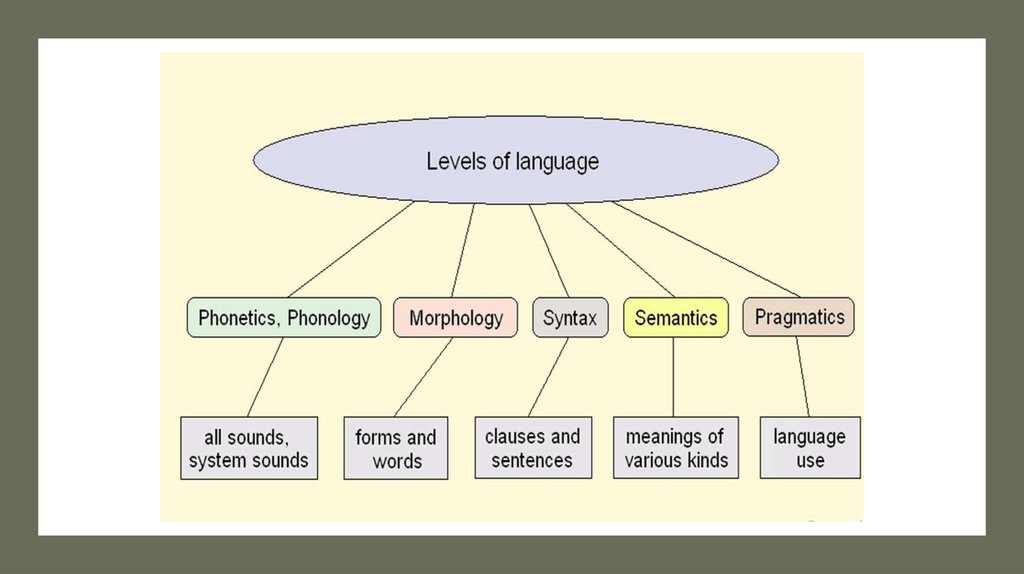
7. Language Structure: Levels of the Language
• Language may be defined as a• The attribute ''structure' in its
definition suggests that the
language system presents a
hierarchy and consists of
subsystems, or levels.
• A level can be defined as a
subsystem of language which
presents a totality of homogeneous
units and a set of rules regulating
their use and classification
structured system of signs used for
forming, storing and exchanging
information in the process of human
communication.
8.
9. Phonemic Level
• The lowest is the phonemic level with its central unit - the phoneme,the smallest unit of language whose function is to differentiate
meanings.
• This level is closed, it comprises a limited set of phonemes and it is
relatively stable -no sounds are borrowed from other languages and
phonetic changes even if they do occur develop very slowly and
embrace long periods of time.
10. Morphemic Level
The central unit of this unit is the morpheme- the smallest meaningful part of language.
The morpheme may present a combination of
two or more phonemes, but it may also be
presented by one phoneme, e.g. —s in cats.
The main difference between the phoneme and
the morpheme is not in the form but in the
function:
phonemes are used to differentiate
meanings
whereas morphemes express meanings, they
are meaningful.
As compared to the phonemic, the
morphemic level is less closed and more
subject to changes.
In the course of the language development
its units may change their status and
evolutionize from words to morphemes
e.g. such was the case with the morphemes
-dom, -hood and some others which
developed from notional words.
One of the most characteristic features of
the English language is a limited number
of form-building morphemes and a great
number of homonymous morphemes:
e.g. the function of the morpheme -s in the
following words: books, reads, news,
yours.
11. Lexemic Level
• Combining morphemes, we produce words, which constitute thelexemic level with the word as its central unit.
The lexemic level presents the most open, densely populated and the
most changeable domain of any language.
• The vocabulary system of a developed language is enormous and
comprises thousands of words
12. Development of Vocabulary System
The vocabulary system of a developed language is enormous and comprisesthousands of words. It never remains stable: some words fall out of use:
e.g. “brine” was used by William Shakespeare in the meaning of "ocean" but is
almost forgotten now
New words are coined daily: coffeeholic, netiquette, webliography. Borrowed:
palimpsest, rajah, guru
Others acquire new meanings: stress, cripple, crib.
Words fulfil a nominating function in the language, by means of words we give
names to various objects of reality, i.e. physical phenomena (the world outside us)
and to various abstract notions, i.e. mental phenomena (the world within us).
13. Phrasemic Level
A combination of words results in the formation of a phrase - theconstituent of the phrasemic level - which serves as a pre-fab for
building a sentence.
Combining words into phrases enriches the nominative potential of
the language,
e.g. a blue sky, sky blue (her eyes were sky blue); a university city,
a city university.
14. Proposemic Level
Combining a noun-phrase with a verb phrase we build a sentence, thecentral unit of the sentential, or proposemic level.
From the point of view of its semiotic nature the sentence presents a
complex sign, it names not an object, but a situation of reality and
forms a judgment (a proposition) about this situation.
Another essential difference between the sentence and the word is
that the sentence fulfils not only a nominating function, but a
communicative one whereas words fulfil only a nominating function.
15. Suprasentantional Level
A combination of at least two sentences results in the formation of asuprasentential unit, or a dicteme which constitutes the highest level in
the language structure, the level of text, or the dictemic level.
It must be especially pointed out that semantics does not constitute a
level of its own, but rather cuts across the levels and is present at all the
levels.
16. Specifics of the Level
On the one hand, a level is atotality of homogeneous
means, i.e. a lingual reality;
on the other it is a set of
rules regulating the use and
classification of these units,
which brings us to the
classification of linguistic
branches that study the
language units.
17. Interdependence between the Levels
American scholar Dwight Bolinger says:"Sounds, words, and grammar are the three
great layers - more like the layers of atmosphere
than the layers of a cake, for it is impossible to
cut clearly between them" [Bolinger 1980, 25].
18. Fuzzy Borders between Classes
• The boundaries between them are not hard but rather fuzzy.• There are a lot of transitional cases between a morpheme and a word e.g. a seaman
and also between an analytical grammatical form and a free syntactic combination (e.g.
the combination to be going to Inf. which is often similar in its function to the
grammatical form of the future.
• E.g. What's going to happen to us!.
19. The Interaction between the Phonemic and Lexemic Levels
• The change of a phoneme results in the change of a word meaning, e.g.warm - ward - card -cord - cold - the distance between warm and cold is
just three words long.
The change of the stress converts a
word from one part of speech to
another: a ^present — to pre ^sent, a
* record — to re ^cord, an *
increase — to in ^crease.
20. The Interaction between the Phonemic and Syntactic Levels
• A statement can be turned into a question by a mere change of intonation,without changing the word order:
• "So you are going away?“
• Pauses as well as logical stress, too, can be crucial for the understanding of a
message. Compare the following example: “Казнить нельзя помиловать”,
• in which pausation plays the main role in understanding the meaning of the
sentence.
21. The Interaction between the Lexical and Grammatical Levels
• The grammatical neighbours can modify the lexical meaning of a word, e.g. the verb'to try' has different meanings depending on whether it is followed by an Infinitive, a
Gerund or a finite form of another verb. E.g.
• 1)I tried to concentrate on the lecture but soon felt bored
(make an attempt)
• 2) Have you ever tried growing bananas in Siberia?
• (make an experiment)
• 3) Try and behave like a gentleman. (weakened and it carries out an intensifying
function)
22. The Role of the Levels
The lexical system presents the contents of this experienceThe grammatical system determines the structure of this experience.
The role of grammar is to arrange our thoughts, to present them in a certain
structure.
Grammar presents a bridge by which words enter the sphere of speech and
participate in communication.
Words alone, even spelt or pronounced properly fail to communicate meanings
unless they are properly arranged.
23. A Story about the Japanese Professor
• After a visit to the USA a Japanese professorwrote a thank-you-letter to his American
colleague who gave him a jar of honey as a
gift to take back home. Wishing to sound very
thankful and polite the Japanese professor
wrote:
• "Thank you for the honey. It is eating my
whole family"
24. Grammatical Approach in Teaching
• The British linguist and methodologistRobert Close once said that the most
sensible way of teaching English is
to teach it on a grammatical basis.
• The majority of teachers and
methodologists agree that a
grammarless approach in teaching a
foreign language often results in a
broken, ungrammatical, pidginized
form of the learners' performance
beyond which they seldom progress.
Sadly enough, this type of performance often appears
as a result of trying to pick up a foreign language
very quickly through various intensive programmes
that sometimes discard grammar, allegedly for the
sake of communication.
Yet it is obvious that an utterance can be grammatical
without being communicatively appropriate, but it
can never be communicatively appropriate without
being grammatical
25. Importance of Studying Grammar
• Grammar is closest to thought and the grammar of any language reflects thementality of a nation that speaks this language.
• Learning the grammar of a foreign language helps you to understand the
mentality, the psychology and the whole culture of another nation.
• "The more we know about the grammar of another language, the more we know
about a nation that speaks this language ".
• E.g. a very frequent use of various means of epistemic modality in English (such
words and phrases as: / believe, I suppose, probably, hopefully, perhaps, I am
afraid etc.) reveals such a characteristic feature of the British mentality and speech
etiquette as reserve of opinion, tentativeness, lack of assertiveness, politeness.
26. Three Aspects in Studying the Language
• Syntactics deals with the relations between lingual signs;• Semantics - with the relations between three signs and what they
name (objects) and signify (concepts);
• Pragmatics studies the relations between the lingual sign and its users
• The study of language in linguistics, philosophy and literature has
been going on along these three dimensions, but not simultaneously.
The history of humanities shows that at different periods different
aspects of the language were in the focus of scholastic attention
27. Different Approaches to Language Study
• The structural linguistics concentrated its attention on syntactics, i.ethe relations between the units of the language.
• The present-day linguistics is mostly focused on the semantic and
pragmatic aspects of the language.
• The concentration of scholastic attention on any of the three
dimensions of the language is the feature that lies at the basis of the so
called paradigm (i.e. a methodological approach, a style of thinking).
28. Peculiarities of the Grammatical Structure of English: Simple Morphology
1. The present-day English is a very flexible language which is theresult of a loss of a great number of inflections in the course of its
historical development. Many words in English have a simple
morphological structure and no special part-of-speech markers and
therefore can be put to any variety of uses within a sentence.
E.g. Let's round the conversation. They had another round of talks
yesterday. Her face was round and cheerful. He suddenly turned round.
They live just round the corner.
29. Polysemy and Homonymy
• These two features make the English language a very good tool forcreating various paradoxes and puns,
• e.g. Then he had tried selling dry sherry. That did not answer; the sherry
was a little too dry (O. Wilde).
The pun is based on the interplay of two
meanings of the adjective dry in English:
free from sweetness (dry wine) and
unprofitable. Another example: "Order,
children, order!" "OK, a coke and a
hamburger, please!“
30. Fixed Word Order
• e.g. He was taken a good care of.• Some grammarians have argued against this use
claiming that it is poor English to end a sentence
with a preposition. Probably the best answer to this
would be the witty remark ascribed to Winston
Churchill.
When he was accused of ending his sentence with a
preposition he retorted by saying: "This is the sort of
pedantic nonsense up with which I will not put". Don Le
Pan gives another joke on this account: "Where do you
come from?" "From a place where we don't end sentences
with prepositions " "Let me rephrase. Where do you come
from, you stupid pedant?
31. Obligatory Subject
• It is a subject-prominent language which means that allsentence must have a subject, even if it is a dummy one, as in
It's never too late to learn', There is no getting away from it.
Most of the tense-aspect forms of the
English verb are analytical
formations.
32. Nominalization
Non –Finite FormsCompare: I've never seen him smile like
• English has a more abundant use of this – Я никогда не видел, чтобы он так
улыбался;
the non-finite forms of the verb
than Russian, therefore sentences A lot depends on your being diplomatic
in English are often characterized enough –Многое зависит oт того,
by a greater degree of
бydeme лu Вы достаточно
compression.
дипломатичны.
• Structures of secondary predication
will often occur in English where
Russian will employ a complex
sentence.