
 electronics
Similar presentations:









Calculation methods of branched DC linear electric circuits Part I
1.
Annotation for the lectureCalculation methods of the branched DC linear electric circuits
Part I
The lecture gives the definitions of Kirchhoff’s laws, the rule for choosing the signs of
the terms in the equations and focuses on the number of equations that need to be written.
The essence of the mesh current analysis (method of loop currents) is revealed, the
derivation of equations for calculating mesh currents is given, and the calculation of the
currents of the circuit’s branches using the found values of mesh currents is explained.
The essence of the nodal analysis (method of nodal potentials) is revealed, the
derivation of equations for calculating the potentials of the nodes of the circuit is given,
and the calculation of the currents of the circuit’s branches using the found values of the
potentials of the nodes is explained.
2. Theory of Electrical Circuits for IT specialty
Lecture 3Calculation methods of the branched
DC linear electric circuits
Part I
Senior lecturer of the Department of Radioengineering, Electronics and Telecommunications
Kreslina Svetlana Yuryevna
s.kreslina@iitu.edu.kz
3.
List of references:1 John Bird. Electrical Circuit Theory and Technology – Sixth edition 2017. – 844 p.
2 Fundamentals of Electric Circuits / Charles K. Alexander, Matthew N. O. Sadiku. – 5th edition – 2013.
– 995 p.
3 Introductory Circuit Analysis / Robert L. Boylestad. – 13th edition 2015. – 1224 p.
Internet sources:
4 Kazakhstan National Electronic Library http://kazneb.kz/
5 Online course https://www.coursera.org/learn/linear-circuits-dcanalysis
6 Online course https://www.coursera.org/learn/linear-circuits-ac-analysis
7 Online course https://www.coursera.org/learn/electrodynamics-solutions-maxwells-equations
8 Free online courses from 140 leading universities in the world https://www.edx.org/
9 https://www.twirpx.com/files/science/tek/toe/?ft=lecture
10 http://www.toehelp.ru/theory/toe/contents.html
11 Publisher-independent global publication citation database and research analytics platform
https://clarivate.com/webofsciencegroup/solutions/web-of-science/
12 National Open University of Russia INTUIT https://www.intuit.ru/
4. Lecture sections:
3.1 Kirchhoff’s laws3.2 Mesh analysis
3.3 Nodal analysis
5.
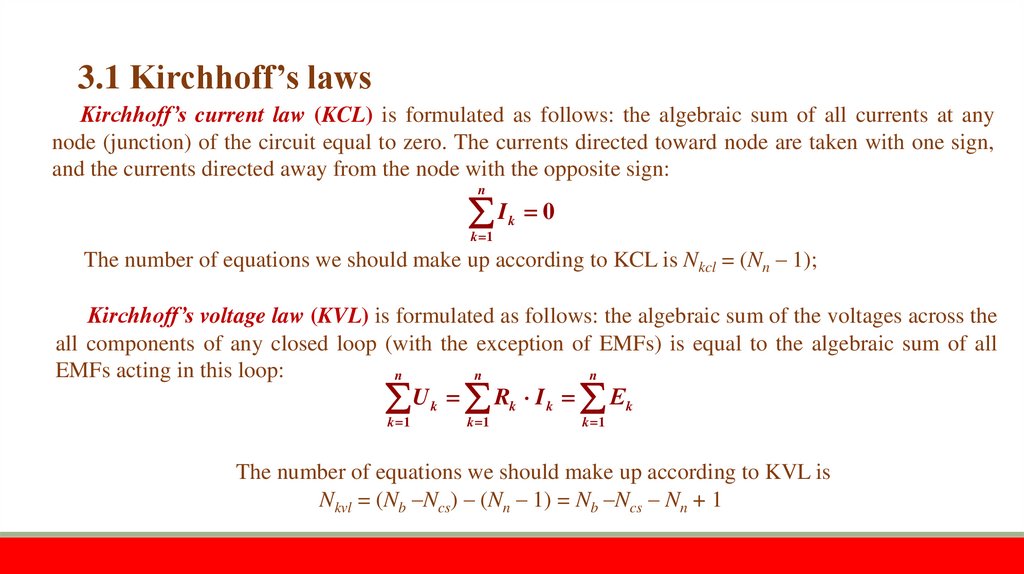
3.1 Kirchhoff’s lawsKirchhoff’s current law (KCL) is formulated as follows: the algebraic sum of all currents at any
node (junction) of the circuit equal to zero. The currents directed toward node are taken with one sign,
and the currents directed away from the node with the opposite sign:
n
I 0
k 1
k
The number of equations we should make up according to KCL is Nkcl = (Nn – 1);
Kirchhoff’s voltage law (KVL) is formulated as follows: the algebraic sum of the voltages across the
all components of any closed loop (with the exception of EMFs) is equal to the algebraic sum of all
EMFs acting in this loop:
n
n
n
U k Rk I k Еk
k 1
k 1
k 1
The number of equations we should make up according to KVL is
Nkvl = (Nb –Ncs) – (Nn – 1) = Nb –Ncs – Nn + 1
6.
The KVL equations should be made up for the independent loops. Branches with current sourcesshould not be included in the independent loops.
The independent loop contains at least one own branch, which does not belongs to any other loop.
The total number of equations we should make up according to the Kirchhoff’s laws is equal to the
number of unknown currents Nt = (Nb – Ncs).
Calculation procedure according to Kirchhoff’s laws for a circuit consisting of Nb branches, Nn
nodes and Ncs current sources:
1) Arbitrarily set positive direction of the current flow through each branch.
2) For all independent loops arbitrarily set direction of the loop’s traversal: either clockwise or
counterclockwise.
3) Make up the simultaneous equations according to the Kirchhoff’s laws.
4) Find the currents in all branches by solving the resulting system of equations.
5) Check the obtained results of the calculation by substituting them into the KCL and KVL
equations
If some of the currents are negative, then its actual direction is opposite to one chosen arbitrarily.
7.
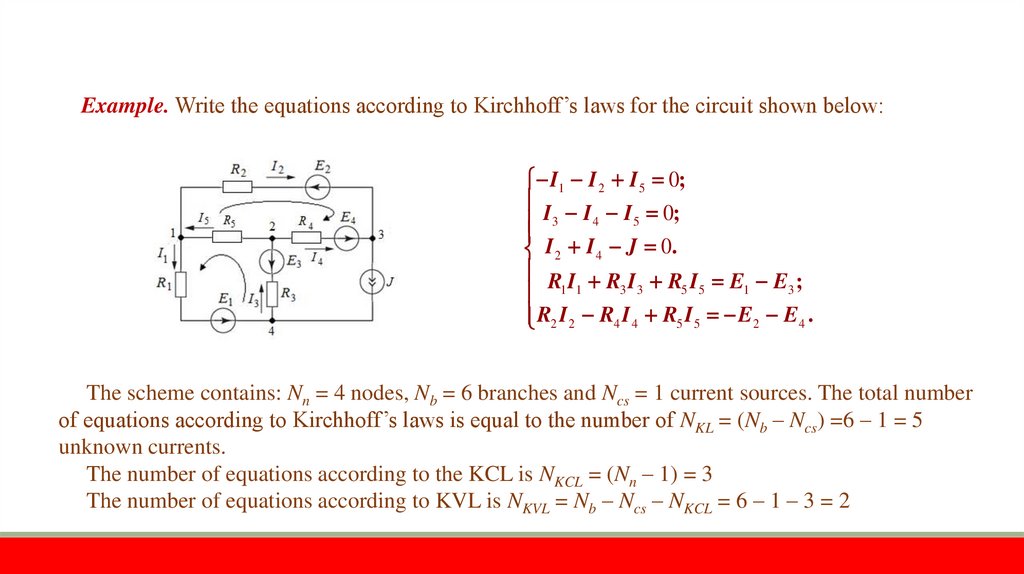
Example. Write the equations according to Kirchhoff’s laws for the circuit shown below:I1 I 2 I 5 0;
I I I 0;
4
5
3
I 2 I 4 J 0.
RI RI R I E E ;
3 3
5 5
1
3
1 1
R2 I 2 R4 I 4 R5 I 5 E2 E4 .
The scheme contains: Nn = 4 nodes, Nb = 6 branches and Ncs = 1 current sources. The total number
of equations according to Kirchhoff’s laws is equal to the number of NKL = (Nb – Ncs) =6 – 1 = 5
unknown currents.
The number of equations according to the KCL is NKCL = (Nn – 1) = 3
The number of equations according to KVL is NKVL = Nb – Ncs – NKCL = 6 – 1 – 3 = 2
8.
3.2 Mesh analysisEnglish physicist James Clerk Maxwell (1831 – 1879) proposed the mesh analysis. According to the
mesh analysis, it is conventionally assumed that each independent loop has its own mesh current, which
flows through all elements of this loop. In this case, the number of unknown currents decreases to the
number of independent loops. The independent loop contains at least one own branch, which does not
enter into any other loop. The equations according to KVL should be written with considering the
voltages across loop’s elements from the action of mesh currents flowing through them. Solving the
resulting simultaneous equations, we find out mesh currents, and then find out the branch currents as the
algebraic sum of the mesh currents flowing through this branch. The mesh current is taken with the plus
sign if its direction coincides with the direction of the branch’s current and with the minus sign
otherwise.
The mesh current analysis (MCA) allows to reduce the number of simultaneous equations up to the
number of equations, which should be written according to KVL. To reduce the number of unknowns,
the currents of the common branches are expressed through the currents of branches belonging to the
independent loops only (so-called mesh currents) using the KCL equations. Substituting these
expressions into equations based on the KVL, we obtain a system of equations according to the mesh
current analysis.
9.
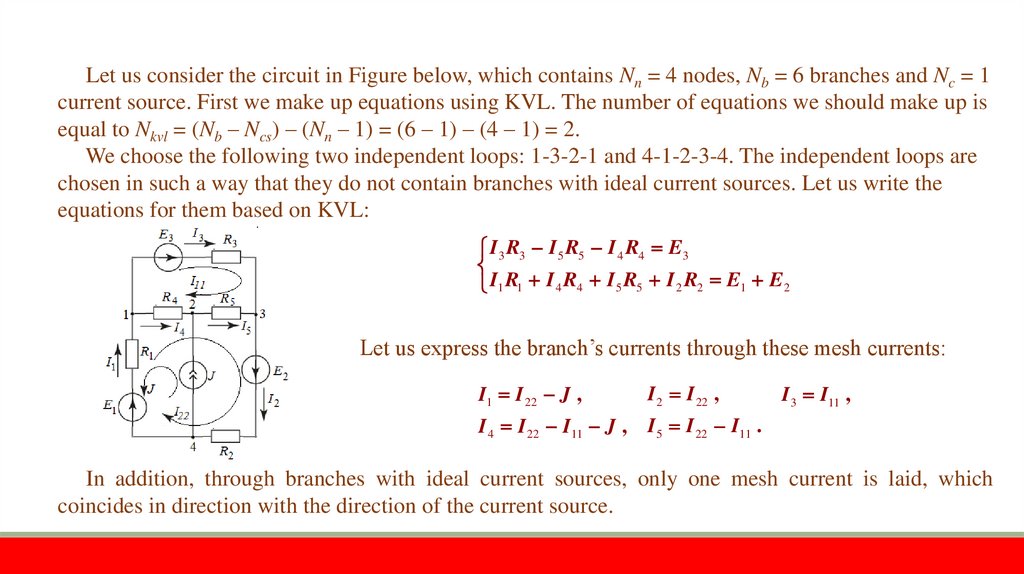
Let us consider the circuit in Figure below, which contains Nn = 4 nodes, Nb = 6 branches and Nc = 1current source. First we make up equations using KVL. The number of equations we should make up is
equal to Nkvl = (Nb – Ncs) – (Nn – 1) = (6 – 1) – (4 – 1) = 2.
We choose the following two independent loops: 1-3-2-1 and 4-1-2-3-4. The independent loops are
chosen in such a way that they do not contain branches with ideal current sources. Let us write the
equations for them based on KVL:
I 3 R3 I 5 R5 I 4 R4 E3
I1 R1 I 4 R4 I 5 R5 I 2 R2 E1 E 2
Let us express the branch’s currents through these mesh currents:
I1 I 22 J ,
I 2 I 22 ,
I 3 I11 ,
I 4 I 22 I11 J , I 5 I 22 I11 .
In addition, through branches with ideal current sources, only one mesh current is laid, which
coincides in direction with the direction of the current source.
10.
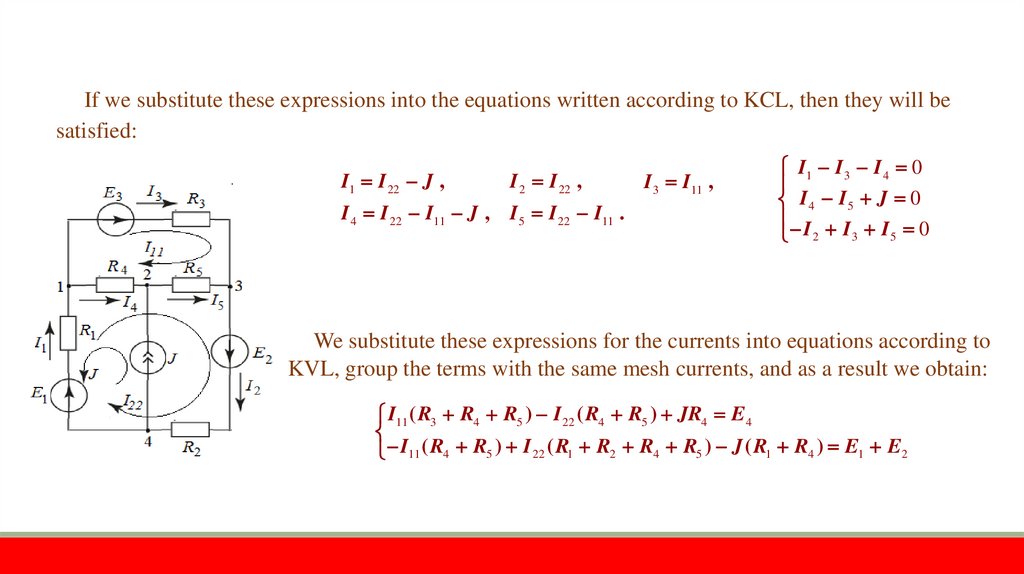
If we substitute these expressions into the equations written according to KCL, then they will besatisfied:
I1 I 22 J ,
I 2 I 22 ,
I 4 I 22 I11 J , I 5 I 22 I11 .
I 3 I11 ,
I1 I 3 I 4 0
I 4 I5 J 0
I I I 0
3
5
2
We substitute these expressions for the currents into equations according to
KVL, group the terms with the same mesh currents, and as a result we obtain:
I11 ( R3 R4 R5 ) I 22 ( R4 R5 ) JR4 E4
I11 ( R4 R5 ) I 22 ( R1 R2 R4 R5 ) J ( R1 R4 ) E1 E 2
11.
3.3 Nodal analysisThe nodal analysis (NA) allows to reduce the number of equations solved simultaneously up to the
number of equations, which should be written according to the Kirchhoff’s currents law. To reduce the
number of unknowns the branch’s currents are expressed in terms of the nodal potentials difference with
considering the EMF and conductivity of the branches. Substituting these expressions into equations
according to the Kirchhoff’s currents law we obtain the simultaneous equations of nodal analysis.
In the method of nodal potentials, the potentials of the nodes of the electric circuit as unknowns are
taken. After the node’s potentials are determined, the currents of branches are calculated using Ohm’s
law written for the branch of circuit.
The number of equations, which should be made up in accordance with the nodal analysis, is equal to
the number of equations according to the Kirchhoff’s currents law: Nna = Nn – 1.
In case when the circuit contains branches without resistances but with ideal sources of EMF, the
number of equations according to the nodal analysis is reduced by the number of such branches NE. This
is because the potential difference at the terminals of such branches, regardless of the current flowing
through them, remains unchanged and equal to the EMF of this branch. The number of equations in this
case is equal: Nna = Nn – 1 – NE.
The potential of one of circuit’s nodes is conditionally assumed to be zero, in other words, grounded.
12.
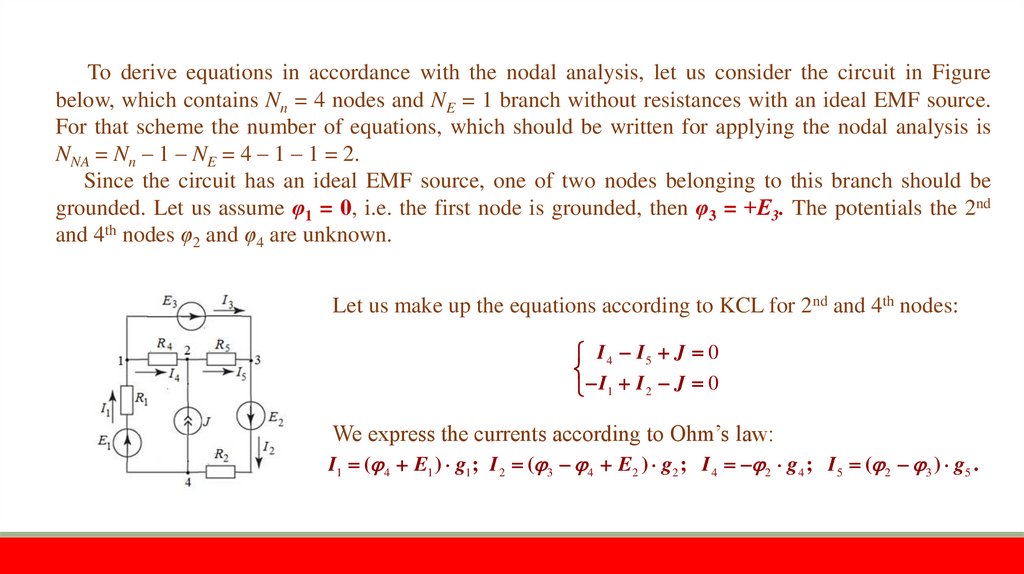
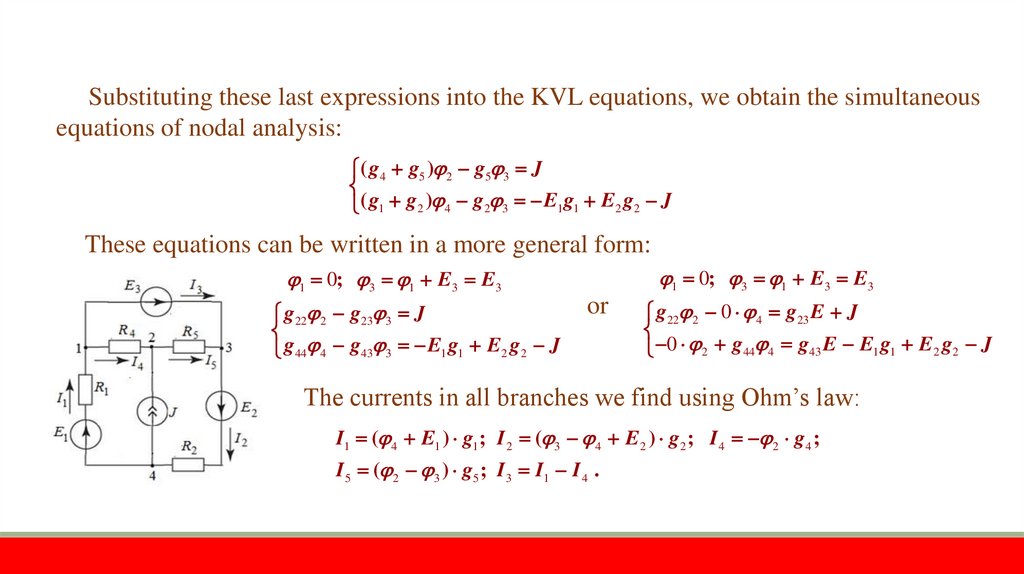
To derive equations in accordance with the nodal analysis, let us consider the circuit in Figurebelow, which contains Nn = 4 nodes and NE = 1 branch without resistances with an ideal EMF source.
For that scheme the number of equations, which should be written for applying the nodal analysis is
NNA = Nn – 1 – NE = 4 – 1 – 1 = 2.
Since the circuit has an ideal EMF source, one of two nodes belonging to this branch should be
grounded. Let us assume φ1 = 0, i.e. the first node is grounded, then φ3 = +Е3. The potentials the 2nd
and 4th nodes φ2 and φ4 are unknown.
Let us make up the equations according to KCL for 2nd and 4th nodes:
I 4 I5 J 0
I1 I 2 J 0
We express the currents according to Ohm’s law:
I1 ( 4 E1 ) g1 ; I 2 ( 3 4 E2 ) g2 ; I 4 2 g4 ; I 5 ( 2 3 ) g5 .
13.
Substituting these last expressions into the KVL equations, we obtain the simultaneousequations of nodal analysis:
( g4 g5 ) 2 g5 3 J
( g1 g2 ) 4 g2 3 E1 g1 E2 g2 J
These equations can be written in a more general form:
1 0; 3 1 E3 E3
1 0; 3 1 E3 E3
g22 2 g23 3 J
g44 4 g43 3 E1 g1 E2 g2 J
or
g22 2 0 4 g23 E J
0 2 g44 4 g43 E E1 g1 E2 g2 J
The currents in all branches we find using Ohm’s law:
I1 ( 4 E1 ) g1 ; I 2 ( 3 4 E2 ) g2 ; I 4 2 g4 ;
I 5 ( 2 3 ) g5 ; I 3 I1 I 4 .
14.
Test questions:1. Formulate the Kirchhoff’s current law and Kirchhoff’s voltage law.
2. How many equations we need to make up according to KCL and KVL??
3. Explain the essence of the mesh analysis.
4. How many equations we need to make up according to mesh analysis?
5. How we choose loops for the circuit containing a current source
according to the mesh analysis?
6. Explain the essence of the nodal analysis.
7. How can we determine the branch’s currents by applying nodal analysis?
15.
Thank Youfor your attention