Similar presentations:



Comparing_Present_Simple_Present_Continuous_Past_Simple_and_Past
1.
Comparing P res ent S imple,P res ent Continuous , P as t
S imple & P as t Continuous
2.
What Are Verb Tenses?Verb tenses are fundamental grammatical tools that indicate when an action
occurs. They help us understand the chronology of events, whether they are in the
past, present, or future. This presentation will focus on four crucial tenses: the
present simple, present continuous, past simple, and past continuous.
A solid grasp of these tenses is essential for clear and accurate communication in
English, enabling you to express ideas with precision and confidence in both
spoken and written forms.
3.
P res ent S imple: Facts & HabitsThe present simple tense is primarily used to describe permanent facts,
established routines, and recurring habits. It portrays actions that are timeless,
general truths, or actions that happen regularly without specific interruption.
Examples:
"She works in London." (A permanent situation)
"I drink coffee every morning." (A daily habit)
This tense is often accompanied by specific keywords that highlight its usage:
Keywords: always, usually, often, sometimes, never, every day/week/month.
4.
Present Continuous: TemporaryActions Now
In contrast to the present simple, the present continuous tense is used to describe
actions that are currently in progress or ongoing around the present moment.
These actions are typically temporary and may not be completed yet.
Examples:
"She is working on a project at the moment." (An action happening right now)
"I am reading a great book these days." (An action ongoing over a period)
Look out for these keywords that signal the use of the present continuous:
Keywords: now, at the moment, currently, today, this week/month.
5.
P res ent S imple vs P res entContinuous : Key Difference
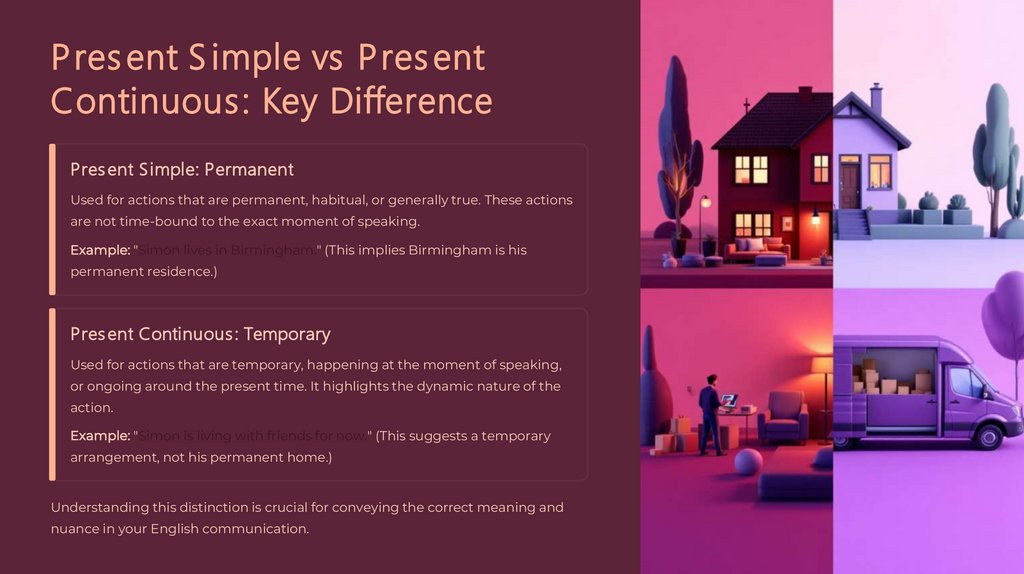
Pres ent S imple: Permanent
Used for actions that are permanent, habitual, or generally true. These actions
are not time-bound to the exact moment of speaking.
Example: "Simon lives in Birmingham." (This implies Birmingham is his
permanent residence.)
Pres ent Continuous : Temporary
Used for actions that are temporary, happening at the moment of speaking,
or ongoing around the present time. It highlights the dynamic nature of the
action.
Example: "Simon is living with friends for now." (This suggests a temporary
arrangement, not his permanent home.)
Understanding this distinction is crucial for conveying the correct meaning and
nuance in your English communication.
6.
Past Simple: Completed Actionsin the Past
The past simple tense is used to describe actions that began and ended at a
specific point in the past. These actions are completely finished and have no direct
connection to the present.
Examples:
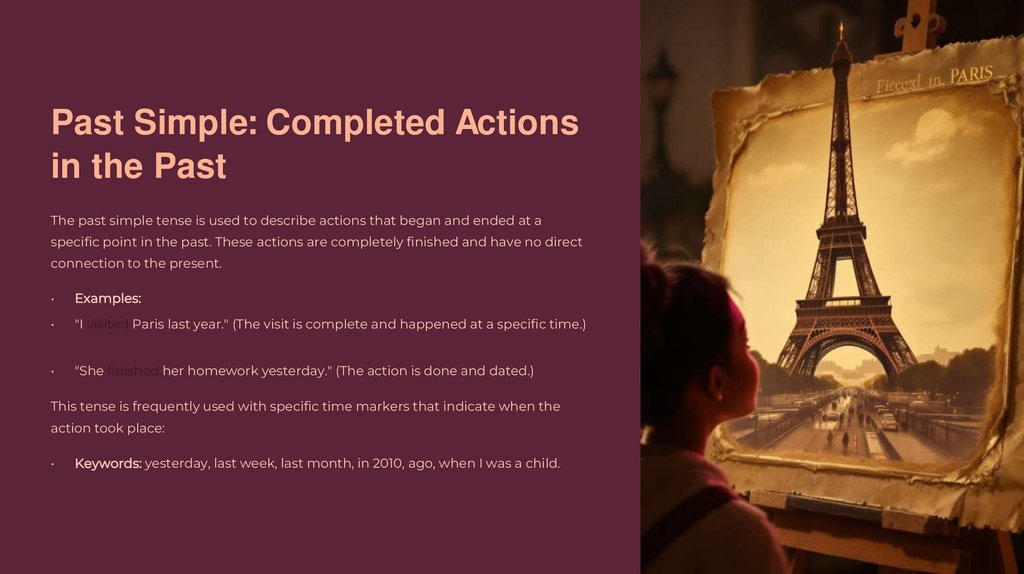
"I visited Paris last year." (The visit is complete and happened at a specific time.)
"She finished her homework yesterday." (The action is done and dated.)
This tense is frequently used with specific time markers that indicate when the
action took place:
Keywords: yesterday, last week, last month, in 2010, ago, when I was a child.
7.
P as t Continuous : Actions inP rogres s in the P as t
The past continuous tense describes actions that were ongoing or in progress at a
particular moment in the past. It sets the scene or describes an action that was
interrupted by another event.
Examples:
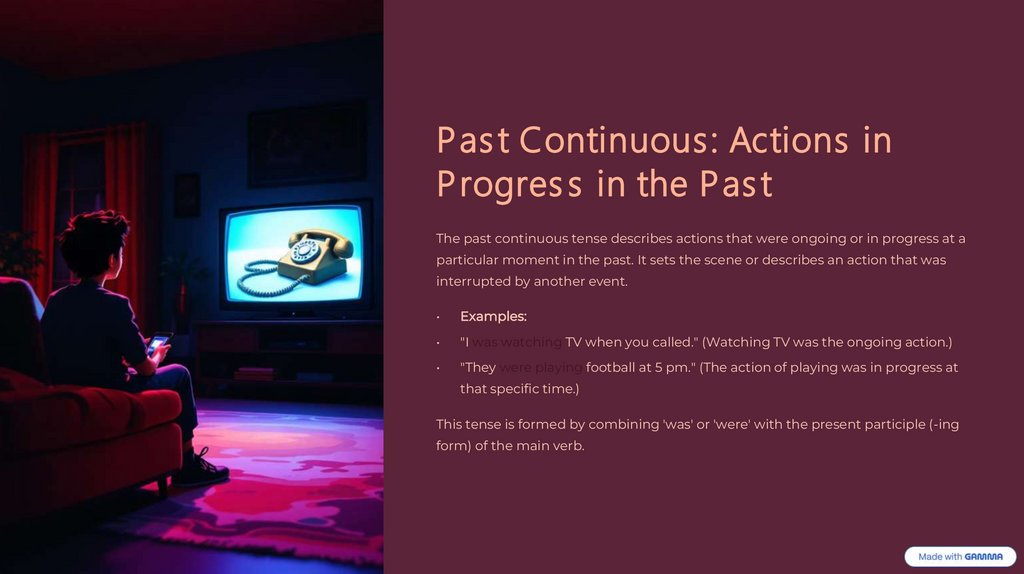
"I was watching TV when you called." (Watching TV was the ongoing action.)
"They were playing football at 5 pm." (The action of playing was in progress at
that specific time.)
This tense is formed by combining 'was' or 'were' with the present participle (-ing
form) of the main verb.
8.
Past Simple vs PastContinuous: How They Work
Together
These two past tenses often work in conjunction to describe events in a narrative.
The past continuous typically sets the scene, describing a longer, ongoing action in
the past, while the past simple interrupts it with a shorter, completed action.
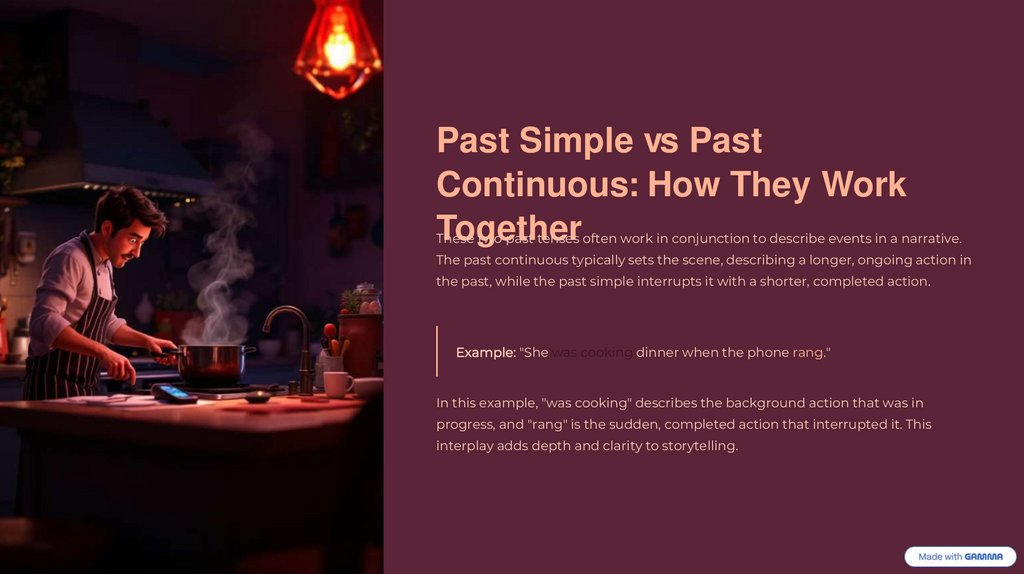
Example: "She was cooking dinner when the phone rang."
In this example, "was cooking" describes the background action that was in
progress, and "rang" is the sudden, completed action that interrupted it. This
interplay adds depth and clarity to storytelling.
9.
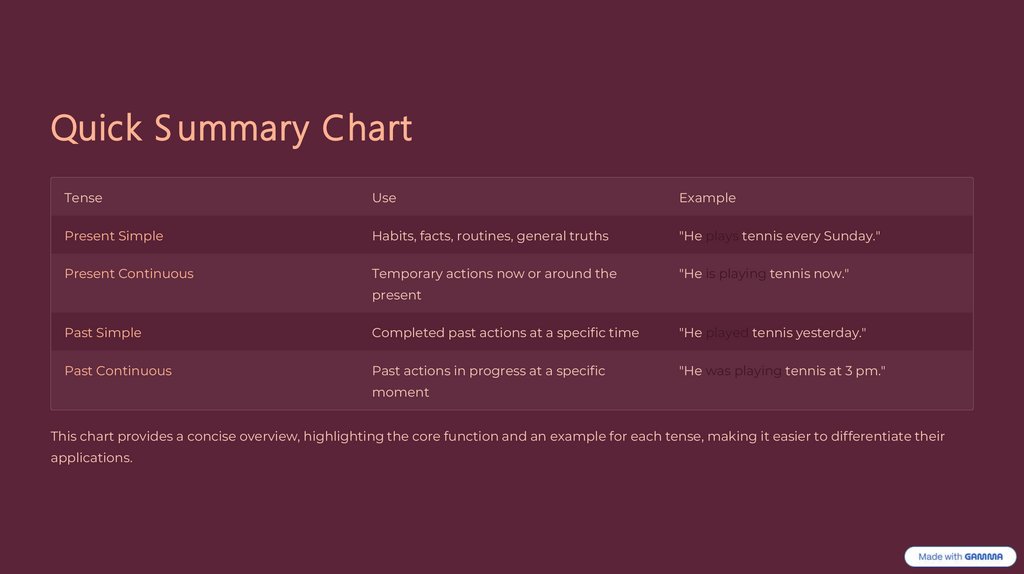
Quick S ummary ChartTense
Use
Example
Present Simple
Habits, facts, routines, general truths
"He plays tennis every Sunday."
Present Continuous
Temporary actions now or around the
"He is playing tennis now."
present
Past Simple
Completed past actions at a specific time
"He played tennis yesterday."
Past Continuous
Past actions in progress at a specific
"He was playing tennis at 3 pm."
moment
This chart provides a concise overview, highlighting the core function and an example for each tense, making it easier to differentiate their
applications.
10.
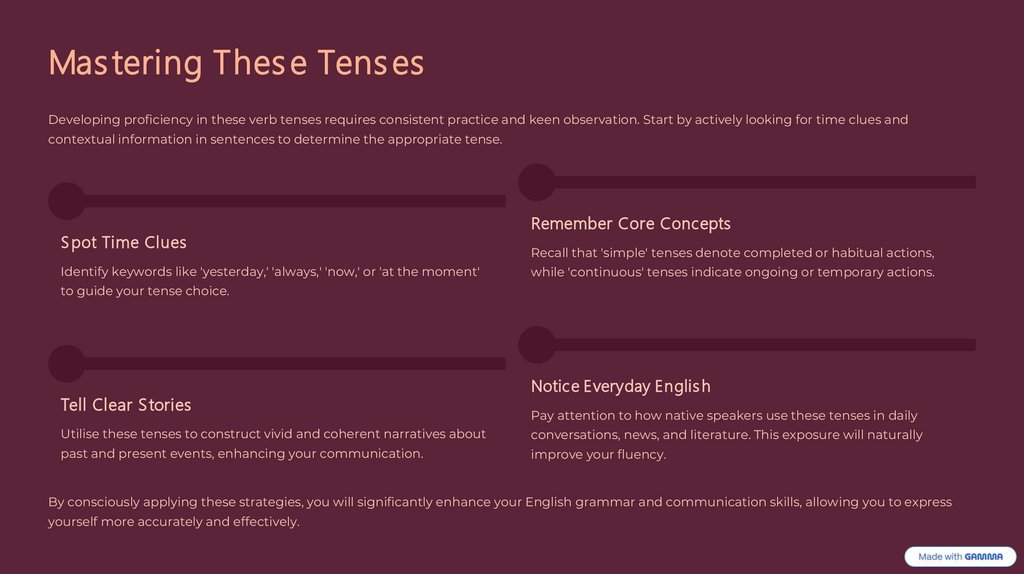
Mas tering Thes e Tens esDeveloping proficiency in these verb tenses requires consistent practice and keen observation. Start by actively looking for time clues and
contextual information in sentences to determine the appropriate tense.
S pot Time Clues
Identify keywords like 'yesterday,' 'always,' 'now,' or 'at the moment'
Remember Core Concepts
Recall that 'simple' tenses denote completed or habitual actions,
while 'continuous' tenses indicate ongoing or temporary actions.
to guide your tense choice.
Tell Clear S tories
Notice Everyday Englis h
Pay attention to how native speakers use these tenses in daily
Utilise these tenses to construct vivid and coherent narratives about
conversations, news, and literature. This exposure will naturally
past and present events, enhancing your communication.
improve your fluency.
By consciously applying these strategies, you will significantly enhance your English grammar and communication skills, allowing you to express
yourself more accurately and effectively.