
 pedagogy
Similar presentations:








Public Speaking…
1. PUBLIC SPEAKING…
2. DEFINITION.
• Public speaking is the processand act of speaking or giving a
lecture to a group of people in a
structured, deliberate manner
intended to inform, influence, or
entertain a listening audience.
3. HISTORY OF PUBLIC SPEAKING .
• As far as the history of public speakingis concerned, the Hebrews, Greeks,
Romans, great speakers of our time and
technology all have important roles to
play.
• What roles have all these played in
public speaking history?
4. History of Public Speaking in Ancient Times
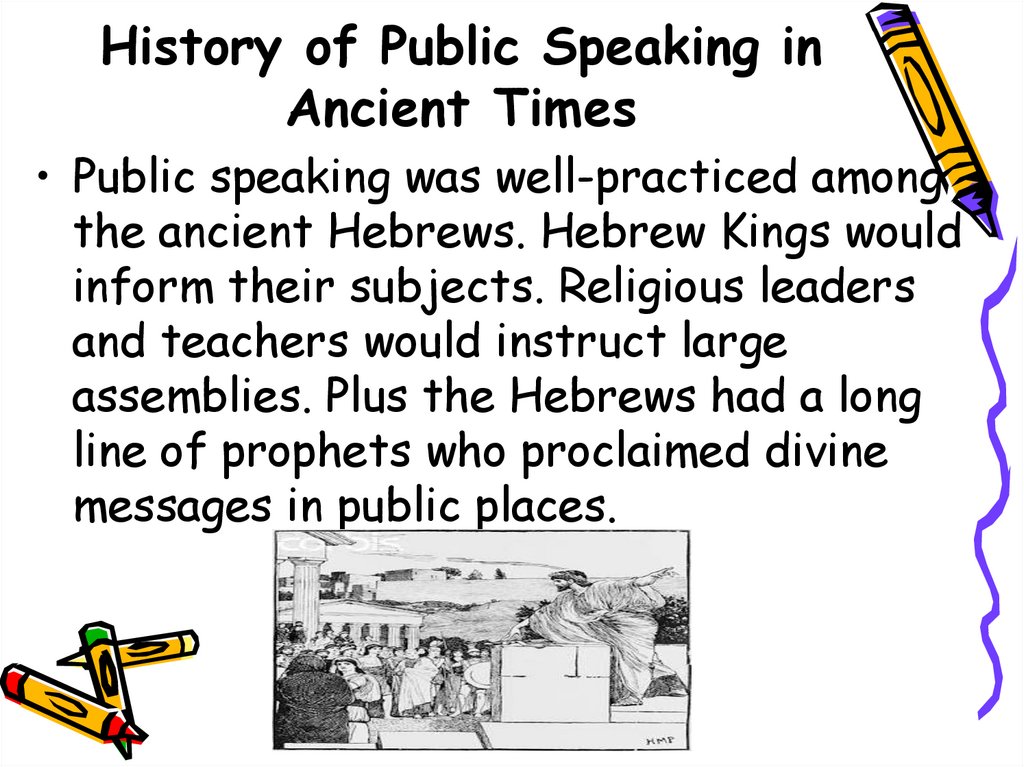
• Public speaking was well-practiced amongthe ancient Hebrews. Hebrew Kings would
inform their subjects. Religious leaders
and teachers would instruct large
assemblies. Plus the Hebrews had a long
line of prophets who proclaimed divine
messages in public places.
5.
• One of the earliest of such prophets was theprophet Moses.
• He constantly had to address the Israelites as
he led them out of slavery from Egypt.
• He had to inform, inspire and at times rebuke
them. He was indeed a great public speaker!
• the first known book about public speaking was
written about 2,400 B.C.E by an Egyptian
official named Ptahhotep.
• He was vizier (minister) to Pharaoh Djedkare
Isesi of the fifth dynasty.
6. Ancient Greeks and the History of Public Speaking
• Around the fifth century B.C.E, theGreek district of Athens was a
prominent military, political and
philosophical center
• Greek orators like Aristotle, Plato and
Socrates developed theories and
techniques that became bedrocks in
public speaking.
7. Rome’s Role in Public Speaking History
• After the fall of Greece, Rome came to thescene as a military and political world power.
The Romans never discarded the public speaking
culture left by the Greeks. They rather
adopted and modified them.
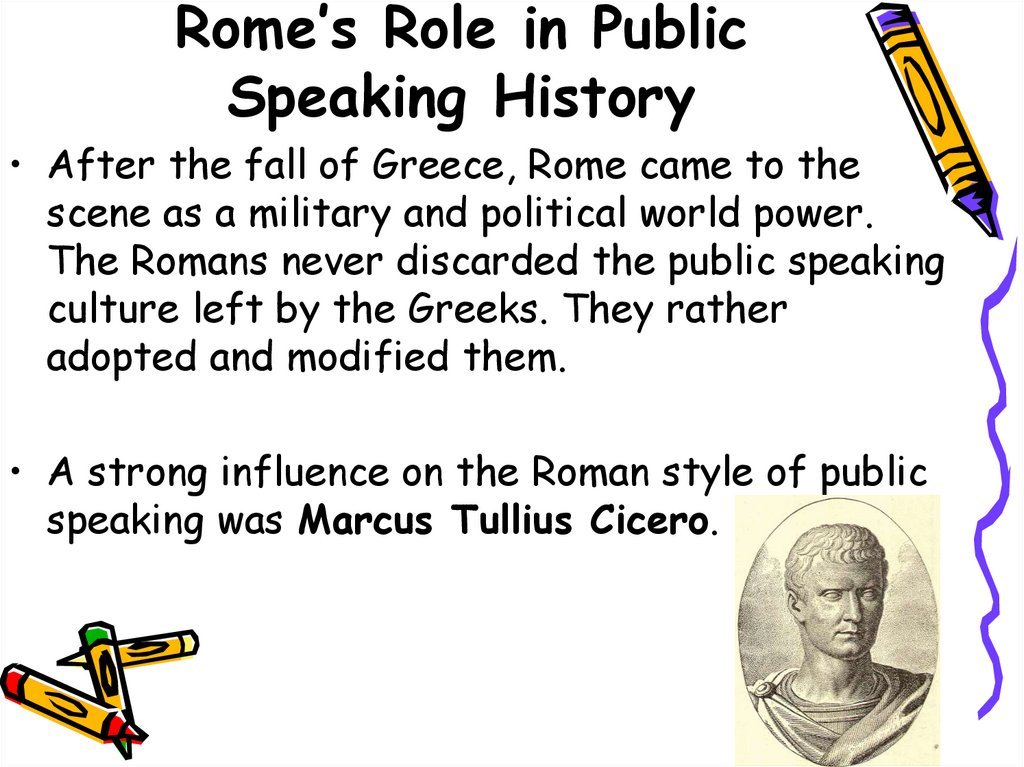
• A strong influence on the Roman style of public
speaking was Marcus Tullius Cicero.
8.
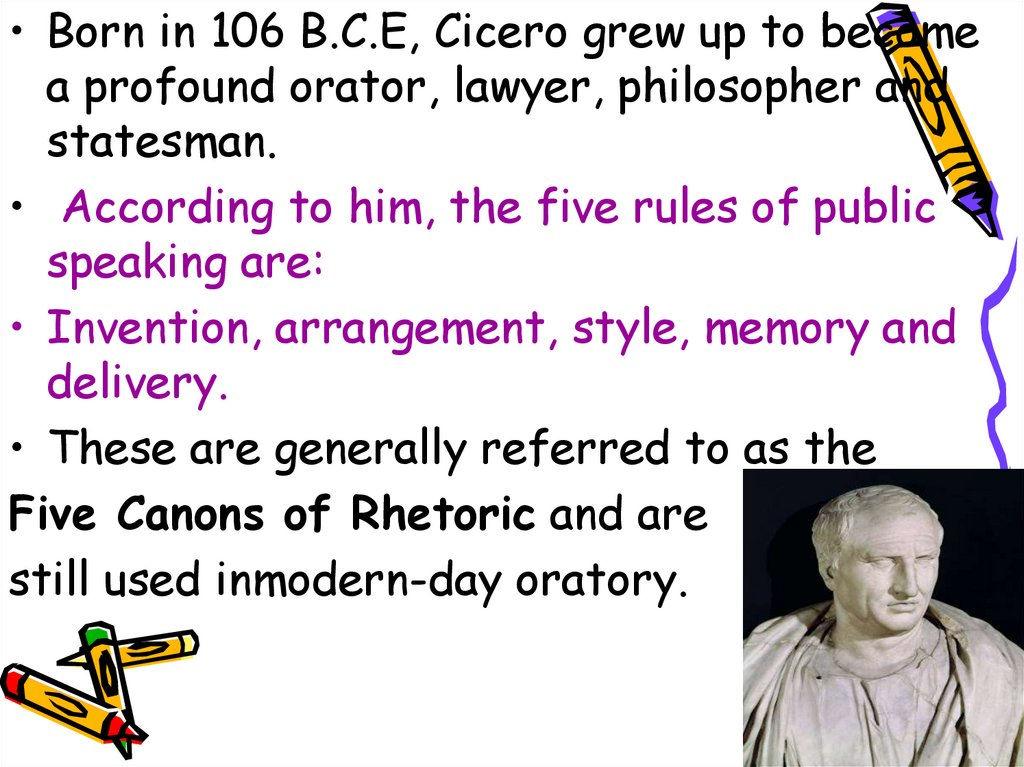
• Born in 106 B.C.E, Cicero grew up to becomea profound orator, lawyer, philosopher and
statesman.
• According to him, the five rules of public
speaking are:
• Invention, arrangement, style, memory and
delivery.
• These are generally referred to as the
Five Canons of Rhetoric and are
still used inmodern-day oratory.
9. Modern Day Developments in the History of Public Speaking.
• The history of the human race is filled withgreat speakers who had tremendous impact
on the world. For example:
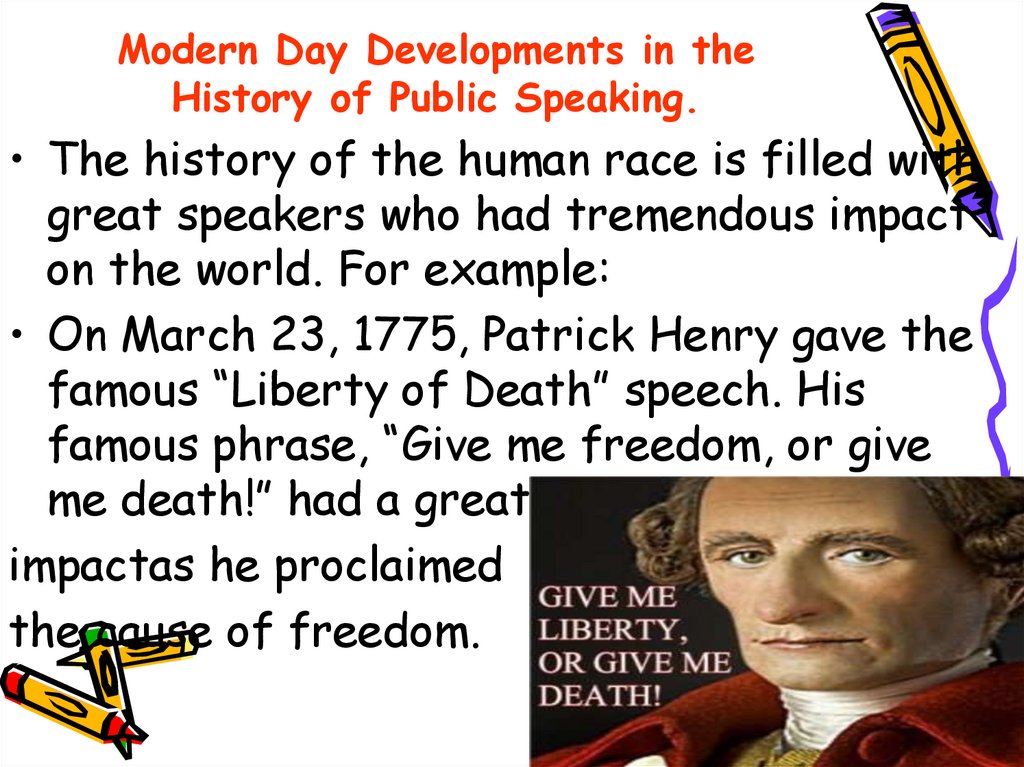
• On March 23, 1775, Patrick Henry gave the
famous “Liberty of Death” speech. His
famous phrase, “Give me freedom, or give
me death!” had a great
impactas he proclaimed
the cause of freedom.
10.
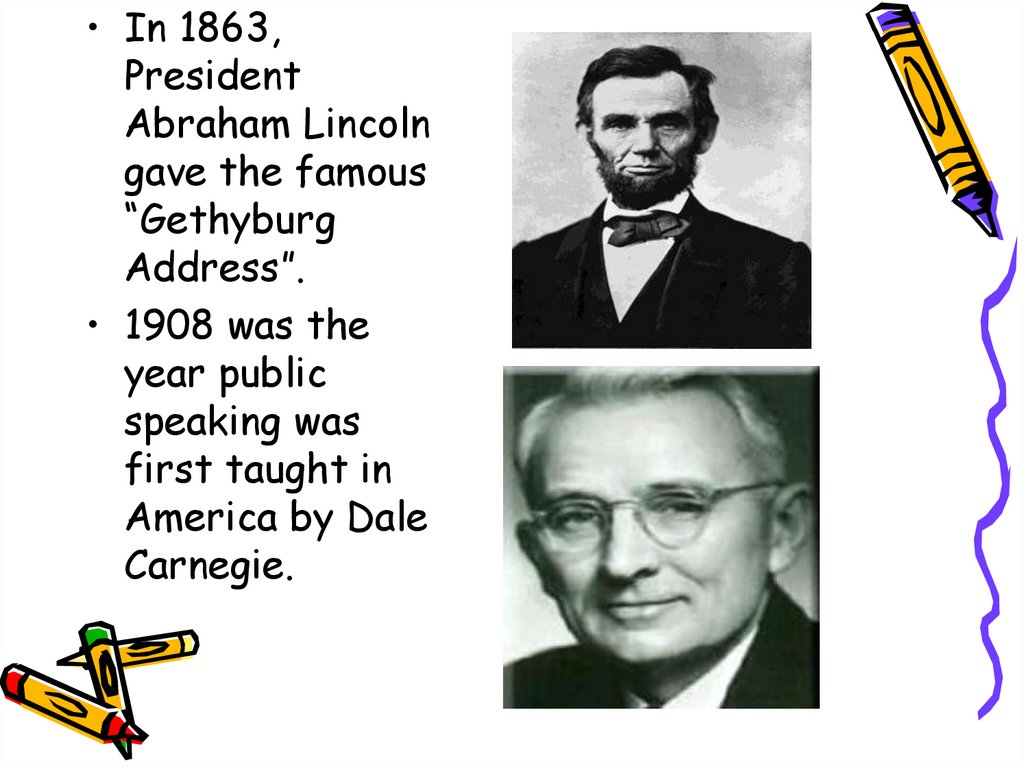
• In 1863,President
Abraham Lincoln
gave the famous
“Gethyburg
Address”.
• 1908 was the
year public
speaking was
first taught in
America by Dale
Carnegie.
11.
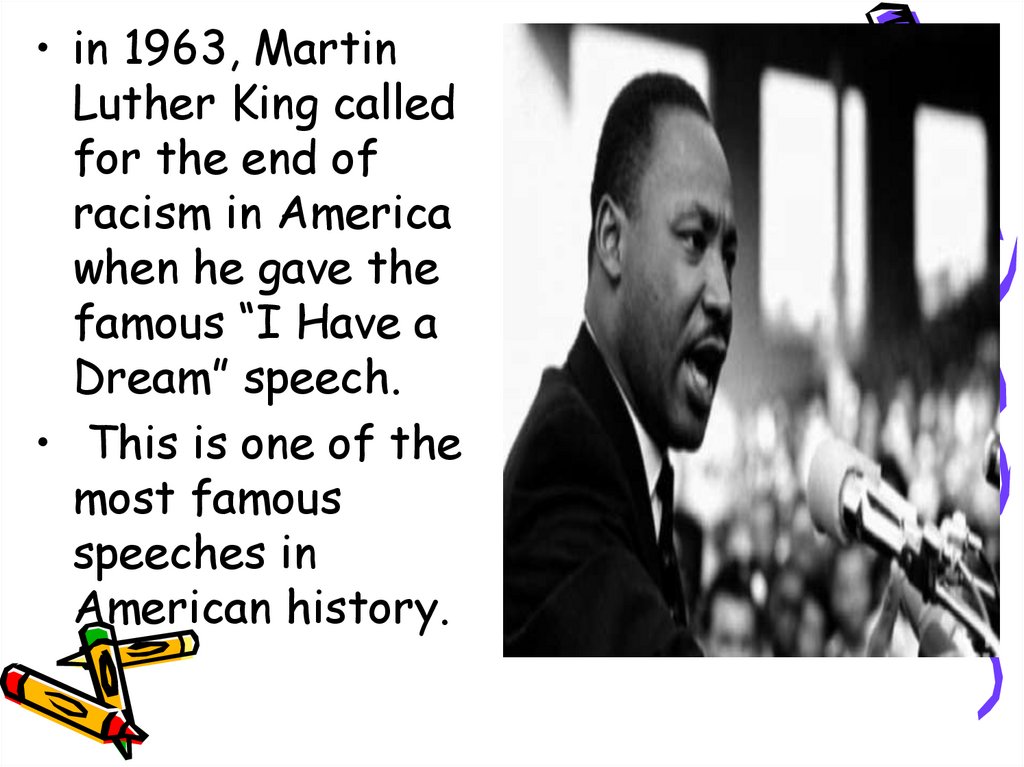
• in 1963, MartinLuther King called
for the end of
racism in America
when he gave the
famous “I Have a
Dream” speech.
• This is one of the
most famous
speeches in
American history.
12. The Role of Technology in Public Speaking History
• Technological advancements in the late20th century as well as the 21st
century have given ‘birth’ to
sophisticated media sources like the
Internet, video-conferencing and
telecommunications. These have
changed the ‘face’ of public speaking.
13.
• the commencement of the first privateInternet service in 1980, public
speaking received a big boost. The
Internet has since been used to reach
worldwide Internet users.
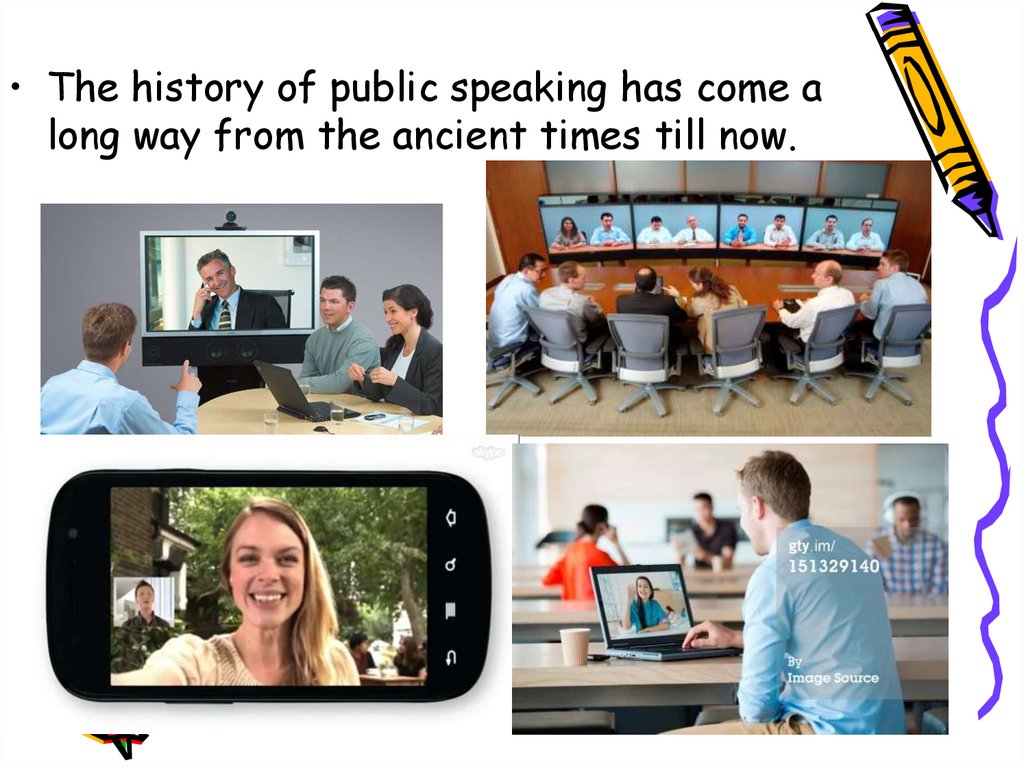
• Video-conferencing, on its part, has now
made it possible for people in different
geographical locations to see and hear
each other as if they are at the same
place.
14.
• The history of public speaking has come along way from the ancient times till now.
15. five basic elements,
• "who is saying• what
• to whom
• using what medium
• with what effects?"
16. Choosing an appropriate pattern
• Chronological Pattern.• Causal Pattern.
• Spatial Pattern.
• Topical Pattern.
• Psychological Pattern.
17. Chronological pattern.
• In this pattern ‘we arrange ideas,keeping in mind the chronology of
events.
• E.g.. Give a speech on The history of
Indian cricket.
18. Causal Pattern
• The ideas are divided into two majorcomponents – causes and their
effects.
• Normally ,this pattern is chosen ti
highlight the relationship between a
problem and the reasons for its
existence.
• Eg,Alcoholism its causes and effects.
19. Spatial Pattern.
• Spatial pattern is best suited tospeeches which have a geographical
or structural orientation.
• Eg.design of an automatic washing
machine., temple Jaipur: A structural
description
20. Topical Pattern
• Chooses to divide and arrange thedifferent parts of a speech into
various heading and sub-headings.
• When the speaker has to inform the
audience about the various kind or
type of something.
• Eg. Types of cancers.
21. Psychological Pattern.
• The speech according to needs ofhis/her listeners.
• The speaker arrange ideas in a
manner most likely to create an
immediate impact on the listeners.
• The speeches structured in the
psychological pattern are quite
emotive in style and sense.
• Eg.lonliness:is by product of modern
l
living.
22. Selecting an appropriate method
Speaking from memory : some publicspeakers rely heavily on their memory
for delivering their speeches.
Speaking from manuscript: In speaking
from the manuscript the speaker walk
the entire manuscript of the speech
written , which is read out word for
word.
23.
Speaking Impromptu: impromptuspeeches are those that are
delivered at the spur of the moment.
• A speech thus delivered without
preparation is considered an
impromptu speech.
Speaking from notes: speaking from
notes, speaker prepares
note/points/slides/and enumerates
the main ideas with help of these
main point.
24. Art of persuasion:
• The speaker have to keep theirspeeches well planned, properly
substantiated, adequately convincing,
and un-questionably relevant to the
needs of the audience.
Research your topic thoroughly.
Use proper data and figures to sound
convincing.
Keep an audience-oriented approach.
25.
Employ personal examples toestablish personal rapport with the
audience.
Create a verbal imagery to leave the
desired impact on the audience.
Use language suited to the occasion.
Keep your audience entertained
during your speech.
26. Making speeches interesting.
Making your beginning catchyUse humour and wit.
Use body language appropriately.
Employ proper voice modulation .
Use examples and instances.
End emphatically.
27. Delivering different types of speeches.
Welcome /introductory speech.• Your organizations receive guest
speakers who are to be introduced to
the audience.
Vote of thanks speech.
• Vote of thanks is delivered at the end
of a particular event, programme etc…
28.
Farewell speech• In their professional career people
often change jobs , leaving one
organizations and joining another .
At times they are transferred or
they have to move away from an
organization after the completion of
a project ,a term or an assignment.
29. Why is Public Speaking Necessary?
• giving a public speech is time- andcost-effective.
For instance, if you give a speech to
your employees, you don't have to
print or email copies of the
information. Speaking to everyone at
once means you don't need to relay
the information one-on-one.
30.
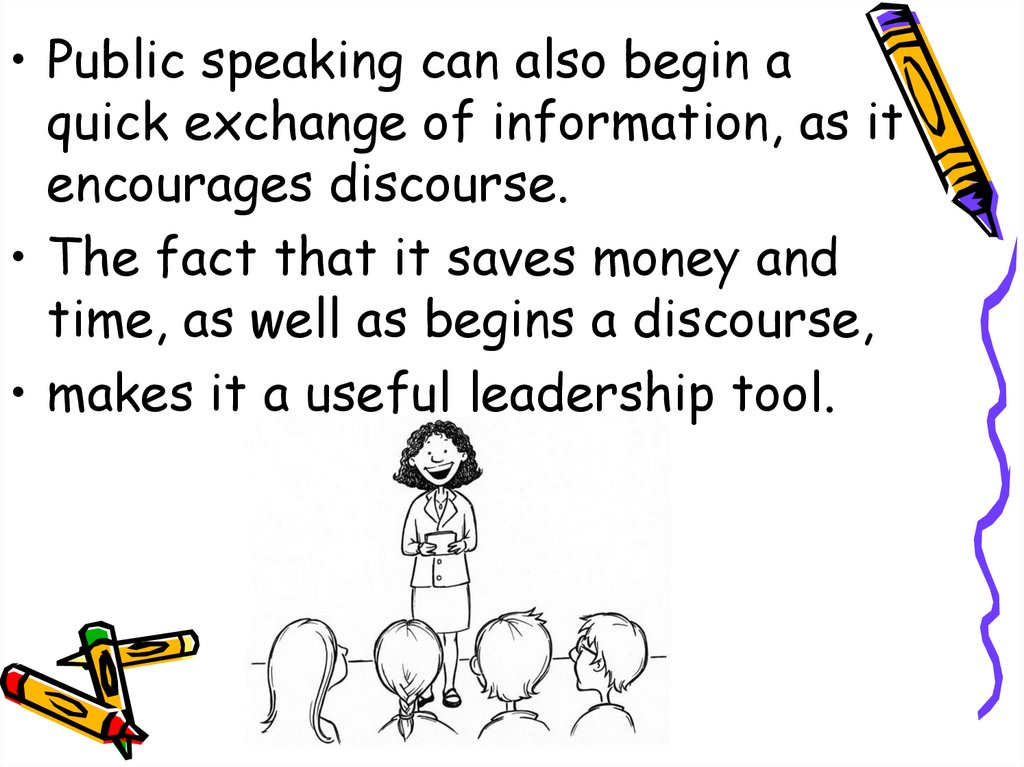
• Public speaking can also begin aquick exchange of information, as it
encourages discourse.
• The fact that it saves money and
time, as well as begins a discourse,
• makes it a useful leadership tool.
31. PURPOSE
• public speaking can range from simplytransmitting information,
• to motivating people to act, to simply
telling a story.
• Good orators should be able to change
the emotions of their listeners, not
just inform them.
32.
• public speaking for business andcommercial events is often done by
professionals .
• Public speaking can be a powerful tool to
use for purposes such as motivation,
influence, persuasion, informing,
translation, or simply ethos.
• such as when politicians give speeches to
convince people how to vote.
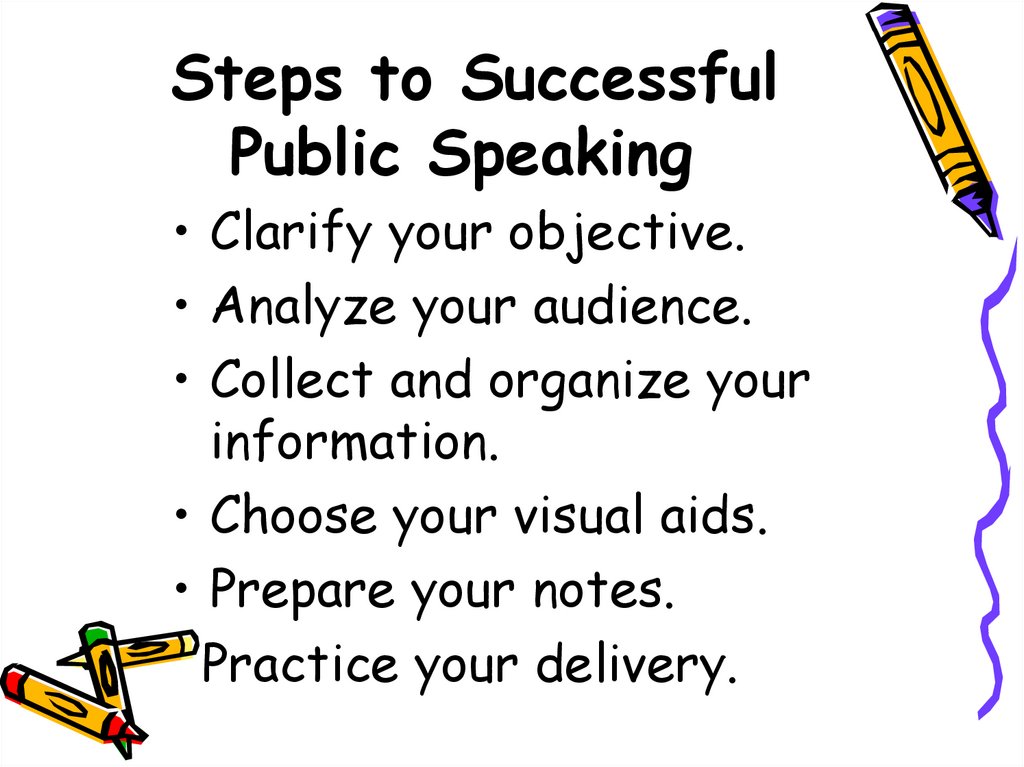
33. Steps to Successful Public Speaking
• Clarify your objective.• Analyze your audience.
• Collect and organize your
information.
• Choose your visual aids.
• Prepare your notes.
Practice your delivery.
34. conclusion
• Public speaking is a form ofcommunication used for large groups
of people. When one-on-one
communication will not be an
effective way to communicate your
information, you must use public
speaking.
35.
Presented BY….POULIN VARGHESE
1ST MSW
DC