 programming
Similar presentations:









The No-Code Revolution: Building Websites and Games Without Writing a Single Line
1.
Институт экономики, математики и информационных технологийФакультет информационных технологий и анализа данных
Кафедра системного анализа и информатики
2023
Федеральное государственное бюджетное образовательное учреждение высшего образования
«РОССИЙСКАЯ АКАДЕМИЯ НАРОДНОГО ХОЗЯЙСТВА
И ГОСУДАРСТВЕННОЙ СЛУЖБЫ при ПРЕЗИДЕНТЕ РОССИЙСКОЙ ФЕДЕРАЦИИ»
Реферат
на тему:
The No-Code Revolution: Building Websites and Games Without Writing a
Single Line
РАНХиГС
Направление подготовки: 09.03.03 Прикладная информатика
Направленность (профиль) образовательной программы:
«Веб-разработка»
(заочная форма обучения)
Выполнила: Талибова Камилла Талибовна
Преподаватель: Будник Екатерина Александровна
Москва
Москва
2026
2. Aim and Objectives
2Aim and Objectives
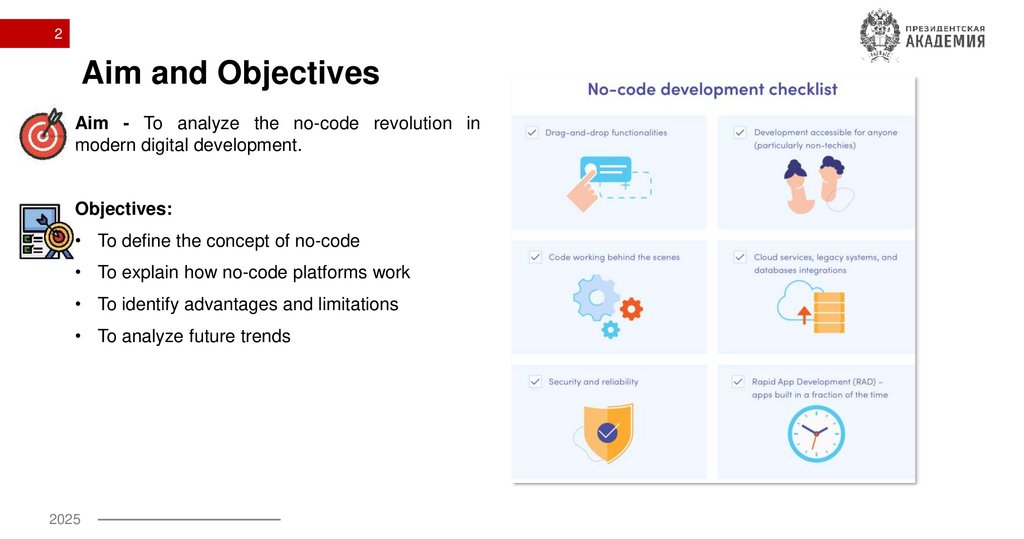
Aim - To analyze the no-code revolution in
modern digital development.
Objectives:
• To define the concept of no-code
• To explain how no-code platforms work
• To identify advantages and limitations
• To analyze future trends
2025
3. Relevance of the Topic
3Relevance of the Topic
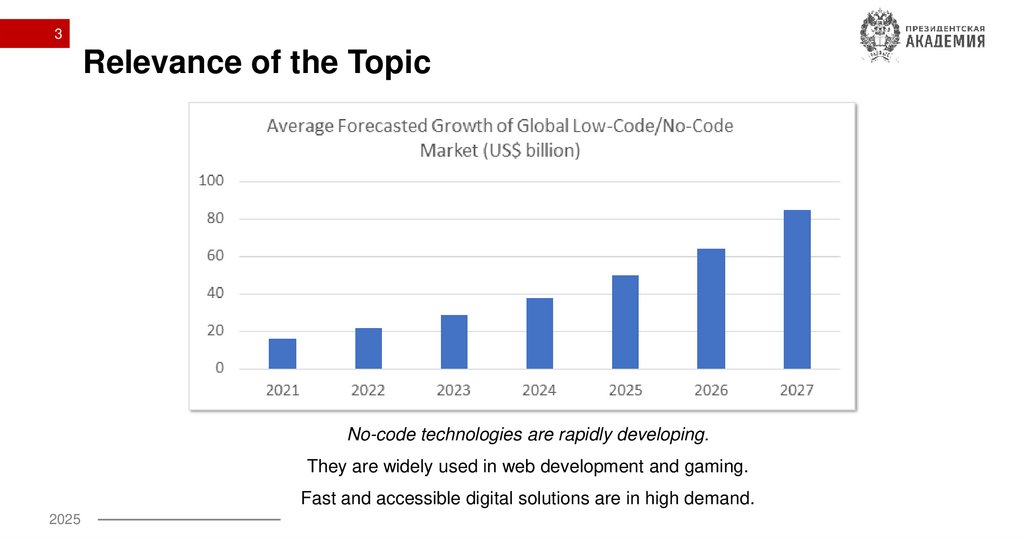
No-code technologies are rapidly developing.
They are widely used in web development and gaming.
Fast and accessible digital solutions are in high demand.
2025
4. Problem of Traditional Development
4Problem of Traditional Development
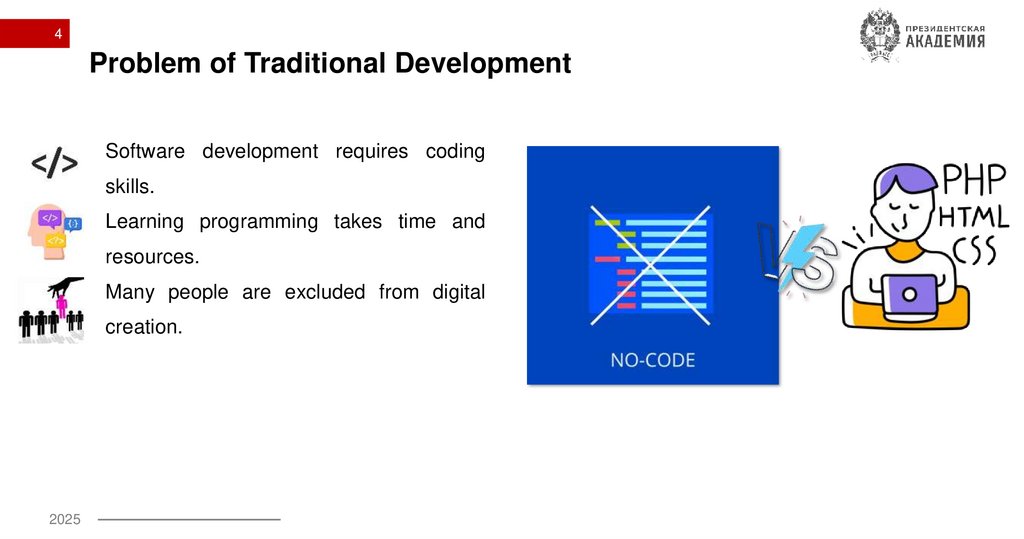
Software development requires coding
skills.
Learning programming takes time and
resources.
Many people are excluded from digital
creation.
2025
5. What Is No-Code?
5What Is No-Code?
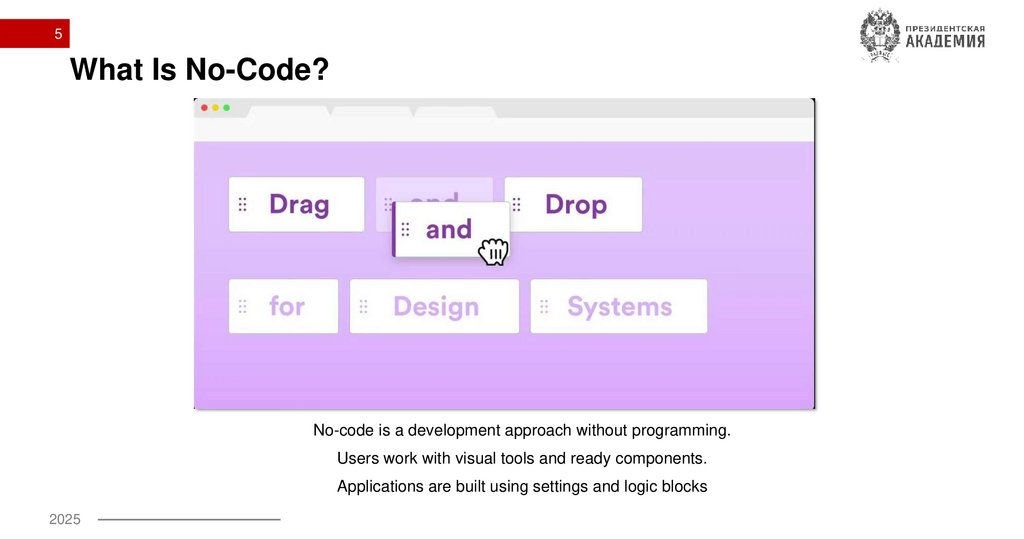
No-code is a development approach without programming.
Users work with visual tools and ready components.
Applications are built using settings and logic blocks
2025
6. Digital Democratization
6Digital Democratization
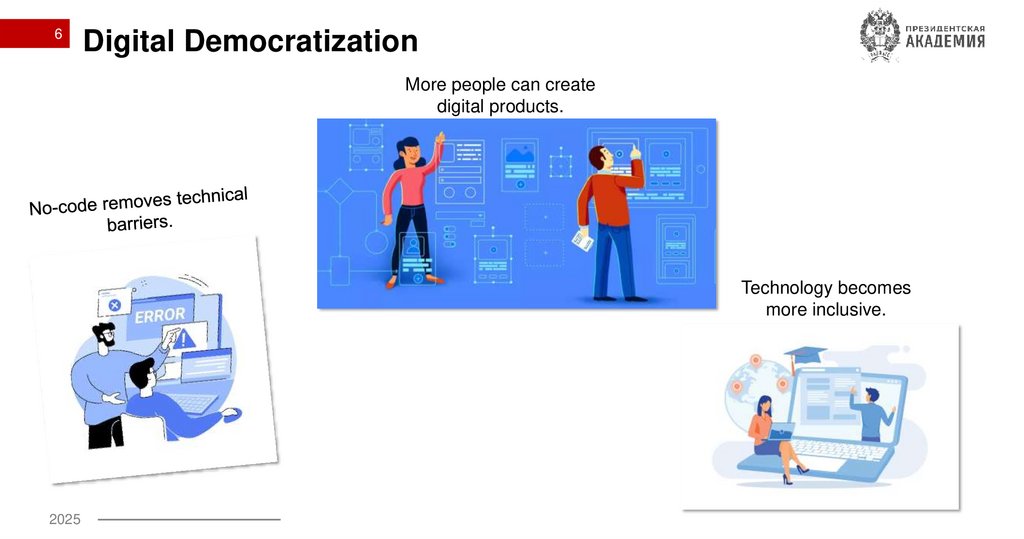
More people can create
digital products.
Technology becomes
more inclusive.
2025
7. No-Code in Game Development
7No-Code in Game Development
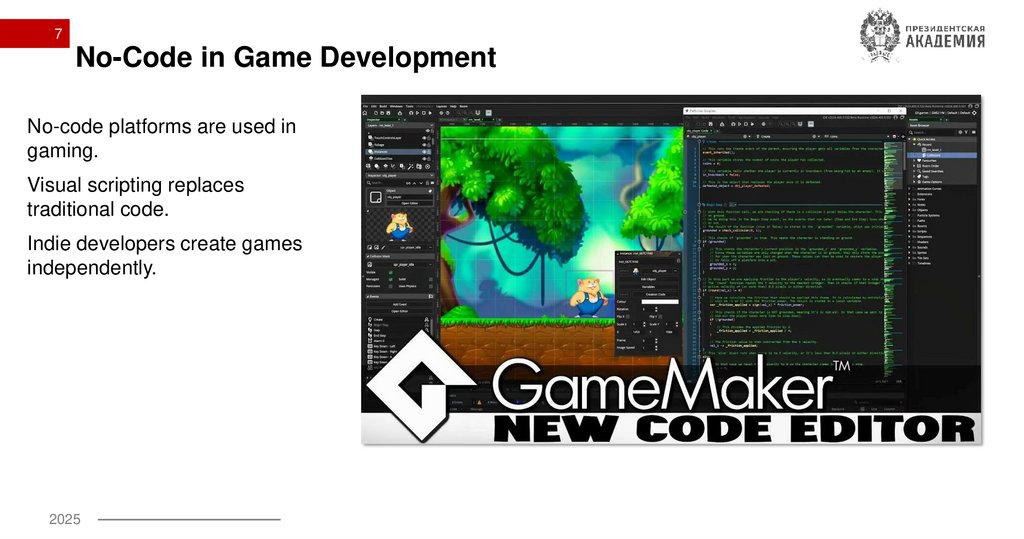
No-code platforms are used in
gaming.
Visual scripting replaces
traditional code.
Indie developers create games
independently.
2025
8. How No-Code Platforms Work
8How No-Code Platforms Work
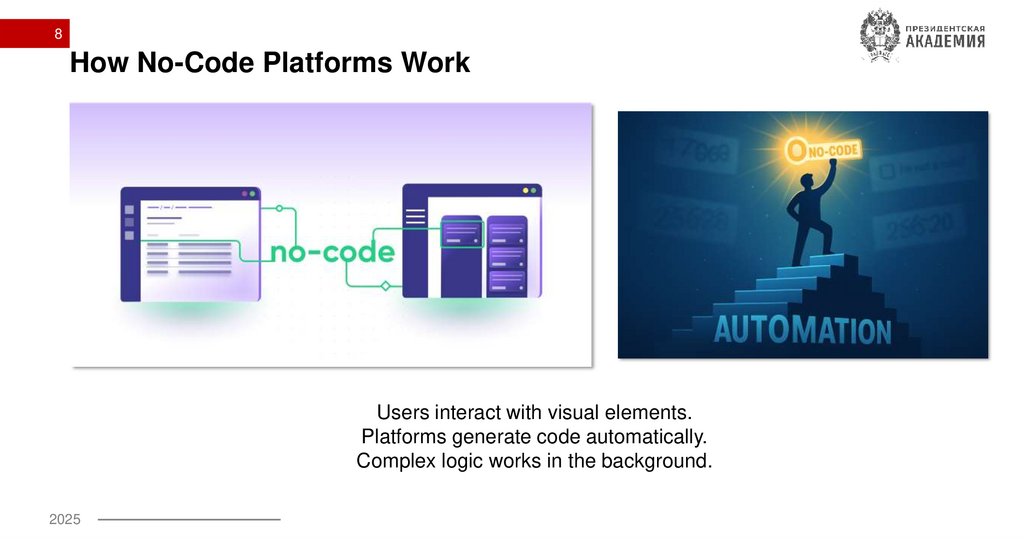
Users interact with visual elements.
Platforms generate code automatically.
Complex logic works in the background.
2025
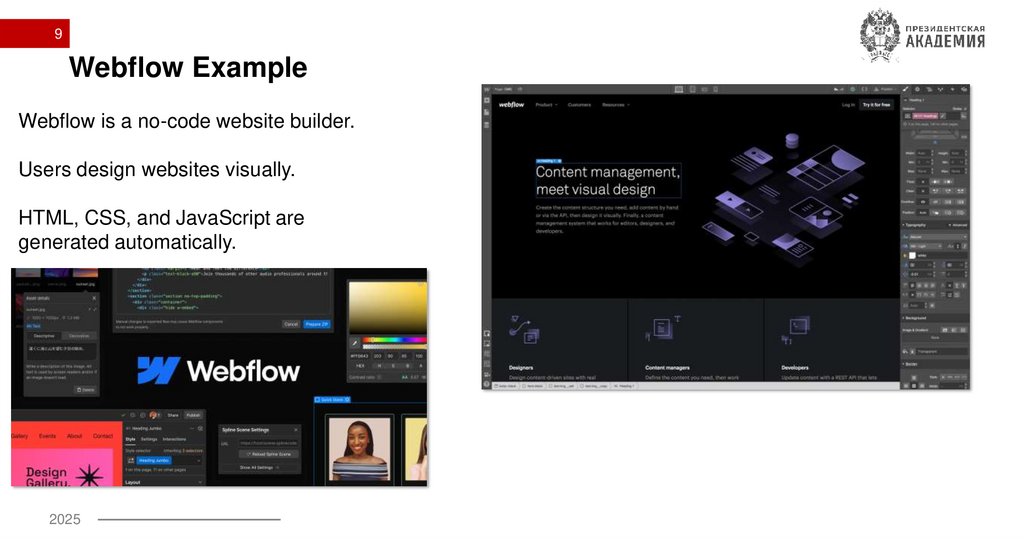
9. Webflow Example
9Webflow Example
Webflow is a no-code website builder.
Users design websites visually.
HTML, CSS, and JavaScript are
generated automatically.
2025
10. Advantages of No-Code
10Advantages of No-Code
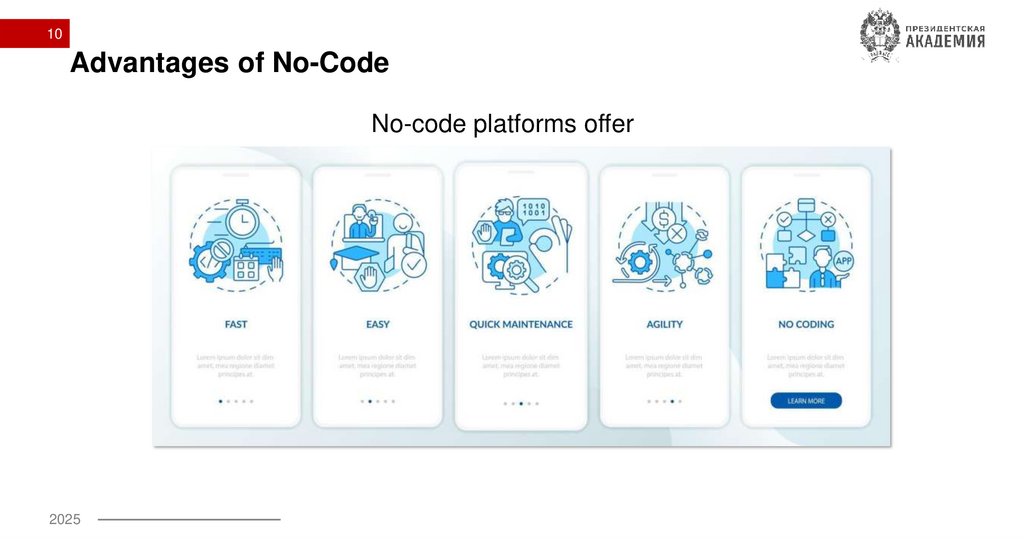
No-code platforms offer
2025
11. Benefits for Game Developers
11Benefits for Game Developers
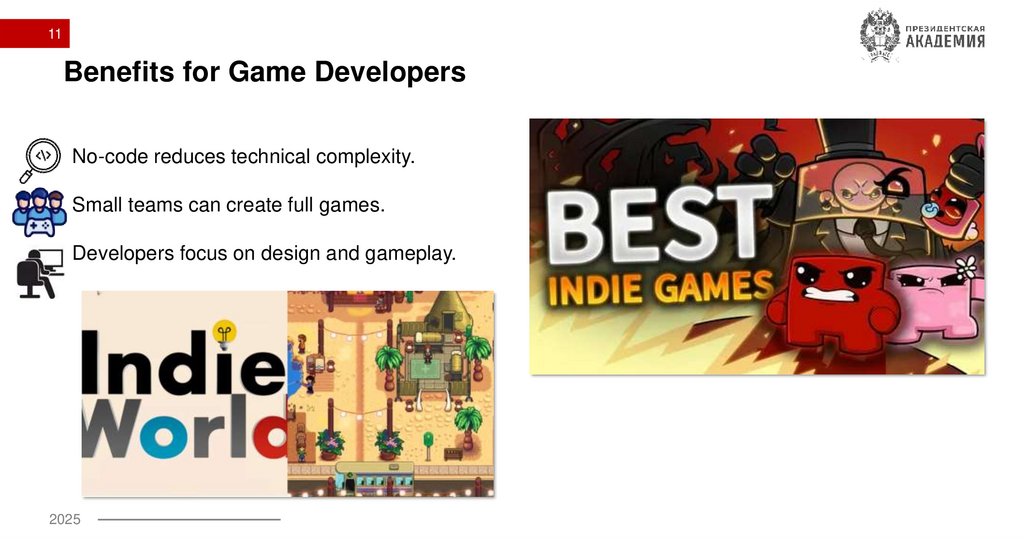
No-code reduces technical complexity.
Small teams can create full games.
Developers focus on design and gameplay.
2025
12. Limitations of No-Code
12Limitations of No-Code
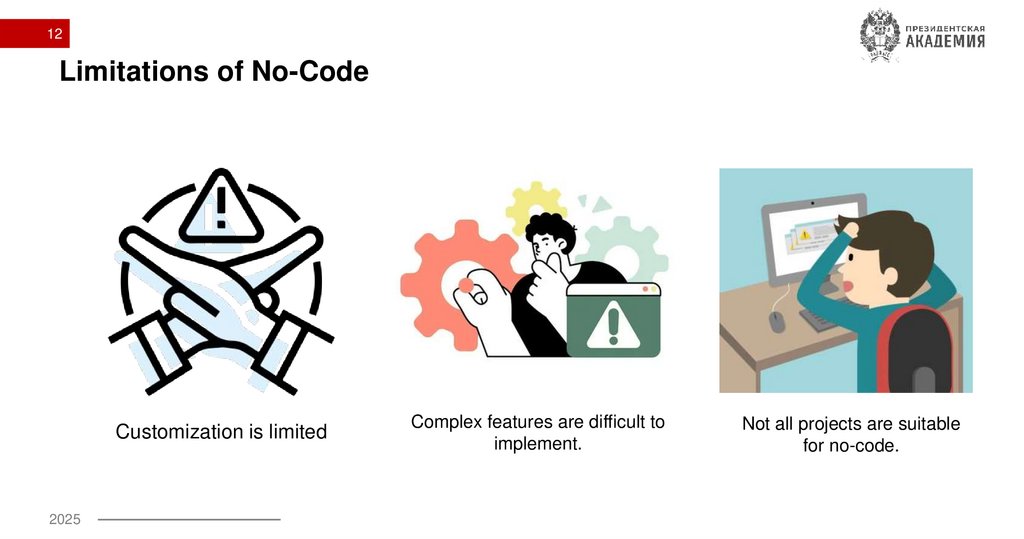
Customization is limited
2025
Complex features are difficult to
implement.
Not all projects are suitable
for no-code.
13. Challenges
13Challenges
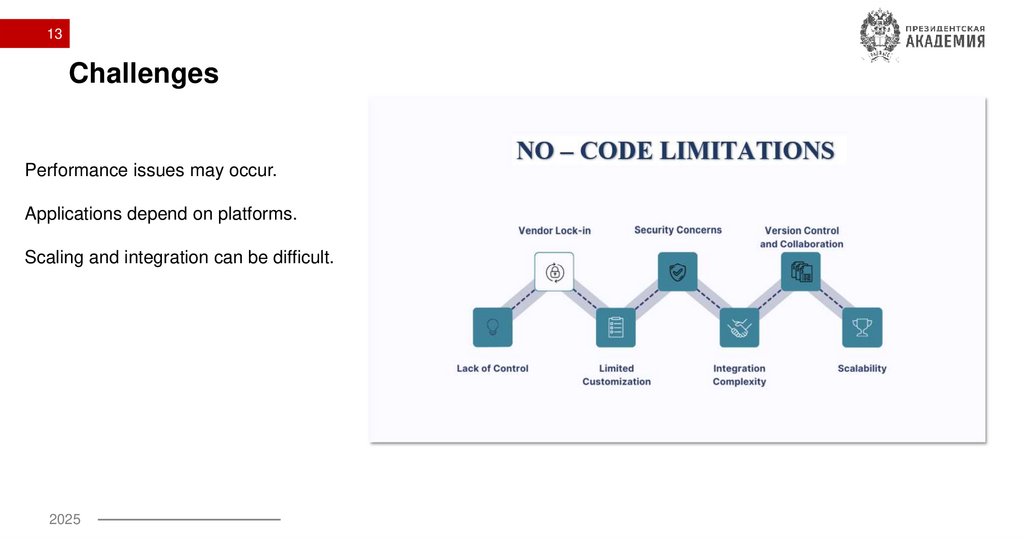
Performance issues may occur.
Applications depend on platforms.
Scaling and integration can be difficult.
2025
14. Future of No-Code
14Future of No-Code
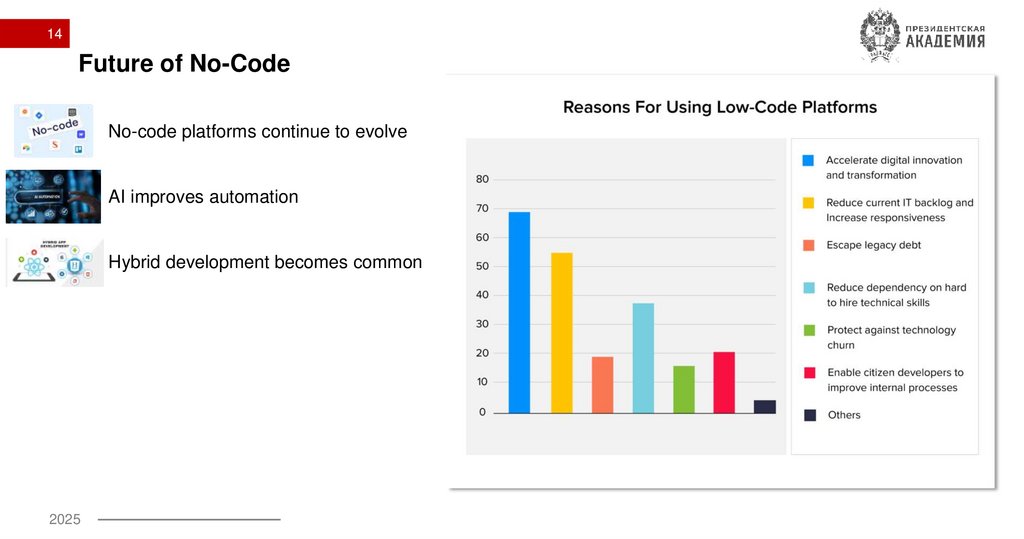
No-code platforms continue to evolve
AI improves automation
Hybrid development becomes common
2025
15. Conclusion
15Conclusion
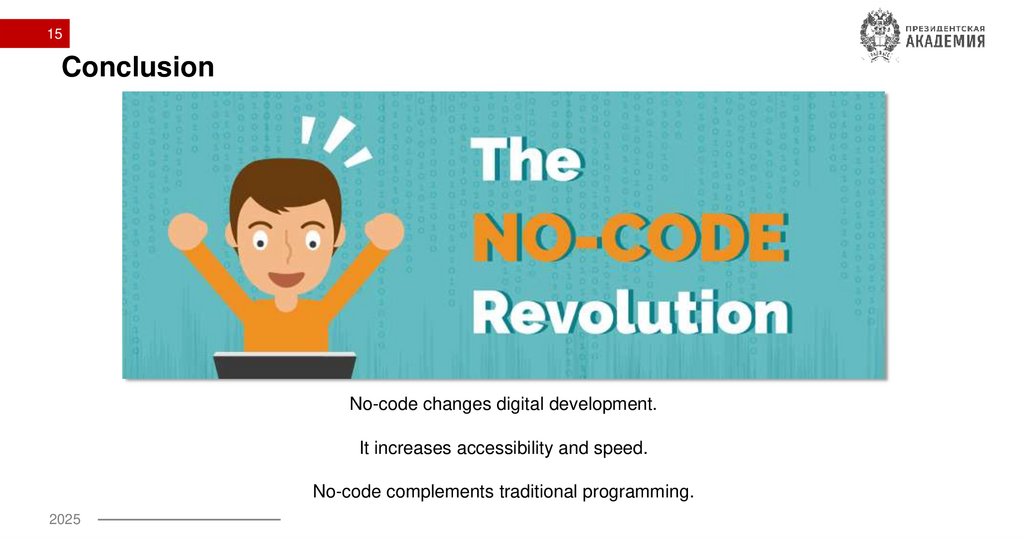
No-code changes digital development.
It increases accessibility and speed.
No-code complements traditional programming.
2025
16. Glossary
16Glossary
No-code — a development approach that allows creating digital products without
writing programming code.
Low-code — a development method that requires minimal coding combined with visual
tools.
Software development — the process of creating websites, applications, and digital
systems.
Visual development — building software using graphical interfaces instead of code.
Drag-and-drop — a method of moving elements visually to build structure and logic.
Platform — an online system that provides tools for creating digital products.
User interface (UI) — the visual part of a digital product that users interact with.
User experience (UX) — how easy and comfortable a product is for users.
Component — a ready-made element such as a button, form, or block.
Workflow — a sequence of automated actions inside an application.
Logic block — a visual element that defines behavior and rules.
Visual scripting — creating logic using blocks instead of written code.
Game development — the process of creating video games.
Indie developer — an independent game creator or small studio.
Automation — using technology to perform tasks automatically.
Artificial intelligence (AI) — technology that simulates human intelligence.
Rapid prototyping — quickly creating a working model of a product.
Time-to-market — the time required to release a product.
Cost efficiency — reducing expenses during development.
Digital democratization — making technology accessible to more people.
Accessibility — the ease of use for people with different skill levels.
Customization — the ability to modify a product to specific needs.
Scalability — the ability of a system to grow and handle more users.
Performance — how fast and efficiently an application works. Integration — connecting
different systems or services.
2025
Platform dependency — reliance on a specific platform to operate.
Vendor lock-in — inability to easily move a product to another platform.
Web development — the process of creating websites.
Responsive design — design that adapts to different screen sizes.
Webflow — a no-code platform for website development.
GameMaker — a no-code game development platform.
HTML — a language used to structure web pages.
CSS — a language used to style web pages.
JavaScript — a language used to add interactivity to websites.
Code generation — automatic creation of programming code.
Hybrid development — combining no-code tools with traditional
coding.
Digital product — a software-based product such as a website or
game.
Interface builder — a tool for visual design of applications.
Development speed — how fast a product is created.
Technical background — knowledge of programming and
technologies.
Entry barrier — difficulty of starting development.
Creative freedom — ability to focus on ideas and design.
Game mechanics — rules and systems inside a game.
Event-driven system — logic based on user actions and events.
Digital solution — a technology-based answer to a problem.
Innovation — creation of new ideas or technologies.
Web application — an application accessed through a browser.
Digital creation — the process of creating digital content.
Automation tools — technologies that reduce manual work.
Future trends — expected directions of technological development.
17.
Институт экономики, математики и информационных технологийФакультет информационных технологий и анализа данных
Кафедра системного анализа и информатики
2023
Федеральное государственное бюджетное образовательное учреждение высшего образования
«РОССИЙСКАЯ АКАДЕМИЯ НАРОДНОГО ХОЗЯЙСТВА
И ГОСУДАРСТВЕННОЙ СЛУЖБЫ при ПРЕЗИДЕНТЕ РОССИЙСКОЙ ФЕДЕРАЦИИ»
ИТОГОВЫЙ ПРОЕКТ
на тему:
The No-Code Revolution: Building Websites and Games Without Writing a
Single Line
РАНХиГС
Направление подготовки: 09.04.03 Прикладная информатика
Направленность (профиль) образовательной программы:
«Разработка компьютерных игр (гейм-дизайн)»
(очная форма обучения)
Выполнила: Талибова Камилла Талибовна
Преподаватель: Будник Екатерина Александровна
Москва
Москва
2026