 pedagogy
Similar presentations:







Software Requirements Validation and Review
1. Software Requirements Validation and Review
SOFTWAREREQUIREMENTS
VALIDATION AND REVIEW
DR. CHANDRA REKA
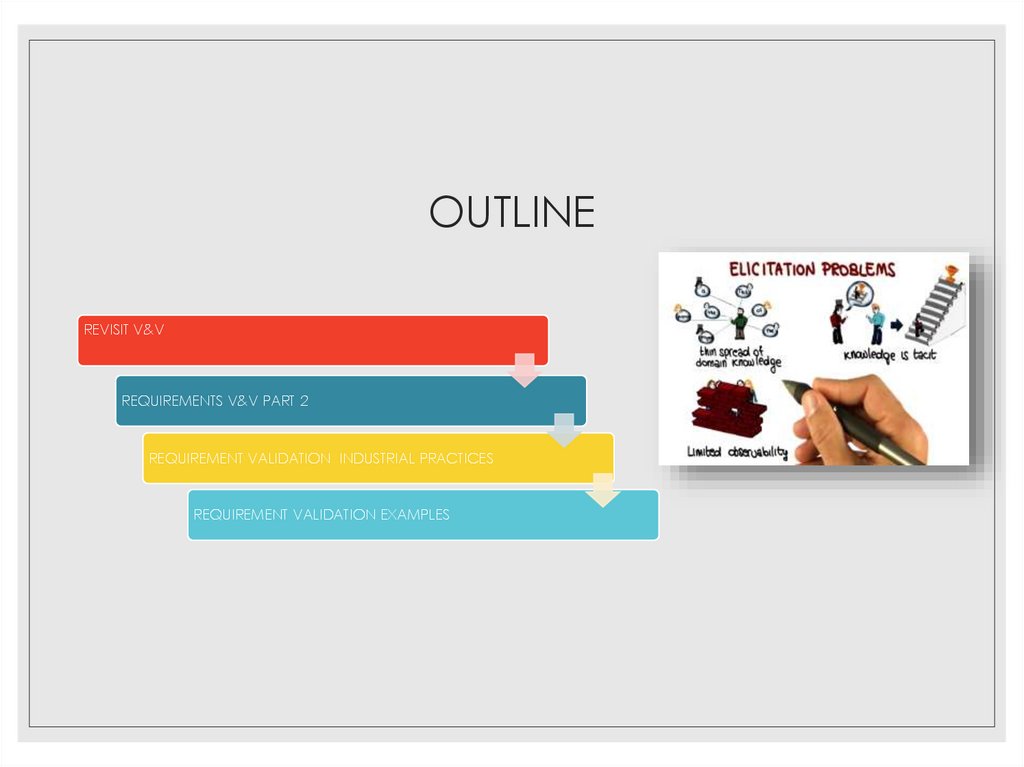
2. OUTLINE
REVISIT V&VREQUIREMENTS V&V PART 2
REQUIREMENT VALIDATION INDUSTRIAL PRACTICES
REQUIREMENT VALIDATION EXAMPLES
3. Learning Outcomes
At the end of this lecture,you should be able to:
◦ Review what is
Requirements V & V
◦ Describe the importance
of validating requirements
◦ Identify the techniques
used in Requirements
Verification
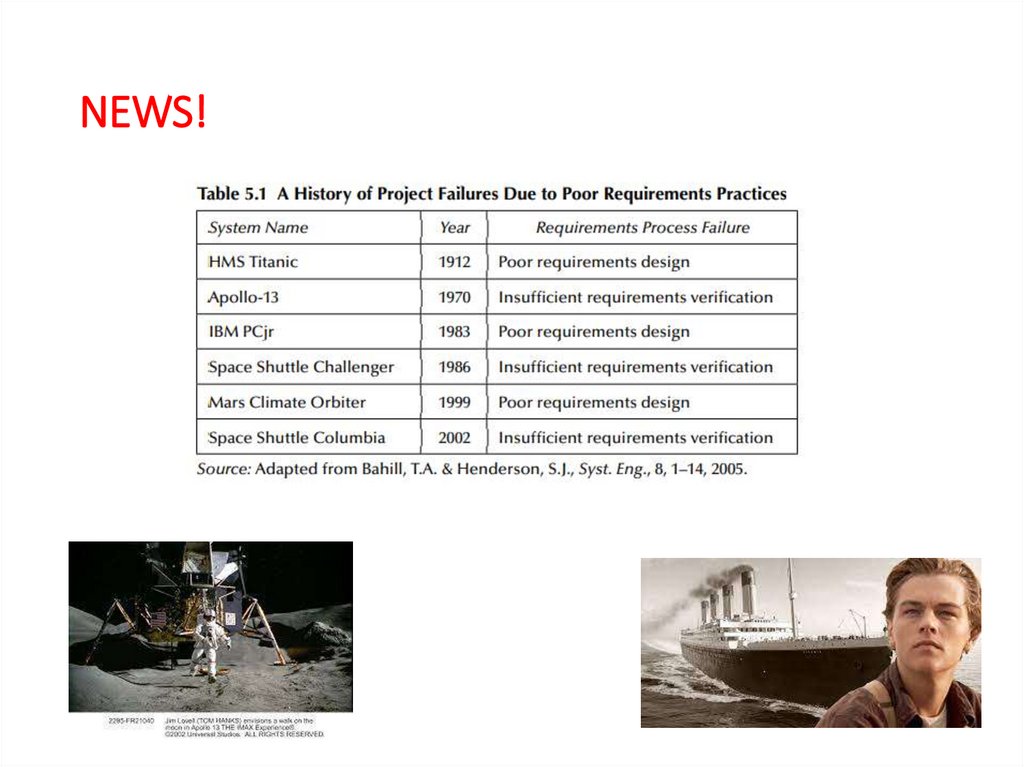
4. NEWS!
17/1/20265. Need for Requirements Validation and Requirements Verification
Requirements are often written in natural language, which is asource of defects in the product development process.
Obtaining consistency and completeness of requirements remains
difficult by the only human-visual review since several thousands of
requirements are managed in most of cases.
Fanmuy, Fraga and Llorens (2012)
6.
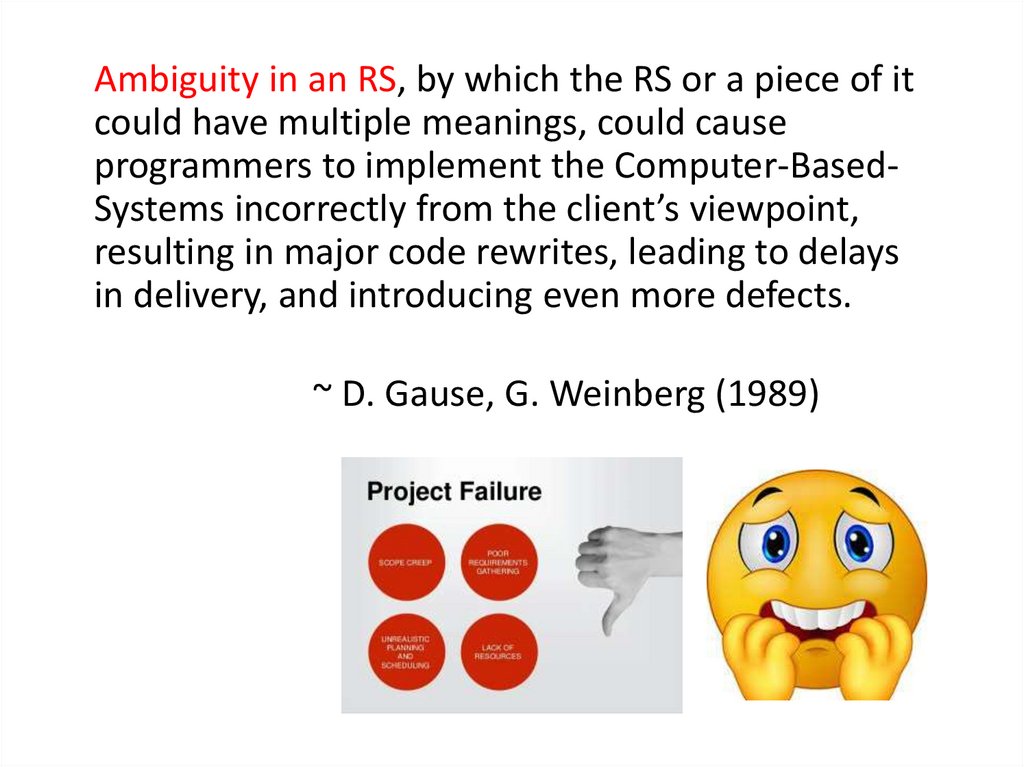
Ambiguity in an RS, by which the RS or a piece of itcould have multiple meanings, could cause
programmers to implement the Computer-BasedSystems incorrectly from the client’s viewpoint,
resulting in major code rewrites, leading to delays
in delivery, and introducing even more defects.
~ D. Gause, G. Weinberg (1989)
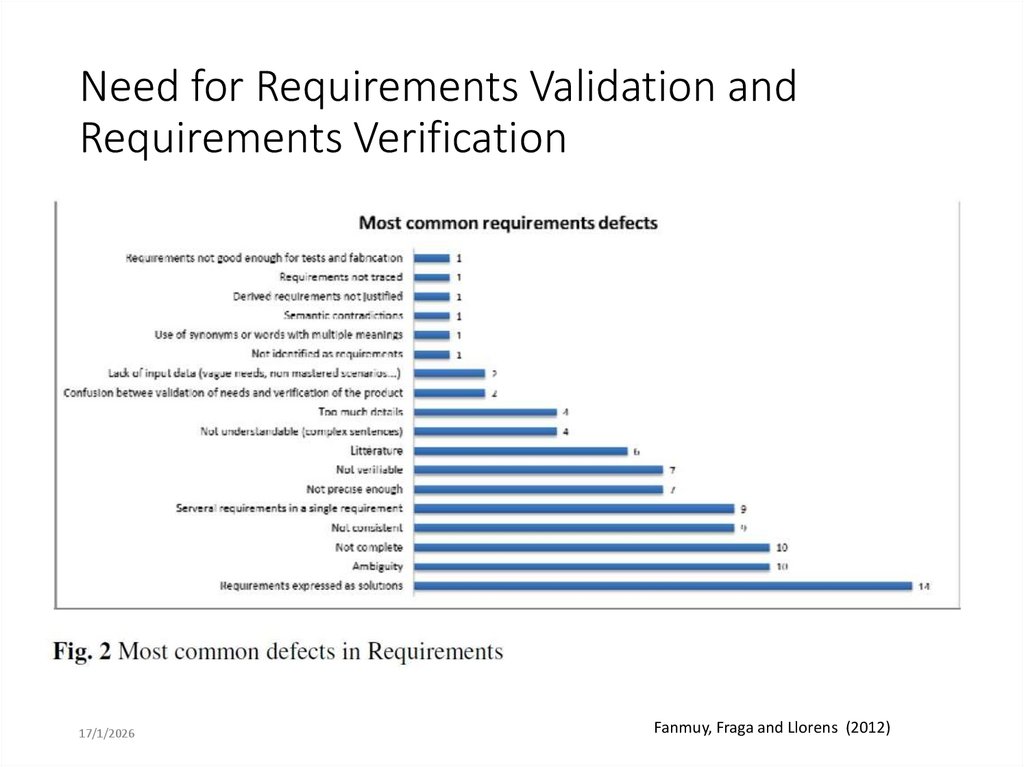
7. Need for Requirements Validation and Requirements Verification
17/1/2026Fanmuy, Fraga and Llorens (2012)
8. What is V&V ?
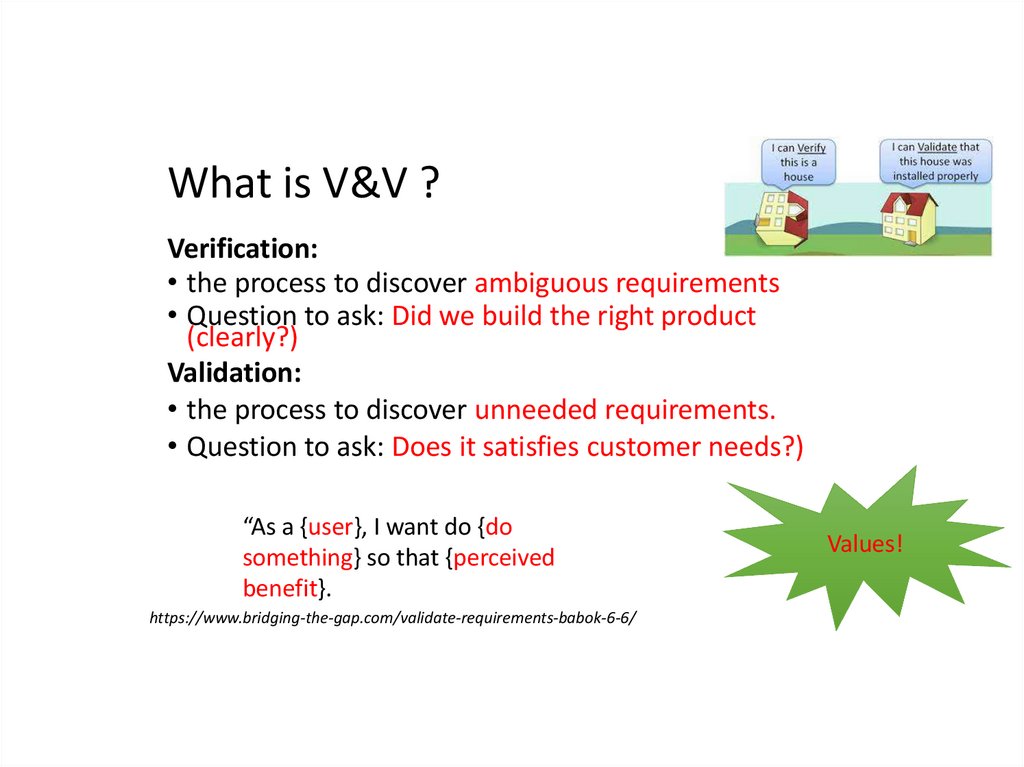
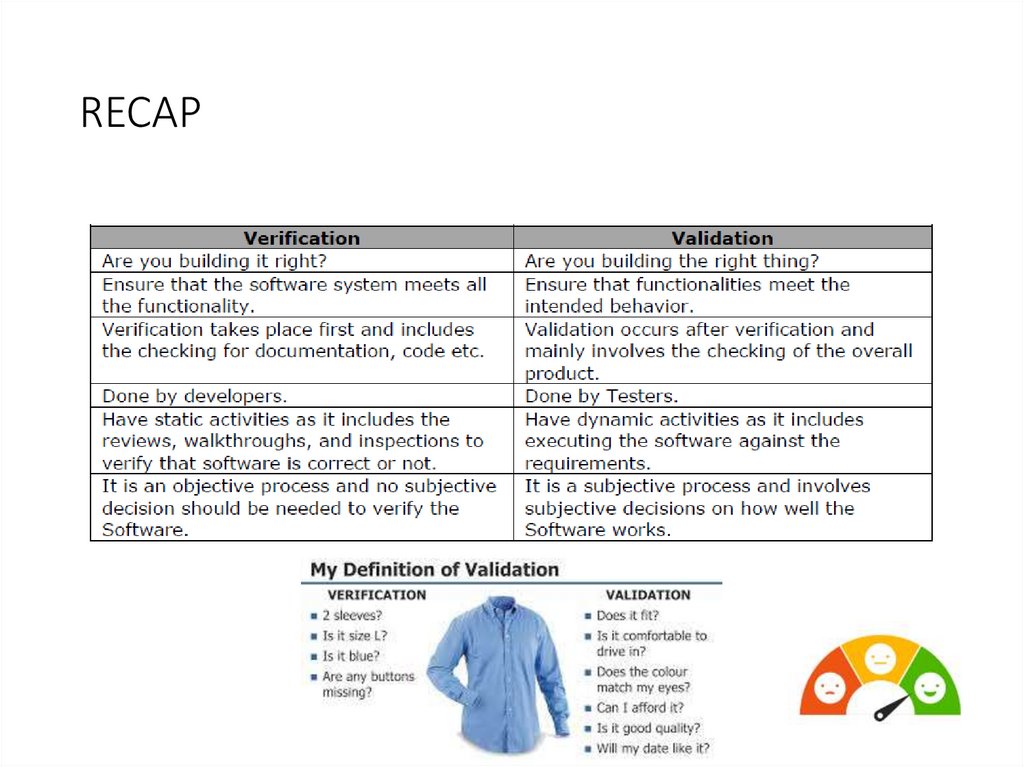
What is V&V ?Verification:
• the process to discover ambiguous requirements
• Question to ask: Did we build the right product
(clearly?)
Validation:
• the process to discover unneeded requirements.
• Question to ask: Does it satisfies customer needs?)
“As a {user}, I want do {do
something} so that {perceived
benefit}.
https://www.bridging-the-gap.com/validate-requirements-babok-6-6/
Values!
9. RECAP
10. Requirements Verification
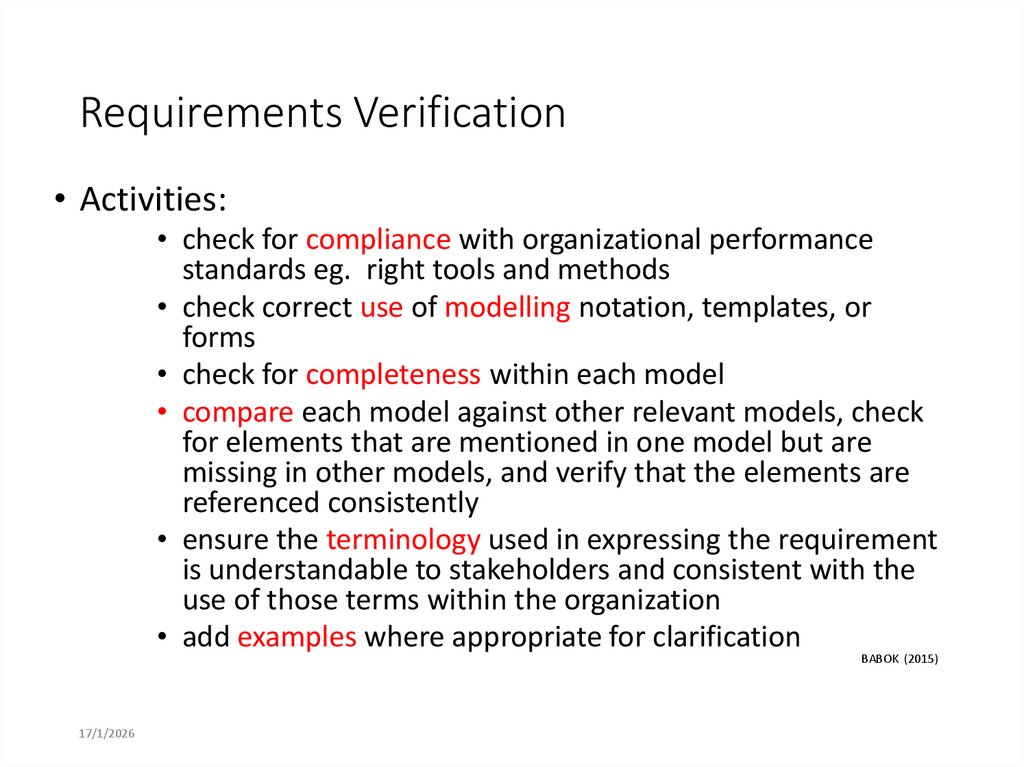
• Activities:• check for compliance with organizational performance
standards eg. right tools and methods
• check correct use of modelling notation, templates, or
forms
• check for completeness within each model
• compare each model against other relevant models, check
for elements that are mentioned in one model but are
missing in other models, and verify that the elements are
referenced consistently
• ensure the terminology used in expressing the requirement
is understandable to stakeholders and consistent with the
use of those terms within the organization
• add examples where appropriate for clarification
BABOK (2015)
17/1/2026
11. Requirements Verification Technique
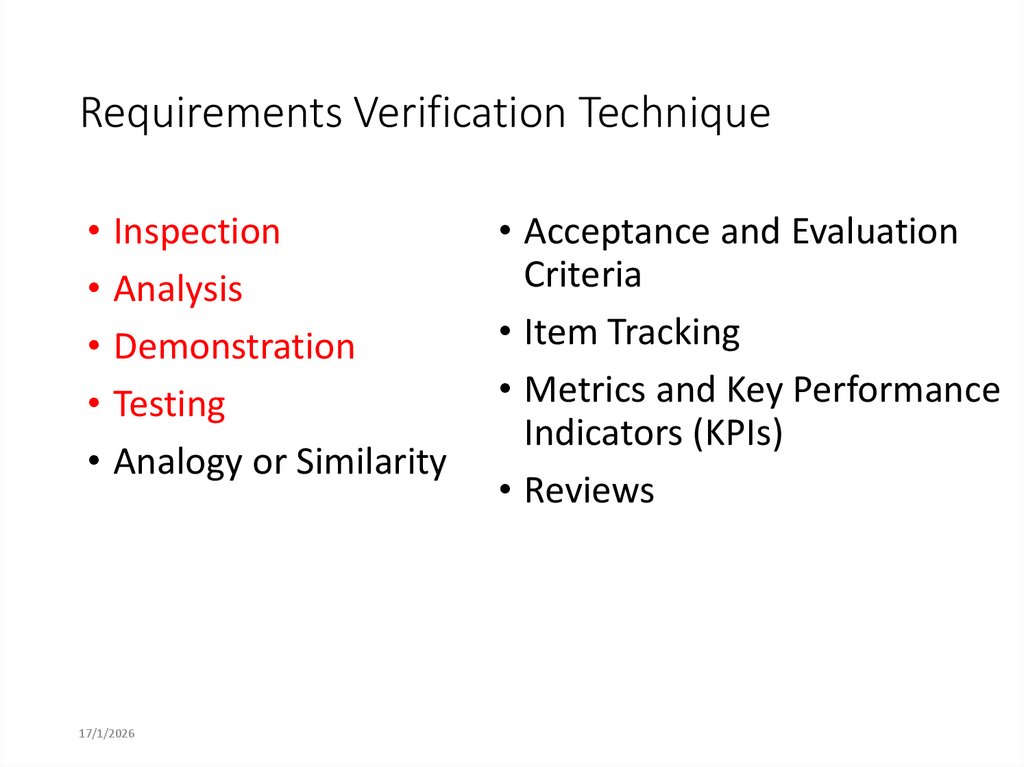
• Inspection• Analysis
• Demonstration
• Testing
• Analogy or Similarity
17/1/2026
• Acceptance and Evaluation
Criteria
• Item Tracking
• Metrics and Key Performance
Indicators (KPIs)
• Reviews
12. Requirements Verification Technique
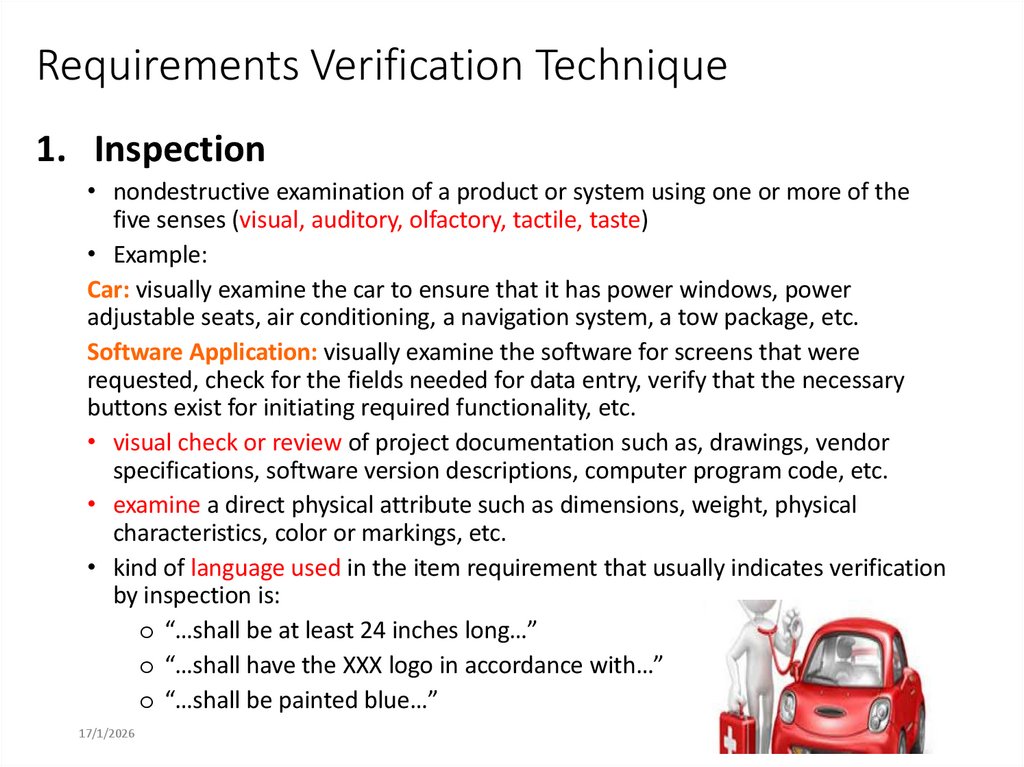
1. Inspection• nondestructive examination of a product or system using one or more of the
five senses (visual, auditory, olfactory, tactile, taste)
• Example:
Car: visually examine the car to ensure that it has power windows, power
adjustable seats, air conditioning, a navigation system, a tow package, etc.
Software Application: visually examine the software for screens that were
requested, check for the fields needed for data entry, verify that the necessary
buttons exist for initiating required functionality, etc.
• visual check or review of project documentation such as, drawings, vendor
specifications, software version descriptions, computer program code, etc.
• examine a direct physical attribute such as dimensions, weight, physical
characteristics, color or markings, etc.
• kind of language used in the item requirement that usually indicates verification
by inspection is:
o “…shall be at least 24 inches long…”
o “…shall have the XXX logo in accordance with…”
o “…shall be painted blue…”
17/1/2026
13. Requirements Verification Technique
2. Analysis• evaluation of data by generally accepted analytical
techniques to determine that the item will meet specified
requirements
• techniques: systems engineering analysis, statistics, and
qualitative analysis, analog modeling, similarity, and
computer and hardware simulation
• selected as the verification activity when test or
demonstration techniques cannot adequately or costeffectively address all the conditions under which the system
must perform or the system cannot be shown to meet the
requirement without analysis
• kind of language used in the item requirement that usually
indicates verification by analysis is:
o “…shall be designed to…”
o “…shall be developed to…”
o “…shall have a probability of…”
17/1/2026
14. Requirements Verification Technique
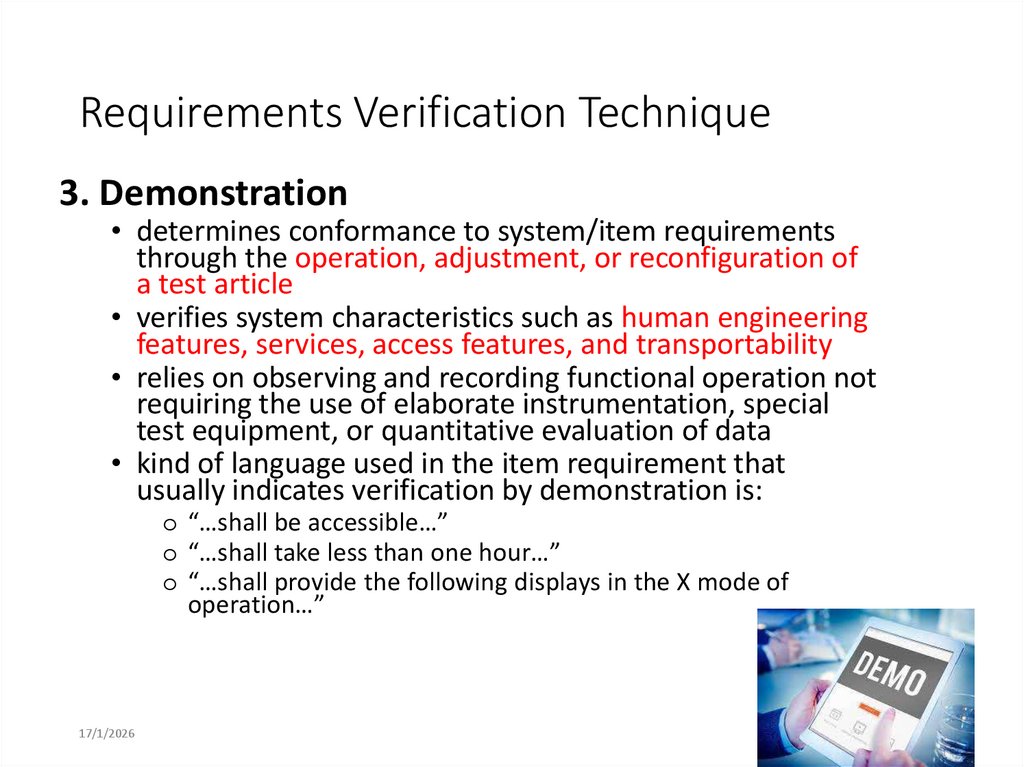
3. Demonstration• determines conformance to system/item requirements
through the operation, adjustment, or reconfiguration of
a test article
• verifies system characteristics such as human engineering
features, services, access features, and transportability
• relies on observing and recording functional operation not
requiring the use of elaborate instrumentation, special
test equipment, or quantitative evaluation of data
• kind of language used in the item requirement that
usually indicates verification by demonstration is:
o “…shall be accessible…”
o “…shall take less than one hour…”
o “…shall provide the following displays in the X mode of
operation…”
17/1/2026
15. Requirements Verification Technique
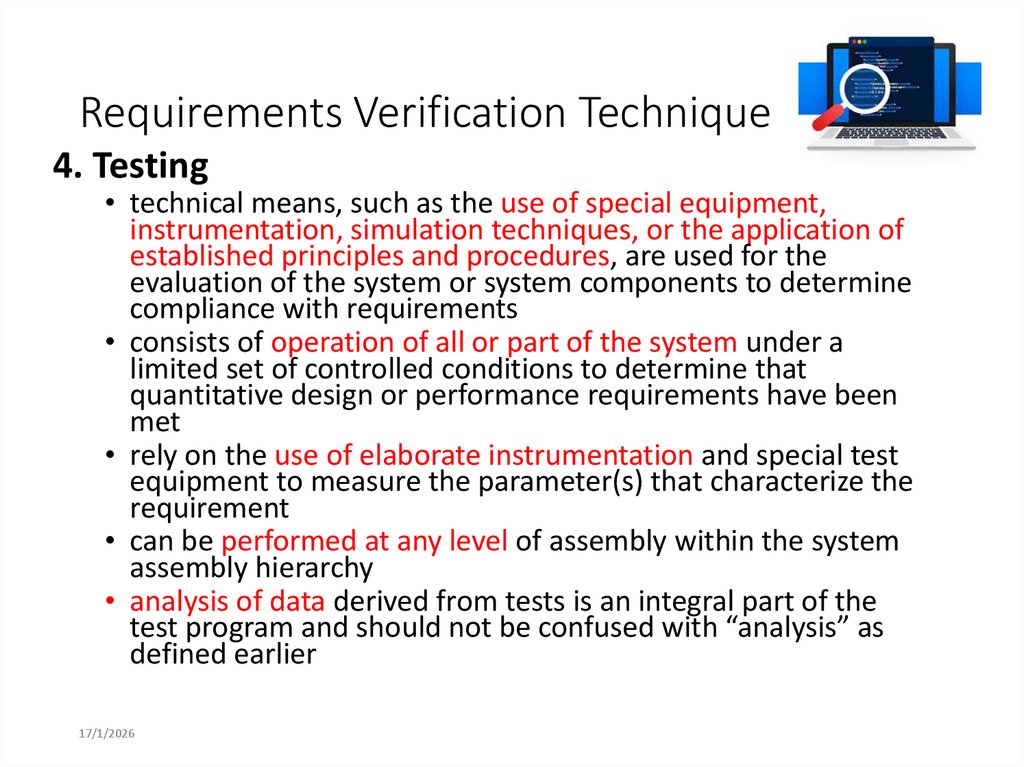
4. Testing• technical means, such as the use of special equipment,
instrumentation, simulation techniques, or the application of
established principles and procedures, are used for the
evaluation of the system or system components to determine
compliance with requirements
• consists of operation of all or part of the system under a
limited set of controlled conditions to determine that
quantitative design or performance requirements have been
met
• rely on the use of elaborate instrumentation and special test
equipment to measure the parameter(s) that characterize the
requirement
• can be performed at any level of assembly within the system
assembly hierarchy
• analysis of data derived from tests is an integral part of the
test program and should not be confused with “analysis” as
defined earlier
17/1/2026
16. Requirements Verification Technique
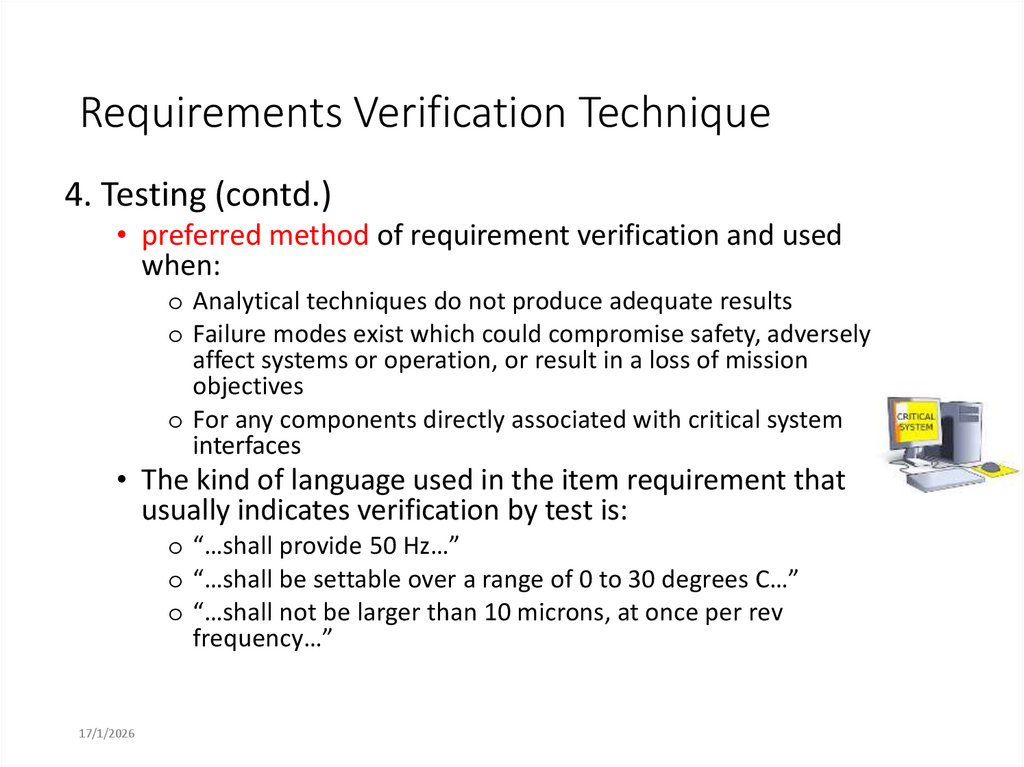
4. Testing (contd.)• preferred method of requirement verification and used
when:
o Analytical techniques do not produce adequate results
o Failure modes exist which could compromise safety, adversely
affect systems or operation, or result in a loss of mission
objectives
o For any components directly associated with critical system
interfaces
• The kind of language used in the item requirement that
usually indicates verification by test is:
o “…shall provide 50 Hz…”
o “…shall be settable over a range of 0 to 30 degrees C…”
o “…shall not be larger than 10 microns, at once per rev
frequency…”
17/1/2026
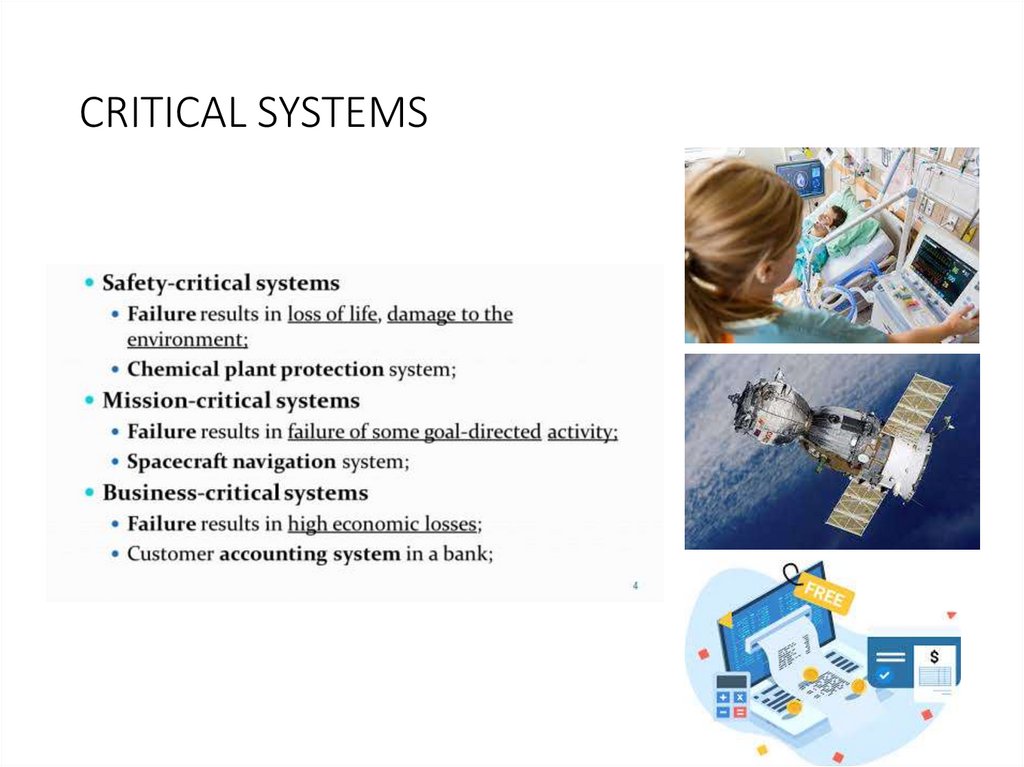
17. CRITICAL SYSTEMS
18. Requirements Verification Technique
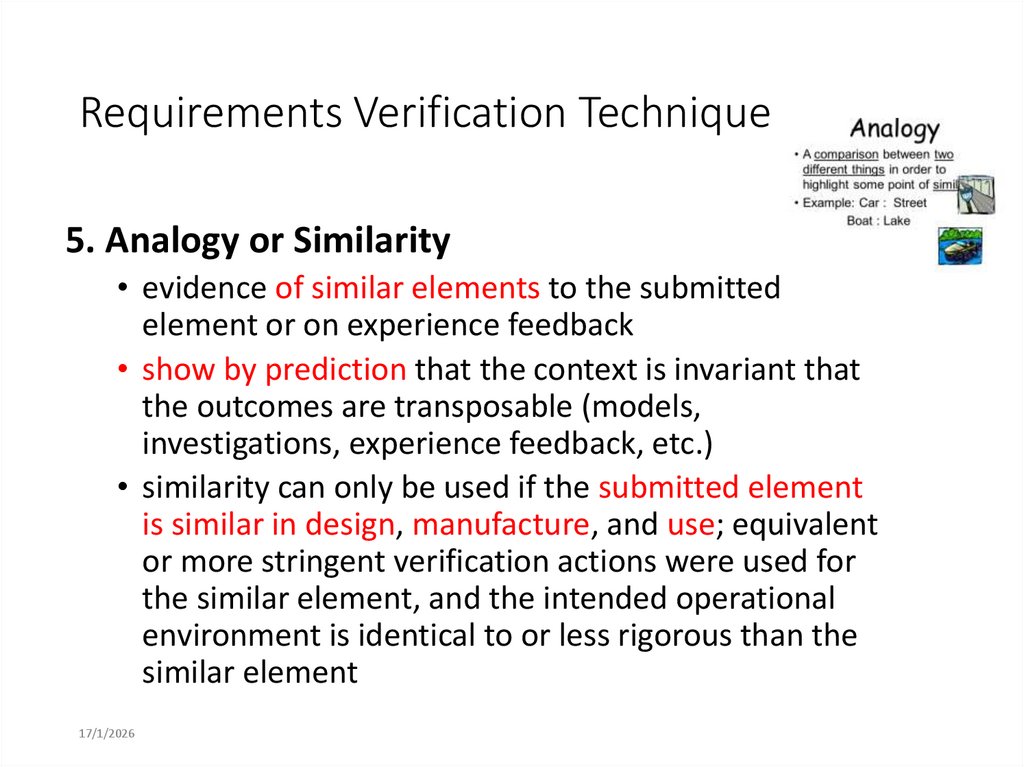
5. Analogy or Similarity• evidence of similar elements to the submitted
element or on experience feedback
• show by prediction that the context is invariant that
the outcomes are transposable (models,
investigations, experience feedback, etc.)
• similarity can only be used if the submitted element
is similar in design, manufacture, and use; equivalent
or more stringent verification actions were used for
the similar element, and the intended operational
environment is identical to or less rigorous than the
similar element
17/1/2026
19. More Requirements Verification Techniques
• Acceptance and Evaluation Criteriaused to ensure that requirements are stated clearly
enough to devise a set of tests that can prove that the
requirements have been met
• Item Tracking
used to ensure that any problems or issues identified
during verification are managed and resolved
• Metrics and Key Performance Indicators (KPIs)
used to identify how to evaluate the quality of the
requirements
• Reviews
used to inspect requirements documentation to identify
requirements that are not of acceptable quality
BABOK (2015)
17/1/2026
20. Requirements Verification Artefacts
• verification plans (contain the verification strategy)• verification matrices (contain the verification action,
submitted element, applied technique, step of execution,
system block concerned, expected result, obtained result,
etc.)
• verification procedures (describe verification actions to be
performed, verification tools needed, the verification
configuration, resources and personnel needed, the schedule,
etc.)
• verification reports
• verification tools
• verified elements
• issue / non-conformance / trouble reports
• change requests to the design
17/1/2026
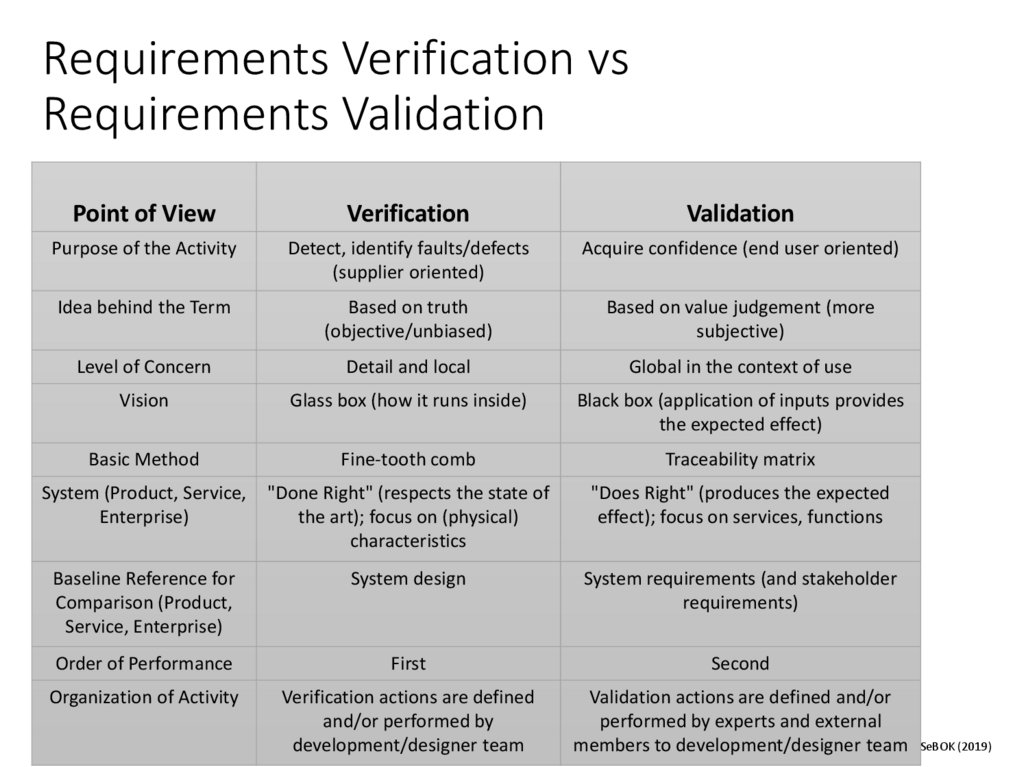
21. Requirements Verification vs Requirements Validation
Point of ViewVerification
Validation
Purpose of the Activity
Detect, identify faults/defects
(supplier oriented)
Acquire confidence (end user oriented)
Idea behind the Term
Based on truth
(objective/unbiased)
Based on value judgement (more
subjective)
Level of Concern
Detail and local
Global in the context of use
Vision
Glass box (how it runs inside)
Black box (application of inputs provides
the expected effect)
Basic Method
Fine-tooth comb
Traceability matrix
System (Product, Service,
Enterprise)
"Done Right" (respects the state of
the art); focus on (physical)
characteristics
"Does Right" (produces the expected
effect); focus on services, functions
Baseline Reference for
Comparison (Product,
Service, Enterprise)
System design
System requirements (and stakeholder
requirements)
Order of Performance
First
Second
Organization of Activity
Verification actions are defined
and/or performed by
development/designer team
17/1/2026
Validation actions are defined and/or
performed by experts and external
members to development/designer team SeBOK (2019)
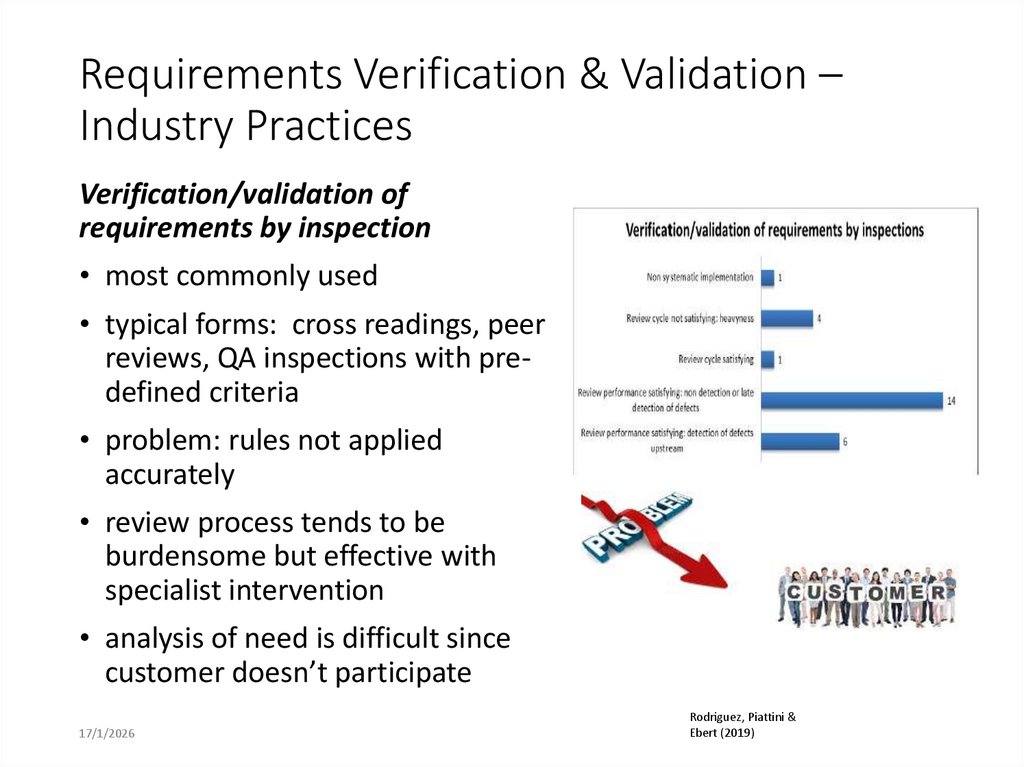
22. Requirements Verification & Validation – Industry Practices
Requirements Verification & Validation –Industry Practices
Verification/validation of
requirements by inspection
• most commonly used
• typical forms: cross readings, peer
reviews, QA inspections with predefined criteria
• problem: rules not applied
accurately
• review process tends to be
burdensome but effective with
specialist intervention
• analysis of need is difficult since
customer doesn’t participate
17/1/2026
Rodriguez, Piattini &
Ebert (2019)
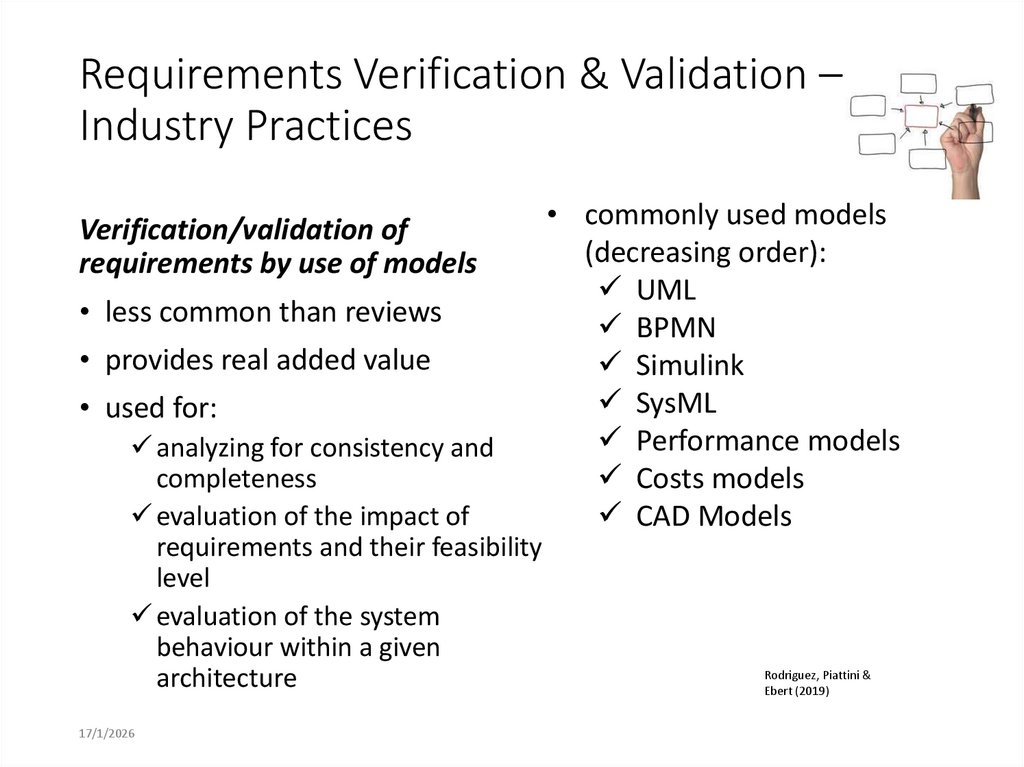
23. Requirements Verification & Validation – Industry Practices
Requirements Verification & Validation –Industry Practices
Verification/validation of
requirements by use of models
• less common than reviews
• provides real added value
• used for:
analyzing for consistency and
completeness
evaluation of the impact of
requirements and their feasibility
level
evaluation of the system
behaviour within a given
architecture
17/1/2026
• commonly used models
(decreasing order):
UML
BPMN
Simulink
SysML
Performance models
Costs models
CAD Models
Rodriguez, Piattini &
Ebert (2019)
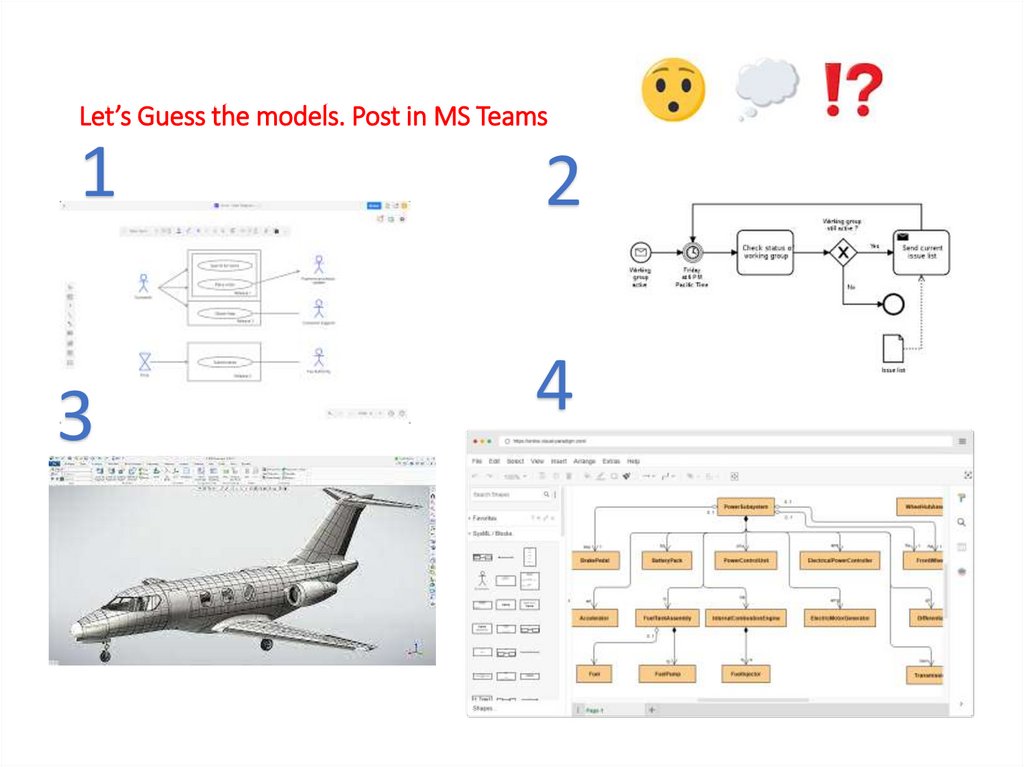
24. Let’s Guess the models. Post in MS Teams
12
3
4
25. Requirements Verification & Validation – Industry Practices
Requirements Verification & Validation –Industry Practices
Tools for Requirements Verification
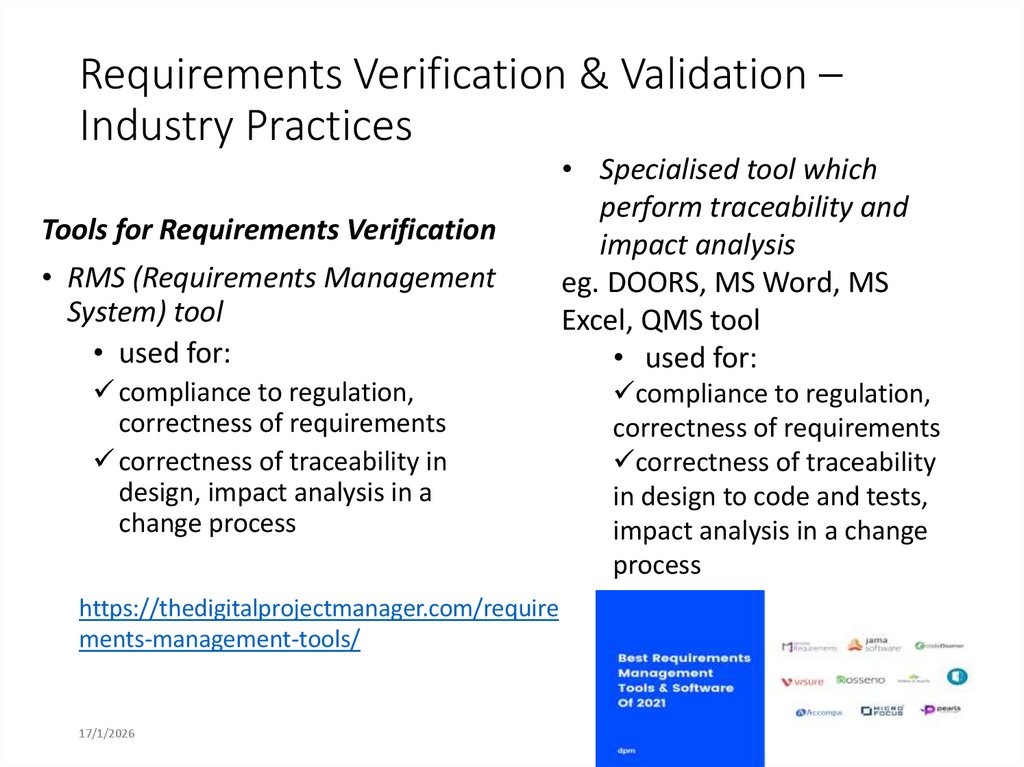
• RMS (Requirements Management
System) tool
• used for:
compliance to regulation,
correctness of requirements
correctness of traceability in
design, impact analysis in a
change process
• Specialised tool which
perform traceability and
impact analysis
eg. DOORS, MS Word, MS
Excel, QMS tool
• used for:
compliance to regulation,
correctness of requirements
correctness of traceability
in design to code and tests,
impact analysis in a change
process
https://thedigitalprojectmanager.com/require
ments-management-tools/
Rodriguez, Piattini & Ebert (2019)
17/1/2026
26. Requirements Verification & Validation – Industry Practices
Requirements Verification & Validation –Industry Practices
Tools for Requirements Verification
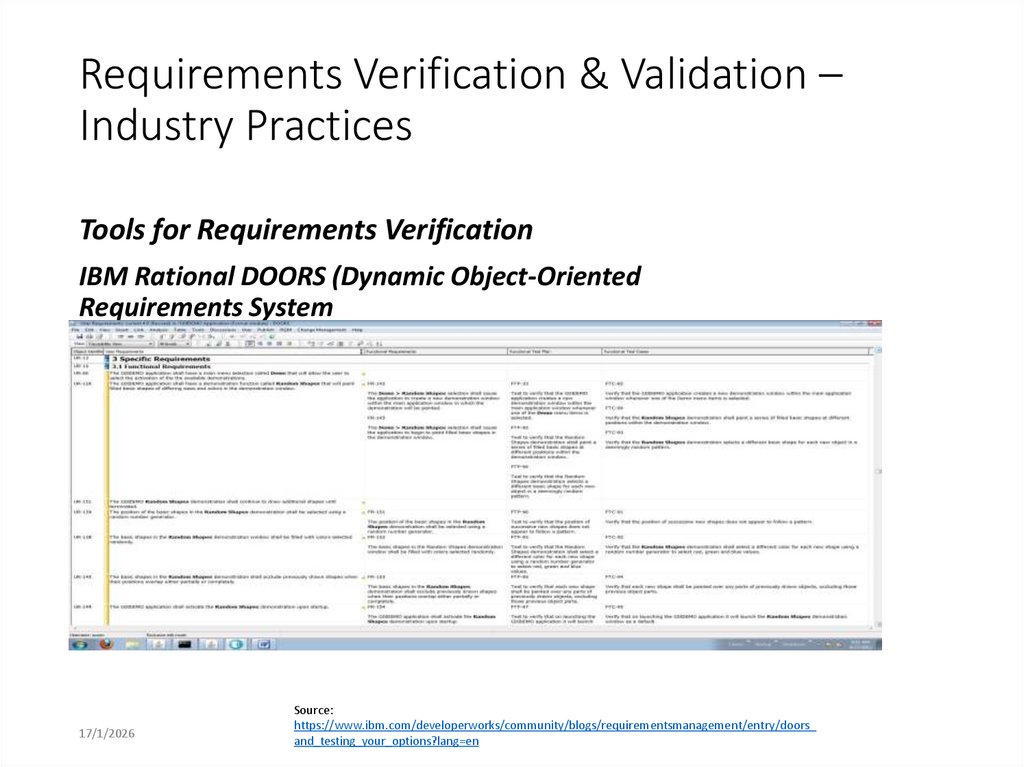
IBM Rational DOORS (Dynamic Object-Oriented
Requirements System
17/1/2026
Source:
https://www.ibm.com/developerworks/community/blogs/requirementsmanagement/entry/doors_
and_testing_your_options?lang=en
27. Requirements Verification & Validation – Industry Practices
Requirements Verification & Validation –Industry Practices
Tools for Requirements Verification
• Specialised tool which perform lexical
and syntactical analysis of
• detects the use of wrong
requirements
words, bad grammatical
• requirements in natural languages sentences and multiple
are typically imprecise, ambiguous requirements
• use of tools (e.g. Requirements
• used for:
Quality Analyzer®, Lexior®,...) to
Analysis of Requests for
check requirements regarding
Proposals (Bid)
SMART (Specific, Measurable,
Requirements verification
Attainable, Realizable, Traceable)
before a business or project
quality rules enable to correct
review
defects in the form before
Rodriguez, Piattini &
Ebert (2019)
business or project reviews
17/1/2026
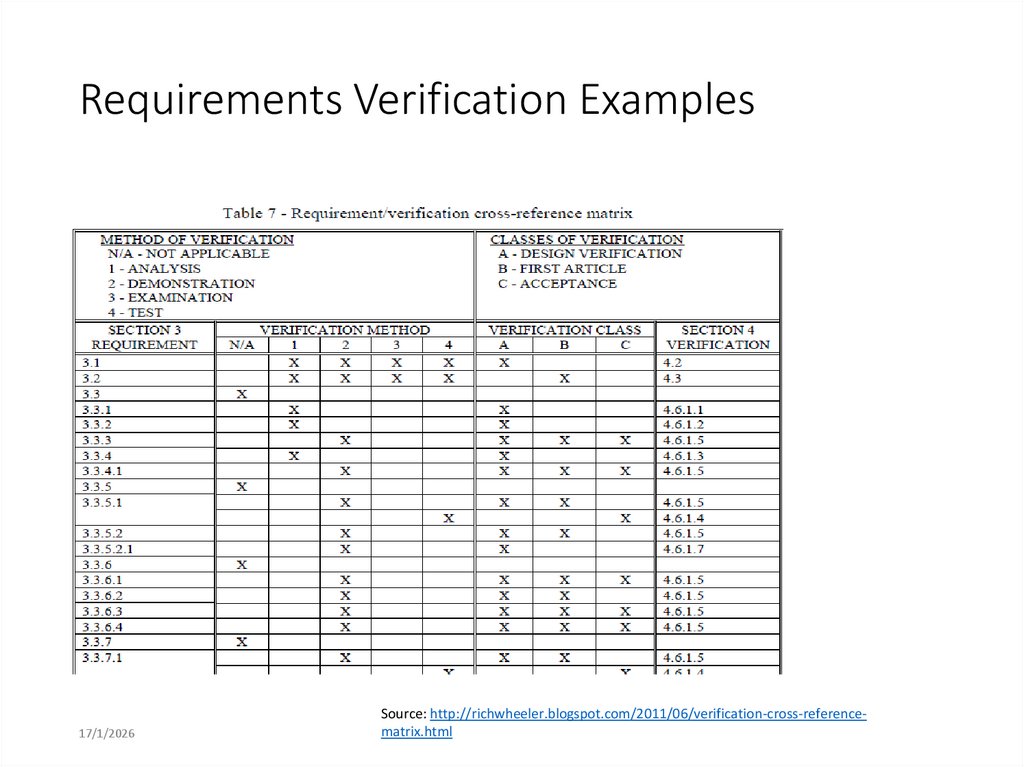
28. Requirements Verification Examples
17/1/2026Source: http://richwheeler.blogspot.com/2011/06/verification-cross-referencematrix.html
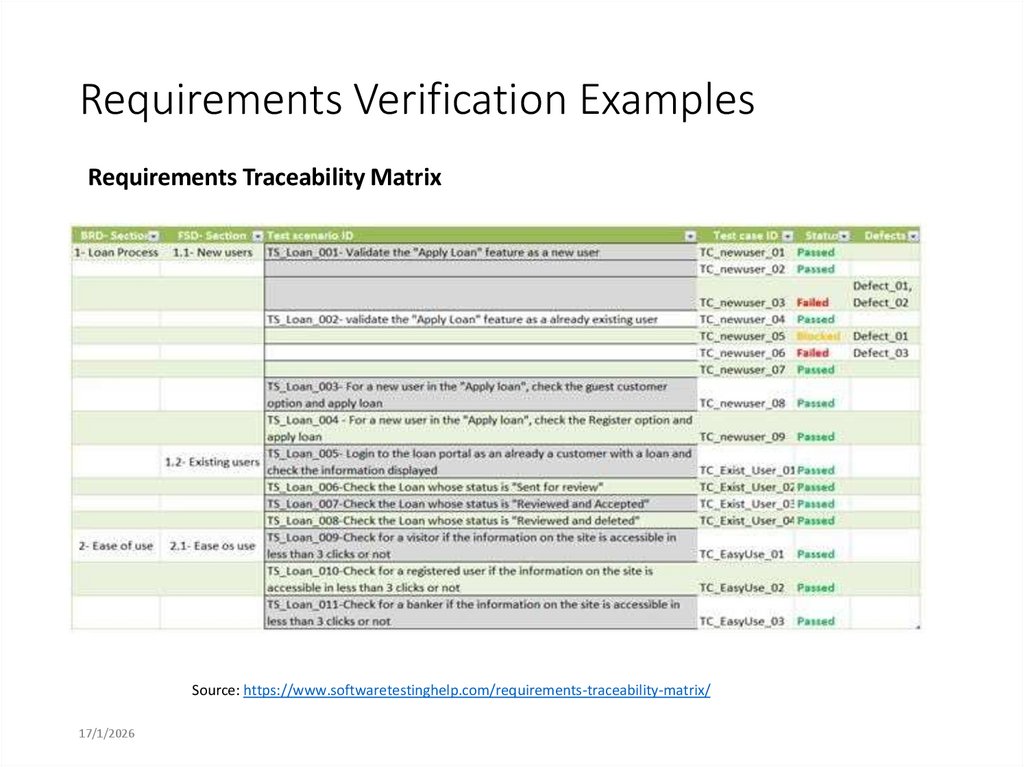
29. Requirements Verification Examples
Requirements Traceability MatrixSource: https://www.softwaretestinghelp.com/requirements-traceability-matrix/
17/1/2026
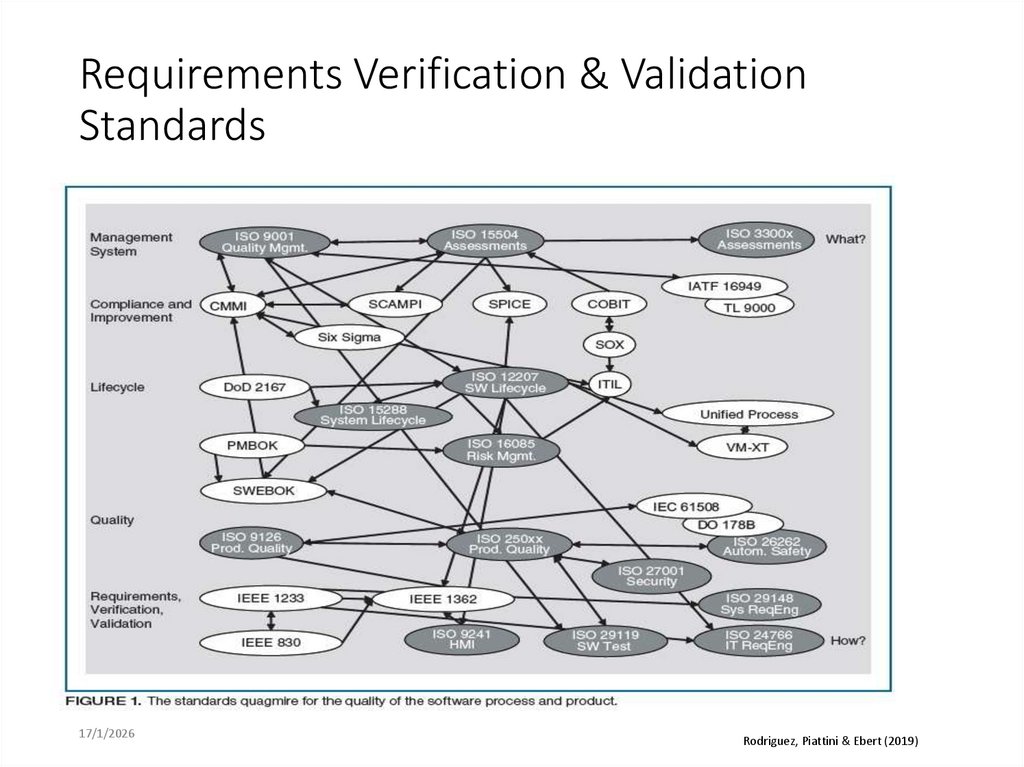
30. Requirements Verification & Validation Standards
Requirements Verification & ValidationStandards
17/1/2026
Rodriguez, Piattini & Ebert (2019)
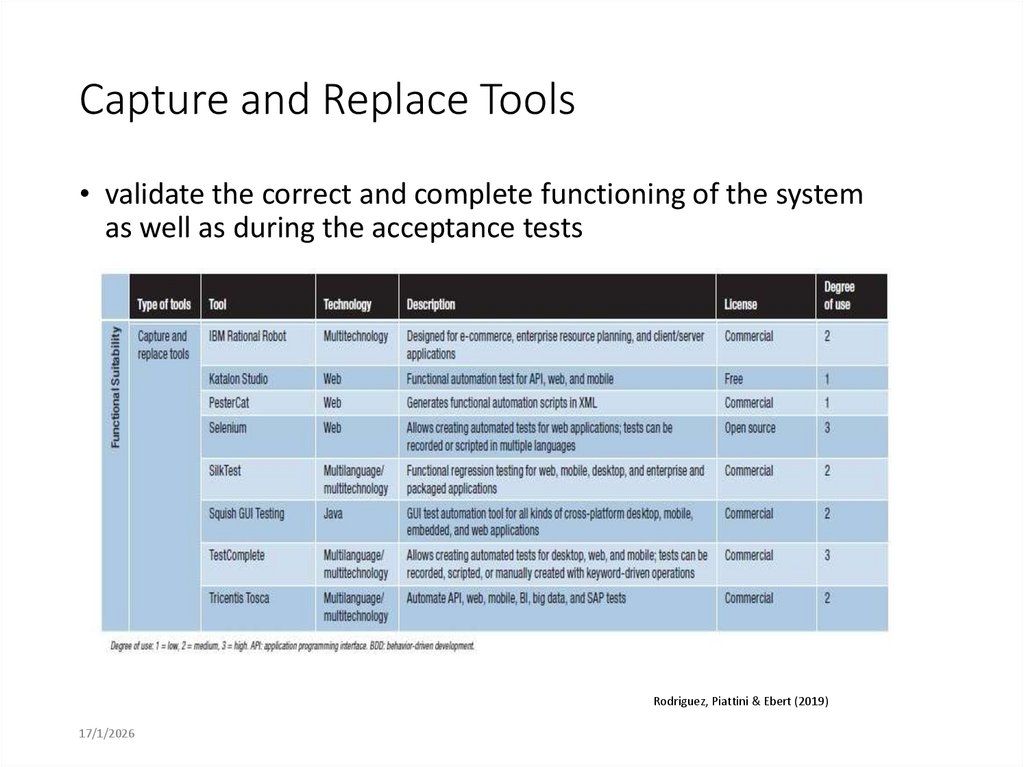
31. Capture and Replace Tools
• validate the correct and complete functioning of the systemas well as during the acceptance tests
Rodriguez, Piattini & Ebert (2019)
17/1/2026
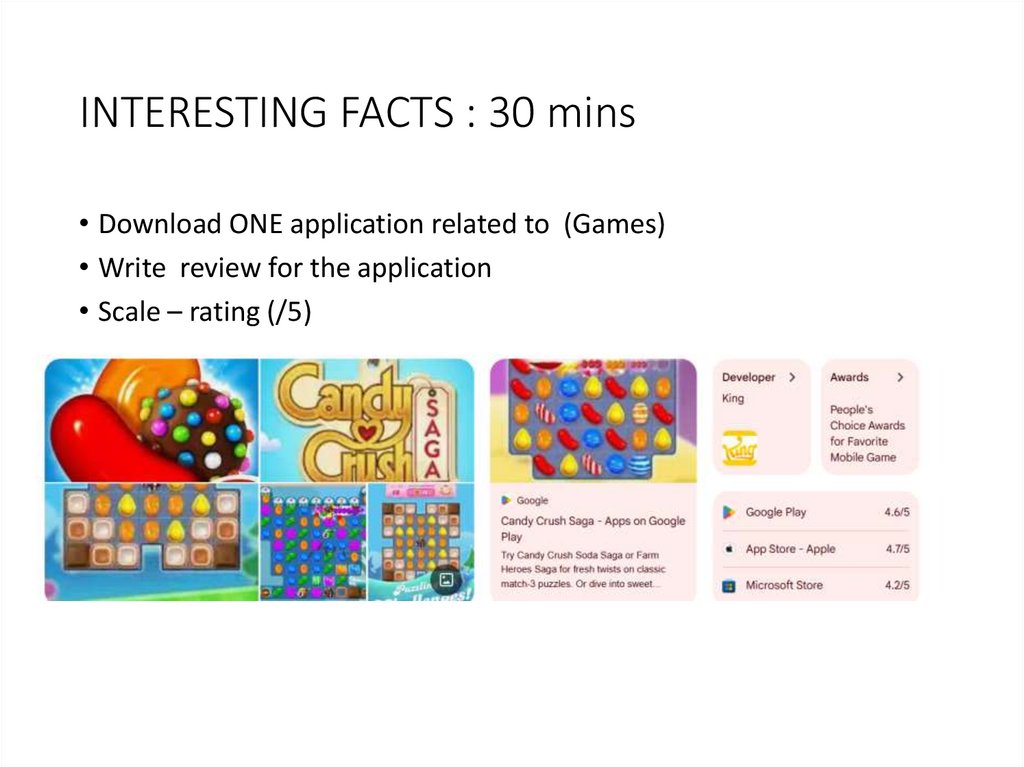
32. INTERESTING FACTS : 30 mins
• Download ONE application related to (Games)• Write review for the application
• Scale – rating (/5)
33. EXERCISE- GROUP
Q1. Elaborate ONE requirements verification techniqueQ2. Explain ONE commonly used models
34. Reference Materials
• Fanmuy G., Fraga A., Llorens J. (2012) Requirements Verification in the Industry.In: Hammami O., Krob D., Voirin JL. (eds) Complex Systems Design &
Management. Springer, Berlin, Heidelberg
• D. Gause, G. Weinberg (1989). Exploring Requirements: Quality Before Design,
Dorset House, New York, NY, USA.
• Michael, J. B., Drusinsky, D., Omtani, T. W., Shing, M-T. (2011). Verification and
Validation for Trustworthy Software System. IEEE Software.
• Rodriguez, M., Piattini, M., Ebert, C. (2019). Software Verification and Validation
Technologies and Tools. IEEE Software.
• Sommerville, I. (2015). Software Engineering (10th Edition). Pearson Publishing.
0133943038.
• ISO/IEC/IEEE. (2018). Systems and software engineering — Life cycle processes
— Requirements engineering. ISO/IEC/IEEE 29148:2018(E).
• System Validation. (2019). SEBoK. Retrieved from
https://www.sebokwiki.org/w/index.php?title=System_Validation&oldid=55954.
• Wallace, D. R., Fujii, R. U. (1989). Software Verification and Validation: An
Overview. IEEE Software.
17/1/2026