


 pedagogy
Similar presentations:









Requirements Elicitation (Part 2)
1. Requirements Elicitation (Part 2)
REQUIREMENTSELICITATION (PART 2)
DR. CHANDRA REKA
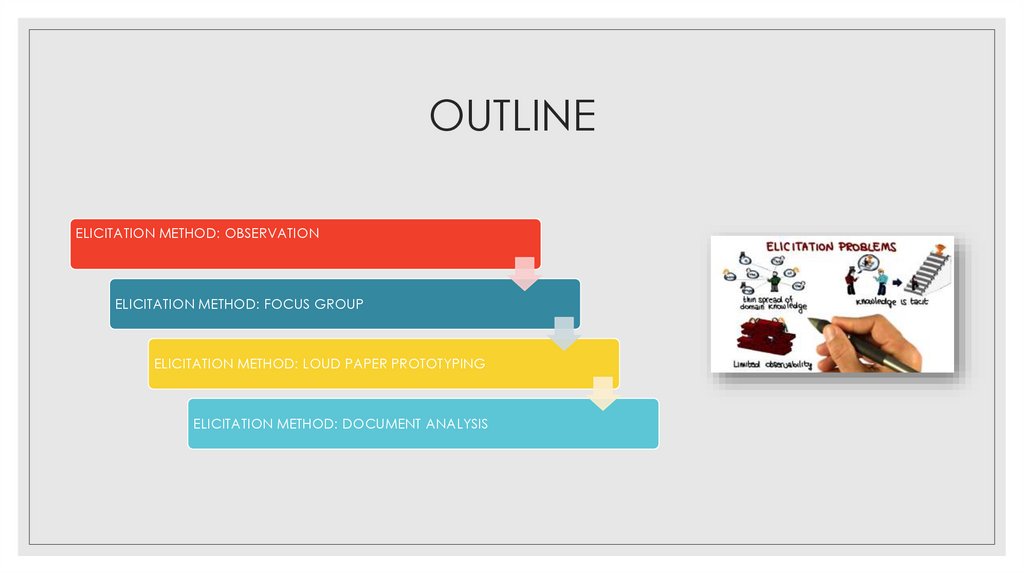
2. OUTLINE
ELICITATION METHOD: OBSERVATIONELICITATION METHOD: FOCUS GROUP
ELICITATION METHOD: LOUD PAPER PROTOTYPING
ELICITATION METHOD: DOCUMENT ANALYSIS
3. Learning Outcomes
After this session, you should be able to:◦ Describe various requirements elicitation methods
explained
◦ Compare the effectiveness on each methods discussed
◦ Decide which method to use in your case study
4. Elicitation Methods: Observation
SWE307
Method of collecting information by observing the
operations while they are taking place
Eg. point of sales in a supermarket, guest registration
counter in a busy hospital/hotel, customer support
person/help desk, and etc.
Observer needs to be immersed in the settings
Better suited for:
• Monitoring current process/improve existing
process where stakeholder have difficulty
explaining
• Repeatable processes
• Important to verify the validity of data
4
5. Elicitation Methods: Observation
◦ Observation is one of the more widely used ethnographictechniques.
◦ The actual execution of existing processes by the users without
direct interference.
◦ It is used in conjunction with others such as interviews and task
analysis.
◦ As a general rule ethnographic techniques such as observation
are very expensive to perform and require significant skill and
effort on the part of the analyst to interpret and understand the
actions being performed.
◦ The effectiveness of observation and other ethnographic
techniques can vary as users have a tendency to adjust the way
they perform tasks when knowingly being watched.
6. Elicitation Methods: Observation
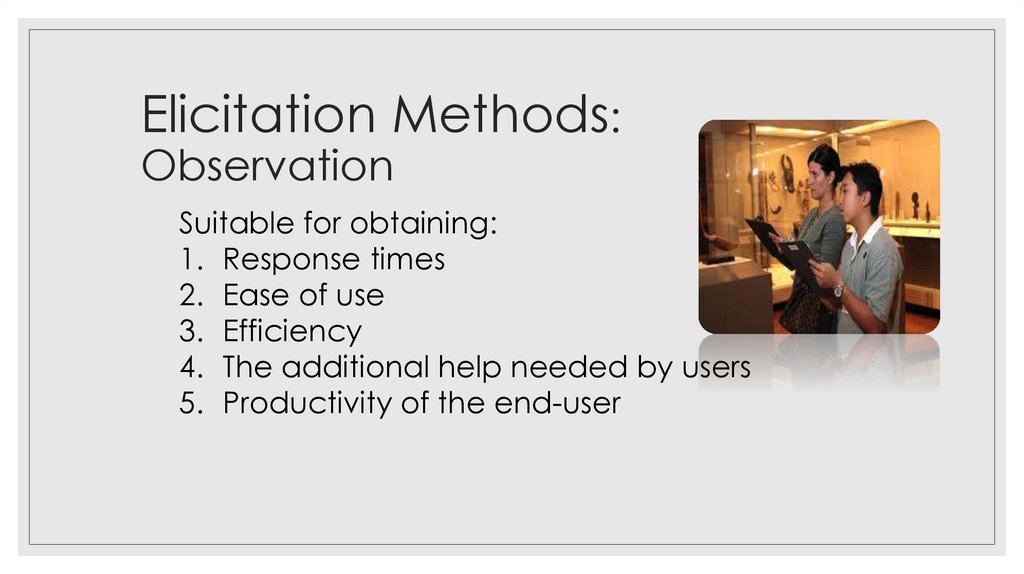
Suitable for obtaining:1. Response times
2. Ease of use
3. Efficiency
4. The additional help needed by users
5. Productivity of the end-user
7. Elicitation Methods: Observation
Criteria for selecting type of observation:• Structured vs unstructured
• Natural vs participant vs controlled
• Disguised vs undisguised
• Human vs mechanical
SWE307
7
8. Structured Observation
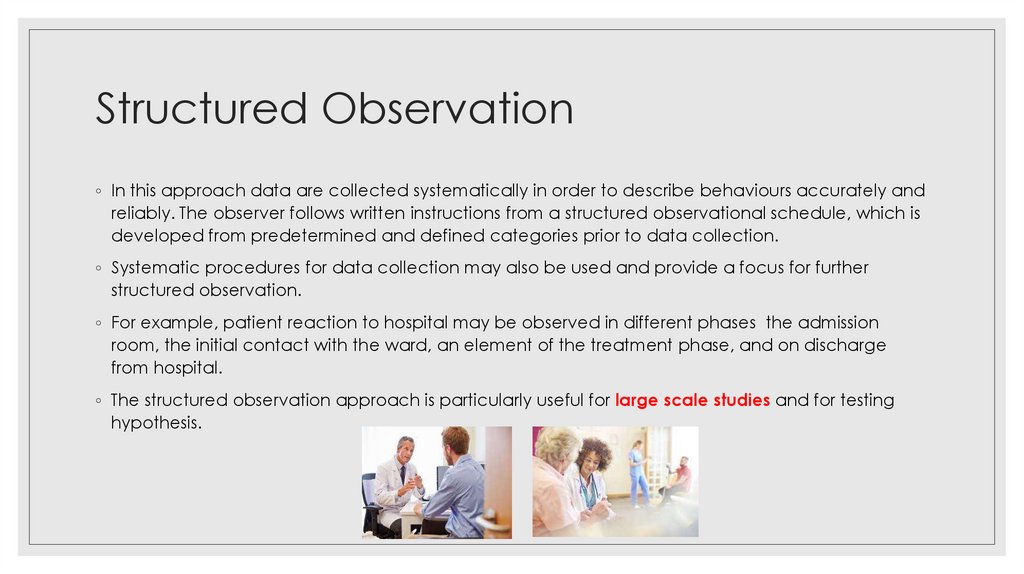
◦ In this approach data are collected systematically in order to describe behaviours accurately andreliably. The observer follows written instructions from a structured observational schedule, which is
developed from predetermined and defined categories prior to data collection.
◦ Systematic procedures for data collection may also be used and provide a focus for further
structured observation.
◦ For example, patient reaction to hospital may be observed in different phases the admission
room, the initial contact with the ward, an element of the treatment phase, and on discharge
from hospital.
◦ The structured observation approach is particularly useful for large scale studies and for testing
hypothesis.
9. Unstructured observation
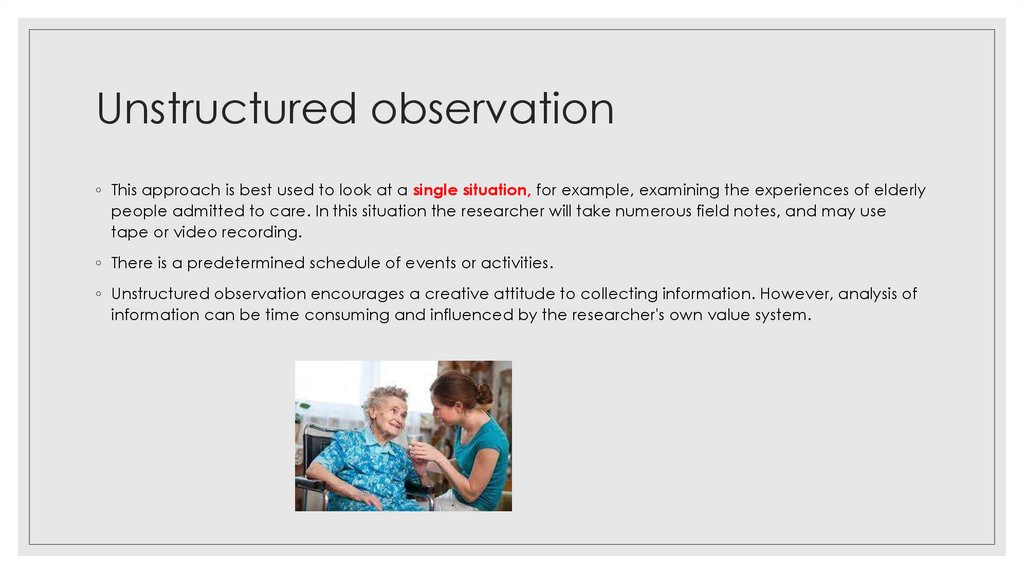
◦ This approach is best used to look at a single situation, for example, examining the experiences of elderlypeople admitted to care. In this situation the researcher will take numerous field notes, and may use
tape or video recording.
◦ There is a predetermined schedule of events or activities.
◦ Unstructured observation encourages a creative attitude to collecting information. However, analysis of
information can be time consuming and influenced by the researcher's own value system.
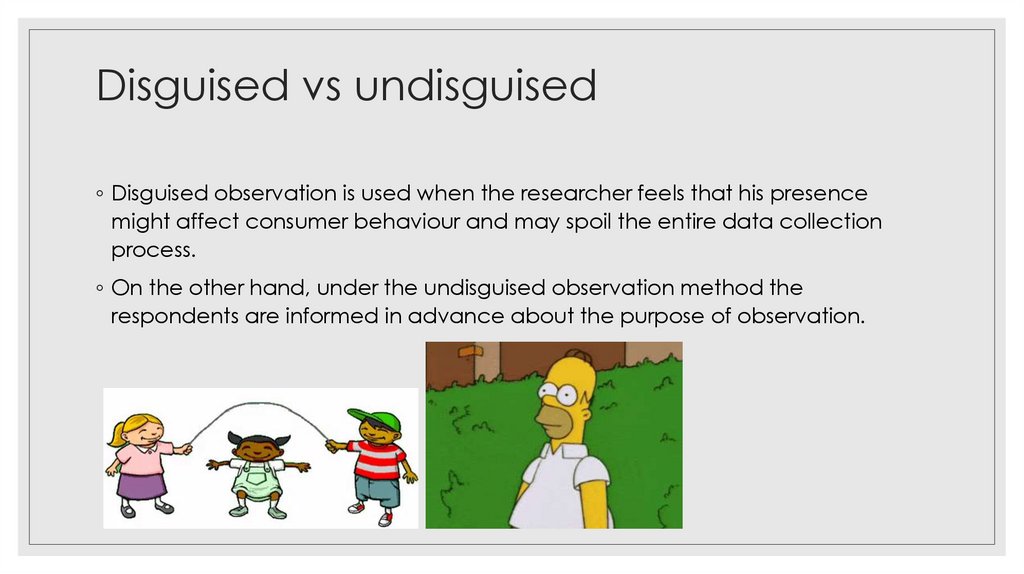
10. Disguised vs undisguised
◦ Disguised observation is used when the researcher feels that his presencemight affect consumer behaviour and may spoil the entire data collection
process.
◦ On the other hand, under the undisguised observation method the
respondents are informed in advance about the purpose of observation.
11. Natural vs participant vs controlled
◦ Controlled observations (usually a structured observation) are likely to be carriedout in a psychology laboratory.
◦ The researcher decides where the observation will take place, at what time, with
which participants, in what circumstances and uses a standardized procedure.
Participants are randomly allocated to each independent variable group.
◦ Naturalistic observation is a research method commonly used by psychologists
and other social scientists.
◦ This technique involves observing involves studying the spontaneous behavior of
participants in natural surroundings.
https://www.simplypsychology.org/observation.html
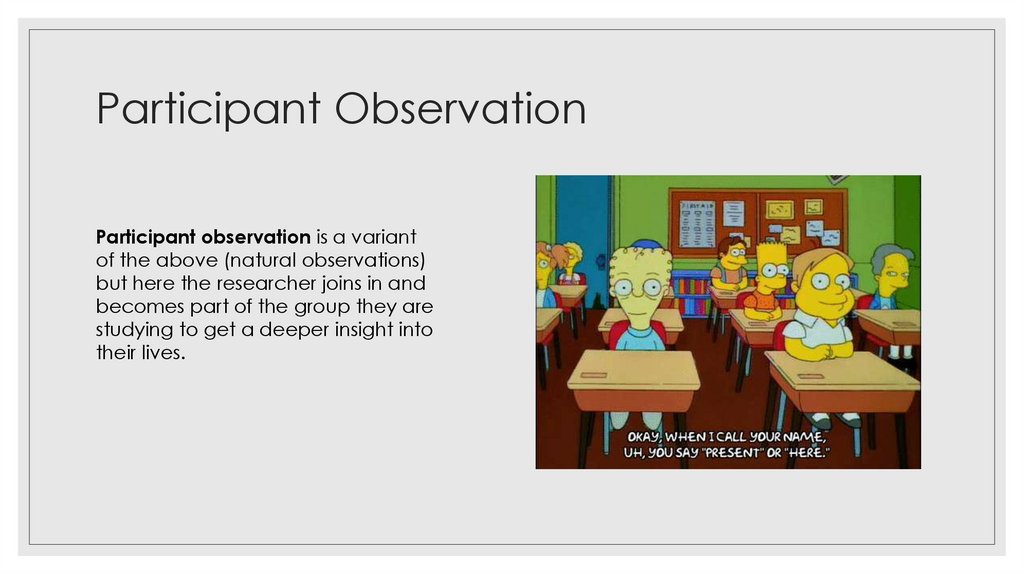
12. Participant Observation
Participant observation is a variantof the above (natural observations)
but here the researcher joins in and
becomes part of the group they are
studying to get a deeper insight into
their lives.
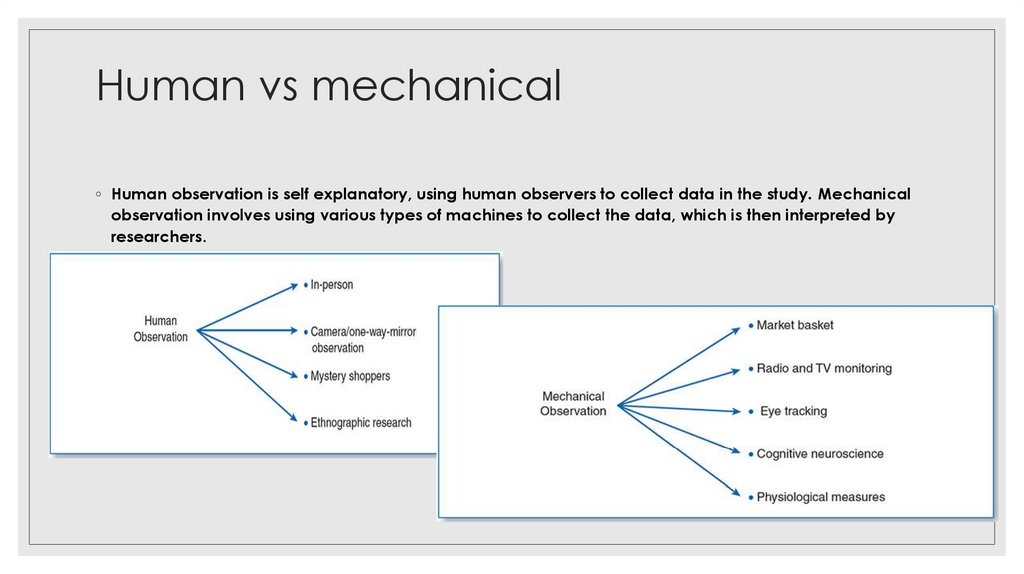
13. Human vs mechanical
◦ Human observation is self explanatory, using human observers to collect data in the study. Mechanicalobservation involves using various types of machines to collect the data, which is then interpreted by
researchers.
14. Elicitation Methods: Observation
SWE307Benefits:
• May be used to confirm information
from interviews or surveys
• View of stakeholders external to system
(eg. Customer) may be obtained
• May confirm efficacy of system
Weaknesses:
• Longer time needed
• Observer bias
• Observer presence may influence
group/individual observed
• Ethical issues (need informed consent)
14
15. Elicitation Methods: Observation
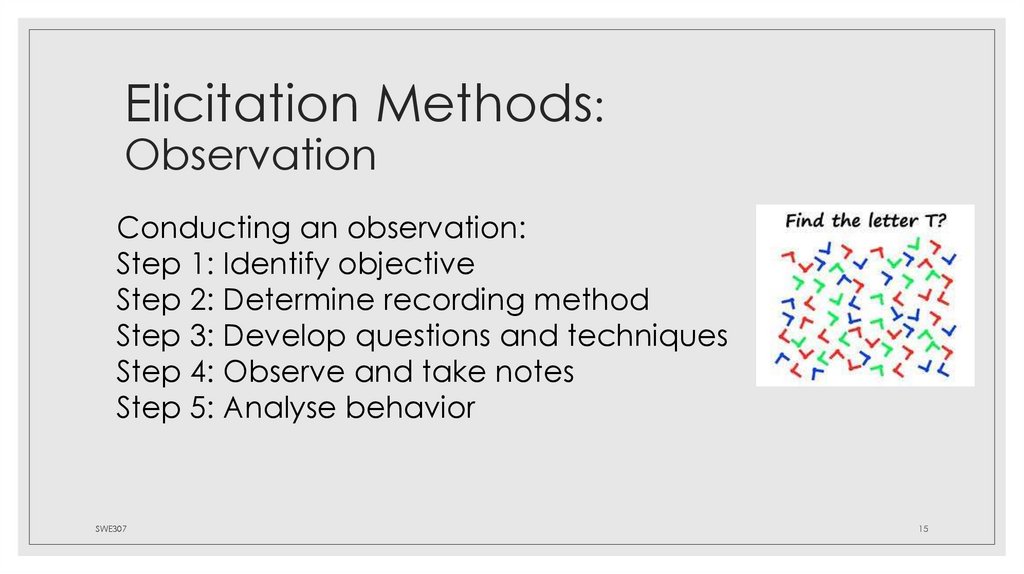
Conducting an observation:Step 1: Identify objective
Step 2: Determine recording method
Step 3: Develop questions and techniques
Step 4: Observe and take notes
Step 5: Analyse behavior
SWE307
15
16. OBSERVATION
17. BREAK
18. Elicitation Methods: Prototyping
◦ Providing stakeholders with prototypes of the system to support theinvestigation of possible solutions is an effective way to gather
detailed information and relevant feedback .
◦ It is common that prototypes are used in conjunction with other
elicitation techniques such as interviews and JAD.
◦ useful when developing human-computer interfaces, or where the
stakeholders are unfamiliar with the available solutions.
◦ storyboards, executable, throwaway and evolutionary, with varying
levels of effort required.
◦ Expensive to produce in terms of time and cost.
◦ This encourage stakeholders, and more specifically the users, to play
an active role in developing the requirements.
◦ users may become attached to them, and therefore become
resistant to alternative solutions from then on.
19. Elicitation Methods: Prototyping
20. Loud Paper Prototyping (LPP): Storyboard
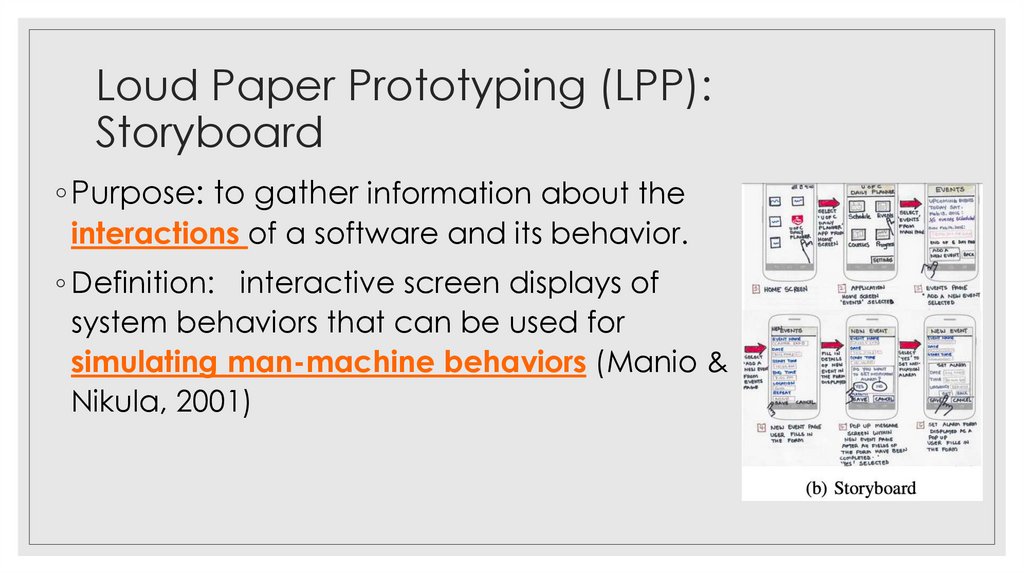
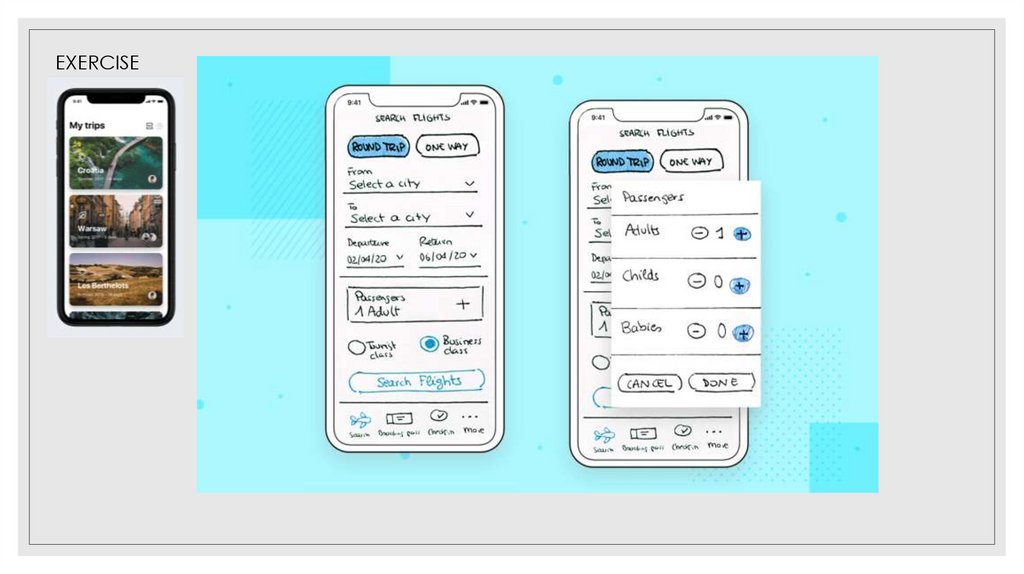
◦ Purpose: to gather information about theinteractions of a software and its behavior.
◦ Definition: interactive screen displays of
system behaviors that can be used for
simulating man-machine behaviors (Manio &
Nikula, 2001)
21. LPP: Sketching
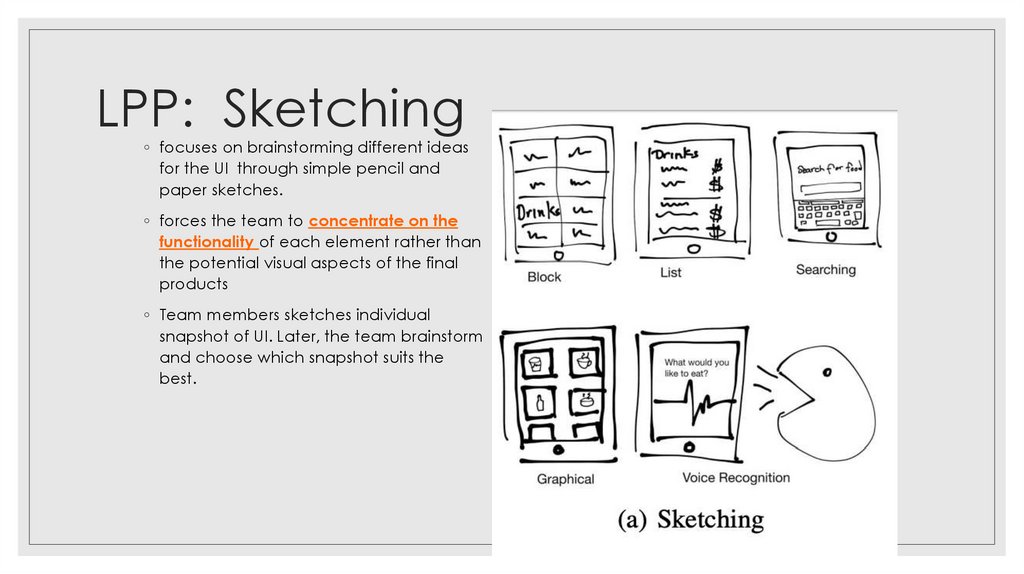
◦ focuses on brainstorming different ideasfor the UI through simple pencil and
paper sketches.
◦ forces the team to concentrate on the
functionality of each element rather than
the potential visual aspects of the final
products
◦ Team members sketches individual
snapshot of UI. Later, the team brainstorm
and choose which snapshot suits the
best.
22. LPP: Wizard of oz
23. LPP: Wizard of oz
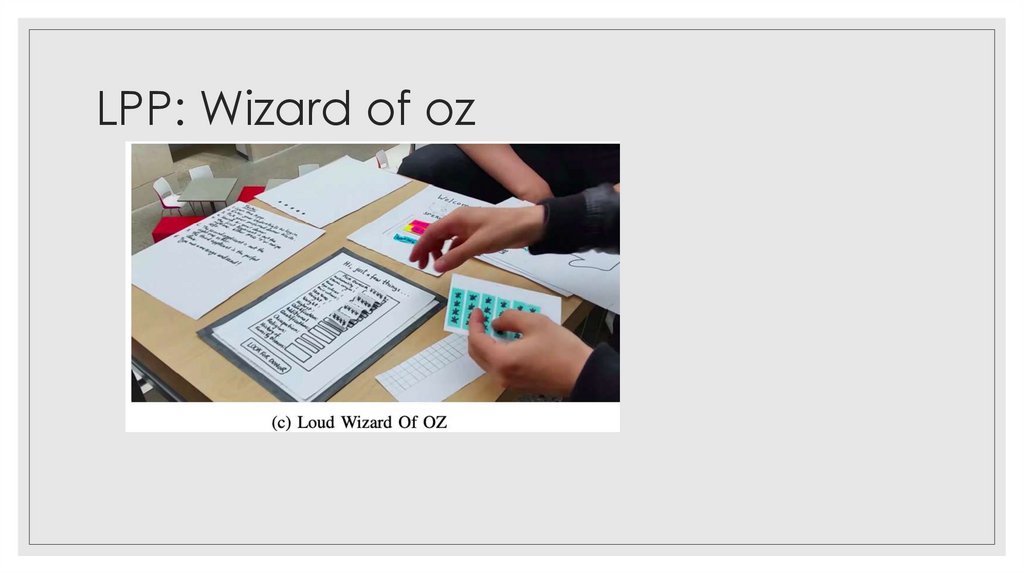
◦ Tests the usability of the design layout and detectsany inaccurate user preference assumptions
made during earlier design stages.
◦ allowing the client to test the UI through
interacting with a paper prototype as a user
◦ A working paper model of the App is made by
sketching
a series of snapshots of the UI onto different sheets
of paper
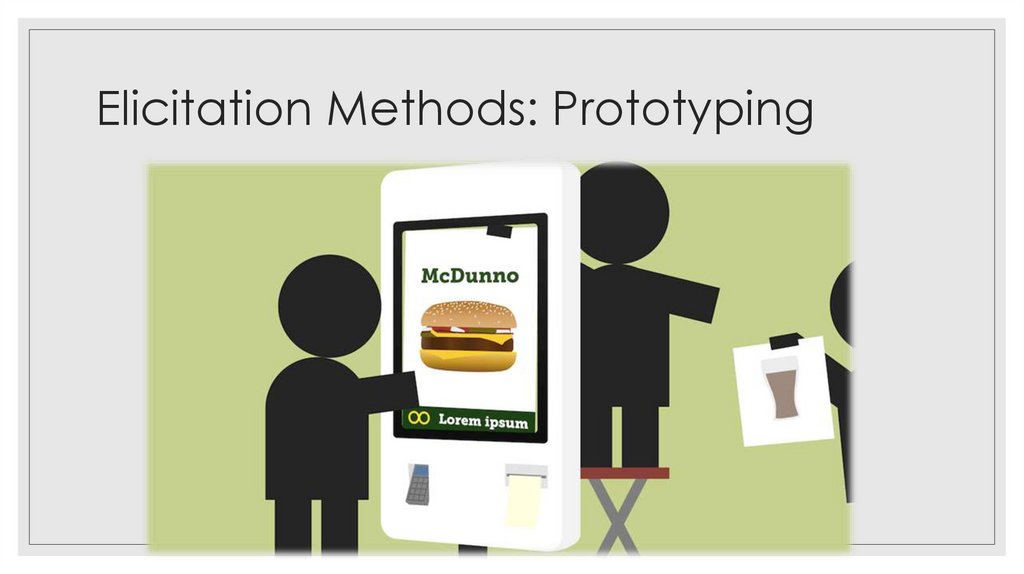
◦ Example (Self-Service Checkout Counter)
https://www.youtube.com/watch?v=d8SEFSpBYzY
24. Remarks about LPP
◦ LPP helps modify the Functional Requirements throughvisualization and discussions
◦ It is more suitable for Rapid Application Development (Agile
environment)
◦ The paper claim that LPP is most suitable for mobile application
◦ Requirements Elicitation via LPP for Large systems might not be
suitable unless the FR is already divided, ie Task Hierarchy is
applied first
25. Elicitation Methods: Scenarios
◦ Scenarios are narrative and specific descriptions ofcurrent and future processes including actions and
interactions between the users and the system.
◦ Like use cases, scenarios do not typically consider the
internal structure of the system, and require an
incremental and interactive approach to their
development.
◦ structured and rigorous approaches to requirements
elicitation using scenarios including CREWS, The Inquiry
Cycle, SBRE and Scenario Plus
◦ Very useful for understanding and validating
requirements, as well as test case development.
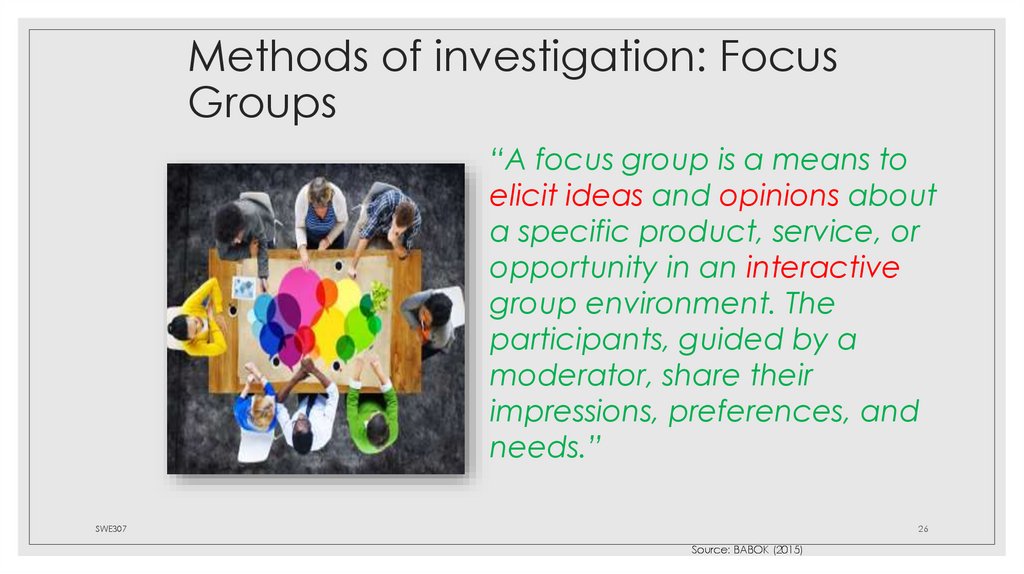
26. Methods of investigation: Focus Groups
“A focus group is a means toelicit ideas and opinions about
a specific product, service, or
opportunity in an interactive
group environment. The
participants, guided by a
moderator, share their
impressions, preferences, and
needs.”
SWE307
26
Source: BABOK (2015)
27. Methods of investigation: Focus Groups
• group setting with pre-qualifiedparticipants
• similar to brainstorming but more
structured and focus on views of
participants
• objective: discuss and comment on a
topic within a context
• participants share their perspectives and
attitudes about a topic and discuss
them
• facilitated by a moderator
SWE307
27
28. Methods of investigation: Focus Groups
• utilised at various points:product under development leading to improvements
completed product - leading to
market positioning
product in production – leading to
revisions on next release
assess customer satisfaction
SWE307
28
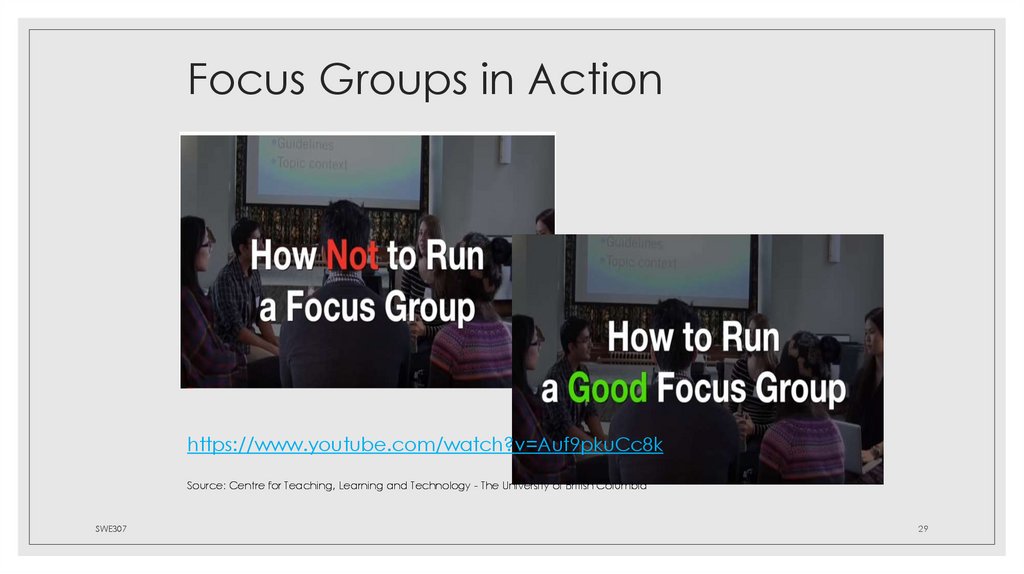
29. Focus Groups in Action
https://www.youtube.com/watch?v=Auf9pkuCc8kSource: Centre for Teaching, Learning and Technology - The University of British Columbia
SWE307
29
30. Methods of investigation: Document Analysis
“Document analysis is used to elicitbusiness analysis information,
including contextual understanding
and requirements, by examining
available materials that describe
either the business environment or
existing organizational assets.”
Source: BABOK (2015)
SWE307
30
31. Methods of investigation: Document Analysis
SWE307May be used to:
gather background information to
understand business
research how existing solutions are
implemented
validate findings from other elicitation
address information gaps when expert is not
available
Approach:
data mining
methodically review materials for relevance
31
32. Methods of investigation: Document Analysis
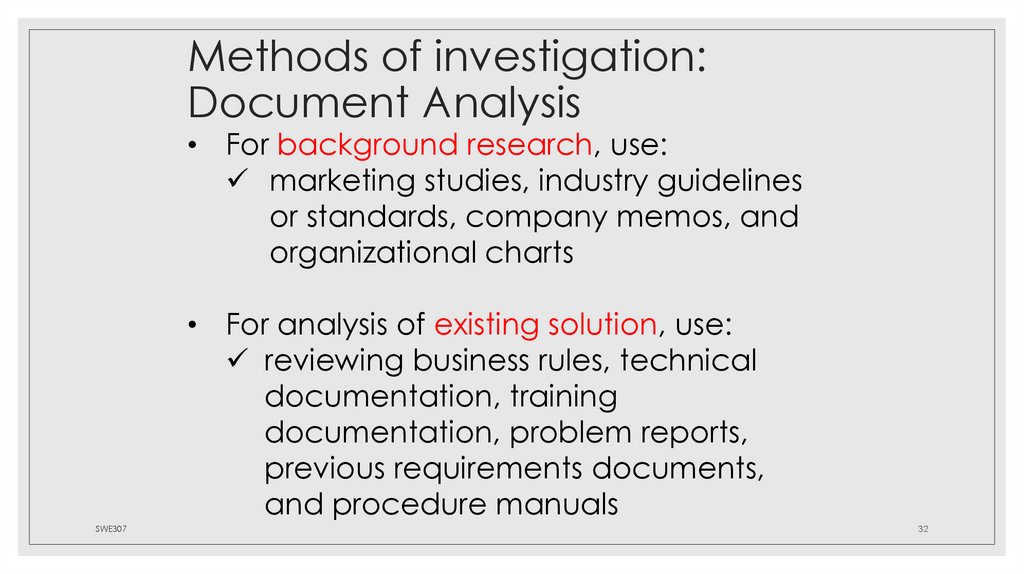
• For background research, use:marketing studies, industry guidelines
or standards, company memos, and
organizational charts
• For analysis of existing solution, use:
reviewing business rules, technical
documentation, training
documentation, problem reports,
previous requirements documents,
and procedure manuals
SWE307
32
33. Methods of investigation: Document Analysis
SWE307
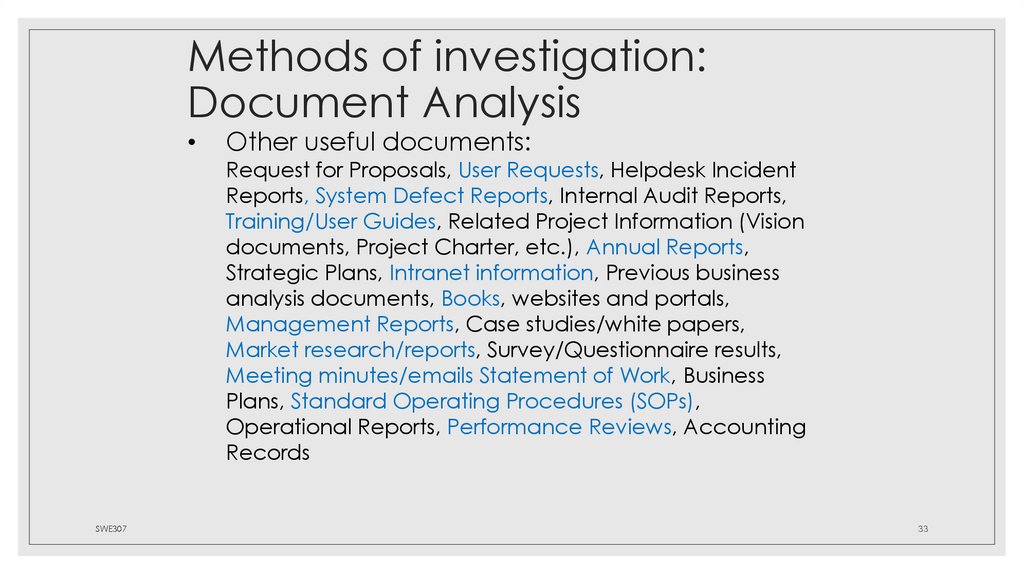
Other useful documents:
Request for Proposals, User Requests, Helpdesk Incident
Reports, System Defect Reports, Internal Audit Reports,
Training/User Guides, Related Project Information (Vision
documents, Project Charter, etc.), Annual Reports,
Strategic Plans, Intranet information, Previous business
analysis documents, Books, websites and portals,
Management Reports, Case studies/white papers,
Market research/reports, Survey/Questionnaire results,
Meeting minutes/emails Statement of Work, Business
Plans, Standard Operating Procedures (SOPs),
Operational Reports, Performance Reviews, Accounting
Records
33
34. Methods of investigation: Document Analysis
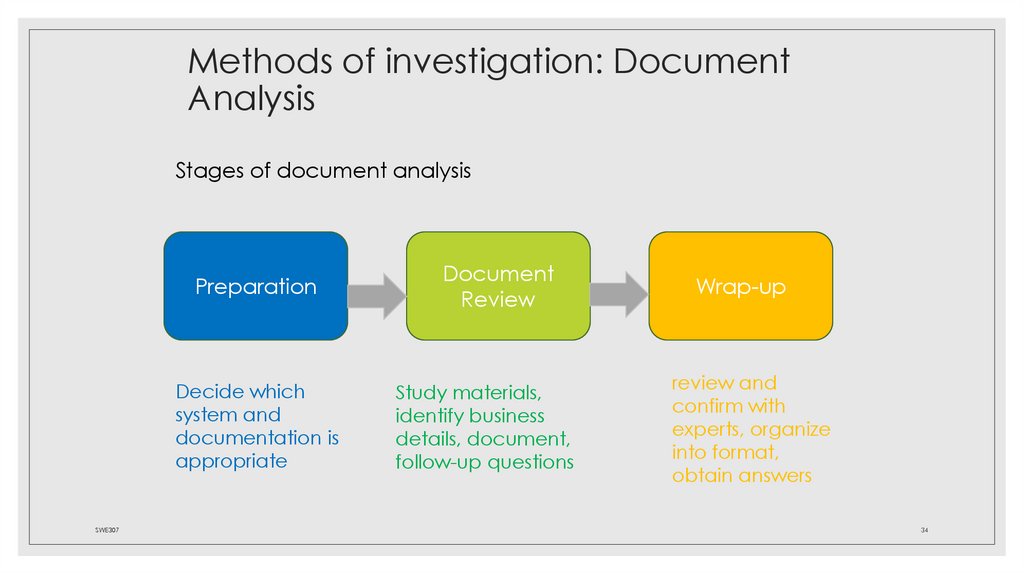
Stages of document analysisPreparation
Decide which
system and
documentation is
appropriate
SWE307
Document
Review
Study materials,
identify business
details, document,
follow-up questions
Wrap-up
review and
confirm with
experts, organize
into format,
obtain answers
34
35. Methods of investigation: Document Analysis
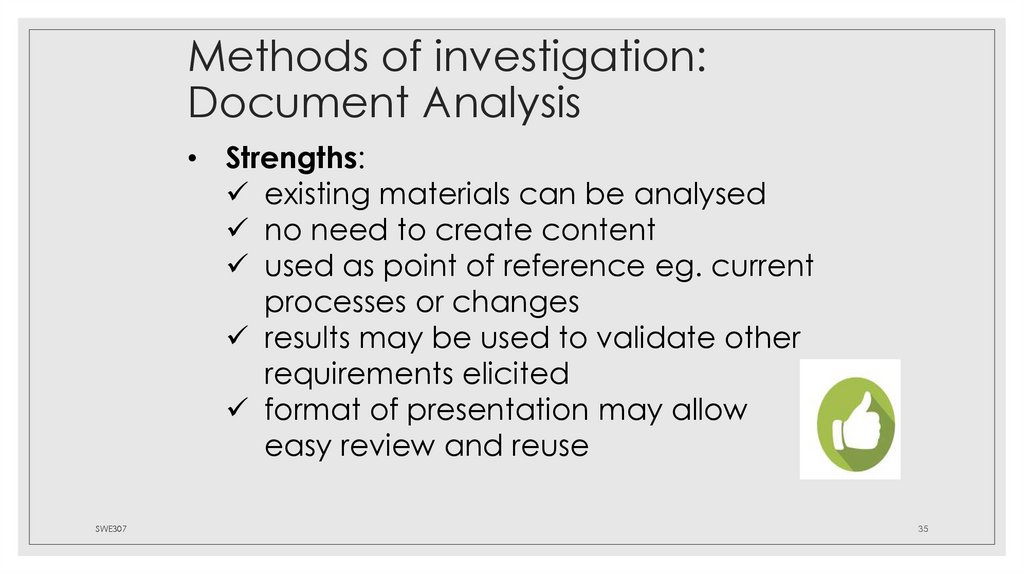
• Strengths:existing materials can be analysed
no need to create content
used as point of reference eg. current
processes or changes
results may be used to validate other
requirements elicited
format of presentation may allow
easy review and reuse
SWE307
35
36. Methods of investigation: Document Analysis
Weaknessesinvalid or out-of-date documents
document authors may not be
available for further clarification
useful for evaluation current state
may be time-consuming and
confusing if volume of documents too
large
SWE307
36
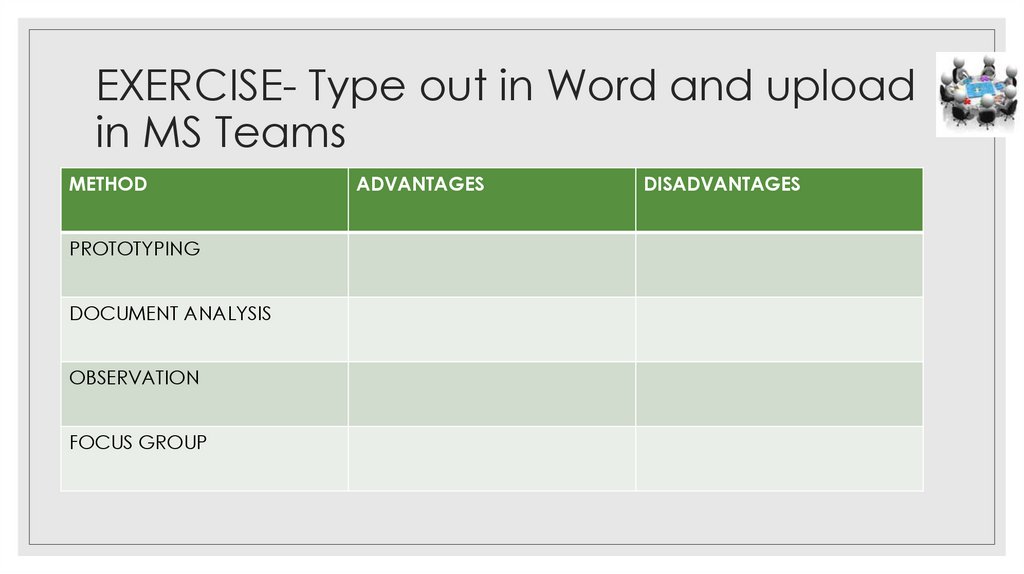
37. EXERCISE- Type out in Word and upload in MS Teams
METHODPROTOTYPING
DOCUMENT ANALYSIS
OBSERVATION
FOCUS GROUP
ADVANTAGES
DISADVANTAGES
38.
EXERCISE39.
EXERCISE40. Resources
1.Zahra Shakeri Hossein Abad, Muneera Bano, Didar Zowghi, "How Much Authenticity can be
Achieved in Software Engineering Project Based Courses?", Software Engineering: Software
Engineering Education and Training (ICSE-SEET) 2019 IEEE/ACM 41st International Conference on, pp.
208-219, 2019.
2.
M. Mannio and U. Nikula, “Requirements elicitation using a combination of prototypes and
scenarios,” in WER, Citeseer, 2001, pp. 283–296.
3.
https://www.modernanalyst.com/Resources/Articles/tabid/115/ID/2483/The-Top-Five-Go-ToRequirements-Elicitation-Methods.aspx
4.
https://businessanalystmentor.com/elicitation-technique/