 psychology
Similar presentations:





What is Behavior Therapy?
1. What is Behavior Therapy?
WHAT IS BEHAVIOR THERAPY?Randi Pochtar, Ph.D.
PSYCH-GA 2062
Fall 2014
2. BEHAVIOR THERAPY ENCOMPASSES:
o Behavioral Analysis/Assessmento Behavioral Modification
o Cognitive Behavioral Therapy
3. “Values” of Behavior Therapy
“VALUES” OF BEHAVIOR THERAPYEmpirical
Active
In-vivo
Self-controlled
Collaborative
Individualized
Present Focused
Learning Focused
Progressive
Brevity
4. Historical Bases of CBT
HISTORICAL BASES OF CBTFrom Pavlov to Problem-Solving
5. Emergence of Behavioral Therapies
EMERGENCE OF BEHAVIORAL THERAPIESDiscontent with psychoanalysis
Learning theories
Conditioning
Classical (Pavlovian)
Operant
6. Classical Conditioning
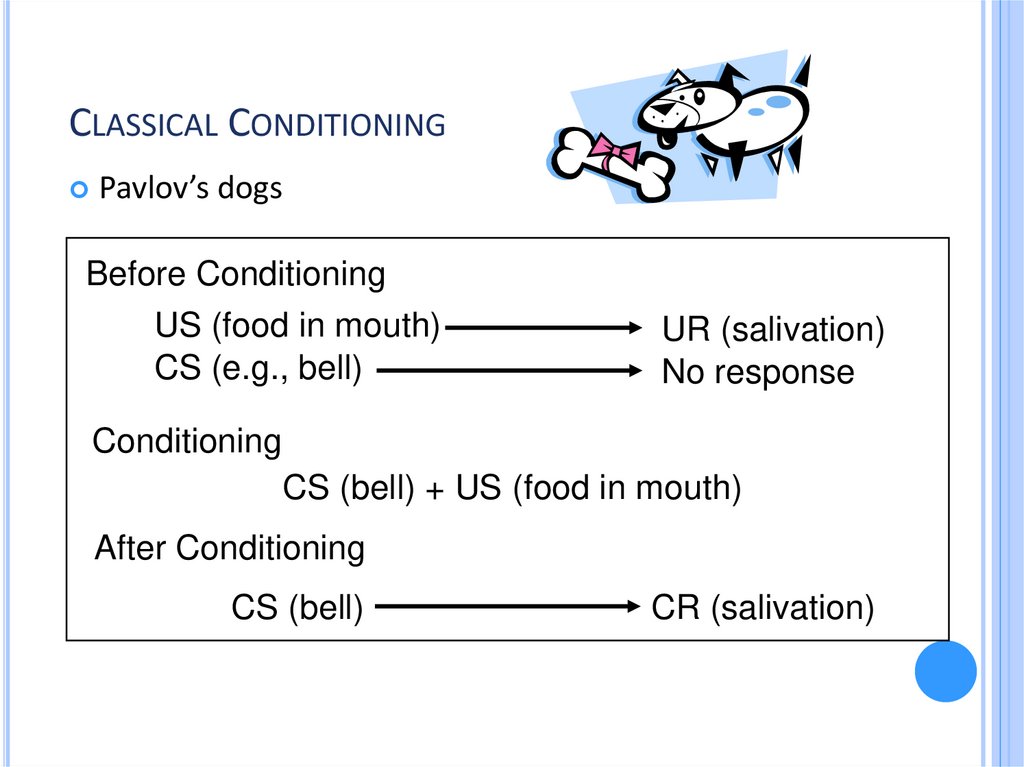
CLASSICAL CONDITIONINGPavlov’s dogs
Before Conditioning
US (food in mouth)
CS (e.g., bell)
UR (salivation)
No response
Conditioning
CS (bell) + US (food in mouth)
After Conditioning
CS (bell)
CR (salivation)
7. CLASSICAL CONDITIONING CONTINUED
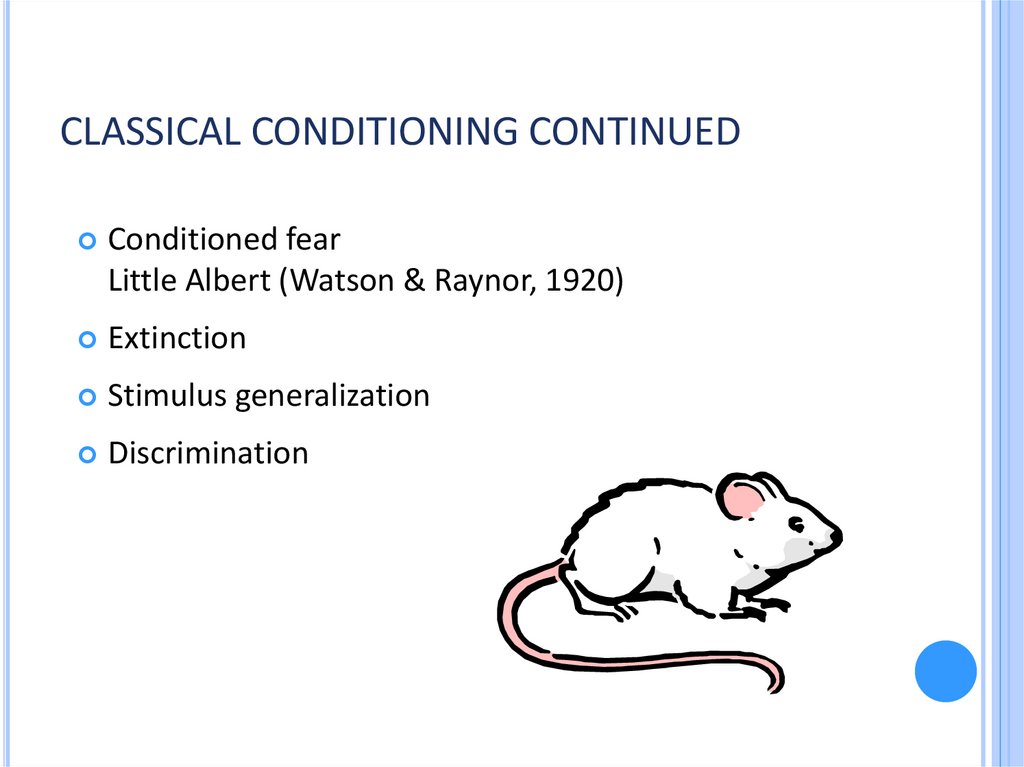
Conditioned fearLittle Albert (Watson & Raynor, 1920)
Extinction
Stimulus generalization
Discrimination
8. Applications to Behavior Change
APPLICATIONS TO BEHAVIOR CHANGEMary Cover Jones (1924)
Treatment of Peter
Modeling
Graded exposure
Hobart & Willie Mowrer (1935)
Bell & Pad technique
Joseph Wolpe (1950’s)
Systematic Desensitization
9. Fundamentals of Operant Conditioning
FUNDAMENTALS OF OPERANT CONDITIONINGBehaviors are rewarded and punished, leading to
increases and decreases in these behaviors dependent
on response.
In terms of psychopathology, behaviors that are typically
rewarded/punished become entrenched in maladaptive
ways and can be altered to be more adaptive.
10. Operant Conditioning Principles
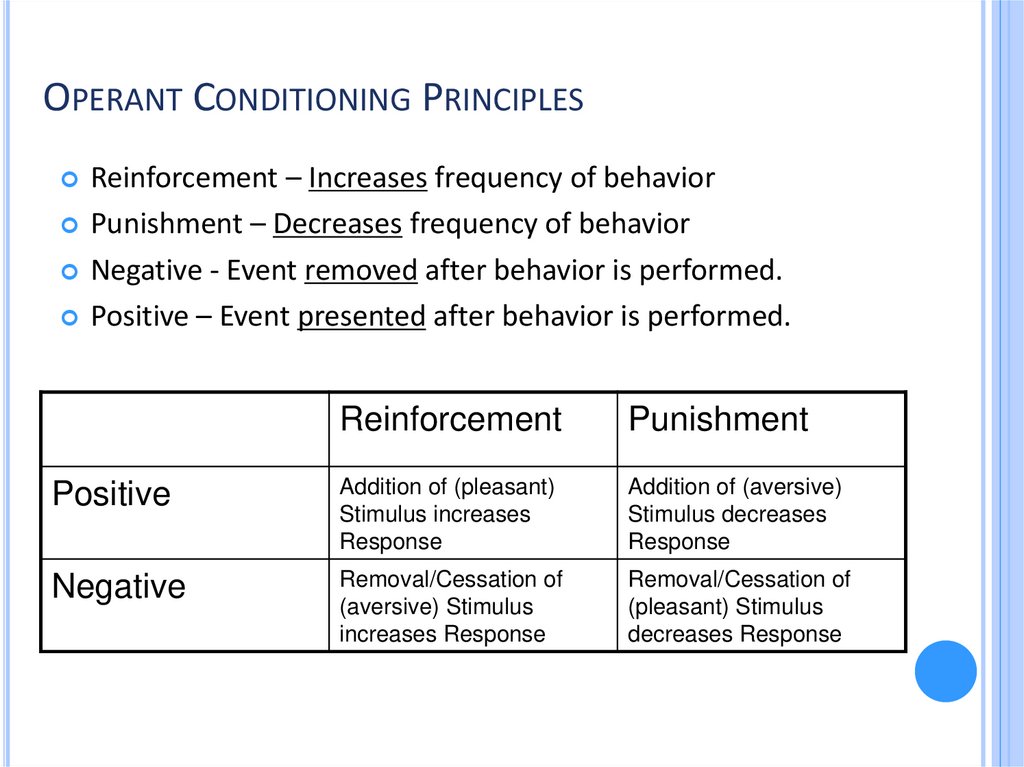
OPERANT CONDITIONING PRINCIPLESReinforcement – Increases frequency of behavior
Punishment – Decreases frequency of behavior
Negative - Event removed after behavior is performed.
Positive – Event presented after behavior is performed.
Reinforcement
Punishment
Positive
Addition of (pleasant)
Stimulus increases
Response
Addition of (aversive)
Stimulus decreases
Response
Negative
Removal/Cessation of
(aversive) Stimulus
increases Response
Removal/Cessation of
(pleasant) Stimulus
decreases Response
11. Operant Conditioning
OPERANT CONDITIONINGThorndike (late 1800’s)
Law of Effect: If a response is followed by a reward then that
response will be strengthened. If it is not followed by a reward
or followed by punishment, it will be weakened
B.F. Skinner (1930’s)
Instrumental responses (operants): operate on environment to
bring about outcome (reward)
Skinner Box
12. Clinical Applications
CLINICAL APPLICATIONSPositive Reinforcement
Ogden Lindsley (1950s) first use of operant techniques with
psychiatric population
Ayllon & Azrin (1961): first token economy (inpatient setting)
Negative Reinforcement: Avoidance Learning
Punishment
Learned Helplessness (Seligman & Meier, 1975) - depression
13. Social Learning Theory
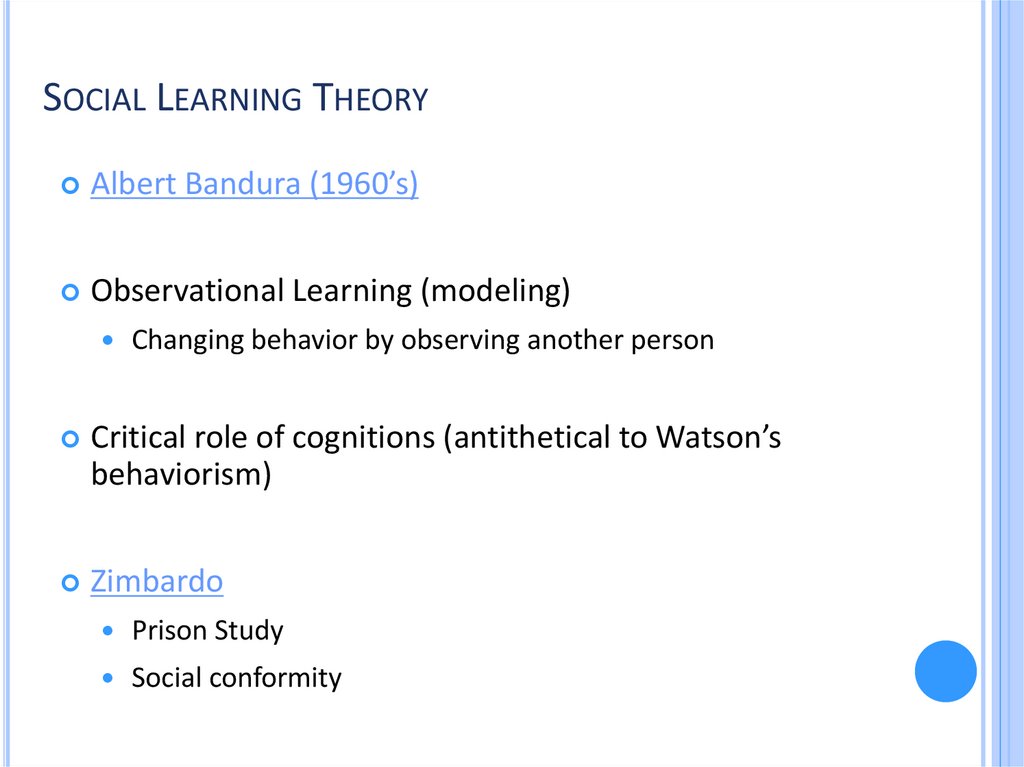
SOCIAL LEARNING THEORYAlbert Bandura (1960’s)
Observational Learning (modeling)
Changing behavior by observing another person
Critical role of cognitions (antithetical to Watson’s
behaviorism)
Zimbardo
Prison Study
Social conformity
14. Emergence of Cognitive Theories
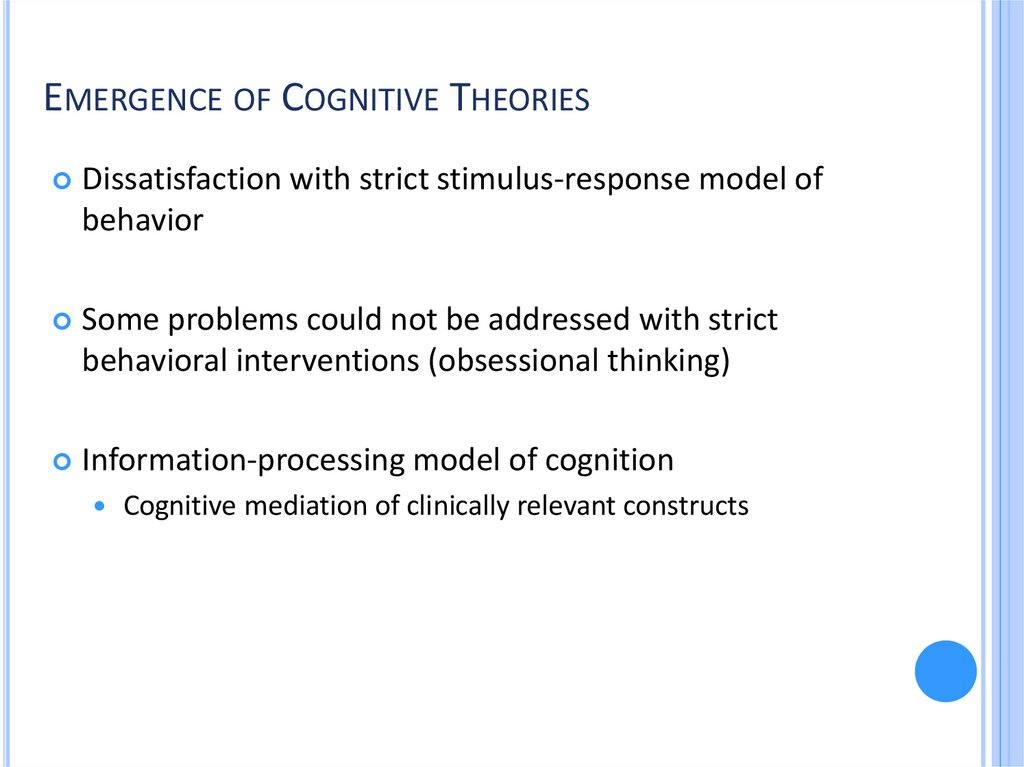
EMERGENCE OF COGNITIVE THEORIESDissatisfaction with strict stimulus-response model of
behavior
Some problems could not be addressed with strict
behavioral interventions (obsessional thinking)
Information-processing model of cognition
Cognitive mediation of clinically relevant constructs
15. Cognitive-Behavioral Therapies
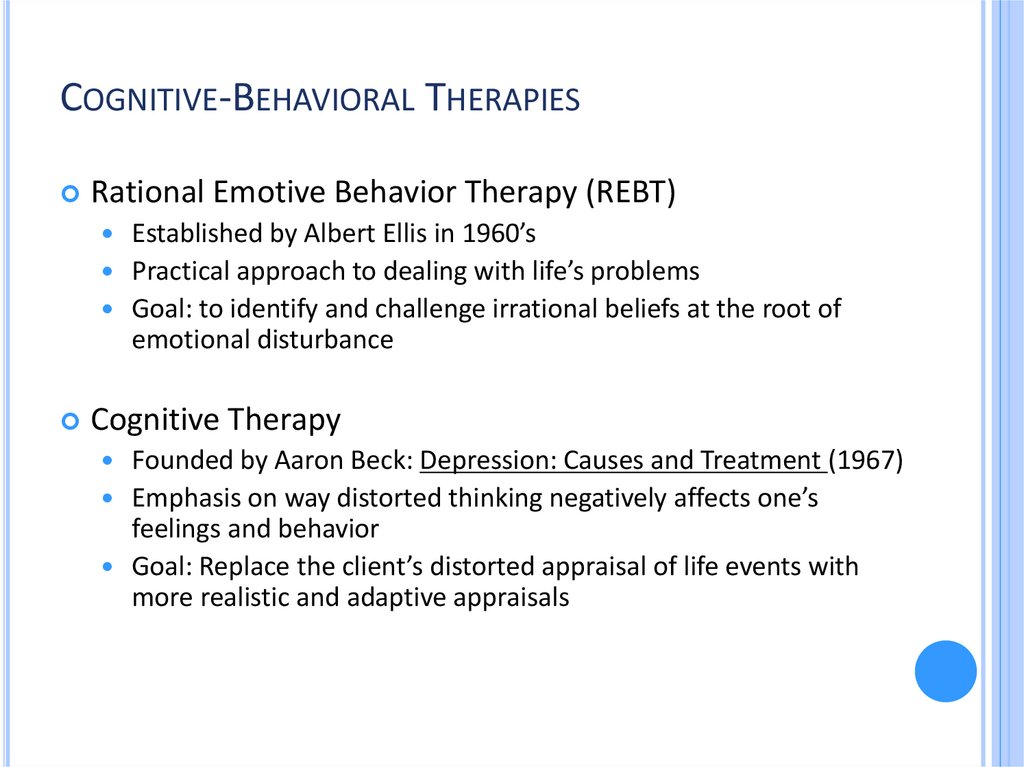
COGNITIVE-BEHAVIORAL THERAPIESRational Emotive Behavior Therapy (REBT)
Established by Albert Ellis in 1960’s
Practical approach to dealing with life’s problems
Goal: to identify and challenge irrational beliefs at the root of
emotional disturbance
Cognitive Therapy
Founded by Aaron Beck: Depression: Causes and Treatment (1967)
Emphasis on way distorted thinking negatively affects one’s
feelings and behavior
Goal: Replace the client’s distorted appraisal of life events with
more realistic and adaptive appraisals
16. Addition of the C in CBT
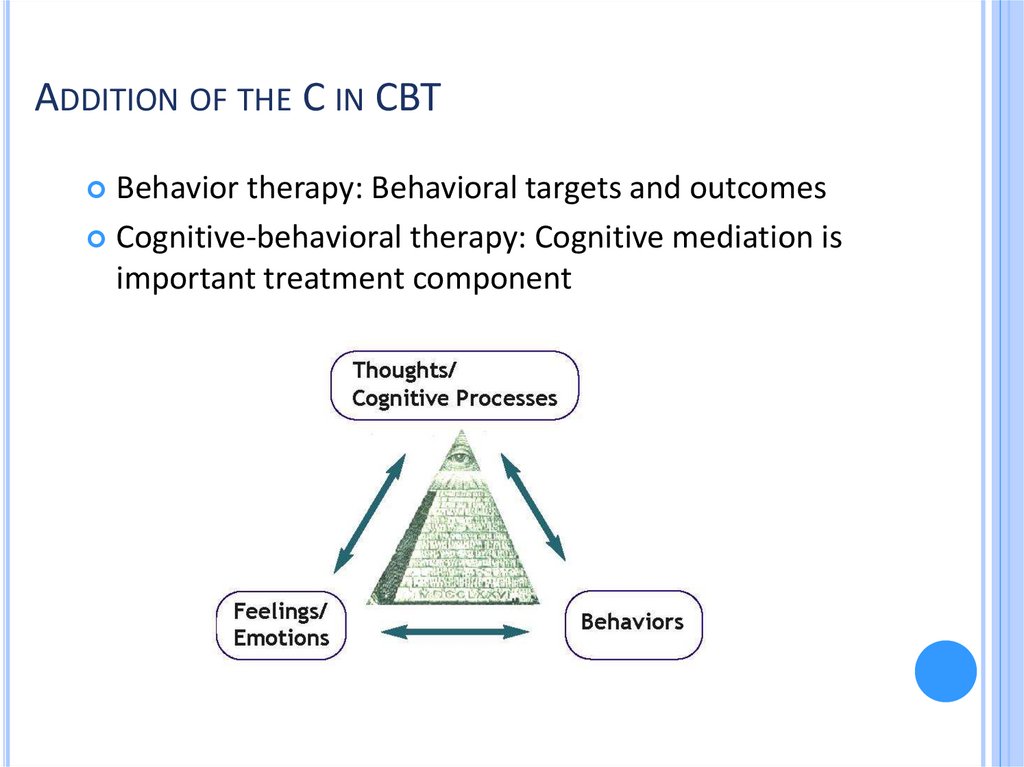
ADDITION OF THE C IN CBTBehavior therapy: Behavioral targets and outcomes
Cognitive-behavioral therapy: Cognitive mediation is
important treatment component
17. Fundamental Propositions of CBT
FUNDAMENTAL PROPOSITIONS OF CBTCognitive activity affects behavior
Cognitive activity can be monitored and altered
Desired behavior may be affected through cognitive
change
18. Assumptions of CBT
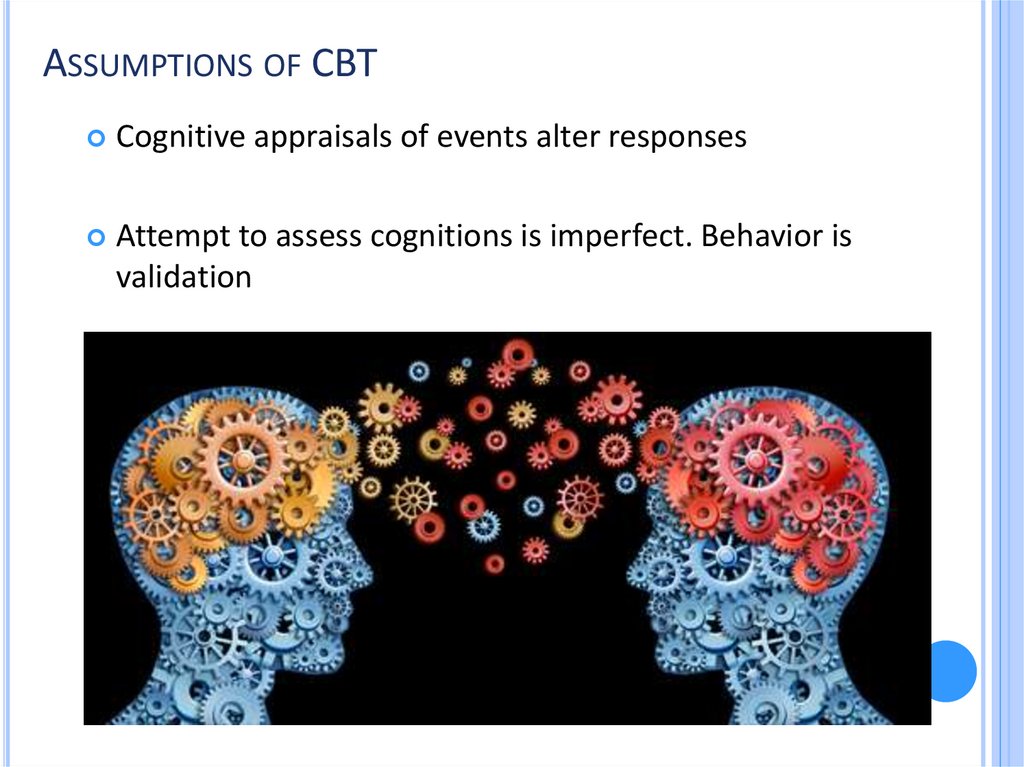
ASSUMPTIONS OF CBTCognitive appraisals of events alter responses
Attempt to assess cognitions is imperfect. Behavior is
validation
19. Stress Inoculation Training
STRESS INOCULATION TRAININGDonald Meichenbaum (1970’s)
Systematic acquisition of coping skills: clients who learn
ways of coping with mild levels of stress are
“innoculated” against uncontrollable levels of stress
Three stages
(1) Education
(2) Presentation of coping skills
(3) Exposure
Has been applied to anxiety, anger, pain
20. Therapist-Client Relationship in CBT
THERAPIST-CLIENT RELATIONSHIP IN CBTNecessary but not a sufficient condition for change
Increases client’s positive expectations and hope for
success
Encourage client to complete assignments that may
involve risk-taking
Overcome obstacles such as noncompliance
Transference and countertransference exist- just not a
focus of treatment process
21. CBT & Research
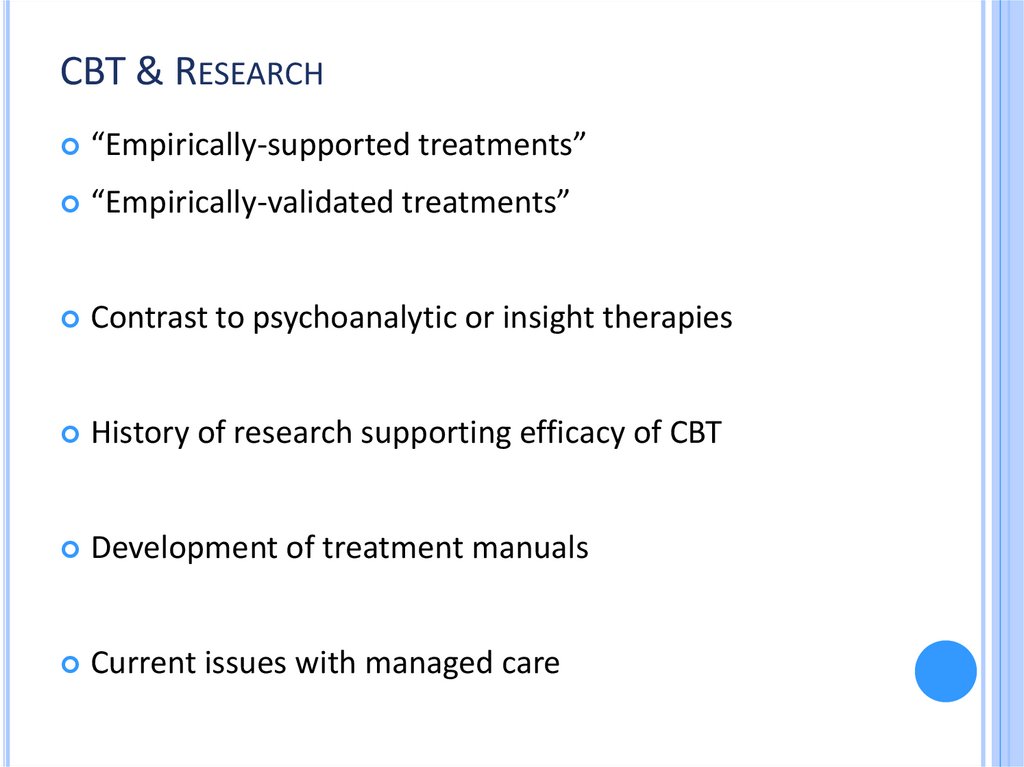
CBT & RESEARCH“Empirically-supported treatments”
“Empirically-validated treatments”
Contrast to psychoanalytic or insight therapies
History of research supporting efficacy of CBT
Development of treatment manuals
Current issues with managed care
22. CBT Timeline
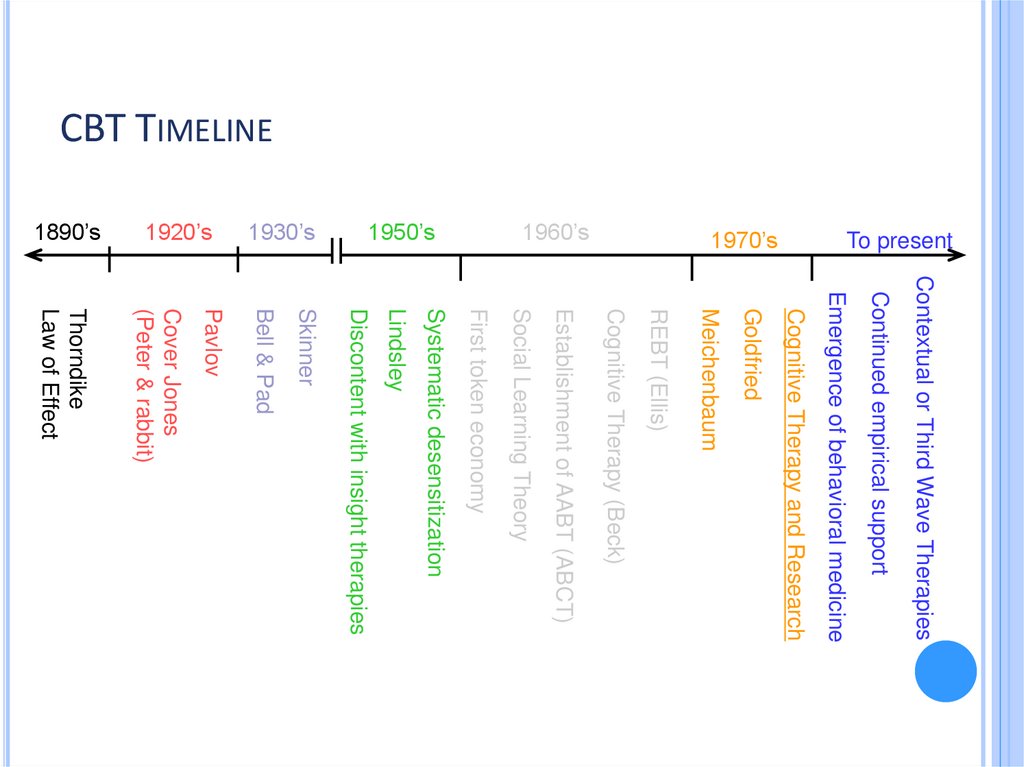
CBT TIMELINETo present
1970’s
1960’s
1950’s
Contextual or Third Wave Therapies
Continued empirical support
Emergence of behavioral medicine
Cognitive Therapy and Research
Goldfried
Meichenbaum
REBT (Ellis)
Cognitive Therapy (Beck)
Establishment of AABT (ABCT)
Social Learning Theory
First token economy
Systematic desensitization
Lindsley
Discontent with insight therapies
Skinner
Bell & Pad
Thorndike
Law of Effect
Cover Jones
(Peter & rabbit)
Pavlov
1920’s
1930’s
1890’s
23. Approach of Behavior Therapy
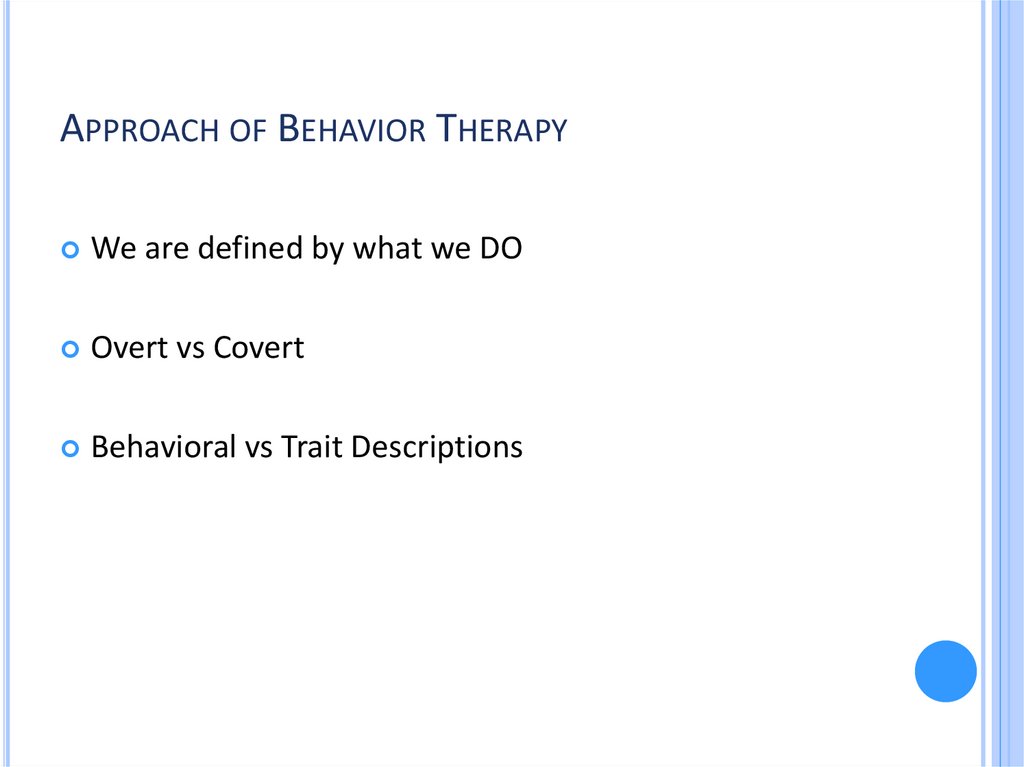
APPROACH OF BEHAVIOR THERAPYWe are defined by what we DO
Overt vs Covert
Behavioral vs Trait Descriptions
24. ABC’s of Behavior Therapy
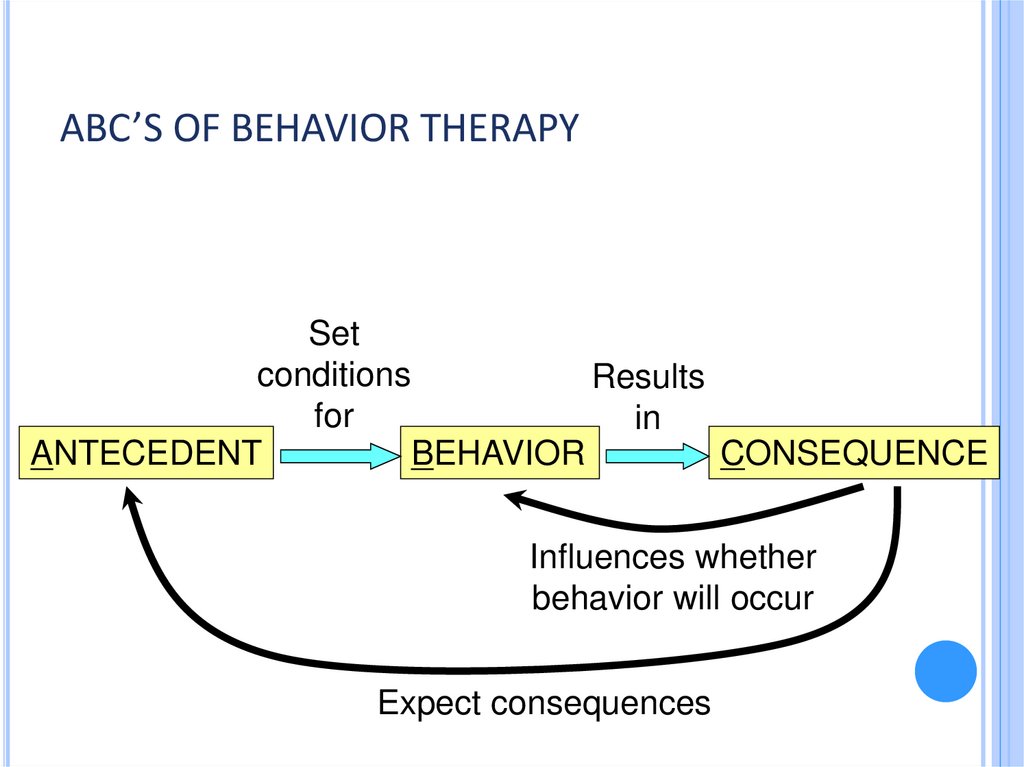
ABC’S OF BEHAVIOR THERAPYSet
conditions
Results
for
in
ANTECEDENT
BEHAVIOR
CONSEQUENCE
Influences whether
behavior will occur
Expect consequences
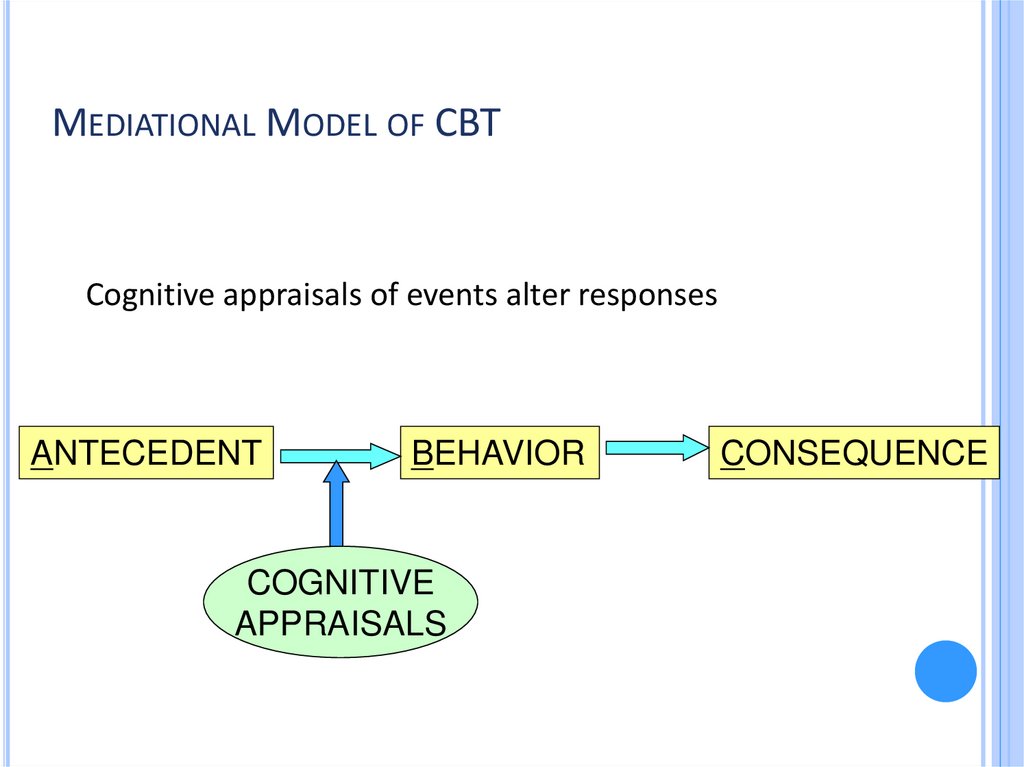
25. Mediational Model of CBT
MEDIATIONAL MODEL OF CBTCognitive appraisals of events alter responses
ANTECEDENT
BEHAVIOR
COGNITIVE
APPRAISALS
CONSEQUENCE
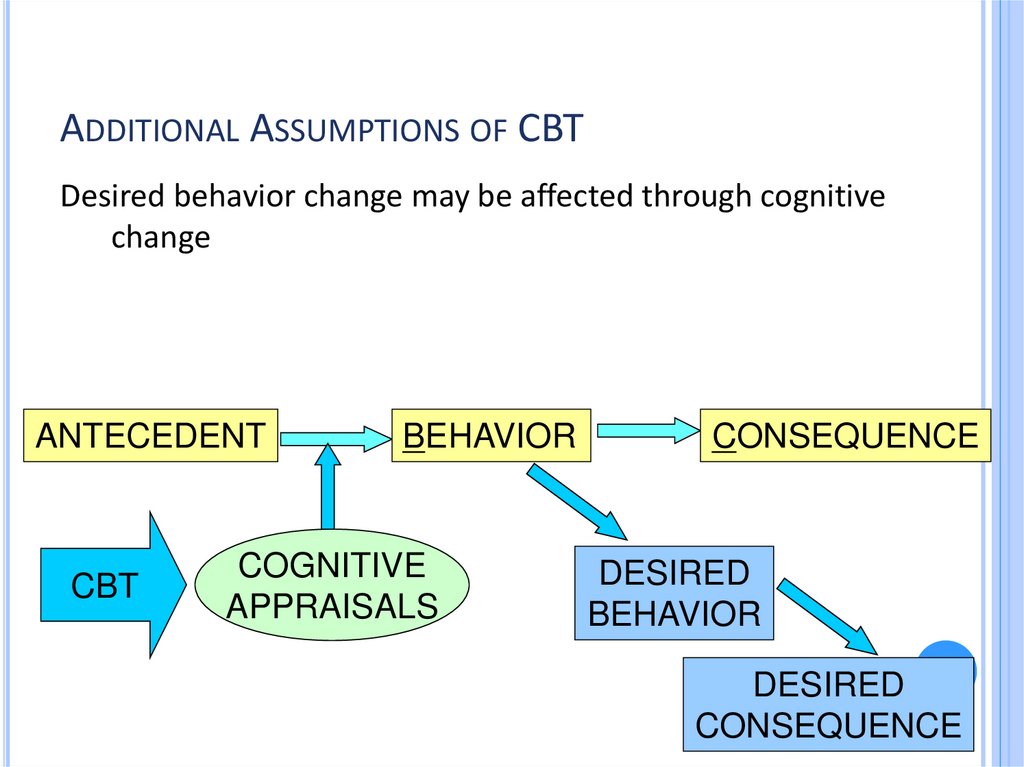
26. Additional Assumptions of CBT
ADDITIONAL ASSUMPTIONS OF CBTDesired behavior change may be affected through cognitive
change
ANTECEDENT
CBT
BEHAVIOR
COGNITIVE
APPRAISALS
CONSEQUENCE
DESIRED
BEHAVIOR
DESIRED
CONSEQUENCE
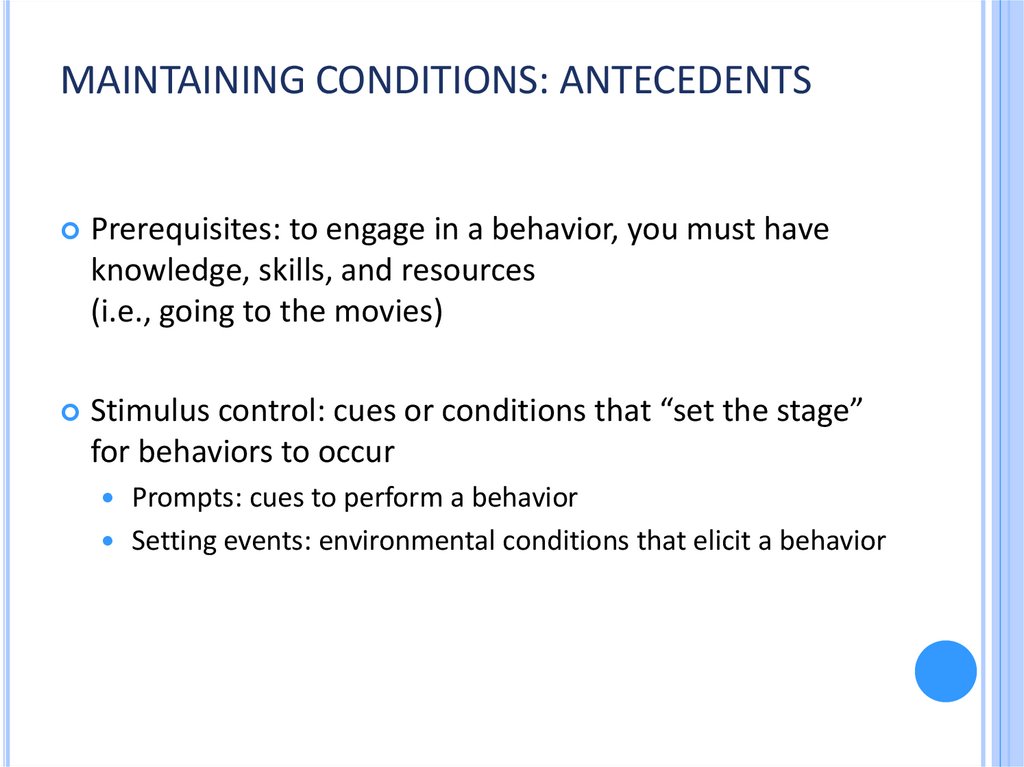
27. MAINTAINING CONDITIONS: ANTECEDENTS
Prerequisites: to engage in a behavior, you must haveknowledge, skills, and resources
(i.e., going to the movies)
Stimulus control: cues or conditions that “set the stage”
for behaviors to occur
Prompts: cues to perform a behavior
Setting events: environmental conditions that elicit a behavior
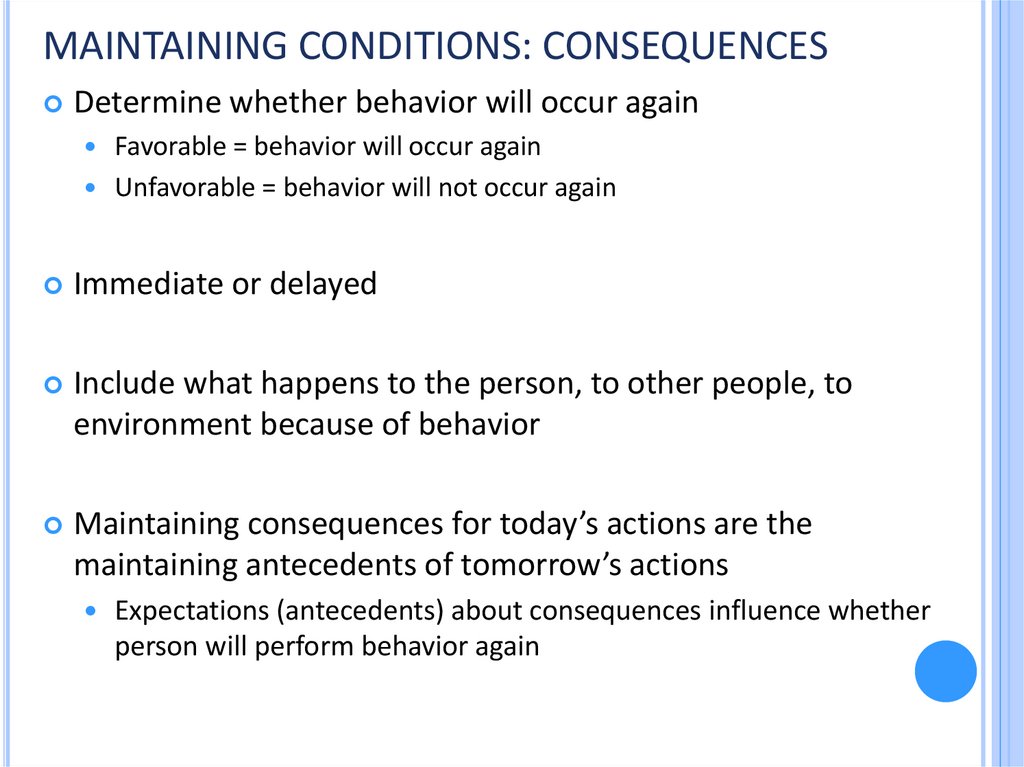
28. MAINTAINING CONDITIONS: CONSEQUENCES
Determine whether behavior will occur againFavorable = behavior will occur again
Unfavorable = behavior will not occur again
Immediate or delayed
Include what happens to the person, to other people, to
environment because of behavior
Maintaining consequences for today’s actions are the
maintaining antecedents of tomorrow’s actions
Expectations (antecedents) about consequences influence whether
person will perform behavior again
29. Identifying Antecedents & Consequences
IDENTIFYING ANTECEDENTS & CONSEQUENCESManny spotted a fire alarm box at the corner. He wanted
to impress his friends and thought of all the excitement
that would occur if he pulled the alarm. After reading
the instructions on the fire alarm and looking to see that
no one was around, he pulled the alarm. Fire trucks
raced to the scene within minutes. A crowd quickly
gathered. The angry fire chief announced that it was a
false alarm. The fire marshal began an investigation,
while the crowd slowly dispersed and the fire trucks
returned to the station.
30. Role of past experiences?
ROLE OF PAST EXPERIENCES?Present maintaining conditions vs. past originating conditions
Same behavior may be maintained in present by conditions that are
very different from conditions in which it originated
Past events can have indirect effect on current behavior
Present behaviors are maintained by present maintaining
conditions
Learning/environment vs. Heredity and biology
31. Behavior Therapy vs Psychoanalysis
BEHAVIOR THERAPY VS PSYCHOANALYSISText says: “Psychoanalysis postulates that early experiences have a
direct and permanent effect on later behaviors, implying that
current circumstances have little or no influence on adult (or later
childhood) behaviors
Text says: “behaviors that result from early experiences can, with
appropriate learning, be changed so that these early experiences
exert little or no influence on later behaviors”?
Text says: “Looking to past for determinants of present behavior
can be problematic. Examining past events is difficult and involves
gathering information that is retrospective, which is often
inaccurate.
32. Additional Assumptions of CBT
ADDITIONAL ASSUMPTIONS OF CBTPersonal control *critical for CBT*
-Individuals have control over their behaviors and
cognitions
Cognitive activity may be monitored & altered
i.e. thought listing, cognitive restructuring
Reciprocal Determinism: Reciprocal relationship between
environment, overt behaviors, and covert behaviors