Similar presentations:





Разработка ПО
1.
Software DevelopmentFrom Idea to Finished Product
2.
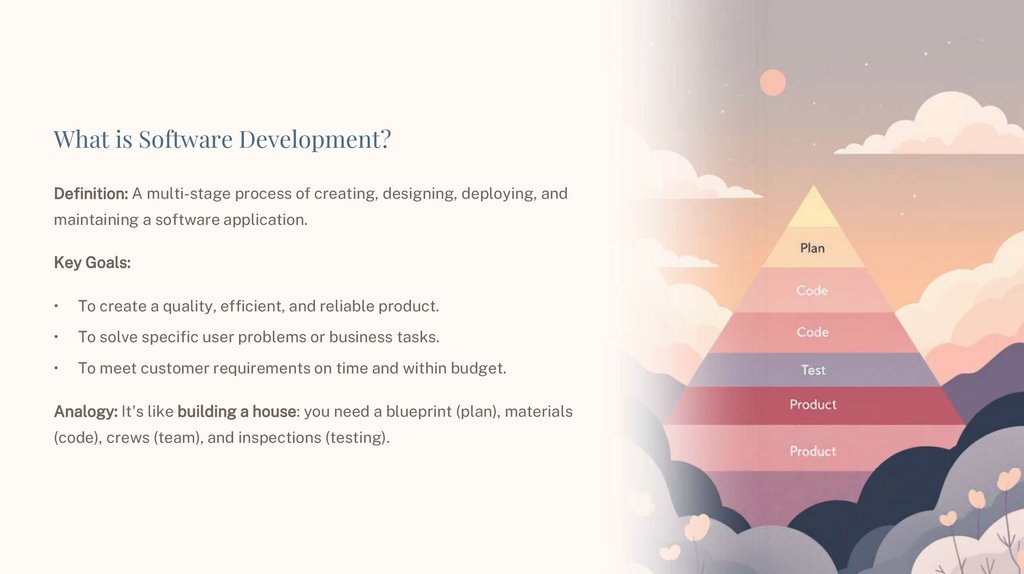
What is Software Development?Definition: A multi-stage process of creating, designing, deploying, and
maintaining a software application.
Key Goals:
To create a quality, efficient, and reliable product.
To solve specific user problems or business tasks.
To meet customer requirements on time and within budget.
Analogy: It's like building a house: you need a blueprint (plan), materials
(code), crews (team), and inspections (testing).
3.
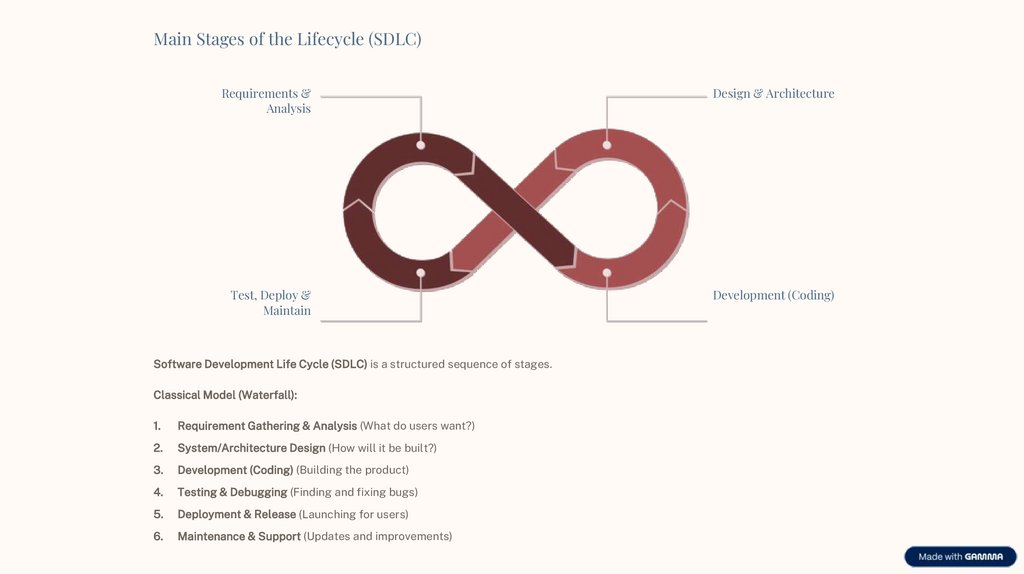
Main Stages of the Lifecycle (SDLC)Requirements &
Analysis
Design & Architecture
Test, Deploy &
Maintain
Development (Coding)
Software Development Life Cycle (SDLC) is a structured sequence of stages.
Classical Model (Waterfall):
1.
Requirement Gathering & Analysis (What do users want?)
2.
System/Architecture Design (How will it be built?)
3.
Development (Coding) (Building the product)
4.
Testing & Debugging (Finding and fixing bugs)
5.
Deployment & Release (Launching for users)
6.
Maintenance & Support (Updates and improvements)
4.
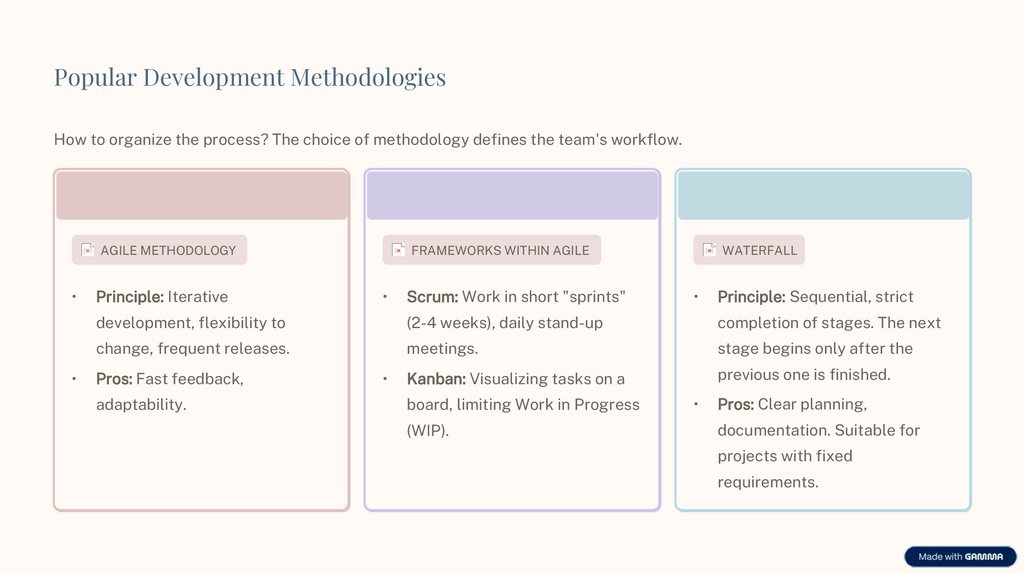
Popular Development MethodologiesHow to organize the process? The choice of methodology defines the team's workflow.
AGILE METHODOLOGY
Principle: Iterative
FRAMEWORKS WITHIN AGILE
Scrum: Work in short "sprints"
WATERFALL
Principle: Sequential, strict
development, flexibility to
(2-4 weeks), daily stand-up
completion of stages. The next
change, frequent releases.
meetings.
stage begins only after the
Kanban: Visualizing tasks on a
previous one is finished.
Pros: Fast feedback,
adaptability.
board, limiting Work in Progress
(WIP).
Pros: Clear planning,
documentation. Suitable for
projects with fixed
requirements.
5.
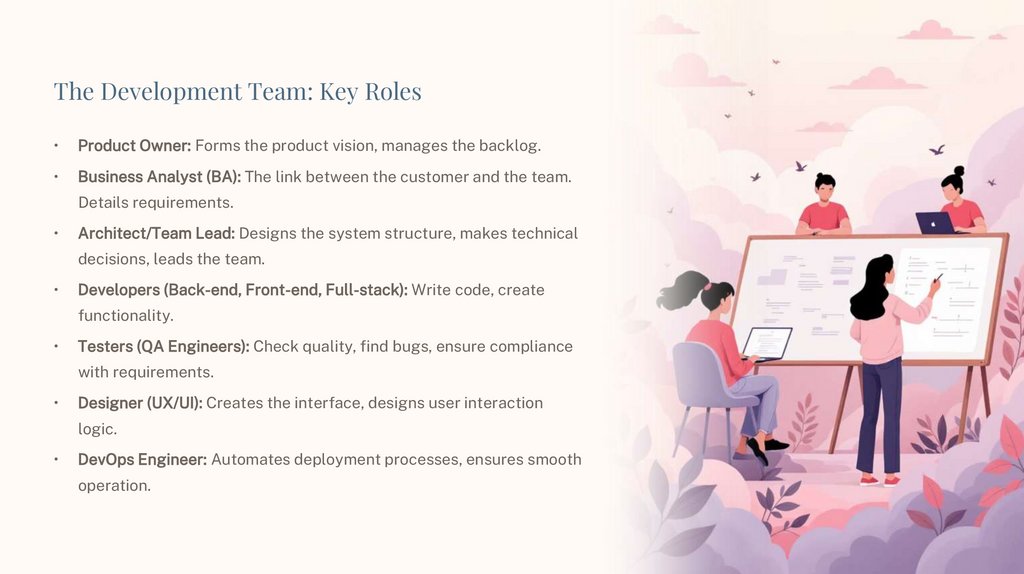
The Development Team: Key RolesProduct Owner: Forms the product vision, manages the backlog.
Business Analyst (BA): The link between the customer and the team.
Details requirements.
Architect/Team Lead: Designs the system structure, makes technical
decisions, leads the team.
Developers (Back-end, Front-end, Full-stack): Write code, create
functionality.
Testers (QA Engineers): Check quality, find bugs, ensure compliance
with requirements.
Designer (UX/UI): Creates the interface, designs user interaction
logic.
DevOps Engineer: Automates deployment processes, ensures smooth
operation.
6.
Technology Stack (Tech Stack)A set of technologies, languages, and tools for building a product.
Frontend (Client-side)
Backend (Server-side)
Infrastructure & Tools
What the user sees.
Logic and data on the server.
Languages: HTML, CSS,
JavaScript.
Frameworks: React, Angular,
Vue.js.
Databases: PostgreSQL, MySQL,
MongoDB, Redis.
Containerization: Docker,
Kubernetes.
Frameworks: Django, Spring,
.NET, Express.js.
(GitHub, GitLab).
Languages: Python, Java, C#,
JavaScript (Node.js), PHP, Go.
Version Control Systems: Git
Clouds: AWS, Google Cloud,
Microsoft Azure.
7.
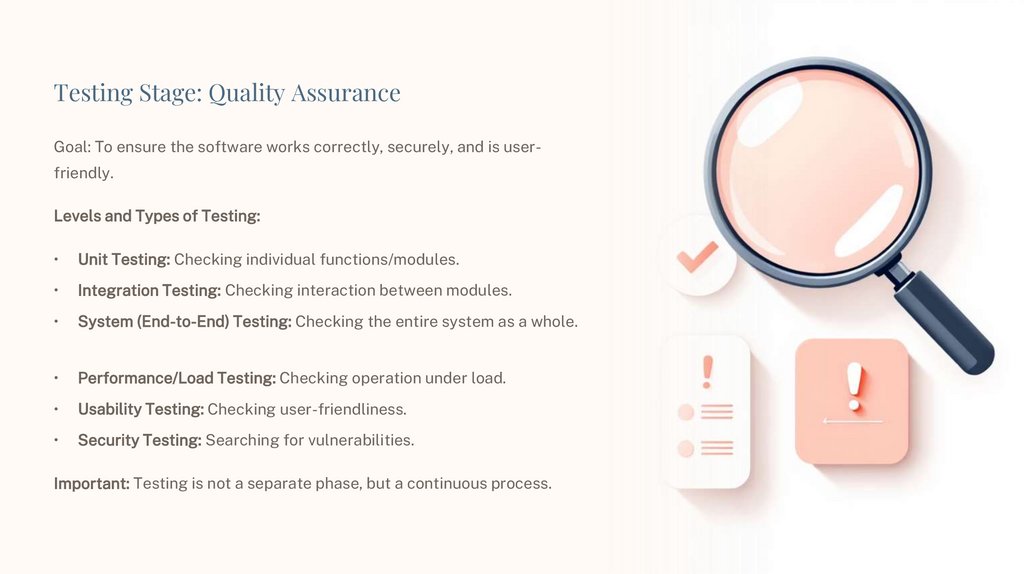
Testing Stage: Quality AssuranceGoal: To ensure the software works correctly, securely, and is userfriendly.
Levels and Types of Testing:
Unit Testing: Checking individual functions/modules.
Integration Testing: Checking interaction between modules.
System (End-to-End) Testing: Checking the entire system as a whole.
Performance/Load Testing: Checking operation under load.
Usability Testing: Checking user-friendliness.
Security Testing: Searching for vulnerabilities.
Important: Testing is not a separate phase, but a continuous process.
8.
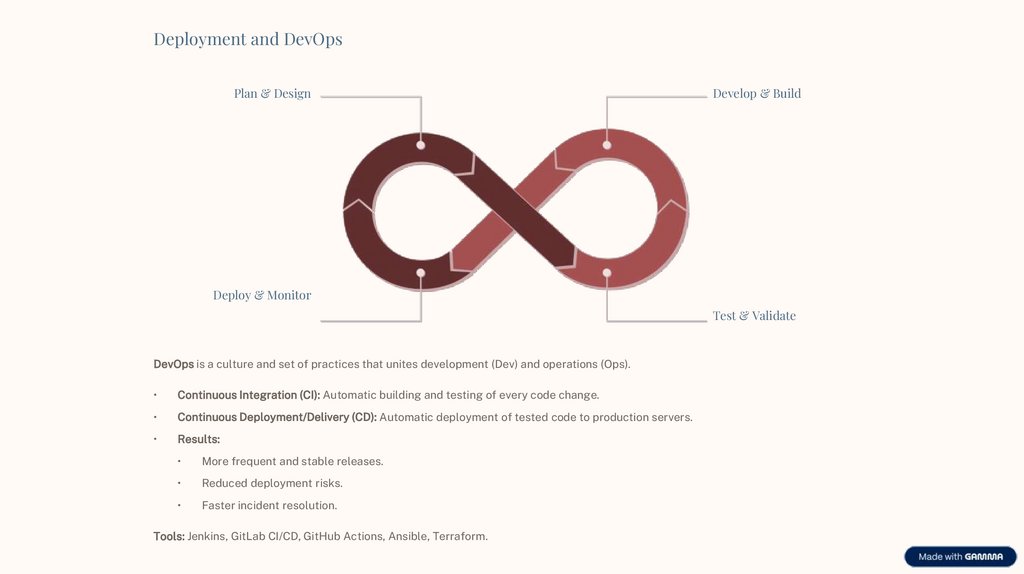
Deployment and DevOpsPlan & Design
Develop & Build
Deploy & Monitor
Test & Validate
DevOps is a culture and set of practices that unites development (Dev) and operations (Ops).
Continuous Integration (CI): Automatic building and testing of every code change.
Continuous Deployment/Delivery (CD): Automatic deployment of tested code to production servers.
Results:
More frequent and stable releases.
Reduced deployment risks.
Faster incident resolution.
Tools: Jenkins, GitLab CI/CD, GitHub Actions, Ansible, Terraform.
9.
Trends in Software DevelopmentArtificial Intelligence & Machine Learning
(AI/ML)
Low-Code/No-Code Platforms
Accelerating development with visual tools.
Integrating smart features (chatbots,
recommendations).
Cross-Platform Development
Microservices Architecture
Creating apps for iOS and Android from a single
Replacing monolithic systems with a set of
codebase (Flutter, React Native).
independent services.
Cybersecurity (Security by Design)
Cloud-Native Technologies
Building security into the design phase.
Developing applications specifically for the cloud
from the start.
10.
Conclusion. The Key to SuccessSoftware Development is:
✅ Teamwork and clear communication.
✅ A structured process from idea to support.
✅ A balance between technology, business tasks, and user needs.
✅ Continuous learning and adaptation to new trends.