 mechanics
Similar presentations:






Angular Motion (EE007-4-0 Mechanics For Engineers)
1.
EE007-4-0 Mechanics For EngineersTopic 11 : Angular Motion
EE007-4-0 Mechanics For Engineers
Angular Motion
SLIDE 1
2. TOPIC LEARNING OUTCOMES
At the end of this topic, you should be able to:1. relate linear displacement, velocity and acceleration with angular displacement,
velocity and acceleration.
2. solve problems on motion with constant acceleration by using kinematics
equations.
EE007-4-0 Mechanics For Engineers
Angular Motion
SLIDE 2
3. Contents & Structure
Contents & Structure• Conversion from angular to linear displacement, velocity and acceleration
• Kinematic equation (angular)
EE007-4-0 Mechanics For Engineers
Angular Motion
SLIDE 3
4. Recap From Last Lesson
• Linear Motion – variable acceleration• Linear Motion – constant acceleration
EE007-4-0 Mechanics For Engineers
Angular Motion
SLIDE 4
5. ANGULAR MOTION
Teaching ContentsANGULAR MOTION
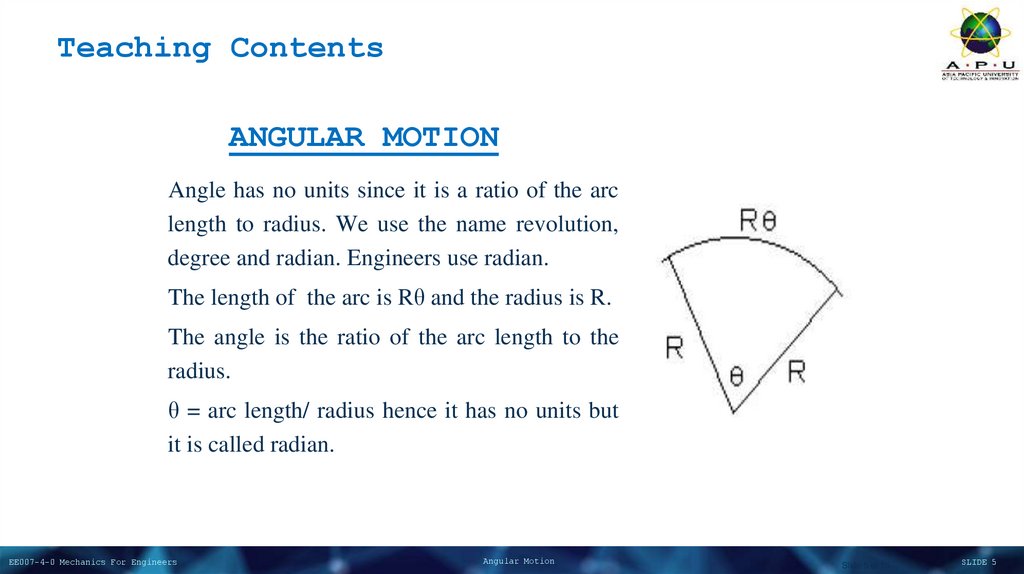
Angle has no units since it is a ratio of the arc
length to radius. We use the name revolution,
degree and radian. Engineers use radian.
The length of the arc is Rθ and the radius is R.
The angle is the ratio of the arc length to the
radius.
θ = arc length/ radius hence it has no units but
it is called radian.
EE007-4-0 Mechanics For Engineers
Angular Motion
Slide 5 of 15
SLIDE 5
6. ANGULAR VELOCITY
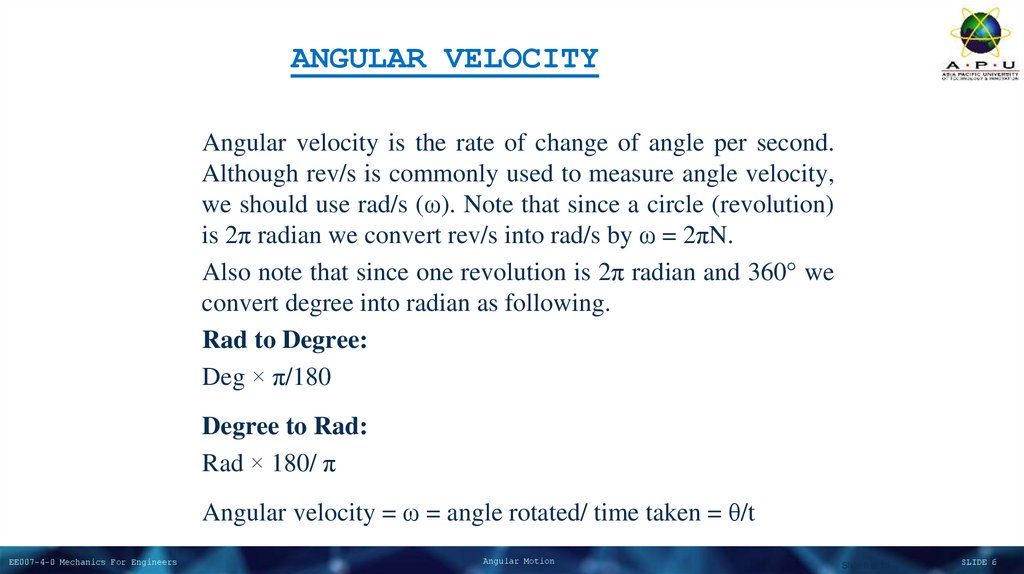
Angular velocity is the rate of change of angle per second.Although rev/s is commonly used to measure angle velocity,
we should use rad/s (ω). Note that since a circle (revolution)
is 2π radian we convert rev/s into rad/s by ω = 2πN.
Also note that since one revolution is 2π radian and 360° we
convert degree into radian as following.
Rad to Degree:
Deg × π/180
Degree to Rad:
Rad × 180/ π
Angular velocity = ω = angle rotated/ time taken = θ/t
EE007-4-0 Mechanics For Engineers
Angular Motion
Slide 6 of 15
SLIDE 6
7. WORKED EXAMPLE
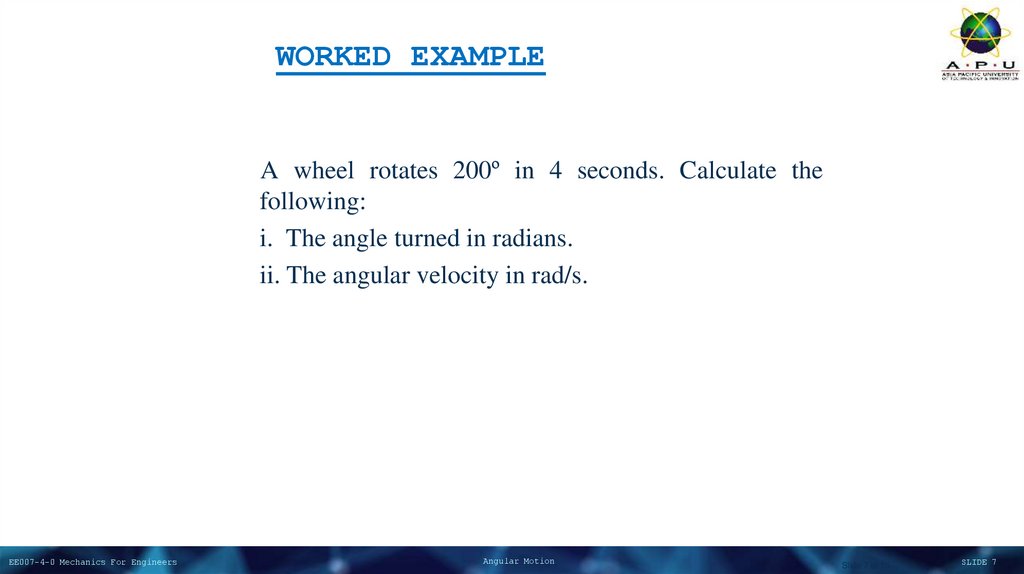
A wheel rotates 200º in 4 seconds. Calculate thefollowing:
i. The angle turned in radians.
ii. The angular velocity in rad/s.
EE007-4-0 Mechanics For Engineers
Angular Motion
Slide 7 of 15
SLIDE 7
8. WORKED EXAMPLE
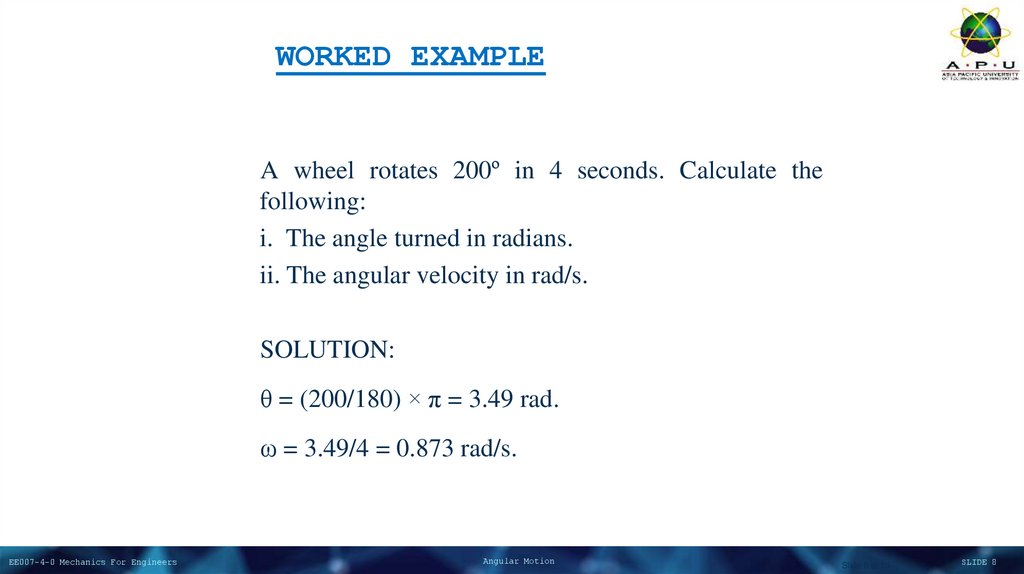
A wheel rotates 200º in 4 seconds. Calculate thefollowing:
i. The angle turned in radians.
ii. The angular velocity in rad/s.
SOLUTION:
θ = (200/180) × π = 3.49 rad.
ω = 3.49/4 = 0.873 rad/s.
EE007-4-0 Mechanics For Engineers
Angular Motion
Slide 8 of 15
SLIDE 8
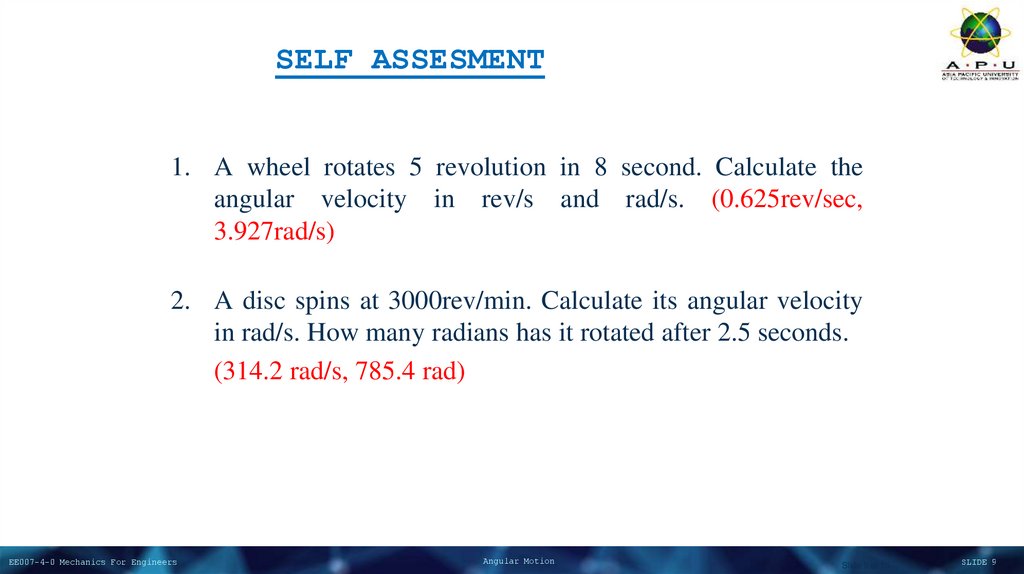
9. SELF ASSESMENT
1. A wheel rotates 5 revolution in 8 second. Calculate theangular velocity in rev/s and rad/s. (0.625rev/sec,
3.927rad/s)
2. A disc spins at 3000rev/min. Calculate its angular velocity
in rad/s. How many radians has it rotated after 2.5 seconds.
(314.2 rad/s, 785.4 rad)
EE007-4-0 Mechanics For Engineers
Angular Motion
Slide 9 of 15
SLIDE 9
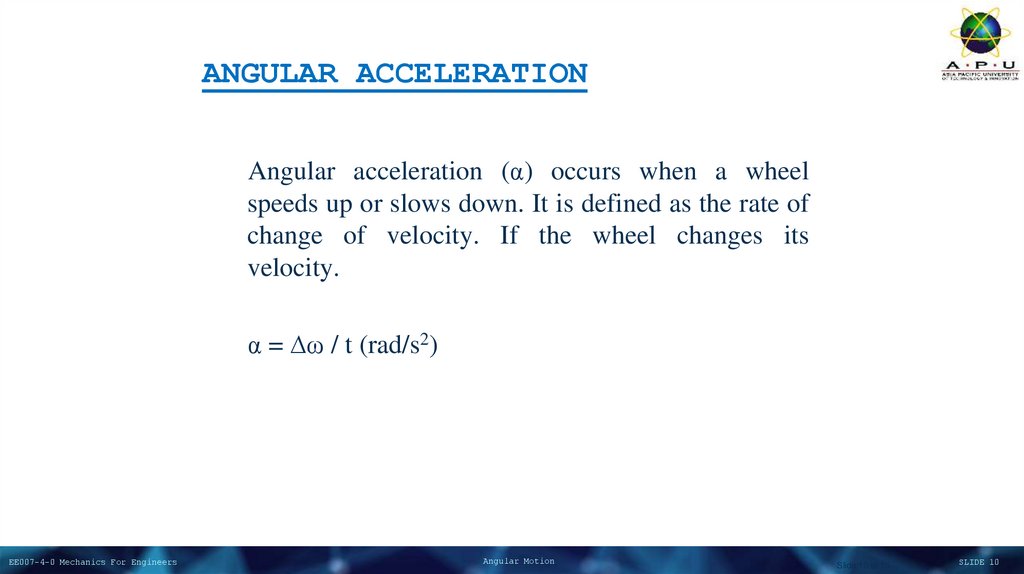
10. ANGULAR ACCELERATION
Angular acceleration (α) occurs when a wheelspeeds up or slows down. It is defined as the rate of
change of velocity. If the wheel changes its
velocity.
α = ∆ω / t (rad/s2)
EE007-4-0 Mechanics For Engineers
Angular Motion
Slide 10 of 15
SLIDE 10
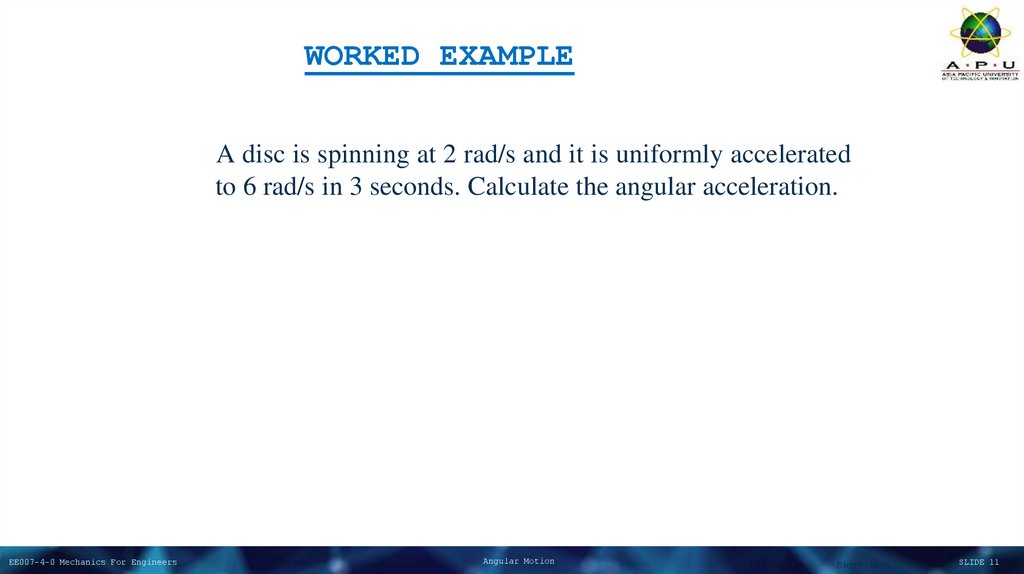
11. WORKED EXAMPLE
A disc is spinning at 2 rad/s and it is uniformly acceleratedto 6 rad/s in 3 seconds. Calculate the angular acceleration.
EE007-4-0 Mechanics For Engineers
Angular Motion
Slide 11 of 15
SLIDE 11
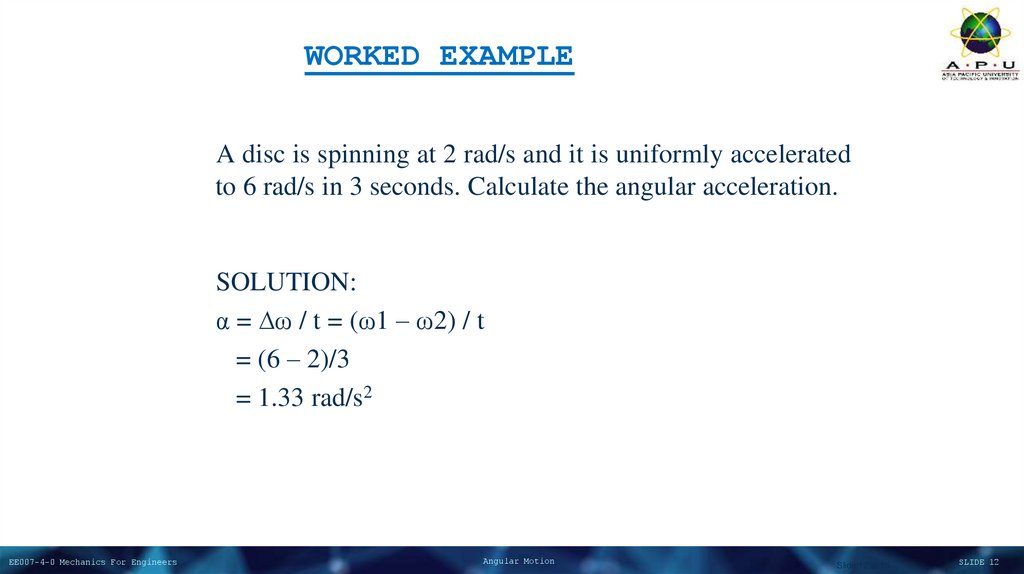
12. WORKED EXAMPLE
A disc is spinning at 2 rad/s and it is uniformly acceleratedto 6 rad/s in 3 seconds. Calculate the angular acceleration.
SOLUTION:
α = ∆ω / t = (ω1 – ω2) / t
= (6 – 2)/3
= 1.33 rad/s2
EE007-4-0 Mechanics For Engineers
Angular Motion
Slide 12 of 15
SLIDE 12
13. SELF ASSESMENT
1. A wheel at rest accelerates to 8 rad/s in 2 seconds.Calculate the acceleration.
(4 rad/s2)
2. A flywheel spins at 5000 rev/ min and is decelerated
uniformly to 2000 rev/min in 12 seconds. Calculate the
acceleration in rad/s. (-26.2 rad/s2)
EE007-4-0 Mechanics For Engineers
Angular Motion
Slide 13 of 15
SLIDE 13
14. ANGULAR & LINEAR MOTION
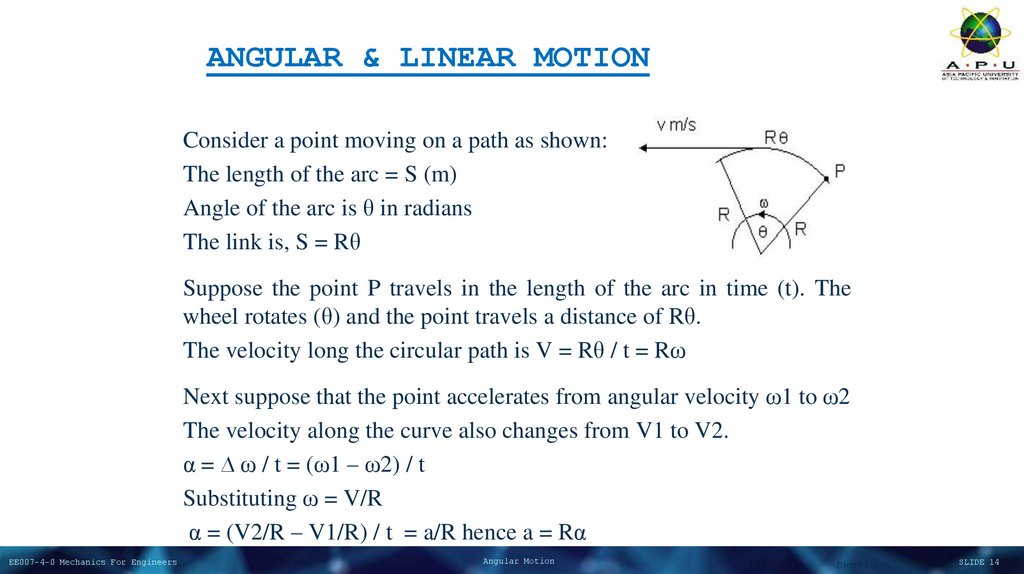
ANGULAR & LINEAR MOTIONConsider a point moving on a path as shown:
The length of the arc = S (m)
Angle of the arc is θ in radians
The link is, S = Rθ
Suppose the point P travels in the length of the arc in time (t). The
wheel rotates (θ) and the point travels a distance of Rθ.
The velocity long the circular path is V = Rθ / t = Rω
Next suppose that the point accelerates from angular velocity ω1 to ω2
The velocity along the curve also changes from V1 to V2.
α = ∆ ω / t = (ω1 – ω2) / t
Substituting ω = V/R
α = (V2/R – V1/R) / t = a/R hence a = Rα
EE007-4-0 Mechanics For Engineers
Angular Motion
Slide 14 of 15
SLIDE 14
15. WORKED EXAMPLE
A car travels around a circular track of a radius 40 m at avelocity of 8 m/s. Calculate its angular velocity.
EE007-4-0 Mechanics For Engineers
Angular Motion
Slide 15 of 15
SLIDE 15
16. WORKED EXAMPLE
A car travels around a circular track of a radius 40 m at avelocity of 8 m/s. Calculate its angular velocity.
SOLUTION:
V=ωR
ω=V/R
= 8 / 40 = 0.2 rad/s
EE007-4-0 Mechanics For Engineers
Angular Motion
Slide 16 of 15
SLIDE 16
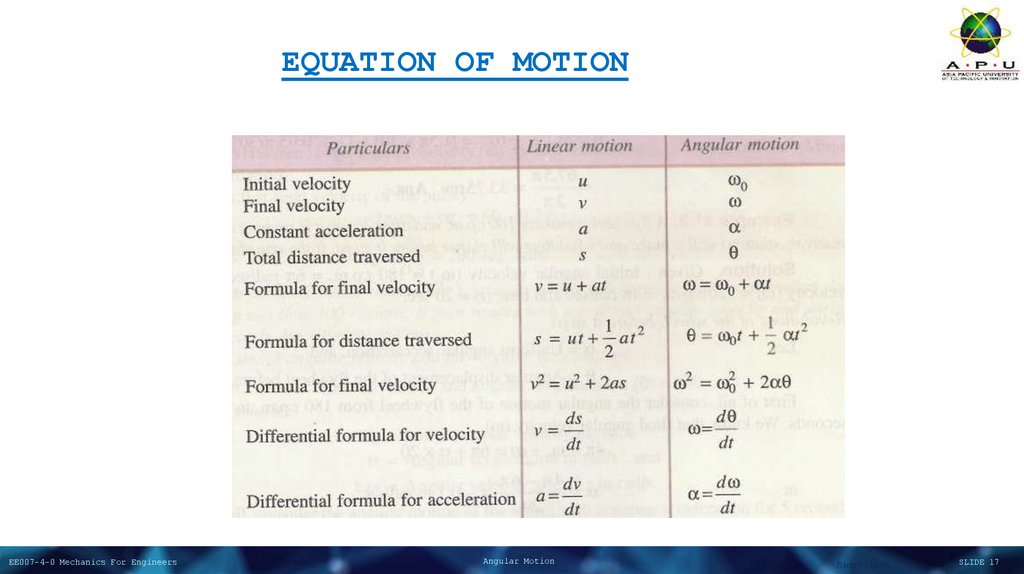
17. EQUATION OF MOTION
EE007-4-0 Mechanics For EngineersAngular Motion
Slide 17 of 15
SLIDE 17
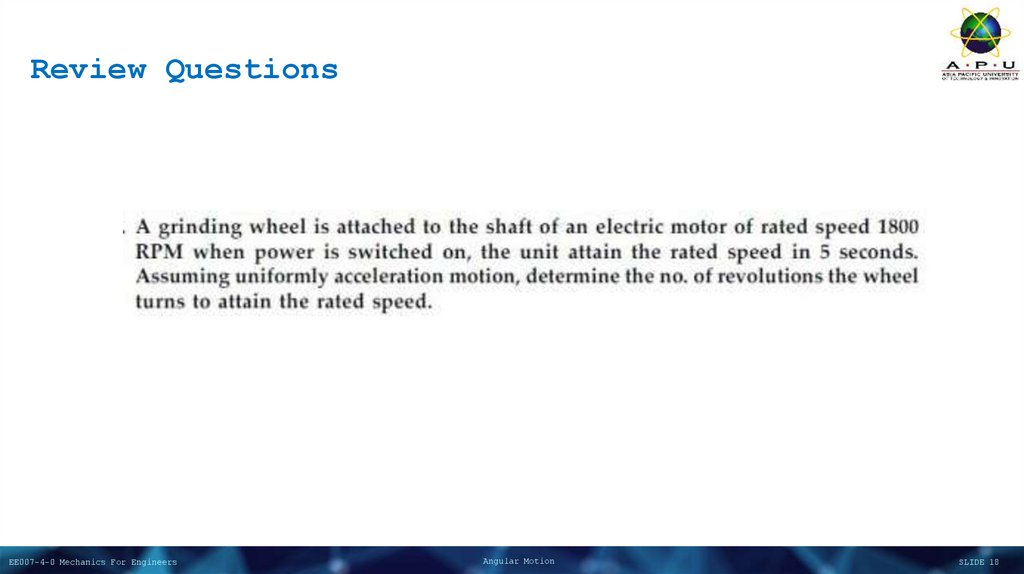
18. Review Questions
EE007-4-0 Mechanics For EngineersAngular Motion
SLIDE 18
19. Summary / Recap of Main Points
• Conversion from angular to linear displacement, velocity and acceleration• Kinematic equation (angular)
EE007-4-0 Mechanics For Engineers
Angular Motion
SLIDE 19
20. What To Expect Next Week
In Class• Impact and Collision
EE007-4-0 Mechanics For Engineers
Preparation for Class
• Momentum
• Conservation of momentum
Angular Motion
SLIDE 20