 policy
Similar presentations:




European Union
1.
European Union2.
European UnionThe European Union (EU) is a political and economic union of 27 member
states that are located primarily in Europe.
The union and EU citizenship were established when the Maastricht
Treaty came into force in 1993. The EU traces its origins to the European
Coal and Steel Community (ECSC) and the European Economic
Community (EEC), established, respectively, by the 1951 Treaty of
Paris and 1957 Treaty of Rome. The original member states of what came
to be known as the European Communities were the Inner Six: Belgium,
France, Italy, Luxembourg, the Netherlands, and West Germany.
Containing some 5.8 per cent of the world population in 2020, the EU had
generated a nominal gross domestic product (GDP) of
around US$17.1 trillion in 2021, constituting approximately 18% of
global nominal GDP.
3.
Member statesThe European Union (EU) consists of 27 member
states which are signatories to the founding treaties of the
union and thereby shares in the privileges and obligations of
membership. They have agreed by the treaties to share their
own sovereignty through the institutions of the European
Union in some (but by no means all) aspects of government.
In the 1950s, six core states founded the EU's
predecessor European
Communities (Belgium, France, Italy, Luxembourg,
the Netherlands, and West Germany). The remaining states
have acceded in subsequent enlargements.
4.
Member statesEnlargements:
The 1973 enlargement of the European Communities:
Denmark, Ireland and the United Kingdom (UK) acceded to the EC.
Gibraltar and Greenland also joined the EC as part of the United Kingdom
and Denmark respectively, but the Danish Faroe Islands, the other British
Overseas Territories and the Crown dependencies of the United
Kingdom did not join the EC.
The 1981 enlargement of the European Communities (Mediterranean
enlargement): Greece.
The 1986 enlargement of the European Communities (Mediterranean
enlargement): Spain and Portugal.
The 1995 enlargement of the European Union: Austria, Finland,
and Sweden.
The 2004 enlargement of the European Union: Cyprus, the Czech
Republic, Estonia, Hungary, Latvia, Lithuania, Malta, Poland, Slovakia an
d Slovenia.
The 2007 enlargement of the European Union: Bulgaria and Romania.
The 2013 enlargement of the European Union: Croatia.
5.
BrexitUK’s withdrawal from the European Union
The decision took place on 23 June 2016 in the United Kingdom (UK)
and Gibraltar to ask the electorate whether the country should remain a
member of, or leave, the European Union (EU).
Results: 51,89% in favour; 48,11% against.
The actual withdrawal took place on 31 January 2020. The UK entered a
Transition Period for the rest of 2020. Trade, travel and freedom of
movement remain largely unchanged during this period. The Transition
Period ended on 31 December 2020.
The UK is the first and so far only sovereign country to have left the EU,
after 47 years of having been a member state of the EU and its
predecessor, the European Communities (EC), since 1 January
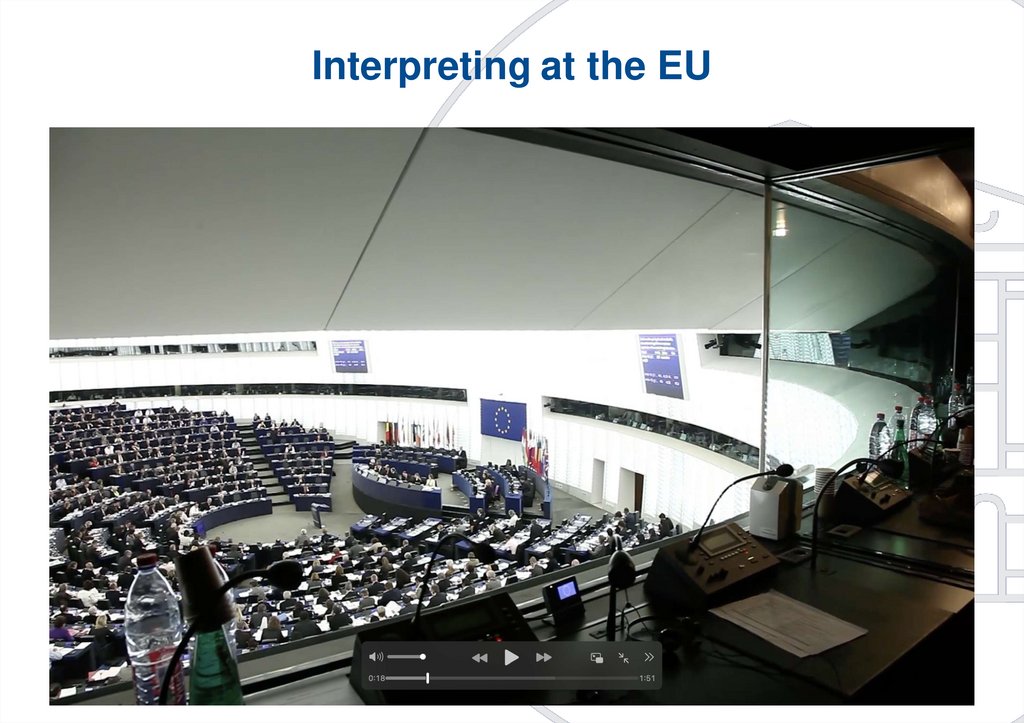
1973. Greenland left the EC 1 February 1985.
Under the terms of the Brexit Withdrawal Agreement, Northern
Ireland continues to participate in the European Single Market in relation to
goods, and to be a de facto member of the EU Customs Union.
6.
LanguagesThe EU has 24 official languages:
Bulgarian
Croatian
Czech
Danish
Dutch
English
Estonian
Finnish
French
German
Greek
Hungarian
Irish
Italian
Latvian
Lithuanian
Maltese
Polish
Portuguese
Romanian
Slovak
Slovenian
Spanish
Swedish
7.
EU structureEU institutions and bodies:
European Parliament
European Council
Council of the European Union
European Commission
Court of Justice of the European Union (CJEU)
European Central Bank (ECB)
European Court of Auditors (ECA)
European External Action Service (EEAS)
European Economic and Social Committee (EESC)
European Committee of the Regions (CoR)
European Investment Bank (EIB)
European Ombudsman
European Data Protection Supervisor (EDPS)
European Data Protection Board (EDPB)
Interinstitutional bodies
8.
European ParliamentRole: Directly-elected EU body with legislative, supervisory, and budgetary responsibilities
Members: 705 MEPs (Members of the European Parliament)
President: Roberta Metsola
Established in: 1952 as Common Assembly of the European Coal and Steel Community, 1962 as European
Parliament, first direct elections in 1979
Location: Strasbourg (France) (plenary sessions), Brussels (Belgium) (the Parliament's committee
meetings), Luxembourg (the Parliament's secretariat)
The European Parliament is the EU's law-making body. It is directly elected by EU voters every 5 years. The
last elections were in 2022.
Three main roles: legislative (passing EU laws, together with the Council of the EU, based on European
Commission proposals, deciding on international agreements, deciding on enlargements, reviewing the
Commission's work programme and asking it to propose legislation), supervisory (democratic scrutiny of all EU
institutions, granting discharge, i.e. approving the way EU budgets have been spent, Examining
citizens' petitions and setting up inquiries), budgetary (establishing the EU budget, together with the Council,
Approving the EU's long-term budget, the "Multiannual Financial Framework”).
9.
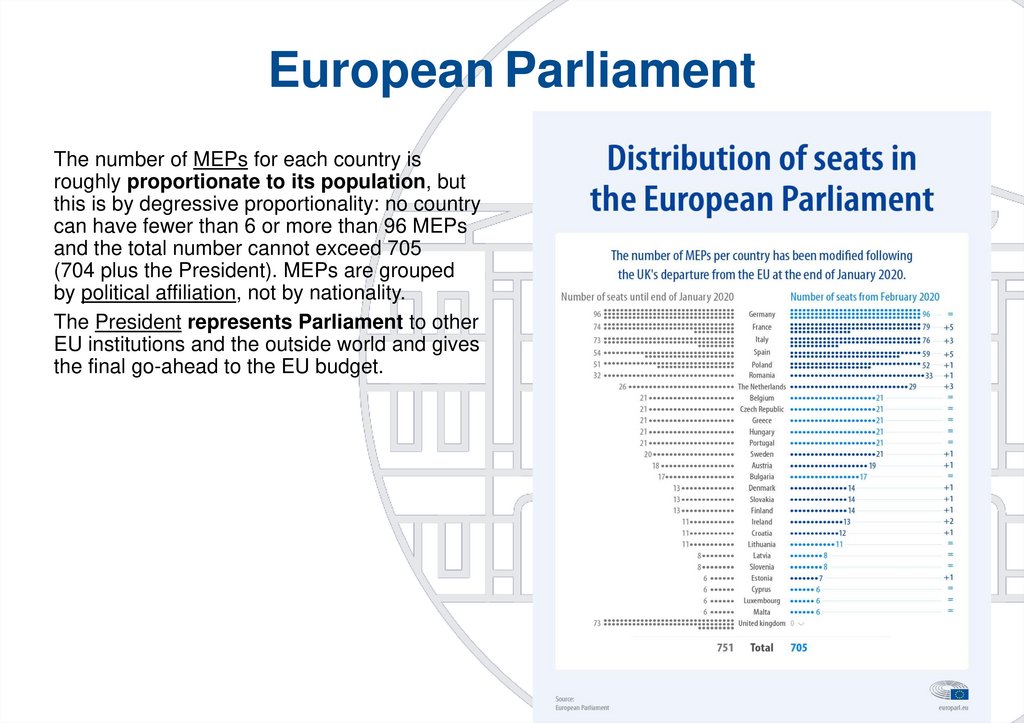
European ParliamentThe number of MEPs for each country is
roughly proportionate to its population, but
this is by degressive proportionality: no country
can have fewer than 6 or more than 96 MEPs
and the total number cannot exceed 705
(704 plus the President). MEPs are grouped
by political affiliation, not by nationality.
The President represents Parliament to other
EU institutions and the outside world and gives
the final go-ahead to the EU budget.
10.
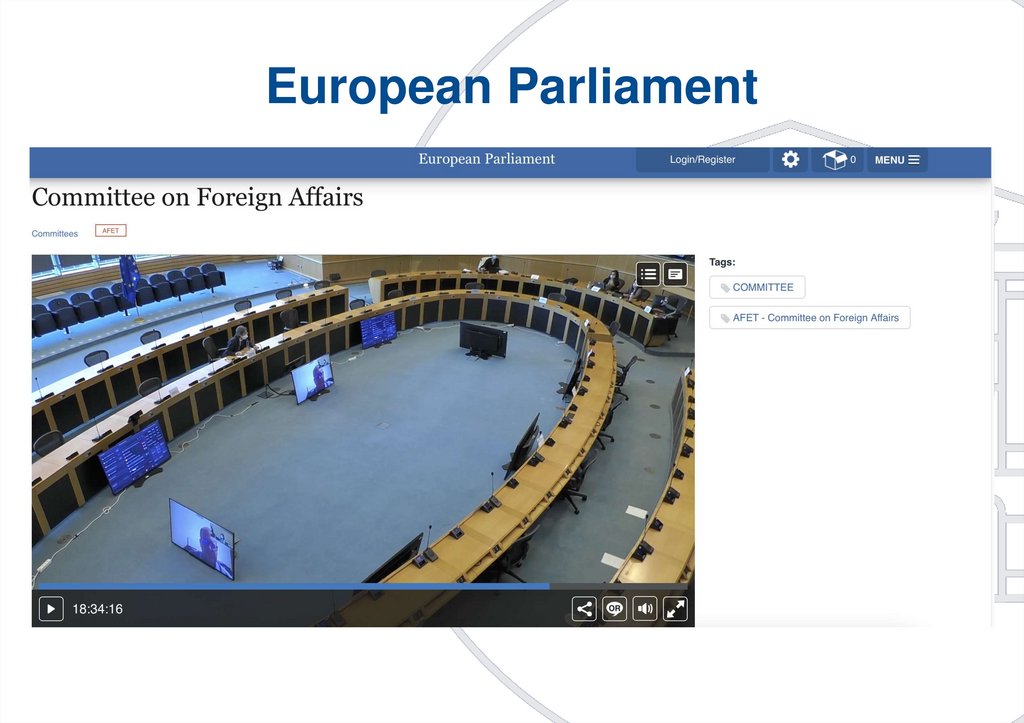
European ParliamentHow does the Parliament work?
Parliament's work comprises two main stages:
Committees - to prepare legislation.
The Parliament numbers 20 committees and three subcommittees, each
handling a particular policy area. The committees examine proposals for
legislation, and MEPs and political groups can put forward amendments
or propose to reject a bill. These issues are also debated within the
political groups. You can watch the meetings online:
https://multimedia.europarl.europa.eu/en/search?st=&ut=&ol=WS_VIDEO
Plenary sessions – to pass legislation.
This is when all the MEPs gather in the chamber to give a final vote on
the proposed legislation and the proposed amendments. Normally held in
Strasbourg for four days a month, but sometimes there are additional
sessions in Brussels.
11.
European Parliament12.
Committees of the EuropeanParliament
List of EP Standing Committees:
AFET Foreign Affairs
DROI Human Rights
SEDE Security and Defence
DEVE Development
INTA International Trade
BUDG Budgets
CONT Budgetary Control
ECON Economic and Monetary
Affairs
EMPL Employment and Social
Affairs
ENVI Environment, Public Health
and Food Safety
ITRE Industry, Research and Energy
IMCO Internal Market and Consumer
Protection
TRAN Transport and Tourism
REGI Regional Development
AGRI Agriculture and Rural Development
PECH Fisheries
CULT Culture and Education
JURI Legal Affairs
LIBE Civil Liberties, Justice and Home
Affairs
AFCO Constitutional Affairs
FEMM Women's Rights and Gender
Equality
PETI Petitions
13.
European CouncilRole: Defines the general political direction and priorities of the European
Union
Members: Heads of state or government of EU countries, European Council
President, European Commission President
President: Charles Michel
Established in: 1974 (informal forum), 1992 (formal status), 2009 (official EU
institution)
Location: Brussels (Belgium).
The European Council brings together EU leaders to set the EU's political
agenda. It represents the highest level of political cooperation between EU
countries. One of the EU's 7 official institutions, the European Council takes
the form of (usually quarterly) summit meetings between EU leaders, chaired
by a permanent president.
14.
European CouncilWhat does the European Council do?
decides on the EU's overall direction and political priorities – but does not
pass laws
deals with complex or sensitive issues that cannot be resolved at lower
levels of intergovernmental cooperation
sets the EU's common foreign & security policy, taking into account EU
strategic interests and defence implications
nominates and appoints candidates to certain high profile EU level roles,
such as the ECB and the Commission
On each issue, the European Council can:
ask the European Commission to make a proposal to address it
pass it on to the Council of the EU to deal with
How does the European Council work?
It usually meets 4 times a year – but the President can convene additional
meetings to address urgent issues.
It generally decides issues by consensus – but by unanimity or qualified
majority in some cases. Only the heads of state/government can vote.
15.
Council of the European UnionRole: Voice of EU member governments, adopting EU laws and coordinating EU policies
Members: Government ministers from each EU country, according to the policy area to be
discussed
President: Each EU country holds the presidency on a 6-month rotating basis
Established in: 1958 (as Council of the European Economic Community)
Location: Brussels (Belgium).
In the Council of the EU, informally also known as the Council, government ministers from
each EU country meet to discuss, amend and adopt laws, and coordinate policies. The ministers
have the authority to commit their governments to the actions agreed on in the meetings.
Together with the European Parliament, the Council is the main decision-making body of the
EU.
Not to be confused with:
European Council - quarterly summits, where EU leaders meet to set the broad direction of EU
policy making.
Council of Europe - not an EU body at all.
16.
Council of the European UnionWhat does the Council do?
negotiates and adopts EU laws, together with
the European Parliament, based on proposals from
the European Commission
coordinates EU countries' policies
develops the EU's foreign & security policy, based
on European Council guidelines
concludes agreements between the EU and other countries
or international organisations
adopts the annual EU budget - jointly with the European
Parliament.
17.
Council of the European UnionComposition
There are no fixed members of the EU Council. Instead, the Council meets in 10 different
configurations, each corresponding to the policy area being discussed. Depending on the
configuration, each country sends their minister responsible for that policy area.
For example, when the Council meeting on economic and financial affairs (the "Ecofin Council") is held,
it is attended by each country's finance minister.
Who chairs the meetings?
The Foreign Affairs Council has a permanent chairperson - the EU High Representative for Foreign
Affairs and Security Policy. All other Council meetings are chaired by the relevant minister of the
country holding the rotating EU presidency.
For example, any Environment Council meeting in the period when Estonia holds the presidency will be
chaired by the Estonian environment minister.
Overall consistency is ensured by the General Affairs Council - which is supported by the Permanent
Representatives Committee. This is composed of EU countries' Permanent Representatives to the
EU, who are, in effect, national ambassadors to the EU.
18.
Council of the European UnionHow does the Council work?
EU ministers meet in public when they discuss or vote on draft legislative
acts
to be passed, decisions usually require a qualified majority:
55% of countries (with 27 current members, this means 15 countries)
representing at least 65 % of total EU population
You can watch the Council's public sessions live in all EU languages.
When a Council meeting is public, so are its minutes and votes.
To block a decision, at least 4 countries are needed (representing at
least 35% of total EU population)
exception - sensitive topics like foreign policy and taxation require
a unanimous vote (all countries in favour).
Simple majority is required for procedural & administrative issues.
19.
European CommissionRole: Promotes the general interest of the EU by proposing and
enforcing legislation as well as by implementing policies and the EU
budget
Members: A team or 'College' of Commissioners, 1 from each EU
country
President: Ursula von der Leyen
Year established: 1958
Location: Brussels (Belgium).
The European Commission is the EU's politically independent
executive arm. It is alone responsible for drawing up proposals for
new European legislation, and it implements the decisions of
the European Parliament and the Council of the EU.
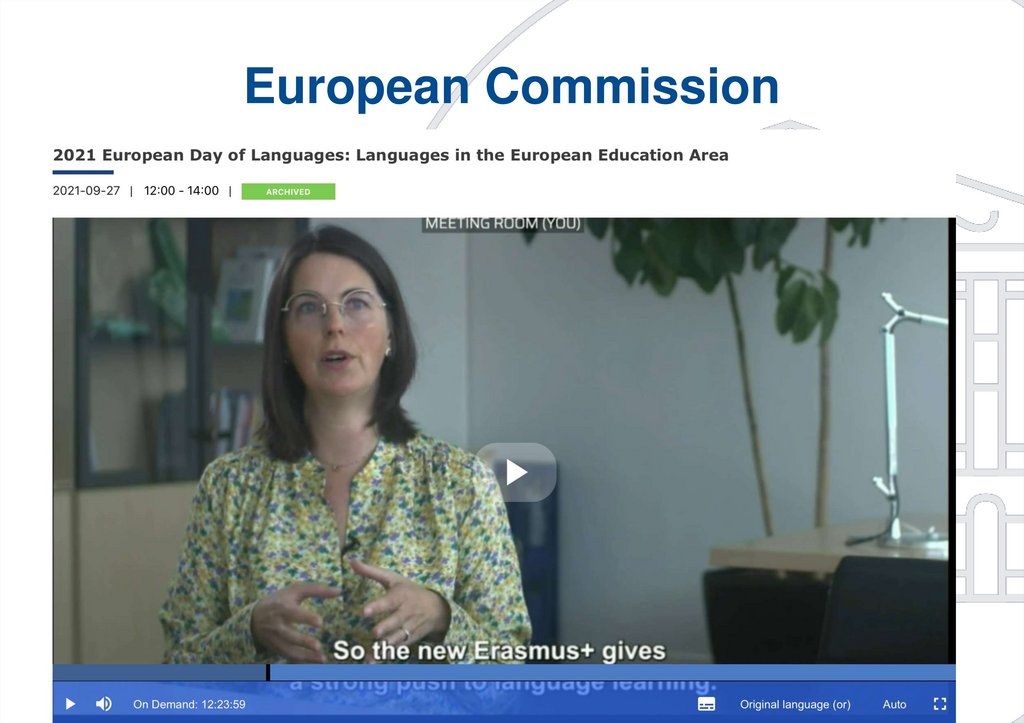
You can watch webstreaming of the meetings here:
https://webcast.ec.europa.eu
20.
European Commission21.
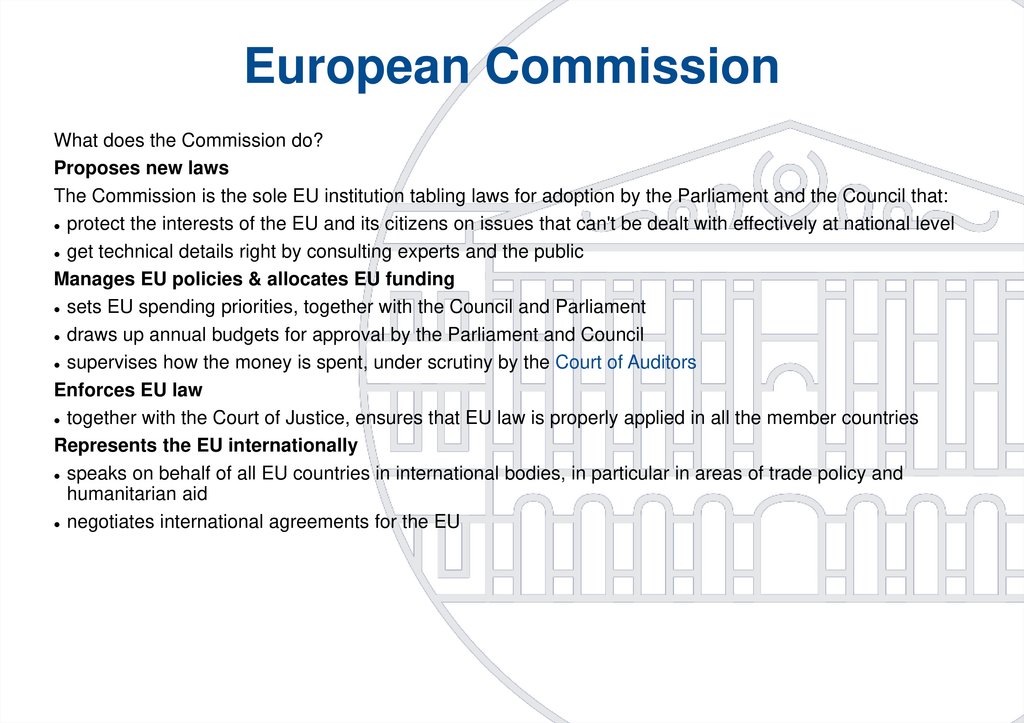
European CommissionWhat does the Commission do?
Proposes new laws
The Commission is the sole EU institution tabling laws for adoption by the Parliament and the Council that:
protect the interests of the EU and its citizens on issues that can't be dealt with effectively at national level
get technical details right by consulting experts and the public
Manages EU policies & allocates EU funding
sets EU spending priorities, together with the Council and Parliament
draws up annual budgets for approval by the Parliament and Council
supervises how the money is spent, under scrutiny by the Court of Auditors
Enforces EU law
together with the Court of Justice, ensures that EU law is properly applied in all the member countries
Represents the EU internationally
speaks on behalf of all EU countries in international bodies, in particular in areas of trade policy and
humanitarian aid
negotiates international agreements for the EU
22.
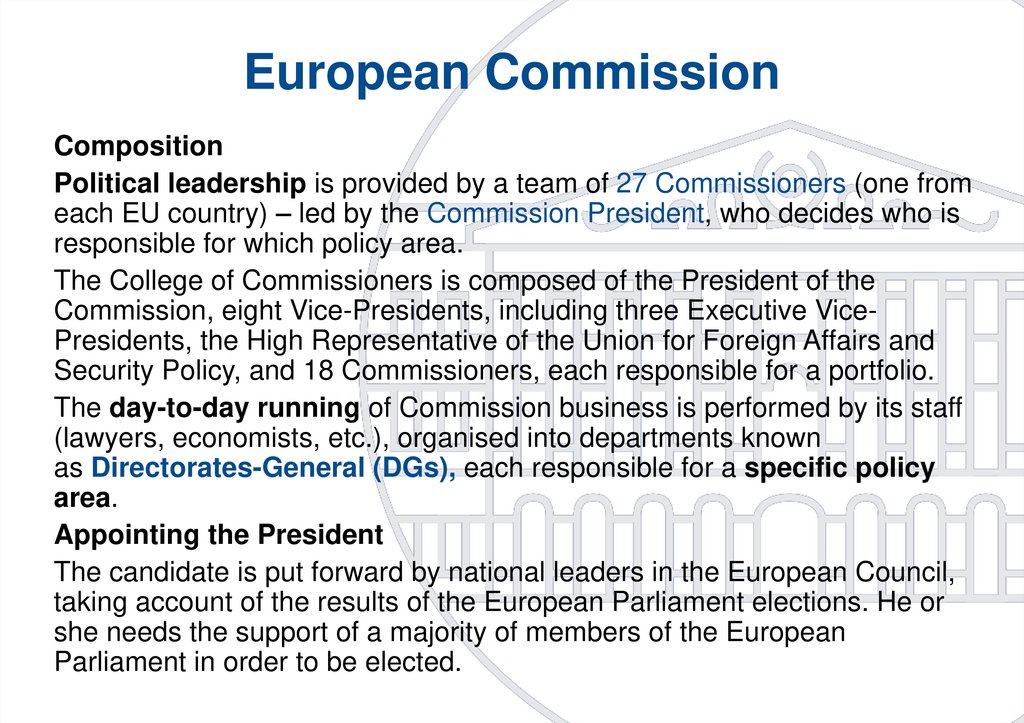
European CommissionComposition
Political leadership is provided by a team of 27 Commissioners (one from
each EU country) – led by the Commission President, who decides who is
responsible for which policy area.
The College of Commissioners is composed of the President of the
Commission, eight Vice-Presidents, including three Executive VicePresidents, the High Representative of the Union for Foreign Affairs and
Security Policy, and 18 Commissioners, each responsible for a portfolio.
The day-to-day running of Commission business is performed by its staff
(lawyers, economists, etc.), organised into departments known
as Directorates-General (DGs), each responsible for a specific policy
area.
Appointing the President
The candidate is put forward by national leaders in the European Council,
taking account of the results of the European Parliament elections. He or
she needs the support of a majority of members of the European
Parliament in order to be elected.
23.
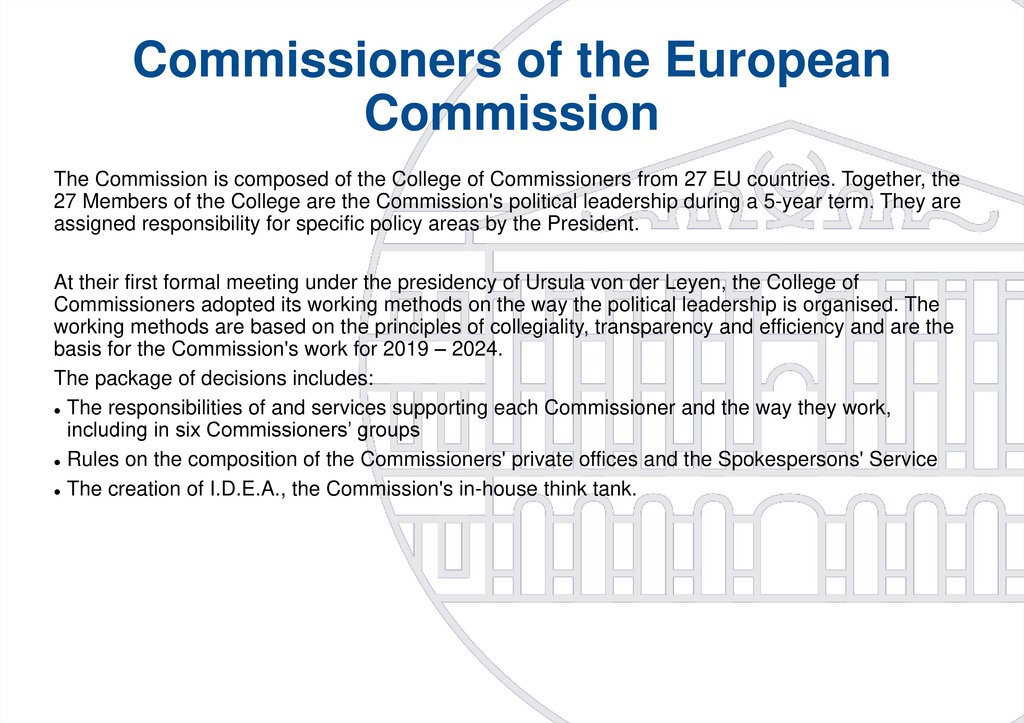
Commissioners of the EuropeanCommission
The Commission is composed of the College of Commissioners from 27 EU countries. Together, the
27 Members of the College are the Commission's political leadership during a 5-year term. They are
assigned responsibility for specific policy areas by the President.
At their first formal meeting under the presidency of Ursula von der Leyen, the College of
Commissioners adopted its working methods on the way the political leadership is organised. The
working methods are based on the principles of collegiality, transparency and efficiency and are the
basis for the Commission's work for 2019 – 2024.
The package of decisions includes:
The responsibilities of and services supporting each Commissioner and the way they work,
including in six Commissioners’ groups
Rules on the composition of the Commissioners' private offices and the Spokespersons' Service
The creation of I.D.E.A., the Commission's in-house think tank.
24.
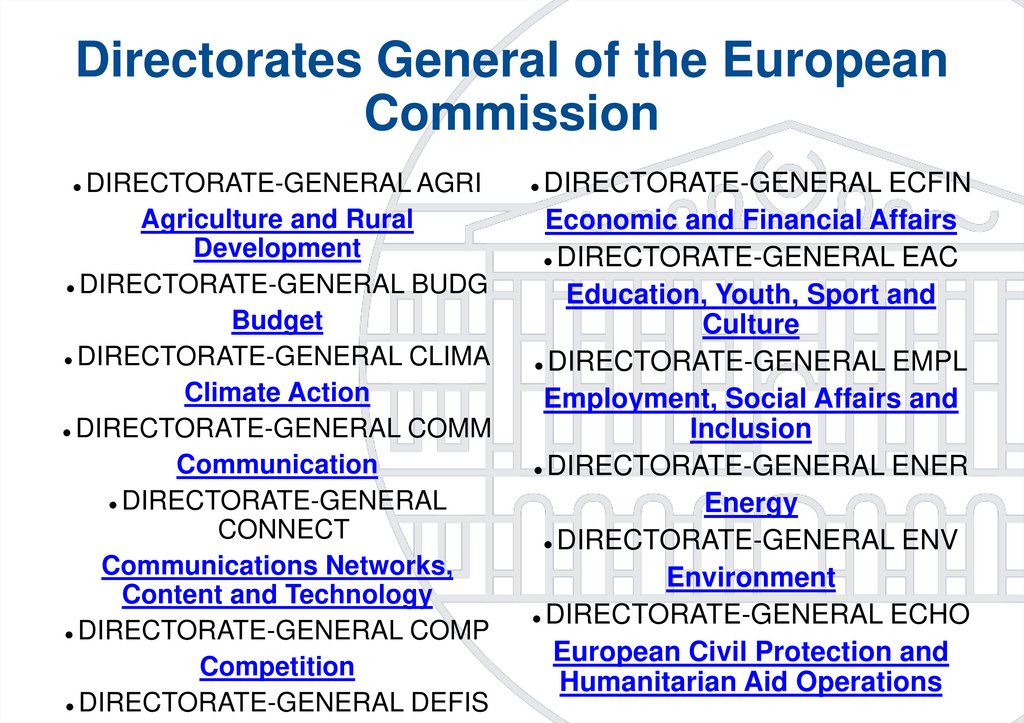
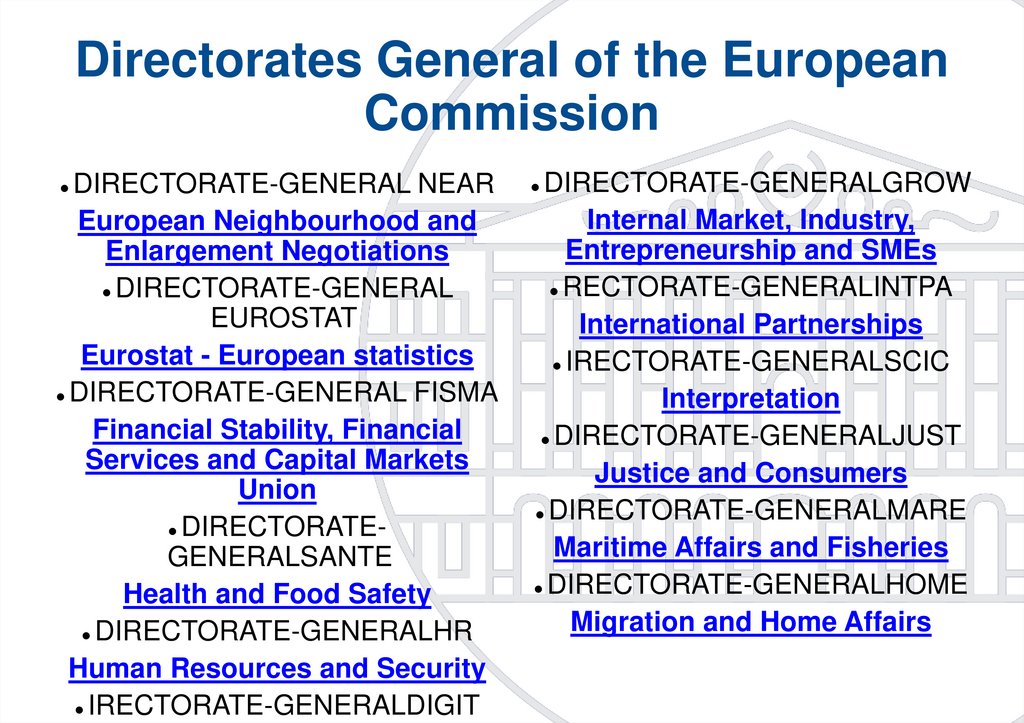
Directorates General of the EuropeanCommission
DIRECTORATE-GENERAL AGRI
Agriculture and Rural
Development
DIRECTORATE-GENERAL BUDG
Budget
DIRECTORATE-GENERAL CLIMA
Climate Action
DIRECTORATE-GENERAL COMM
Communication
DIRECTORATE-GENERAL
CONNECT
Communications Networks,
Content and Technology
DIRECTORATE-GENERAL COMP
Competition
DIRECTORATE-GENERAL DEFIS
DIRECTORATE-GENERAL ECFIN
Economic and Financial Affairs
DIRECTORATE-GENERAL EAC
Education, Youth, Sport and
Culture
DIRECTORATE-GENERAL EMPL
Employment, Social Affairs and
Inclusion
DIRECTORATE-GENERAL ENER
Energy
DIRECTORATE-GENERAL ENV
Environment
DIRECTORATE-GENERAL ECHO
European Civil Protection and
Humanitarian Aid Operations
25.
Directorates General of the EuropeanCommission
DIRECTORATE-GENERAL NEAR
European Neighbourhood and
Enlargement Negotiations
DIRECTORATE-GENERAL
EUROSTAT
Eurostat - European statistics
DIRECTORATE-GENERAL FISMA
Financial Stability, Financial
Services and Capital Markets
Union
DIRECTORATEGENERALSANTE
Health and Food Safety
DIRECTORATE-GENERALHR
Human Resources and Security
IRECTORATE-GENERALDIGIT
DIRECTORATE-GENERALGROW
Internal Market, Industry,
Entrepreneurship and SMEs
RECTORATE-GENERALINTPA
International Partnerships
IRECTORATE-GENERALSCIC
Interpretation
DIRECTORATE-GENERALJUST
Justice and Consumers
DIRECTORATE-GENERALMARE
Maritime Affairs and Fisheries
DIRECTORATE-GENERALHOME
Migration and Home Affairs
26.
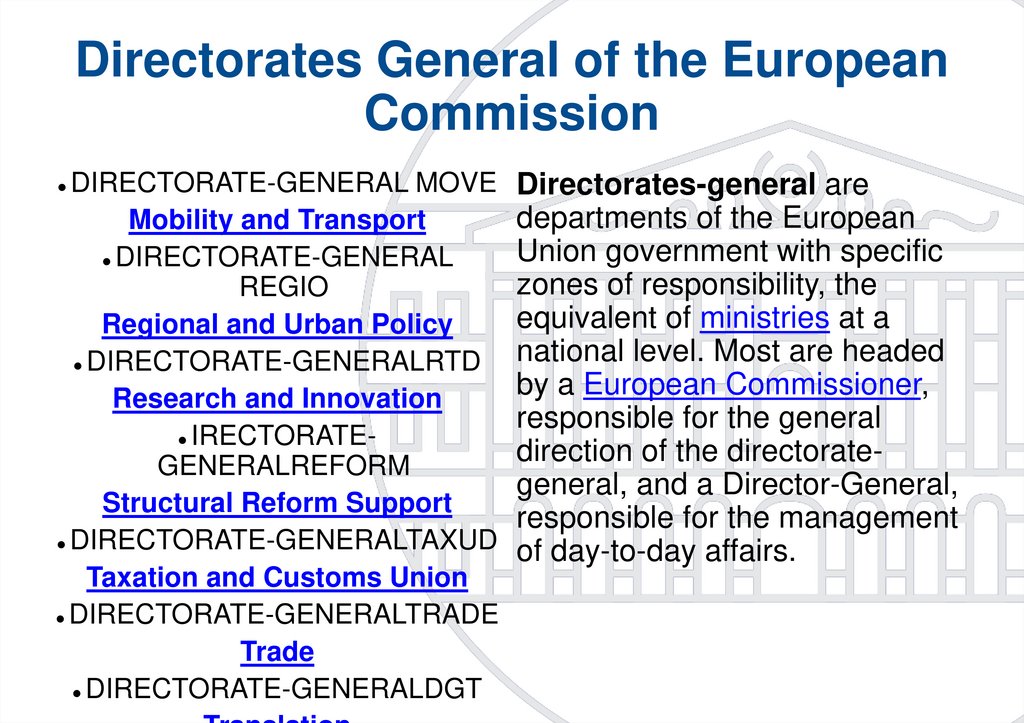
Directorates General of the EuropeanCommission
DIRECTORATE-GENERAL MOVE Directorates-general are
departments of the European
Mobility and Transport
Union government with specific
DIRECTORATE-GENERAL
zones of responsibility, the
REGIO
equivalent of ministries at a
Regional and Urban Policy
national
level.
Most
are
headed
DIRECTORATE-GENERALRTD
by
a
European
Commissioner,
Research and Innovation
responsible for the general
IRECTORATEdirection
of
the
directorateGENERALREFORM
general, and a Director-General,
Structural Reform Support
responsible for the management
DIRECTORATE-GENERALTAXUD
of day-to-day affairs.
Taxation and Customs Union
DIRECTORATE-GENERALTRADE
Trade
DIRECTORATE-GENERALDGT
27.
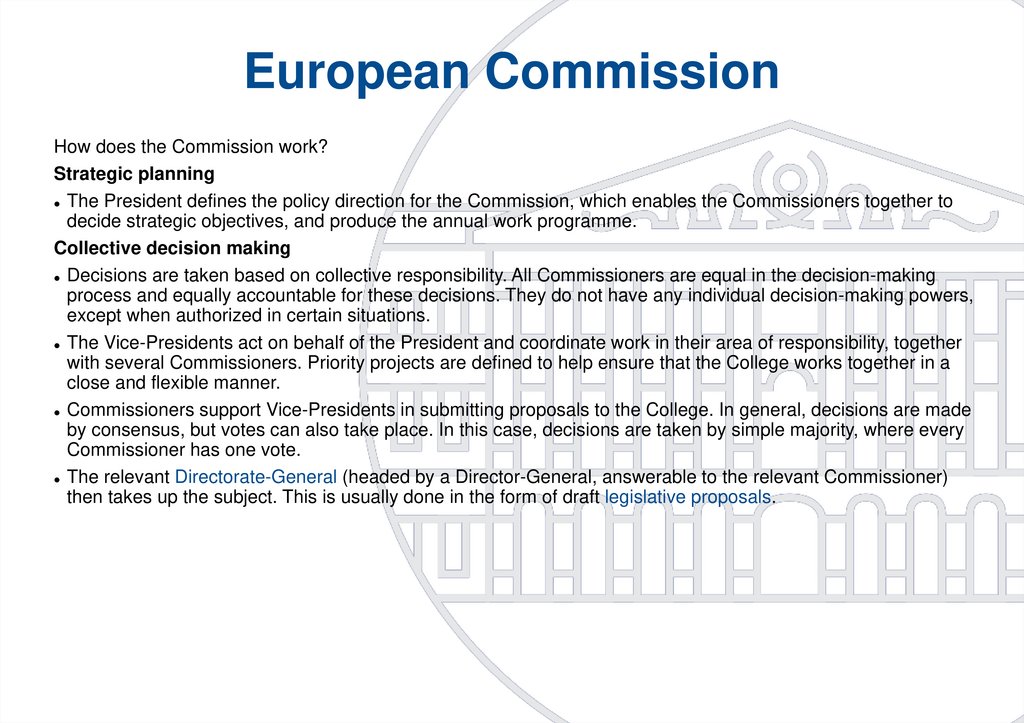
European CommissionHow does the Commission work?
Strategic planning
The President defines the policy direction for the Commission, which enables the Commissioners together to
decide strategic objectives, and produce the annual work programme.
Collective decision making
Decisions are taken based on collective responsibility. All Commissioners are equal in the decision-making
process and equally accountable for these decisions. They do not have any individual decision-making powers,
except when authorized in certain situations.
The Vice-Presidents act on behalf of the President and coordinate work in their area of responsibility, together
with several Commissioners. Priority projects are defined to help ensure that the College works together in a
close and flexible manner.
Commissioners support Vice-Presidents in submitting proposals to the College. In general, decisions are made
by consensus, but votes can also take place. In this case, decisions are taken by simple majority, where every
Commissioner has one vote.
The relevant Directorate-General (headed by a Director-General, answerable to the relevant Commissioner)
then takes up the subject. This is usually done in the form of draft legislative proposals.
28.
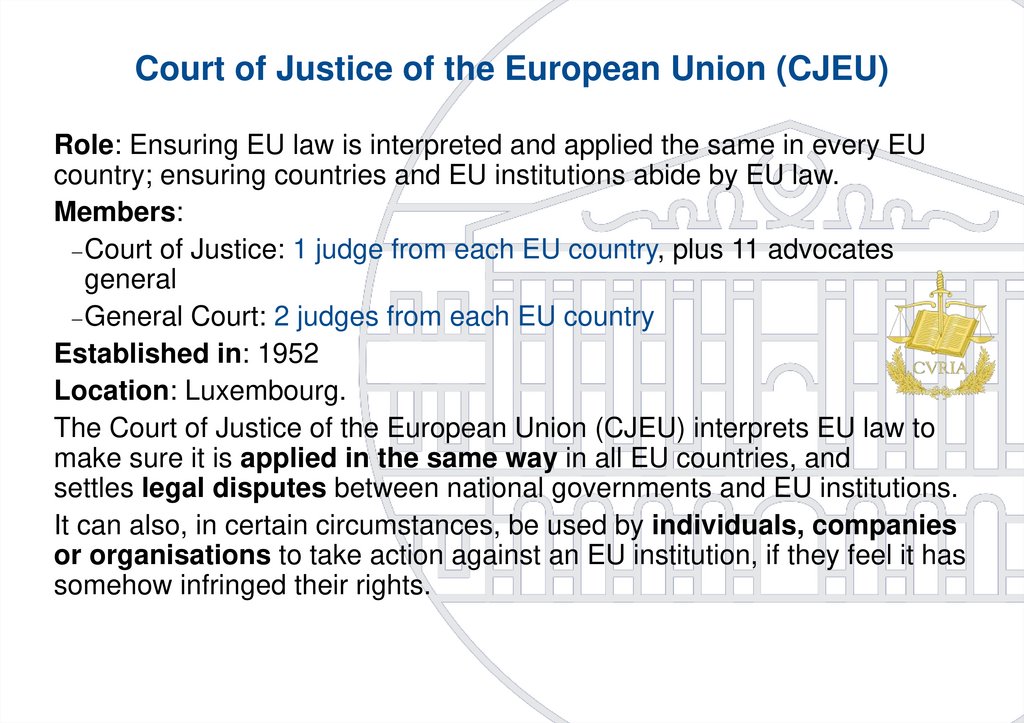
Court of Justice of the European Union (CJEU)Role: Ensuring EU law is interpreted and applied the same in every EU
country; ensuring countries and EU institutions abide by EU law.
Members:
Court of Justice: 1 judge from each EU country, plus 11 advocates
general
General Court: 2 judges from each EU country
Established in: 1952
Location: Luxembourg.
The Court of Justice of the European Union (CJEU) interprets EU law to
make sure it is applied in the same way in all EU countries, and
settles legal disputes between national governments and EU institutions.
It can also, in certain circumstances, be used by individuals, companies
or organisations to take action against an EU institution, if they feel it has
somehow infringed their rights.
29.
Court of Justice of the European Union(CJEU)
What does the CJEU do?
The CJEU gives rulings on cases brought before it. The most common types of case are:
interpreting the law (preliminary rulings) – national courts of EU countries are required to ensure EU law is properly applied, but courts in different countries might interpret it differently. If a national court is in doubt about the
interpretation or validity of an EU law, it can ask the Court for clarification. The same mechanism can be used to determine whether a national law or practice is compatible with EU law.
enforcing the law (infringement proceedings) – this type of case is taken against a national government for failing to comply with EU law. Can be started by the European Commission or another EU country. If the country is found to be
at fault, it must put things right at once, or risk a second case being brought, which may result in a fine.
annulling EU legal acts (actions for annulment) – if an EU act is believed to violate EU treaties or fundamental rights, the Court can be asked to annul it – by an EU government, the Council of the EU, the European Commission or (in
some cases) the European Parliament.
Private individuals can also ask the Court to annul an EU act that directly concerns them.
ensuring the EU takes action (actions for failure to act) – the Parliament, Council and Commission must make certain decisions under certain circumstances. If they don't, EU governments, other EU institutions or (under certain
conditions) individuals or companies can complain to the Court.
sanctioning EU institutions (actions for damages) – any person or company who has had their interests harmed as a result of the action or inaction of the EU or its staff can take action against them through the Court.
30.
Court of Justice of the European Union(CJEU)
Composition
The CJEU is divided into 2 courts:
Court of Justice – deals with requests for preliminary rulings from
national courts, certain actions for annulment and appeals.
General Court – rules on actions for annulment brought by
individuals, companies and, in some cases, EU governments. In
practice, this means that this court deals mainly with competition
law, State aid, trade, agriculture, trade marks.
Each judge and advocate general is appointed for a renewable 6year term, jointly by national governments. In each Court, the
judges select a President who serves a renewable term of 3 years.
31.
Court of Justice of the European Union(CJEU)
How does the CJEU work?
In the Court of Justice, each case is assigned 1 judge (the "judge-rapporteur") and 1 advocate general. Cases are processed in 2 stages:
Written stage
The parties give written statements to the Court - and observations can also be submitted by national authorities, EU institutions and
sometimes private individuals.
All of this is summarised by the judge-rapporteur and then discussed at the Court's general meeting, which decides:
How many judges will deal with the case: 3, 5 or 15 judges (the whole Court), depending on the importance and complexity of the
case. Most cases are dealt with by 5 judges, and it is very rare for the whole Court to hear the case.
Whether a hearing (oral stage) needs to be held and whether an official opinion from the advocate general is necessary.
Oral stage – a public hearing
Lawyers from both sides can put their case to the judges and advocate general, who can question them.
If the Court has decided an Opinion of the advocate general is necessary, this is given some weeks after the hearing.
The judges then deliberate and give their verdict.
General Court procedure is similar, except that most cases are heard by 3 judges and there are no advocates general.
32.
European Central BankRole: To manage the euro, keep prices stable and conduct EU economic &
monetary policy
President: Christine Lagarde
Members: ECB President and Vice-President and governors of national
central banks from all EU countries
Established in: 1998
Location: Frankfurt (Germany).
The European Central Bank (ECB) manages the euro and frames and
implements EU economic & monetary policy. Its main aim is to keep
prices stable, thereby supporting economic growth and job creation.
33.
European Central BankWhat does the ECB do?
sets the interest rates at which it lends to commercial banks in
the eurozone (also known as the euro area), thus controlling
money supply and inflation
manages the eurozone's foreign currency reserves and the
buying or selling of currencies to balance exchange rates
ensures that financial markets & institutions are well
supervised by national authorities, and that payment systems
work well
ensures the safety and soundness of the European banking
system
authorises production of euro banknotes by eurozone countries
monitors price trends and assesses risks to price stability.
34.
European Central BankComposition
The ECB President represents the Bank at high-level EU and
international meetings. The ECB has the 3 following decisionmaking bodies:
Governing Council – the main decision-making body.
Consists of the Executive Board (see below) plus the governors of
the national central banks from eurozone countries.
Executive Board – handles the day-to-day running of the ECB.
Consists of the ECB President and Vice-President and 4 other
members appointed for 8-year terms by the leaders of the
eurozone countries.
General Council – has more of an advisory & coordination role.
Consists of the ECB President and Vice-President and the
governors of the central banks from all EU countries.
35.
European Central BankHow does the ECB work?
The ECB works with the national central banks of all EU countries.
Together they form the European System of Central Banks.
It leads cooperation between central banks in the eurozone. This is
referred to as the Eurosystem.
The work of the governing bodies
Governing Council – assesses economic and monetary developments,
defines eurozone monetary policy and fixes the interest rates at which
commercial banks can borrow from the ECB.
Executive Board – implements monetary policy, manages day-to-day
operations, prepares Governing Council meetings and exercises powers
delegated to it by the Governing Council.
General Council – contributes to advisory and coordination work and
helps to prepare for new countries joining the euro.
36.
European Court of Auditors (ECA)Role: To check EU funds are collected and used correctly, and
help improve EU financial management.
President: Klaus-Heiner Lehne
Members: 1 from each EU country
Established in: 1977
Location: Luxembourg.
As the EU's independent external auditor, the European
Court of Auditors (ECA) looks after the interests of EU
taxpayers. It does not have legal powers, but works to improve
the European Commission's management of the EU budget
and reports on EU finances.
37.
European Court of Auditors (ECA)What does the ECA do?
audits EU revenue & expenditure, to check EU funds are correctly raised,
spent, achieve value for money and accounted for
checks any person or organisation handling EU funds – including spot
checks in EU institutions (especially the Commission), EU countries and
countries receiving EU aid
writes up findings and recommendations in audit reports, for the European
Commission and national governments
reports suspected fraud, corruption or other illegal activity to
the European Anti-Fraud Office (OLAF)
produces an annual report for the European Parliament and Council of the
EU, which the Parliament examines before deciding whether to approve the
Commission's handling of the EU budget
gives its expert opinion to EU policymakers on how EU finances could be
better managed and made more accountable to citizens
38.
European Court of Auditors (ECA)Composition
Court members are appointed by the Council, after consulting the
Parliament, for renewable 6-year terms. They choose one of their number
as President for a 3-year term (also renewable).
How does the ECA work?
It carries out 3 types of audit:
Financial audits – checking that accounts accurately present the
financial position, results and cash flow for the year.
Compliance audits – checking that financial transactions follow the
rules.
Performance audits – checking that the EU funds achieve its goals with
the fewest possible resources and in the most economical manner.
The Court is divided into audit groups called 'chambers'. They
prepare reports & opinions for the Court members to adopt, thus
making them official.
39.
European External Action Service (EEAS)Role: Manages the EU's diplomatic relations with other
countries outside the bloc and conducts EU foreign &
security policy
High Representative for Foreign Affairs & Security
Policy: Josep Borrell
Established in: 2011
Location: Brussels (Belgium).
The European External Action Service (EEAS) is the
EU's diplomatic service. It aims to make EU foreign policy
more coherent and effective, thus increasing Europe's global
influence.
40.
European External Action Service (EEAS)What does the EEAS do?
supports the EU High Representative in conducting EU foreign and
security policy
manages diplomatic relations & strategic partnerships with non-EU
countries
works with the national diplomatic services of EU countries, the UN and
other leading powers
Practical examples include:
peace building – through political, economic and practical support
ensuring security – under the Common Security & Defence Policy
maintaining good relations with the EU's immediate neighbours through
the European Neighbourhood Policy
development and humanitarian aid and crisis response
tackling climate change and human rights issues
41.
European External Action Service (EEAS)Composition
The European External Action Service is led by the EU foreign affairs chief – or High Representative for
Foreign Affairs & Security Policy. It is composed of:
in Brussels – expert staff transferred from the Council of the EU, the European Commission and EU
countries' diplomatic services
worldwide – a network of EU "embassies" (delegations)
How does EEAS work?
The High Representative is also a Vice-President of the European Commission. He represents the EU's
foreign and security policy around the world, coordinates the work of the European Commission on EU
external relations and chairs meetings of EU Foreign, Defence and Development ministers. The High
Representative/Vice President implements EU foreign & security policy, together with EU countries
and using national and EU resources. This helps ensure consistency in foreign policy across the bloc.
Outside its borders, the European Union is represented by a number of in-country offices – EU
delegations – which have a similar role to that of an embassy.
42.
European External Action Service (EEAS)Role: Advisory body representing employers' and workers' organisations
and other interest groups
President: Christa Schweng
Members: 329 from all EU countries
Established in: 1957
Location: Brussels (Belgium).
The European Economic and Social Committee (EESC) is an EU advisory
bodycomprising representatives of workers' and employers'
organisations and other interest groups. It issues opinions on EU
issues to the European Commission, the Council of the EU and the
European Parliament, thus acting as a bridge between the EU's decisionmaking institutions and EU citizens.
43.
European External Action Service (EEAS)What does the EESC do?
It gives the interest groups a formal say on EU legislative
proposals. Its three key tasks are to:
ensure that EU policy and law are geared to economic and
social conditions, by seeking a consensus that serves the
common good
promote a participatory EU by giving workers' and
employers' organisations and other interest groups a voice
and securing dialogue with them
promote the values of European integration, and advance
the cause of participatory democracy and civil society
organisations
44.
European External Action Service (EEAS)Composition
EESC members represent the variety of civil society organisations across Europe, including businesses, trade unions and
other interests. They are nominated by national governments and appointed by the Council of the EU for renewable 5-year
terms. The number of members per country depends on that country's population.
The EESC elects its President and 2 Vice-Presidents for two-and-a-half-year terms. Members belong to one of three groups:
employers
workers
other interest groups (e.g. farmers, consumers)
How does the EESC work?
The EESC is consulted by the European Parliament, the Council of the EU and the European Commission on a variety of
subjects. It also issues opinions on its own initiative.
Members work for the EU, independently of their governments. They meet 9 times a year. Opinions are adopted by a simple
majority vote.
Meetings are prepared by the EESC's specialised sections and the consultative commission on industrial change. The
EESC's specialist think-tanks (known as 'observatories') track the progress of EU strategies.
The EESC keeps in touch with regional and national economic and social councilsthroughout the EU - mainly to share
information and discuss particular issues.
45.
European Committee of the Regions (CoR)Role: Advisory body representing Europe's regional and local
authorities
President: Apostolos Tzitzikostas
Established in: 1994
Location: Brussels (Belgium).
The European Committee of the Regions (CoR) is an EU advisory
body composed of locally and regionally elected representatives
coming from all 27 Member States. Through the CoR they are able
to share their opinion on EU legislation that directly impacts regions
and cities.
46.
European Committee of the Regions (CoR)What does the CoR do?
The CoR gives regions and cities a formal say in EU law-making ensuring
that the position and needs of regional and local authorities are
respected.
The European Commission, the Council of the EU and the European
Parliament must consult the CoR when drawing up legislation on matters
concerning local and regional government such as health, education,
employment, social policy, economic and social cohesion, transport,
energy and climate change.
If this is not done, the CoR can bring a case before the Court of Justice.
Once the CoR receives a legislative proposal, it prepares and adopts
an opinion and circulates it to the relevant EU institutions.
The CoR also issues opinions on its own initiative.
47.
European Committee of the Regions (CoR)Composition
The CoR members are elected representatives serving in local or regional
authorities. Each country nominates members of its choice who are appointed for
renewable five-year terms by the Council of the EU. The number of members per
country depends on the size of that country's population.
Members from one country form the national delegation which reflects the political,
geographical, regional and local balance of their country.
Each member can also choose to be part of a political group in the CoR. Currently
there are six political groups reflecting a range of political affiliations: the European
People's Party (EPP), the Party of European Socialists (PES), Renew
Europe, the European Alliance Group (EA), the European Conservatives and
Reformists Group (ECR) and The Greens. Members can also choose not to be part of
a political party if they so wish (non-aligned).
The CoR appoints a president from among its members for a two-and-a-half-year
term.
48.
European Committee of the Regions (CoR)How does the CoR work?
The CoR appoints a rapporteur (one of its members) who
consults stakeholders and prepares the opinion. The text is
discussed and adopted by the CoR commission in charge of
the policy area concerned. The opinion is then presented to
all members in plenary session who vote to amend and
adopt it. Finally, the opinion is shared and communicated to
all relevant EU institutions.
There are up to 6 plenary sessions per year, adopting
opinions that cover 50 to 80 EU legislative projects.
49.
European Investment Bank (EIB)Role: provides funding for projects that help to achieve EU aims, both
within and outside the EU
President: Werner Hoyer
Board of Directors: comprises one director per EU country, plus one from
the European Commission
Founded in: 1958
Location: Luxembourg.
The European Investment Bank (EIB) is jointly owned by the EU countries.
It seeks to:
boost Europe's potential in terms of jobs & growth
support action to mitigate climate change
promote EU policies outside the EU
50.
European Investment Bank (EIB)What the EIB does
The Bank borrows money on capital markets and lends it on favourable
terms to projects that support EU objectives. About 90 % of loans are
made within the EU. None of the money comes from the EU budget.
The EIB provides 3 main types of products and services:
lending – about 90 % of its total financial commitment. The Bank lends to
clients of all sizes to support growth and jobs, and this support often helps
to attract other investors
'blending' - allowing clients to combine EIB financing with additional
investment
advising and technical assistance - maximising value for money
The EIB makes loans above EUR 25 million directly. Where smaller
loans are involved, it opens credit lines for financial institutions that then
lend funds to creditors.
51.
European Investment Bank (EIB)Composition
All EU countries are shareholders in the EIB. Decisions are taken by the
following bodies:
the Board of Governors, comprising ministers (mostly finance ministers)
from all EU countries. It defines general lending policy.
the Board of Directors, chaired by the EIB President, which comprises 28
members appointed by the EU countries and one appointed by the
European Commission. It approves lending and borrowing operations.
the Management Committee, the Bank's executive body, which handles
day-to-day business.
The Audit Committee checks that EIB operations are conducted in a
proper manner.
The Bank's departments implement management decisions.
52.
European Investment Bank (EIB)How does the EIB work?
It makes borrowing and lending decisions, based on the
merits of each project and the opportunities offered by
financial markets. Within the EU, it has specific lending
priorities. Outside the EU, it supports the EU development
and cooperation policies worldwide.
As an independent body, the Bank takes its own borrowing
and lending decisions. It cooperates with other EU
institutions, especially the European Commission,
the European Parliament, and the Council of the EU.
53.
European Data Protection Supervisor (EDPS)Role: Ensures that EU institutions and bodies respect people's right to
privacy when processing their personal data
Supervisor: Wojciech Wiewiórowski
Established in: 2004
Location: Brussels (Belgium).
The EU institutions and bodies sometimes process citizens' personal
information - in electronic, written or visual format - in the course of their
duties. Processing includes collecting, recording, storing, retrieving,
sending, blocking or erasing data. It is the task of the European Data
Protection Supervisor (EDPS) to uphold the strict privacy rulesgoverning
these activities.
54.
European Data Protection Supervisor (EDPS)What does the EDPS do?
supervises the EU administration's processing of personal data to ensure compliance
with privacy rules
advises EU institutions and bodies on all aspects of personal data processing and
related policies and legislation
handles complaints and conducts inquiries
works with the national authorities of EU countries to ensure consistency in data
protection
monitors new technologies that might have an impact on data protection
How does the EDPS work?
The Supervisor is appointed for a renewable 5-year term of office. For everyday
operations, the EDPS comprises 2 main entities:
Supervision and Enforcement - evaluates data protection compliance by EU
institutions and bodies.
Policy and Consultation - advises EU legislators on data protection issues in
various policy areas and new legislative proposals.
55.
The European Data Protection Board (EDPB)Role: To ensure that the General Data Protection Regulation (GDPR) and
the Data Protection Law Enforcement Directive are consistently applied in
the EU countries, as well as Norway, Liechtenstein and Iceland.
Chair: Andrea Jelinek
Established in: 2018
Number of staff: 21
Location: Brussels.
The EDPB is an independent body which: ensures that EU law in this field
– especially the General Data Protection Regulation (GDPR) and the Data
Protection Law Enforcement Directive – is consistently applied in all
countries that are covered by it promotes cooperation among the national
data protection authorities.
56.
The European Data Protection Board (EDPB)What does the EDPB do?
provides general guidance (including guidelines, recommendations and best practice) to
clarify the GDPR
adopts consistency findings, designed to make sure the GDPR is interpreted consistently by
all national regulatory bodies, for example in cases relating to 2 or more countries
advises the European Commission on data protection issues and any proposed new EU
legislation of particular importance for the protection of personal data - encouragesnational
data protection authorities to work together and share information and best practices with each
other
If you think your data has not been protected, you have 3 options:
contact the organisation holding your data
contact your national data protection authority
put the matter before a national court
National data protection authorities can conduct investigations and impose penalties where
necessary.
57.
European OmbudsmanRole: Investigates complaints against EU institutions, bodies, offices & agencies
Ombudsman: Emily O'Reilly
Established in: 1995
Location: Strasbourg (France).
The European Ombudsman investigates complaints about poor administration by EU
institutions or other EU bodies. These may be lodged by citizens or residents of EU
countries or by EU-based associations or businesses.
What does the Ombudsman do?
The Ombudsman investigates different types of poor administration, for example:
unfair conduct
discrimination
abuse of power
lack of information or refusal to provide it
unnecessary delays
incorrect procedures
58.
European OmbudsmanHow is the Ombudsman chosen?
The European Parliament elects the Ombudsman for a renewable 5-year term.
This is one of its first tasks when newly elected.
How does the Ombudsman work?
The Ombudsman's office launches investigations either in response to
complaints or on its own initiative. An impartial body, it takes no orders from any
government or other organisation. It produces an annual activity report for the
European Parliament.
The Ombudsman may be able to solve your problem simply by informing the
institutionconcerned. If more is needed, every effort is made to reach
an amicable solution that will put matters right. Should this fail, the Ombudsman
can make recommendations to the institution. If these are not accepted, the
Ombudsman can draw up a special report to the European Parliament, which
must then take appropriate action.
59.
Interinstitutional bodiesComputer Emergency Response Team (CERT) became fully operational in September 2012. CERT's remit
is to help manage threats to EU institutions' computer systems – supporting IT security teams in each EU
institution and liaising with public-sector CERT counterparts in EU countries.
European School of Administration was set up on 10 February 2005. Its task is to provide training in specific
areas for members of EU staff. Its courses are open to staff of all the EU institutions, thereby helping spread
common values, promoting better understanding among EU staff and achieving economies of scale. It works in
close cooperation with the training departments of all the institutions to avoid any duplication of effort.
European Personnel Selection Office (EPSO) became operational in January 2003. Its task is to set
competitive examinations for recruiting staff to work in all the EU institutions. This is more efficient than having
each institution organise its own recruitment competitions. EPSO’s annual budget of roughly €21 million is 11%
less than that which the EU institutions used to spend on recruitment.
Publications Office - the full name of this body is the Publications Office of the European Union - acts as the
publishing house for the EU institutions, producing and distributing all official European Union publications, on
paper and in digital form.
60.
Translation service in the European CommissionThe Directorate-General for Translation translates texts for the European
Commission into and out of the EU's 24 official languages, and a few others when
needed. The department deals exclusively with written texts.
Responsibilities
translate laws, policy papers, reports, correspondence, etc. drafted by or sent to
the Commission
help the Commission communicate with the public, thereby helping citizens
understand EU policies
edit original documents drafted by Commission authors
advise Commission departments on language and on managing multilingual
websites
ensure correct terminology in all official EU languages, as documented in the
interinstitutional database IATE.
With an annual output of about 1.5 million pages, it is the largest translation service
in the world, employing some 1,750 linguists.
61.
Interpretation service in the EuropeanCommission
The Directorate-General for Interpretation is the Commission’s interpreting service and conference organiser.
It allocates meeting rooms and provides support for the smooth running of multilingual meetings.
Responsibilities:
provide interpretation services for the Commission, European Council, Council of the EU, Committee of the
Regions, European Economic and Social Committee, European Investment Bank as well as agencies and
offices in EU countries
allocate Commission meeting rooms and provide support for multilingual meetings and conferences
advise on the construction and renovation of conference facilities with installations for simultaneous
interpretation
help to put the Commission's multilingualism strategy into practice
bring together partners from non-EU countries to share expertise in the field of interpretation and pass on best
practices from their respective fields
It provides interpreters for around 11,000 meetings every year, thus being the largest interpreting service in the
world.
62.
Interpreting at the EU63.
Translation service in the European ParliamentThe European Parliament’s translation service enables multilingual written and electronic
communication in all official languages of the European Union. It has a crucial role in ensuring the
transparency of the legislative and budgetary process of the EU and in bringing the EU closer to its
citizens.
The Directorate-General for Translation employs approximately 1140 staff, among them more than
600 translators, and is one of the biggest employers of its kind in the world.
The mission:
to make available in all official languages documents relating to Parliament's role as co-legislator
and as one of the two arms of the budgetary authority, in order to ensure
the legitimacy and transparency of the legislative and budgetary process of the European
Union;
to enable the European Parliament to meet its commitment to the policy of multilingualism,
designed to ensure the equal treatment of languages, which enables all citizens of the
European Union to communicate with the institutions and access EU documents in their own
language;
to ensure that these translation services are supplied as efficiently and effectively as possible.
64.
Interpretation service in the EuropeanParliament
The main task of the European Parliament’s interpreters is to
render orally the speeches given by MEPs faithfully and in real time
into all the official languages. Interpreting services are provided for
all multilingual meetings organised by the official bodies of the
institution.
The European Parliament’s Directorate-General for Logistics
and Interpretation for Conferences employs approximately 270
staff interpreters and has at its disposal a reserve of some 1500
external accredited interpreters whom it calls on very regularly as
required to cover its needs.
65.
(CDT) Translation Centre for the Bodies of theEuropean Union
Role: Translation and related services for EU agencies and bodies;
interinstitutional cooperation
Director: Benoît Vitale
Partners: other EU and international translation services via
the Interinstitutional Committee for Translation and Interpretation (ICTI),
the International Annual Meeting on Language Arrangements, Documentation
and Publication (IAMLADP), the Joint Inter-Agency Meeting on ComputerAssisted Translation and Terminlogy (JIAMCATT).
Established in: 1994
Number of staff: 200, including about 100 translators
Location: Luxembourg.
The Translation Centre provides translation services for EU agencies and
bodies around Europe and works together with the EU’s other translation
services.
66.
(CDT) Translation Centre for the Bodies of theEuropean Union
It provides language services to the EU’s specialised agencies and bodies, especially:
translation
revision
editing
terminology work
video subtitling.
The Centre also helps the translation services of other EU institutions and bodies when they are particularly overloaded,
and with special projects.
And it works with the EU’s other translation services in the Interinstitutional Committee for Translation &
Interpretation to:
make working methods and tools more efficient
bring the procedures of the different EU translation services into line with each other
make overall savings in translation at the EU
cooperate on large-scale projects, such as IATE, the EU’s terminology database.
Finally, the Centre helps implement the EU’s strategic framework for multilingualism which aims to build up citizens'
linguistic skills.
67.
Council of Europe (not EU!)It is an international organisation founded in the wake of World War II to uphold human rights, democracy and
the rule of law in Europe. Founded in 1949, it has 47 member states, with a population of approximately 820
million, and operates with an annual budget of approximately 500 million euros.
The head of the Council is the Secretary General is elected by the Parliamentary Assembly for a five-year
term at the head of the Organisation. She is responsible for the strategic planning and direction of the
Council's work programme and budget. She leads and represents the Organisation.
Committee of Ministers is the Council's decision-making body and is made up of the ministers of foreign
affairs of each member state or their permanent diplomatic representatives in Strasbourg. The Committee of
Ministers decides Council of Europe policy and approves its budget and programme of activities.
The Parliamentary Assembly consists of 324 members of parliament from the 47 member states; the
Assembly elects the Secretary General, the Human Rights Commissioner and the judges to the European
Court of Human Rights; it provides a democratic forum for debate and monitors elections; its committees play
an important role in examining current issues.
68.
Council of Europe (not EU!)The Congress of Local and Regional Authorities is responsible for strengthening local and
regional democracy in its 47 member states. Composed of two chambers – the Chamber of
Local Authorities and the Chamber of Regions – and three committees, it brings together 648
elected officials representing more than 150 000 local and regional authorities.
European Court of Human Rights is the permanent judicial body which garantees for all
Europeans the rights safeguarded by the European Convention on Human Rights. It is open to
states and individuals regardless of nationality. The 47 member states of the Council of Europe
are parties to the Convention.
The Human Rights Commissioner independently addresses and brings attention to human
rights violations.
The Conference of INGOs includes some 400 international Non Governmental Organisations
(INGOs). It provides vital links between politicians and the public and brings the voice of civil
society to the Council. The Council's work benefi ts extensively from the INGOs' expertise and
their outreach to European citizens.