
 english
Similar presentations:



Techniques for understanding grammar in context
1.
Bagdad 2025CEFR Mock 28
Reading and
Listening
Paper
NSFLA Multilevel Hub
2.
Thank you!3.
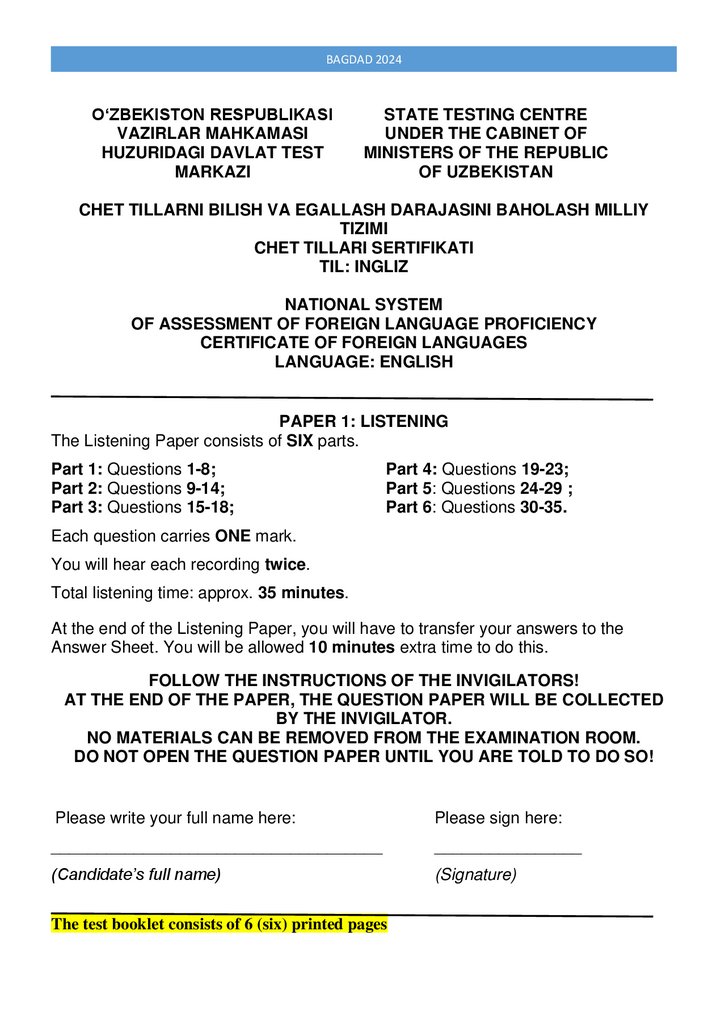
BAGDAD 2024O‘ZBEKISTON RESPUBLIKASI
VAZIRLAR MAHKAMASI
HUZURIDAGI DAVLAT TEST
MARKAZI
STATE TESTING CENTRE
UNDER THE CABINET OF
MINISTERS OF THE REPUBLIC
OF UZBEKISTAN
CHET TILLARNI BILISH VA EGALLASH DARAJASINI BAHOLASH MILLIY
TIZIMI
CHET TILLARI SERTIFIKATI
TIL: INGLIZ
NATIONAL SYSTEM
OF ASSESSMENT OF FOREIGN LANGUAGE PROFICIENCY
CERTIFICATE OF FOREIGN LANGUAGES
LANGUAGE: ENGLISH
PAPER 1: LISTENING
The Listening Paper consists of SIX parts.
Part 1: Questions 1-8;
Part 2: Questions 9-14;
Part 3: Questions 15-18;
Part 4: Questions 19-23;
Part 5: Questions 24-29 ;
Part 6: Questions 30-35.
Each question carries ONE mark.
You will hear each recording twice.
Total listening time: approx. 35 minutes.
At the end of the Listening Paper, you will have to transfer your answers to the
Answer Sheet. You will be allowed 10 minutes extra time to do this.
FOLLOW THE INSTRUCTIONS OF THE INVIGILATORS!
AT THE END OF THE PAPER, THE QUESTION PAPER WILL BE COLLECTED
BY THE INVIGILATOR.
NO MATERIALS CAN BE REMOVED FROM THE EXAMINATION ROOM.
DO NOT OPEN THE QUESTION PAPER UNTIL YOU ARE TOLD TO DO SO!
Please write your full name here:
Please sign here:
____________________________________
________________
(Candidate’s full name)
(Signature)
The test booklet consists of 6 (six) printed pages
4.
BAGDAD 2024Part 1
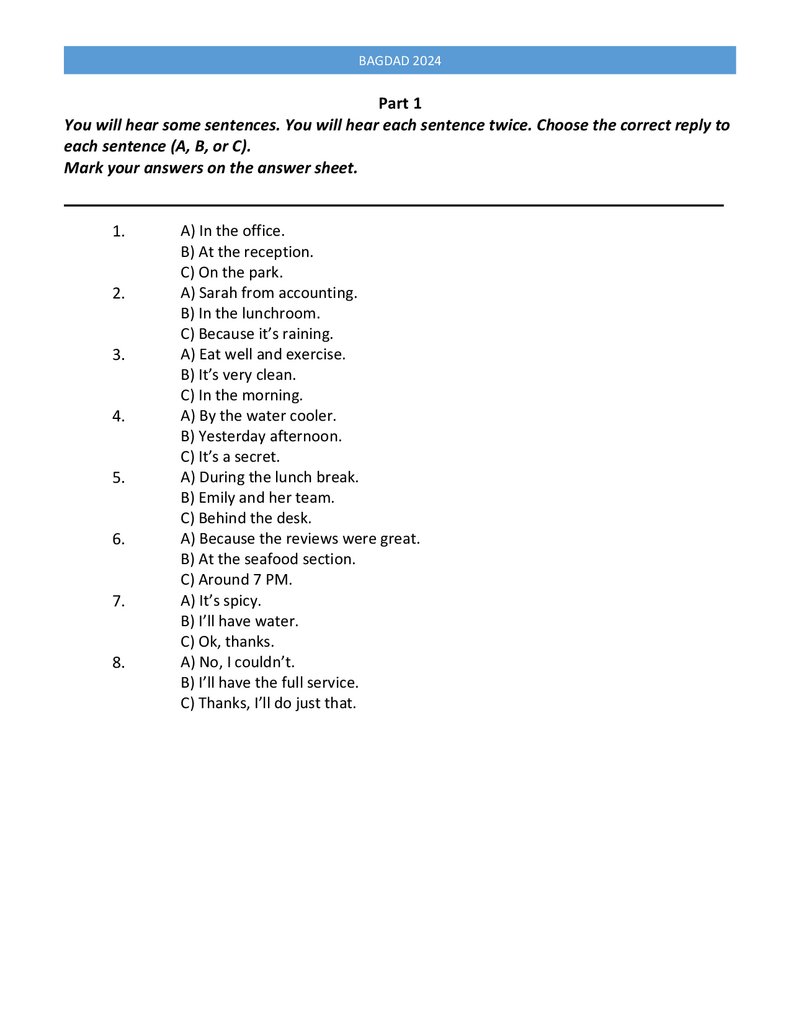
You will hear some sentences. You will hear each sentence twice. Choose the correct reply to
each sentence (A, B, or C).
Mark your answers on the answer sheet.
1.
2.
3.
4.
5.
6.
7.
8.
A) In the office.
B) At the reception.
C) On the park.
A) Sarah from accounting.
B) In the lunchroom.
C) Because it’s raining.
A) Eat well and exercise.
B) It’s very clean.
C) In the morning.
A) By the water cooler.
B) Yesterday afternoon.
C) It’s a secret.
A) During the lunch break.
B) Emily and her team.
C) Behind the desk.
A) Because the reviews were great.
B) At the seafood section.
C) Around 7 PM.
A) It’s spicy.
B) I’ll have water.
C) Ok, thanks.
A) No, I couldn’t.
B) I’ll have the full service.
C) Thanks, I’ll do just that.
5.
BAGDAD 2024Part 2
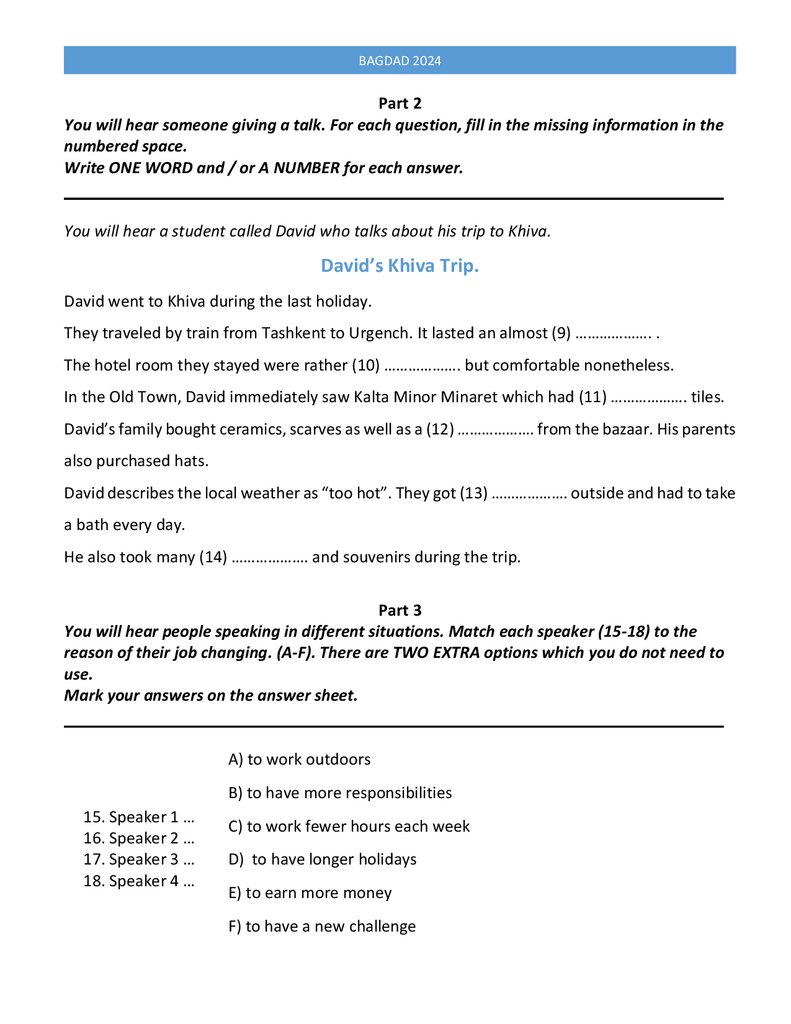
You will hear someone giving a talk. For each question, fill in the missing information in the
numbered space.
Write ONE WORD and / or A NUMBER for each answer.
You will hear a student called David who talks about his trip to Khiva.
David’s Khiva Trip.
David went to Khiva during the last holiday.
They traveled by train from Tashkent to Urgench. It lasted an almost (9) ………………. .
The hotel room they stayed were rather (10) ………………. but comfortable nonetheless.
In the Old Town, David immediately saw Kalta Minor Minaret which had (11) ………………. tiles.
David’s family bought ceramics, scarves as well as a (12) ………………. from the bazaar. His parents
also purchased hats.
David describes the local weather as “too hot”. They got (13) ………………. outside and had to take
a bath every day.
He also took many (14) ………………. and souvenirs during the trip.
Part 3
You will hear people speaking in different situations. Match each speaker (15-18) to the
reason of their job changing. (A-F). There are TWO EXTRA options which you do not need to
use.
Mark your answers on the answer sheet.
A) to work outdoors
B) to have more responsibilities
15. Speaker 1 …
16. Speaker 2 …
17. Speaker 3 …
18. Speaker 4 …
C) to work fewer hours each week
D) to have longer holidays
E) to earn more money
F) to have a new challenge
6.
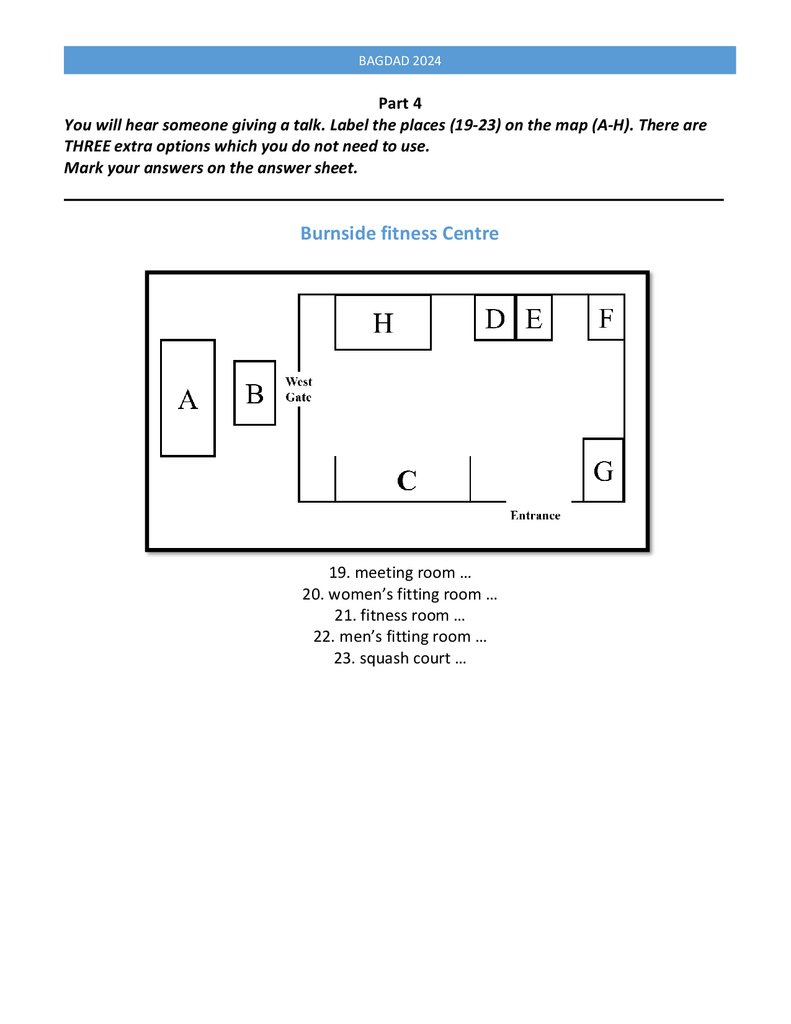
BAGDAD 2024Part 4
You will hear someone giving a talk. Label the places (19-23) on the map (A-H). There are
THREE extra options which you do not need to use.
Mark your answers on the answer sheet.
Burnside fitness Centre
19. meeting room …
20. women’s fitting room …
21. fitness room …
22. men’s fitting room …
23. squash court …
7.
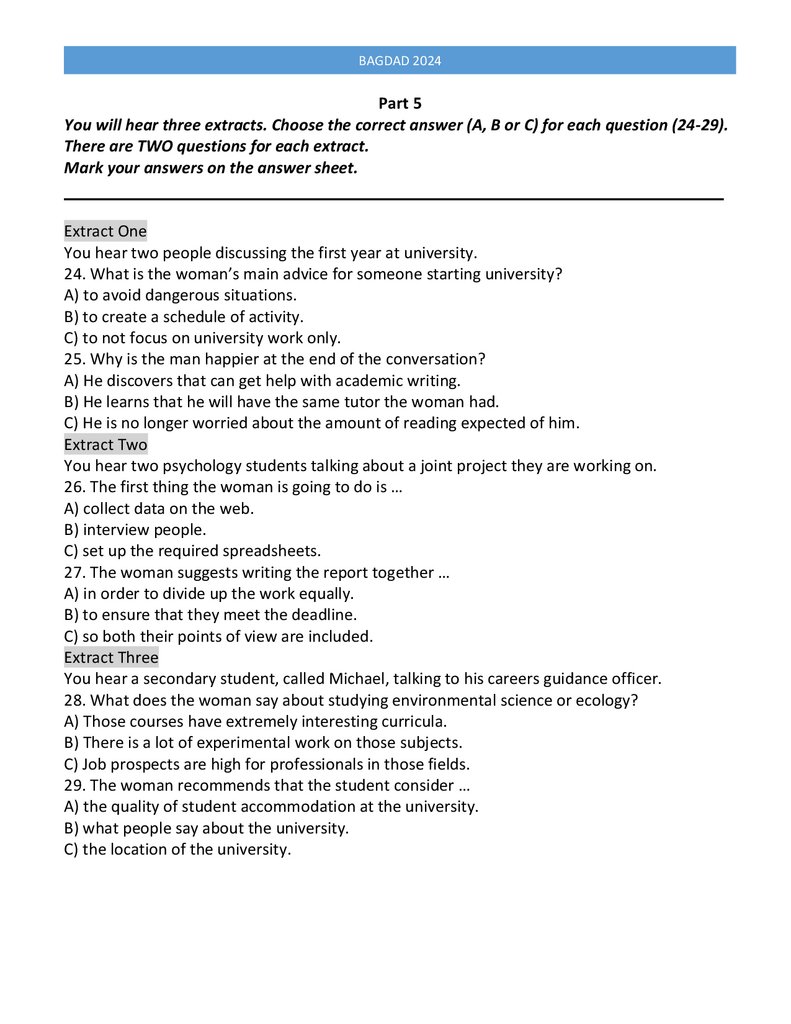
BAGDAD 2024Part 5
You will hear three extracts. Choose the correct answer (A, B or C) for each question (24-29).
There are TWO questions for each extract.
Mark your answers on the answer sheet.
Extract One
You hear two people discussing the first year at university.
24. What is the woman’s main advice for someone starting university?
A) to avoid dangerous situations.
B) to create a schedule of activity.
C) to not focus on university work only.
25. Why is the man happier at the end of the conversation?
A) He discovers that can get help with academic writing.
B) He learns that he will have the same tutor the woman had.
C) He is no longer worried about the amount of reading expected of him.
Extract Two
You hear two psychology students talking about a joint project they are working on.
26. The first thing the woman is going to do is …
A) collect data on the web.
B) interview people.
C) set up the required spreadsheets.
27. The woman suggests writing the report together …
A) in order to divide up the work equally.
B) to ensure that they meet the deadline.
C) so both their points of view are included.
Extract Three
You hear a secondary student, called Michael, talking to his careers guidance officer.
28. What does the woman say about studying environmental science or ecology?
A) Those courses have extremely interesting curricula.
B) There is a lot of experimental work on those subjects.
C) Job prospects are high for professionals in those fields.
29. The woman recommends that the student consider …
A) the quality of student accommodation at the university.
B) what people say about the university.
C) the location of the university.
8.
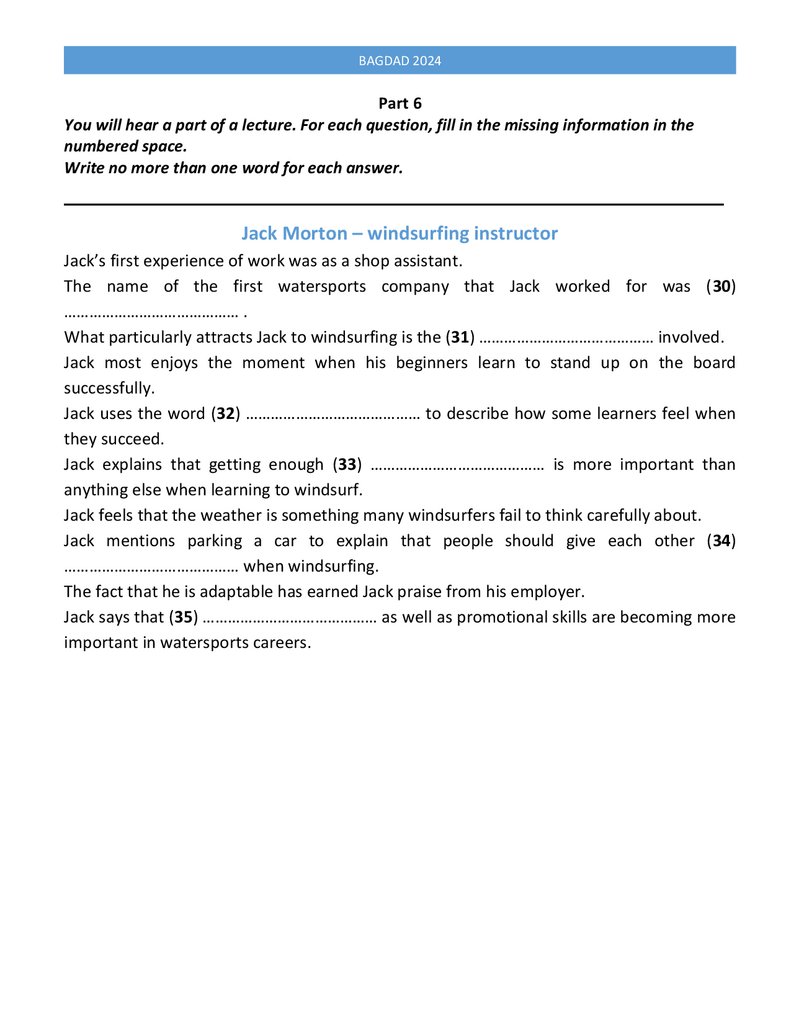
BAGDAD 2024Part 6
You will hear a part of a lecture. For each question, fill in the missing information in the
numbered space.
Write no more than one word for each answer.
Jack Morton – windsurfing instructor
Jack’s first experience of work was as a shop assistant.
The name of the first watersports company that Jack worked for was (30)
…………………………………… .
What particularly attracts Jack to windsurfing is the (31) …………………………………… involved.
Jack most enjoys the moment when his beginners learn to stand up on the board
successfully.
Jack uses the word (32) …………………………………… to describe how some learners feel when
they succeed.
Jack explains that getting enough (33) …………………………………… is more important than
anything else when learning to windsurf.
Jack feels that the weather is something many windsurfers fail to think carefully about.
Jack mentions parking a car to explain that people should give each other (34)
…………………………………… when windsurfing.
The fact that he is adaptable has earned Jack praise from his employer.
Jack says that (35) …………………………………… as well as promotional skills are becoming more
important in watersports careers.
9.
BAGDAD 2025O‘ZBEKISTON RESPUBLIKASI
VAZIRLAR MAHKAMASI
HUZURIDAGI DAVLAT TEST
MARKAZI
STATE TESTING CENTRE
UNDER THE CABINET OF
MINISTERS OF THE REPUBLIC
OF UZBEKISTAN
CHET TILLARNI BILISH VA EGALLASH DARAJASINI BAHOLASH MILLIY
TIZIMI
CHET TILLARI SERTIFIKATI
TIL: INGLIZ
NATIONAL SYSTEM
OF ASSESSMENT OF FOREIGN LANGUAGE PROFICIENCY
CERTIFICATE OF FOREIGN LANGUAGES
LANGUAGE: ENGLISH
PAPER 2: READING
The Reading Paper consists of FIVE parts.
Part 1: Questions 1-6;
Part 2: Questions 7-14;
Part 3: Questions 15-20;
Part 4: Questions 21-29;
Part 5: Questions 30-35.
Each question carries ONE mark.
Total time allowed: 1 hour
You may write on the question paper if you wish, but you must transfer your
answers to the Answer Sheet within the time limit. No extra time is allowed to do
so.
FOLLOW THE INSTRUCTIONS OF THE INVIGILATORS!
AT THE END OF THE PAPER, THE QUESTION PAPER WILL BE COLLECTED
BY THE INVIGILATOR.
NO MATERIALS CAN BE REMOVED FROM THE EXAMINATION ROOM.
DO NOT OPEN THE QUESTION PAPER UNTIL YOU ARE TOLD TO DO SO!
Please write your full name here:
______________________________________
(Candidate’s full name)
The test booklet consists of 9 (nine) printed pages
Please sign here:
________________
(Signature)
10.
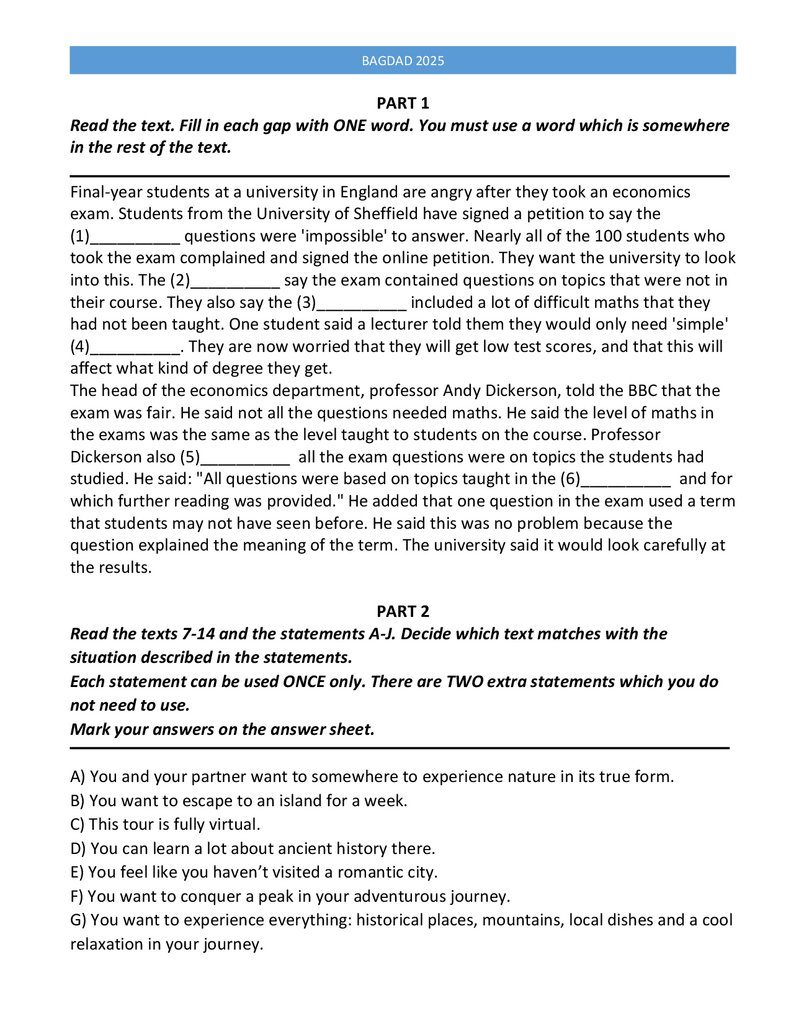
BAGDAD 2025PART 1
Read the text. Fill in each gap with ONE word. You must use a word which is somewhere
in the rest of the text.
Final-year students at a university in England are angry after they took an economics
exam. Students from the University of Sheffield have signed a petition to say the
(1)__________ questions were 'impossible' to answer. Nearly all of the 100 students who
took the exam complained and signed the online petition. They want the university to look
into this. The (2)__________ say the exam contained questions on topics that were not in
their course. They also say the (3)__________ included a lot of difficult maths that they
had not been taught. One student said a lecturer told them they would only need 'simple'
(4)__________. They are now worried that they will get low test scores, and that this will
affect what kind of degree they get.
The head of the economics department, professor Andy Dickerson, told the BBC that the
exam was fair. He said not all the questions needed maths. He said the level of maths in
the exams was the same as the level taught to students on the course. Professor
Dickerson also (5)__________ all the exam questions were on topics the students had
studied. He said: "All questions were based on topics taught in the (6)__________ and for
which further reading was provided." He added that one question in the exam used a term
that students may not have seen before. He said this was no problem because the
question explained the meaning of the term. The university said it would look carefully at
the results.
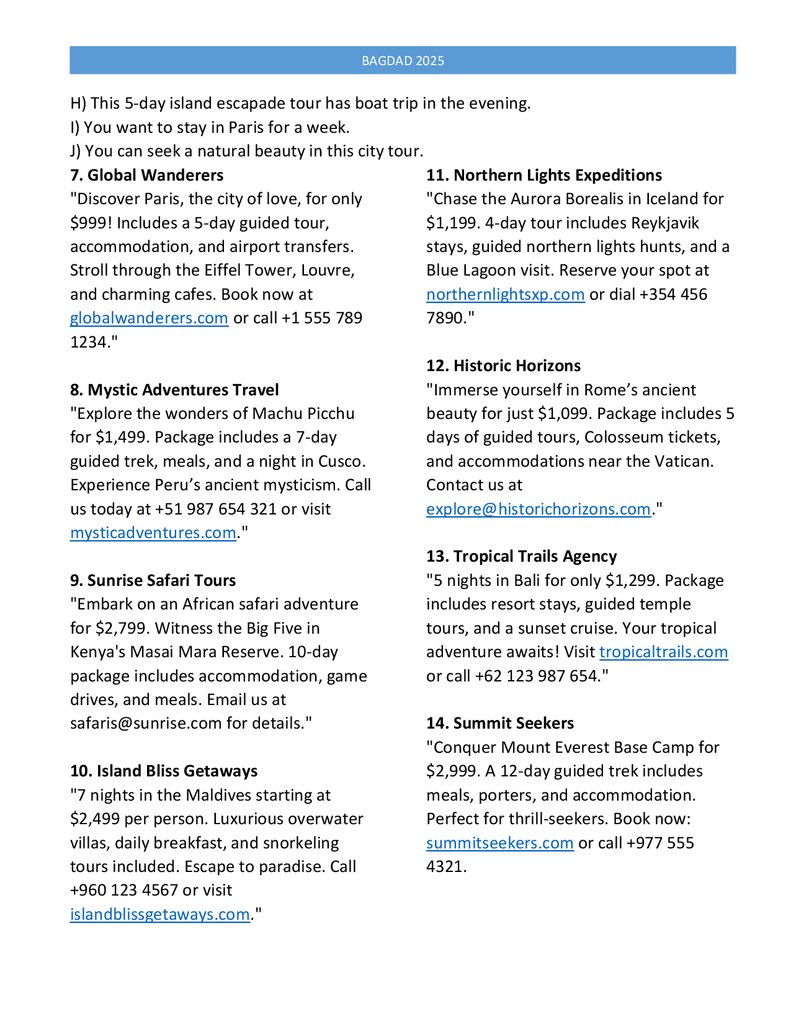
PART 2
Read the texts 7-14 and the statements A-J. Decide which text matches with the
situation described in the statements.
Each statement can be used ONCE only. There are TWO extra statements which you do
not need to use.
Mark your answers on the answer sheet.
A) You and your partner want to somewhere to experience nature in its true form.
B) You want to escape to an island for a week.
C) This tour is fully virtual.
D) You can learn a lot about ancient history there.
E) You feel like you haven’t visited a romantic city.
F) You want to conquer a peak in your adventurous journey.
G) You want to experience everything: historical places, mountains, local dishes and a cool
relaxation in your journey.
11.
BAGDAD 2025H) This 5-day island escapade tour has boat trip in the evening.
I) You want to stay in Paris for a week.
J) You can seek a natural beauty in this city tour.
7. Global Wanderers
11. Northern Lights Expeditions
"Discover Paris, the city of love, for only
"Chase the Aurora Borealis in Iceland for
$999! Includes a 5-day guided tour,
$1,199. 4-day tour includes Reykjavik
accommodation, and airport transfers.
stays, guided northern lights hunts, and a
Stroll through the Eiffel Tower, Louvre,
Blue Lagoon visit. Reserve your spot at
and charming cafes. Book now at
northernlightsxp.com or dial +354 456
globalwanderers.com or call +1 555 789
7890."
1234."
12. Historic Horizons
8. Mystic Adventures Travel
"Immerse yourself in Rome’s ancient
"Explore the wonders of Machu Picchu
beauty for just $1,099. Package includes 5
for $1,499. Package includes a 7-day
days of guided tours, Colosseum tickets,
guided trek, meals, and a night in Cusco.
and accommodations near the Vatican.
Experience Peru’s ancient mysticism. Call
Contact us at
us today at +51 987 654 321 or visit
explore@historichorizons.com."
mysticadventures.com."
13. Tropical Trails Agency
9. Sunrise Safari Tours
"5 nights in Bali for only $1,299. Package
"Embark on an African safari adventure
includes resort stays, guided temple
for $2,799. Witness the Big Five in
tours, and a sunset cruise. Your tropical
Kenya's Masai Mara Reserve. 10-day
adventure awaits! Visit tropicaltrails.com
package includes accommodation, game
or call +62 123 987 654."
drives, and meals. Email us at
safaris@sunrise.com for details."
14. Summit Seekers
"Conquer Mount Everest Base Camp for
10. Island Bliss Getaways
$2,999. A 12-day guided trek includes
"7 nights in the Maldives starting at
meals, porters, and accommodation.
$2,499 per person. Luxurious overwater
Perfect for thrill-seekers. Book now:
villas, daily breakfast, and snorkeling
summitseekers.com or call +977 555
tours included. Escape to paradise. Call
4321.
+960 123 4567 or visit
islandblissgetaways.com."
12.
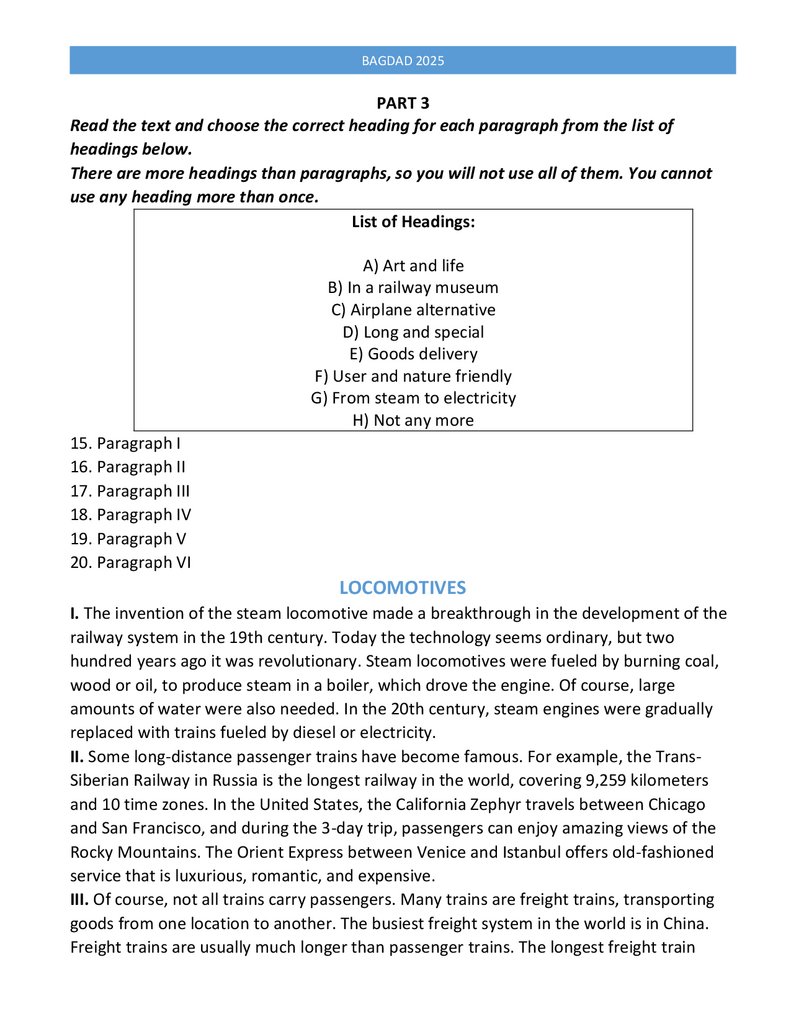
BAGDAD 2025PART 3
Read the text and choose the correct heading for each paragraph from the list of
headings below.
There are more headings than paragraphs, so you will not use all of them. You cannot
use any heading more than once.
List of Headings:
A) Art and life
B) In a railway museum
C) Airplane alternative
D) Long and special
E) Goods delivery
F) User and nature friendly
G) From steam to electricity
H) Not any more
15. Paragraph I
16. Paragraph II
17. Paragraph III
18. Paragraph IV
19. Paragraph V
20. Paragraph VI
LOCOMOTIVES
I. The invention of the steam locomotive made a breakthrough in the development of the
railway system in the 19th century. Today the technology seems ordinary, but two
hundred years ago it was revolutionary. Steam locomotives were fueled by burning coal,
wood or oil, to produce steam in a boiler, which drove the engine. Of course, large
amounts of water were also needed. In the 20th century, steam engines were gradually
replaced with trains fueled by diesel or electricity.
II. Some long-distance passenger trains have become famous. For example, the TransSiberian Railway in Russia is the longest railway in the world, covering 9,259 kilometers
and 10 time zones. In the United States, the California Zephyr travels between Chicago
and San Francisco, and during the 3-day trip, passengers can enjoy amazing views of the
Rocky Mountains. The Orient Express between Venice and Istanbul offers old-fashioned
service that is luxurious, romantic, and expensive.
III. Of course, not all trains carry passengers. Many trains are freight trains, transporting
goods from one location to another. The busiest freight system in the world is in China.
Freight trains are usually much longer than passenger trains. The longest freight train
13.
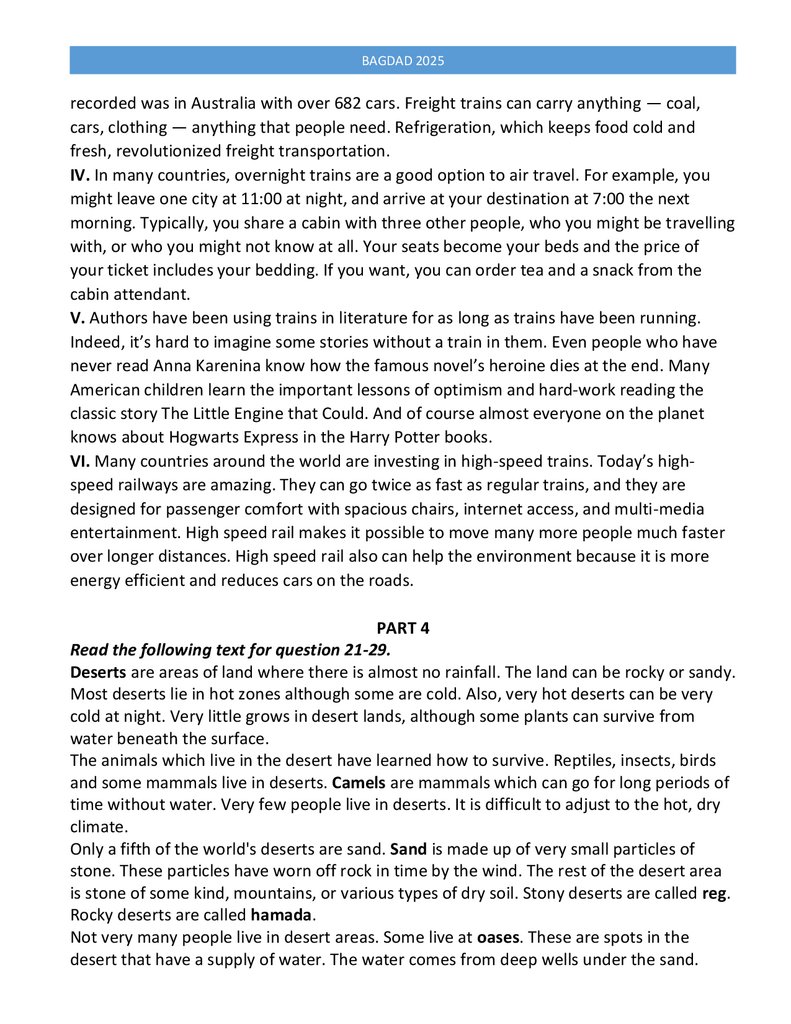
BAGDAD 2025recorded was in Australia with over 682 cars. Freight trains can carry anything — coal,
cars, clothing — anything that people need. Refrigeration, which keeps food cold and
fresh, revolutionized freight transportation.
IV. In many countries, overnight trains are a good option to air travel. For example, you
might leave one city at 11:00 at night, and arrive at your destination at 7:00 the next
morning. Typically, you share a cabin with three other people, who you might be travelling
with, or who you might not know at all. Your seats become your beds and the price of
your ticket includes your bedding. If you want, you can order tea and a snack from the
cabin attendant.
V. Authors have been using trains in literature for as long as trains have been running.
Indeed, it’s hard to imagine some stories without a train in them. Even people who have
never read Anna Karenina know how the famous novel’s heroine dies at the end. Many
American children learn the important lessons of optimism and hard-work reading the
classic story The Little Engine that Could. And of course almost everyone on the planet
knows about Hogwarts Express in the Harry Potter books.
VI. Many countries around the world are investing in high-speed trains. Today’s highspeed railways are amazing. They can go twice as fast as regular trains, and they are
designed for passenger comfort with spacious chairs, internet access, and multi-media
entertainment. High speed rail makes it possible to move many more people much faster
over longer distances. High speed rail also can help the environment because it is more
energy efficient and reduces cars on the roads.
PART 4
Read the following text for question 21-29.
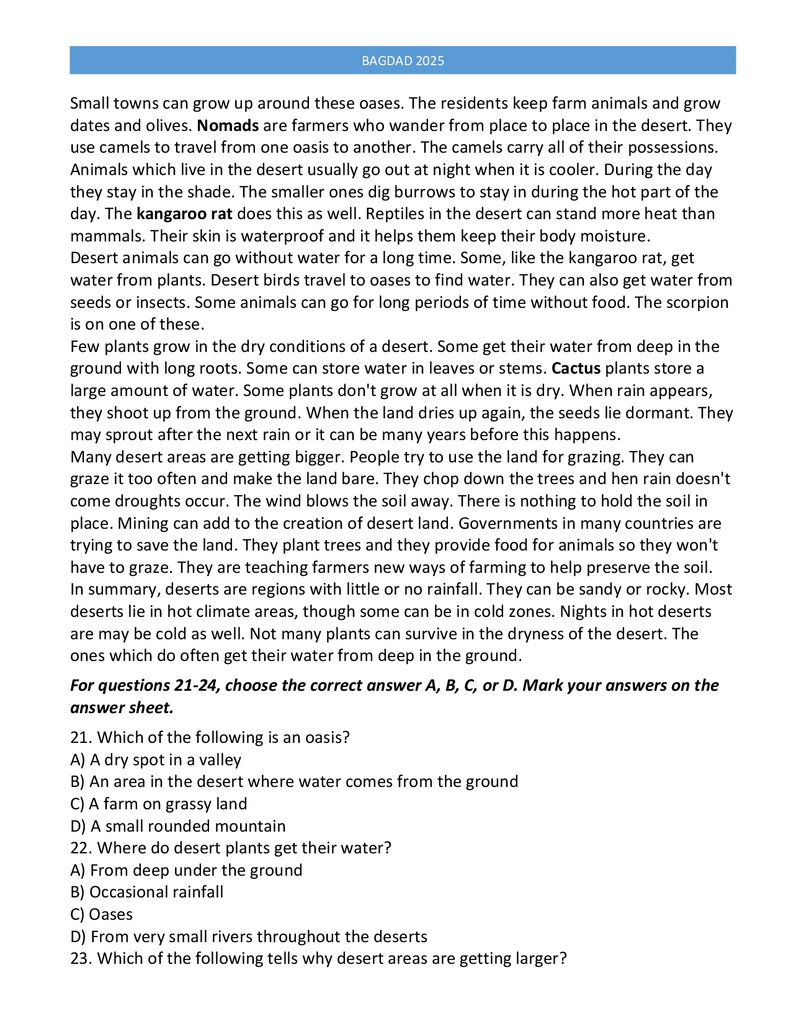
Deserts are areas of land where there is almost no rainfall. The land can be rocky or sandy.
Most deserts lie in hot zones although some are cold. Also, very hot deserts can be very
cold at night. Very little grows in desert lands, although some plants can survive from
water beneath the surface.
The animals which live in the desert have learned how to survive. Reptiles, insects, birds
and some mammals live in deserts. Camels are mammals which can go for long periods of
time without water. Very few people live in deserts. It is difficult to adjust to the hot, dry
climate.
Only a fifth of the world's deserts are sand. Sand is made up of very small particles of
stone. These particles have worn off rock in time by the wind. The rest of the desert area
is stone of some kind, mountains, or various types of dry soil. Stony deserts are called reg.
Rocky deserts are called hamada.
Not very many people live in desert areas. Some live at oases. These are spots in the
desert that have a supply of water. The water comes from deep wells under the sand.
14.
BAGDAD 2025Small towns can grow up around these oases. The residents keep farm animals and grow
dates and olives. Nomads are farmers who wander from place to place in the desert. They
use camels to travel from one oasis to another. The camels carry all of their possessions.
Animals which live in the desert usually go out at night when it is cooler. During the day
they stay in the shade. The smaller ones dig burrows to stay in during the hot part of the
day. The kangaroo rat does this as well. Reptiles in the desert can stand more heat than
mammals. Their skin is waterproof and it helps them keep their body moisture.
Desert animals can go without water for a long time. Some, like the kangaroo rat, get
water from plants. Desert birds travel to oases to find water. They can also get water from
seeds or insects. Some animals can go for long periods of time without food. The scorpion
is on one of these.
Few plants grow in the dry conditions of a desert. Some get their water from deep in the
ground with long roots. Some can store water in leaves or stems. Cactus plants store a
large amount of water. Some plants don't grow at all when it is dry. When rain appears,
they shoot up from the ground. When the land dries up again, the seeds lie dormant. They
may sprout after the next rain or it can be many years before this happens.
Many desert areas are getting bigger. People try to use the land for grazing. They can
graze it too often and make the land bare. They chop down the trees and hen rain doesn't
come droughts occur. The wind blows the soil away. There is nothing to hold the soil in
place. Mining can add to the creation of desert land. Governments in many countries are
trying to save the land. They plant trees and they provide food for animals so they won't
have to graze. They are teaching farmers new ways of farming to help preserve the soil.
In summary, deserts are regions with little or no rainfall. They can be sandy or rocky. Most
deserts lie in hot climate areas, though some can be in cold zones. Nights in hot deserts
are may be cold as well. Not many plants can survive in the dryness of the desert. The
ones which do often get their water from deep in the ground.
For questions 21-24, choose the correct answer A, B, C, or D. Mark your answers on the
answer sheet.
21. Which of the following is an oasis?
A) A dry spot in a valley
B) An area in the desert where water comes from the ground
C) A farm on grassy land
D) A small rounded mountain
22. Where do desert plants get their water?
A) From deep under the ground
B) Occasional rainfall
C) Oases
D) From very small rivers throughout the deserts
23. Which of the following tells why desert areas are getting larger?
15.
BAGDAD 2025A) Mining strips the land.
B) Farmers overgraze the land.
C) People chop down the trees.
D) All of the above.
24. Nomads …
A) live at oases.
B) use camel to gain access to water.
C) travel from place to place in the desert.
D) often wonders why they live in the desert.
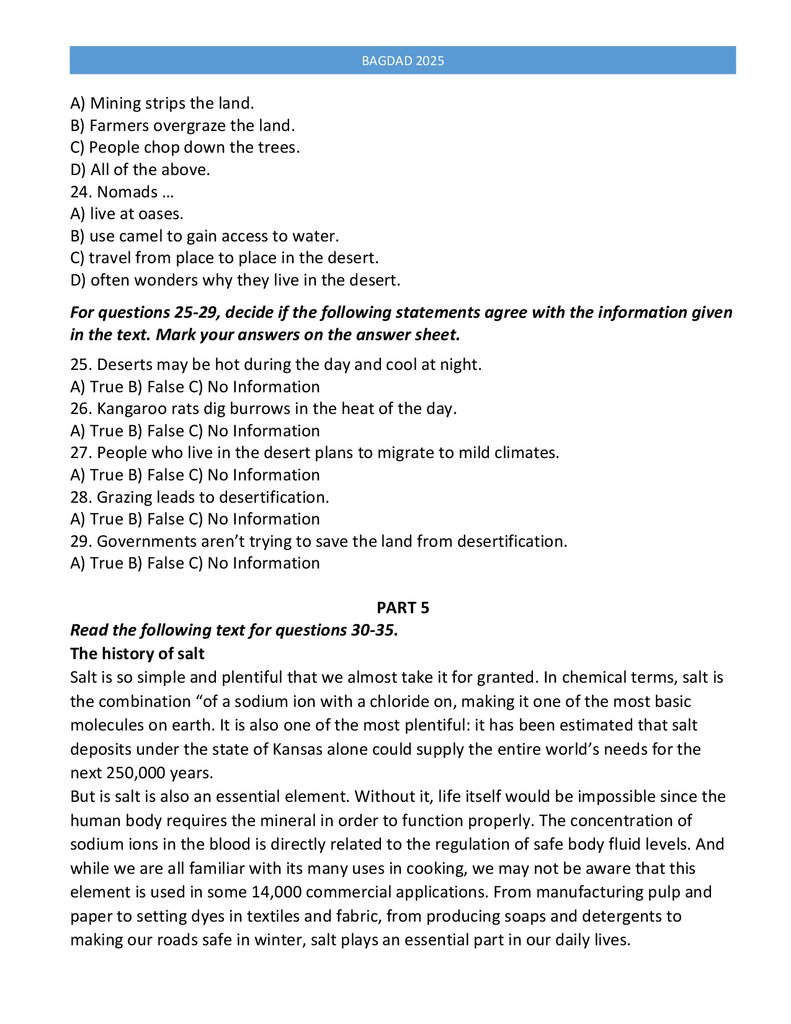
For questions 25-29, decide if the following statements agree with the information given
in the text. Mark your answers on the answer sheet.
25. Deserts may be hot during the day and cool at night.
A) True B) False C) No Information
26. Kangaroo rats dig burrows in the heat of the day.
A) True B) False C) No Information
27. People who live in the desert plans to migrate to mild climates.
A) True B) False C) No Information
28. Grazing leads to desertification.
A) True B) False C) No Information
29. Governments aren’t trying to save the land from desertification.
A) True B) False C) No Information
PART 5
Read the following text for questions 30-35.
The history of salt
Salt is so simple and plentiful that we almost take it for granted. In chemical terms, salt is
the combination “of a sodium ion with a chloride on, making it one of the most basic
molecules on earth. It is also one of the most plentiful: it has been estimated that salt
deposits under the state of Kansas alone could supply the entire world’s needs for the
next 250,000 years.
But is salt is also an essential element. Without it, life itself would be impossible since the
human body requires the mineral in order to function properly. The concentration of
sodium ions in the blood is directly related to the regulation of safe body fluid levels. And
while we are all familiar with its many uses in cooking, we may not be aware that this
element is used in some 14,000 commercial applications. From manufacturing pulp and
paper to setting dyes in textiles and fabric, from producing soaps and detergents to
making our roads safe in winter, salt plays an essential part in our daily lives.
16.
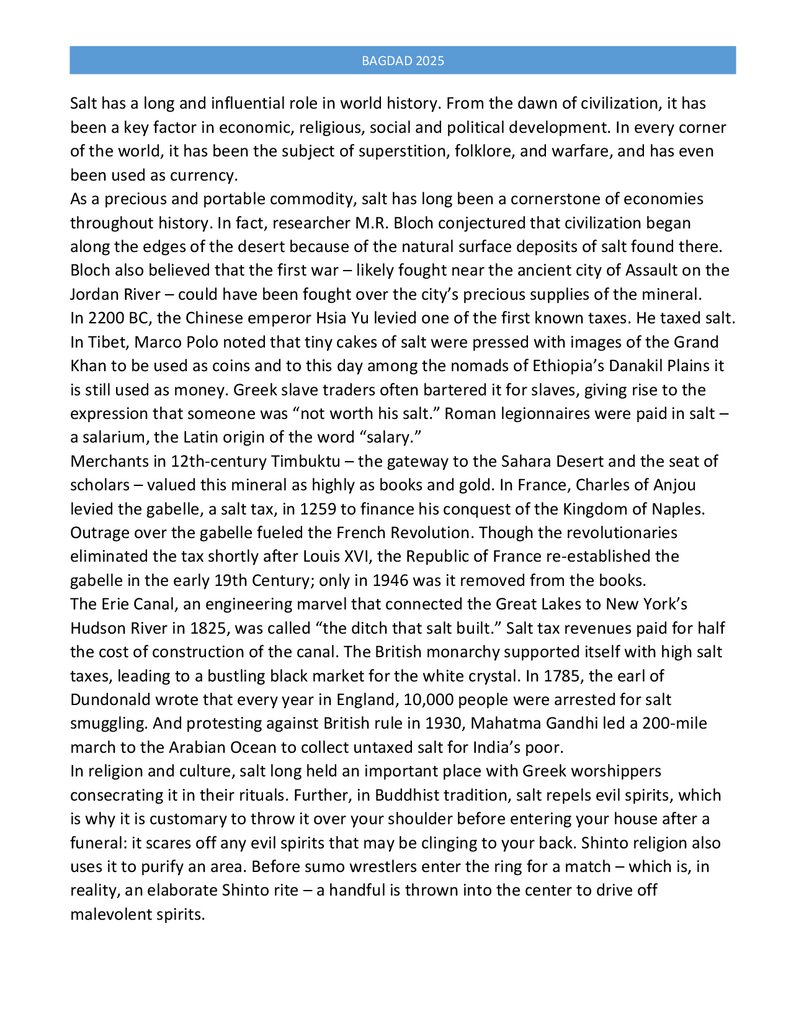
BAGDAD 2025Salt has a long and influential role in world history. From the dawn of civilization, it has
been a key factor in economic, religious, social and political development. In every corner
of the world, it has been the subject of superstition, folklore, and warfare, and has even
been used as currency.
As a precious and portable commodity, salt has long been a cornerstone of economies
throughout history. In fact, researcher M.R. Bloch conjectured that civilization began
along the edges of the desert because of the natural surface deposits of salt found there.
Bloch also believed that the first war – likely fought near the ancient city of Assault on the
Jordan River – could have been fought over the city’s precious supplies of the mineral.
In 2200 BC, the Chinese emperor Hsia Yu levied one of the first known taxes. He taxed salt.
In Tibet, Marco Polo noted that tiny cakes of salt were pressed with images of the Grand
Khan to be used as coins and to this day among the nomads of Ethiopia’s Danakil Plains it
is still used as money. Greek slave traders often bartered it for slaves, giving rise to the
expression that someone was “not worth his salt.” Roman legionnaires were paid in salt –
a salarium, the Latin origin of the word “salary.”
Merchants in 12th-century Timbuktu – the gateway to the Sahara Desert and the seat of
scholars – valued this mineral as highly as books and gold. In France, Charles of Anjou
levied the gabelle, a salt tax, in 1259 to finance his conquest of the Kingdom of Naples.
Outrage over the gabelle fueled the French Revolution. Though the revolutionaries
eliminated the tax shortly after Louis XVI, the Republic of France re-established the
gabelle in the early 19th Century; only in 1946 was it removed from the books.
The Erie Canal, an engineering marvel that connected the Great Lakes to New York’s
Hudson River in 1825, was called “the ditch that salt built.” Salt tax revenues paid for half
the cost of construction of the canal. The British monarchy supported itself with high salt
taxes, leading to a bustling black market for the white crystal. In 1785, the earl of
Dundonald wrote that every year in England, 10,000 people were arrested for salt
smuggling. And protesting against British rule in 1930, Mahatma Gandhi led a 200-mile
march to the Arabian Ocean to collect untaxed salt for India’s poor.
In religion and culture, salt long held an important place with Greek worshippers
consecrating it in their rituals. Further, in Buddhist tradition, salt repels evil spirits, which
is why it is customary to throw it over your shoulder before entering your house after a
funeral: it scares off any evil spirits that may be clinging to your back. Shinto religion also
uses it to purify an area. Before sumo wrestlers enter the ring for a match – which is, in
reality, an elaborate Shinto rite – a handful is thrown into the center to drive off
malevolent spirits.
17.
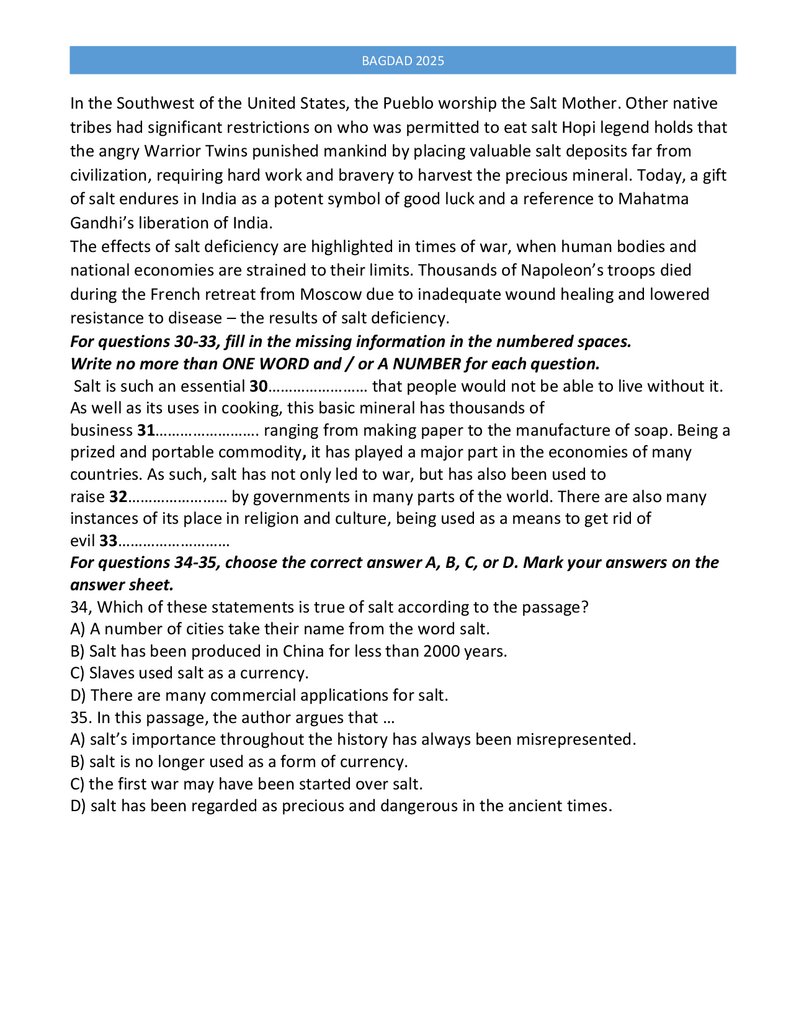
BAGDAD 2025In the Southwest of the United States, the Pueblo worship the Salt Mother. Other native
tribes had significant restrictions on who was permitted to eat salt Hopi legend holds that
the angry Warrior Twins punished mankind by placing valuable salt deposits far from
civilization, requiring hard work and bravery to harvest the precious mineral. Today, a gift
of salt endures in India as a potent symbol of good luck and a reference to Mahatma
Gandhi’s liberation of India.
The effects of salt deficiency are highlighted in times of war, when human bodies and
national economies are strained to their limits. Thousands of Napoleon’s troops died
during the French retreat from Moscow due to inadequate wound healing and lowered
resistance to disease – the results of salt deficiency.
For questions 30-33, fill in the missing information in the numbered spaces.
Write no more than ONE WORD and / or A NUMBER for each question.
Salt is such an essential 30…………………… that people would not be able to live without it.
As well as its uses in cooking, this basic mineral has thousands of
business 31……………………. ranging from making paper to the manufacture of soap. Being a
prized and portable commodity, it has played a major part in the economies of many
countries. As such, salt has not only led to war, but has also been used to
raise 32…………………… by governments in many parts of the world. There are also many
instances of its place in religion and culture, being used as a means to get rid of
evil 33………………………
For questions 34-35, choose the correct answer A, B, C, or D. Mark your answers on the
answer sheet.
34, Which of these statements is true of salt according to the passage?
A) A number of cities take their name from the word salt.
B) Salt has been produced in China for less than 2000 years.
C) Slaves used salt as a currency.
D) There are many commercial applications for salt.
35. In this passage, the author argues that …
A) salt’s importance throughout the history has always been misrepresented.
B) salt is no longer used as a form of currency.
C) the first war may have been started over salt.
D) salt has been regarded as precious and dangerous in the ancient times.
18.
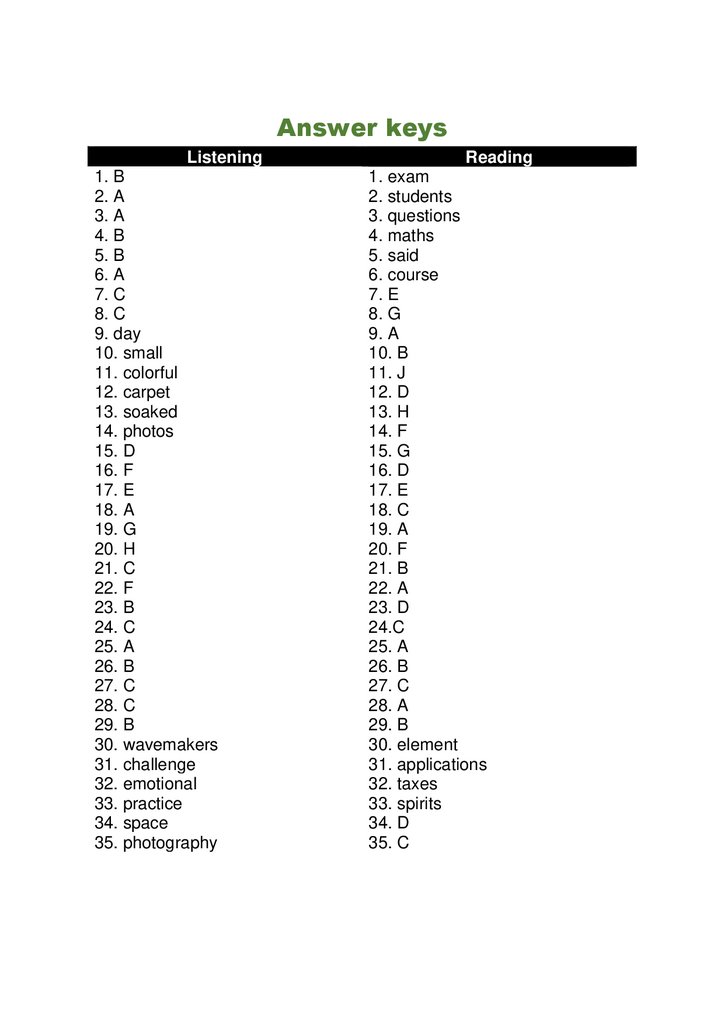
Answer keysListening
1. B
2. A
3. A
4. B
5. B
6. A
7. C
8. C
9. day
10. small
11. colorful
12. carpet
13. soaked
14. photos
15. D
16. F
17. E
18. A
19. G
20. H
21. C
22. F
23. B
24. C
25. A
26. B
27. C
28. C
29. B
30. wavemakers
31. challenge
32. emotional
33. practice
34. space
35. photography
Reading
1. exam
2. students
3. questions
4. maths
5. said
6. course
7. E
8. G
9. A
10. B
11. J
12. D
13. H
14. F
15. G
16. D
17. E
18. C
19. A
20. F
21. B
22. A
23. D
24.C
25. A
26. B
27. C
28. A
29. B
30. element
31. applications
32. taxes
33. spirits
34. D
35. C