 geography
Similar presentations:


Canada: The Land of the Maple Leaf and Northern Harmony
1. Canada: The Land of the Maple Leaf and Northern Harmony
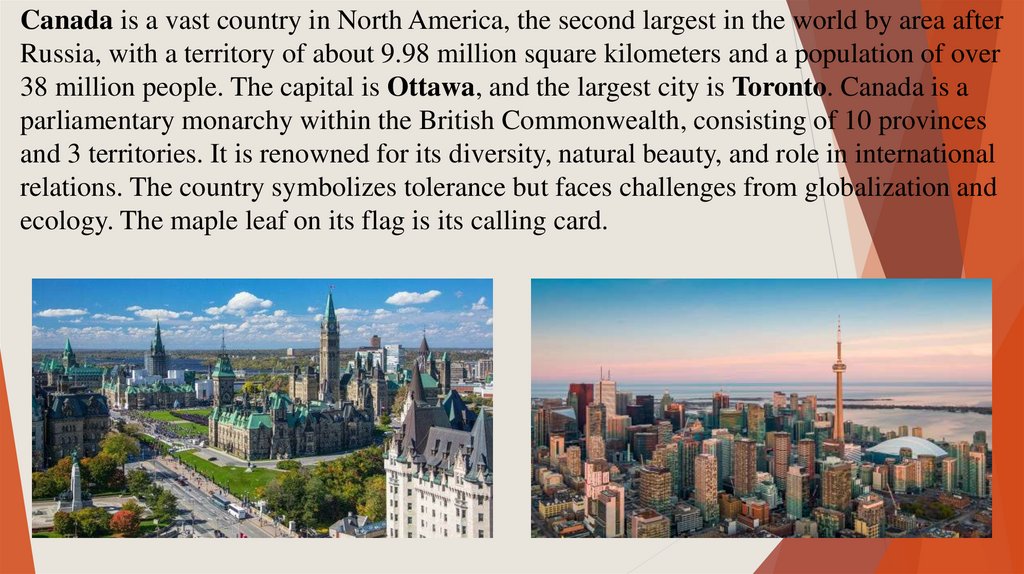
2. Canada is a vast country in North America, the second largest in the world by area after Russia, with a territory of about 9.98
million square kilometers and a population of over38 million people. The capital is Ottawa, and the largest city is Toronto. Canada is a
parliamentary monarchy within the British Commonwealth, consisting of 10 provinces
and 3 territories. It is renowned for its diversity, natural beauty, and role in international
relations. The country symbolizes tolerance but faces challenges from globalization and
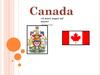
ecology. The maple leaf on its flag is its calling card.
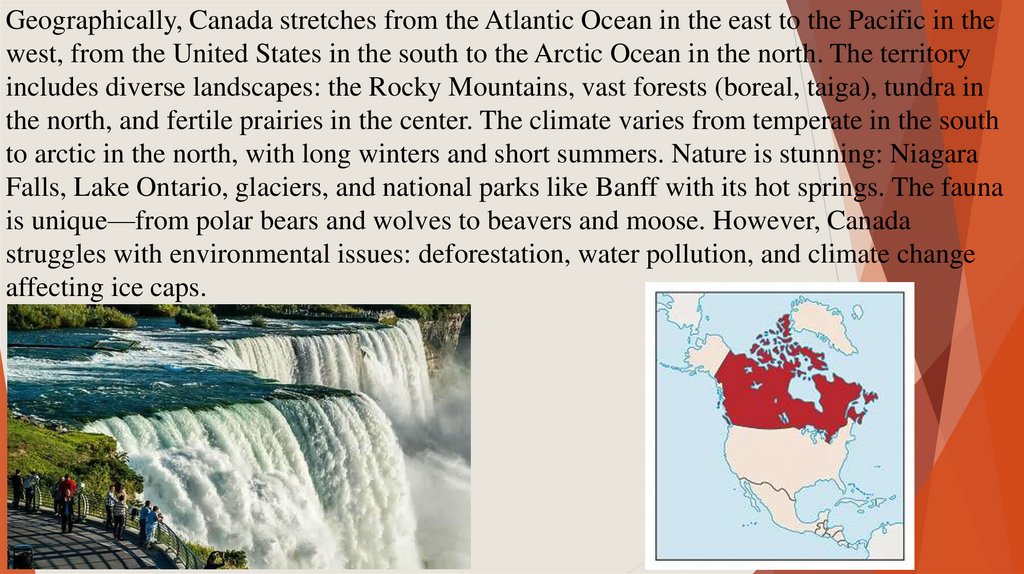
3. Geographically, Canada stretches from the Atlantic Ocean in the east to the Pacific in the west, from the United States in the
south to the Arctic Ocean in the north. The territoryincludes diverse landscapes: the Rocky Mountains, vast forests (boreal, taiga), tundra in
the north, and fertile prairies in the center. The climate varies from temperate in the south
to arctic in the north, with long winters and short summers. Nature is stunning: Niagara
Falls, Lake Ontario, glaciers, and national parks like Banff with its hot springs. The fauna
is unique—from polar bears and wolves to beavers and moose. However, Canada
struggles with environmental issues: deforestation, water pollution, and climate change
affecting ice caps.
4. Canada's history dates back to ancient times when indigenous peoples—Indigenous peoples, Inuit, and Métis—lived here. In the
Canada's history dates back to ancient times when indigenous peoples—Indigenouspeoples, Inuit, and Métis—lived here. In the 17th century, colonization began by the
French (New France) and the British. After the Seven Years' War (1763), Canada became a
British colony. In 1867, the Confederation was formed from four provinces, and in 1982,
the Constitution was adopted, securing independence. The 20th century brought
participation in world wars and development as a democratic nation. Today, Canada is a
multicultural society, but its history includes conflicts with indigenous peoples and
struggles for rights.
Canada's economy is one of the world's largest, with a GDP of about 2 trillion dollars. The
country is rich in resources: oil and gas (Alberta), timber, minerals (gold, uranium), and
fish. Industry includes automotive manufacturing (Ontario) and technology (Vancouver).
Tourism (national parks, ski resorts) and agriculture (wheat) are important. Canada is a
member of NAFTA (now USMCA) and a leader in green technologies, but it depends on
raw material exports and faces trade disputes.
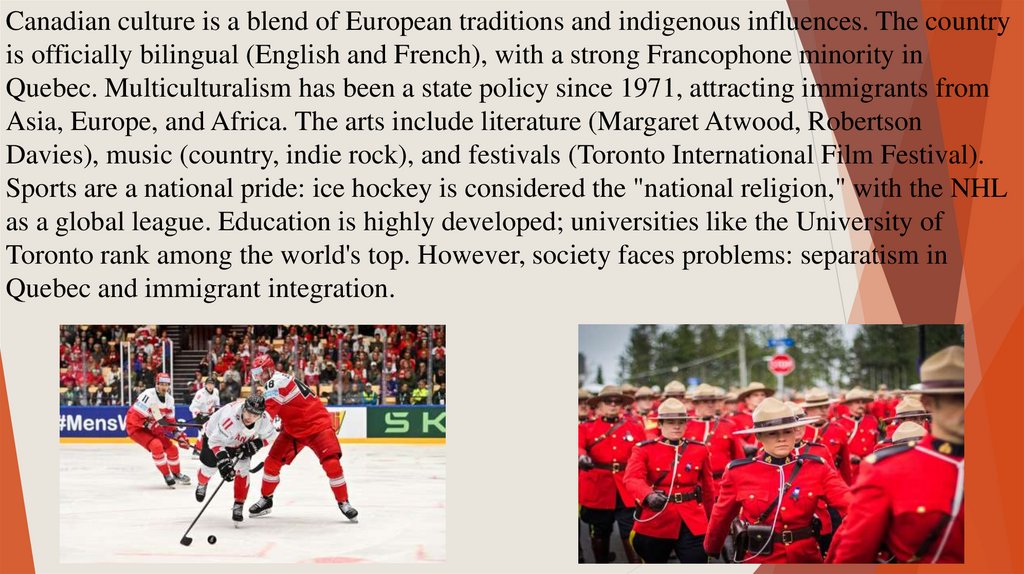
5. Canadian culture is a blend of European traditions and indigenous influences. The country is officially bilingual (English and
French), with a strong Francophone minority inQuebec. Multiculturalism has been a state policy since 1971, attracting immigrants from
Asia, Europe, and Africa. The arts include literature (Margaret Atwood, Robertson
Davies), music (country, indie rock), and festivals (Toronto International Film Festival).
Sports are a national pride: ice hockey is considered the "national religion," with the NHL
as a global league. Education is highly developed; universities like the University of
Toronto rank among the world's top. However, society faces problems: separatism in
Quebec and immigrant integration.