 law
lawSimilar presentations:







What is Law? Law and Morality Law and Power Law and Other Social Norms Anita Karlovna Soboleva, associate professor
1. What is Law? Law and Morality Law and Power Law and Other Social Norms Anita Karlovna Soboleva, associate professor
asoboleva@hse.ruAcademic year 2025
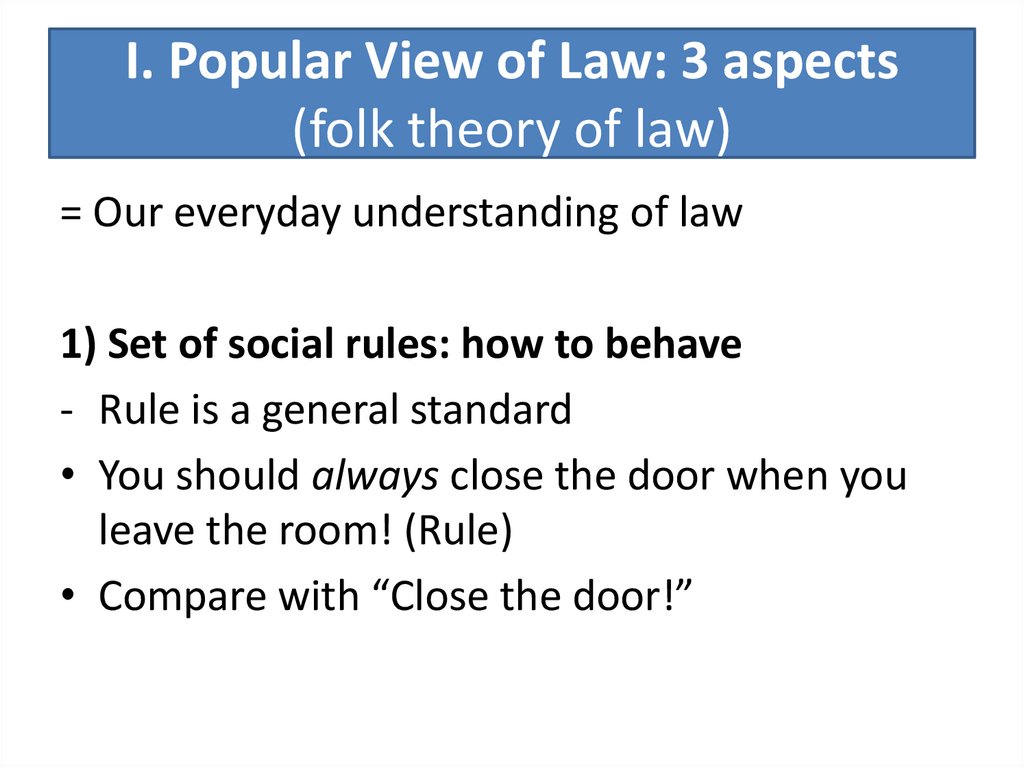
2. I. Popular View of Law: 3 aspects (folk theory of law)
= Our everyday understanding of law1) Set of social rules: how to behave
- Rule is a general standard
• You should always close the door when you
leave the room! (Rule)
• Compare with “Close the door!”
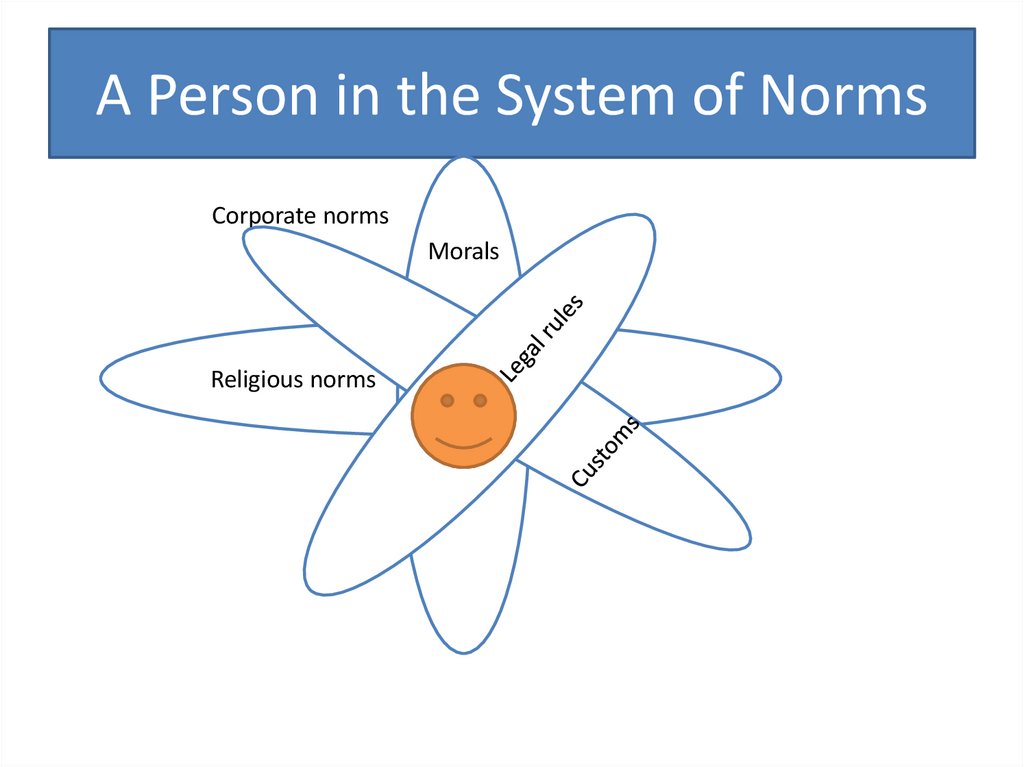
3. A Person in the System of Norms
Corporate normsMorals
Religious norms
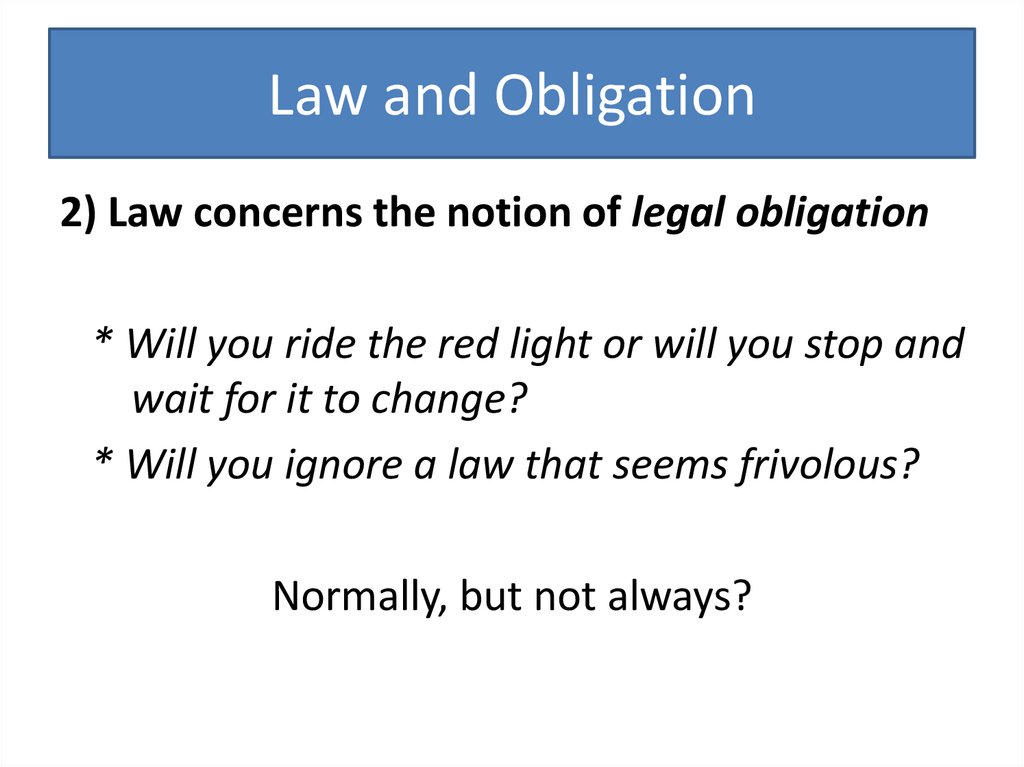
4. Law and Obligation
2) Law concerns the notion of legal obligation* Will you ride the red light or will you stop and
wait for it to change?
* Will you ignore a law that seems frivolous?
Normally, but not always?
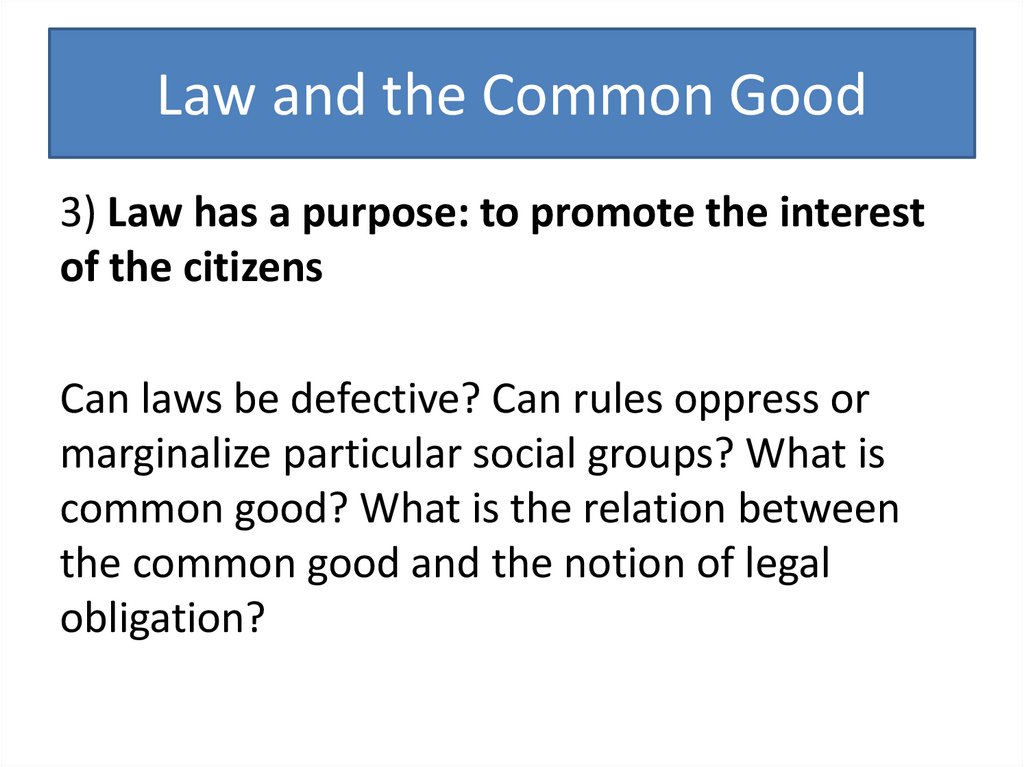
5. Law and the Common Good
3) Law has a purpose: to promote the interestof the citizens
Can laws be defective? Can rules oppress or
marginalize particular social groups? What is
common good? What is the relation between
the common good and the notion of legal
obligation?
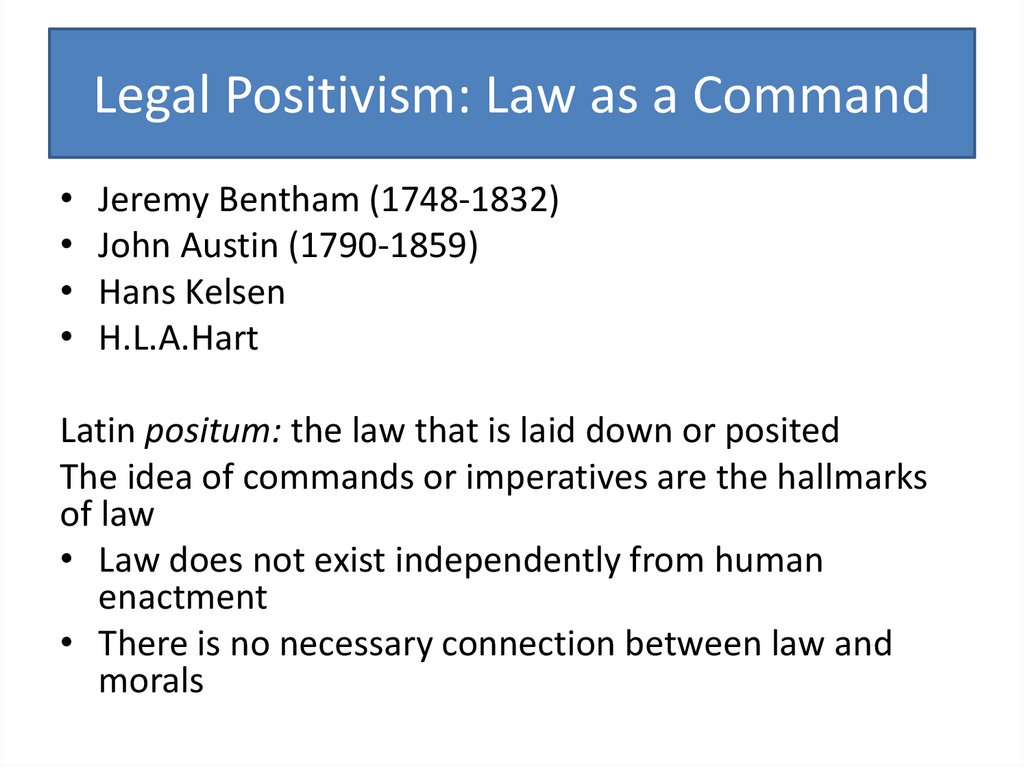
6. Legal Positivism: Law as a Command
• Jeremy Bentham (1748-1832)• John Austin (1790-1859)
• Hans Kelsen
• H.L.A.Hart
Latin positum: the law that is laid down or posited
The idea of commands or imperatives are the hallmarks
of law
• Law does not exist independently from human
enactment
• There is no necessary connection between law and
morals
7.
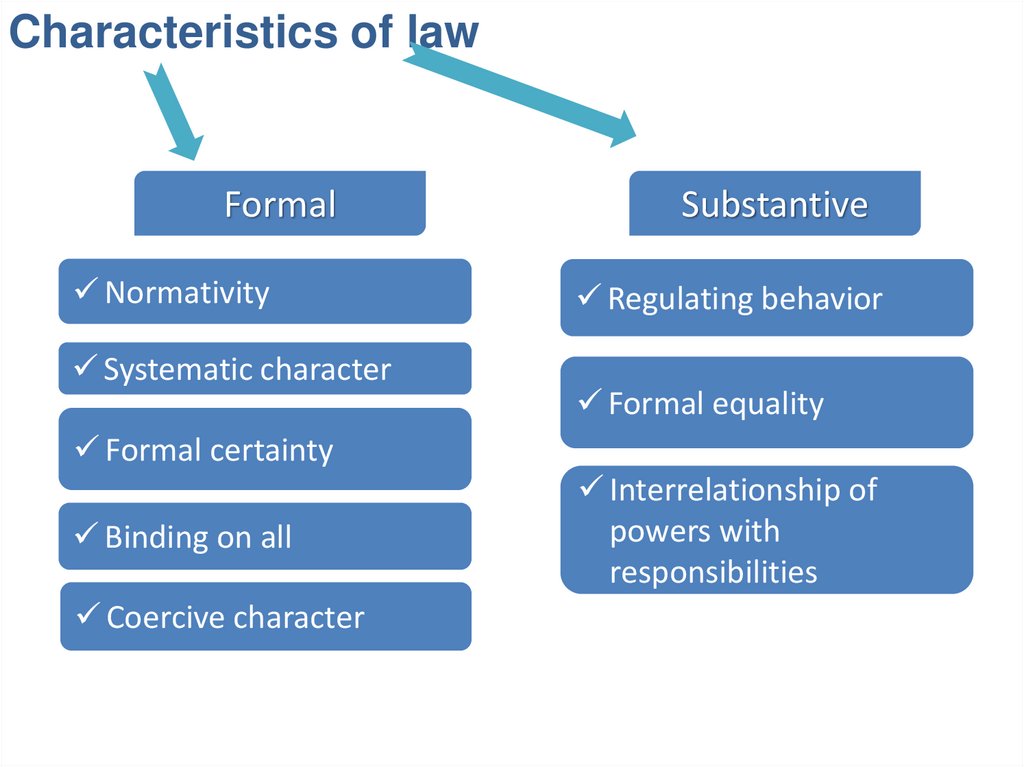
Characteristics of lawFormal
Normativity
Systematic character
Substantive
Regulating behavior
Formal equality
Formal certainty
Binding on all
Coercive character
Interrelationship of
powers with
responsibilities
8.
Normativity• Law as a system
of norms (rules)
9. Law and Morality
• Morality is also a set of social rulesWe should always obey the law. And if law and
morality do not coincide? Can they lead us in
different directions?
10. H.L.A.Hart The Concept of Law (1961)
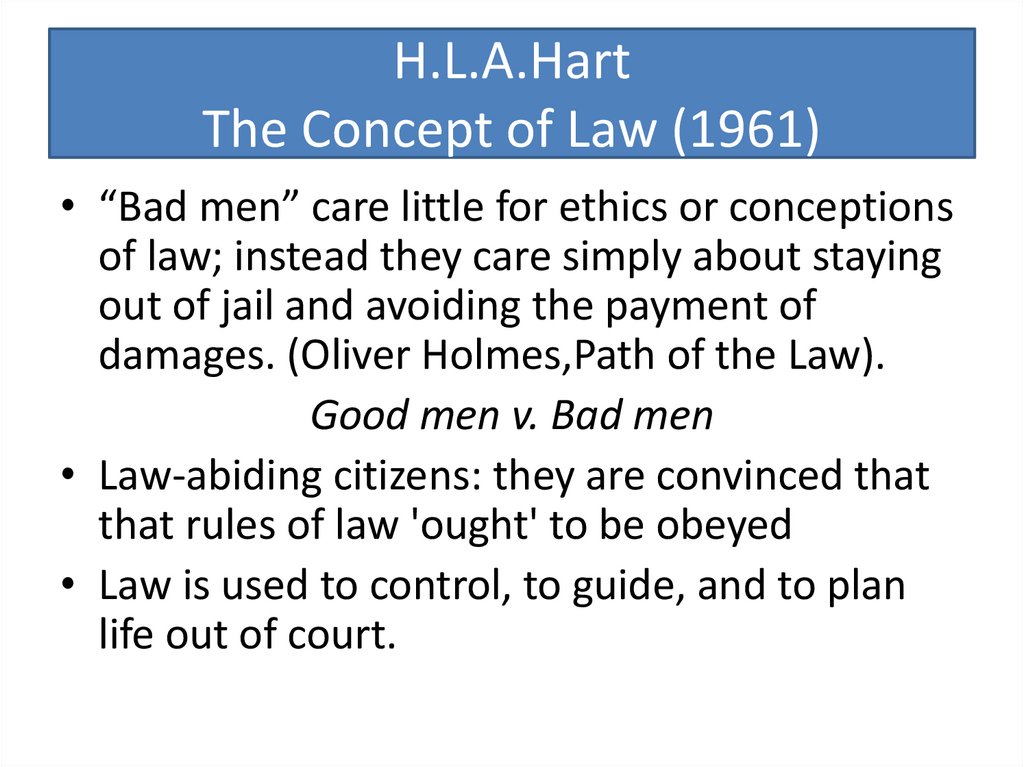
• “Bad men” care little for ethics or conceptionsof law; instead they care simply about staying
out of jail and avoiding the payment of
damages. (Oliver Holmes,Path of the Law).
Good men v. Bad men
• Law-abiding citizens: they are convinced that
that rules of law 'ought' to be obeyed
• Law is used to control, to guide, and to plan
life out of court.
11. Two traditions – two responses
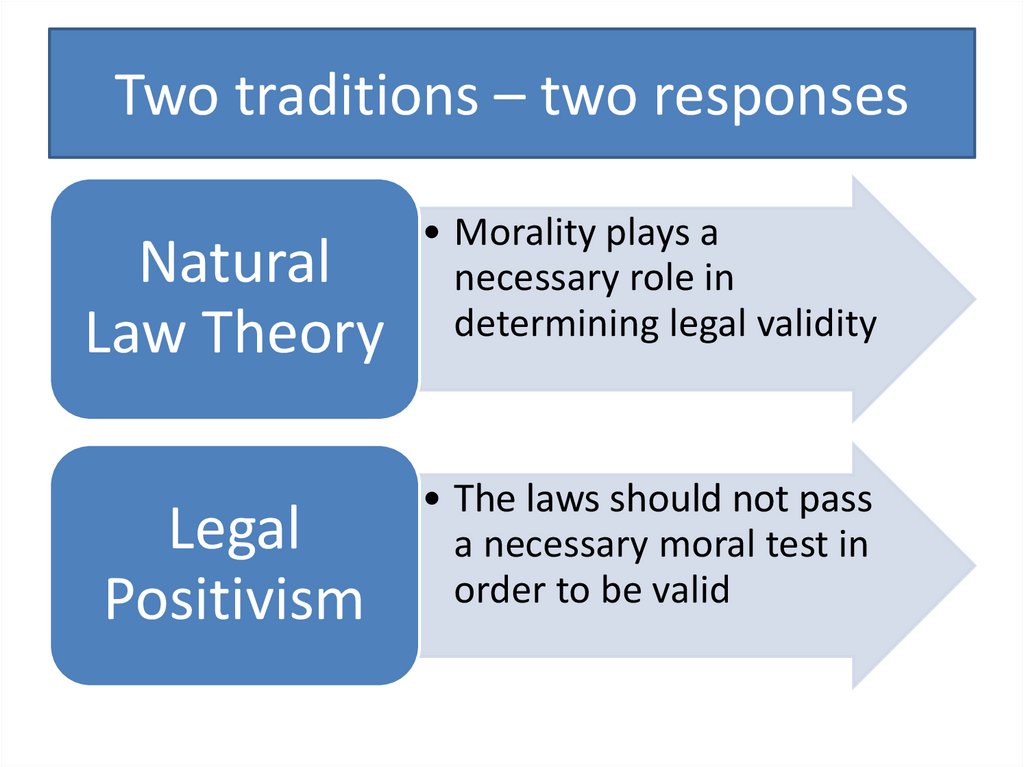
NaturalLaw Theory
• Morality plays a
necessary role in
determining legal validity
Legal
Positivism
• The laws should not pass
a necessary moral test in
order to be valid
12. Law and Power
• Both traditions agree that laws are validbecause they are issued in a recognized form
and by a recognized authority, but for natural
law theorists it’s not enough
• Impact of law on less powerful social groups is
outside the realm of legal positivism
13. Dogmatic definition YOU MUST KNOW IT BY HEART!!!
Basic terms in Theory of Law course:“Law is a system of formally defined rules
(norms), established and guaranteed by the
state power, which are obligatory for all and
which regulate relations in the society
through establishing of rights and duties of
the subjects and which are defended by the
coercive power of the state”
14. Socio-legal approach to law
Van Hoecke, М. L.Petrazhitsky:• at the heart of theory of law lies the mechanism of rights and
responsibilities;
• thee source of information about one’s rights and responsibilities
differs from the actual experiences (perceptions) of the individual;
• text is a ‘shell’ of a legal norm, which acquires its significance only
after it is perceived, interpreted and assessed by the subject of law;
• legal norms do not emerge from the subject’s individual
communication with the legal text, but they are introduced into the
life of a society by way of interacting of this individual with other
similarly behaved subjects =› there should be shared
understanding of what the rights and responsibilities are.
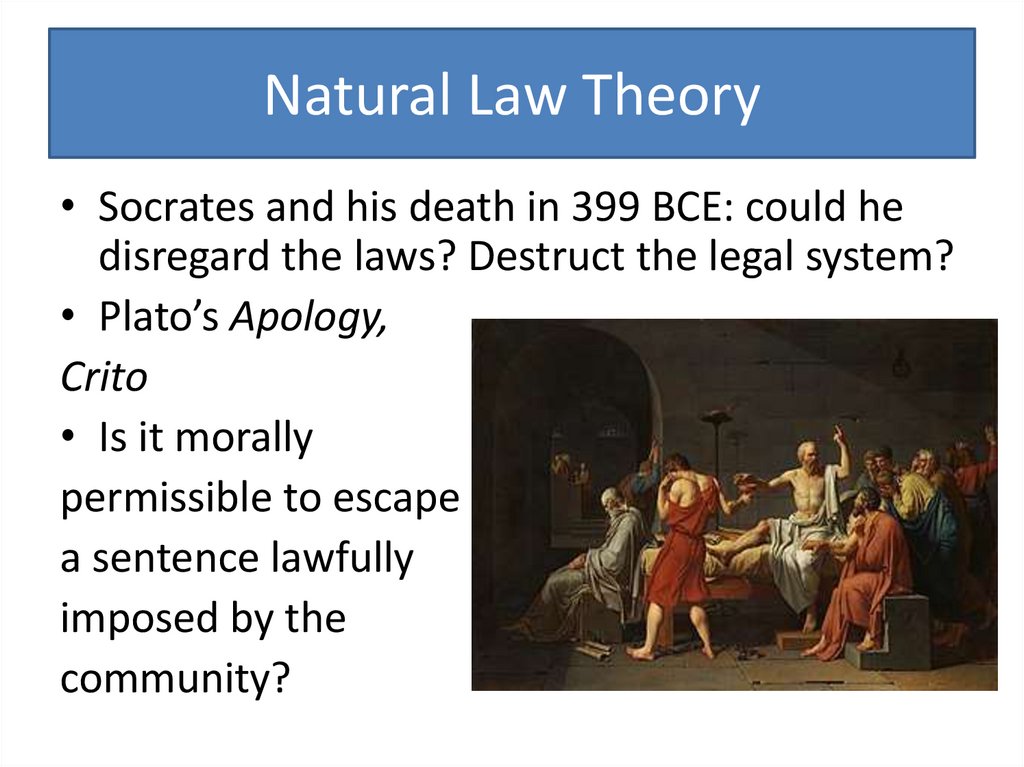
15. Natural Law Theory
• Socrates and his death in 399 BCE: could hedisregard the laws? Destruct the legal system?
• Plato’s Apology,
Crito
• Is it morally
permissible to escape
a sentence lawfully
imposed by the
community?
16. Plato
• The form of the good plays a central role inPlato’s view of law
• The purpose of law is to guide and educate
people, enabling everyone to participate in the
good life
• The well-educated will be the best rulers, but
they are the most reluctant to rule, so they have
a duty to share their wisdom
• Law can only be adequately defined by reference
to its moral function
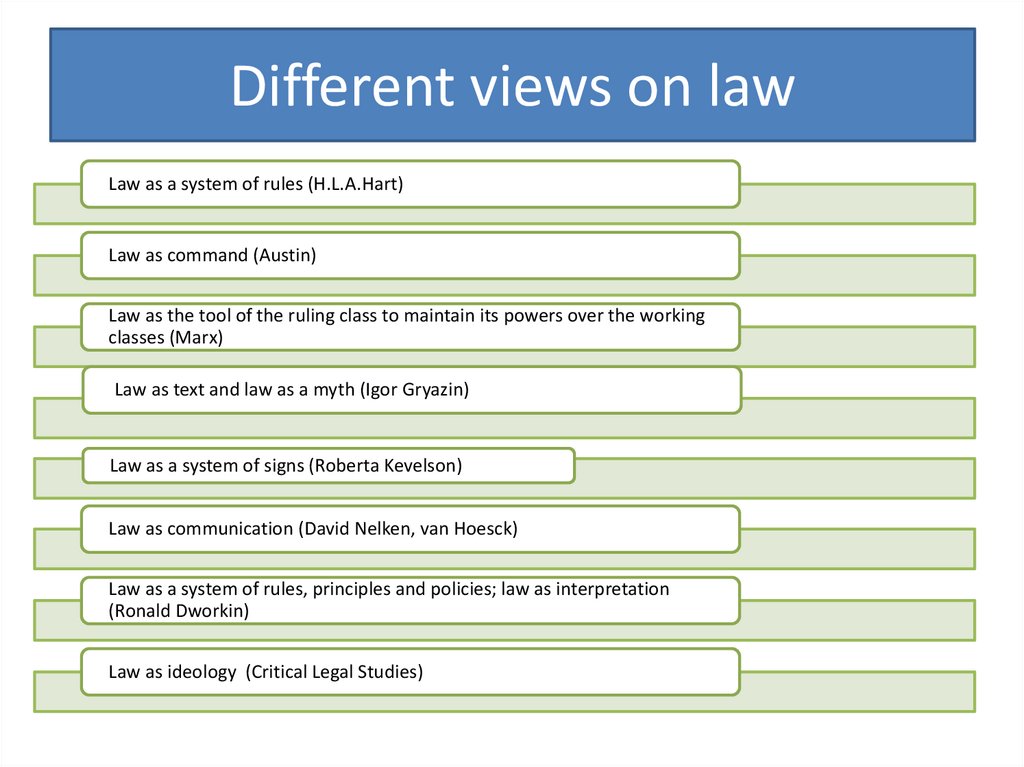
17. Different views on law
Law as a system of rules (H.L.A.Hart)Law as command (Austin)
Law as the tool of the ruling class to maintain its powers over the working
classes (Мarx)
Law as text and law as a myth (Igor Gryazin)
Law as a system of signs (Roberta Kevelson)
Law as communication (David Nelken, van Hoesck)
Law as a system of rules, principles and policies; law as interpretation
(Ronald Dworkin)
Law as ideology (Critical Legal Studies)
18. JUSTICE RULE OF LAW LAW-BASED STATE
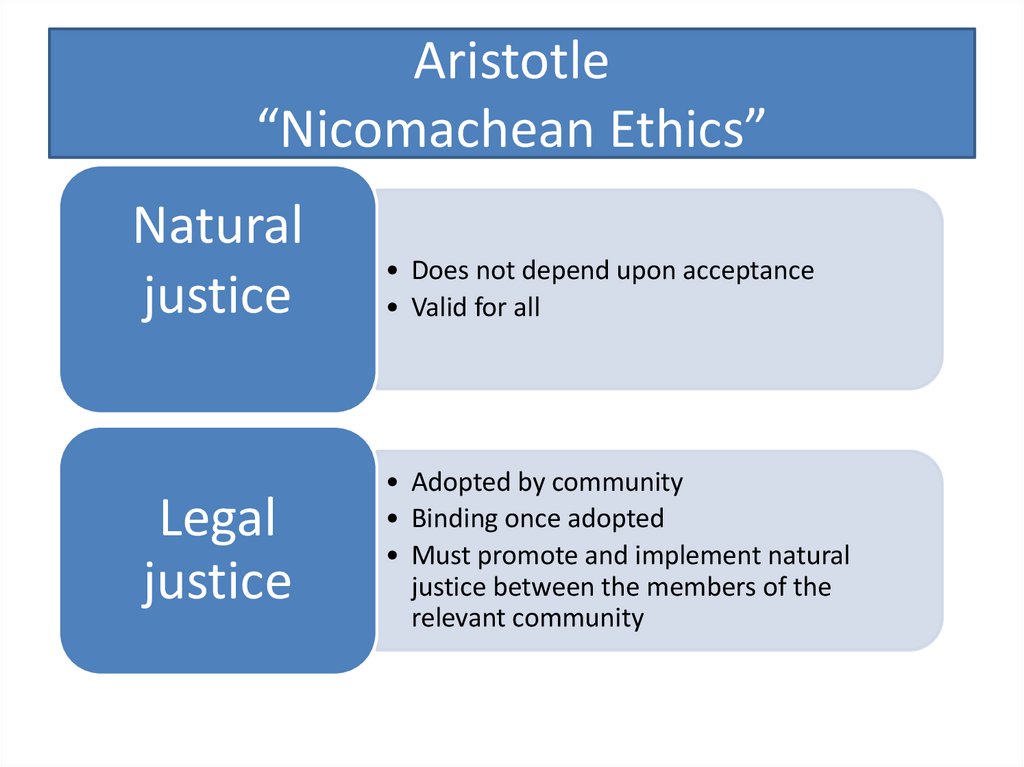
19. Aristotle “Nicomachean Ethics”
Naturaljustice
Legal
justice
• Does not depend upon acceptance
• Valid for all
• Adopted by community
• Binding once adopted
• Must promote and implement natural
justice between the members of the
relevant community
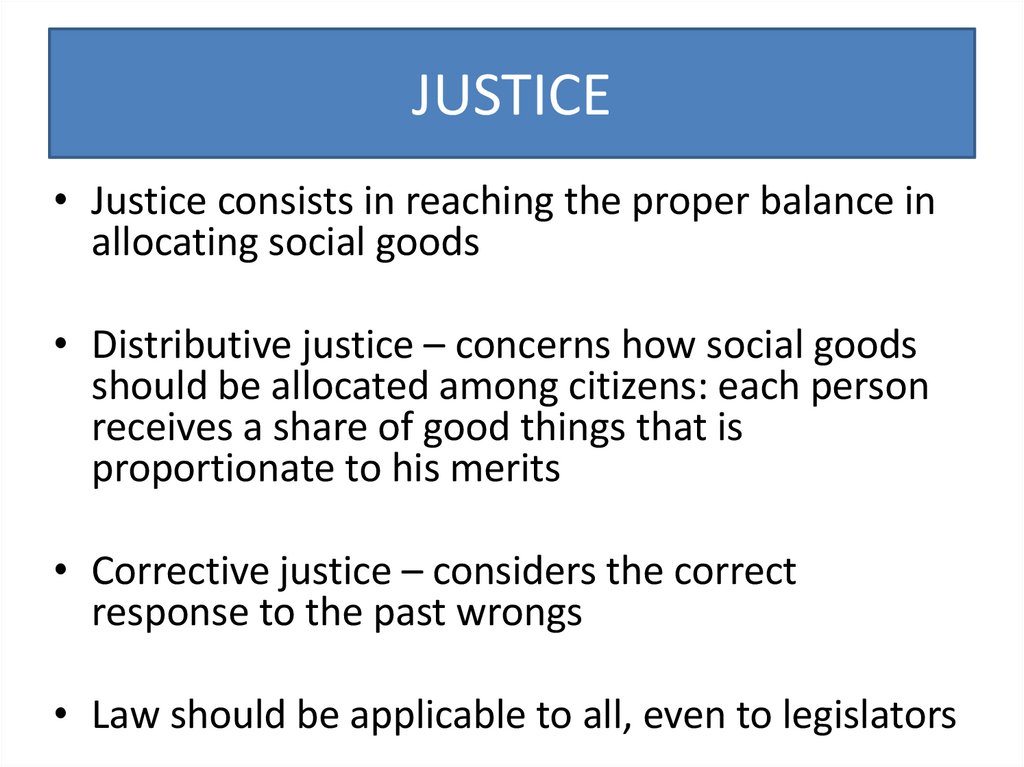
20. JUSTICE
• Justice consists in reaching the proper balance inallocating social goods
• Distributive justice – concerns how social goods
should be allocated among citizens: each person
receives a share of good things that is
proportionate to his merits
• Corrective justice – considers the correct
response to the past wrongs
• Law should be applicable to all, even to legislators
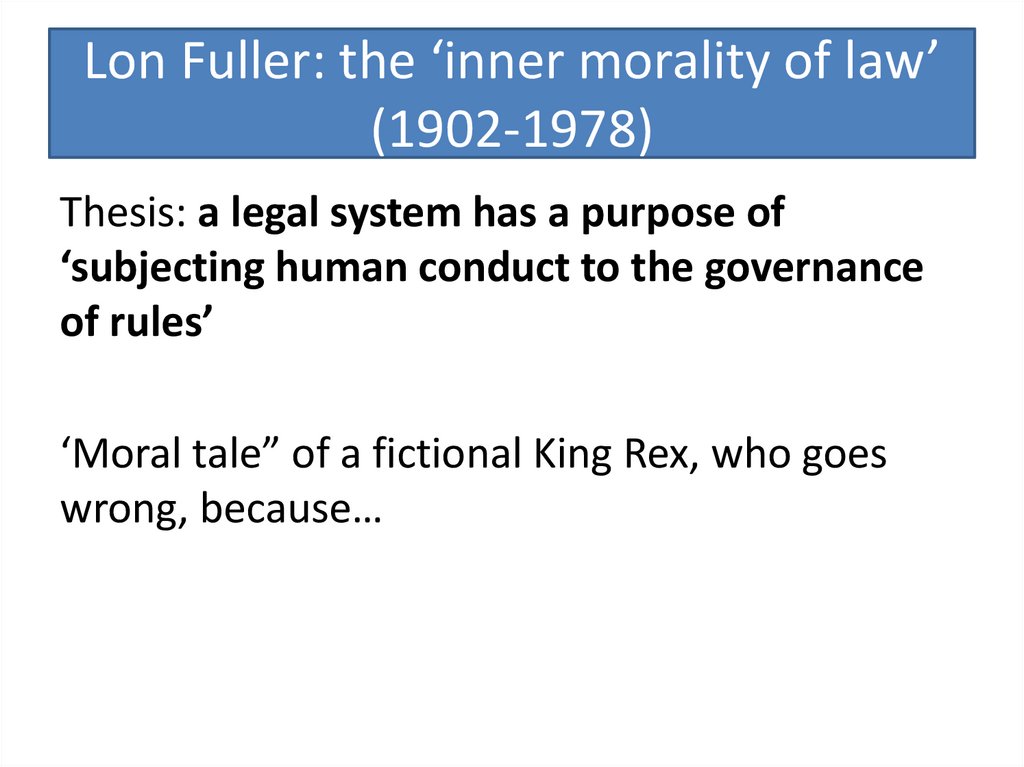
21. Lon Fuller: the ‘inner morality of law’ (1902-1978)
Thesis: a legal system has a purpose of‘subjecting human conduct to the governance
of rules’
‘Moral tale” of a fictional King Rex, who goes
wrong, because…
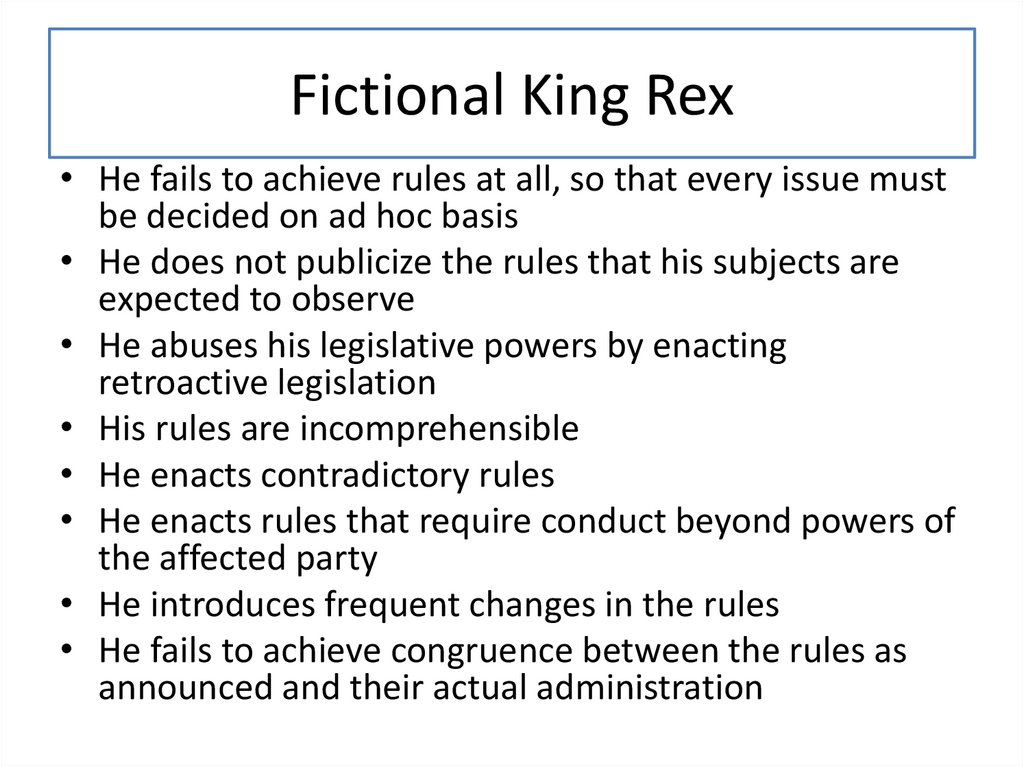
22. Fictional King Rex
• He fails to achieve rules at all, so that every issue mustbe decided on ad hoc basis
• He does not publicize the rules that his subjects are
expected to observe
• He abuses his legislative powers by enacting
retroactive legislation
• His rules are incomprehensible
• He enacts contradictory rules
• He enacts rules that require conduct beyond powers of
the affected party
• He introduces frequent changes in the rules
• He fails to achieve congruence between the rules as
announced and their actual administration
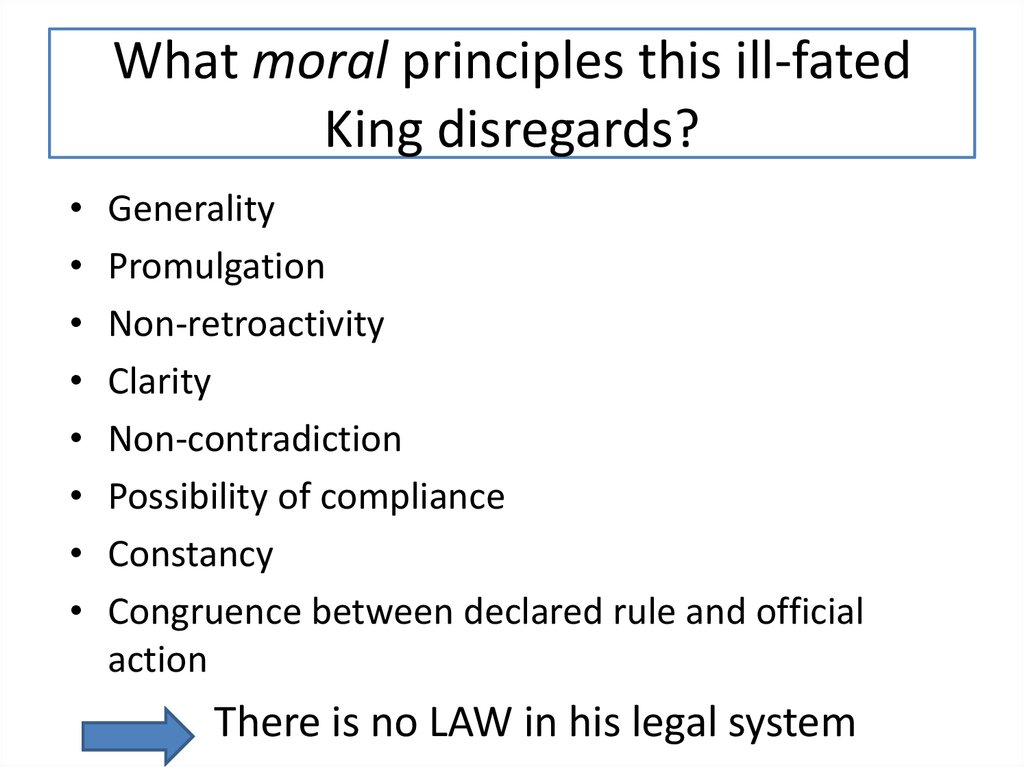
23. What moral principles this ill-fated King disregards?
• Generality• Promulgation
• Non-retroactivity
• Clarity
• Non-contradiction
• Possibility of compliance
• Constancy
• Congruence between declared rule and official
action
There is no LAW in his legal system
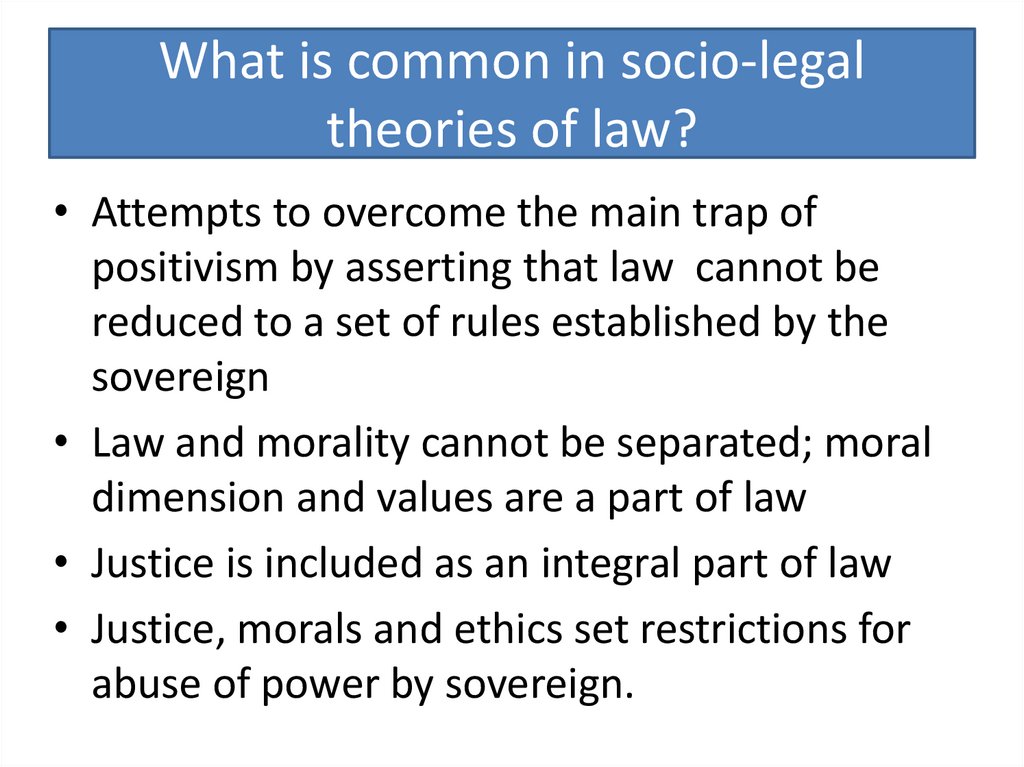
24. What is common in socio-legal theories of law?
• Attempts to overcome the main trap ofpositivism by asserting that law cannot be
reduced to a set of rules established by the
sovereign
• Law and morality cannot be separated; moral
dimension and values are a part of law
• Justice is included as an integral part of law
• Justice, morals and ethics set restrictions for
abuse of power by sovereign.
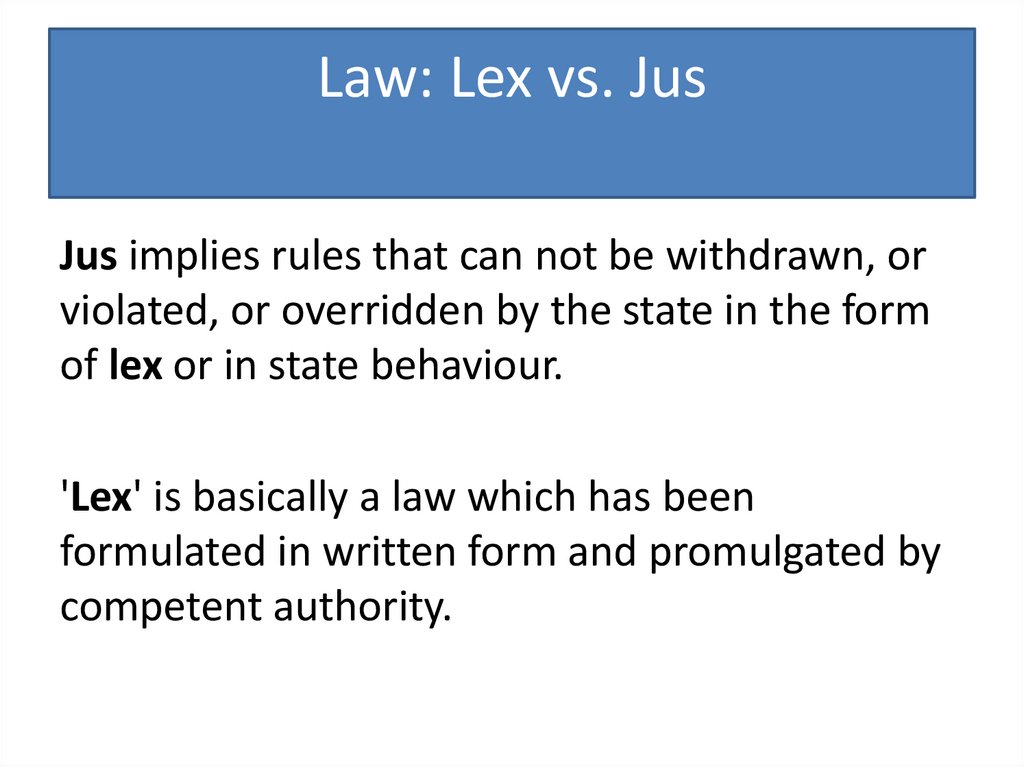
25. Law: Lex vs. Jus
Jus implies rules that can not be withdrawn, orviolated, or overridden by the state in the form
of lex or in state behaviour.
'Lex' is basically a law which has been
formulated in written form and promulgated by
competent authority.
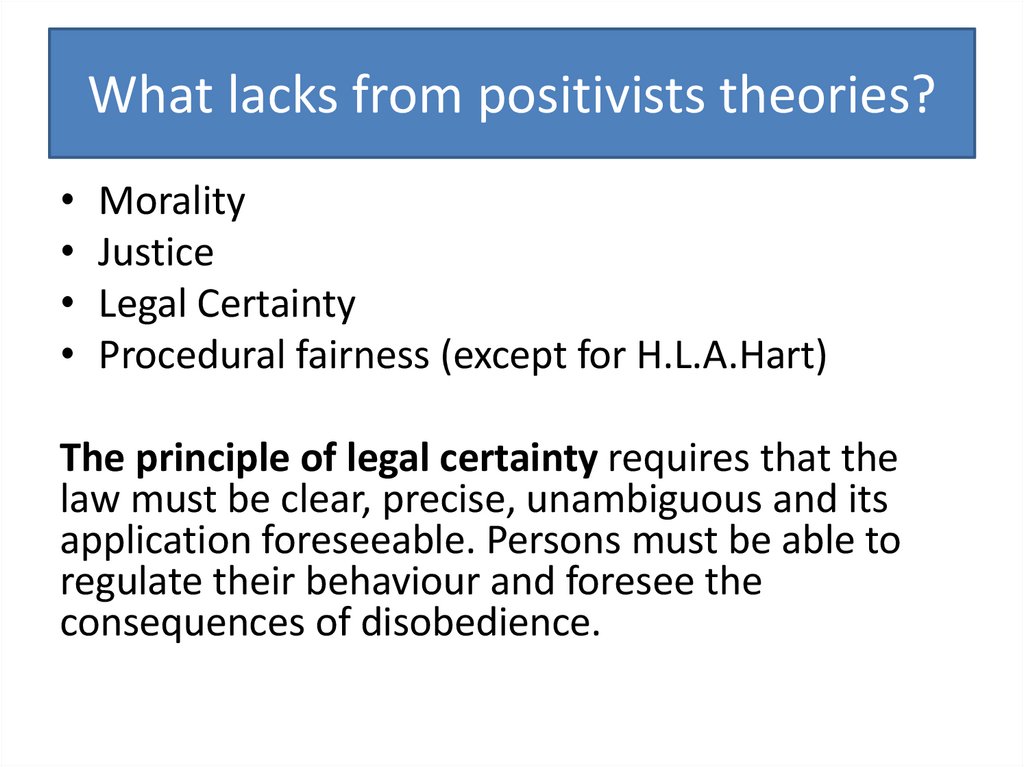
26. What lacks from positivists theories?
• Morality• Justice
• Legal Certainty
• Procedural fairness (except for H.L.A.Hart)
The principle of legal certainty requires that the
law must be clear, precise, unambiguous and its
application foreseeable. Persons must be able to
regulate their behaviour and foresee the
consequences of disobedience.
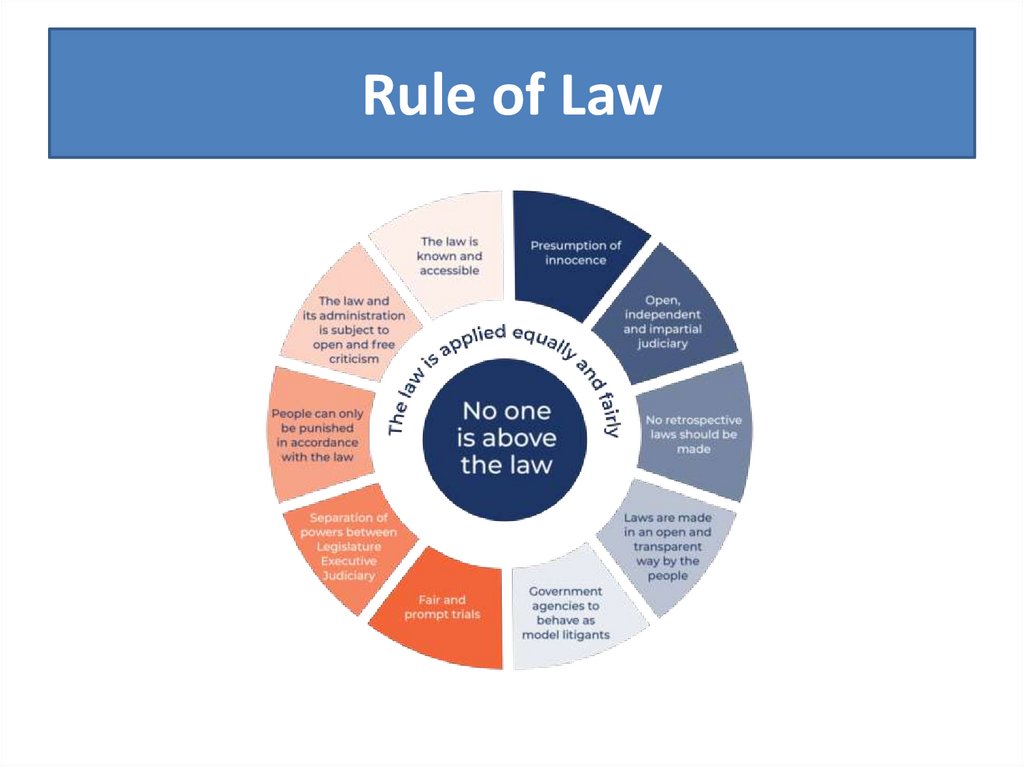
27. Rule of Law
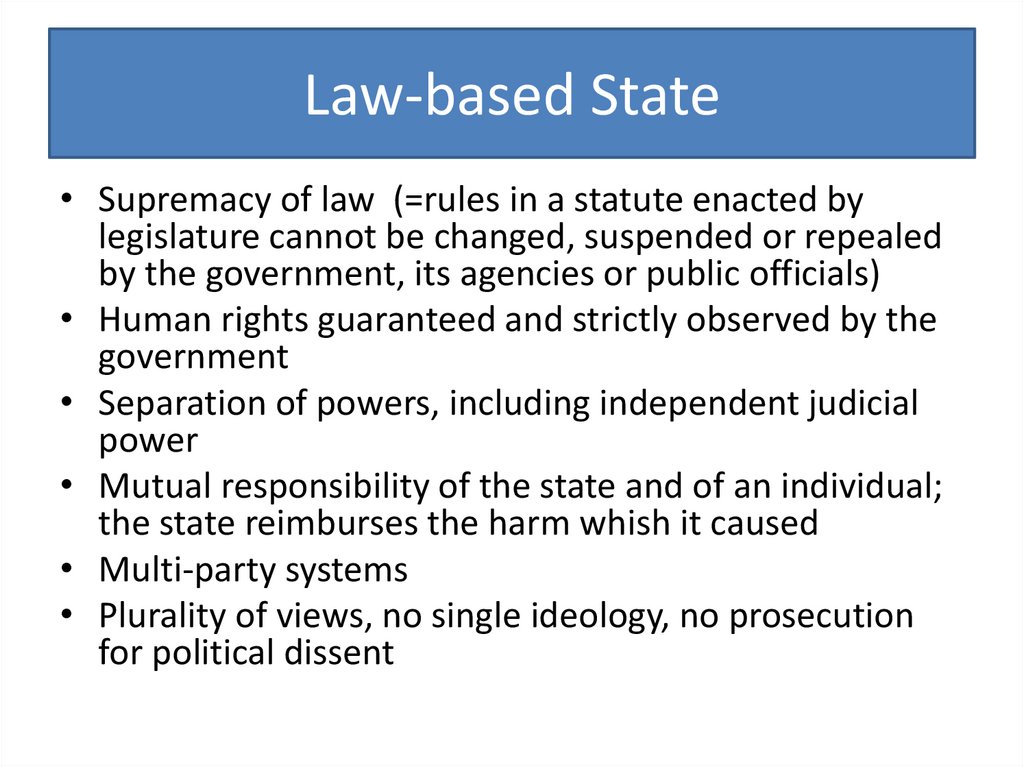
28. Law-based State
• Supremacy of law (=rules in a statute enacted bylegislature cannot be changed, suspended or repealed
by the government, its agencies or public officials)
• Human rights guaranteed and strictly observed by the
government
• Separation of powers, including independent judicial
power
• Mutual responsibility of the state and of an individual;
the state reimburses the harm whish it caused
• Multi-party systems
• Plurality of views, no single ideology, no prosecution
for political dissent
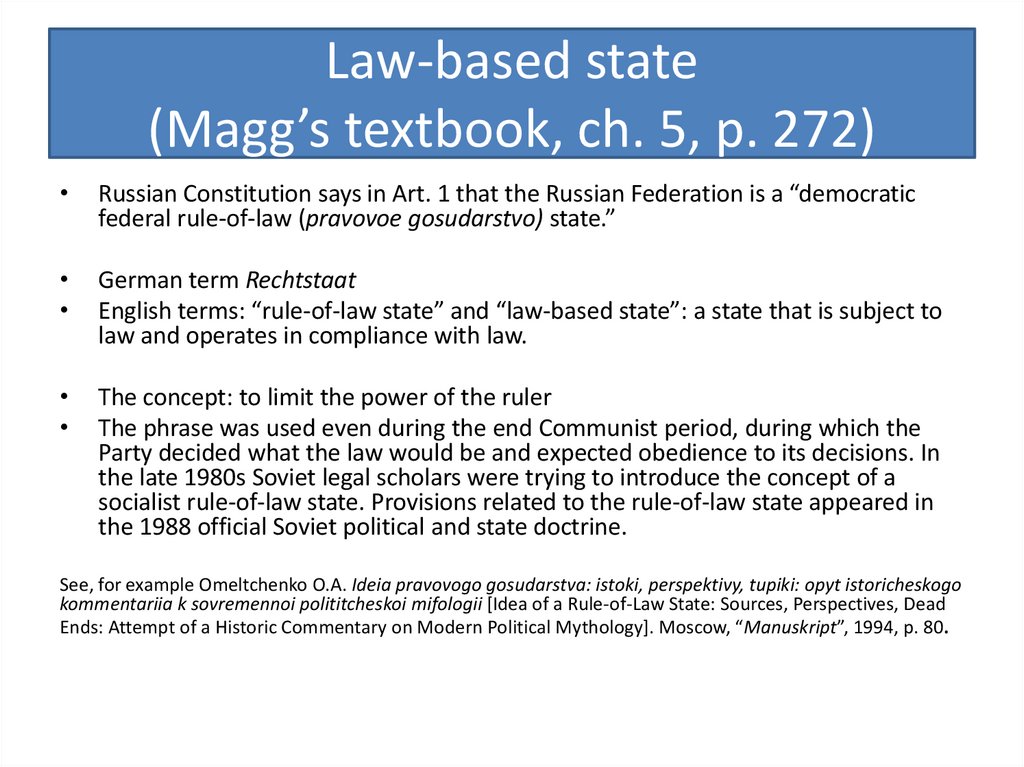
29. Law-based state (Magg’s textbook, ch. 5, p. 272)
Russian Constitution says in Art. 1 that the Russian Federation is a “democratic
federal rule-of-law (pravovoe gosudarstvo) state.”
German term Rechtstaat
English terms: “rule-of-law state” and “law-based state”: a state that is subject to
law and operates in compliance with law.
The concept: to limit the power of the ruler
The phrase was used even during the end Communist period, during which the
Party decided what the law would be and expected obedience to its decisions. In
the late 1980s Soviet legal scholars were trying to introduce the concept of a
socialist rule-of-law state. Provisions related to the rule-of-law state appeared in
the 1988 official Soviet political and state doctrine.
See, for example Omeltchenko O.A. Ideia pravovogo gosudarstva: istoki, perspektivy, tupiki: opyt istoricheskogo
kommentariia k sovremennoi polititcheskoi mifologii [Idea of a Rule-of-Law State: Sources, Perspectives, Dead
Ends: Attempt of a Historic Commentary on Modern Political Mythology]. Moscow, “Manuskript”, 1994, p. 80.