

Similar presentations:





Report Writing TOPIC 11
1. Report Writing
TOPIC 112. Plan:
1. Notion of a report.2. Types of reports.
3. Structure of a report.
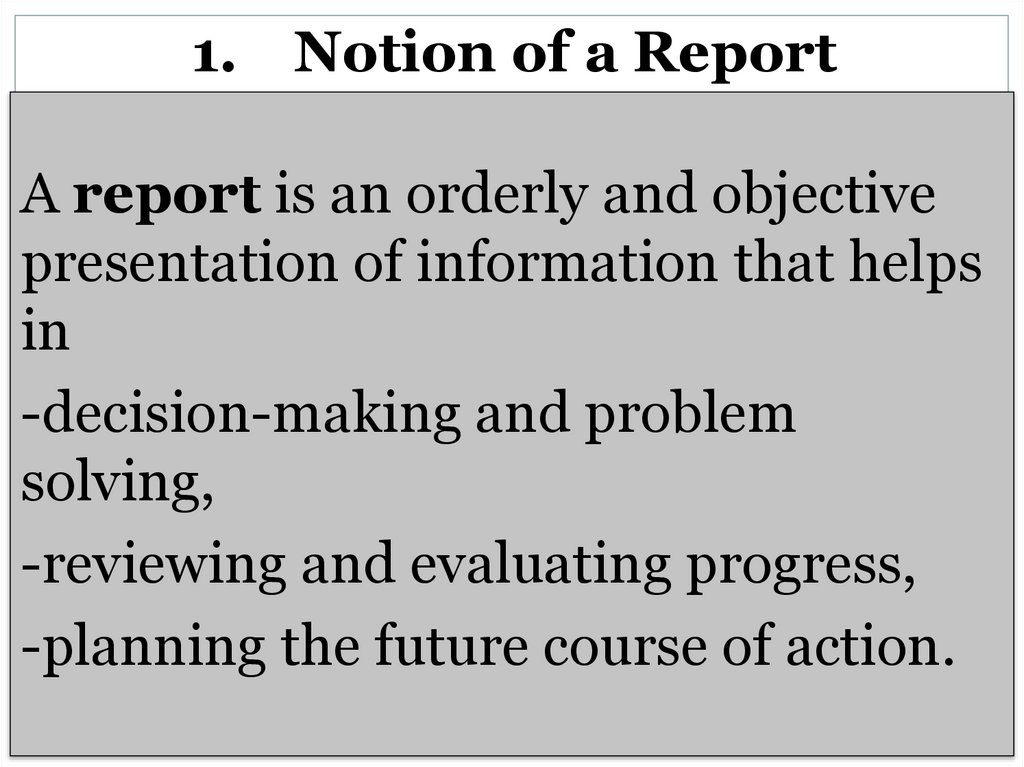
3. 1. Notion of a Report
A report is an orderly and objectivepresentation of information that helps
in
-decision-making and problem
solving,
-reviewing and evaluating progress,
-planning the future course of action.
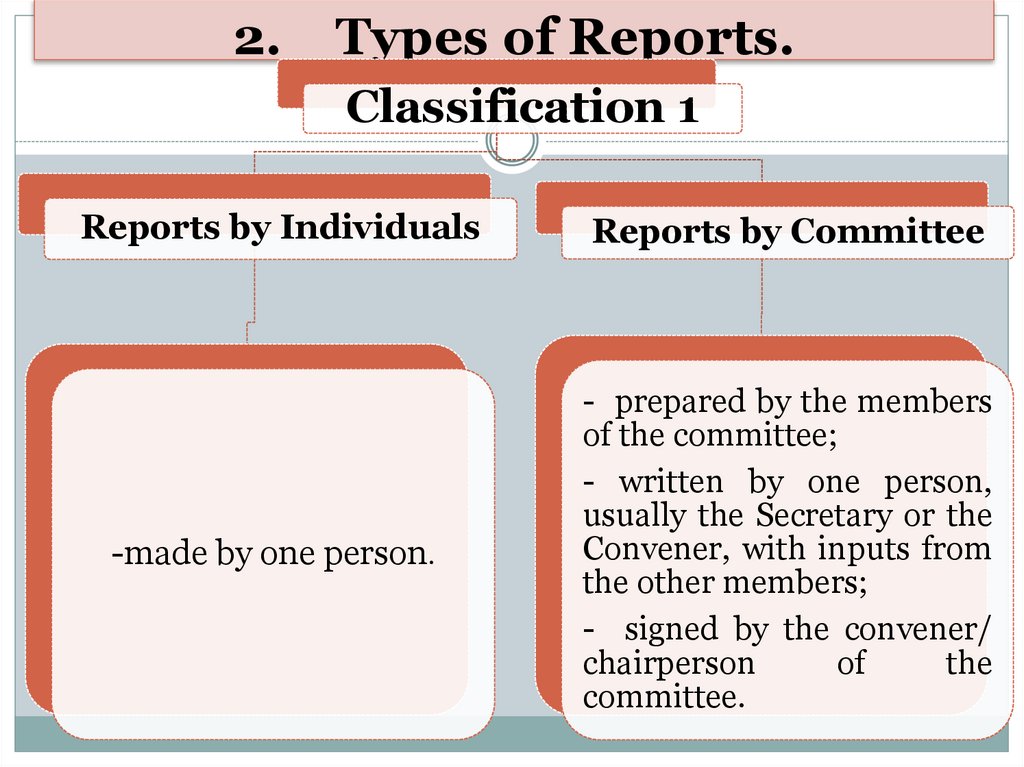
4. 2. Types of Reports.
Classification 1Reports by Individuals
Reports by Committee
-made by one person.
- prepared by the members
of the committee;
- written by one person,
usually the Secretary or the
Convener, with inputs from
the other members;
- signed by the convener/
chairperson
of
the
committee.
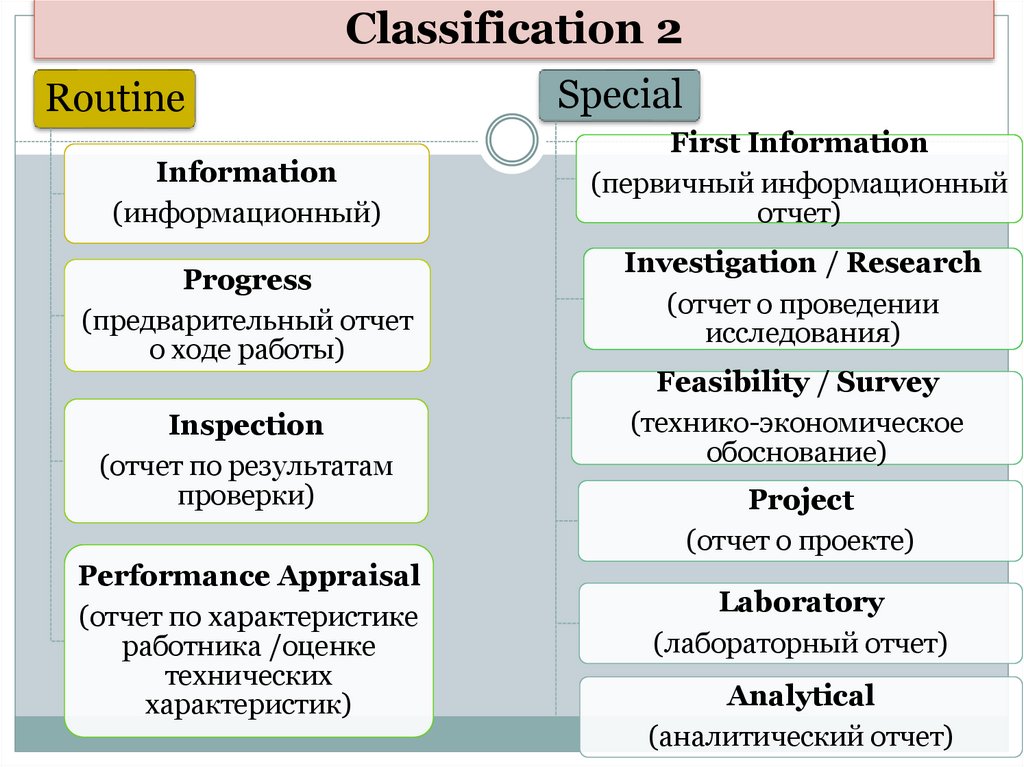
5. Classification 2
RoutineInformation
(информационный)
Progress
(предварительный отчет
о ходе работы)
Inspection
(отчет по результатам
проверки)
Performance Appraisal
(отчет по характеристике
работника /оценке
технических
характеристик)
Special
First Information
(первичный информационный
отчет)
Investigation / Research
(отчет о проведении
исследования)
Feasibility / Survey
(технико-экономическое
обоснование)
Project
(отчет о проекте)
Laboratory
(лабораторный отчет)
Analytical
(аналитический отчет)
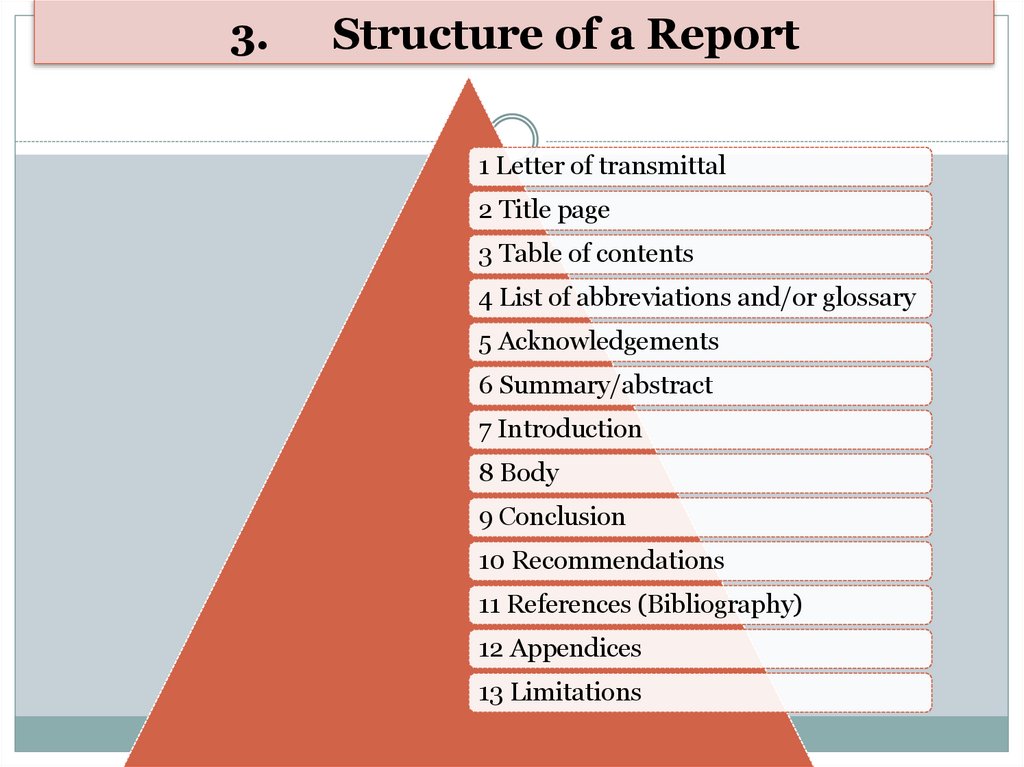
6. 3. Structure of a Report
1 Letter of transmittal2 Title page
3 Table of contents
4 List of abbreviations and/or glossary
5 Acknowledgements
6 Summary/abstract
7 Introduction
8 Body
9 Conclusion
10 Recommendations
11 References (Bibliography)
12 Appendices
13 Limitations
7.
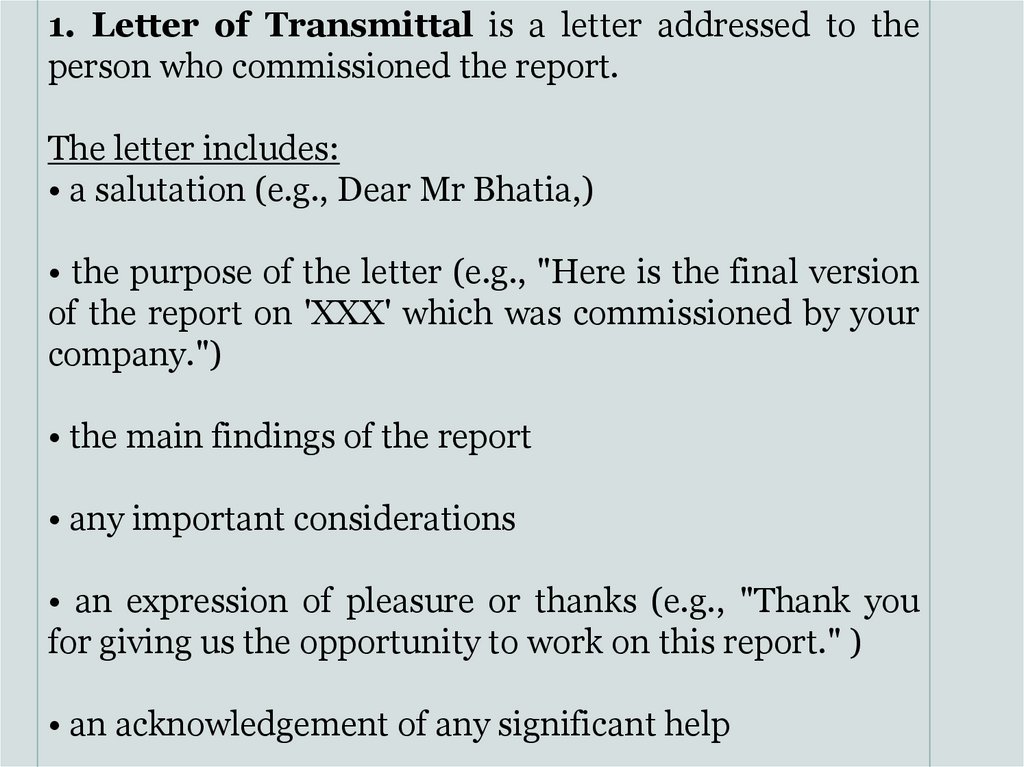
1. Letter of Transmittal is a letter addressed to theperson who commissioned the report.
The letter includes:
• a salutation (e.g., Dear Mr Bhatia,)
• the purpose of the letter (e.g., "Here is the final version
of the report on 'XXX' which was commissioned by your
company.")
• the main findings of the report
• any important considerations
• an expression of pleasure or thanks (e.g., "Thank you
for giving us the opportunity to work on this report." )
• an acknowledgement of any significant help
8.
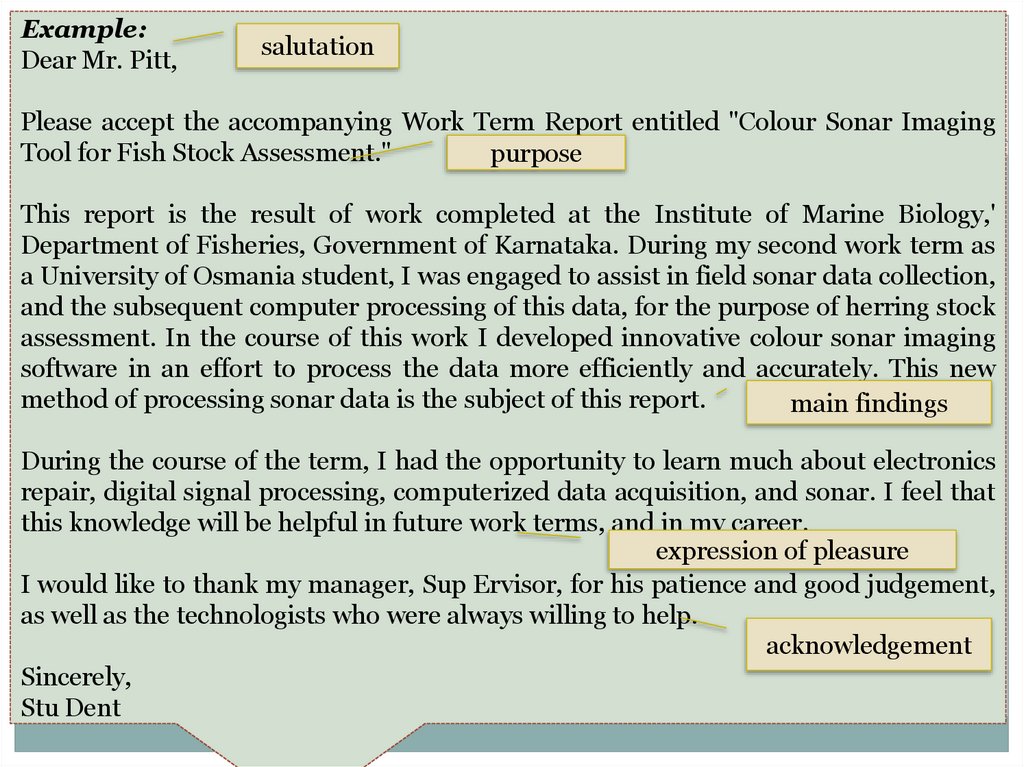
Example:Dear Mr. Pitt,
salutation
Please accept the accompanying Work Term Report entitled "Colour Sonar Imaging
Tool for Fish Stock Assessment."
purpose
This report is the result of work completed at the Institute of Marine Biology,'
Department of Fisheries, Government of Karnataka. During my second work term as
a University of Osmania student, I was engaged to assist in field sonar data collection,
and the subsequent computer processing of this data, for the purpose of herring stock
assessment. In the course of this work I developed innovative colour sonar imaging
software in an effort to process the data more efficiently and accurately. This new
method of processing sonar data is the subject of this report.
main findings
During the course of the term, I had the opportunity to learn much about electronics
repair, digital signal processing, computerized data acquisition, and sonar. I feel that
this knowledge will be helpful in future work terms, and in my career.
expression of pleasure
I would like to thank my manager, Sup Ervisor, for his patience and good judgement,
as well as the technologists who were always willing to help.
acknowledgement
Sincerely,
Stu Dent
9.
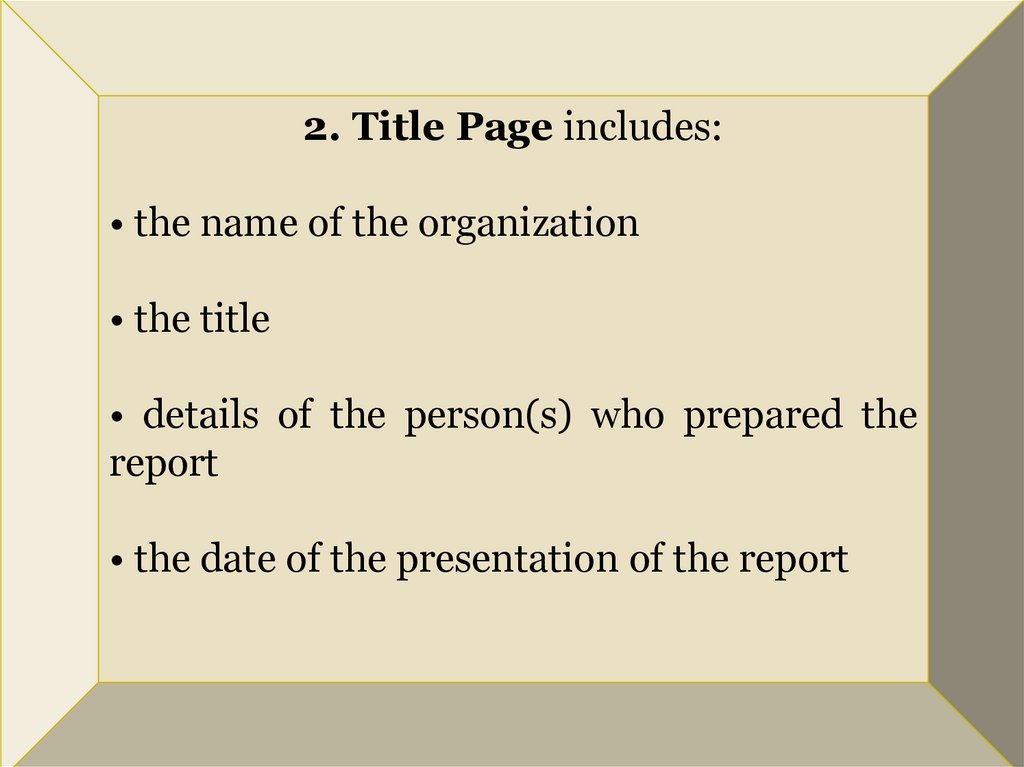
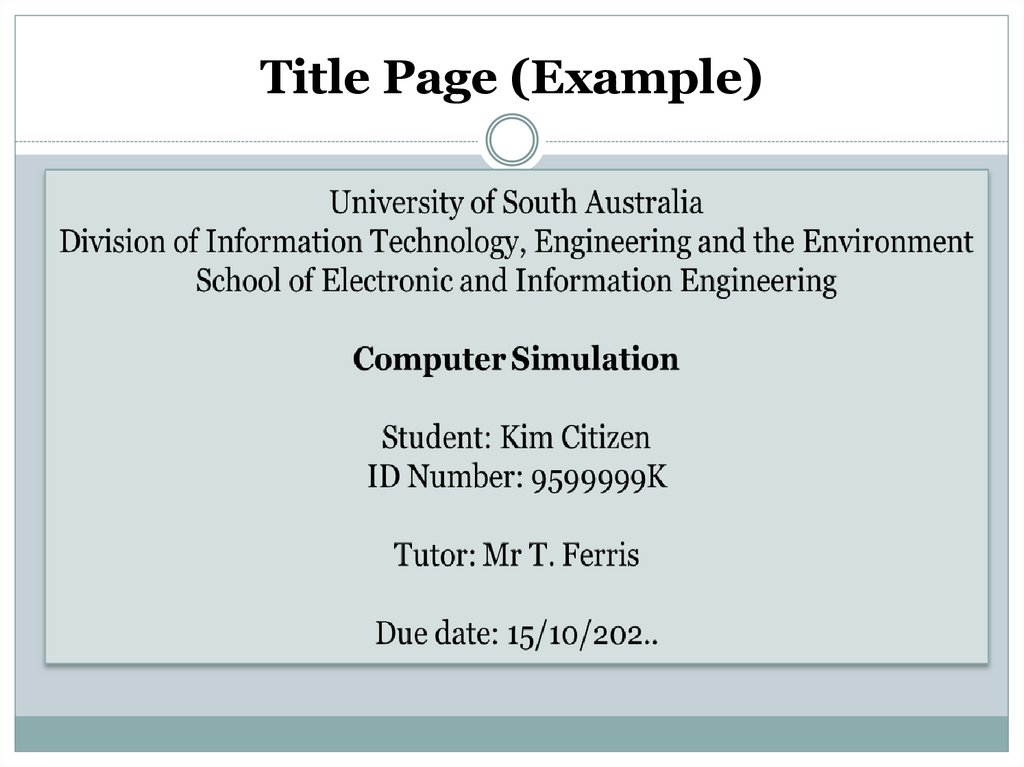
2. Title Page includes:• the name of the organization
• the title
• details of the person(s) who prepared the
report
• the date of the presentation of the report
10. Title Page (Example)
11.
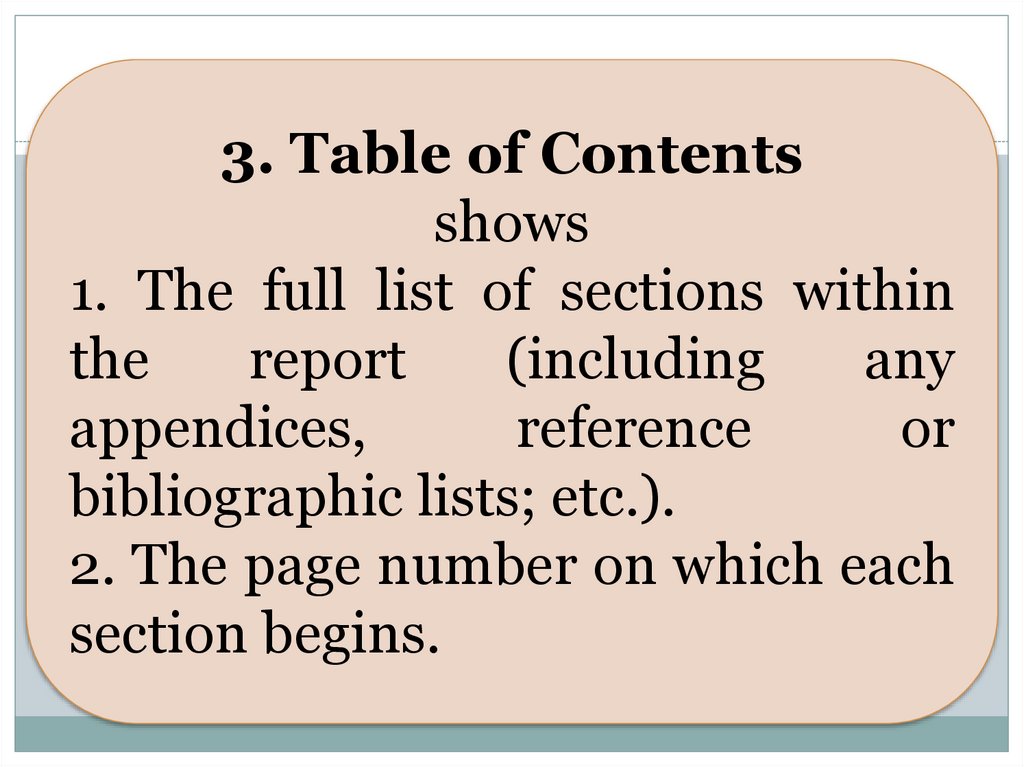
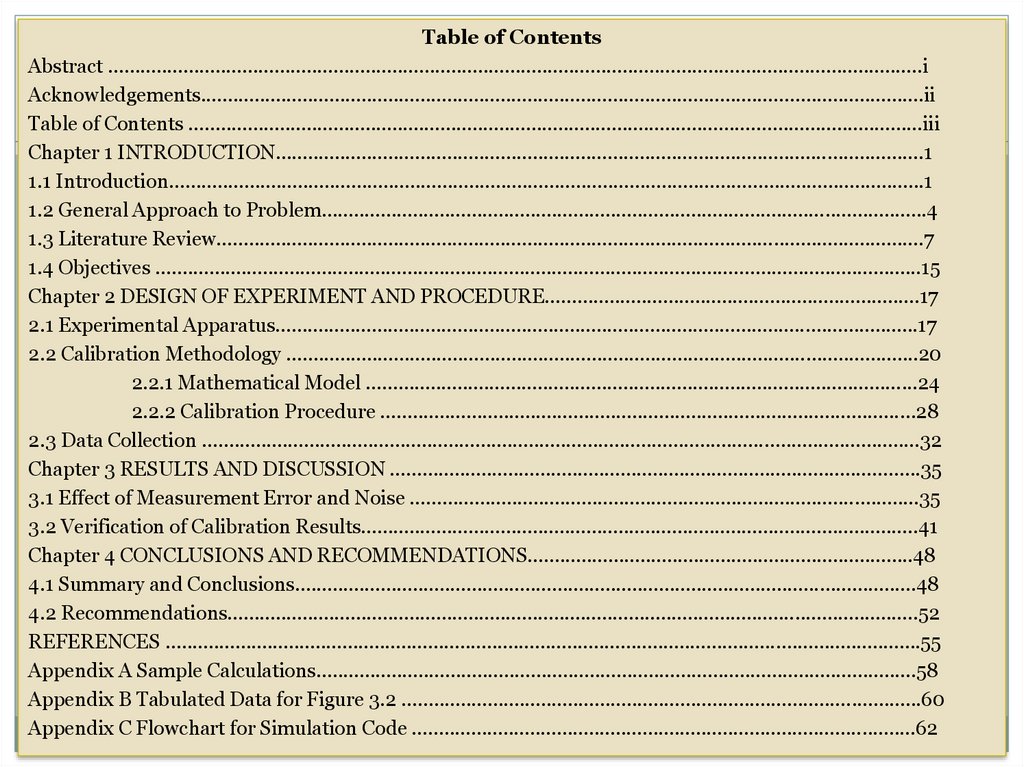
3. Table of Contentsshows
1. The full list of sections within
the
report
(including
any
appendices,
reference
or
bibliographic lists; etc.).
2. The page number on which each
section begins.
12.
Table of ContentsAbstract ........................................................................................................................................................i
Acknowledgements.......................................................................................................................................ii
Table of Contents .........................................................................................................................................iii
Chapter 1 INTRODUCTION.........................................................................................................................1
1.1 Introduction.............................................................................................................................................1
1.2 General Approach to Problem.................................................................................................................4
1.3 Literature Review....................................................................................................................................7
1.4 Objectives ...............................................................................................................................................15
Chapter 2 DESIGN OF EXPERIMENT AND PROCEDURE......................................................................17
2.1 Experimental Apparatus........................................................................................................................17
2.2 Calibration Methodology ......................................................................................................................20
2.2.1 Mathematical Model .......................................................................................................24
2.2.2 Calibration Procedure ....................................................................................................28
2.3 Data Collection ......................................................................................................................................32
Chapter 3 RESULTS AND DISCUSSION ...................................................................................................35
3.1 Effect of Measurement Error and Noise ...............................................................................................35
3.2 Verification of Calibration Results........................................................................................................41
Chapter 4 CONCLUSIONS AND RECOMMENDATIONS........................................................................48
4.1 Summary and Conclusions....................................................................................................................48
4.2 Recommendations.................................................................................................................................52
REFERENCES .............................................................................................................................................55
Appendix A Sample Calculations................................................................................................................58
Appendix B Tabulated Data for Figure 3.2 .................................................................................................60
Appendix C Flowchart for Simulation Code ..............................................................................................62
13. 4. List of Abbreviations and/or Glossary
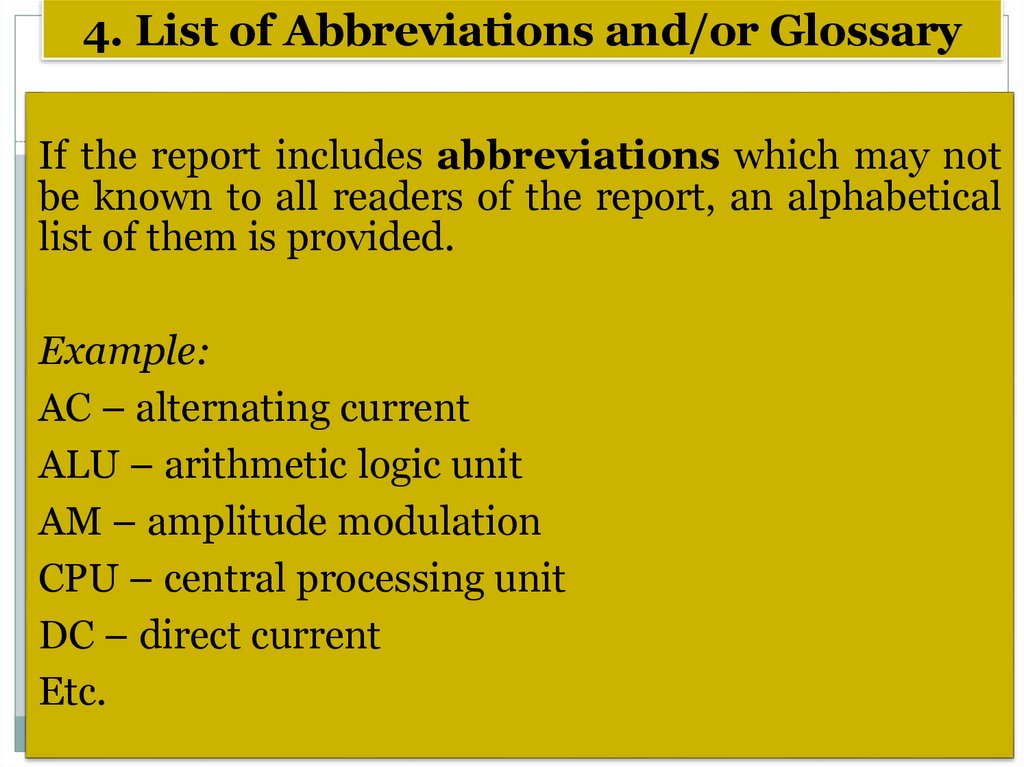
If the report includes abbreviations which may notbe known to all readers of the report, an alphabetical
list of them is provided.
Example:
AC – alternating current
ALU – arithmetic logic unit
AM – amplitude modulation
CPU – central processing unit
DC – direct current
Etc.
14.
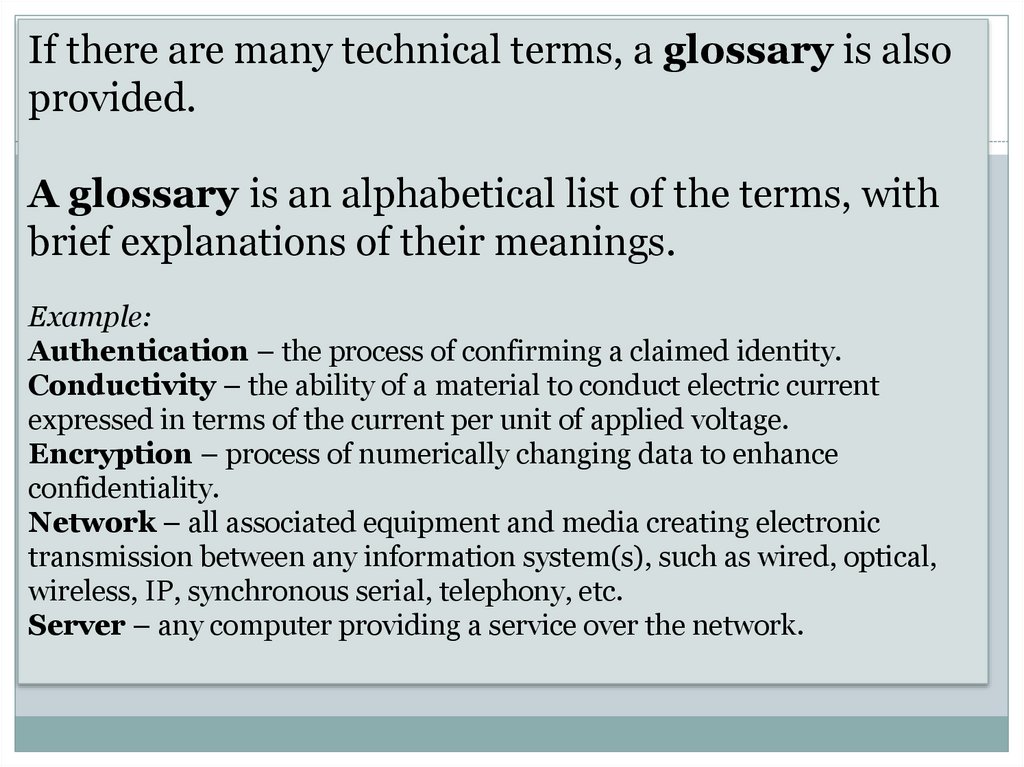
If there are many technical terms, a glossary is alsoprovided.
A glossary is an alphabetical list of the terms, with
brief explanations of their meanings.
Example:
Authentication – the process of confirming a claimed identity.
Conductivity – the ability of a material to conduct electric current
expressed in terms of the current per unit of applied voltage.
Encryption – process of numerically changing data to enhance
confidentiality.
Network – all associated equipment and media creating electronic
transmission between any information system(s), such as wired, optical,
wireless, IP, synchronous serial, telephony, etc.
Server – any computer providing a service over the network.
15. 5. Acknowledgements
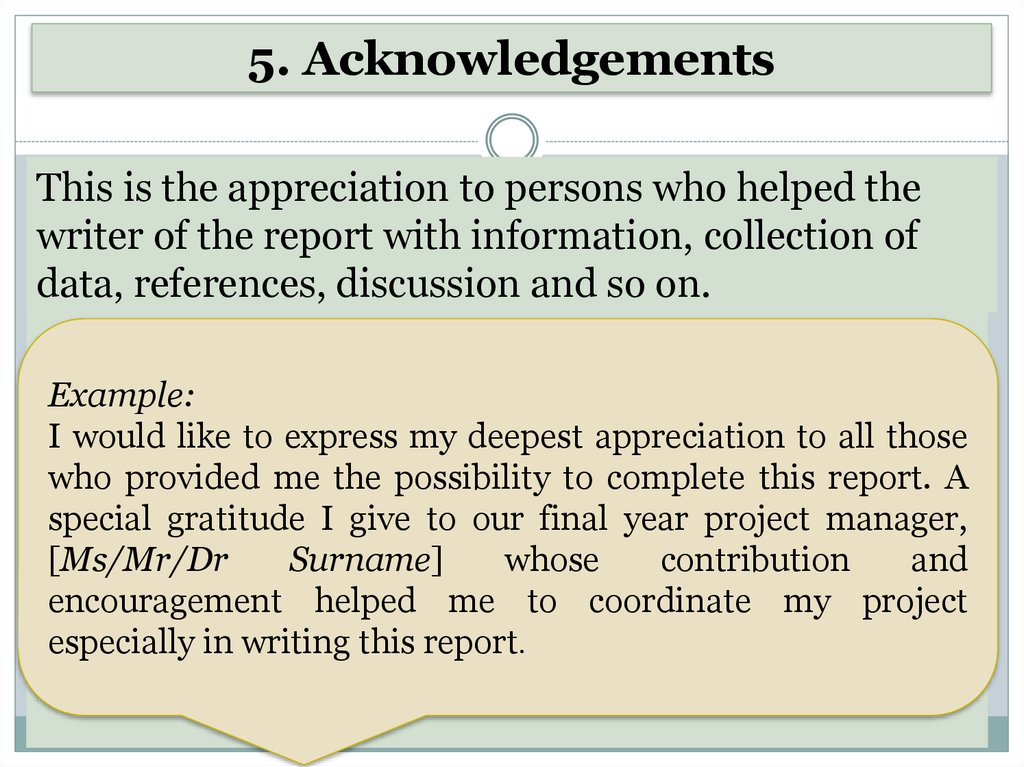
This is the appreciation to persons who helped thewriter of the report with information, collection of
data, references, discussion and so on.
Example:
I would like to express my deepest appreciation to all those
who provided me the possibility to complete this report. A
special gratitude I give to our final year project manager,
[Ms/Mr/Dr
Surname]
whose
contribution
and
encouragement helped me to coordinate my project
especially in writing this report.
16. 6. Summary
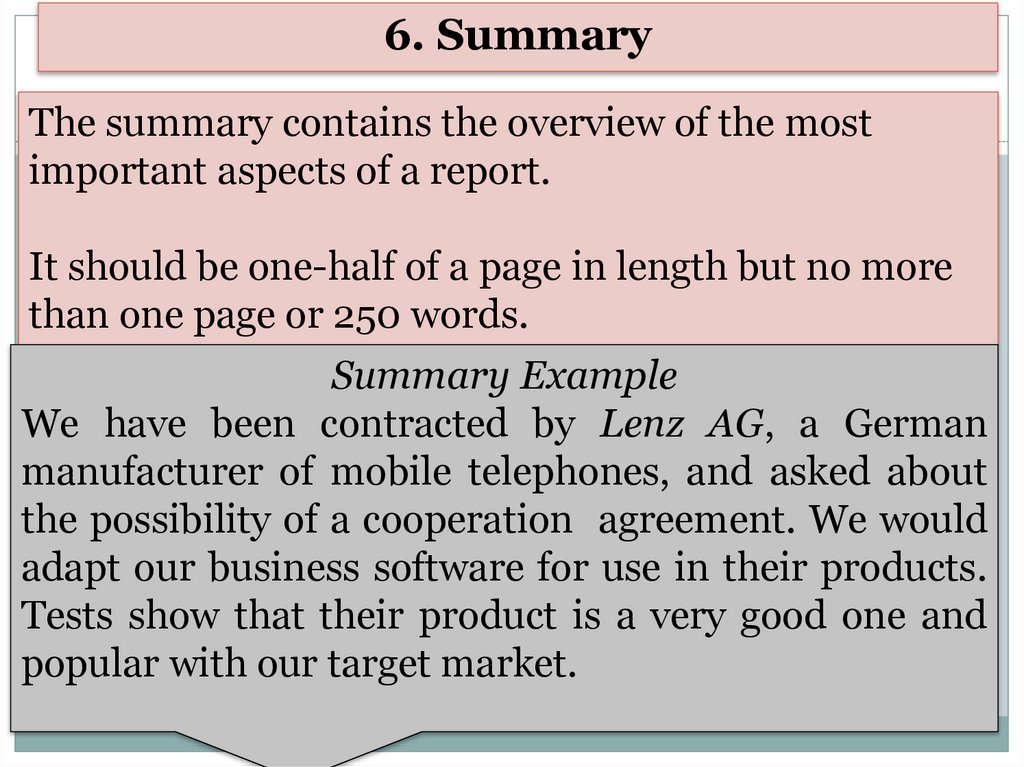
The summary contains the overview of the mostimportant aspects of a report.
It should be one-half of a page in length but no more
than one page or 250 words.
Summary Example
We have been contracted by Lenz AG, a German
manufacturer of mobile telephones, and asked about
the possibility of a cooperation agreement. We would
adapt our business software for use in their products.
Tests show that their product is a very good one and
popular with our target market.
17. 7. Introduction
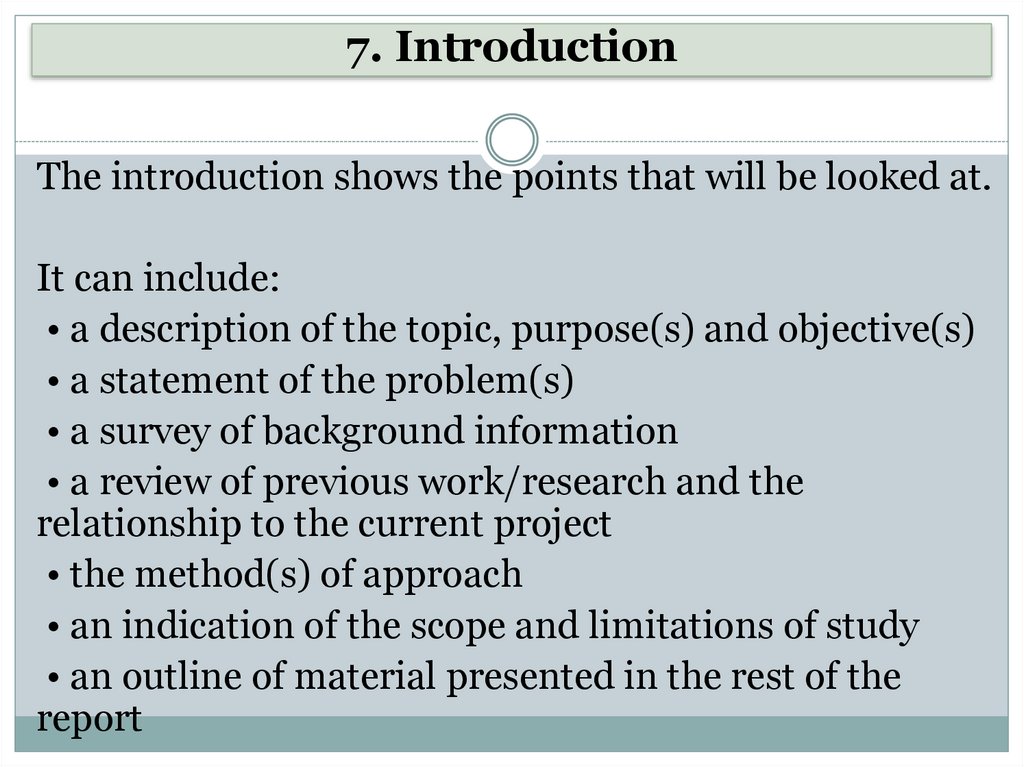
The introduction shows the points that will be looked at.It can include:
• a description of the topic, purpose(s) and objective(s)
• a statement of the problem(s)
• a survey of background information
• a review of previous work/research and the
relationship to the current project
• the method(s) of approach
• an indication of the scope and limitations of study
• an outline of material presented in the rest of the
report
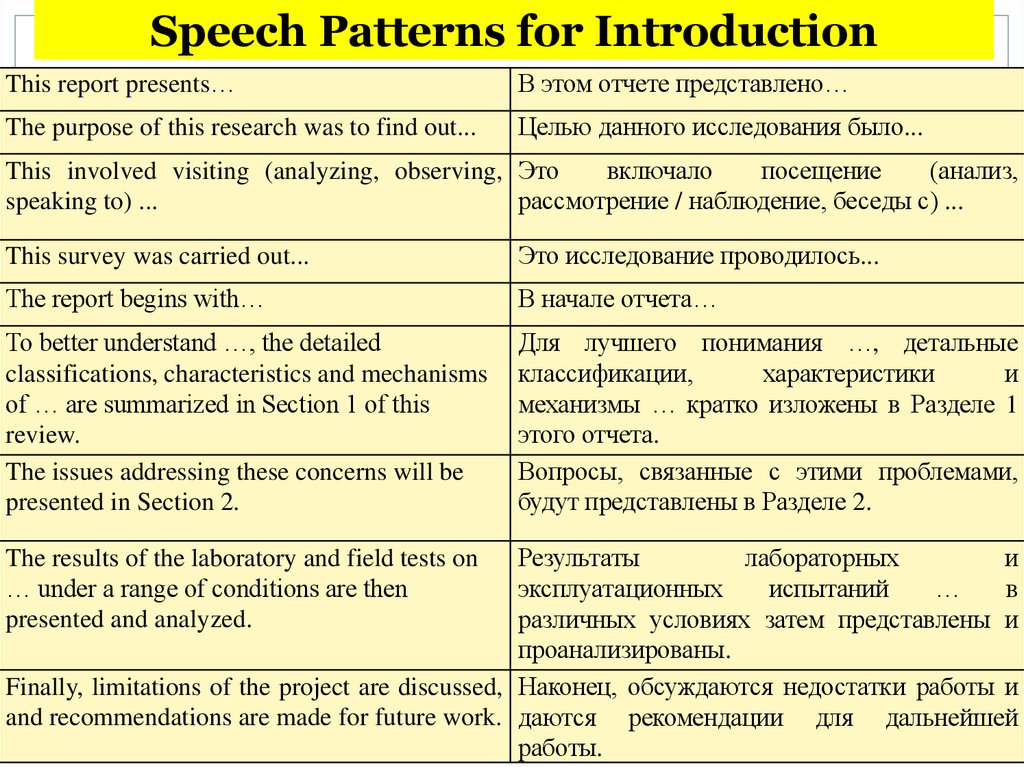
18. Speech Patterns for Introduction
This report presents…В этом отчете представлено…
The purpose of this research was to find out...
Целью данного исследования было...
This involved visiting (analyzing, observing, Это
включало
посещение
(анализ,
speaking to) ...
рассмотрение / наблюдение, беседы с) ...
This survey was carried out...
Это исследование проводилось...
The report begins with…
В начале отчета…
To better understand …, the detailed
classifications, characteristics and mechanisms
of … are summarized in Section 1 of this
review.
The issues addressing these concerns will be
presented in Section 2.
Для лучшего понимания …, детальные
классификации,
характеристики
и
механизмы … кратко изложены в Разделе 1
этого отчета.
Вопросы, связанные с этими проблемами,
будут представлены в Разделе 2.
Результаты
лабораторных
и
эксплуатационных
испытаний
…
в
различных условиях затем представлены и
проанализированы.
Finally, limitations of the project are discussed, Наконец, обсуждаются недостатки работы и
and recommendations are made for future work. даются рекомендации для дальнейшей
работы.
The results of the laboratory and field tests on
… under a range of conditions are then
presented and analyzed.
19.
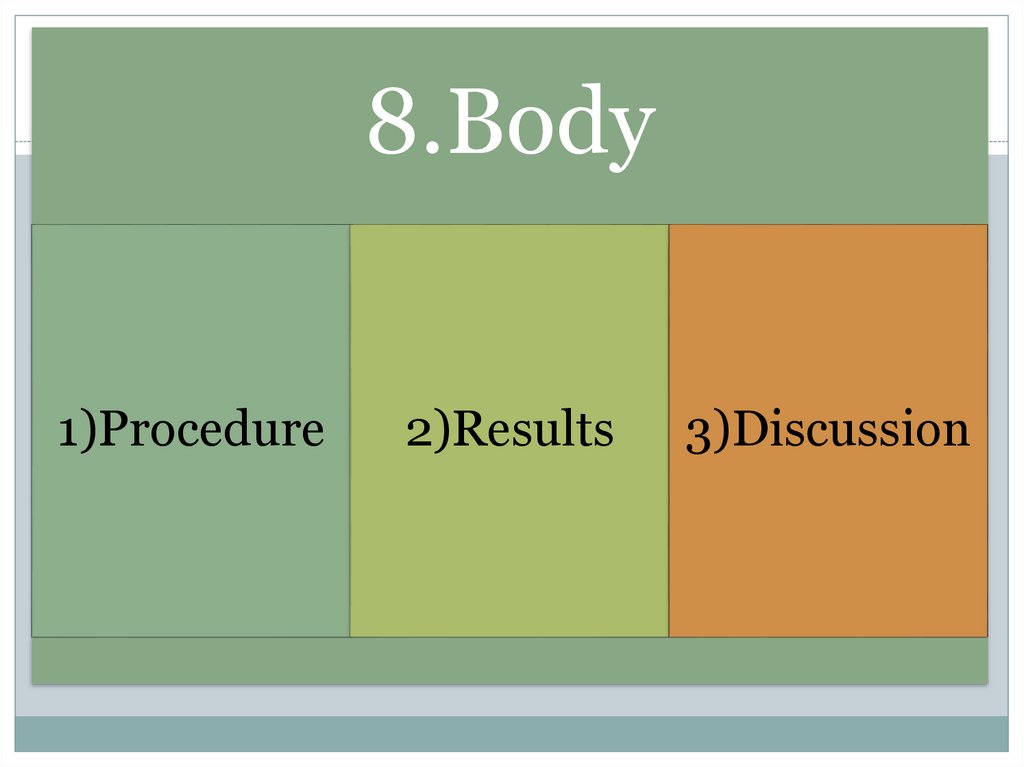
8.Body1)Procedure
2)Results
3)Discussion
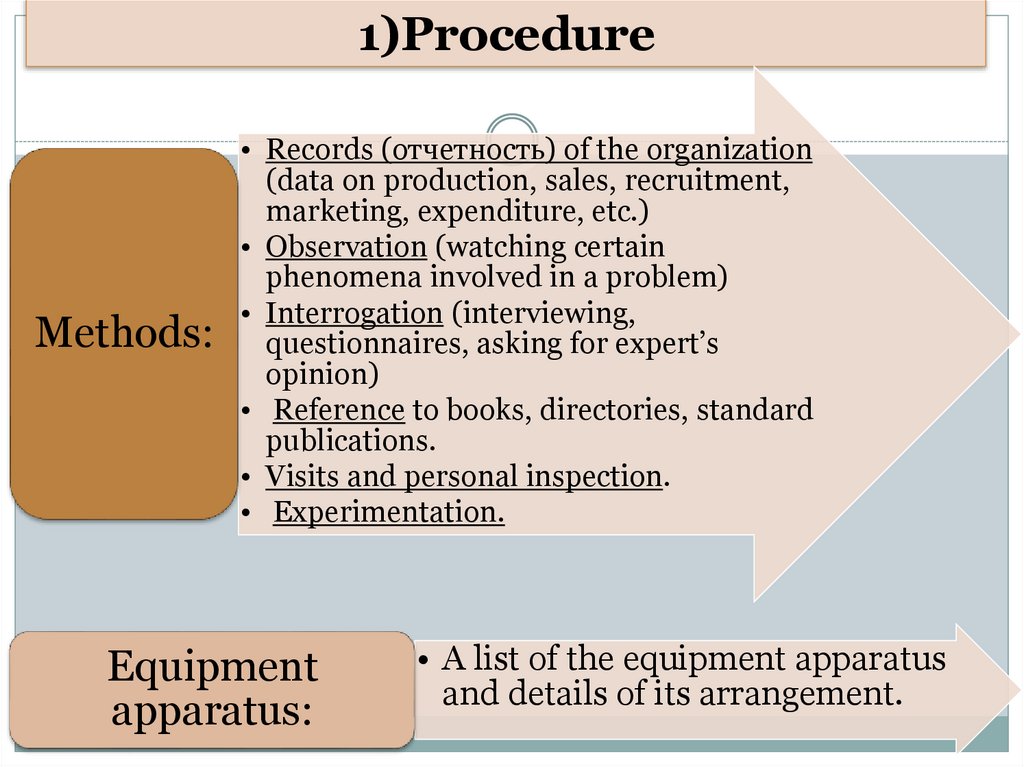
20. 1)Procedure
Methods:• Records (отчетность) of the organization
(data on production, sales, recruitment,
marketing, expenditure, etc.)
• Observation (watching certain
phenomena involved in a problem)
• Interrogation (interviewing,
questionnaires, asking for expert’s
opinion)
• Reference to books, directories, standard
publications.
• Visits and personal inspection.
• Experimentation.
Equipment
apparatus:
• A list of the equipment apparatus
and details of its arrangement.
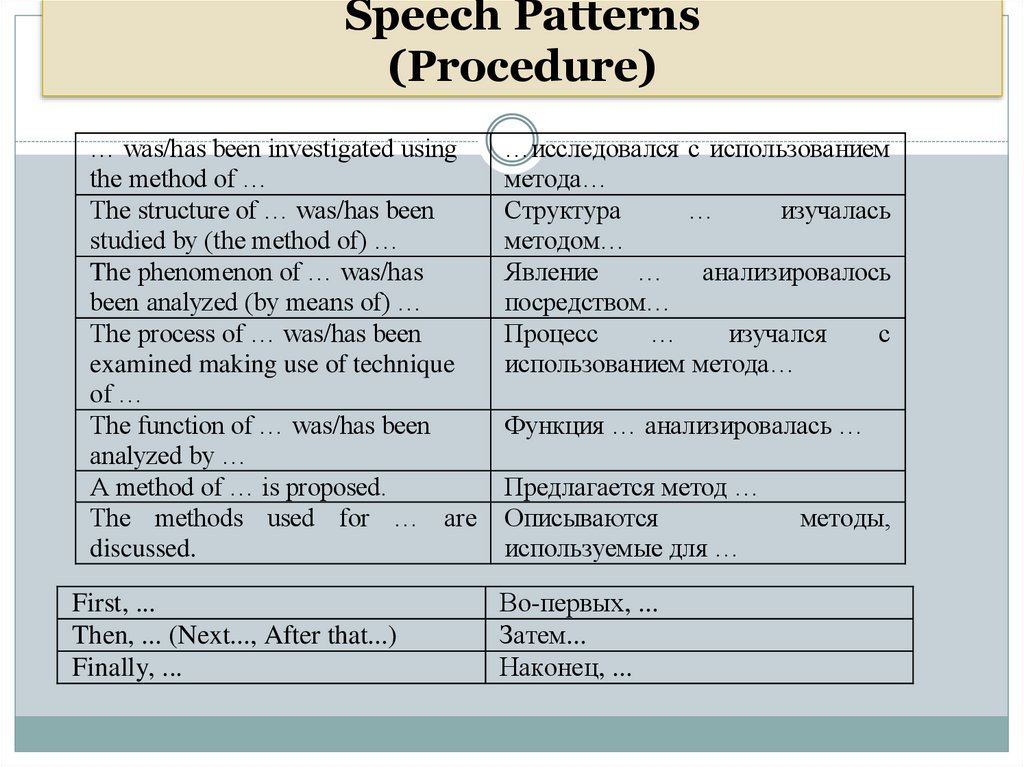
21. Speech Patterns (Procedure)
… was/has been investigated usingthe method of …
The structure of … was/has been
studied by (the method of) …
The phenomenon of … was/has
been analyzed (by means of) …
The process of … was/has been
examined making use of technique
of …
The function of … was/has been
analyzed by …
A method of … is proposed.
The methods used for … are
discussed.
…исследовался с использованием
метода…
Структура
…
изучалась
методом…
Явление … анализировалось
посредством…
Процесс
…
изучался
с
использованием метода…
First, ...
Then, ... (Next..., After that...)
Finally, ...
Во-первых, ...
Затем...
Наконец, ...
Функция … анализировалась …
Предлагается метод …
Описываются
используемые для …
методы,
22.
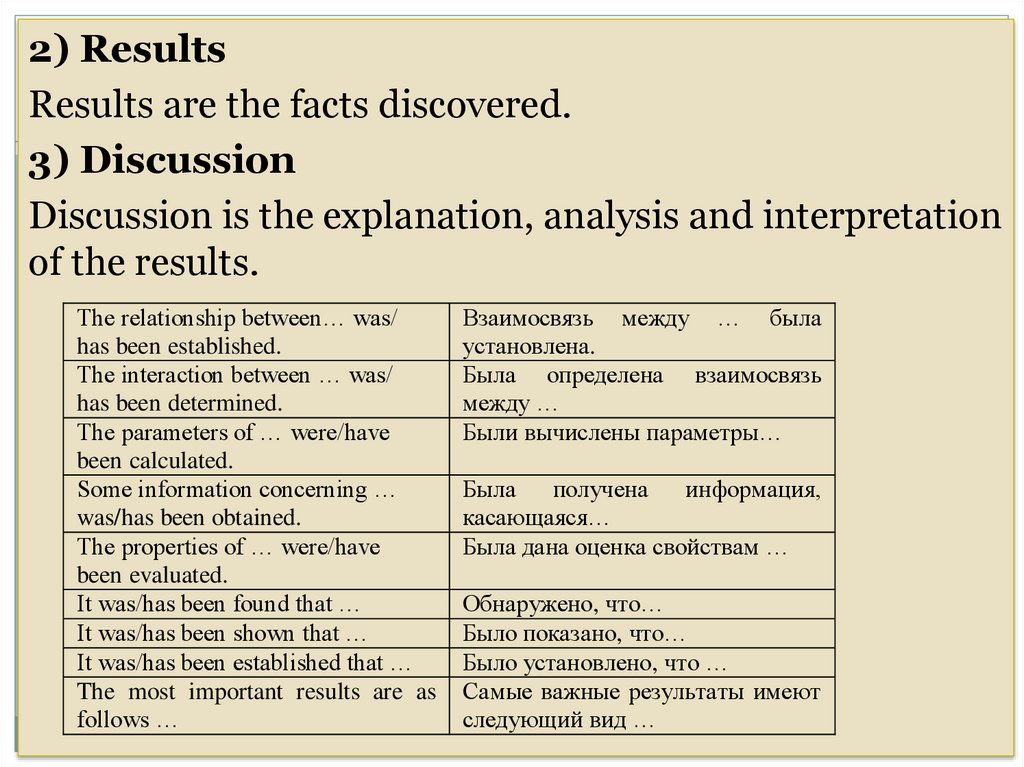
2) ResultsResults are the facts discovered.
3) Discussion
Discussion is the explanation, analysis and interpretation
of the results.
The relationship between… was/
has been established.
The interaction between … was/
has been determined.
The parameters of … were/have
been calculated.
Some information concerning …
was/has been obtained.
The properties of … were/have
been evaluated.
It was/has been found that …
It was/has been shown that …
It was/has been established that …
The most important results are as
follows …
Взаимосвязь между … была
установлена.
Была определена взаимосвязь
между …
Были вычислены параметры…
Была
получена
информация,
касающаяся…
Была дана оценка свойствам …
Обнаружено, что…
Было показано, что…
Было установлено, что …
Самые важные результаты имеют
следующий вид …
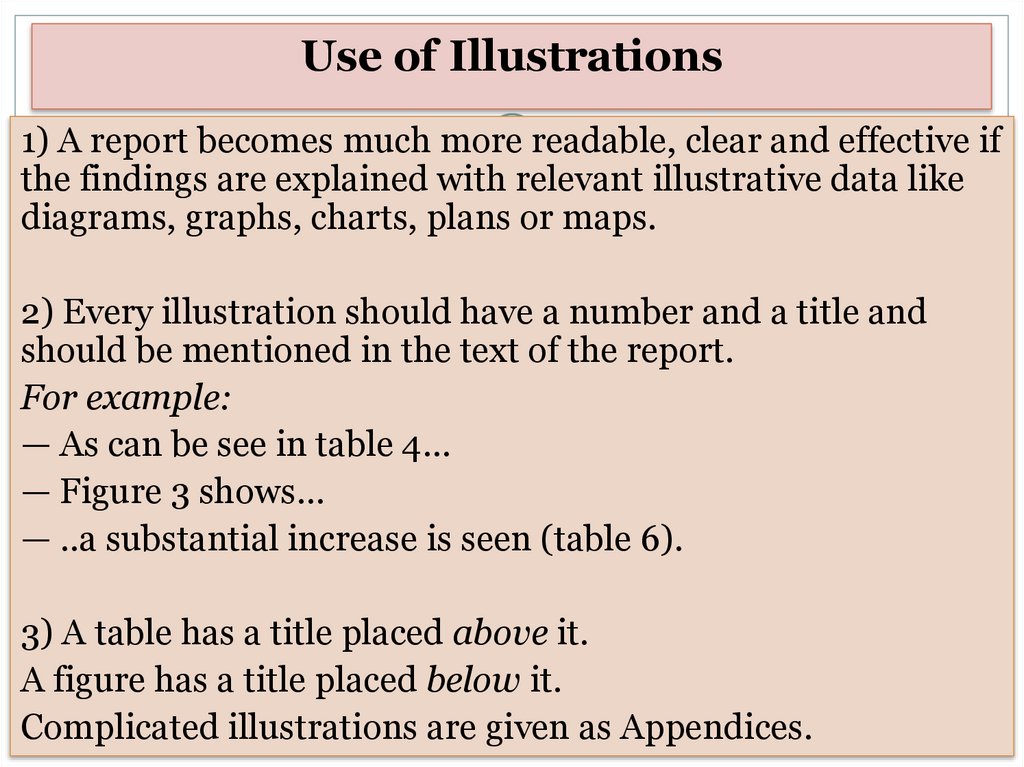
23. Use of Illustrations
1) A report becomes much more readable, clear and effective ifthe findings are explained with relevant illustrative data like
diagrams, graphs, charts, plans or maps.
2) Every illustration should have a number and a title and
should be mentioned in the text of the report.
For example:
— As can be see in table 4…
— Figure 3 shows…
— ..a substantial increase is seen (table 6).
3) A table has a title placed above it.
A figure has a title placed below it.
Complicated illustrations are given as Appendices.
24.
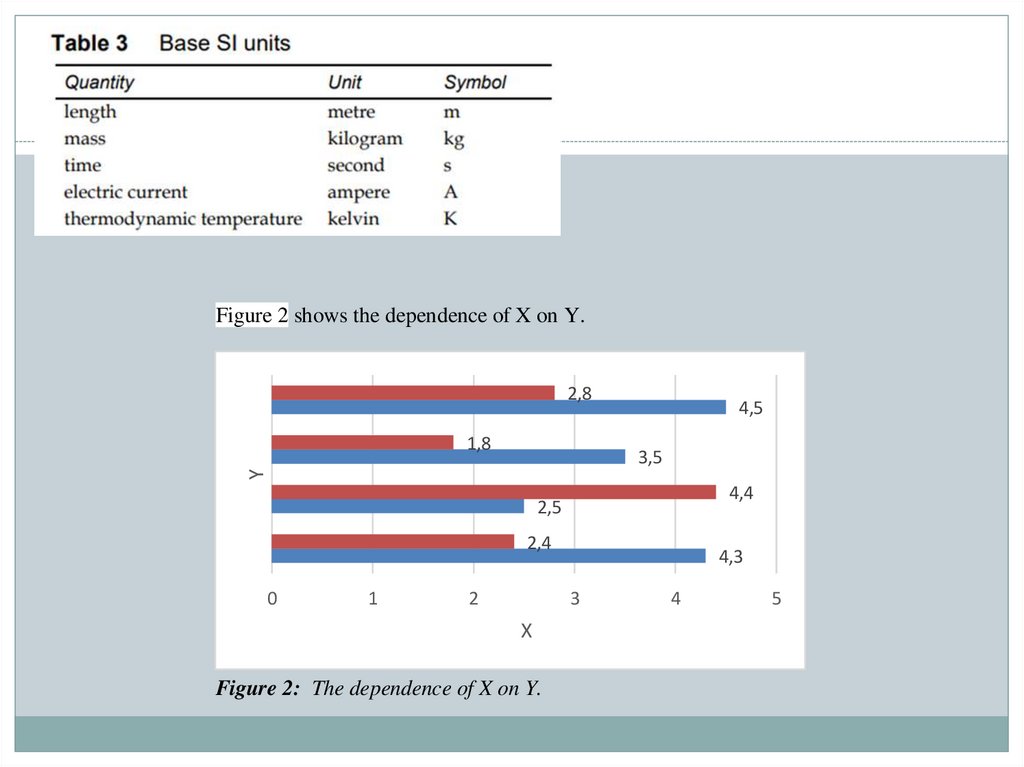
Figure 2 shows the dependence of X on Y.2,8
1,8
4,5
Y
3,5
4,4
2,5
2,4
0
1
2
4,3
3
X
Figure 2: The dependence of X on Y.
4
5
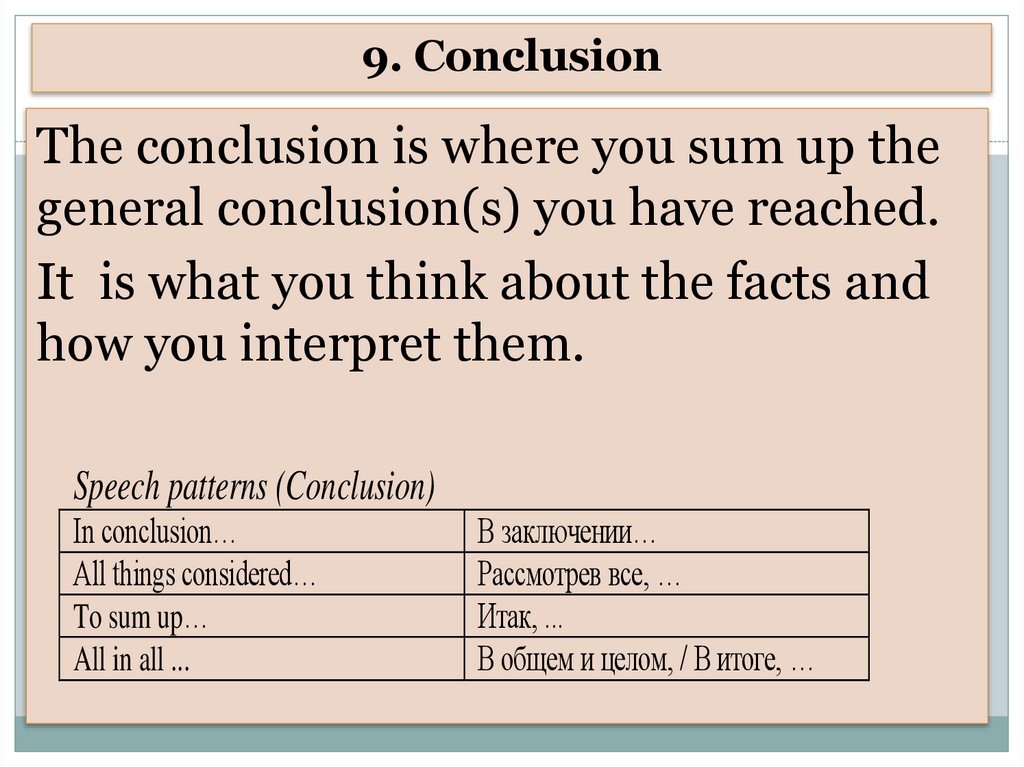
25. 9. Conclusion
The conclusion is where you sum up thegeneral conclusion(s) you have reached.
It is what you think about the facts and
how you interpret them.
Speech patterns (Conclusion)
In conclusion…
All things considered…
To sum up…
All in all ...
В заключении…
Рассмотрев все, …
Итак, ...
В общем и целом, / В итоге, …
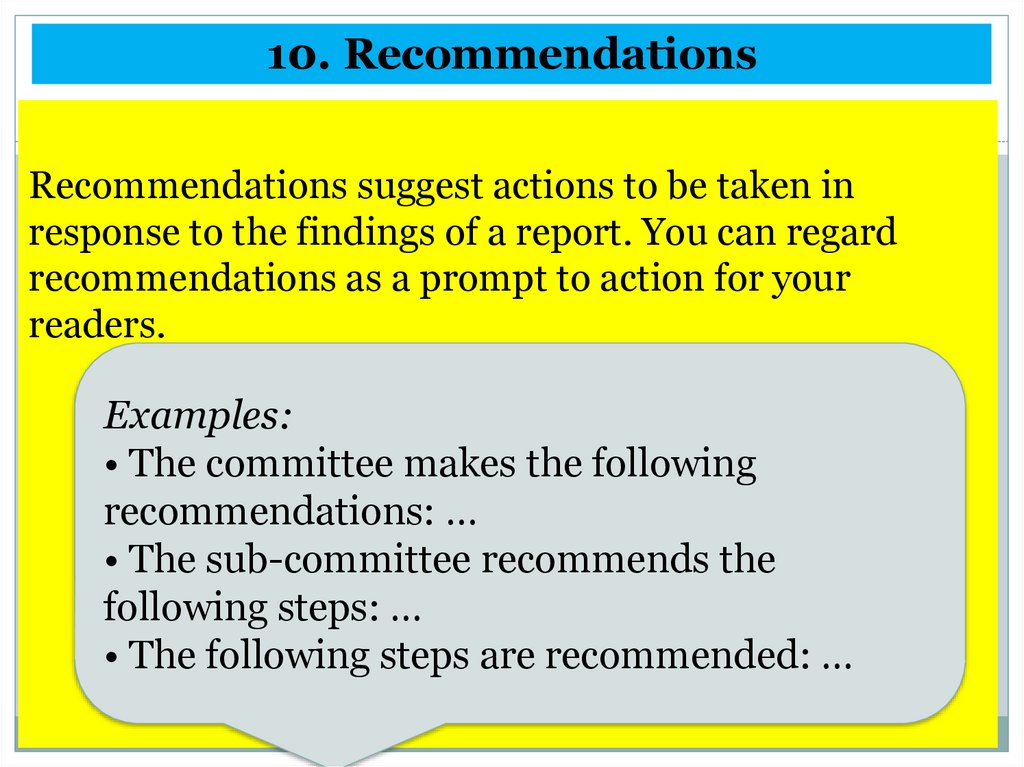
26. 10. Recommendations
Recommendations suggest actions to be taken inresponse to the findings of a report. You can regard
recommendations as a prompt to action for your
readers.
Examples:
• The committee makes the following
recommendations: …
• The sub-committee recommends the
following steps: …
• The following steps are recommended: …
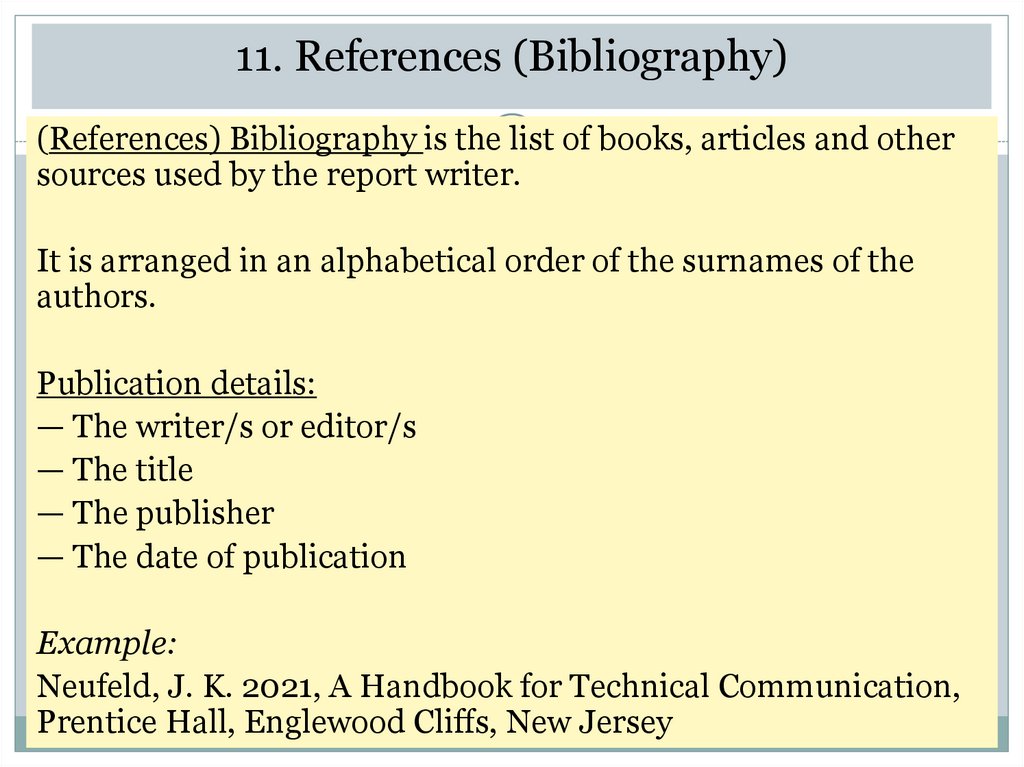
27. 11. References (Bibliography)
(References) Bibliography is the list of books, articles and othersources used by the report writer.
It is arranged in an alphabetical order of the surnames of the
authors.
Publication details:
— The writer/s or editor/s
— The title
— The publisher
— The date of publication
Example:
Neufeld, J. K. 2021, A Handbook for Technical Communication,
Prentice Hall, Englewood Cliffs, New Jersey
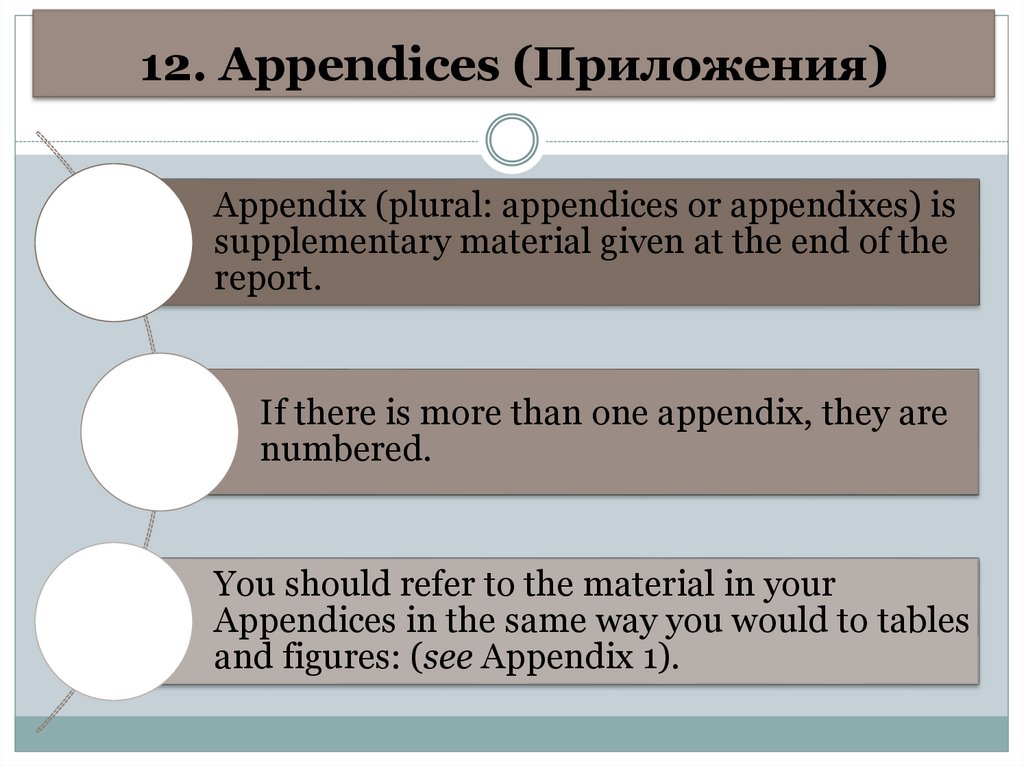
28. 12. Appendices (Приложения)
Appendix (plural: appendices or appendixes) issupplementary material given at the end of the
report.
If there is more than one appendix, they are
numbered.
You should refer to the material in your
Appendices in the same way you would to tables
and figures: (see Appendix 1).
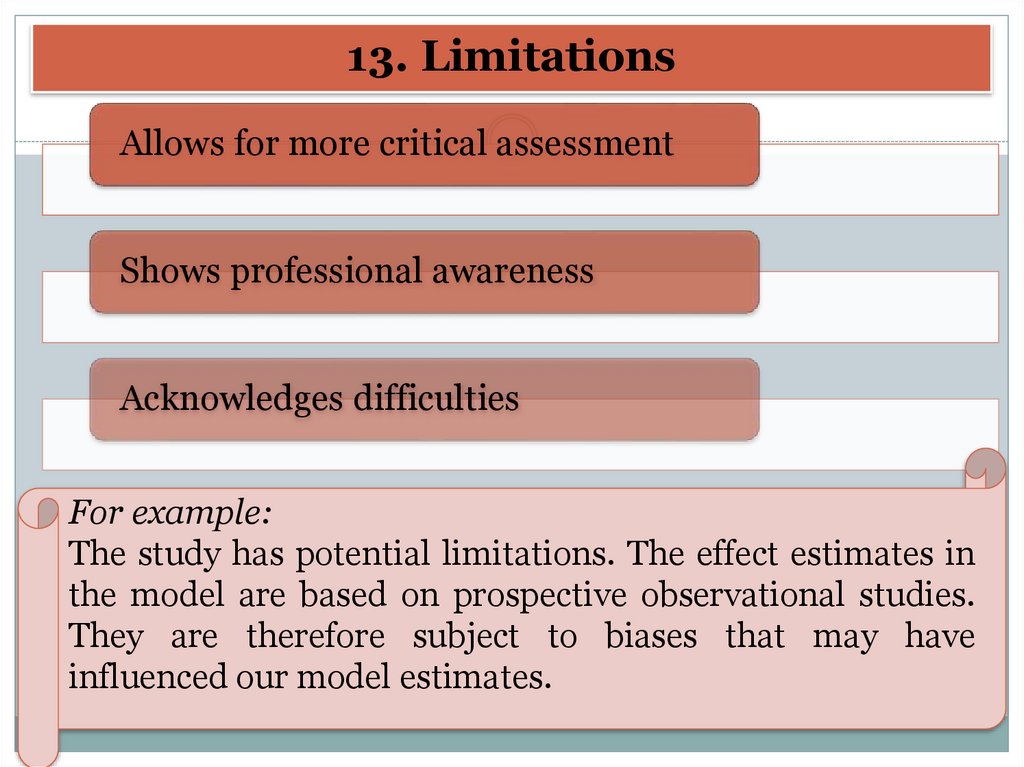
29. 13. Limitations
Allows for more critical assessmentShows professional awareness
Acknowledges difficulties
For example:
The study has potential limitations. The effect estimates in
the model are based on prospective observational studies.
They are therefore subject to biases that may have
influenced our model estimates.