
 english
Similar presentations:





Journal of English for Academic Purposes
1.
Journal of English for Academic Purposes 35 (2018) 16e30Contents lists available at ScienceDirect
Journal of English for Academic Purposes
journal homepage: www.elsevier.com/locate/jeap
Three minute thesis presentations as an academic genre: A
cross-disciplinary study of genre moves
Guangwei Hu a, *, Yanhua Liu b
a
b
The Hong Kong Polytechnic University, Chung Sze Yuen Building, Hunghom, Kowloon, Hong Kong
Nanyang Technological University, Yibin University, China
a r t i c l e i n f o
a b s t r a c t
Article history:
Received 3 February 2017
Received in revised form 6 May 2018
Accepted 7 June 2018
Available online 8 June 2018
This paper reports on a cross-disciplinary study of the rhetorical structure of Three Minute
Thesis (3MT) presentations, an increasingly popular yet largely unexamined academic
speech genre. The study analyzed a corpus of 142 presentations by PhD students from four
disciplines chosen to operationalize two widely discussed disciplinary distinctions (i.e.,
hard vs. soft and pure vs. applied disciplines). The analysis identi ed eight distinct
rhetorical moves in the 3MT presentations, including six obligatory moves (i.e., Orientation, Rationale, Purpose, Methods, Implication, and Termination) and two optional ones
(i.e., Framework and Results). Further analyses revealed statistically signi cant associations between disciplinary af liation and the likelihood to employ three moves (i.e.,
Framework, Methods, and Results). These relationships are explained in terms of the
dominant epistemological codes at work in the different disciplines. The ndings have
important implications for graduate students, 3MT tutors, EAP instructors, and other academics involved in preparing PhD students for 3MT competitions and teaching spoken
academic discourse in general.
© 2018 Elsevier Ltd. All rights reserved.
Keywords:
Academic speech
Disciplinary variation
Genre
Move analysis
Three Minute Thesis (3MT) presentations
1. Introduction
Academic communication is the life blood of academia because both knowledge making and personal reputation depend
crucially on it (Becher & Trowler, 2001). While written academic discourse has traditionally been the center of research and
pedagogical attention, the importance of spoken academic communication has increasingly been recognised in recent years
(Hyland, 2006; Lee, 2016). There is a growing consensus that strong oral academic communication skills constitute a vital
asset for both early-career and established scholars (Shaikh-Lesko, 2014). Against this backdrop has emerged a new and
increasingly popular academic communication genre, Three Minute Thesis (3MT) presentations, which challenges graduate
students to report their dissertation research in just 3 min to a disciplinarily heterogeneous audience following strict
competition rules such as the use of only one static PPT slide. Such presentations are delivered at the fast-spreading 3MT
competitions pioneered by The University of Queensland (UQ) in 2008 and now held globally in over 600 universities and
institutions across some 60 countries.1 Although 3MT presentations are delivered only by graduate students and may thus be
regarded as marginal, they have been envisioned as having important educative value. As pointed out by Skrbis et al. (2010),
* Corresponding author. English Department, Chung Sze Yuen Building, The Hong Kong Polytechnic University, Hunghom, Kowloon, Hong Kong.
E-mail address: guangwei.hu@polyu.edu.hk (G. Hu).
1
For details, see the of cial 3MT website (https://threeminutethesis.uq.edu.au/about).
https://doi.org/10.1016/j.jeap.2018.06.004
1475-1585/© 2018 Elsevier Ltd. All rights reserved.
2.
G. Hu, Y. Liu / Journal of English for Academic Purposes 35 (2018) 16e3017
initiators of the 3MT concept, 3MT was launched as an integral part of academic oral presentation skill training for PhD/MPhil
students at UQ to counter the widespread imbalance of privileging academic writing skills at the expense of spoken
communication skills in higher degree programs and to better prepare graduate students for future academic or nonacademic careers. In the eld of EAP, the need for graduate students to communicate with non-specialist audiences was
highlighted three decades ago by Huckin and Olsen (1984), and their observation “has never been more true than it is today”
(Feak, 2016, p. 496). The academic genre of 3MT presentations provides impetus and opportunity for graduate students to
hone their skills to communicate with non-experts and general presentational competence (Feak, 2016) and prepare for their
PhD oral defense (Me
zek & Swales, 2016).
Despite the exponential spread of 3MT events, a growing recognition of their important role in cultivating graduate
students' communicative competence, and EAP scholars' view of 3MT as “certainly an area worthy of research attention”
(Feak, 2013, p. 39), the 3MT genre has until now been ignored by genre scholars, as evidenced by the paucity of empirical
research published on this genre in the eld of EAP. This lack of research attention is conspicuous, considering the daunting
challenges faced by graduate students to condense a colossal doctoral dissertation into a three-minute presentation and the
inadequate attention to the rhetorical features of this genre in the training they may receive. Although many universities do
provide preparatory workshops or coaching sessions, which are often conducted by communication instructors, the focus is
typically on general public speaking tips such as showing enthusiasm for the subject, being aware of body language, and
projecting one's voice (Copeman, 2015; Shaikh-Lesko, 2014). Such advice, while practical, has been criticized for being very
“basic” and “super cial” (Copeman, 2015, p. 78). Thus, there is a pressing need for genre research that can contribute a better
and more nuanced understanding of 3MT presentations so that genre-speci c pedagogical advice can be offered to graduate
students, 3MT tutors, and other academics such as EAP instructors for more effective training.
1.1. Swalesian genre analysis and previous research on spoken academic genres
The ESP approach to genre analysis developed by Swales (1990, 2004) provides a robust framework for investigating the
rhetorical structure of 3MT presentations. The rhetorical structure of a genre is constituted by a series of moves and/or steps,
each being “a discoursal or rhetorical unit that performs a coherent communicative function in a written or spoken discourse”
(Swales, 2004, p. 228). Notably, a move is “a functional, not a formal, unit” (p.229) because, apart from having its own purpose,
it also contributes to the unifying communicative purposes of the genre. These local and overall communicative purposes
motivate and shape the genre, whose texts exhibit “various patterns of similarity in terms of structure, style, content and
intended audience” (Swales, 1990, p. 58). Thus, the Swalesian approach emphasizes the primary role of communicative/
rhetorical functions in identifying distinct moves/steps. Although it is applicable to both written and spoken genres, the
functional approach has been widely adopted to examine the schematic structures of various written academic genres, such
as research articles (Holmes, 1997; Moreno & Swales, 2018), theses/dissertations (Bunton, 1998; Kwan, 2006), student laboratory reports (Parkinson, 2017), and conference abstracts (Halleck & Connor, 2006; Payant & Hardy, 2016). By contrast, a
much smaller body of EAP genre studies has taken the Swalesian approach to examine the rhetorical structures of spoken
academic genres, such as PhD defenses (Me
zek & Swales, 2016; Swales, 2004), conference presentations (Rowley-Jolivet &
Carter-Thomas, 2005), academic lectures (Lee, 2016), and TED talks (Chang & Huang, 2015).
Of the relevant academic speech genres examined, lectures have perhaps received the most research attention. Thompson
(1994) conducted a Swalesian move analysis of 18 lecture introductions sampled from several disciplines and was able to
identify two distinctive rhetorical moves (i.e., Setting up Lecture Framework and Putting Topic in Context) and several steps
within each move (e.g., Announcing Topic, Indicating Scope, and Showing Importance/Relevance of Topic). She also noticed
the absence of a clearly preferred sequence of functional elements in the data and attributed the observed variation in
sequencing to the unique communicative purposes and spontaneous nature of lectures as a pedagogic and spoken genre. Two
other studies, Cheng (2012) and Lee (2009), also focused on the rhetorical structures of distinct lecture phases (i.e., introductions and closings, respectively) and examined how factors such as class size might impact on them. In a recent study,
Lee (2016) combined a Swalesian move analysis of 24 EAP lessons with corpus-based methods and identi ed nine moves
within three distinct phrases of the lessons. Some of these moves, for example, Getting Started and Bidding Farewell, can be
expected to appear in 3MT presentations as well because of their commonalities with lectures as spoken genres involving an
immediate audience and prizing positive interpersonal rapport. Lee also found that the rhetorical moves in each lesson phase
seldom progressed in a linear sequence, corroborating Thompson’s (1994) earlier nding about lecture introductions.
Apart from rhetorical structures, previous studies also investigated various linguistic features of the lecture genre. Some
(e.g., Fortanet, 2004; Lee & Subtirelu, 2015) examined the use of metadiscourse in framing lectures, engendering student
involvement, establishing relationships among ideas, and advancing arguments. Other studies (e.g., Biber & Barbieri, 2007;
Biber, Conrad, & Cortes, 2004; Lee, 2016) uncovered how lexical bundles were used as discourse-signaling cues to structure ongoing lectures and indicate stance. There were also corpus-based studies that focused on the use of various lexicogrammatical resources in marking the relevance/importance of lecture points to engage in interactive and textual
sorientation (Deroey, 2012, 2014, 2015) and the deployment of attitudinal language in expressing explicit evaluation (Belle
~ o, 2016, 2018). Contrastive analyses of these lexicogrammatical resources in lectures revealed that they varied across
Fortun
s-Fortun
~ o, 2016). In connection with the analytic approach
disciplines (Deroey, 2012) and across different languages (Belle
adopted in the present study, it is important to point out that although some linguistic features index communicative intentions and consequently tend to co-occur in certain rhetorical moves, they can only assist in, rather than constitute the
3.
18G. Hu, Y. Liu / Journal of English for Academic Purposes 35 (2018) 16e30
primary basis for, the identi cation of these moves. This stems from the fact that moves are functional rather than formal
units of discourse and that their identi cation must therefore rely primarily on the delineation of their communicative
purposes (Kwan, 2006; Moreno & Swales, 2018).
Another spoken academic genre, conference presentations, deserves attention here because of its apparent similarities
with the 3MT genre; that is, both are carefully prepared presentations delivered to a live audience to disseminate research and
subject to constraints of information processing in real time. Although Dubois’s (1980) pioneering work investigated the
schematic structure of biomedical conference presentations in the early 1980s, it was only 20 years later that the genre began
to receive some focused attention. Arguing for the value of a genre-based approach to understanding conference presentations and the importance of equipping novice presenters with generic knowledge, Ventola (2002) proposed a generic
structure for conference presentations and stressed the need to identify generic variations of such presentations in crosslinguistic and cross-cultural contexts. Seeing the need for novice academics to deploy moves valued in their disciplinary
communities, Shalom (2002) compared conference presentations by novice and established applied linguists and found a
marked difference in the use of a move named “contextualizing the paper”. Analysing interrelated conference genres (e.g.,
€isa
€nen (2002) demonstrated that
conference presentations, their related published papers, and conference abstracts), Ra
conference genres are a mixture of oral and written genres that have different communicative purposes and rhetorical
characteristics. Thus, to gain entry to conference forums, novice academics require situated knowledge of the different genres
to make sense of the discursive practices of their disciplines. Drawing on a corpus of 90 conference presentations from three
disciplines, Rowley-Jolivet (2002) found that the reporting of novel and typically preliminary results in conference presentations clearly positioned the genre at an early stage of a multi-staged knowledge-making process and that there were
“signi cant differences between the three elds studied, related to their different research methods and deontologies”
(p.112). Of particular relevance to the present study is Rowley-Jolivet and Carter-Thomas's (2005) genre analysis of the introductions of 44 conference presentations from three science disciplines that identi ed a three-move structure: Setting up
the Framework, Contextualizing the Framework, and Stating the Research Rationale. This move structure was compared with
three previous move models of academic introductions (Dubois, 1980; Swales, 1990; Thompson, 1994) in spoken (conference
presentations and university lectures) and written (research article introductions) genres. The comparison revealed that
introductions of conference presentations are “related in certain aspects to introductions in other academic genres” but create
“a fresh synthesis” (p.56) of rhetorical features.
Several studies have forayed into spoken student genres. Swales, Barks, Ostermann, and Simpson (2001) analyzed architecture presentations (also known as crits or design reviews) given by graduate students for assessment purposes and
identi ed three major moves (i.e., Site Description, Architecturally Contextualized Rationale, and Design Details) in the genre.
Furthermore, the researchers found that successful presenters managed the ow of the three moves judiciously and drew on
various rhetorical and lexicogrammatical resources (e.g., functional description and the present tense) to make their project
real and experienceable. These ndings were largely corroborated by Morton’s (2009) study of architecture presentations by
undergraduate students, which revealed successful presenters' effective use of narratives and other resources to establish
their credibility as designers, draw the audience into their own worlds, and manage the moves effectively to contextualize
their designs. In another study of successful student presentations, Zareva (2013) found that TESOL graduate students'
projection of their identity roles was heavily in uenced by and resembled the written academic genres (e.g., book chapters
and articles) that they consulted for the presentations. This nding was consistent with what Weissberg (1993) discovered in
his examination of graduate seminars presented by students to a disciplinary audience, including departmental faculty,
academic guests, and peers: The structure of such seminars, be they PhD proposals, in-progress reports or reports of nished
research, usually followed the typical Introduction-Method-Results-Discussion format of the research article, with the Results
component absent from the rst two types of seminar for an obvious reason.
The PhD defense is another oral academic genre that focally involves students and is perhaps the closest to the 3MT
presentation in terms of their dependence on the written PhD dissertation. Both genres provide opportunities for graduate
students to communicate their PhD work and demonstrate their scholarly prowess to an authoritative panel (i.e., examiners
and 3MT judges) and an academic audience (e.g., faculty and fellow PhD students). Hence, a review of extant research on PhD
defenses is in order. In one of the earliest genre studies of PhD defences, Hasan (1994) drew on systemic functional linguistics
and proposed, based on a close analysis of a sociology PhD examination at a US university, a 14-stage inventory depicting the
generic structure potential of the genre since not all the stages will necessarily occur in a single PhD defense. Examining the
same sociology PhD defense, Grimshaw, Feld, and Jenness (1994) identi ed four major segments of a typical defense: the
opening segment, the defense proper, the in camera segment, and the closing segment. Each of these segments comprised
several moves; for example, the opening segment consisted of settling in, the chair's statement of procedures, the candidate's
brief narrative, and his/her summary of the doctoral project and its principal ndings. Swales (2004) examined the generic
structure of four PhD defences in different disciplines at another US university and found that Grimshaw et al.’s 4-segment
structure, with some rearrangement of the constituent parts, captured the structural movement of the defences well. More
recently, Me
zek and Swales (2016) surveyed research on PhD defenses in different educational contexts and found both
differences and similarities in the generic structures of the defenses. As an illustration, while defences in the US, Iran, and
Norway follow the aforementioned generic structure identi ed by Swales (2004), those in Belgium and The Netherlands have
an additional segment called “laudatio”, where the supervisor praises the candidate for his/her academic achievements. There
are also disciplinary differences; for example, at Swedish universities, a thesis summary is provided as part of the defense
proper by the candidate in the natural sciences but by the examiner in the humanities and social sciences.
4.
G. Hu, Y. Liu / Journal of English for Academic Purposes 35 (2018) 16e3019
To sum up, the above review of research on academic speech genres has demonstrated the value of a Swalesian move
analysis as a robust and powerful tool for investigating and gaining insight into how “the communicative purpose of a genre (a
‘privileged’ criterion) shapes the genre and provides it with an internal structure e a schematic structure” (Askehave &
Swales, 2001, p. 198). The review has also revealed that academic speech genres are not “pure” or “isolated” genres but
draw on and repurpose generic resources from related genres, both written and spoken, in new communicative contexts.
Such generic repurposing, known as interdiscursivity, is further discussed below.
1.2. Interdiscursivity and 3MT presentations
Interdiscursivity recognizes the complex and interrelated nature of genres, as re ected in the mixing of different genres to
create genres in response to new communicative purposes and contexts (Bhatia, 2004; Hyland, 2009). The role of interdiscursivity in the development of new genres has long been acknowledged. As Todorov and Berrong (1976) point out, “a new
genre is always the transformation of one or several old genres: by inversion, by displacement, by combination” (p.161). As a
discursive practice, interdiscursivity is pervasive in the professional and academic worlds and can be observed in both written
and spoken genres. Bhatia (2004), for example, demonstrates how various written genres (e.g., corporate annual reports, job
descriptions, and book reviews) blend generic resources and rhetorical features from different sources. By the same token,
spoken genres, such as conference presentations (Hyland, 2009), seminars (Aguilar, 2004), poster presentations (MacIntoshMurry, 2007), and TED talks (Caliendo, 2014), have also been found to incorporate a range of generic conventions and
rhetorical strategies to create genre-speci c syntheses and respond to unique communicative needs. Notably, such crossgenre borrowings do not just occur within the same semiotic modes (e.g., written or spoken) but also between different
modes (for examples see Aguilar, 2004; Caliendo, 2014; Hyland, 2009; MacIntosh-Murray, 2007).
There is good reason to expect interdiscursivity to occur in the 3MT genre, given the many similarities it shares with the
genres discussed above and in view of the three key factors suggested by Bhatia (1999) for genre identi cation/characterization, viz., “the rhetorical context in which the genre is situated, the communicative purpose(s) it tends to serve, and the
cognitive structure that it is meant to represent” (p.23). As regards the rhetorical context, 3MT presentations are situated in
academic settings and center around the communication of doctoral research to a live audience. Thus, the genre resembles
other oral academic genres (e.g., seminars, lectures, and conference presentations) in the necessity of attending to the needs
of the audience and working under constraints of real-time information processing by adopting similar rhetorical strategies
such as establishing interpersonal rapport and providing an orienting framework upfront. Unlike most other academic genres,
however, it draws a disciplinarily heterogeneous audience and is staged in competition before a judging panel that rates
individual presentations according to common and stringent criteria on content, performance, duration, and visual aids.2 The
competitive nature of the genre means that 3MT presentations are carefully scripted and well rehearsed for peak performance to impress the judges. Consequently, the 3MT genre is a highly institutionalized and unique response to a novel
rhetorical context. As for its communicative purposes, the 3MT genre has been created to disseminate and promote PhD
research. As such, it belongs to a genre set that doctoral students engage in as part of their disciplinary enculturation and
research training. Other members of this public research-process genre set include spoken genres such as conference/poster
presentations, graduate seminars, and PhD defenses as well as written ones such as research articles, conference abstracts,
and dissertations (Swales, 1990; Zareva, 2013). Given its communicative purposes and interdiscursive linkages with other
public research-process genres, the 3MT genre can be expected to incorporate some of the generic moves (e.g., Introduction,
Method, Results, and Discussion) that have been found to characterize the other research presentation genres to create its
own cognitive structure, namely its generic patterning.
The hybrid nature of the 3MT genre, however, does not preclude the value of investigating its rhetorical structure.
Although 3MT presentations are likely to draw on generic features from other academic genres, as Rowley-Jolivet and CarterThomas (2005) found in their study of conference presentations, such interdiscursive borrowings can be expected to combine
generic resources in a genre-speci c structure. Thus, there is a need to uncover this genre-speci c structure and its variation
across contexts of use. One likely source of such variation is disciplinary in uences.
1.3. Disciplinary in uences on academic genres
Based on his review of research on several spoken academic genres, Swales (2004) concluded that disciplinary differences
often reported in the academic writing literature were not evident in academic speech. He attributed what he saw as “a
considerably greater homogeneity in oral performance” in part to the prevalence of a levelling “open style” (p.205). The
research reviewed above, however, is indicative of disciplinary in uences on academic speech genres, including student
presentations and PhD defenses. Both Zareva (2013) and Weissberg (1993), for example, found that student presentations
followed the typical structures of written academic genres, suggesting the existence of disciplinary in uences because such
differences have been observed in these written genres. Morton's (2009) study of student architecture presentations revealed
that successful presentations were able to apply rhetorical strategies invested with disciplinary norms and valued by
disciplinary experts. Similarly, the generic organization and semiotic media (e.g., drawings and models) of the presentations
2
The competition rules and judging criteria can be found at https://threeminutethesis.uq.edu.au.
5.
20G. Hu, Y. Liu / Journal of English for Academic Purposes 35 (2018) 16e30
examined made them immediately recognizable as a discipline-speci c student presentation genre. Me
zek and Swales (2016)
also noted some disciplinary differences in PhD defences at Swedish and UK universities. In view of the many similarities that
3MT shares with student presentations and PhD defenses, there is a need to study potential disciplinary in uences on the
3MT genre, that is, how 3MT presentations “package information in ways that conform to a discipline's norms, values, and
ideology” (Berkenkotter & Huckin, 1995, p. 1).
Much extant research on disciplinary rhetorical and linguistic variation has drawn on Becher's (1989) two-way typological
classi cation of disciplines into hard (e.g., biology) vs. soft (e.g., education) and pure (e.g., history) vs. applied (e.g., mechanical
engineering) ones. For example, this line of research has considered the in uences of hard and soft disciplines on the move
structures of written genres such as abstracts (Hyland, 2000; Jiang & Hyland, 2017) and thesis abstracts (Bunton, 1998).
Although disciplinary variation in written academic genres has been well established, fewer studies have looked into spoken
academic genres from a disciplinary perspective, especially in terms of variation in move structures. The few extant studies (e.g.,
Chang, 2012; Simpson-Vlach, 2006) that we have located focused mainly on disciplinary variation in the use of lexicogrammatical features. For instance, Simpson-Vlach (2006) con rmed the variation pattern in the use of hedges by hard and
soft disciplines found in Hyland's (1998) study of written discourse. The paucity of cross-disciplinary studies of academic speech
genres means that the extent and nature of disciplinary variation in these genres remain to be examined. Thus, to address the
research lacuna, the present study examines to what extent disciplinary variation exists in the schematic structure of 3MT.
In contrast to the extensive body of research comparing hard and soft disciplines in generic and linguistic variation, much fewer
studies have been conducted to compare pure and applied elds. However, extant scholarship did uncover interesting differences
between the two disciplinary groupings. For example, Nesi and Gardner (2006) found that undergraduate writing tasks in applied
disciplines tended to place a greater emphasis on practical relevance, knowledge application and the practice-theory nexus than
their counterparts in pure disciplines did. Examining the generic structure of doctoral dissertations, Ridley (2000) observed a
difference between pure and applied disciplines: While most dissertations from pure sciences adopted an article-compilation
dissertation format, only a few engineering dissertations followed this structure.3 Given the small number of extant studies,
further research is needed to produce insights into what generic differences exist between pure and applied disciplines and how
they may relate to the epistemological characteristics of these disciplines. The present study is an effort along this line.
Recently, cross-disciplinary variation in academic literacy practices has also been examined within a knowledge-knower
framework (Maton, 2000, 2014) that distinguishes disciplines by their prevalent epistemological orientations. Two of these
epistemological orientations are known as a knowledge code and a knower code. Disciplines dominated by a knowledge code
have a more structured hierarchical body of knowledge that is veri ed against established scienti c principles and procedures
(Maton, 2014). In such disciplines, the backgrounds of the scientists or “knowers” are largely irrelevant to knowledge making.
By contrast, disciplines operating with a knower code depend more on the distinct individual characteristics of academics
constructing disciplinary knowledge. Knowledge claims tend to be legitimated by appealing to knowers’ personal voice,
expertise, experience, and authority. The explanatory power of the knowledge-knower framework has been testi ed in recent
cross-disciplinary variation studies such as Hood (2011) on citation practices and Hu and Cao (2015) on metadiscourse in
research articles. For instance, Hu and Cao found that in their corpus the applied linguistics and education research articles,
with a stronger knower code, employed boosters more frequently than psychology ones, displaying a stronger knowledge
code, because such devices enabled them to increase their commitment to their knowledge claims, assert authority, and
position themselves as legitimate knowers. Existing research indicates that the knowledge-knower code orientations prevailing in different disciplines can be a useful explanatory framework for identifying and interpreting disciplinary in uences
on academic discourse. However, more empirical work is needed to understand how the epistemological orientation of a
discipline in uences the rhetorical structure of its academic genres, including spoken genres such as 3MT presentations.
The research reviewed above has pointed to a dearth of genre studies on 3MT presentations. Given the envisioned
educative value of this genre (Feak, 2016; Skrbis et al., 2010), there is a need for research that draws on a large corpus of
representative 3MT presentations from multiple disciplines to identify the schematic structure of the genre reliably and to
describe its cross-disciplinary variation accurately. Such a generic knowledge can provide meaningful and appropriate
support to graduate students who are interested or need to make 3MT presentations. Thus, this study aims to establish the
rhetorical moves of the 3MT genre and their instantiation across broad disciplinary groupings (i.e., hard/soft and pure/
applied) to explore factors shaping generic variation. Speci cally, we address the following research questions:
1. What rhetorical moves can be found in 3MT presentations?
2. Is there any systematic generic variation in 3MT presentations from different disciplines?
2. Method
2.1. The corpus
To answer the research questions, a corpus was constructed to include 142 3MT presentations delivered between 2010 and
2016 by PhD students coming from over 70 universities across the world and four different disciplines e Biological Sciences,
3
As one reviewer points out, the difference observed by Ridley 17 years ago is gone at many universities.
6.
G. Hu, Y. Liu / Journal of English for Academic Purposes 35 (2018) 16e3021
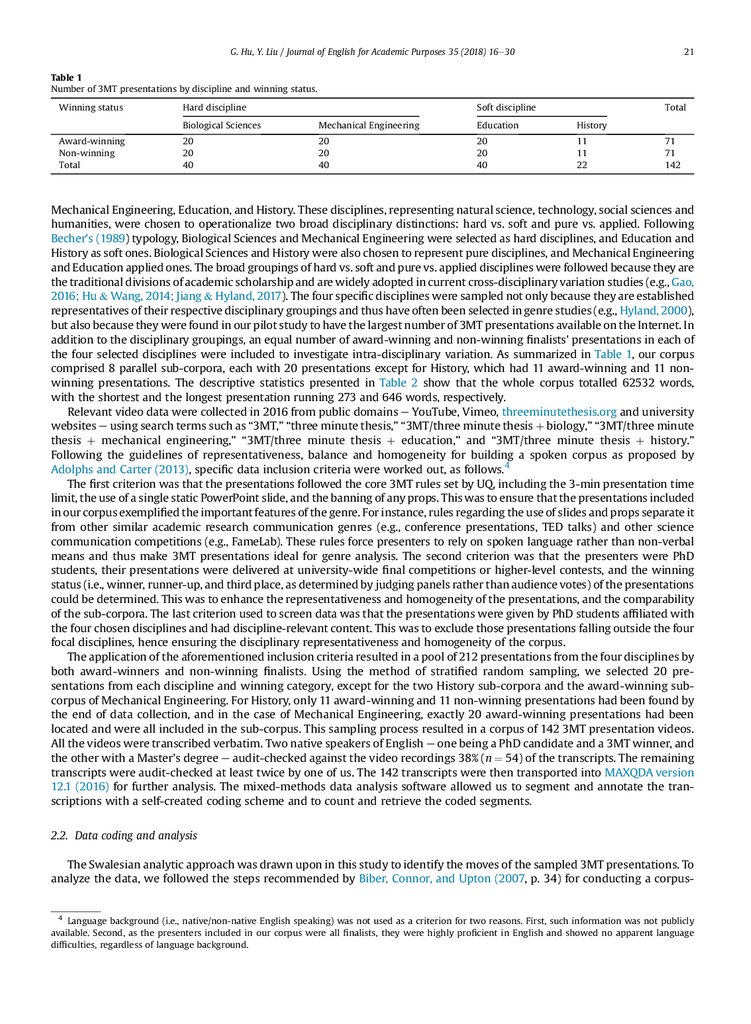
Table 1
Number of 3MT presentations by discipline and winning status.
Winning status
Award-winning
Non-winning
Total
Hard discipline
Soft discipline
Total
Biological Sciences
Mechanical Engineering
Education
History
20
20
40
20
20
40
20
20
40
11
11
22
71
71
142
Mechanical Engineering, Education, and History. These disciplines, representing natural science, technology, social sciences and
humanities, were chosen to operationalize two broad disciplinary distinctions: hard vs. soft and pure vs. applied. Following
Becher's (1989) typology, Biological Sciences and Mechanical Engineering were selected as hard disciplines, and Education and
History as soft ones. Biological Sciences and History were also chosen to represent pure disciplines, and Mechanical Engineering
and Education applied ones. The broad groupings of hard vs. soft and pure vs. applied disciplines were followed because they are
the traditional divisions of academic scholarship and are widely adopted in current cross-disciplinary variation studies (e.g., Gao,
2016; Hu & Wang, 2014; Jiang & Hyland, 2017). The four speci c disciplines were sampled not only because they are established
representatives of their respective disciplinary groupings and thus have often been selected in genre studies (e.g., Hyland, 2000),
but also because they were found in our pilot study to have the largest number of 3MT presentations available on the Internet. In
addition to the disciplinary groupings, an equal number of award-winning and non-winning nalists' presentations in each of
the four selected disciplines were included to investigate intra-disciplinary variation. As summarized in Table 1, our corpus
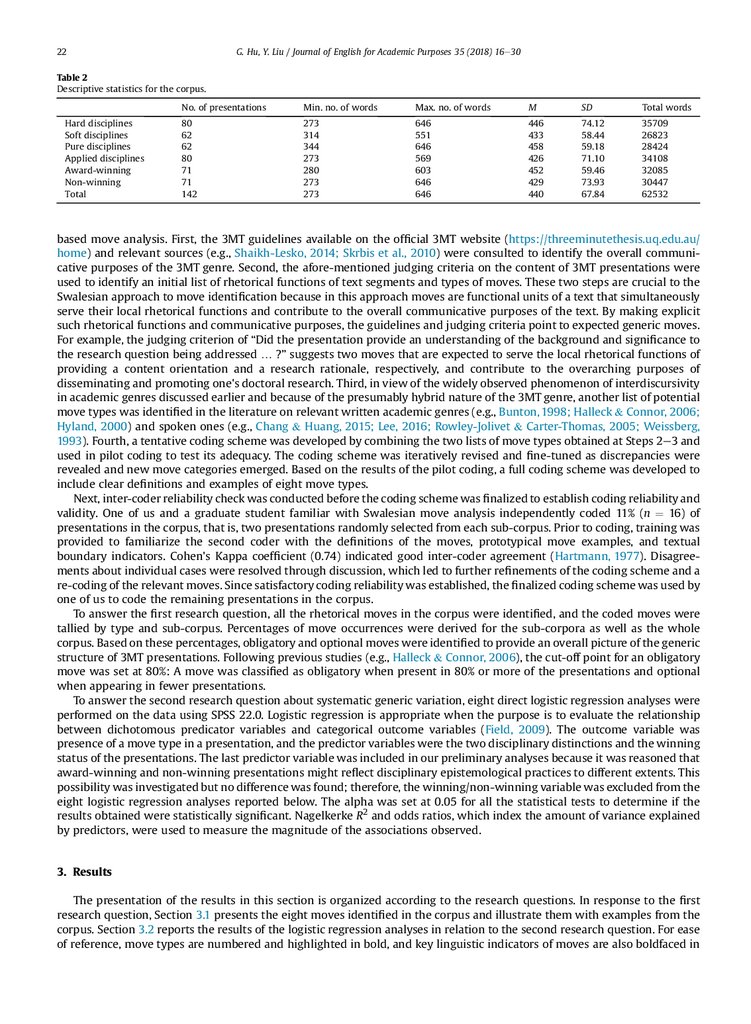
comprised 8 parallel sub-corpora, each with 20 presentations except for History, which had 11 award-winning and 11 nonwinning presentations. The descriptive statistics presented in Table 2 show that the whole corpus totalled 62532 words,
with the shortest and the longest presentation running 273 and 646 words, respectively.
Relevant video data were collected in 2016 from public domains e YouTube, Vimeo, threeminutethesis.org and university
websites e using search terms such as “3MT,” “three minute thesis,” “3MT/three minute thesis þ biology,” “3MT/three minute
thesis þ mechanical engineering,” “3MT/three minute thesis þ education,” and “3MT/three minute thesis þ history.”
Following the guidelines of representativeness, balance and homogeneity for building a spoken corpus as proposed by
Adolphs and Carter (2013), speci c data inclusion criteria were worked out, as follows.4
The rst criterion was that the presentations followed the core 3MT rules set by UQ, including the 3-min presentation time
limit, the use of a single static PowerPoint slide, and the banning of any props. This was to ensure that the presentations included
in our corpus exempli ed the important features of the genre. For instance, rules regarding the use of slides and props separate it
from other similar academic research communication genres (e.g., conference presentations, TED talks) and other science
communication competitions (e.g., FameLab). These rules force presenters to rely on spoken language rather than non-verbal
means and thus make 3MT presentations ideal for genre analysis. The second criterion was that the presenters were PhD
students, their presentations were delivered at university-wide nal competitions or higher-level contests, and the winning
status (i.e., winner, runner-up, and third place, as determined by judging panels rather than audience votes) of the presentations
could be determined. This was to enhance the representativeness and homogeneity of the presentations, and the comparability
of the sub-corpora. The last criterion used to screen data was that the presentations were given by PhD students af liated with
the four chosen disciplines and had discipline-relevant content. This was to exclude those presentations falling outside the four
focal disciplines, hence ensuring the disciplinary representativeness and homogeneity of the corpus.
The application of the aforementioned inclusion criteria resulted in a pool of 212 presentations from the four disciplines by
both award-winners and non-winning nalists. Using the method of strati ed random sampling, we selected 20 presentations from each discipline and winning category, except for the two History sub-corpora and the award-winning subcorpus of Mechanical Engineering. For History, only 11 award-winning and 11 non-winning presentations had been found by
the end of data collection, and in the case of Mechanical Engineering, exactly 20 award-winning presentations had been
located and were all included in the sub-corpus. This sampling process resulted in a corpus of 142 3MT presentation videos.
All the videos were transcribed verbatim. Two native speakers of English e one being a PhD candidate and a 3MT winner, and
the other with a Master's degree e audit-checked against the video recordings 38% (n ¼ 54) of the transcripts. The remaining
transcripts were audit-checked at least twice by one of us. The 142 transcripts were then transported into MAXQDA version
12.1 (2016) for further analysis. The mixed-methods data analysis software allowed us to segment and annotate the transcriptions with a self-created coding scheme and to count and retrieve the coded segments.
2.2. Data coding and analysis
The Swalesian analytic approach was drawn upon in this study to identify the moves of the sampled 3MT presentations. To
analyze the data, we followed the steps recommended by Biber, Connor, and Upton (2007, p. 34) for conducting a corpus-
4
Language background (i.e., native/non-native English speaking) was not used as a criterion for two reasons. First, such information was not publicly
available. Second, as the presenters included in our corpus were all nalists, they were highly pro cient in English and showed no apparent language
dif culties, regardless of language background.
7.
22G. Hu, Y. Liu / Journal of English for Academic Purposes 35 (2018) 16e30
Table 2
Descriptive statistics for the corpus.
Hard disciplines
Soft disciplines
Pure disciplines
Applied disciplines
Award-winning
Non-winning
Total
No. of presentations
Min. no. of words
Max. no. of words
M
SD
Total words
80
62
62
80
71
71
142
273
314
344
273
280
273
273
646
551
646
569
603
646
646
446
433
458
426
452
429
440
74.12
58.44
59.18
71.10
59.46
73.93
67.84
35709
26823
28424
34108
32085
30447
62532
based move analysis. First, the 3MT guidelines available on the of cial 3MT website (https://threeminutethesis.uq.edu.au/
home) and relevant sources (e.g., Shaikh-Lesko, 2014; Skrbis et al., 2010) were consulted to identify the overall communicative purposes of the 3MT genre. Second, the afore-mentioned judging criteria on the content of 3MT presentations were
used to identify an initial list of rhetorical functions of text segments and types of moves. These two steps are crucial to the
Swalesian approach to move identi cation because in this approach moves are functional units of a text that simultaneously
serve their local rhetorical functions and contribute to the overall communicative purposes of the text. By making explicit
such rhetorical functions and communicative purposes, the guidelines and judging criteria point to expected generic moves.
For example, the judging criterion of “Did the presentation provide an understanding of the background and signi cance to
the research question being addressed … ?” suggests two moves that are expected to serve the local rhetorical functions of
providing a content orientation and a research rationale, respectively, and contribute to the overarching purposes of
disseminating and promoting one's doctoral research. Third, in view of the widely observed phenomenon of interdiscursivity
in academic genres discussed earlier and because of the presumably hybrid nature of the 3MT genre, another list of potential
move types was identi ed in the literature on relevant written academic genres (e.g., Bunton, 1998; Halleck & Connor, 2006;
Hyland, 2000) and spoken ones (e.g., Chang & Huang, 2015; Lee, 2016; Rowley-Jolivet & Carter-Thomas, 2005; Weissberg,
1993). Fourth, a tentative coding scheme was developed by combining the two lists of move types obtained at Steps 2e3 and
used in pilot coding to test its adequacy. The coding scheme was iteratively revised and ne-tuned as discrepancies were
revealed and new move categories emerged. Based on the results of the pilot coding, a full coding scheme was developed to
include clear de nitions and examples of eight move types.
Next, inter-coder reliability check was conducted before the coding scheme was nalized to establish coding reliability and
validity. One of us and a graduate student familiar with Swalesian move analysis independently coded 11% (n ¼ 16) of
presentations in the corpus, that is, two presentations randomly selected from each sub-corpus. Prior to coding, training was
provided to familiarize the second coder with the de nitions of the moves, prototypical move examples, and textual
boundary indicators. Cohen's Kappa coef cient (0.74) indicated good inter-coder agreement (Hartmann, 1977). Disagreements about individual cases were resolved through discussion, which led to further re nements of the coding scheme and a
re-coding of the relevant moves. Since satisfactory coding reliability was established, the nalized coding scheme was used by
one of us to code the remaining presentations in the corpus.
To answer the rst research question, all the rhetorical moves in the corpus were identi ed, and the coded moves were
tallied by type and sub-corpus. Percentages of move occurrences were derived for the sub-corpora as well as the whole
corpus. Based on these percentages, obligatory and optional moves were identi ed to provide an overall picture of the generic
structure of 3MT presentations. Following previous studies (e.g., Halleck & Connor, 2006), the cut-off point for an obligatory
move was set at 80%: A move was classi ed as obligatory when present in 80% or more of the presentations and optional
when appearing in fewer presentations.
To answer the second research question about systematic generic variation, eight direct logistic regression analyses were
performed on the data using SPSS 22.0. Logistic regression is appropriate when the purpose is to evaluate the relationship
between dichotomous predicator variables and categorical outcome variables (Field, 2009). The outcome variable was
presence of a move type in a presentation, and the predictor variables were the two disciplinary distinctions and the winning
status of the presentations. The last predictor variable was included in our preliminary analyses because it was reasoned that
award-winning and non-winning presentations might re ect disciplinary epistemological practices to different extents. This
possibility was investigated but no difference was found; therefore, the winning/non-winning variable was excluded from the
eight logistic regression analyses reported below. The alpha was set at 0.05 for all the statistical tests to determine if the
results obtained were statistically signi cant. Nagelkerke R2 and odds ratios, which index the amount of variance explained
by predictors, were used to measure the magnitude of the associations observed.
3. Results
The presentation of the results in this section is organized according to the research questions. In response to the rst
research question, Section 3.1 presents the eight moves identi ed in the corpus and illustrate them with examples from the
corpus. Section 3.2 reports the results of the logistic regression analyses in relation to the second research question. For ease
of reference, move types are numbered and highlighted in bold, and key linguistic indicators of moves are also boldfaced in
8.
G. Hu, Y. Liu / Journal of English for Academic Purposes 35 (2018) 16e3023
the excerpts. It should be noted that the numbering of the move types does not suggest a linear ordering of the moves
because, as often reported, moves tend to occur recursively.
3.1. The move structure of 3MT presentations
Move 1: Orientation includes listener orientation and content orientation. While the former signals the start of a presentation and engages the audience's attention, often by greeting the audience or giving a self-introduction, the latter introduces the topic and provides background information to prepare the audience for the next move. In the following
examples, the speakers addressed the audience either formally (example 1) or casually (example 2) before moving on to
introduce the topic or the objective of the presentation. Orientation was the most frequently used move in the corpus as it
occurred in over 97% of the presentations.
(1) Ladies and gentlemen! Today I want to talk to all of you about thousands of robots right across the world that want to make
your lives better. (MW14)5
(2) Hi! I think it's a reasonable assumption that for the majority of you ants don't feature particularly highly on your list of
priorities. Well, during the next 3 min I'd like to try change that. (BN1)
Move 2: Rationale directly states the motivation of the research, which functions to convince the audience of the relevance or usefulness of the presented research in addressing gaps, problems, and needs in the real or research world. This is
one main communicative purpose of 3MT presentations. Typical linguistic indicators used in this move include unfortunately,
little, a lack of research, as illustrated by examples 3 and 4. Rationale was also an obligatory move as it occurred in over 91% of
the presentations.
(3) Unfortunately, we know very little. But one thing we do not expect … on the other hand, people with other disease also
produce the protein, but somehow they don't stick together and form plug. We do not fully know why. (BW1)
(4) Despite the fact this order very carefully documented their activities in the Hospitaller Archive … there's been a lack of
research on this topic and a lack of consideration for the signi cance of these developments. (HN1)
Move 3: Framework allows presenters to set out a theoretical position, model or framework that was adopted as a basis
for their research prior to the collection and analysis of their data. In example 5, the classi cation criteria for lek breeding
species were clearly laid out before their category membership was determined based on the proposed criteria. The same is
true for example 6, where the theoretical framework was presented at the very beginning and later used as a basis for
interpreting results.
(5) To classify species as a lek breeder, there's four criteria that have to be met. And I use some analogies in human behaviour to
help explain them. The rst is …. (BW2)
(6) My research is founded upon a theory called Activity Theory and activity theory simply tells me that human beings create
or adopt tools to …. (EW2)
Contrary to Orientation and Rationale, Framework was the least frequent move, appearing only in less than 6% of the
presentations.
Move 4: Purpose aims to state research objectives, purposes or focus of the study, and/or speci c research questions. It
was often clearly marked by expressions such as the purpose of my research (example 7), direct questions (example 8), and my
doctoral research focuses on (example 9). Purpose appeared in 81% of the presentations and thus was an obligatory move.
(7) The purpose of my research is to investigate individual feeding strategies in seabirds …. (BN4)
(8) The big question that we want to know is how effective are these reading programs for these struggling readers,
considering their limited resources. (EN4)
(9) And my doctoral research focuses on how the personal and ideological convictions …. (HW10)
Move 5: Methods was also an obligatory move, occurring in over 83% of the presentations. It is employed by 3MT presenters to inform the audience of how the research is/was undertaken, often by describing the materials used, such as a model
species (example 10), and the technology adopted (example 11). Just as an academic writer needs to justify his/her methodology, the 3MT presenters in the corpus often justi ed why a certain material, method or approach was chosen, as illustrated in examples 10 and 12.
5
The 3MT presentations in our corpus were coded as follows: B ¼ Biological Sciences, E ¼ Education, E ¼ History, M ¼ Mechanical Engineering, N ¼ nonaward winning, W ¼ award winning. A number (1e20) after the letters indicates the sequence of the presentation in the sub-corpus.
9.
24G. Hu, Y. Liu / Journal of English for Academic Purposes 35 (2018) 16e30
(10) Now, to do this, I use the common model species, the Trinidadian Guppy. The Trinidadian Guppy is commonly used in
studies of evolution and mate choice. It is a highly social and promiscuous freshwater sh and that's what makes it so
good for answering my question about the audience effect. (BN2)
(11) How I am doing this? By a new combustion technology called MILD or ameless combustion. (MN2)
(12) Now historians have tended to use adults' re ective sources such as autobiographies and memoirs to tell us about childhood,
but I argue that we really need to use and hear the children's voices. So I use hundreds of evacuee letters in my work.
(HN10)
Move 6: Results was optional because it appeared only in 57% of the presentations. As used in the corpus, Results informs
the audience of what has been found so far or what is expected to come out of the research. Typically, the move was signalled
by what I found (example 13), my nding shows (example 14), and as a result (example 15).
(13) And what I found is that where catalase's present, less hydrogen peroxide is produced, causing less damage to the host.
(BN11)
(14) My ndings show that drama can facilitate the reading in at least three ways. (EN09)
(15) As a result, I've discovered that guerrilla warfare is not chaotic …. (HW7)
As an obligatory move present in over 86% of the presentations, Move 7: Implication functions to draw conclusions,
discuss the implications, signi cance and contributions of the reported research, or offer recommendations. The general
communicative purpose of this move is to answer the question of “So what? Why is the research important?”. The move was
often signalled by linguistic indicators such as it is important that (example 16) to offer recommendations and ultimately
(example 17) to preface a discussion of research signi cance or contributions.
(16) My research shows that it is very important to encourage parents to read to the children…. And my research also shows that
it's very important that teachers use diverse strategies to teach vocabulary to young children. (EW9)
(17) And ultimately with this dummy, vehicle manufactures can design safer cars and take a deep bite out of this 7500 people
that dies each year in US from rollover crashes. (MW18)
Move 8: Termination serves to end presentations by thanking the audience with a simple expression (example 18) or in a
more elaborate way (example 19). Some presenters in our corpus also chose to pose questions to the audience to stimulate
their thought or create some kind of suspension (example 20) before ending their presentations. Like the opening move of
Orientation, Termination was an obligatory move, present in about 85% of the presentations.
(18) Thanks! (BN7)
(19) I thank you kindly for your patience and kindness! (EN10)
(20) So, do you want to know what the penny in your pocket will be worth tomorrow? Thank you. (HN6)
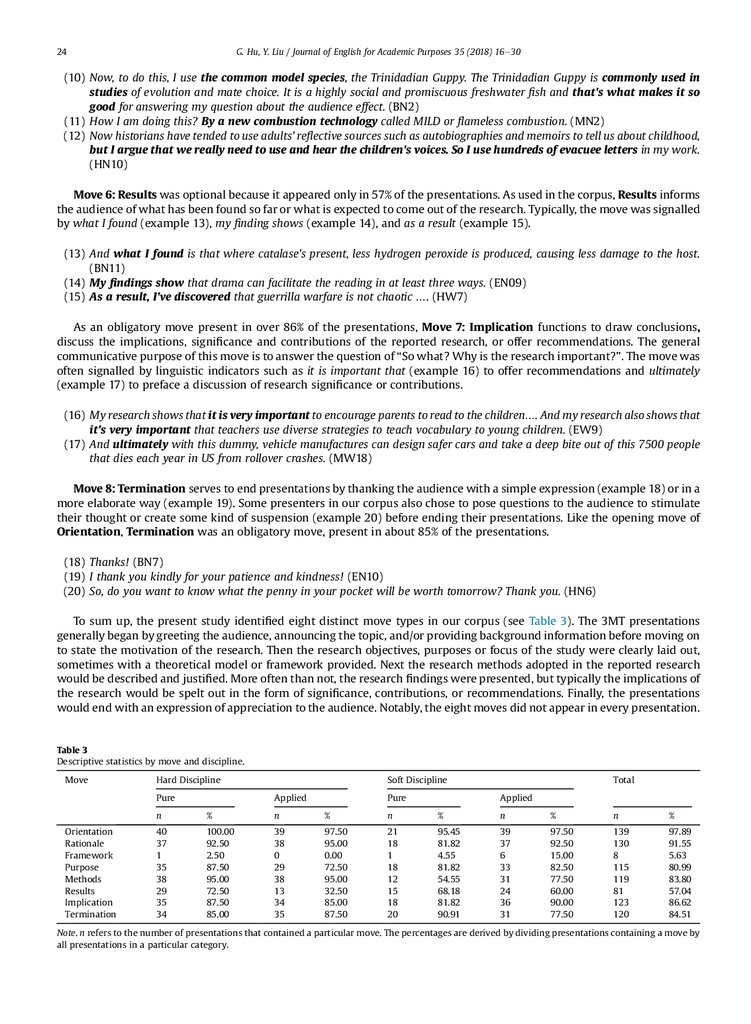
To sum up, the present study identi ed eight distinct move types in our corpus (see Table 3). The 3MT presentations
generally began by greeting the audience, announcing the topic, and/or providing background information before moving on
to state the motivation of the research. Then the research objectives, purposes or focus of the study were clearly laid out,
sometimes with a theoretical model or framework provided. Next the research methods adopted in the reported research
would be described and justi ed. More often than not, the research ndings were presented, but typically the implications of
the research would be spelt out in the form of signi cance, contributions, or recommendations. Finally, the presentations
would end with an expression of appreciation to the audience. Notably, the eight moves did not appear in every presentation.
Table 3
Descriptive statistics by move and discipline.
Move
Hard Discipline
Pure
Orientation
Rationale
Framework
Purpose
Methods
Results
Implication
Termination
Soft Discipline
Applied
Pure
Total
Applied
n
%
n
%
n
%
n
%
n
%
40
37
1
35
38
29
35
34
100.00
92.50
2.50
87.50
95.00
72.50
87.50
85.00
39
38
0
29
38
13
34
35
97.50
95.00
0.00
72.50
95.00
32.50
85.00
87.50
21
18
1
18
12
15
18
20
95.45
81.82
4.55
81.82
54.55
68.18
81.82
90.91
39
37
6
33
31
24
36
31
97.50
92.50
15.00
82.50
77.50
60.00
90.00
77.50
139
130
8
115
119
81
123
120
97.89
91.55
5.63
80.99
83.80
57.04
86.62
84.51
Note. n refers to the number of presentations that contained a particular move. The percentages are derived by dividing presentations containing a move by
all presentations in a particular category.
10.
G. Hu, Y. Liu / Journal of English for Academic Purposes 35 (2018) 16e3025
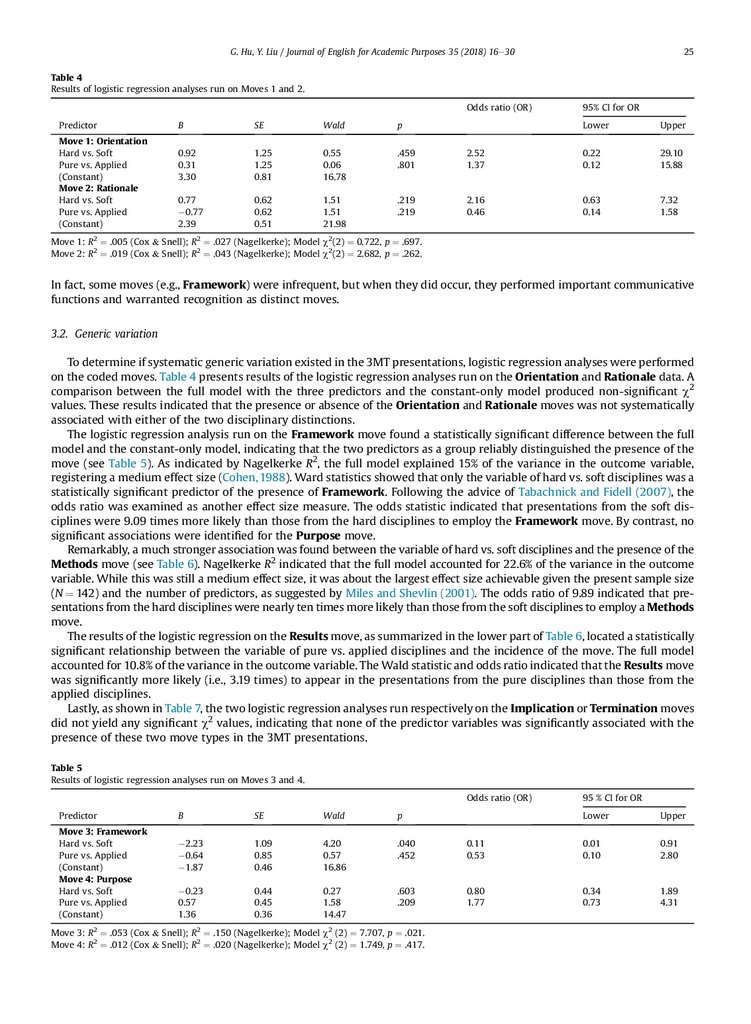
Table 4
Results of logistic regression analyses run on Moves 1 and 2.
Odds ratio (OR)
Predictor
Move 1: Orientation
Hard vs. Soft
Pure vs. Applied
(Constant)
Move 2: Rationale
Hard vs. Soft
Pure vs. Applied
(Constant)
B
SE
Wald
p
0.92
0.31
3.30
1.25
1.25
0.81
0.55
0.06
16.78
.459
.801
0.77
0.77
2.39
0.62
0.62
0.51
1.51
1.51
21.98
.219
.219
95% CI for OR
Lower
Upper
2.52
1.37
0.22
0.12
29.10
15.88
2.16
0.46
0.63
0.14
7.32
1.58
Move 1: R2 ¼ .005 (Cox & Snell); R2 ¼ .027 (Nagelkerke); Model c2(2) ¼ 0.722, p ¼ .697.
Move 2: R2 ¼ .019 (Cox & Snell); R2 ¼ .043 (Nagelkerke); Model c2(2) ¼ 2.682, p ¼ .262.
In fact, some moves (e.g., Framework) were infrequent, but when they did occur, they performed important communicative
functions and warranted recognition as distinct moves.
3.2. Generic variation
To determine if systematic generic variation existed in the 3MT presentations, logistic regression analyses were performed
on the coded moves. Table 4 presents results of the logistic regression analyses run on the Orientation and Rationale data. A
comparison between the full model with the three predictors and the constant-only model produced non-signi cant c2
values. These results indicated that the presence or absence of the Orientation and Rationale moves was not systematically
associated with either of the two disciplinary distinctions.
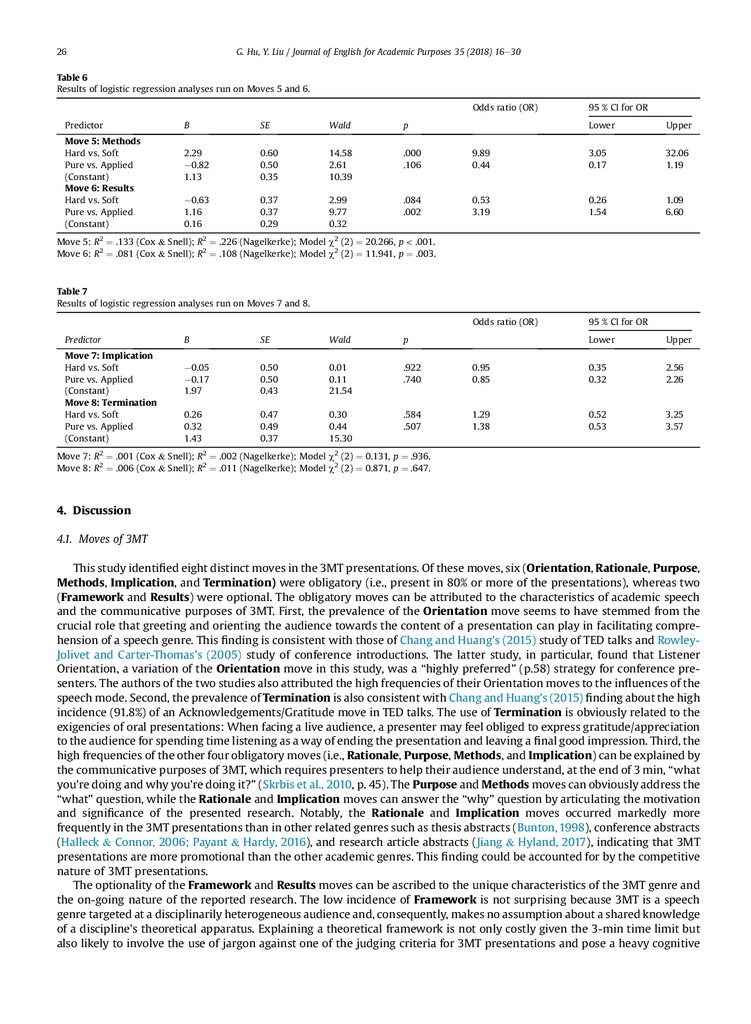
The logistic regression analysis run on the Framework move found a statistically signi cant difference between the full
model and the constant-only model, indicating that the two predictors as a group reliably distinguished the presence of the
move (see Table 5). As indicated by Nagelkerke R2, the full model explained 15% of the variance in the outcome variable,
registering a medium effect size (Cohen, 1988). Ward statistics showed that only the variable of hard vs. soft disciplines was a
statistically signi cant predictor of the presence of Framework. Following the advice of Tabachnick and Fidell (2007), the
odds ratio was examined as another effect size measure. The odds statistic indicated that presentations from the soft disciplines were 9.09 times more likely than those from the hard disciplines to employ the Framework move. By contrast, no
signi cant associations were identi ed for the Purpose move.
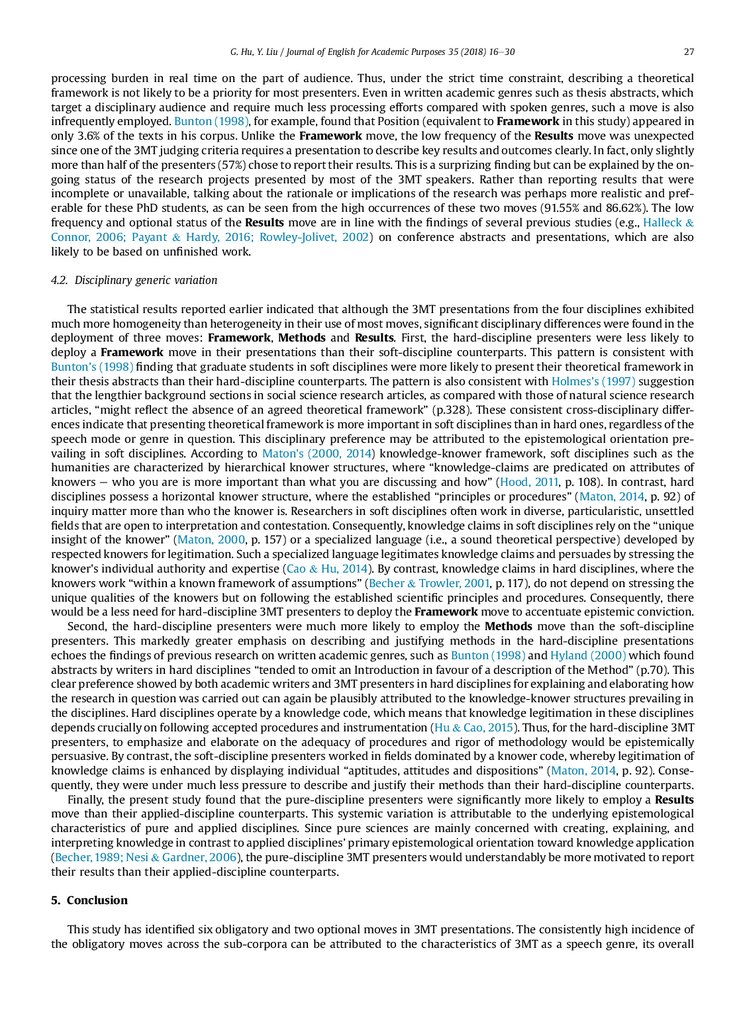
Remarkably, a much stronger association was found between the variable of hard vs. soft disciplines and the presence of the
Methods move (see Table 6). Nagelkerke R2 indicated that the full model accounted for 22.6% of the variance in the outcome
variable. While this was still a medium effect size, it was about the largest effect size achievable given the present sample size
(N ¼ 142) and the number of predictors, as suggested by Miles and Shevlin (2001). The odds ratio of 9.89 indicated that presentations from the hard disciplines were nearly ten times more likely than those from the soft disciplines to employ a Methods
move.
The results of the logistic regression on the Results move, as summarized in the lower part of Table 6, located a statistically
signi cant relationship between the variable of pure vs. applied disciplines and the incidence of the move. The full model
accounted for 10.8% of the variance in the outcome variable. The Wald statistic and odds ratio indicated that the Results move
was signi cantly more likely (i.e., 3.19 times) to appear in the presentations from the pure disciplines than those from the
applied disciplines.
Lastly, as shown in Table 7, the two logistic regression analyses run respectively on the Implication or Termination moves
did not yield any signi cant c2 values, indicating that none of the predictor variables was signi cantly associated with the
presence of these two move types in the 3MT presentations.
Table 5
Results of logistic regression analyses run on Moves 3 and 4.
Odds ratio (OR)
Predictor
Move 3: Framework
Hard vs. Soft
Pure vs. Applied
(Constant)
Move 4: Purpose
Hard vs. Soft
Pure vs. Applied
(Constant)
B
SE
Wald
p
2.23
0.64
1.87
1.09
0.85
0.46
4.20
0.57
16.86
.040
.452
0.23
0.57
1.36
0.44
0.45
0.36
0.27
1.58
14.47
.603
.209
Move 3: R2 ¼ .053 (Cox & Snell); R2 ¼ .150 (Nagelkerke); Model c2 (2) ¼ 7.707, p ¼ .021.
Move 4: R2 ¼ .012 (Cox & Snell); R2 ¼ .020 (Nagelkerke); Model c2 (2) ¼ 1.749, p ¼ .417.
95 % CI for OR
Lower
Upper
0.11
0.53
0.01
0.10
0.91
2.80
0.80
1.77
0.34
0.73
1.89
4.31
11.
26G. Hu, Y. Liu / Journal of English for Academic Purposes 35 (2018) 16e30
Table 6
Results of logistic regression analyses run on Moves 5 and 6.
Odds ratio (OR)
Predictor
Move 5: Methods
Hard vs. Soft
Pure vs. Applied
(Constant)
Move 6: Results
Hard vs. Soft
Pure vs. Applied
(Constant)
B
SE
Wald
p
2.29
0.82
1.13
0.60
0.50
0.35
14.58
2.61
10.39
.000
.106
0.63
1.16
0.16
0.37
0.37
0.29
2.99
9.77
0.32
.084
.002
95 % CI for OR
Lower
Upper
9.89
0.44
3.05
0.17
32.06
1.19
0.53
3.19
0.26
1.54
1.09
6.60
Odds ratio (OR)
95 % CI for OR
Move 5: R2 ¼ .133 (Cox & Snell); R2 ¼ .226 (Nagelkerke); Model c2 (2) ¼ 20.266, p < .001.
Move 6: R2 ¼ .081 (Cox & Snell); R2 ¼ .108 (Nagelkerke); Model c2 (2) ¼ 11.941, p ¼ .003.
Table 7
Results of logistic regression analyses run on Moves 7 and 8.
Predictor
Move 7: Implication
Hard vs. Soft
Pure vs. Applied
(Constant)
Move 8: Termination
Hard vs. Soft
Pure vs. Applied
(Constant)
B
SE
Wald
p
0.05
0.17
1.97
0.50
0.50
0.43
0.01
0.11
21.54
.922
.740
0.26
0.32
1.43
0.47
0.49
0.37
0.30
0.44
15.30
.584
.507
Lower
Upper
0.95
0.85
0.35
0.32
2.56
2.26
1.29
1.38
0.52
0.53
3.25
3.57
Move 7: R2 ¼ .001 (Cox & Snell); R2 ¼ .002 (Nagelkerke); Model c2 (2) ¼ 0.131, p ¼ .936.
Move 8: R2 ¼ .006 (Cox & Snell); R2 ¼ .011 (Nagelkerke); Model c2 (2) ¼ 0.871, p ¼ .647.
4. Discussion
4.1. Moves of 3MT
This study identi ed eight distinct moves in the 3MT presentations. Of these moves, six (Orientation, Rationale, Purpose,
Methods, Implication, and Termination) were obligatory (i.e., present in 80% or more of the presentations), whereas two
(Framework and Results) were optional. The obligatory moves can be attributed to the characteristics of academic speech
and the communicative purposes of 3MT. First, the prevalence of the Orientation move seems to have stemmed from the
crucial role that greeting and orienting the audience towards the content of a presentation can play in facilitating comprehension of a speech genre. This nding is consistent with those of Chang and Huang’s (2015) study of TED talks and RowleyJolivet and Carter-Thomas's (2005) study of conference introductions. The latter study, in particular, found that Listener
Orientation, a variation of the Orientation move in this study, was a “highly preferred” (p.58) strategy for conference presenters. The authors of the two studies also attributed the high frequencies of their Orientation moves to the in uences of the
speech mode. Second, the prevalence of Termination is also consistent with Chang and Huang’s (2015) nding about the high
incidence (91.8%) of an Acknowledgements/Gratitude move in TED talks. The use of Termination is obviously related to the
exigencies of oral presentations: When facing a live audience, a presenter may feel obliged to express gratitude/appreciation
to the audience for spending time listening as a way of ending the presentation and leaving a nal good impression. Third, the
high frequencies of the other four obligatory moves (i.e., Rationale, Purpose, Methods, and Implication) can be explained by
the communicative purposes of 3MT, which requires presenters to help their audience understand, at the end of 3 min, “what
you're doing and why you're doing it?” (Skrbis et al., 2010, p. 45). The Purpose and Methods moves can obviously address the
“what” question, while the Rationale and Implication moves can answer the “why” question by articulating the motivation
and signi cance of the presented research. Notably, the Rationale and Implication moves occurred markedly more
frequently in the 3MT presentations than in other related genres such as thesis abstracts (Bunton, 1998), conference abstracts
(Halleck & Connor, 2006; Payant & Hardy, 2016), and research article abstracts (Jiang & Hyland, 2017), indicating that 3MT
presentations are more promotional than the other academic genres. This nding could be accounted for by the competitive
nature of 3MT presentations.
The optionality of the Framework and Results moves can be ascribed to the unique characteristics of the 3MT genre and
the on-going nature of the reported research. The low incidence of Framework is not surprising because 3MT is a speech
genre targeted at a disciplinarily heterogeneous audience and, consequently, makes no assumption about a shared knowledge
of a discipline's theoretical apparatus. Explaining a theoretical framework is not only costly given the 3-min time limit but
also likely to involve the use of jargon against one of the judging criteria for 3MT presentations and pose a heavy cognitive
12.
G. Hu, Y. Liu / Journal of English for Academic Purposes 35 (2018) 16e3027
processing burden in real time on the part of audience. Thus, under the strict time constraint, describing a theoretical
framework is not likely to be a priority for most presenters. Even in written academic genres such as thesis abstracts, which
target a disciplinary audience and require much less processing efforts compared with spoken genres, such a move is also
infrequently employed. Bunton (1998), for example, found that Position (equivalent to Framework in this study) appeared in
only 3.6% of the texts in his corpus. Unlike the Framework move, the low frequency of the Results move was unexpected
since one of the 3MT judging criteria requires a presentation to describe key results and outcomes clearly. In fact, only slightly
more than half of the presenters (57%) chose to report their results. This is a surprizing nding but can be explained by the ongoing status of the research projects presented by most of the 3MT speakers. Rather than reporting results that were
incomplete or unavailable, talking about the rationale or implications of the research was perhaps more realistic and preferable for these PhD students, as can be seen from the high occurrences of these two moves (91.55% and 86.62%). The low
frequency and optional status of the Results move are in line with the ndings of several previous studies (e.g., Halleck &
Connor, 2006; Payant & Hardy, 2016; Rowley-Jolivet, 2002) on conference abstracts and presentations, which are also
likely to be based on un nished work.
4.2. Disciplinary generic variation
The statistical results reported earlier indicated that although the 3MT presentations from the four disciplines exhibited
much more homogeneity than heterogeneity in their use of most moves, signi cant disciplinary differences were found in the
deployment of three moves: Framework, Methods and Results. First, the hard-discipline presenters were less likely to
deploy a Framework move in their presentations than their soft-discipline counterparts. This pattern is consistent with
Bunton’s (1998) nding that graduate students in soft disciplines were more likely to present their theoretical framework in
their thesis abstracts than their hard-discipline counterparts. The pattern is also consistent with Holmes’s (1997) suggestion
that the lengthier background sections in social science research articles, as compared with those of natural science research
articles, “might re ect the absence of an agreed theoretical framework” (p.328). These consistent cross-disciplinary differences indicate that presenting theoretical framework is more important in soft disciplines than in hard ones, regardless of the
speech mode or genre in question. This disciplinary preference may be attributed to the epistemological orientation prevailing in soft disciplines. According to Maton’s (2000, 2014) knowledge-knower framework, soft disciplines such as the
humanities are characterized by hierarchical knower structures, where “knowledge-claims are predicated on attributes of
knowers e who you are is more important than what you are discussing and how” (Hood, 2011, p. 108). In contrast, hard
disciplines possess a horizontal knower structure, where the established “principles or procedures” (Maton, 2014, p. 92) of
inquiry matter more than who the knower is. Researchers in soft disciplines often work in diverse, particularistic, unsettled
elds that are open to interpretation and contestation. Consequently, knowledge claims in soft disciplines rely on the “unique
insight of the knower” (Maton, 2000, p. 157) or a specialized language (i.e., a sound theoretical perspective) developed by
respected knowers for legitimation. Such a specialized language legitimates knowledge claims and persuades by stressing the
knower's individual authority and expertise (Cao & Hu, 2014). By contrast, knowledge claims in hard disciplines, where the
knowers work “within a known framework of assumptions” (Becher & Trowler, 2001, p. 117), do not depend on stressing the
unique qualities of the knowers but on following the established scienti c principles and procedures. Consequently, there
would be a less need for hard-discipline 3MT presenters to deploy the Framework move to accentuate epistemic conviction.
Second, the hard-discipline presenters were much more likely to employ the Methods move than the soft-discipline
presenters. This markedly greater emphasis on describing and justifying methods in the hard-discipline presentations
echoes the ndings of previous research on written academic genres, such as Bunton (1998) and Hyland (2000) which found
abstracts by writers in hard disciplines “tended to omit an Introduction in favour of a description of the Method” (p.70). This
clear preference showed by both academic writers and 3MT presenters in hard disciplines for explaining and elaborating how
the research in question was carried out can again be plausibly attributed to the knowledge-knower structures prevailing in
the disciplines. Hard disciplines operate by a knowledge code, which means that knowledge legitimation in these disciplines
depends crucially on following accepted procedures and instrumentation (Hu & Cao, 2015). Thus, for the hard-discipline 3MT
presenters, to emphasize and elaborate on the adequacy of procedures and rigor of methodology would be epistemically
persuasive. By contrast, the soft-discipline presenters worked in elds dominated by a knower code, whereby legitimation of
knowledge claims is enhanced by displaying individual “aptitudes, attitudes and dispositions” (Maton, 2014, p. 92). Consequently, they were under much less pressure to describe and justify their methods than their hard-discipline counterparts.
Finally, the present study found that the pure-discipline presenters were signi cantly more likely to employ a Results
move than their applied-discipline counterparts. This systemic variation is attributable to the underlying epistemological
characteristics of pure and applied disciplines. Since pure sciences are mainly concerned with creating, explaining, and
interpreting knowledge in contrast to applied disciplines’ primary epistemological orientation toward knowledge application
(Becher, 1989; Nesi & Gardner, 2006), the pure-discipline 3MT presenters would understandably be more motivated to report
their results than their applied-discipline counterparts.
5. Conclusion
This study has identi ed six obligatory and two optional moves in 3MT presentations. The consistently high incidence of
the obligatory moves across the sub-corpora can be attributed to the characteristics of 3MT as a speech genre, its overall
13.
28G. Hu, Y. Liu / Journal of English for Academic Purposes 35 (2018) 16e30
communicative purposes and its competitive nature, whereas the low frequencies of the optional moves can be explained by
the exigencies of the genre and the un nished status of the reported research. This study has also found systematic disciplinary variation in 3MT presentations that are largely consistent with the results of previous studies on written genres.
Speci cally, the hard-discipline presenters were much less likely to deploy a Framework move than the soft-discipline
presenters. However, the former were much more likely to employ a Methods move than the latter. Furthermore, the
pure-discipline presenters were more often observed to deploy a Results move than their applied-discipline counterparts.
These patterns are explainable in terms of the dominant epistemological orientations and conventional knowledge-making
practices in the respective disciplines.
The identi ed rhetorical moves and disciplinary generic variation of 3MT have not only addressed a gap in our knowledge
of the academic speech genre but also have important implications for graduate students, 3MT workshop tutors, EAP instructors and other academics who are involved in teaching courses of general oral academic skills. The eight move types
identi ed can serve as a viable pedagogical framework in a genre-based approach to 3MT, which is still absent from precompetition workshops and relevant EAP classes. In light of scholarship on genre-based pedagogy (e.g., Cheng, 2015), one
promising pedagogical strategy for prep workshops and relevant EAP classes is to use the identi ed moves as a “heuristic
instructional framework” (Cheng, 2015, p. 134) so that students can be scaffolded to analyze genre exemplars, develop a
rhetorical awareness of 3MT, and effectively master its rhetorical patterning. Furthermore, in view of the systematic disciplinary variation in the use of various moves, there is a need to adopt a more nuanced and contextualized approach to genre
awareness and acquisition (Paltridge, 2013). Instruction on generic variation is likely to be more fruitful and effective if the
functions of speci c moves can be related to discipline-speci c knowledge-making practices and epistemological orientations
at work in a given discipline. In other words, instruction should be tailored to meet the speci c rhetorical needs of students
from different disciplinary backgrounds. With such genre-based instructional support, the quality of pre-competition instruction is likely to be enhanced, and so is the chance for participants to deliver competent and successful 3MT
presentations.
Despite the aforementioned contributions of the present study, the ndings and interpretations should be considered in
view of its limitations. First, the identi ed move types have not been veri ed by disciplinary insiders or experts. Although it
can be argued that expert opinion “is ultimately of no greater credibility than that about nomenclature” (Askehave & Swales,
2001, p. 198) and the 3MT genre is not a discipline-speci c type of text, the involvement of disciplinary community insiders
such as seasoned 3MT participants, judges and PhD supervisors in the collection, analysis and interpretation of the needed
data could potentially add greater insight and validity to the identi ed moves. Second, the limited range of disciplines
examined in this study might constrain the generalizability of the present ndings, and further studies covering a wider
spectrum of disciplines are needed. Third, linguistic features (e.g., promotional language, humor, and gures of speech) and
paralinguistic performance-related aspects were not investigated in the present study. An examination of these features and
aspects has the potential to develop a more comprehensive and nuanced understanding of the unique characteristics of this
increasingly popular genre.
References
Adolphs, S., & Carter, R. (2013). Spoken corpus linguistics: From monomodal to multimodal. London: Routledge.
Aguilar, M. (2004). The peer seminar, a spoken research process genre. Journal of English for Academic Purposes, 3, 55e72.
Askehave, I., & Swales, J. M. (2001). Genre identi cation and communicative purpose: A problem and a possible solution. Applied Linguistics, 22, 195e212.
Becher, T. (1989). Academic tribes and territories: Intellectual inquiry and the culture of disciplines. Buckingham, UK: SRHE and Open University Press.
Becher, T., & Trowler, P. (2001). Academic tribes and territories (2nd ed.). Buckingham, UK: SRHE and Open University Press.
s-Fortun
~ o, B. (2016). Academic discourse markers: A contrastive analysis of the discourse marker then in English and Spanish lectures (Vol. 1, pp. 57e78).
Belle
Verbeia.
s-Fortun
~ o, B. (2018). Evaluative language in medical discourse: A contrastive study between English and Spanish university lectures. Languages in
Belle
Contrast, 18, 155e174. https://doi.org/10.1075/lic.15018.bel.
Berkenkotter, C., & Huckin, T. (1995). Genre knowledge in disciplinary communities. Hillsdale, NJ: Lawrence Erlbaum.
Bhatia, V. K. (1999). Integrating products, processes, purposes and participants in professional writing. In C. N. Candlin, & K. Hyland (Eds.), Writing: Texts,
processes and practices (pp. 21e39). London: Routledge.
Bhatia, V. K. (2004). Worlds of written discourse: A genre-based view. London: Continuum International.
Biber, D., & Barbieri, F. (2007). Lexical bundles in university spoken and written registers. English for Speci c Purposes, 26, 263e286.
Biber, D., Connor, U., & Upton, T. A. (2007). Discourse on the move: Using corpus analysis to describe discourse structure. Amsterdam, the Netherlands: John
Benjamins.
Biber, D., Conrad, S., & Cortes, V. (2004). If you look at: Lexical bundles in university teaching and textbooks. Applied Linguistics, 25, 371e405.
Bunton, D.R. (1998). reportLinguistic and textual problems in Ph. D and M. Phil theses: An analysis of genre moves and metatext (Unpublished doctoral
dissertation). University of Hong Kong.
Caliendo, G. (2014). The popularization of science in web-based genres. In C. Bongo, & G. Caliendo (Eds.), The language of popularization: Theoretical and
descriptive models (pp. 101e132). Bern, Switzerland: Peter Lang.
Cao, F., & Hu, G. (2014). Interactive metadiscourse in research articles: A comparative study of paradigmatic and disciplinary in uences. Journal of Pragmatics, 66, 15e31.
Chang, Y.-j., & Huang, H.-T. (2015). Exploring TED talks as a pedagogical resource for oral presentations: A corpus-based move analysis. English Teaching &
Learning, 39, 29e62.
Chang, Y.-Y. (2012). The use of questions by professors in lectures given in English: In uences of disciplinary cultures. English for Speci c Purposes, 31,
103e116.
Cheng, A. (2015). Genre analysis as a pre-instructional, instructional, and teacher development framework. Journal of English for Academic Purposes, 19,
125e136.
Cheng, S. W. (2012). “That's it for today”: Academic lecture closings and the impact of class size. English for Speci c Purposes, 31, 234e248.
Cohen, J. (1988). Statistical power analysis for the behavioural sciences (2nd ed.). Hillsdale, NJ: Lawrence Earlbaum.
14.
G. Hu, Y. Liu / Journal of English for Academic Purposes 35 (2018) 16e3029
Copeman, P. (2015). Three minute Theatre: Principles and practice for scripting and performing three minute thesis presentations. International Journal for
Researcher Development, 6, 77e92.
Deroey, K. L. (2012). What they highlight is: The discourse functions of basic wh-clefts in lectures. Journal of English for Academic Purposes, 11, 112e124.
Deroey, K. L. (2014). “Anyway, the point I'm making is”: Lexicogrammatical relevance marking in lectures. In K. L.Vandelanotte, C. Davidse, Gentens, & D.
Kimps (Eds.), Recent advances in corpus linguistics: Developing and exploiting corpora (pp. 265e291). Amsterdam, the Netherlands: Rodopi.
Deroey, K. L. (2015). Marking importance in lectures: Interactive and textual orientation. Applied Linguistics, 36, 51e72.
Dubois, B. L. (1980). Genre and structure of biomedical speeches. Forum Linguisticum, 5, 140e169.
Feak, C. B. (2013). ESP and speaking. In B. Paltridge, & S. Star eld (Eds.), The handbook of English for speci c purposes (pp. 35e53). Chichester, UK: WileyBlackwell.
Feak, C. B. (2016). EAP support for postgraduate students. In K. Hyland, & P. Shaw (Eds.), The Routledge handbook of English for academic purposes (pp.
489e501). London: Routledge.
Field, A. (2009). Discovering statistics using SPSS (3rd ed.). Thousand Oaks, CA: Sage.
Fortanet, I. (2004). The use of ‘we’ in university lectures: Reference and function. English for Speci c Purposes, 23, 45e66.
Gao, X. (2016). A cross-disciplinary corpus-based study on English and Chinese native speakers' use of linking adverbials in academic writing. Journal of
English for Academic Purposes, 24, 14e28.
Grimshaw, A. D., Feld, S., & Jenness, D. (1994). The multiple analysis project: Background, history, problems, data. In A. D. Grimshaw (Ed.), What is going on
here?: Complementary studies of professional talk (pp. 3e57). Norwood, NJ: Ablex.
Halleck, G. B., & Connor, U. M. (2006). Rhetorical moves in TESOL conference proposals. Journal of English for Academic Purposes, 5, 70e86.
Hartmann, D. P. (1977). Considerations in the choice of interobserver reliability estimates. Journal of Applied Behavior Analysis, 10, 103e116.
Hasan, R. (1994). Situation and the de nition of genres. In A. D. Grimshaw (Ed.), What is going on here?: Complementary studies of professional talk (pp.
127e167). Norwood, NJ: Ablex.
Holmes, R. (1997). Genre analysis, and the social sciences: An investigation of the structure of research article discussion sections in three disciplines.
English for Speci c Purposes, 16, 321e337.
Hood, S. (2011). Writing discipline: Comparing inscriptions of knowledge and knowers in academic writing. In C. Frances, & K. Maton (Eds.), Disciplinarity:
Functional linguistic and sociological perspectives (pp. 106e128). London: Continuum.
Hu, G., & Cao, F. (2015). Disciplinary and paradigmatic in uences on interactional metadiscourse in research articles. English for Speci c Purposes, 39, 12e25.
Hu, G., & Wang, G. (2014). Disciplinary and ethnolinguistic in uences on citation in research articles. Journal of English for Academic Purposes, 14, 14e28.
Huckin, T. N., & Olsen, L. A. (1984). The need for professionally oriented ESL instruction in the United States. Tesol Quarterly, 18, 273e294.
Hyland, K. (1998). Boosting, hedging and the negotiation of academic knowledge. Text, 18, 349e382.
Hyland, K. (2000). Disciplinary discourses: Social interactions in academic writing. New York: Longman.
Hyland, K. (2006). English for academic purposes: An advanced resource book. London: Routledge.
Hyland, K. (2009). Academic discourse: English in a global context. London: Continuum.
Jiang, F. K., & Hyland, K. (2017). Metadiscursive nouns: Interaction and cohesion in abstractmoves. English for Speci c Purposes, 46, 1e14.
Kwan, B. S. C. (2006). The schematic structure of literature reviews in doctoral theses of applied linguistics. English for Speci c Purposes, 25, 30e55.
Lee, J. J. (2009). Size matters: An exploratory comparison of small- and large-class university lecture introductions. English for Speci c Purposes, 28, 42e57.
Lee, J. J. (2016). “There's intentionality behind it…”: A genre analysis of EAP classroom lessons. Journal of English for Academic Purposes, 23, 99e112.
Lee, J. J., & Subtirelu, N. (2015). Metadiscourse in the classroom: A comparative analysis of EAP lessons and university lectures. English for Speci c Purposes,
37, 52e62.
MacIntosh-Murray, A. (2007). Poster presentations as a genre in knowledge communication: A case study of forms, norms, and values. Science Communication, 28, 347e376.
Maton, K. (2000). Languages of legitimation: The structuring signi cance for intellectual elds of strategic knowledge claims. British Journal of Sociology of
Education, 21, 147e167.
Maton, K. (2014). Knowledge and knowers: Towards a realist sociology of education. London: Routledge.
MAXQDA. (2016). VERBI software. Berlin, Germany: Consult-Sozialforschung GmbH.
& Swales, J. M. (2016). PhD defences and vivas. In K. Hyland, & P. Shaw (Eds.), The Routledge handbook of English for academic purposes (pp.
Me
zek, S.,
361e375). London: Routledge.
Miles, J., & Shevlin, M. (2001). Applying regression and correlation: A guide for students and researchers. London: Sage.
Moreno, A. I., & Swales, J. M. (2018). Strengthening move analysis methodology towards bridging the function-form gap. English for Speci c Purposes, 50,
40e63.
Morton, J. (2009). Genre and disciplinary competence: A case study of contextualisation in an academic speech genre. English for Speci c Purposes, 28,
217e229.
Nesi, H., & Gardner, S. (2006). Variation in disciplinary culture: University tutors' views on assessed writing tasks. In R. Kiely, G. Clibbon, P. Rea-Dickins, & H.
Wood eld (Eds.), Language, culture and identity in applied linguistics (pp. 99e117). Shef eld, UK: Equinox.
Paltridge, B. (2013). Genre and English for speci c purposes. In B. Paltridge, & S. Star eld (Eds.), The handbook of English for speci c purposes (pp. 347e366).
Chichester, UK: Wiley-Blackwell.
Parkinson, J. (2017). The student laboratory report genre: A genre analysis. English for Speci c Purposes, 45, 1e13.
Payant, C., & Hardy, J. A. (2016). The dynamic rhetorical structures of TESOL conference abstracts. BC TEAL Journal, 1, 1e17.
R€
ais€
anen, C. (2002). The conference forum: A system of interrelated genres and discursive practices. In E. Ventola, C. Shalom, & S. Thompson (Eds.), The
language of conferencing (pp. 69e93). Frankfurt, Germany: Peter Lang.
Ridley, D. (2000). The different guises of a PhD thesis and the role of a literature review. In P. Thompson (Ed.), Patterns and perspectives: Insights into EAP
writing practice (pp. 61e76). Reading, England: Centre for Applied Language Studies, The University of Reading.
Rowley-Jolivet, E. (2002). Science in the making: Scienti c conference presentations and the construction of facts. In E. Ventola, C. Shalom, & S. Thompson
(Eds.), The language of conferencing (pp. 95e125). Frankfurt, Germany: Peter Lang.
Rowley-Jolivet, E., & Carter-Thomas, S. (2005). The rhetoric of conference presentation introductions: Context, argument and interaction. International
Journal of Applied Linguistics, 15, 45e70.
Shaikh-Lesko, R. (2014). Science speak, The Scientist, Retrieved from:, http://www.the-scientist.com/?articles.view/articleNo/40572/title/Science-Speak/
Shalom, C. (2002). The academic conference: A forum for enacting genre knowledge. In E. Ventola, C. Shalom, & S. Thompson (Eds.), The language of
conferencing (pp. 51e68). Frankfurt, Germany: Peter Lang.
Simpson-Vlach, R. (2006). Academic speech across disciplines: Lexical and phraseological distinctions. In K. Hyland, & M. Bondi (Eds.), Academic discourse
across disciplines (pp. 295e314). Bern, Switzerland: Peter Lang.
Skrbis, Z., MacDonald, D., Miscamble, T., Tustin, C., Stoddart, C., & Kiley, M. (2010). The three minute thesis (3MT). Paper presented at the quality in postgraduate
Research: Educating researchers for the 21st century, Adelaide, Australia.
Swales, J. M. (1990). Genre analysis: English in academic and research settings. Cambridge, UK: Cambridge University Press.
Swales, J. M. (2004). Research genres: Explorations and applications. Cambridge, UK: Cambridge University Press.
Swales, J. M., Barks, D., Ostermann, A. C., & Simpson, R. C. (2001). Between critique and accommodation: Re ections on an EAP course for masters of
architecture students. English for Speci c Purposes, 20, 439e458.
Tabachnick, B. G., & Fidell, L. S. (2007). Using multivariate statistics (5th ed.). Boston, MA: Allyn & Bacon.
Thompson, S. (1994). Frameworks and contexts: A genre-based approach to analysing lecture introductions. English for Speci c Purposes, 13, 171e186.
Todorov, T., & Berrong, R. M. (1976). The origin of genres. New Literary History, 8, 159e170.
15.
30G. Hu, Y. Liu / Journal of English for Academic Purposes 35 (2018) 16e30
Ventola, E. (2002). Why and what kind of focus on conference presentations. In E. Ventola, C. Shalom, & S. Thompson (Eds.), The language of conferencing (pp.
15e50). Frankfurt, Germany: Peter Lang.
Weissberg, B. (1993). The graduate seminar: Another research-process genre. English for Speci c Purposes, 12, 23e35.
Zareva, A. (2013). Self-mention and the projection of multiple identity roles in TESOL graduate student presentations: The in uence of the written academic
genres. English for Speci c Purposes, 32, 72e83.
Guangwei Hu is Professor of Language and Literacy Education in the Department of English, the Hong Kong Polytechnic University. His research interests
include academic discourse, bilingual education, and second language writing. His co-authored article ‘Disciplinary and ethnolinguistic in uences on citation
in research articles’ published in the Journal of English for Academic Purposes won the 2016 JEAP Best Article Award.
Yanhua Liu is a lecturer at the School of Foreign Languages, Yibin University, the People's Republic of China. He is also a PhD student at the National Institute
of Education, Nanyang Technological University, Singapore. His research interests include genre analysis, spoken discourse, and English language teaching.