 literature
Similar presentations:


Creative Activities of Daniel Defoe and Jonathan Swift. Lecture 6
1. LECTURE 6 Creative Activities of Daniel Defoe and Jonathan Swift
Senior teacher: Sartbayeva E.K.2. Lecture 6
1.Creative activities of Daniel Defoe:- Analysis of novel “Robinson Crusoe”: plot, main
character, genre and stylistic peculiarities
2.. Creative activities of Jonathan Swift:
- Analysis of the novel “Gulliver’s Travels”: plot, satirical
approach, genre and style
The main concepts: essay, Robinson Crusoe, Gulliver
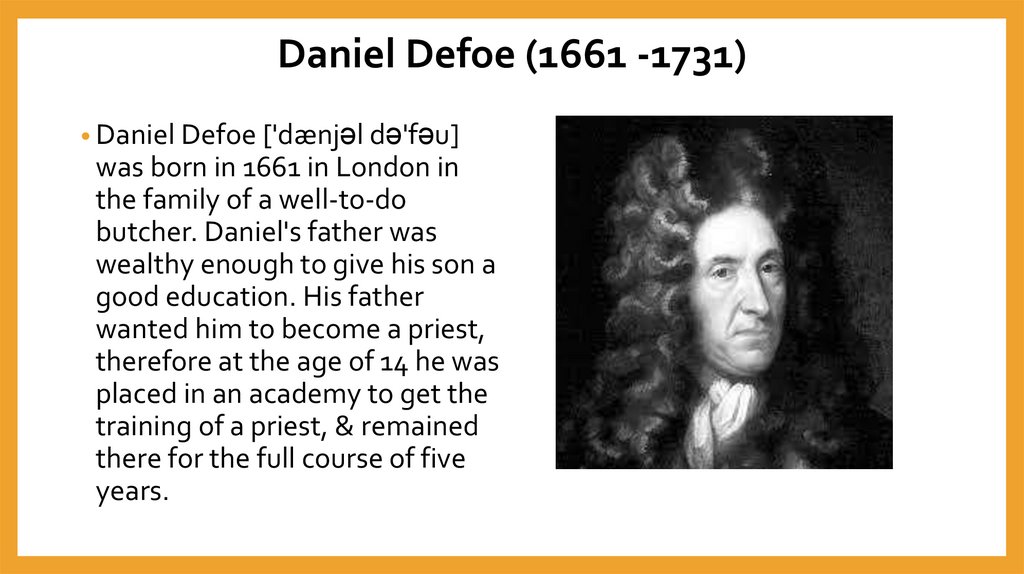
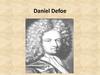
3. Daniel Defoe (1661 -1731)
• Daniel Defoe ['dӕnjəl də'fəu]was born in 1661 in London in
the family of a well-to-do
butcher. Daniel's father was
wealthy enough to give his son a
good education. His father
wanted him to become a priest,
therefore at the age of 14 he was
placed in an academy to get the
training of a priest, & remained
there for the full course of five
years.
4.
• But Daniel Defoe didn't like his profession as, in his opinion, it wasneither honorable nor profitable. He became a merchant. Several
times he went bankrupt because he was more interested in politics
than in business. Being a merchant he travelled much & collected a lot
of material, which he used later in his writings. Several times in his life
Daniel Defoe was persecuted. Thus in 1702 he wrote his pamphlet "The
Shortest Way with the Dissenters". The pamphlet looked as if it had
been written in support of the High Church. In fact Daniel Defoe
described the cruel Measures taken by the High Church. For this
pamphlet Defoe was sentenced to 7 years imprisonment. Besides he
had to stand in the pillory in a public square. In 1719 Daniel Defoe tried
his hand in another kind of literature – fiction & wrote his famous novel
"Robinson Crusoe"['rɒbinsn 'kru:səu]. After the book was published,
Defoe became famous and rich.
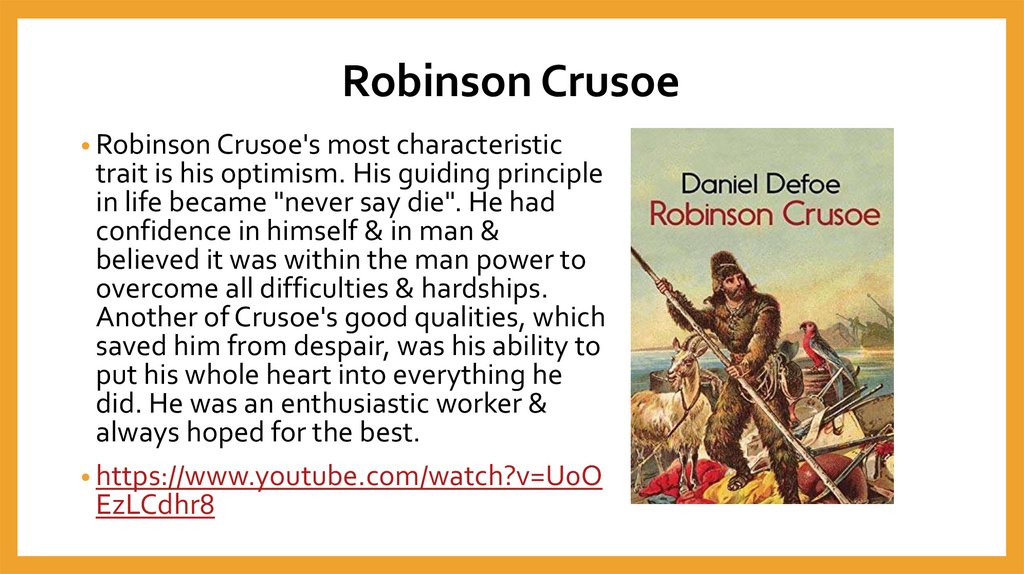
5. Robinson Crusoe
• Robinson Crusoe's most characteristictrait is his optimism. His guiding principle
in life became "never say die". He had
confidence in himself & in man &
believed it was within the man power to
overcome all difficulties & hardships.
Another of Crusoe's good qualities, which
saved him from despair, was his ability to
put his whole heart into everything he
did. He was an enthusiastic worker &
always hoped for the best.
• https://www.youtube.com/watch?v=U0O
EzLCdhr8
6.
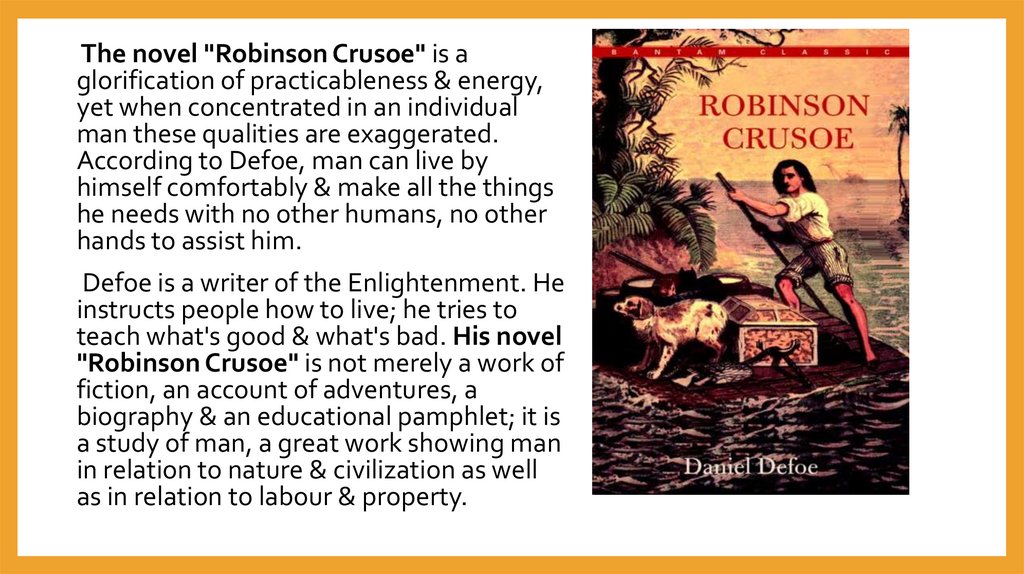
The novel "Robinson Crusoe" is aglorification of practicableness & energy,
yet when concentrated in an individual
man these qualities are exaggerated.
According to Defoe, man can live by
himself comfortably & make all the things
he needs with no other humans, no other
hands to assist him.
Defoe is a writer of the Enlightenment. He
instructs people how to live; he tries to
teach what's good & what's bad. His novel
"Robinson Crusoe" is not merely a work of
fiction, an account of adventures, a
biography & an educational pamphlet; it is
a study of man, a great work showing man
in relation to nature & civilization as well
as in relation to labour & property.
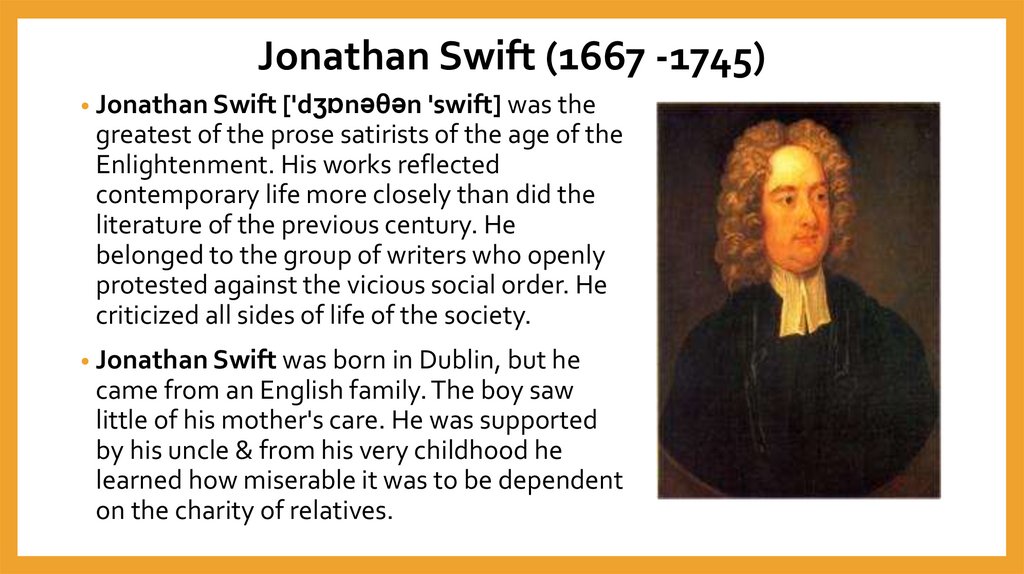
7. Jonathan Swift (1667 -1745)
• Jonathan Swift ['dʒɒnəθən 'swift] was thegreatest of the prose satirists of the age of the
Enlightenment. His works reflected
contemporary life more closely than did the
literature of the previous century. He
belonged to the group of writers who openly
protested against the vicious social order. He
criticized all sides of life of the society.
• Jonathan Swift was born in Dublin, but he
came from an English family. The boy saw
little of his mother's care. He was supported
by his uncle & from his very childhood he
learned how miserable it was to be dependent
on the charity of relatives.
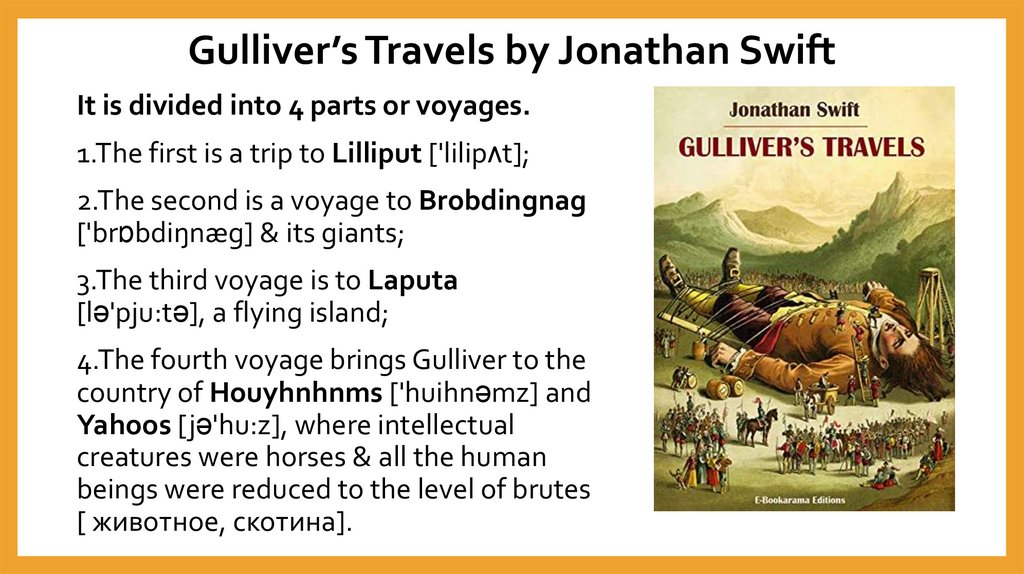
8. Gulliver’s Travels by Jonathan Swift
It is divided into 4 parts or voyages.1.The first is a trip to Lilliput ['lilipʌt];
2.The second is a voyage to Brobdingnag
['brɒbdiŋnӕg] & its giants;
3.The third voyage is to Laputa
[lə'pju:tə], a flying island;
4.The fourth voyage brings Gulliver to the
country of Houyhnhnms ['huihnəmz] and
Yahoos [jə'hu:z], where intellectual
creatures were horses & all the human
beings were reduced to the level of brutes
[ животное, скотина].
9. The first voyage to Lilliput
• Describing the government & the laws, Swift describedEngland of his days in the most ridiculous way. He gave a
picture of how people were promoted in life not according
to their merits but because they were cunning, used
intrigues, bribery. He ridiculed English laws & educational
system.
• https://www.youtube.com/watch?v=P9UMGLVJuS4
10. The second voyage to Brobdingnag - the country of giants
The second voyage to Brobdingnag the country of giants• The king of Brobdingnag often asked Gulliver about European affairs
& his answers were biting satire on contemporary politics. Thus he
told the king about the wars waged in the interests of the rich; these
wars brought nothing but misery to people.
11. The third voyage to Laputa
• During the third voyage Gulliver found himself among scientists of Laputa. Swiftshowed that scientists were busy with foolish problems trying to invent useless things.
It is easy enough to understand that in ridiculing the academy of Laputa, Swift
ridicules the scientists of the 18th century. They are busy inventing such projects as:
• building houses beginning at the roof & working downwards to the foundation;
• converting ice into gunpowder,
• simplifying the language by leaving out the verbs & participles;
• softening marble for pillows etc. It was a parody on scholastics [«оторванная от
жизни наука»].
12. The fourth voyage
• The fourth voyage is to the island inhabited by horses & strangecreatures Yahoos. The horses are endowed with human intelligence &
virtue. Yahoos are ugly, foolish. Relations between Yahoos remind
Gulliver of those existing in England. The horses are clever & noble. The
Yahoos are dirty, greedy. Horses live in free community. The book
presents a series of grotesque satires on the society of the period. Swift
was a pessimist. He criticized the society he lived in & didn't see the way
out. That’s why he was in constant gloom.
13.
In conclusion, "Gulliver's Travels" was one of the greatest works of theperiod of the Enlightenment in the world of literature. Swift's fantastic
characters, however improbable they may seem to the reader, were
used by the author to disclose all the faults & failures of the society,
thus making Swift's imaginary world realistic. Swift's democratic Ideas
expressed in the book had a great influence on the English writers who
came after Swift.
https://www.youtube.com/watch?v=J-wXbyEQ5TM