
 history
Similar presentations:




English Literature of the Enlightenment. Lecture
1. Lecture 6 English Literature of the Enlightenment
LECTURE 6ENGLISH LITERATURE
OF THE
ENLIGHTENMENT
Senior lecturer: Sartbayeva E.K.
2. Lecture 6. English Literature of the Enlightenment
1. The outline of the Age of Enlightenment2. Enlightenment in England
3. The English Literature of the Enlightenment:
- characteristic features
- periodization / 3 main periods
The main concepts: Age of Reason, Journalism,
Sentimentalism
3.
• The Age of Enlightenment, also known as theEnlightenment and the Age of Reason, was a
European social and intellectual movement during
the seventeenth and eighteenth centuries, driven by a
mindset that favoured science and reason over
religious beliefs. The thinkers, writers, and artists during
the Enlightenment had a predisposition towards logic,
scientific enquiry, and individual liberty. As a result, this
period was also marked by a tussle between tradition
and progress.
4.
• The upper classes and the middle classes in Britain during thisage felt more complacent than they had ever felt before or
since. They felt that they lived in the best of all possible worlds.
This 18th century complacency was partly due to the work of
the scientists and philosophers. “Human reason” and
“Common sense" played such a significant role in this period
that it is often called “The Age of reason".
The concept “Reason” can be meant: "the period in the 18th
century in Europe when certain thinkers taught that science
and the use of reason would improve the human condition".
• The 18th century in England was also “The Age of Elegance".
5.
• It was a public literature, which represented the outlook andvalues of this limited society. It did not represent the
impressions, hopes or fears of one individual. It was literature
that could be read aloud in a drawing-room, enjoyed in a
theatre or discussed in a coffee-house. It seems quite natural,
that the atmosphere of this kind encouraged comedy, satire in
verse and prose, pleasant little essays, and criticism, but it did
not encourage poetry, because this society did not expect from
literature anything private. However, very soon the situation
changed drastically. The middle class, especially its women
members took to buying and reading books. If they could not
afford to buy them, they borrowed them from libraries run by
shopkeepers. This fact shows that by 1770s the novel had won
great popularity.
6. The Enlightenment. The 17th – 18th century literature
• This period saw a remarkable rise of literature. People wrote onmany subjects & made great contribution in the fields of
philosophy, history & natural sciences.
• The problem of vital importance to the writers of the 18th
century was the study of man & the origin of his good & evil
qualities. According to them, human nature was virtuous but man
diverged from virtue under the influence of a vicious society.
"Vice is due to ignorance", they said. It's but natural that the
writers of the 18th century started a public movement for
enlightenment of people. The writers of the age of
Enlightenment insisted upon a systematic education for all.
7.
• This period saw a transition from poetry to the prosaic age of theessayists. An essay is a composition of moderate length on any subject
usually written in prose.
• The writer does not go into details, but deals in an easy manner with the
chosen subject, & shows his relation to the subject. The style of prose
became clear, graceful & polished.
• Writers accepted such literary forms as were intelligible to all. Satire
became popular. This period also saw the rise of the political pamphlet.
Most of the authors of the time wrote political pamphlets, but the best
ones came from the pens of Defoe & Swift.
• The leading form of literature became the novel. The hero of the novel
was no longer a prince but a representative of the middle class. This had
never happened before: so far, the common people had usually been
represented as comical characters.
8. The literature of the age of the Enlightenment may be divided into three periods:
• The first period lasted from the "Glorious Revolution"(1688-1689) till the end of the 1730s. It is characterized
by classicism in poetry, the greatest follower of the
classic style was Alexander Pope. Alongside with this
high style there appeared new prose literature, the
essays of Steele and Addison and the first realistic novels
written by Defoe and Swift. Most of the writers of this
time wrote political pamphlets, but the best came from
the pens of Defoe and Swift.
9.
The second period of the Enlightenment was the mostmature period: the forties and the fifties of the 18th
century. It saw the development of the realistic social
novel represented by Richardson, Fielding and Smollett.
The third period refers to the last decades of the century.
It is marked by the appearance of the new trend:
Sentimentalism. The representatives of this trend were
Goldsmith and Sterne. This period also saw the rise of the
realistic drama (Sheridan) and the revival of poetry.
10. The Age of Enlightenment: Literature
Many French authors of the Enlightenment perioddrew inspiration from classic tales and legends
along with the classicist aesthetic. A great example
of classical French literature is the works of comic
dramatist Jean Baptiste Poquelin (1622–73), who
wrote under the pen name Molière. His
masterpiece, Le Misanthrope (1666), is a satirical
composition attacking the petty pursuits and
unfairness of high society.
11. The Age of Enlightenment: Poetry
Poetry in the Age of Enlightenment showed an eruditenature in how the poets sought to educate the public. While
poetry was still considered to be a superior form of art, it
became more concerned with the Humanist tradition that
began during the Renaissance. As for the conventional
requirement for poetry to imitate nature, the thematic shift
towards reason was justified by the argument that nature is
best understood through reason.
The forms of poetry that were prominent during the
Enlightenment period are sentimental poetry, satire, and
essay poems.
12. The Age of Enlightenment: Poetry
The works of the late seventeenth-century Englishpoet John Milton are regarded as the best of the Age of
Enlightenment poetry. Milton's epic poem Paradise
Lost (1667) is one of the greatest poems in English after
Homer's (b. 8 BCE) epics and works of Shakespeare
(1564–1616). Containing ten books and over ten thousand
lines of verse, Paradise Lost tells the Biblical story of
Adam and Eve's fall from grace and Satan's revolt.
13. The Age of Enlightenment: Novel
Defoe's Robinson Crusoe (1719) and Moll Flanders (1722), andSwift's Gulliver's Travels (1726) are examples of how writers of
the Enlightenment era attempted to educate and inform the public.
As an Irish-English author, Swift's satirical prose on different
topics, including ethics and politics in society and the ill-treatment
of the Irish. Swift was among the two leading figures of
Enlightenment satire, the other being the French writer Voltaire
(1694–1778). Candide, ou l'Optimisme (French; Candide, or the
Optimist), published in 1959, is a French novella by Voltaire that
showcases the nature of satire during the Age of Enlightenment.
14. The Age of Enlightenment: Satire
The Enlightenment writers challenged the authority of religionand government. Through their works, they became vocal
opponents of censorship and constraints on individual freedom
and, especially, interference of the Church in civil society. These
issues became the thematic concern for many writers during the
Enlightenment, including Jonathan Swift and Alexander Pope,
culminating in what is known as the Golden Age of Satire (late
seventeenth and early eighteenth centuries).
15. The Age of Enlightenment: Satire
Alexander Pope's mock-epic poems during the Augustan age,including The Rape of the Lock (1712), are examples of
Neoclassicism that coincided with the Age of Enlightenment. In
the poem, Pope narrates the tensions and tussles between a
woman and her suitor, who cuts a lock of her hair as an act of
revenge. In the mock-heroic poem, Pope satirizes this trivial
incident using exaggeration and hyperbole to compare their
scuffles to epic battles between Gods as portrayed in the Greek
classics.
16. Literary Terms of the Age of Enlightenment
Satire: a work of fiction that uses irony and humour to mock andcriticize vanity, folly, and social issues.
Mock-epic: a narrative poem that uses the devices and techniques
used in epic poems to talk about trivia in order to make fun of the
person or the issue addressed in the poem.
Neoclassicism: a European movement in arts and culture that drew
inspiration from ancient Classical works and attempted to emulate
these works.
Hyperbole: a literary device that uses exaggeration.
17.
• Journalism: Journalism’s role in civil society expanded during theAge of Enlightenment. The increased use of mechanically printed
words on paper created new spaces for discussion and association.
Newspapers, pamphlets, magazines, and broadsides could
disseminate ideas and information widely. They provided stories and
commentaries that gave readers a growing awareness of how
decisions, events, and trends might affect them.
• Some of the most striking eighteenth-century expansions of press
freedom occurred in Britain and America where proponents of
liberty of the press often relied on the republican concept that the
people are the ultimate authority and therefore have a right to know
and criticize what their servants in government are doing.
Arguments were also based on the Puritan belief that versions of the
truth should be in competition with each other and the
Enlightenment principle that unfettered expression was a matter of
human dignity and personal self-fulfillment.
18.
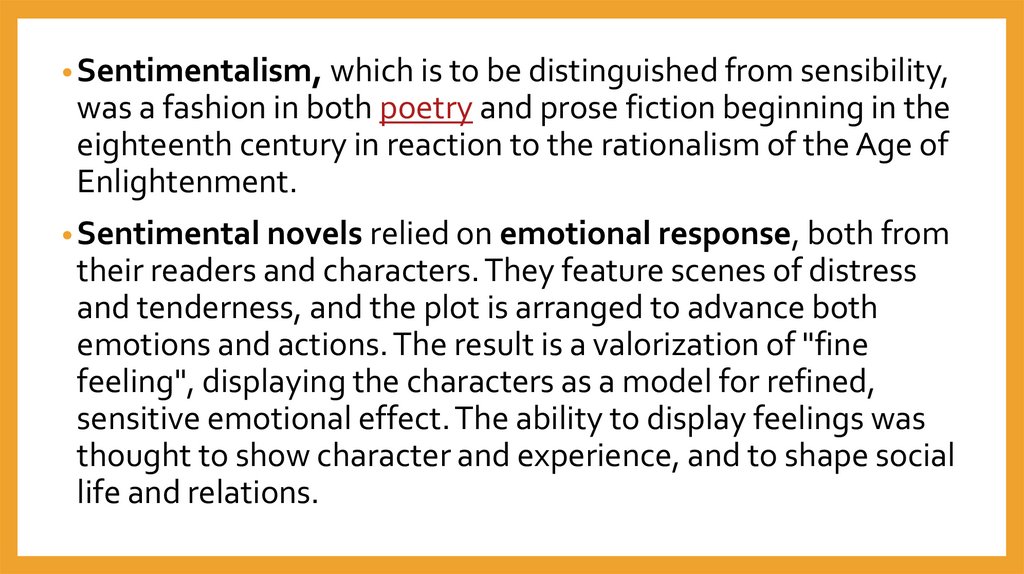
• Sentimentalism, which is to be distinguished from sensibility,was a fashion in both poetry and prose fiction beginning in the
eighteenth century in reaction to the rationalism of the Age of
Enlightenment.
• Sentimental novels relied on emotional response, both from
their readers and characters. They feature scenes of distress
and tenderness, and the plot is arranged to advance both
emotions and actions. The result is a valorization of "fine
feeling", displaying the characters as a model for refined,
sensitive emotional effect. The ability to display feelings was
thought to show character and experience, and to shape social
life and relations.