Similar presentations:




Education in Finland
1.
In Finland, children begin compulsory basic education at age 7 and study in asingle system covering grades 1–9. Schools are free and largely public. Every
pupil gets free daily school meals, textbooks, healthcare services and even
transport if needed.
2.
Municipalities set local curricula within a national coreframework, so students learn a broad range of
subjects (languages, sciences, arts, PE, ethics, etc. )
plus cross-cutting skills like ICT and teamwork. Class
sizes are small (about 250 pupils per school on
average) and teachers have high autonomy.
This approach ensures that students receive a wellrounded education and are well-prepared for both
higher education and the workforce.
3.
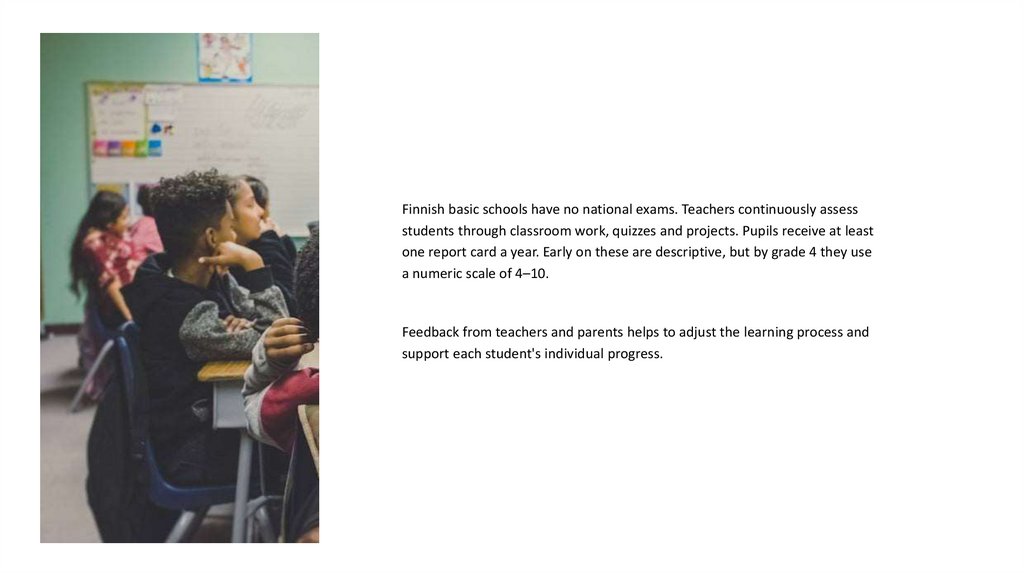
Finnish basic schools have no national exams. Teachers continuously assessstudents through classroom work, quizzes and projects. Pupils receive at least
one report card a year. Early on these are descriptive, but by grade 4 they use
a numeric scale of 4–10.
Feedback from teachers and parents helps to adjust the learning process and
support each student's individual progress.
4.
Finnish students typically go to their local school and stay with the same classmates through grade 9.There are no school uniforms and relatively little
homework; class time is interactive and often
project-based.
Classrooms encourage group work and student voice.
Teachers provide individual support and feedback to
help students develop their skills and confidence.
5.
After basic school, most Finns choose general upper secondary school (lukio),a 3–4 year academic track, or vocational school.
(Both are free and build on grades 1–9.
) Upper secondary students delve deeper into subjects like advanced math,
languages and sciences while also developing critical thinking and life skills.
Upon completion, students receive either the general upper secondary school
diploma or a vocational qualification, preparing them for further education or
the workforce.
6.
Finland has two parallel sectors of higher education: universities (yliopisto) and universities of applied sciences (UAS,ammattikorkeakoulu).
Both offer free tuition in Finnish/Swedish; many
programs in English have fees for non-EU students.
Universities focus on research and academic degrees
(Bachelor’s, Master’s and doctoral), while UAS
institutions offer more practical professional degrees
(Bachelor’s, Master’s) without PhDs.
7.
Admission is handled centrally through an online portal(Studyinfo/Opintopolku). Twice a year there is a joint application period
where you can list multiple degree programs (up to 6 in one form).
Each program sets its own entrance criteria: typically students need a Finnish
upper secondary certificate or equivalent. You can track the status of your
application through the same portal.
8.
Many students live in dormitories run by regionalstudent housing foundations (e.
g. HOAS in Helsinki, KOAS in Oulu, PSOAS in Tampere).
These non-profits offer reasonably cheap rooms and
shared apartments near campuses. For example,
shared student rooms in Helsinki rent for roughly
€200–450/month (utilities included). Additionally,
these foundations often provide support services such
as counseling and social events to enhance the living
experience for students.
9.
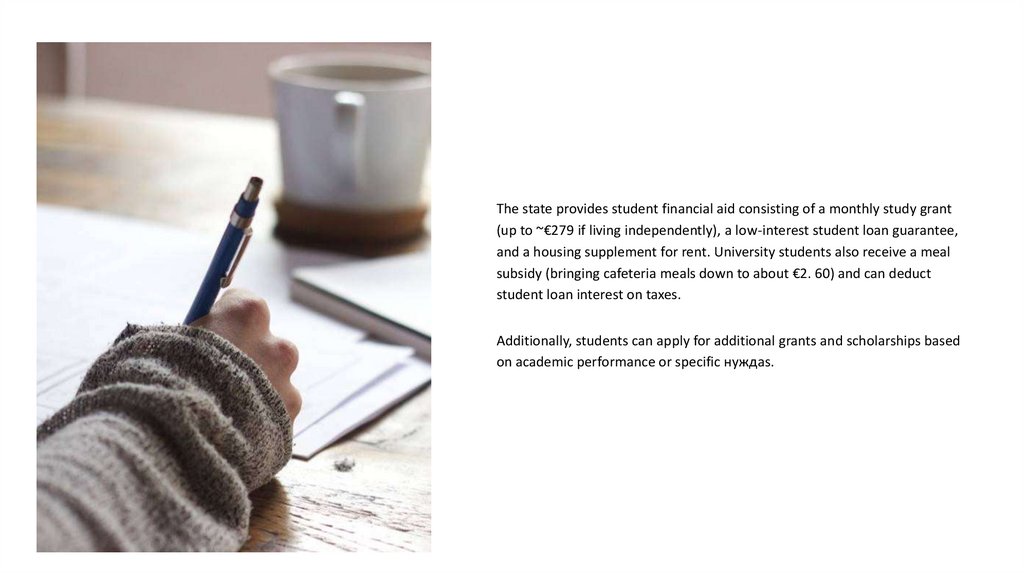
The state provides student financial aid consisting of a monthly study grant(up to ~€279 if living independently), a low-interest student loan guarantee,
and a housing supplement for rent. University students also receive a meal
subsidy (bringing cafeteria meals down to about €2. 60) and can deduct
student loan interest on taxes.
Additionally, students can apply for additional grants and scholarships based
on academic performance or specific нуждаs.
10.
In summary, Finland’s education path is one of broad, free schooling and smooth transition to higher education. Students move from awell-supported 1–9 basic system (with no high-stakes exams) into upper secondary school, then on to university via a national
application system.
Throughout, the emphasis is on equality, flexibility and student well-being – from free meals in schools to affordable dorms and grants
for university learners.
11.
Thank you for your attention. In this presentation, we examined the structure and features of the Finnish education system, fromschool to higher education, as well as the conditions for students in Finland. We hope the information presented will be useful for
further study and analysis of the Finnish educational system.