
 english
Similar presentations:





Literature of the 14-15th centuries. Lecture 2
1. Lecture 2 LITERATURE OF THE 14-15th CENTURIES
MA.,senior lecturer: Sartbayeva E.K.2. LECTURE 2
1. Historic background: England in the 14th century.2. The Literature of the 14 century:
- William Langland
- John Wyclif
3. Geoffrey Chaucer: Life and Literal activities
- “The Canterbury Tales”
- Chaucer’s contribution to literature
4. The Literature of the 15th century.
- Folk – songs and ballads.
- The Robin Hood ballads.
3. Historic background : England in the 14th century
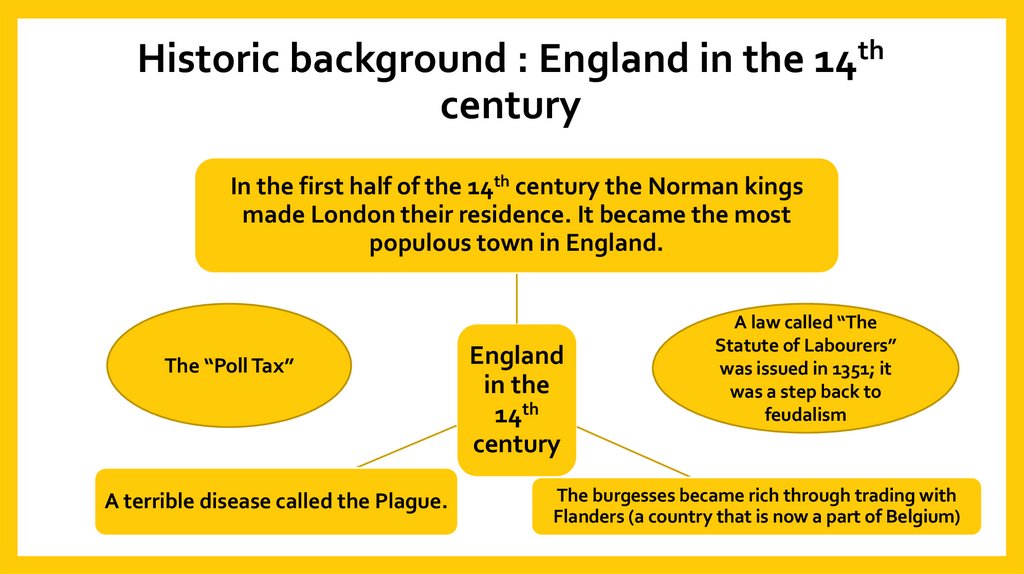
In the first half of the 14th century the Norman kingsmade London their residence. It became the most
populous town in England.
The “Poll Tax”
A terrible disease called the Plague.
England
in the
14th
century
A law called “The
Statute of Labourers”
was issued in 1351; it
was a step back to
feudalism
The burgesses became rich through trading with
Flanders (a country that is now a part of Belgium)
4. The Literature of the 14-th century
• The protest against the catholic church and the growthof national feeling during the first years of the war found
an echo in literature. There appeared poor people who
wandered from one village to another and talked to the
people. They protested not only against rich bishops
but also against churchmen.
5. William Langland (1330-1400)
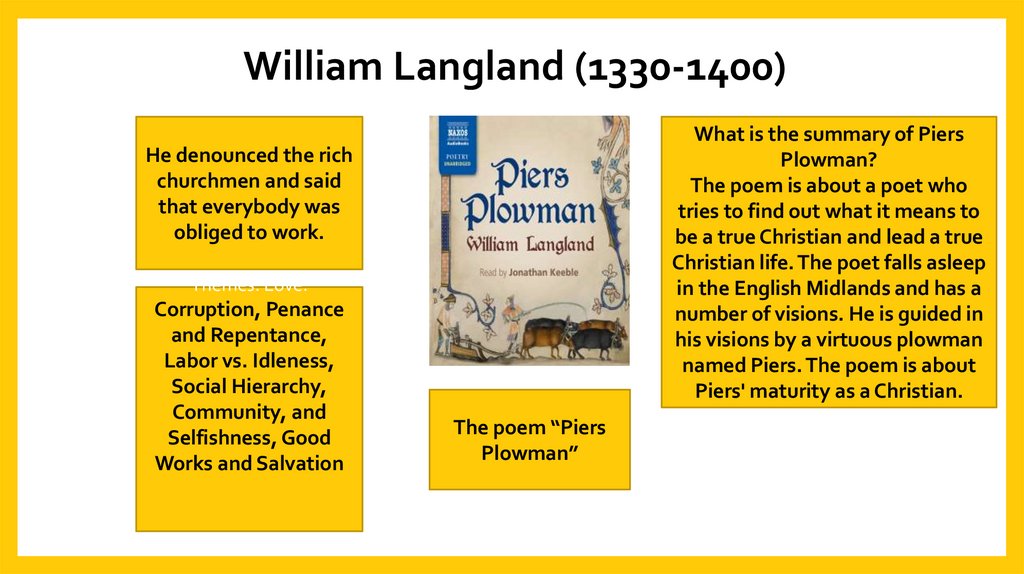
William Langland (1330-1400)What is the summary of Piers
Plowman?
The poem is about a poet who
tries to find out what it means to
be a true Christian and lead a true
Christian life. The poet falls asleep
in the English Midlands and has a
number of visions. He is guided in
his visions by a virtuous plowman
named Piers. The poem is about
Piers' maturity as a Christian.
He denounced the rich
churchmen and said
that everybody was
obliged to work.
Themes: Love.
Corruption, Penance
and Repentance,
Labor vs. Idleness,
Social Hierarchy,
Community, and
Selfishness, Good
Works and Salvation
The poem “Piers
Plowman”
6.
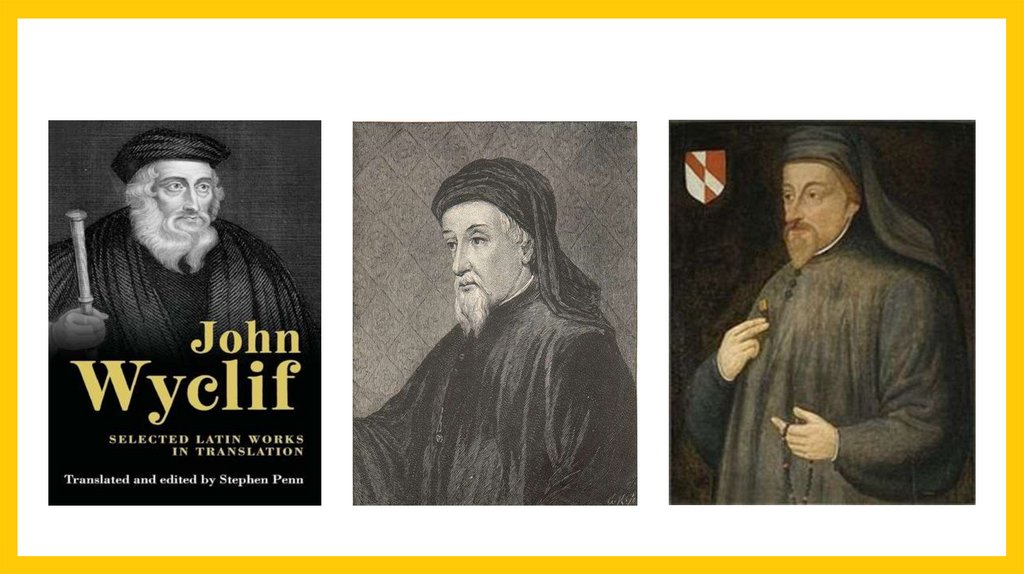
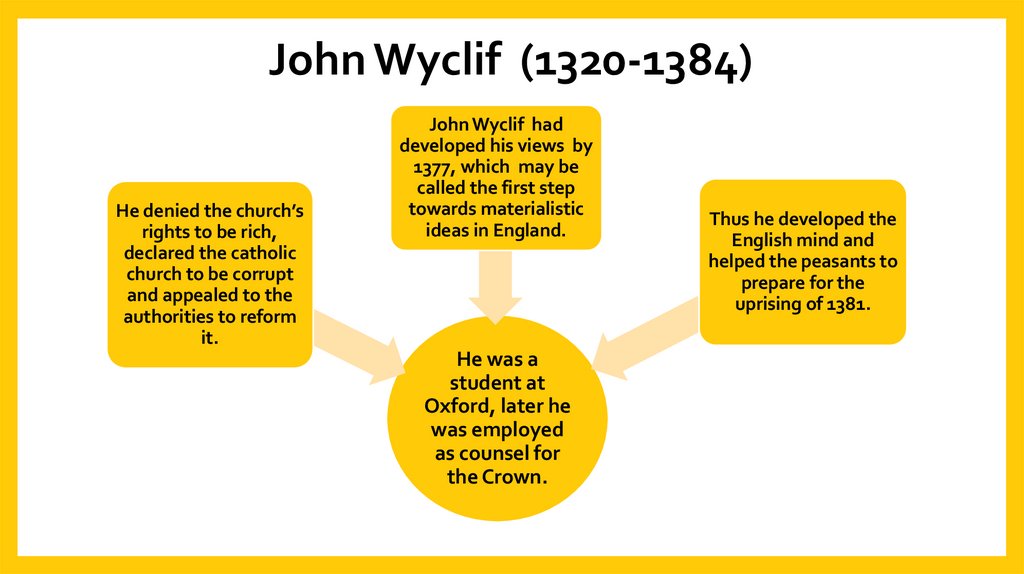
7. John Wyclif (1320-1384)
He denied the church’srights to be rich,
declared the catholic
church to be corrupt
and appealed to the
authorities to reform
it.
John Wyclif had
developed his views by
1377, which may be
called the first step
towards materialistic
ideas in England.
He was a
student at
Oxford, later he
was employed
as counsel for
the Crown.
Thus he developed the
English mind and
helped the peasants to
prepare for the
uprising of 1381.
8. Geoffrey Chaucer: Life and Works (1340-1400)
Geoffrey Chaucer: Life and Works(1340-1400)
The greatest writer of the 14th century was Geoffrey Chaucer;
He was born in London, soon after the Hundred Years’ War broke out. His father,
John Chaucer, was a London wine merchant;
At twenty, Chaucer was in France serving as a squire (arms-bearer to a knight)
and was then taken prisoner by the French;
When he came back to England, he received the post of Controller of the
Customs in the port of London;
Italy was the first country where the bourgeoisie triumphed over feudalism, and
it was there that Chaucer saw the first city-republics. Italian literature was at its
height and opened to Chaucer a new world of art;
He was appointed “Knight for the shire of Kent”, which meant that he sat in
Parliament as a representative for Kent;
9.
He translated from French a famous allegorical poem of the 13th century, “TheRomance of the Rose”;
The second period of Chaucer’s literary work was that of the Italian influence. To
this period belong the following poems: “The House of Fame”, a didactic poem;
“the Parliament of Fouls”, an allegorical poem satirizing Parliament: “Troilus and
Cressida” considered being the predecessor of the psychological novel in
England, and “The Legend of Good Women”, a dream-poem;
The third period of Chaucer’s creative work began in the year 1384 when he
started writing his masterpiece, “The Canterbury Tales”. When the new king,
Henry IV, came to the throne in 1399, the poet immediately addressed a poem to
him, “The Complaints of Chaucer to His Empty Purse”.
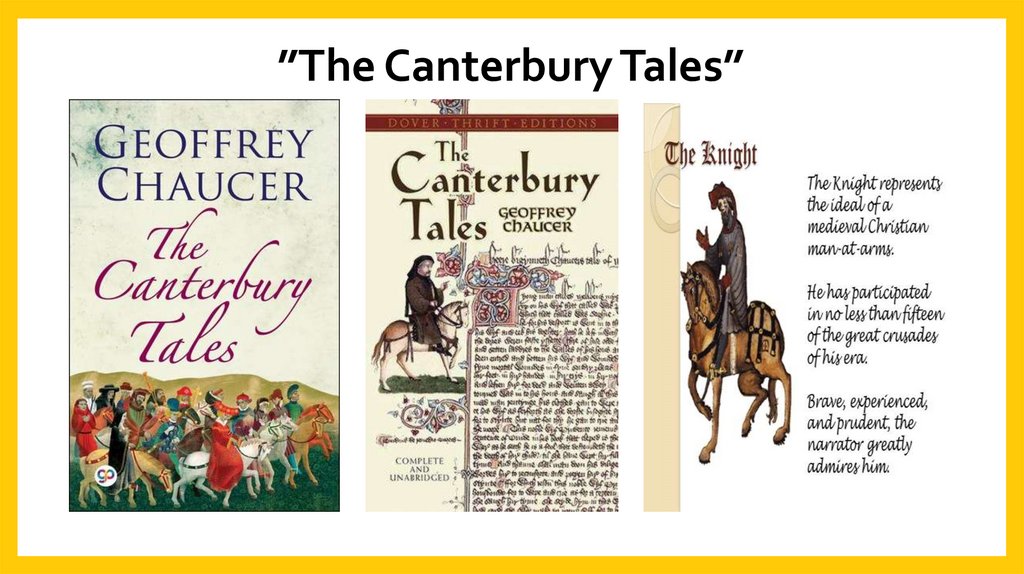
10. ”The Canterbury Tales”
11.
”The Canterbury Tales” are a series of stories written in verse. Theframework which serves to connect them is a pilgrimage to
Canterbury. The distance from London to Canterbury is 60 miles, but
in those days there was no straight road to go by. Pilgrimages of every
kind were extremely common in Chaucer’s time. Such journeys were no
doubt very valuable as a means by which to break the monotony of life
in days when there were no newspapers, no printed books, nor any
theatres. Many people looked forward to them as to pleasant holiday
excursions. The months for these pilgrimages were April and May,
because spring is the best season in the British Isles.
12.
The most popular English pilgrimage was to Canterbury.Pilgrimage towns were crowded with inns and churches.
Some churches had relics of the saints, and people believed
these had the miraculous power to cure diseases. Other
people were attracted by the beautiful monuments. At
Canterbury Cathedral there is the shrine of Thomas Becket,
a bishop of the 12th century, who struggled against the
king for the independence of the church. He was murdered
by the order of King Henry II, and later made a saint.
13.
There was a brave knight who loved truth, honour andgenerosity. He had been in armed expeditions in the
Mediterranean, had travelled in the North and had even
been to Russia. His son was a young squire with curled hair.
His clothes were “as gay as a meadow with white and red
flowers” and he had long white sleeves. He had been on
cavalry raids in France and had fought well “in hope to win
his Lady’s grace”. Their servant was a yeoman dressed in the
clothes of a forester.
14.
They were followed by two nuns and three priests. Oneof the nuns was a prioress, the head of the nunnery. She
had a long face and a small mouth and wept easily: “A
mouse in a trap would make her cry”. She could sing all
that was sung in churches and spoke French as it was
spoken in England, for “French in the Paris style she did
not know”. She had very good manners at table. She
never let a crumb fall from her lips and never dipped her
fingers deep in the sauce. “and she was dressed with
graceful charm.”
15.
There was a fat monk who loved hunting and a gooddinner better than prayers. His hood and his sleeves were
decorated with fine fur and his greyhounds and horse
were of the best. Another monk, though not so rich, also
liked to have a good time: “He knew the taverns well in
every town and every innkeeper and barmaid too”.
A student of Oxford in a shabby cloak rode a lean horse.
He was thin and pale: ”Whatever money from his friends
he took, he spent on learning and another book”.
16.
There was another woman in the company, the wife ofa burgess. She was merry and strong, though no longer
young and a little hard of hearing. She had red cheeks
and red stockings on her fat legs, and her hat was as
broad as a shield. She came from the town of Bath and
was mounted on a good horse. She liked to talk of her
youth and her five husbands.
Then we see a merchant with a forked beard “always
talking about his profits but telling nobody of his debt”; a
man of law “who was less busy than he seemed to be”.
17.
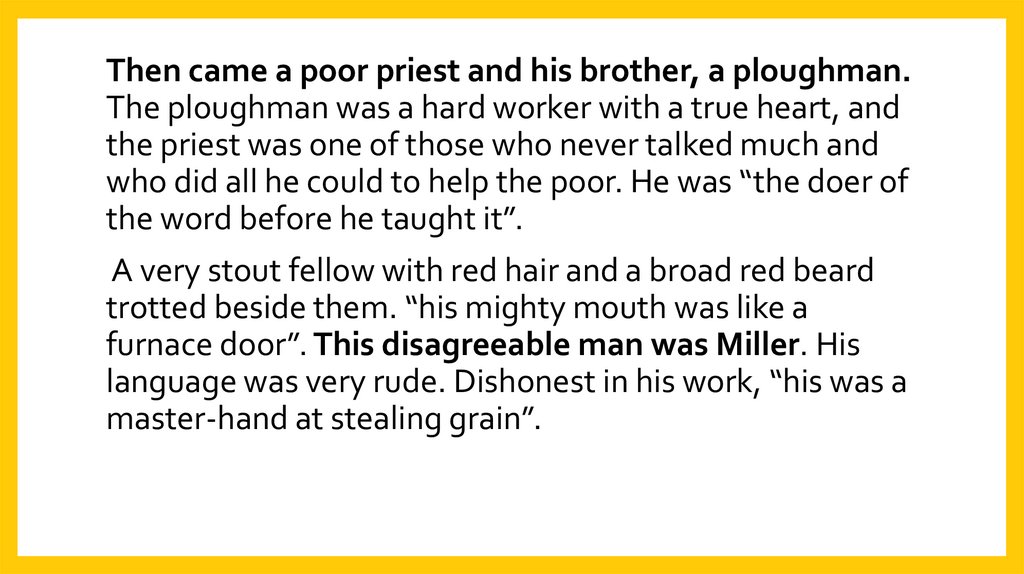
Then came a poor priest and his brother, a ploughman.The ploughman was a hard worker with a true heart, and
the priest was one of those who never talked much and
who did all he could to help the poor. He was “the doer of
the word before he taught it”.
A very stout fellow with red hair and a broad red beard
trotted beside them. “his mighty mouth was like a
furnace door”. This disagreeable man was Miller. His
language was very rude. Dishonest in his work, “his was a
master-hand at stealing grain”.
18.
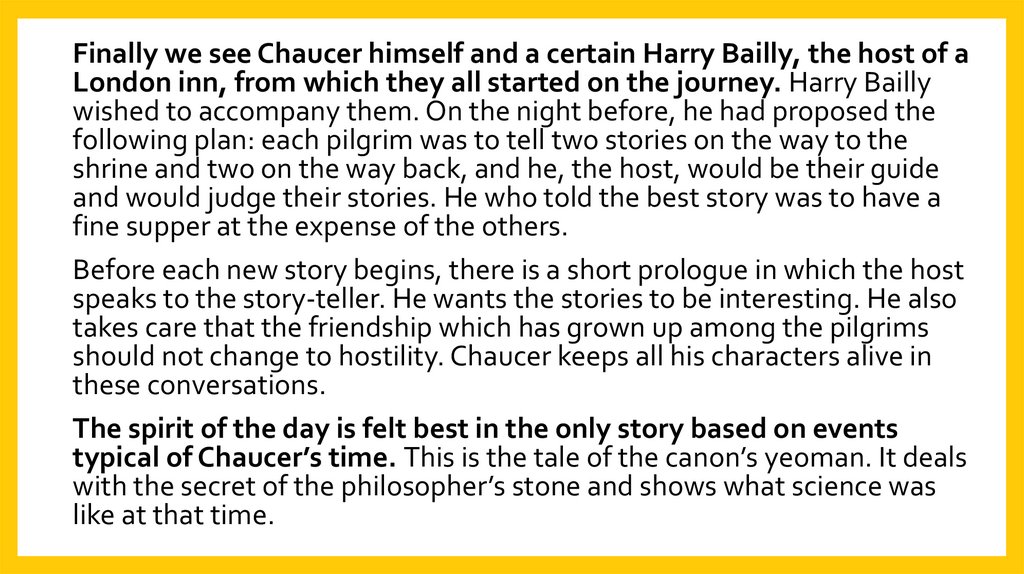
Finally we see Chaucer himself and a certain Harry Bailly, the host of aLondon inn, from which they all started on the journey. Harry Bailly
wished to accompany them. On the night before, he had proposed the
following plan: each pilgrim was to tell two stories on the way to the
shrine and two on the way back, and he, the host, would be their guide
and would judge their stories. He who told the best story was to have a
fine supper at the expense of the others.
Before each new story begins, there is a short prologue in which the host
speaks to the story-teller. He wants the stories to be interesting. He also
takes care that the friendship which has grown up among the pilgrims
should not change to hostility. Chaucer keeps all his characters alive in
these conversations.
The spirit of the day is felt best in the only story based on events
typical of Chaucer’s time. This is the tale of the canon’s yeoman. It deals
with the secret of the philosopher’s stone and shows what science was
like at that time.
19. Chaucer’s contribution to literature
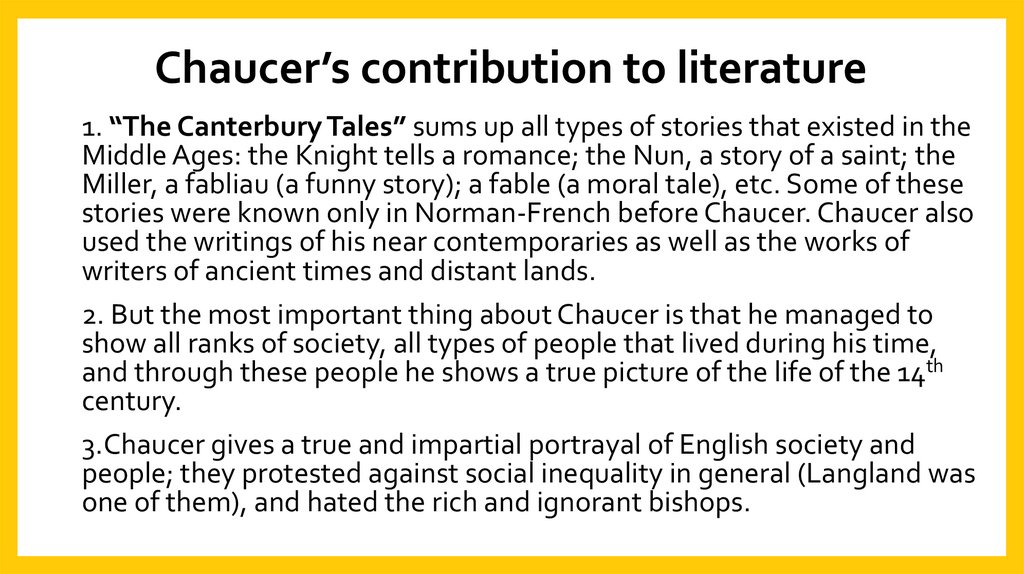
1. “The Canterbury Tales” sums up all types of stories that existed in theMiddle Ages: the Knight tells a romance; the Nun, a story of a saint; the
Miller, a fabliau (a funny story); a fable (a moral tale), etc. Some of these
stories were known only in Norman-French before Chaucer. Chaucer also
used the writings of his near contemporaries as well as the works of
writers of ancient times and distant lands.
2. But the most important thing about Chaucer is that he managed to
show all ranks of society, all types of people that lived during his time,
and through these people he shows a true picture of the life of the 14th
century.
3.Chaucer gives a true and impartial portrayal of English society and
people; they protested against social inequality in general (Langland was
one of them), and hated the rich and ignorant bishops.
20.
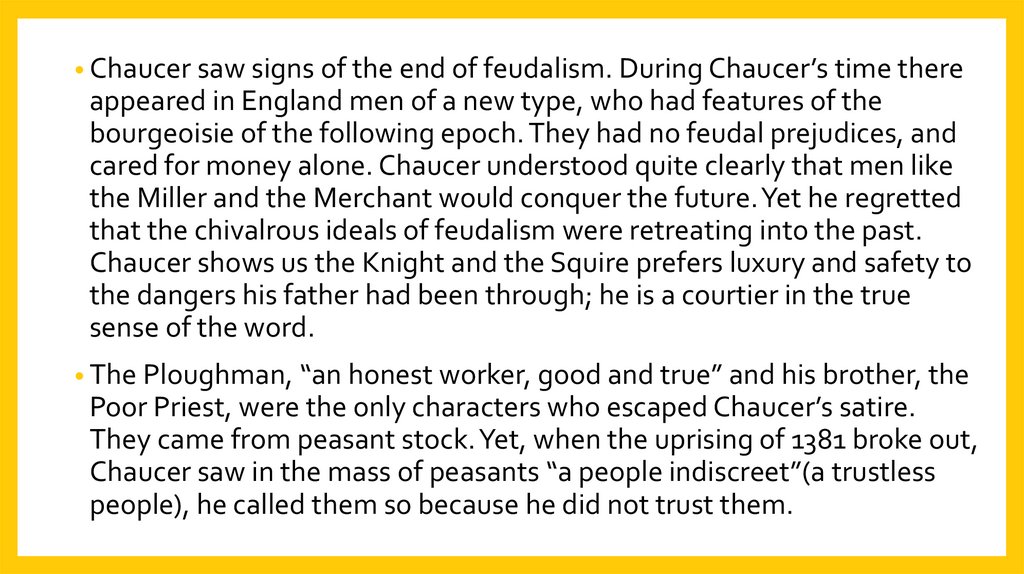
• Chaucer saw signs of the end of feudalism. During Chaucer’s time thereappeared in England men of a new type, who had features of the
bourgeoisie of the following epoch. They had no feudal prejudices, and
cared for money alone. Chaucer understood quite clearly that men like
the Miller and the Merchant would conquer the future. Yet he regretted
that the chivalrous ideals of feudalism were retreating into the past.
Chaucer shows us the Knight and the Squire prefers luxury and safety to
the dangers his father had been through; he is a courtier in the true
sense of the word.
• The Ploughman, “an honest worker, good and true” and his brother, the
Poor Priest, were the only characters who escaped Chaucer’s satire.
They came from peasant stock. Yet, when the uprising of 1381 broke out,
Chaucer saw in the mass of peasants “a people indiscreet”(a trustless
people), he called them so because he did not trust them.
21.
• 3. Chaucer was the creator of a new literary language. He chose to write in thepopular language, though the aristocracy at the time read and spoke French; even the
burgesses up to the year 1362 had to deliver their speeches in Parliament in French.
• A single language emerges from a number of dialects only when the people who
speak these dialects have become one nation. The necessity for one common
language for the English people during the Hundred Years’ War was a sign that they
were becoming one nation. Chaucer shared in this national feeling. He wrote in the
London dialect, for it enabled him to define the typical features of his characters, to
satirize feudal literature and to add humour to many an old story. His use of the many
jokes popular in his time makes his poetry very lively. Chaucer made up new works
which have remained in the language to this day: such as ‘daisy’, the name of a flower,
which meant ‘day’s eye’; “coal –black”, and “snow-white”. It is to be remembered that
with Chaucer’s poetry the popular language became literary English.
• Chaucer was the true founder of English literature, and when the great English poet
Algernon Charles Swinburne (1837-1909) called him “our father Chaucer”, he did him
full justice.
22.
4. Chaucer was by learning a man of the Middle Ages,but his attitude towards mankind was so broad –minded
that his work is timeless. Chaucer did not teach his
readers what is good or bad by moralizing. He called
attention to the people around him; he drew his
characters from life: he saw man as belonging to certain
ranks of society. Chaucer described the individual
features of his characters “according to profession and
degree”, so they instantly became typical of their class.
When assembled, they form one people, the English
people.
23. The Literature of the 15th century
• - Folk – Songs and Ballads.• - The Robin Hood Ballads.
The Wars of the Roses. The death of Chaucer was a great blow to English
poetry. It took two centuries to produce a poet equal to him. The Hundred
Years’ War ended, but another misfortune befell the country: in 1455 a feudal
war broke out between the descendants of Edward III, which is known as the
Wars of the Roses.
The feud turned into a bitter struggle for the crown, each party splitting up
into smaller parties that murdered every likely heir to the throne. The
commons took little part in the struggle. Anarchy reigned, making the
exchange of knowledge almost impossible. Indeed, it was impossible for
others to continue the work Chaucer had begun while the people suffered
from continual war and remained completely ignorant.
24. Folk – Songs and Ballads
• Folk poetry flourished in England and Scotland in the 15th century. Folk –songs is a short poem in rhymed stanzas usually set to a melody. The
rhythm goes along with the subject dealt with in the song. Thus mowingsons, spinning- and weaving-songs were made up to the measured motion
of that kind of work. Harvest-songs and wedding-songs were set to the
measured motion of a dance.
• Ballads. The most interesting examples of folk poetry were the ballads. The
first ballads were songs made up by bards and minstrels who travelled from
town to town earning their living by singing. Ballads were either for singing
or for reciting. They were often accompanied by musical instruments (such
as the bagpipes in Scotland) and dancing. The ballad became the most
popular form of amusement in towns and villages because it was something
intermediate between a performance and a game. Ballads were passed on
orally. They were handed down by word of mouth from generation to
generation.
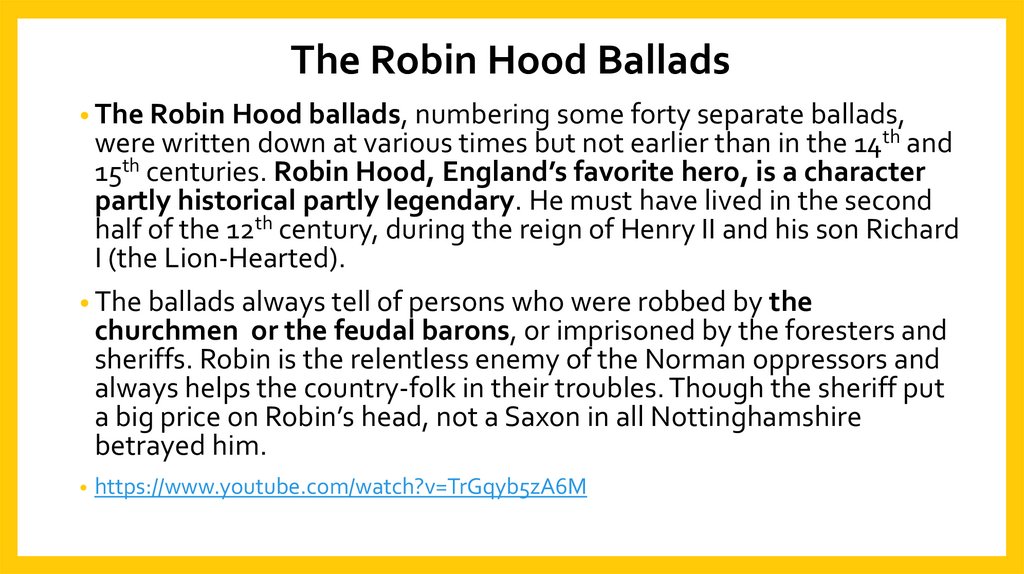
25. The Robin Hood Ballads
• The Robin Hood ballads, numbering some forty separate ballads,were written down at various times but not earlier than in the 14th and
15th centuries. Robin Hood, England’s favorite hero, is a character
partly historical partly legendary. He must have lived in the second
half of the 12th century, during the reign of Henry II and his son Richard
I (the Lion-Hearted).
• The ballads always tell of persons who were robbed by the
churchmen or the feudal barons, or imprisoned by the foresters and
sheriffs. Robin is the relentless enemy of the Norman oppressors and
always helps the country-folk in their troubles. Though the sheriff put
a big price on Robin’s head, not a Saxon in all Nottinghamshire
betrayed him.
• https://www.youtube.com/watch?v=TrGqyb5zA6M