
 history
Similar presentations:





Old and Middle English Literature. Lecture 1
1. Lecture 1. Old and Middle English Literature
MA., SENIOR LECTURER: SARTBAYEVA E.K.2. Lecture 1. Old and Middle English Literature
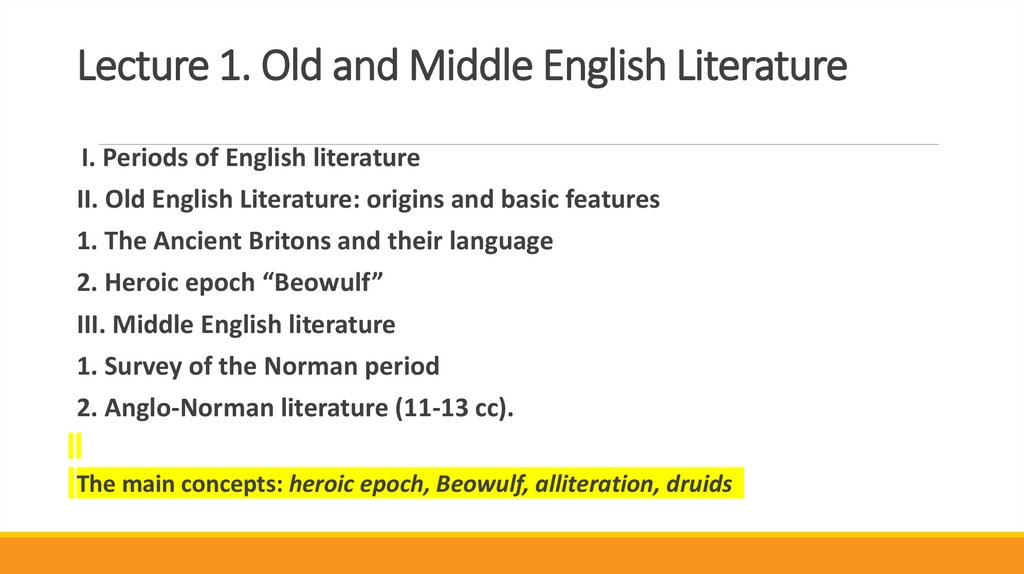
I. Periods of English literatureII. Old English Literature: origins and basic features
1. The Ancient Britons and their language
2. Heroic epoch “Beowulf”
III. Middle English literature
1. Survey of the Norman period
2. Anglo-Norman literature (11-13 cc).
The main concepts: heroic epoch, Beowulf, alliteration, druids
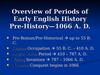
3. Periods of English Literature
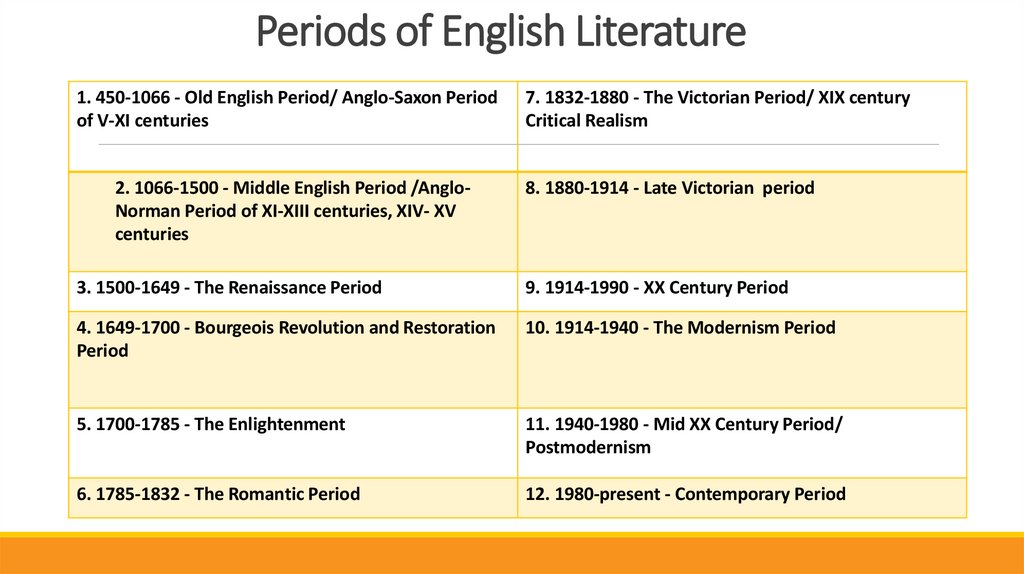
1. 450-1066 - Old English Period/ Anglo-Saxon Periodof V-XI centuries
2. 1066-1500 - Middle English Period /AngloNorman Period of XI-XIII centuries, XIV- XV
centuries
7. 1832-1880 - The Victorian Period/ XIX century
Critical Realism
8. 1880-1914 - Late Victorian period
3. 1500-1649 - The Renaissance Period
9. 1914-1990 - XX Century Period
4. 1649-1700 - Bourgeois Revolution and Restoration
Period
10. 1914-1940 - The Modernism Period
5. 1700-1785 - The Enlightenment
11. 1940-1980 - Mid XX Century Period/
Postmodernism
6. 1785-1832 - The Romantic Period
12. 1980-present - Contemporary Period
4. 1. The Ancient Britons and Their Language
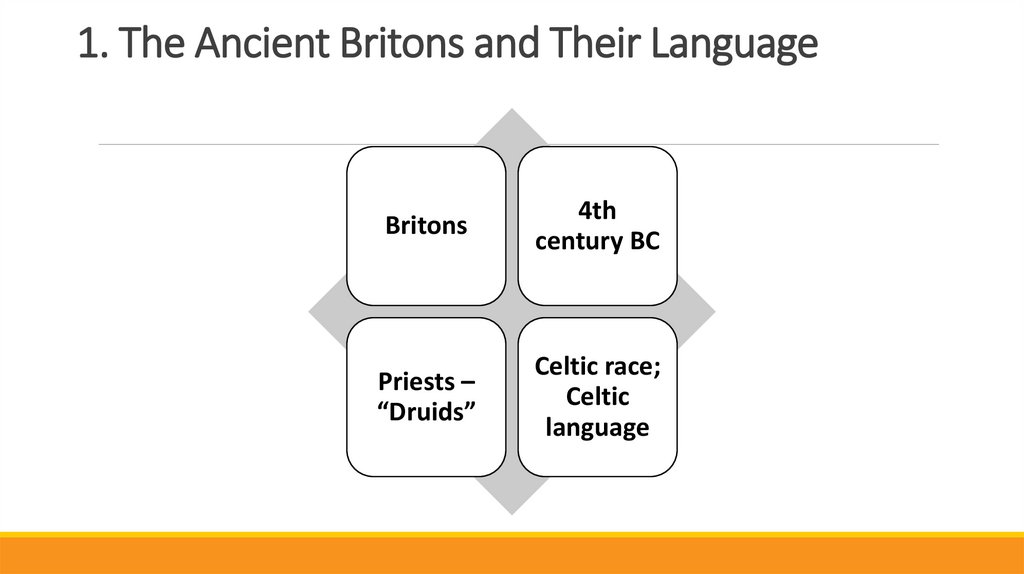
Britons4th
century BC
Priests –
“Druids”
Celtic race;
Celtic
language
5.
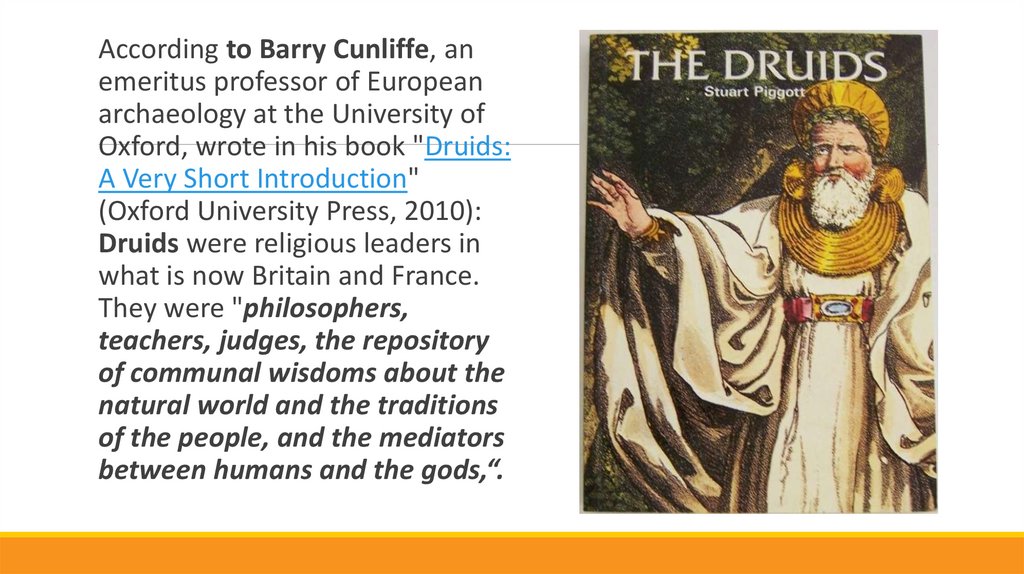
According to Barry Cunliffe, anemeritus professor of European
archaeology at the University of
Oxford, wrote in his book "Druids:
A Very Short Introduction"
(Oxford University Press, 2010):
Druids were religious leaders in
what is now Britain and France.
They were "philosophers,
teachers, judges, the repository
of communal wisdoms about the
natural world and the traditions
of the people, and the mediators
between humans and the gods,“.
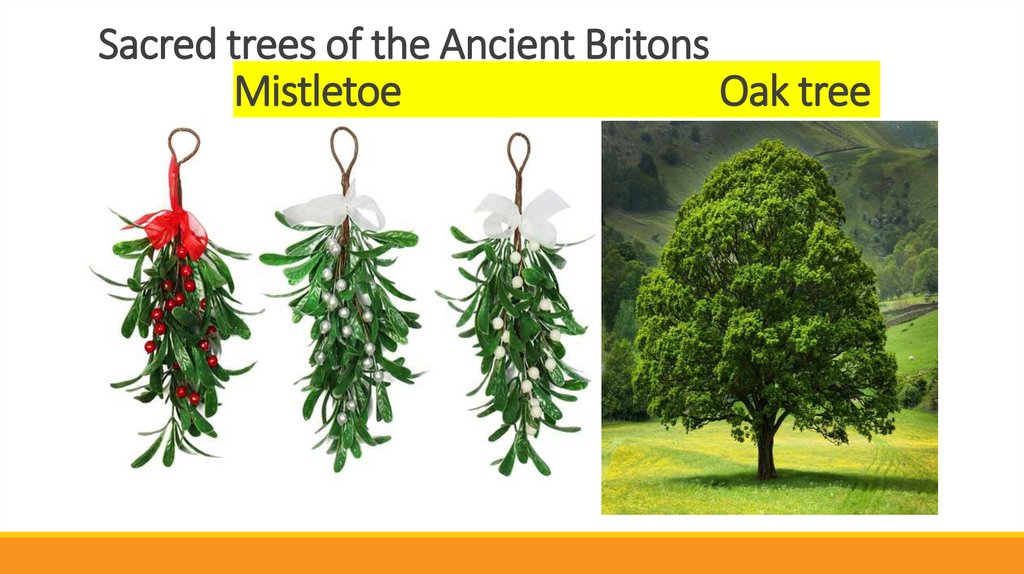
6. Sacred trees of the Ancient Britons Mistletoe Oak tree
7. The Celt’s Culture
The Celts came to the British Isles from France about 3000 years ago;The language they spoke was Celtic;
The Celts were strong, tall fighters;
They absorbed the early Britons and became the ancestors of the Scotish, Irish and Welsh
people;
Celtic tribes called the Picts;
Celts had no towns and lived in villages;
They were acquainted with the use of copper, iron and tin, they kept large herds of cattle
and sheep. They also cultivated crops;
Celts worshipped nature and believed in many gods;
The Celts made up many legends about their gods and heroes, they were called Sagas;
The greatest hero of such sagas was Cuchulainn ['ku:kulin].
8. The Roman Invasion
In the 1st century beforeour era Britain was
conquered by the powerful
State of Rome.
The Romans lived on the
peninsula, which is now called
Italy, and their language was
Latin.
The Romans thought a
great deal of fighting and
they were so strong that
they usually managed to
win most of the battles
they fought.
The Romans decided to occupy the
island; they crossed the sea in
galleys under the command of
Julius Caesar, who wrote and
interesting account of Britain.
9. The Invasion of Britain by Germanic Tribes
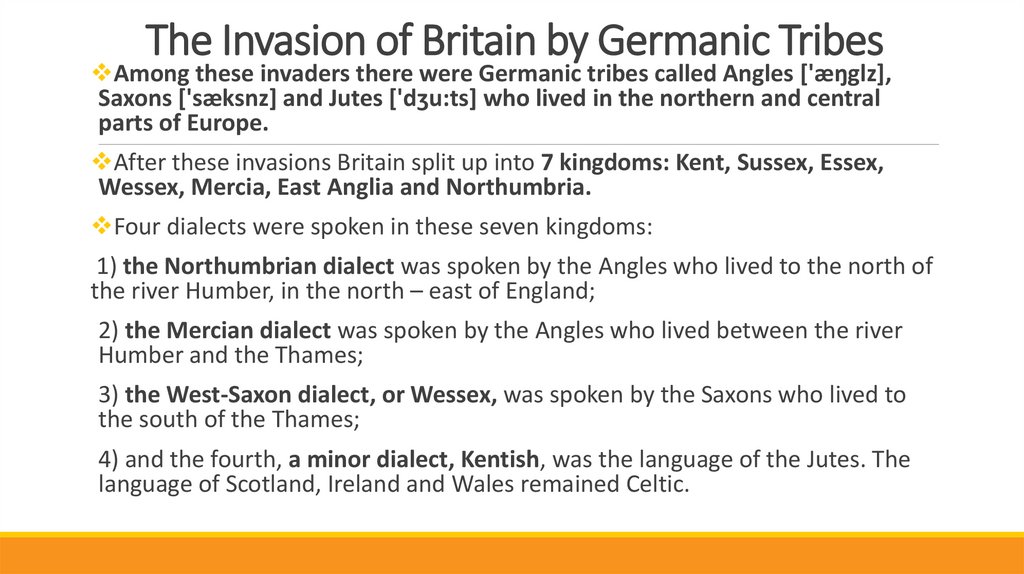
Among these invaders there were Germanic tribes called Angles ['æŋglz],Saxons ['sæksnz] and Jutes ['dʒu:ts] who lived in the northern and central
parts of Europe.
After these invasions Britain split up into 7 kingdoms: Kent, Sussex, Essex,
Wessex, Mercia, East Anglia and Northumbria.
Four dialects were spoken in these seven kingdoms:
1) the Northumbrian dialect was spoken by the Angles who lived to the north of
the river Humber, in the north – east of England;
2) the Mercian dialect was spoken by the Angles who lived between the river
Humber and the Thames;
3) the West-Saxon dialect, or Wessex, was spoken by the Saxons who lived to
the south of the Thames;
4) and the fourth, a minor dialect, Kentish, was the language of the Jutes. The
language of Scotland, Ireland and Wales remained Celtic.
10.
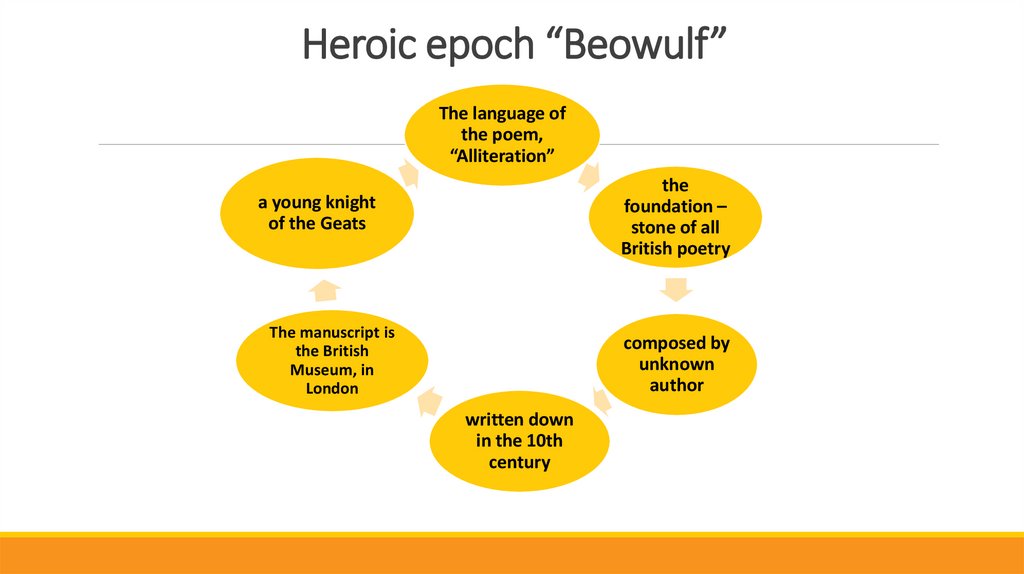
11. Heroic epoch “Beowulf”
The language ofthe poem,
“Alliteration”
a young knight
of the Geats
the
foundation –
stone of all
British poetry
The manuscript is
the British
Museum, in
London
composed by
unknown
author
written down
in the 10th
century
12. https://www.youtube.com/watch?v=pkOi7c13yYM time: 6:50
Language and Style of Beowulfhttps://www.youtube.com/watch?v=CH-_GwoO4xI
Time: 1:35
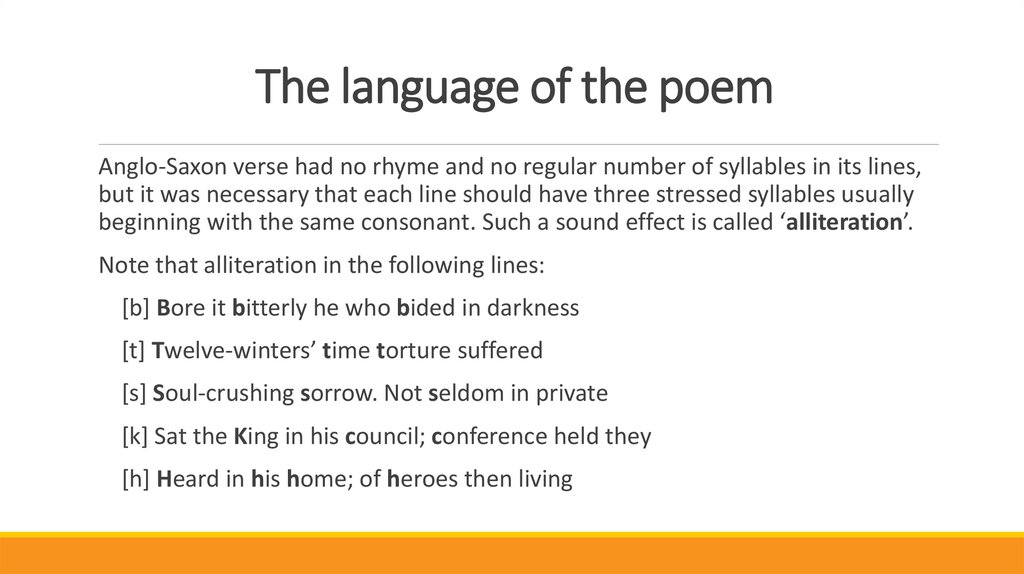
13. The language of the poem
Anglo-Saxon verse had no rhyme and no regular number of syllables in its lines,but it was necessary that each line should have three stressed syllables usually
beginning with the same consonant. Such a sound effect is called ‘alliteration’.
Note that alliteration in the following lines:
[b] Bore it bitterly he who bided in darkness
[t] Twelve-winters’ time torture suffered
[s] Soul-crushing sorrow. Not seldom in private
[k] Sat the King in his council; conference held they
[h] Heard in his home; of heroes then living
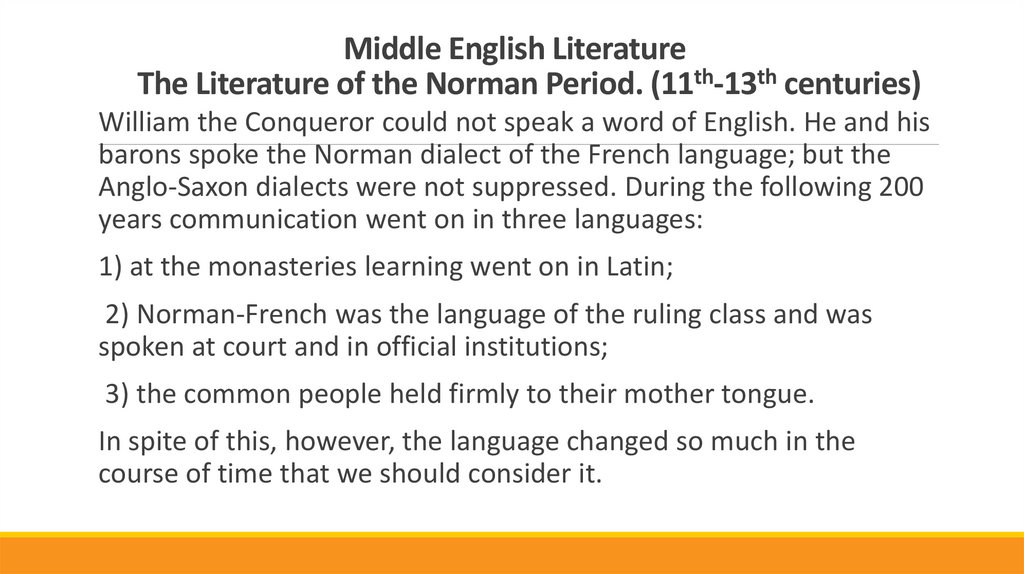
14. Middle English Literature The Literature of the Norman Period. (11th-13th centuries)
William the Conqueror could not speak a word of English. He and hisbarons spoke the Norman dialect of the French language; but the
Anglo-Saxon dialects were not suppressed. During the following 200
years communication went on in three languages:
1) at the monasteries learning went on in Latin;
2) Norman-French was the language of the ruling class and was
spoken at court and in official institutions;
3) the common people held firmly to their mother tongue.
In spite of this, however, the language changed so much in the
course of time that we should consider it.
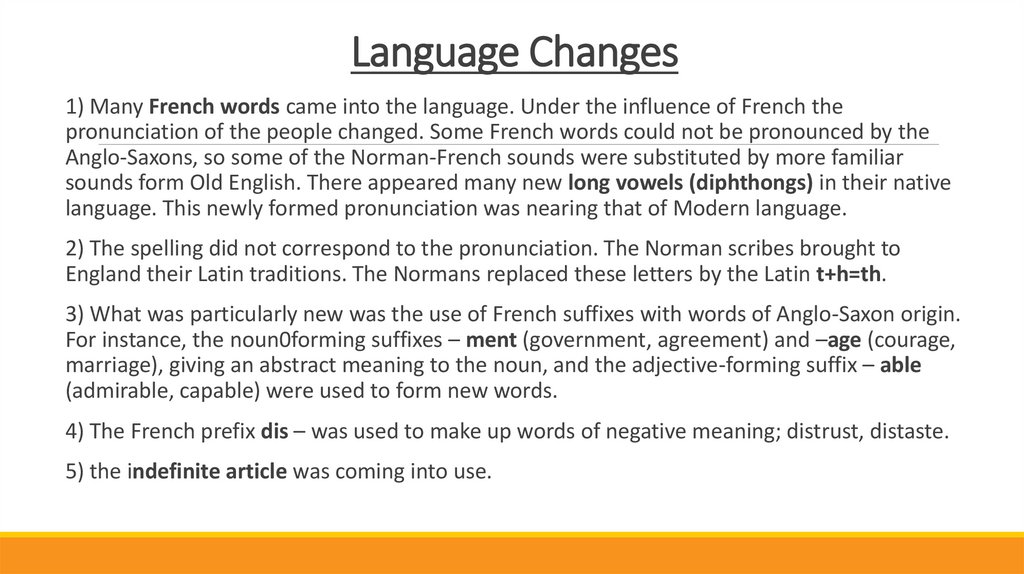
15. Language Changes
1) Many French words came into the language. Under the influence of French thepronunciation of the people changed. Some French words could not be pronounced by the
Anglo-Saxons, so some of the Norman-French sounds were substituted by more familiar
sounds form Old English. There appeared many new long vowels (diphthongs) in their native
language. This newly formed pronunciation was nearing that of Modern language.
2) The spelling did not correspond to the pronunciation. The Norman scribes brought to
England their Latin traditions. The Normans replaced these letters by the Latin t+h=th.
3) What was particularly new was the use of French suffixes with words of Anglo-Saxon origin.
For instance, the noun0forming suffixes – ment (government, agreement) and –age (courage,
marriage), giving an abstract meaning to the noun, and the adjective-forming suffix – able
(admirable, capable) were used to form new words.
4) The French prefix dis – was used to make up words of negative meaning; distrust, distaste.
5) the indefinite article was coming into use.
16.
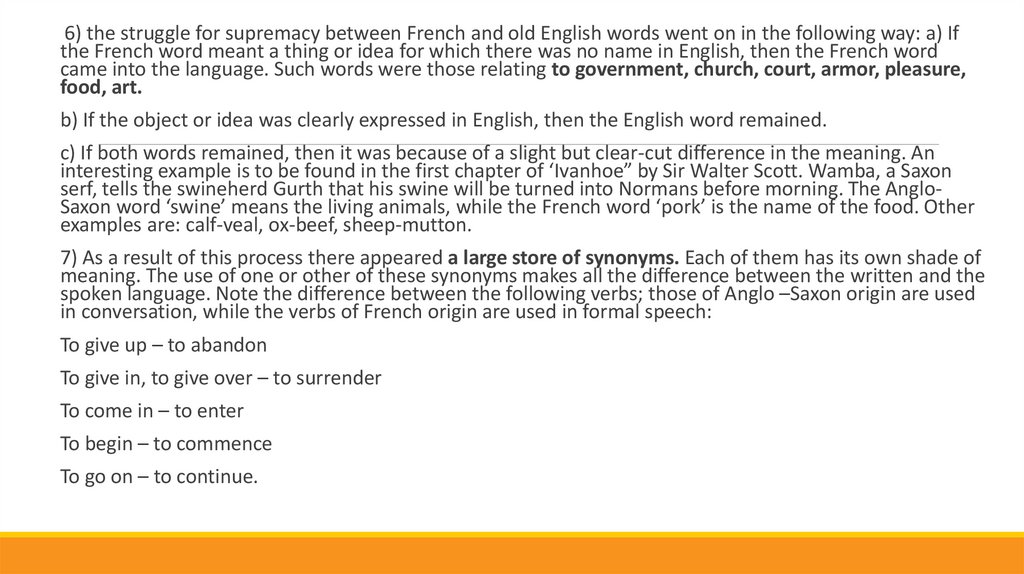
6) the struggle for supremacy between French and old English words went on in the following way: a) Ifthe French word meant a thing or idea for which there was no name in English, then the French word
came into the language. Such words were those relating to government, church, court, armor, pleasure,
food, art.
b) If the object or idea was clearly expressed in English, then the English word remained.
c) If both words remained, then it was because of a slight but clear-cut difference in the meaning. An
interesting example is to be found in the first chapter of ‘Ivanhoe” by Sir Walter Scott. Wamba, a Saxon
serf, tells the swineherd Gurth that his swine will be turned into Normans before morning. The AngloSaxon word ‘swine’ means the living animals, while the French word ‘pork’ is the name of the food. Other
examples are: calf-veal, ox-beef, sheep-mutton.
7) As a result of this process there appeared a large store of synonyms. Each of them has its own shade of
meaning. The use of one or other of these synonyms makes all the difference between the written and the
spoken language. Note the difference between the following verbs; those of Anglo –Saxon origin are used
in conversation, while the verbs of French origin are used in formal speech:
To give up – to abandon
To give in, to give over – to surrender
To come in – to enter
To begin – to commence
To go on – to continue.
17. The first Universities/ Oxford and Cambridge
With the development of such sciences as medicine and law,corporations of general study called ’universitas’ appeared in Italy
and France. A fully developed university had four faculties: three
superior (higher) faculties, that of Theology , of Law and of
medicine; and one inferior (primary) faculty, that of Art, where
seven subjects were studied: Latin Grammar, Rhetoric (the art of
expressive speaking), Logic, Arithmetic, Geometry, Astronomy and
Music.
18. Anglo-Norman literature (11-13 cc.)
Trilingual situation affected the development of literature.Various literary works were written in three languages:
-
Historical literature in Latin language
-
Literature in French language
-
Literature in English language
19. The Fable and the Fabliau
In the literature of the townsfolk we find the fable and the fabliau.Fables were short stories with animals for characters and conveying
a moral.
Fabliaux were funny stories about cunning humbugs and the
unfaithful wives of rich merchants. They were metrical tales
(poems) brought form France. These stories were told in the dialects
of Middle English. They were collected and written down much later.
The literature of the towns did not idealize characters as the
romances did. The fabliaux showed a practical attitude to life.
20. Conclusion
Thus Old English literature, or Anglo-Saxon literature, comprises literature written in OldEnglish in Anglo-Saxon England, in the period after the settlement of the Saxons and other
Germanic tribes in England after the withdrawal of the Romans and "ending soon after the
Norman Conquest" in 1066. These works include such genres as epic poetry, Bible
translations, legal works, chronicles, riddles, and others. All in all there are about 400
surviving manuscripts from the period.
Oral tradition was very strong in early English culture and most literary works were written
to be performed. Epic poems were very popular, and some, including Beowulf, have survived
to the present day. Much Old English verse in the manuscripts is probably adapted from the
earlier Germanic war poems from the continent. When such poetry was brought to England
it was still handed down orally from one generation to another.
Old English poetry falls broadly into two styles or fields of reference, the heroic Germanic
and the Christian. The Anglo-Saxons were converted to Christianity after their arrival in
England.
The epic poem Beowulf is the most famous work in Old English and has achieved national
epic status in England, despite being set in Scandinavia.