 history
Similar presentations:








Kazakhstan The heart of Eurasia
1. Kazakhstan The heart of Eurasia
Qazaqstan Respublikasyby Aidar Issenalin
2. Content
3.
4.
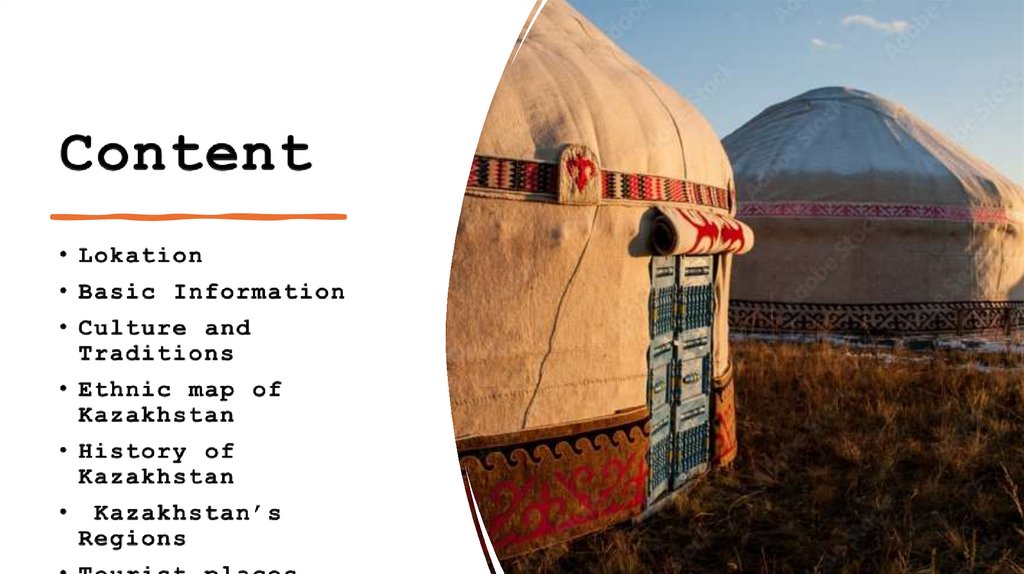
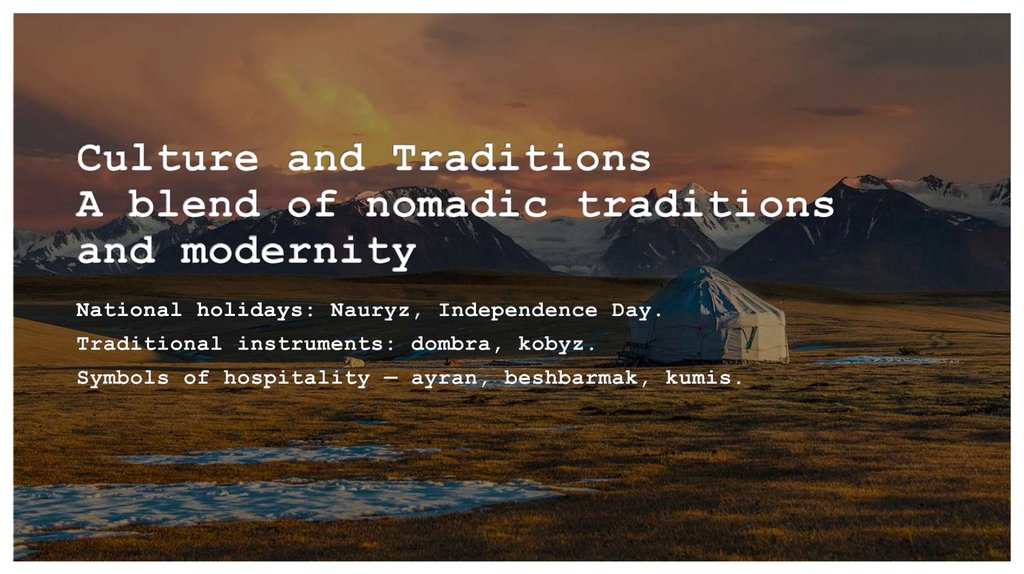
5. Culture and Traditions A blend of nomadic traditions and modernity
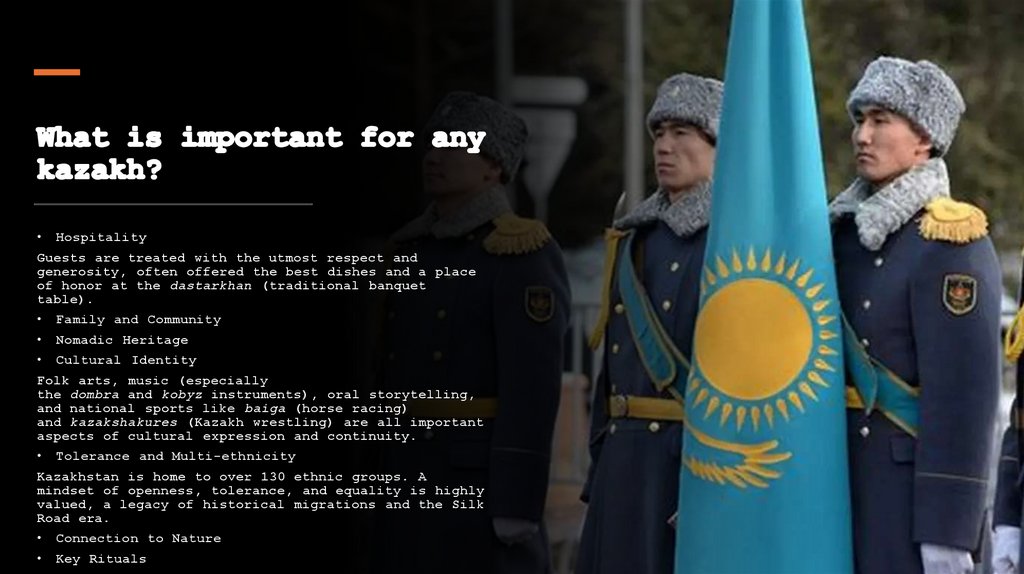
6. What is important for any kazakh?
Hospitality
Guests are treated with the utmost respect and
generosity, often offered the best dishes and a place
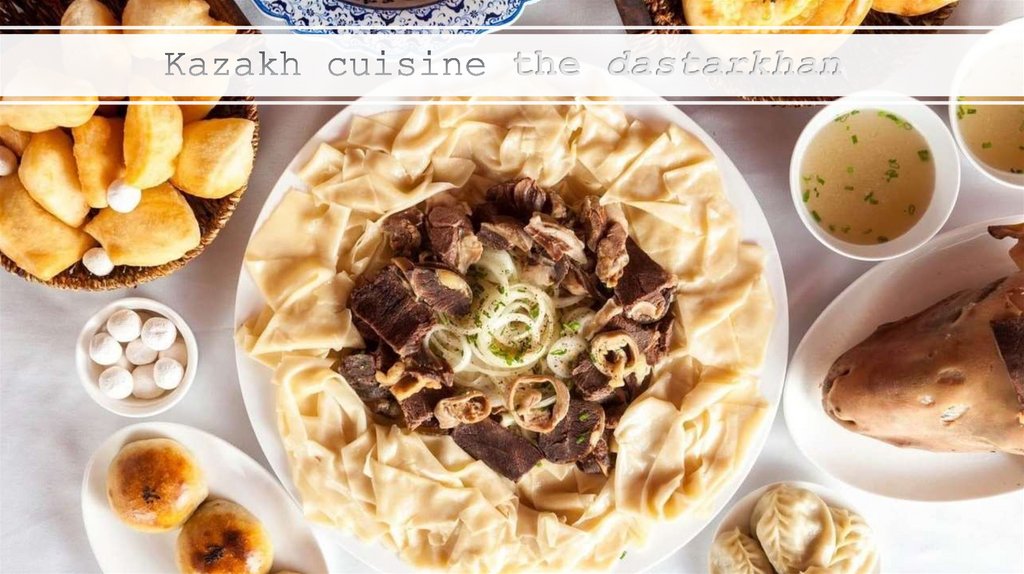
of honor at the dastarkhan (traditional banquet
table).
Family and Community
Nomadic Heritage
Cultural Identity
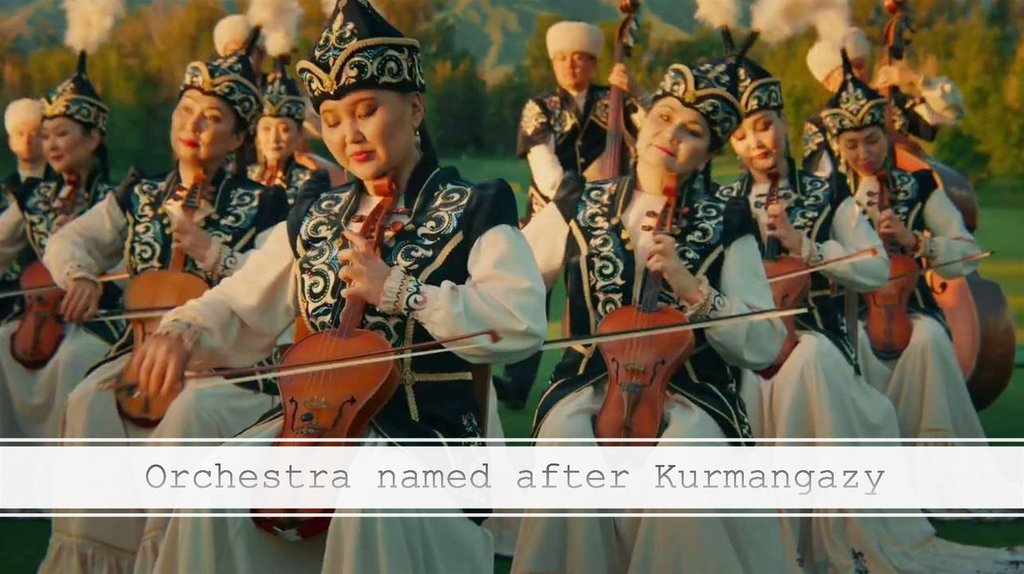
Folk arts, music (especially
the dombra and kobyz instruments), oral storytelling,
and national sports like baiga (horse racing)
and kazakshakures (Kazakh wrestling) are all important
aspects of cultural expression and continuity.
Tolerance and Multi-ethnicity
Kazakhstan is home to over 130 ethnic groups. A
mindset of openness, tolerance, and equality is highly
valued, a legacy of historical migrations and the Silk
Road era.
Connection to Nature
Key Rituals
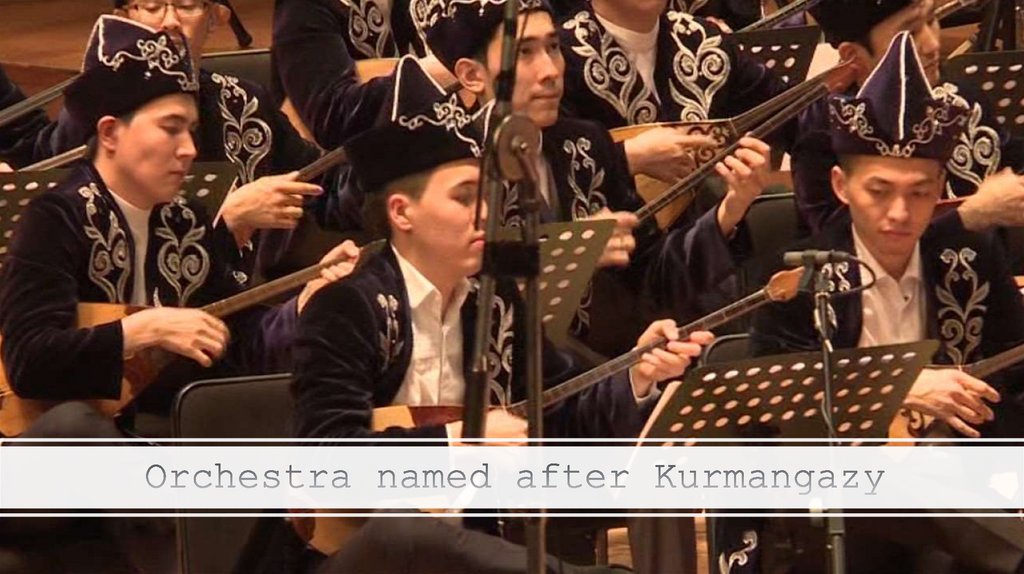
7. Orchestra named after Kurmangazy
8.
the dastarkhan9.
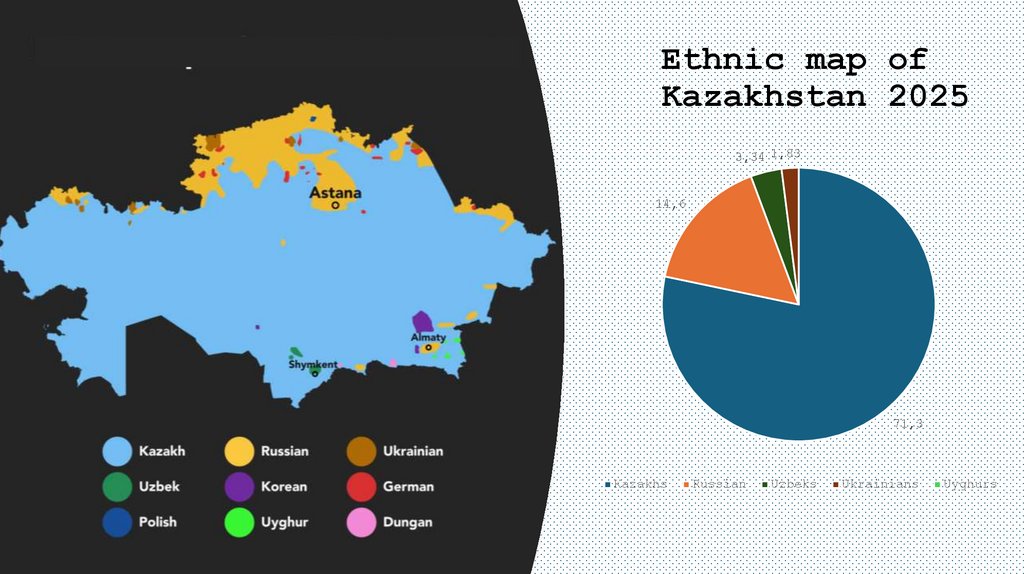
10. Ethnic map of Kazakhstan 2025
3,34 1,8314,6
71,3
Kazakhs
Russian
Uzbeks
Ukrainians
Uyghurs
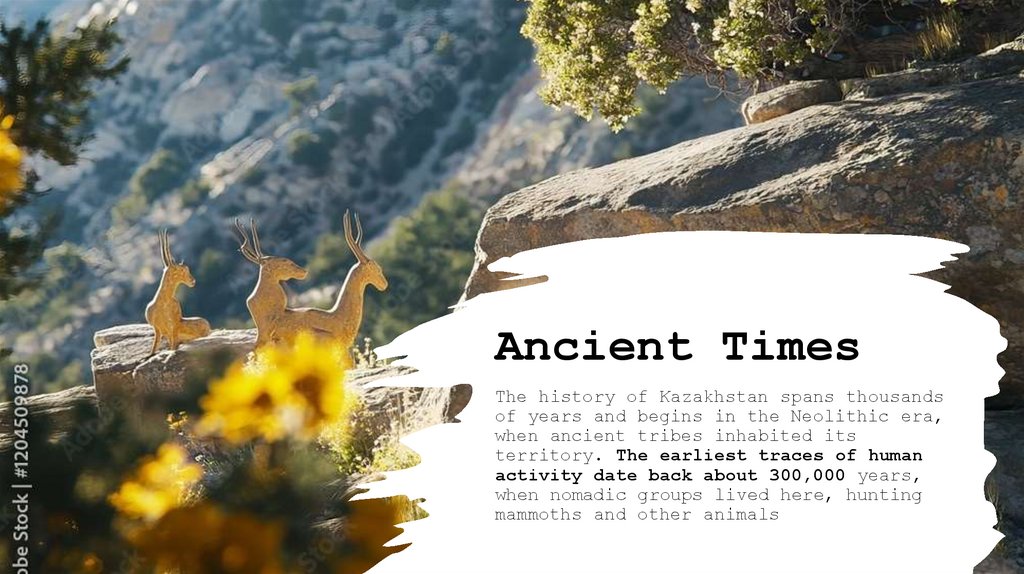
11. Ancient Times
The history of Kazakhstan spans thousandsof years and begins in the Neolithic era,
when ancient tribes inhabited its
territory. The earliest traces of human
activity date back about 300,000 years,
when nomadic groups lived here, hunting
mammoths and other animals
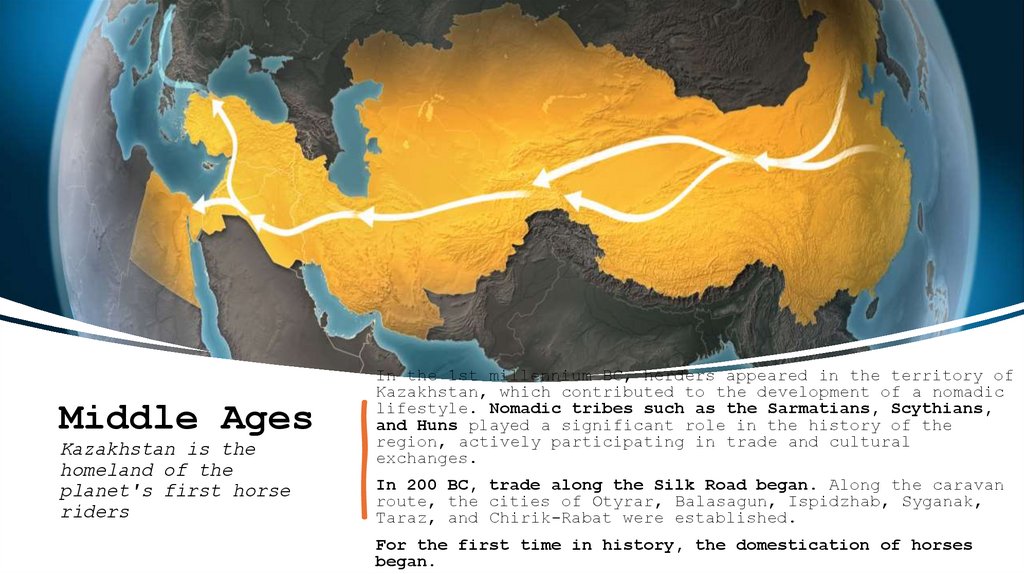
12. Middle Ages Kazakhstan is the homeland of the planet's first horse riders
Middle AgesKazakhstan is the
homeland of the
planet's first horse
riders
In the 1st millennium BC, herders appeared in the territory of
Kazakhstan, which contributed to the development of a nomadic
lifestyle. Nomadic tribes such as the Sarmatians, Scythians,
and Huns played a significant role in the history of the
region, actively participating in trade and cultural
exchanges.
In 200 BC, trade along the Silk Road began. Along the caravan
route, the cities of Otyrar, Balasagun, Ispidzhab, Syganak,
Taraz, and Chirik-Rabat were established.
For the first time in history, the domestication of horses
began.
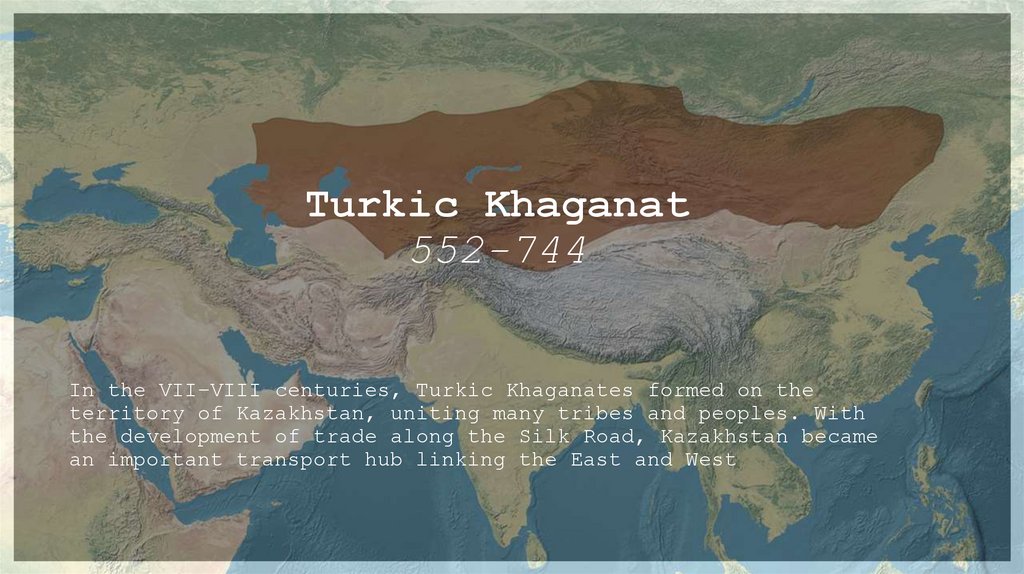
13. Turkic Khaganat 552-744
In the VII–VIII centuries, Turkic Khaganates formed on theterritory of Kazakhstan, uniting many tribes and peoples. With
the development of trade along the Silk Road, Kazakhstan became
an important transport hub linking the East and West
14. Mongol invasion Golden Horde
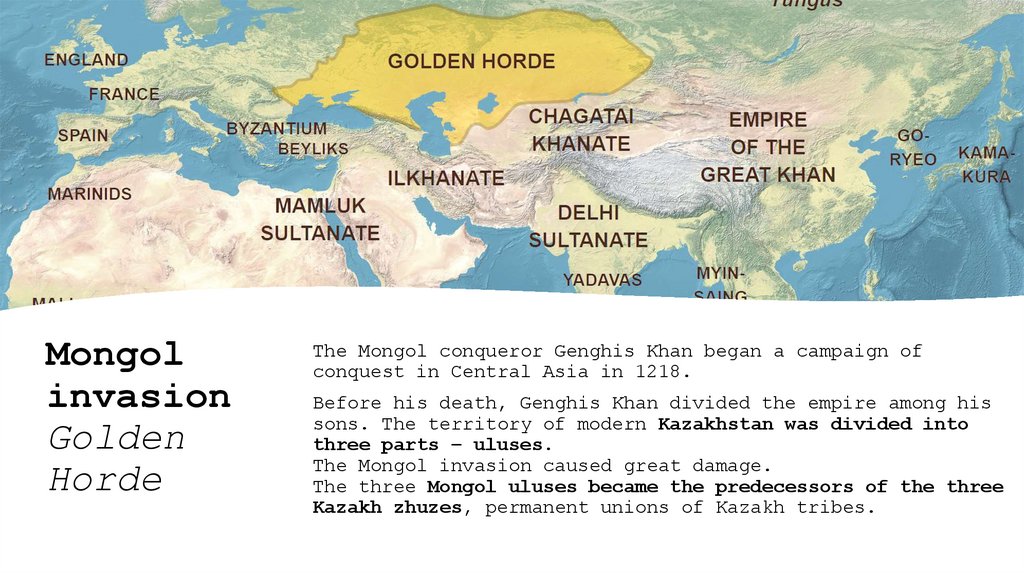
The Mongol conqueror Genghis Khan began a campaign ofconquest in Central Asia in 1218.
Before his death, Genghis Khan divided the empire among his
sons. The territory of modern Kazakhstan was divided into
three parts – uluses.
The Mongol invasion caused great damage.
The three Mongol uluses became the predecessors of the three
Kazakh zhuzes, permanent unions of Kazakh tribes.
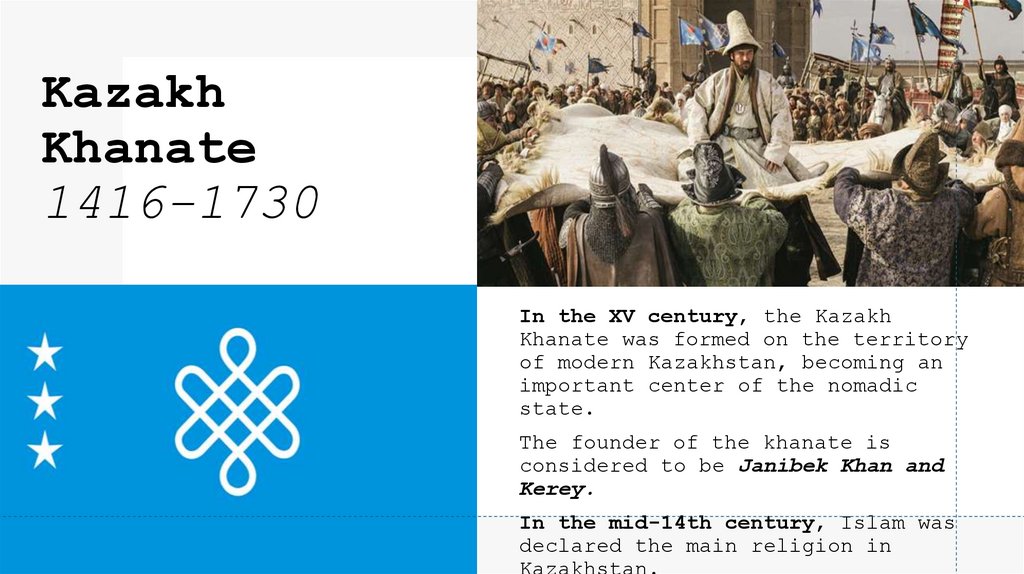
15. Kazakh Khanate 1416-1730
In the XV century, the KazakhKhanate was formed on the territory
of modern Kazakhstan, becoming an
important center of the nomadic
state.
The founder of the khanate is
considered to be Janibek Khan and
Kerey.
In the mid-14th century, Islam was
declared the main religion in
Kazakhstan.
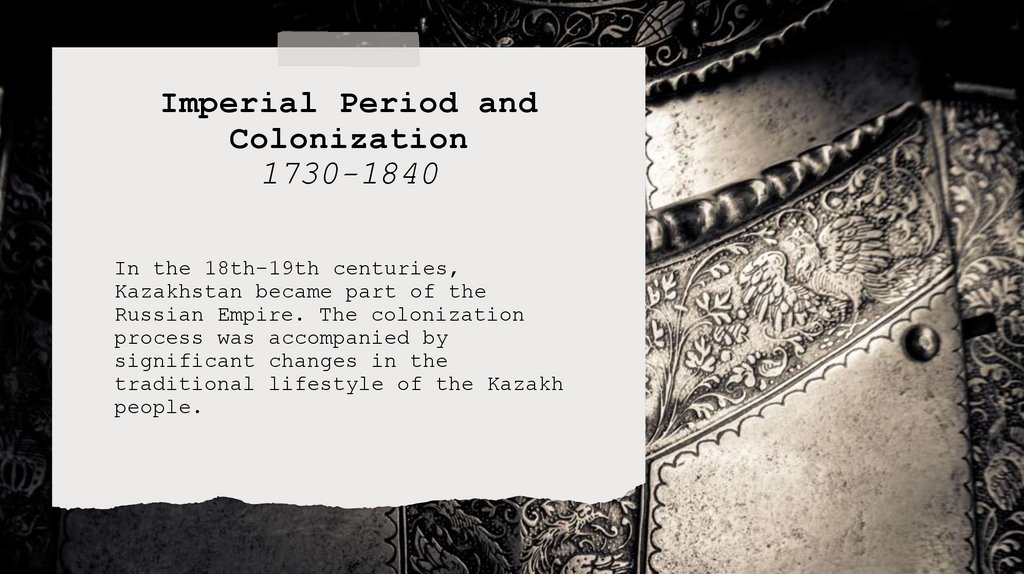
16. Imperial Period and Colonization 1730-1840
In the 18th-19th centuries,Kazakhstan became part of the
Russian Empire. The colonization
process was accompanied by
significant changes in the
traditional lifestyle of the Kazakh
people.
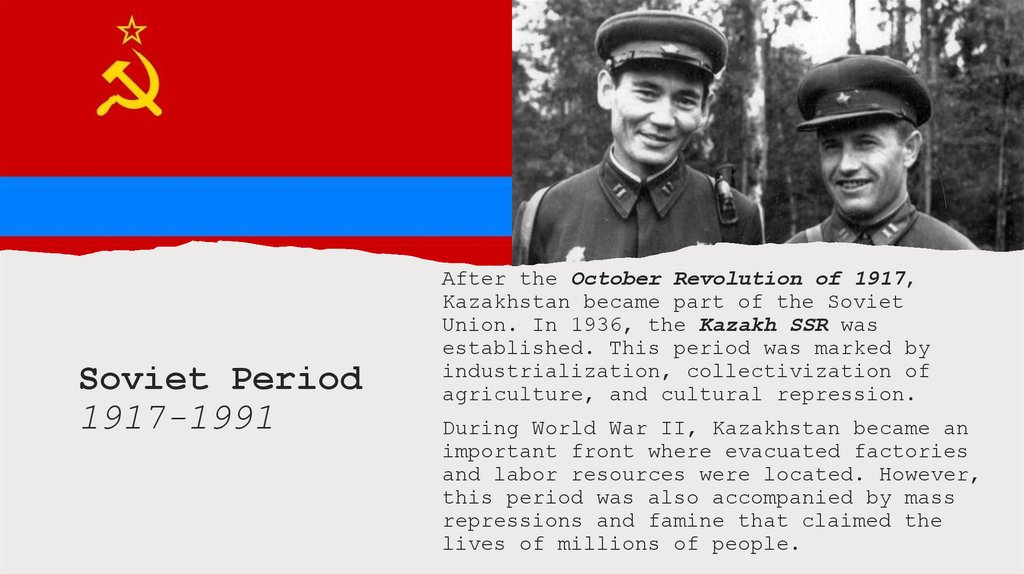
17. Soviet Period 1917-1991
After the October Revolution of 1917,Kazakhstan became part of the Soviet
Union. In 1936, the Kazakh SSR was
established. This period was marked by
industrialization, collectivization of
agriculture, and cultural repression.
During World War II, Kazakhstan became an
important front where evacuated factories
and labor resources were located. However,
this period was also accompanied by mass
repressions and famine that claimed the
lives of millions of people.
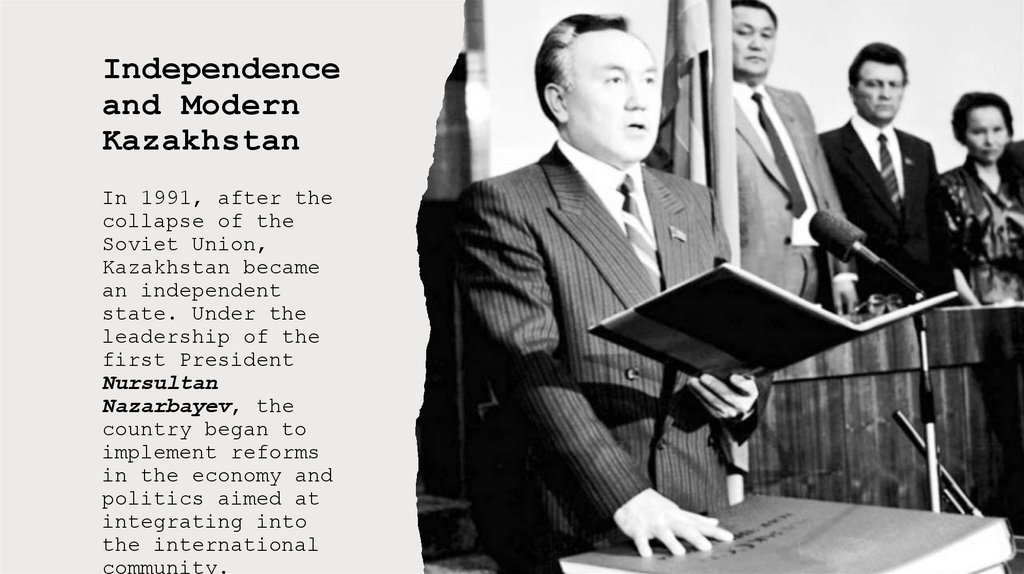
18. Independence and Modern Kazakhstan
In 1991, after thecollapse of the
Soviet Union,
Kazakhstan became
an independent
state. Under the
leadership of the
first President
Nursultan
Nazarbayev, the
country began to
implement reforms
in the economy and
politics aimed at
integrating into
the international
community.
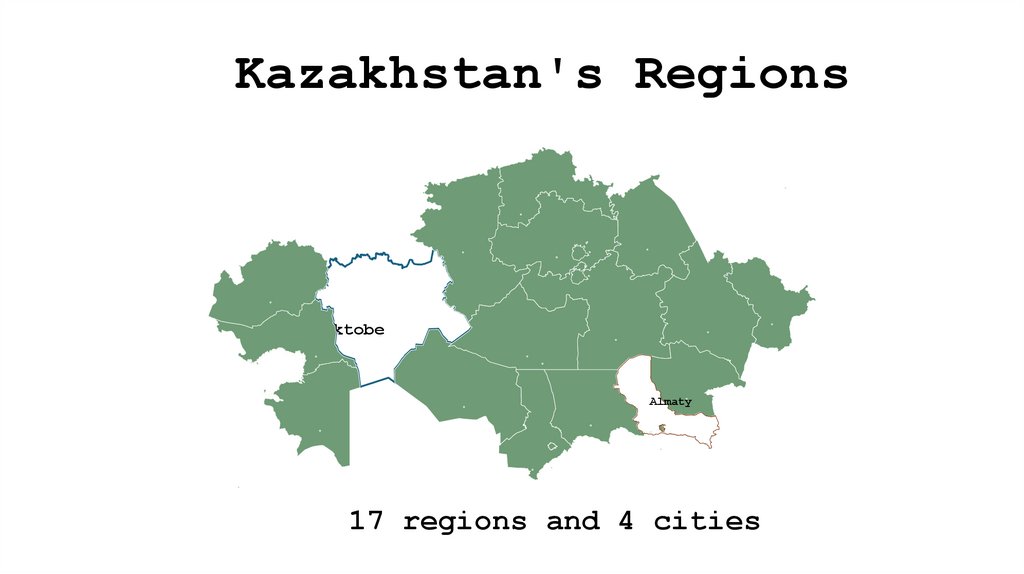
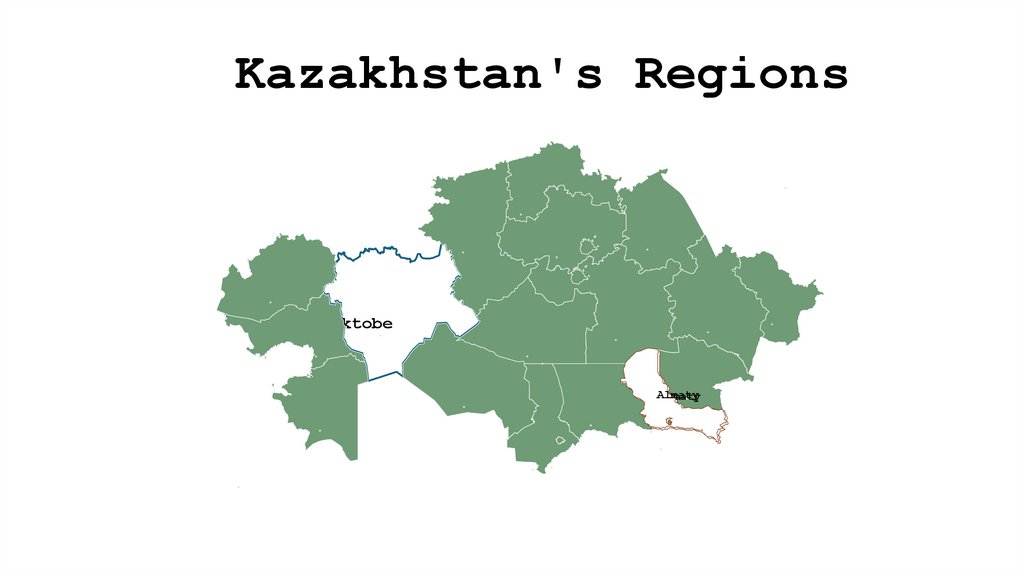
19. Kazakhstan's Regions
Kazakhstan's RegionsAktobe
Almaty
17 regions and 4 cities
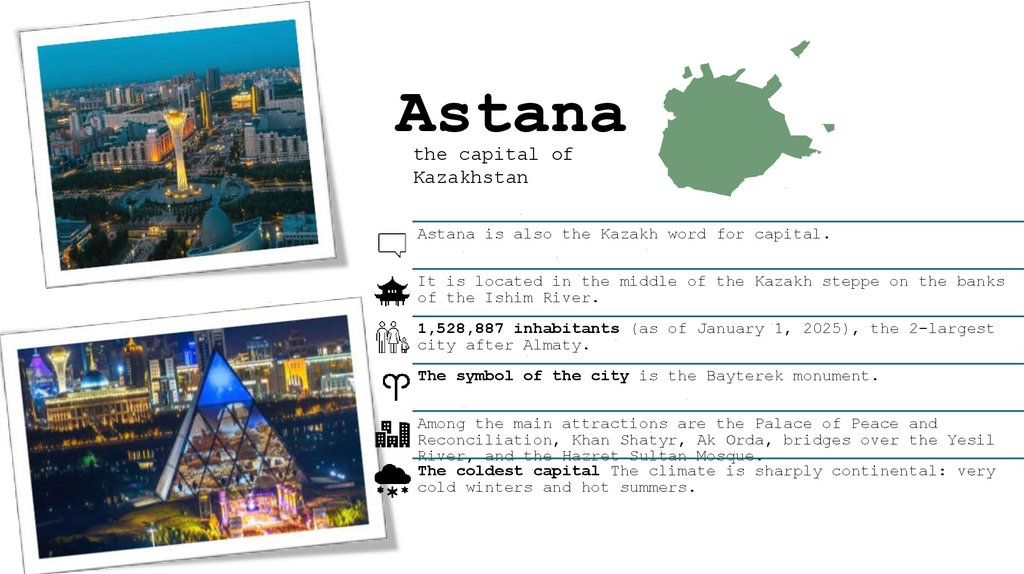
20. Astana
the capital ofKazakhstan
Astana is also the Kazakh word for capital.
It is located in the middle of the Kazakh steppe on the banks
of the Ishim River.
1,528,887 inhabitants (as of January 1, 2025), the 2-largest
city after Almaty.
The symbol of the city is the Bayterek monument.
Among the main attractions are the Palace of Peace and
Reconciliation, Khan Shatyr, Ak Orda, bridges over the Yesil
River, and the Hazret Sultan Mosque.
The coldest capital The climate is sharply continental: very
cold winters and hot summers.
21. Kazakhstan's Regions
Kazakhstan's RegionsAktobe
Almaty
Almaty
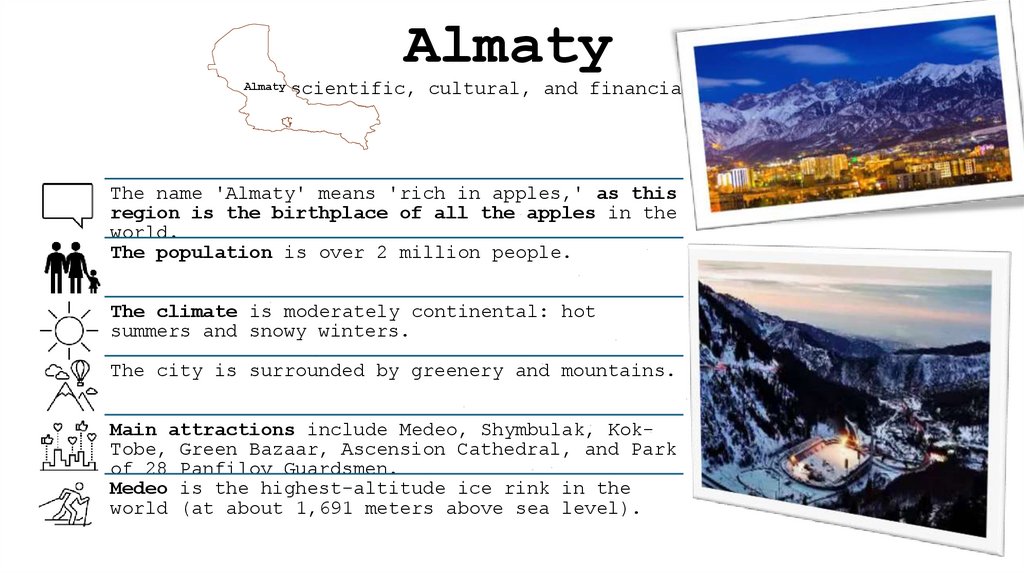
22. Almaty The scientific, cultural, and financial center
AlmatyAlmaty scientific, cultural, and financial center
The
The name 'Almaty' means 'rich in apples,' as this
region is the birthplace of all the apples in the
world.
The population is over 2 million people.
The climate is moderately continental: hot
summers and snowy winters.
The city is surrounded by greenery and mountains.
Main attractions include Medeo, Shymbulak, KokTobe, Green Bazaar, Ascension Cathedral, and Park
of 28 Panfilov Guardsmen.
Medeo is the highest-altitude ice rink in the
world (at about 1,691 meters above sea level).
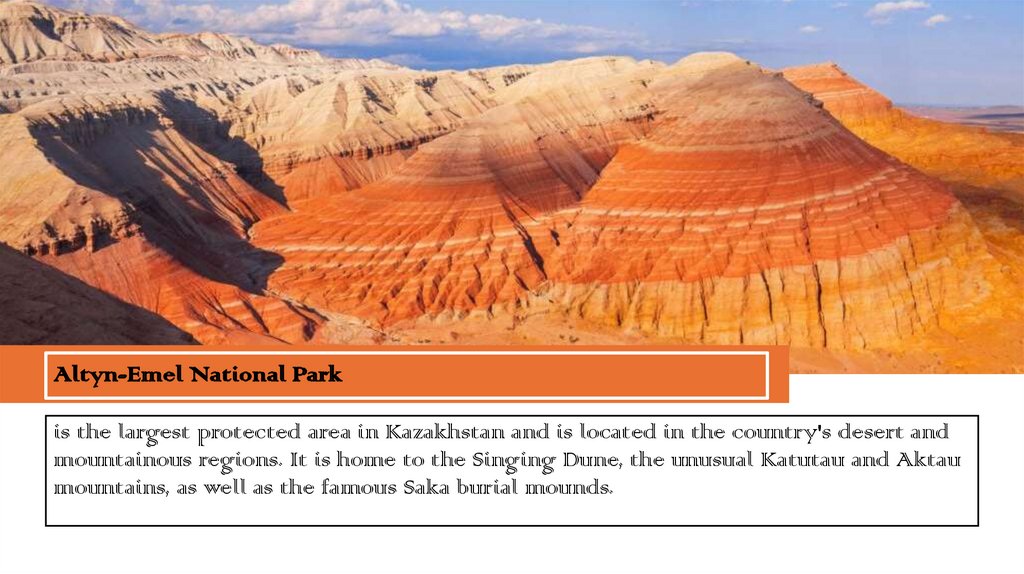
23. Altyn-Emel National Park
is the largest protected area in Kazakhstan and is located in the country's desert andmountainous regions. It is home to the Singing Dune, the unusual Katutau and Aktau
mountains, as well as the famous Saka burial mounds.
24.
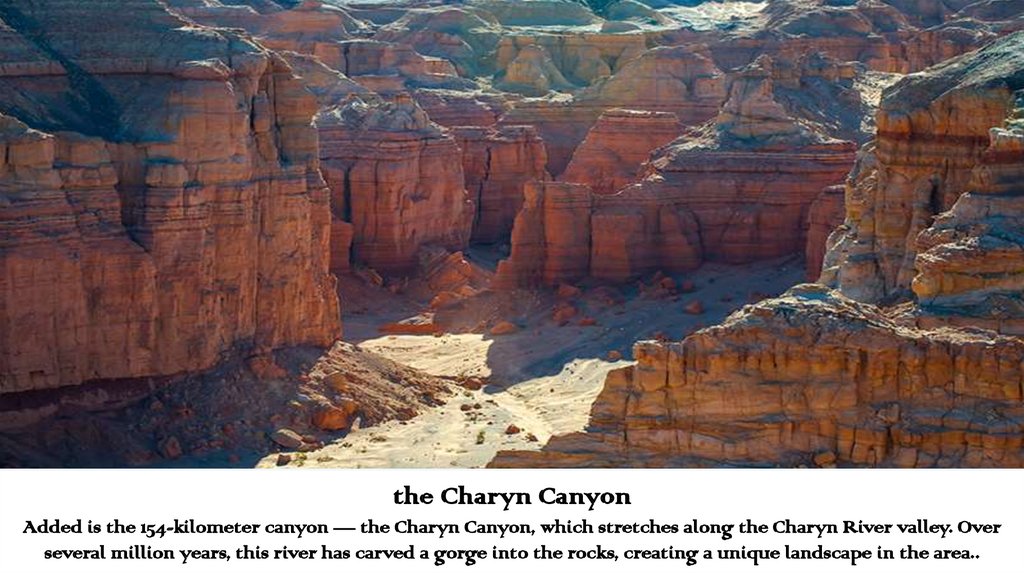
the Charyn CanyonAdded is the 154-kilometer canyon — the Charyn Canyon, which stretches along the Charyn River valley. Over
several million years, this river has carved a gorge into the rocks, creating a unique landscape in the area..
25.
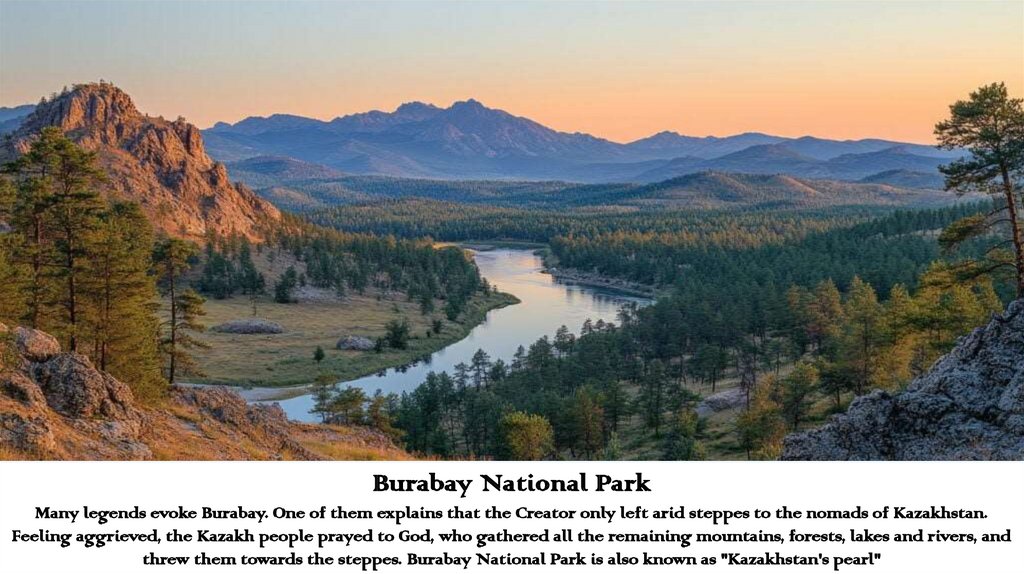
Burabay National ParkMany legends evoke Burabay. One of them explains that the Creator only left arid steppes to the nomads of Kazakhstan.
Feeling aggrieved, the Kazakh people prayed to God, who gathered all the remaining mountains, forests, lakes and rivers, and
threw them towards the steppes. Burabay National Park is also known as "Kazakhstan's pearl"
26.
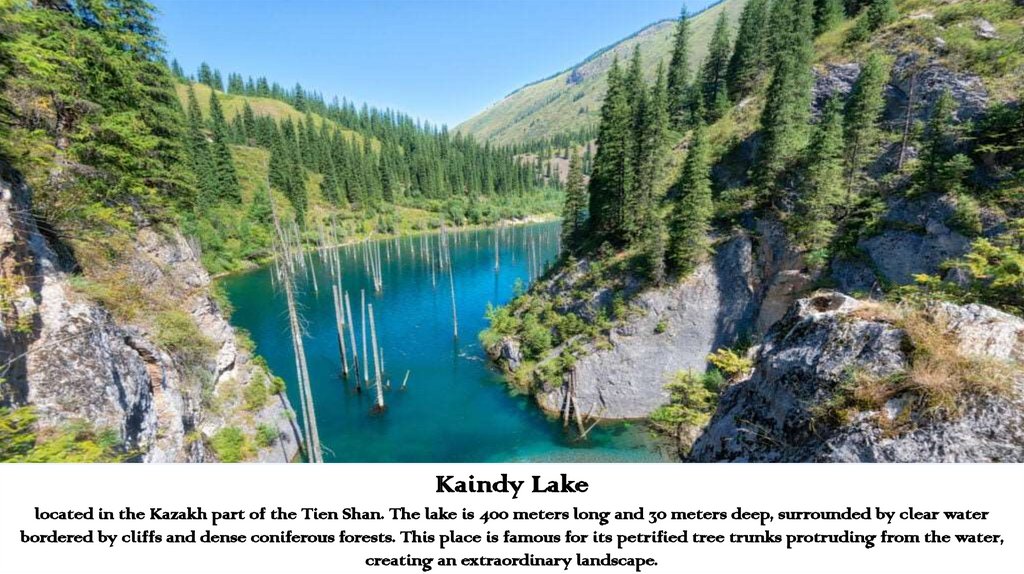
Kaindy Lakelocated in the Kazakh part of the Tien Shan. The lake is 400 meters long and 30 meters deep, surrounded by clear water
bordered by cliffs and dense coniferous forests. This place is famous for its petrified tree trunks protruding from the water,
creating an extraordinary landscape.
27.
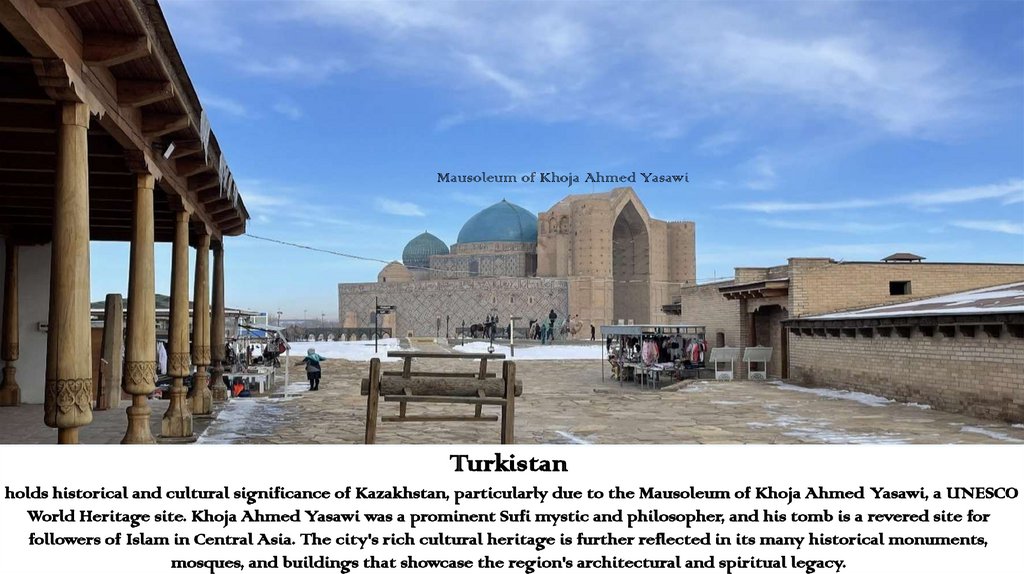
Mausoleum of Khoja Ahmed YasawiTurkistan
holds historical and cultural significance of Kazakhstan, particularly due to the Mausoleum of Khoja Ahmed Yasawi, a UNESCO
World Heritage site. Khoja Ahmed Yasawi was a prominent Sufi mystic and philosopher, and his tomb is a revered site for
followers of Islam in Central Asia. The city's rich cultural heritage is further reflected in its many historical monuments,
mosques, and buildings that showcase the region's architectural and spiritual legacy.
28. Ressource
• https://www.auswaertigesamt.de/de/service/laender/kasachstannode/steckbrief-206340
• https://www.istmira.com/dr
ugoe-razlichnyetemy/17854-kratkajaistorija-kazahstana.html
• Kasachstan: Steckbrief -
Auswärtiges Amt