
 education
Similar presentations:




The education system in the UK
1. The education system in the UK
THE EDUCATION SYSTEM IN THE UKВЫПОЛНИЛА СУВОРОВА КРИСТИНА
СТУДЕНТКА 104-СПД
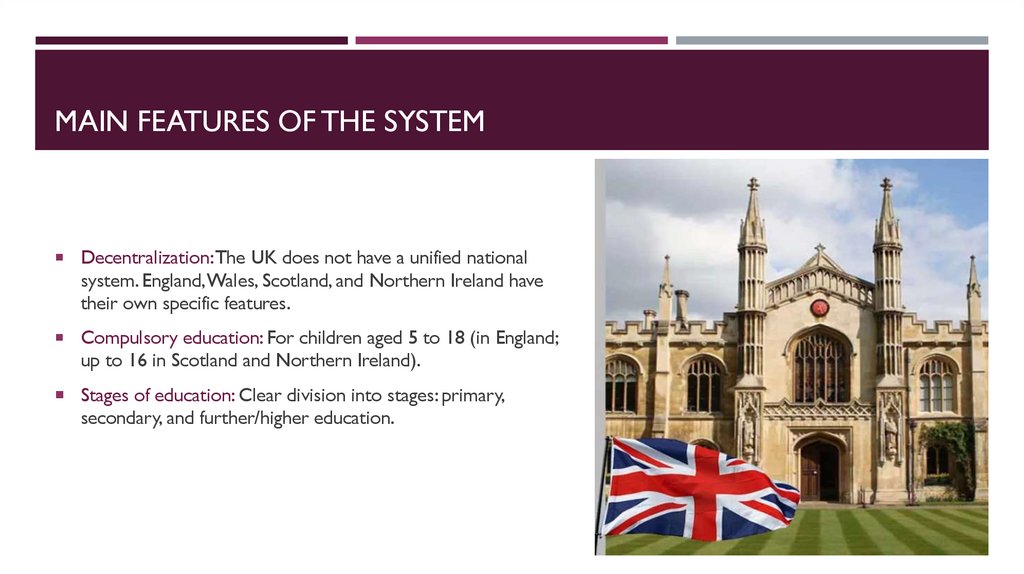
2. Main features of the system
MAIN FEATURES OF THE SYSTEMDecentralization: The UK does not have a unified national
system. England, Wales, Scotland, and Northern Ireland have
their own specific features.
Compulsory education: For children aged 5 to 18 (in England;
up to 16 in Scotland and Northern Ireland).
Stages of education: Clear division into stages: primary,
secondary, and further/higher education.
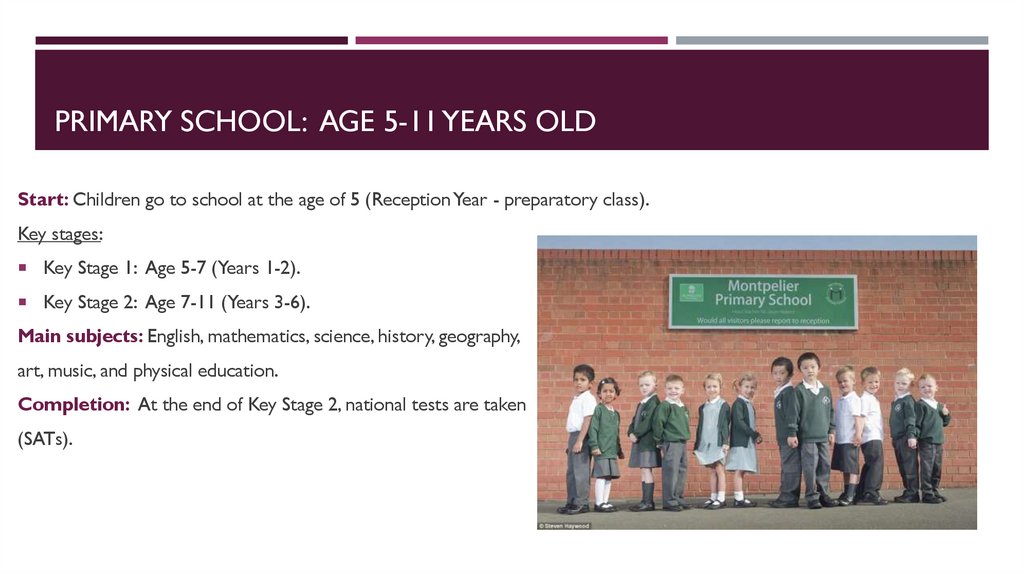
3. Primary school: Age 5-11 years old
PRIMARY SCHOOL: AGE 5-11 YEARS OLDStart: Children go to school at the age of 5 (Reception Year - preparatory class).
Key stages:
Key Stage 1: Age 5-7 (Years 1-2).
Key Stage 2: Age 7-11 (Years 3-6).
Main subjects: English, mathematics, science, history, geography,
art, music, and physical education.
Completion: At the end of Key Stage 2, national tests are taken
(SATs).
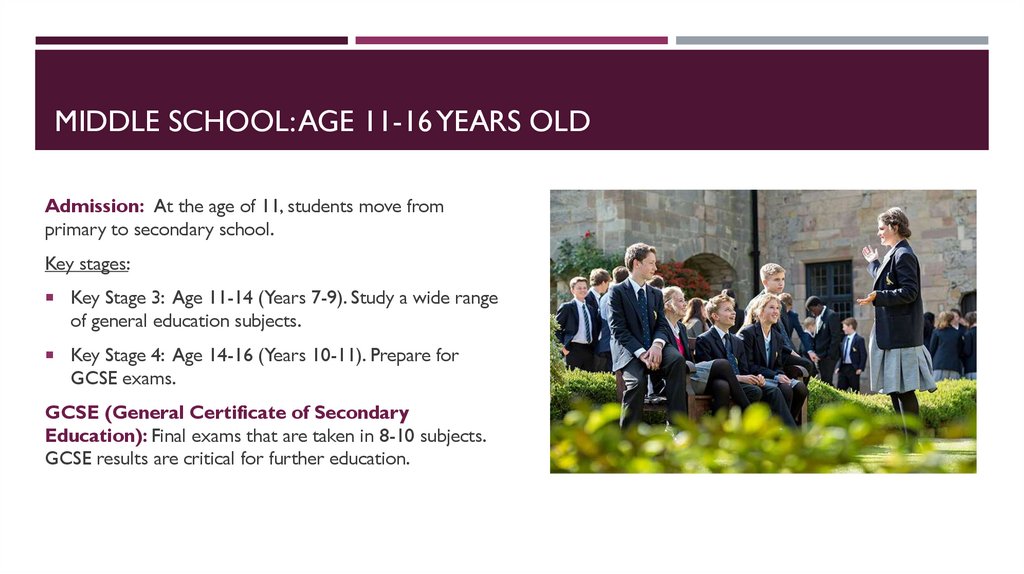
4. Middle school: Age 11-16 years old
MIDDLE SCHOOL: AGE 11-16 YEARS OLDAdmission: At the age of 11, students move from
primary to secondary school.
Key stages:
Key Stage 3: Age 11-14 (Years 7-9). Study a wide range
of general education subjects.
Key Stage 4: Age 14-16 (Years 10-11). Prepare for
GCSE exams.
GCSE (General Certificate of Secondary
Education): Final exams that are taken in 8-10 subjects.
GCSE results are critical for further education.
5. Sixth grade (Sixth Form): Age 16-18 years old
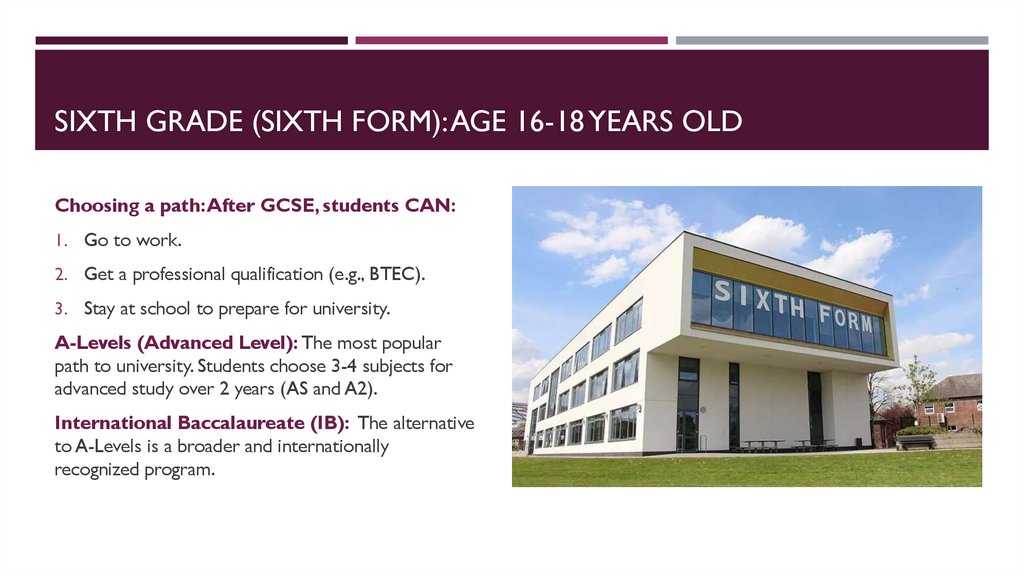
SIXTH GRADE (SIXTH FORM): AGE 16-18 YEARS OLDChoosing a path: After GCSE, students CAN:
1. Go to work.
2. Get a professional qualification (e.g., BTEC).
3. Stay at school to prepare for university.
A-Levels (Advanced Level): The most popular
path to university. Students choose 3-4 subjects for
advanced study over 2 years (AS and A2).
International Baccalaureate (IB): The alternative
to A-Levels is a broader and internationally
recognized program.
6. Private sector: "Public Schools"
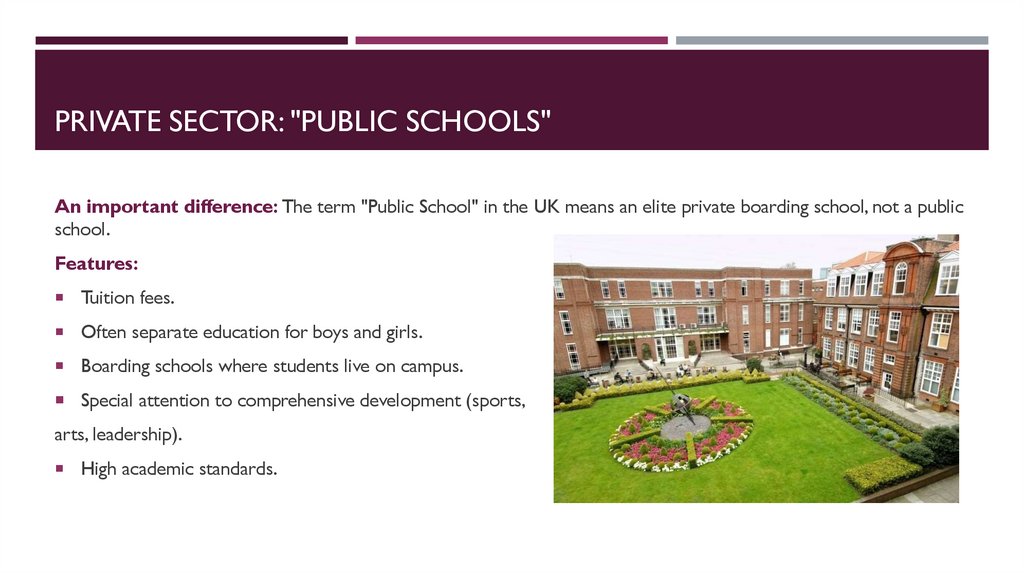
PRIVATE SECTOR: "PUBLIC SCHOOLS"An important difference: The term "Public School" in the UK means an elite private boarding school, not a public
school.
Features:
Tuition fees.
Often separate education for boys and girls.
Boarding schools where students live on campus.
Special attention to comprehensive development (sports,
arts, leadership).
High academic standards.
7. Oxford and Cambridge: A Unique System
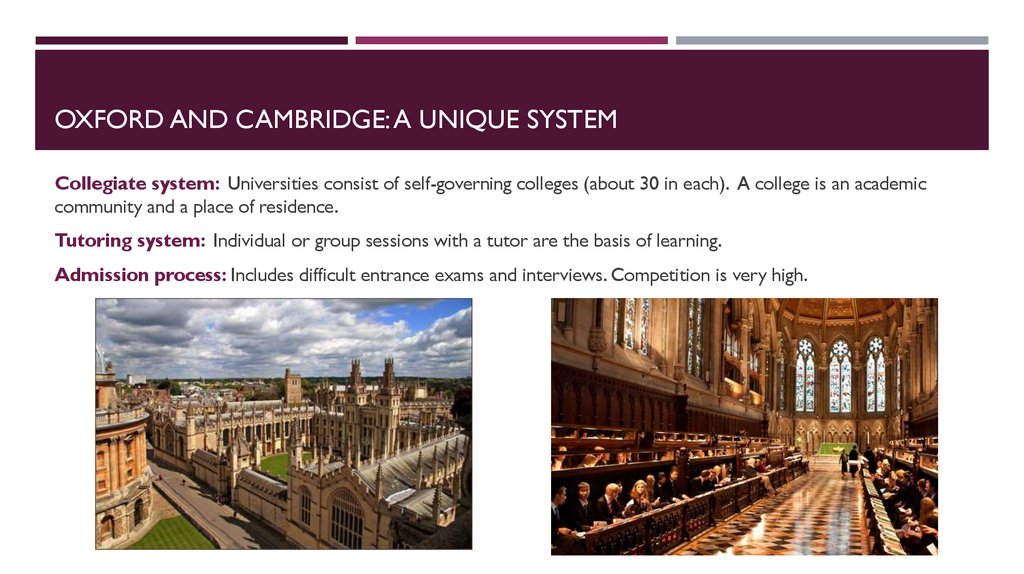
OXFORD AND CAMBRIDGE: A UNIQUE SYSTEMCollegiate system: Universities consist of self-governing colleges (about 30 in each). A college is an academic
community and a place of residence.
Tutoring system: Individual or group sessions with a tutor are the basis of learning.
Admission process: Includes difficult entrance exams and interviews. Competition is very high.
8. Results: Advantages and challenges of the system
RESULTS: ADVANTAGES AND CHALLENGES OF THE SYSTEMStrengths:
Academic depth and specialization (A-Levels).
Rich historical traditions and prestige.
Flexibility of choice at all stages.
High quality of university research.
Possible disadvantages:
Early specialization (at the age of 16).
Social stratification (due to expensive private schools).
High cost of higher education for students.
Conclusion: The British education system remains one of the most influential and respected in the world, combining
centuries-old traditions with modern approaches.