 english
Similar presentations:




Syntactical expressive means and stylistic devices. Part 2
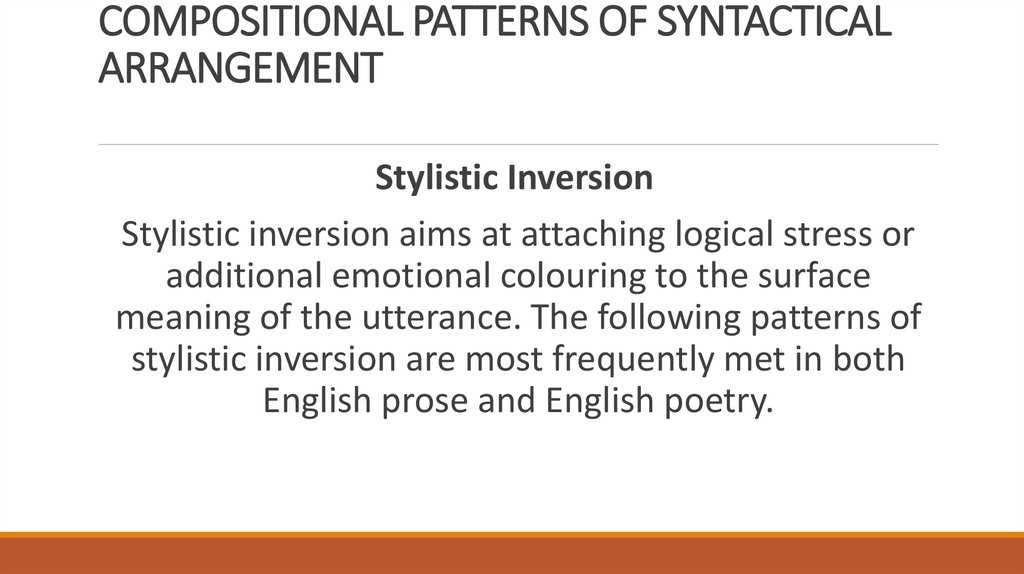
1. COMPOSITIONAL PATTERNS OF SYNTACTICAL ARRANGEMENT
Stylistic InversionStylistic inversion aims at attaching logiсal stress or
additional emotional colouring to the surface
meaning of the utterance. The following patterns of
stylistic inversion are most frequently met in both
English prose and English poetry.
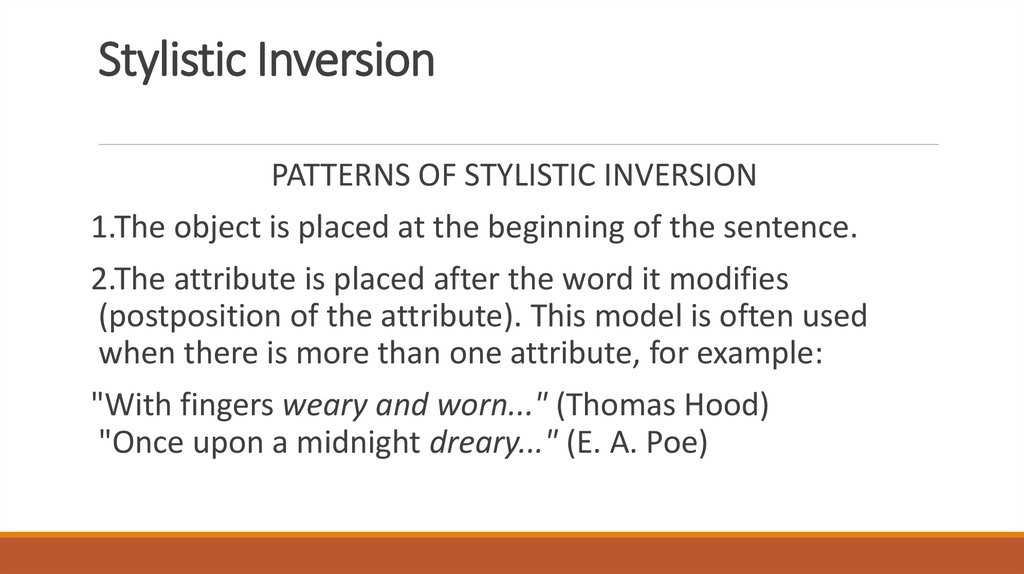
2. Stylistic Inversion
PATTERNS OF STYLISTIC INVERSION1.The object is placed at the beginning of the sentence.
2.The attribute is placed after the word it modifies
(postposition of the attribute). This model is often used
when there is more than one attribute, for example:
"With fingers weary and worn..." (Thomas Hood)
"Once upon a midnight dreary..." (E. A. Poe)
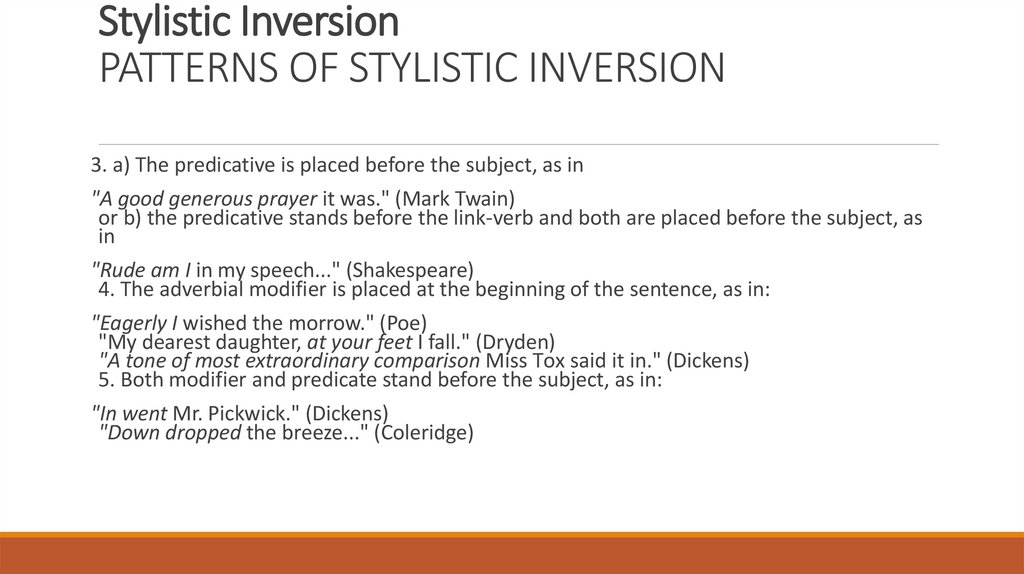
3. Stylistic Inversion PATTERNS OF STYLISTIC INVERSION
3. a) The predicative is placed before the subject, as in"A good generous prayer it was." (Mark Twain)
or b) the predicative stands before the link-verb and both are placed before the subject, as
in
"Rude am I in my speech..." (Shakespeare)
4. The adverbial modifier is placed at the beginning of the sentence, as in:
"Eagerly I wished the morrow." (Poe)
"My dearest daughter, at your feet I fall." (Dryden)
"A tone of most extraordinary comparison Miss Tох said it in." (Dickens)
5. Both modifier and predicate stand before the subject, as in:
"In went Mr. Pickwick." (Dickens)
"Down dropped the breeze..." (Coleridge)
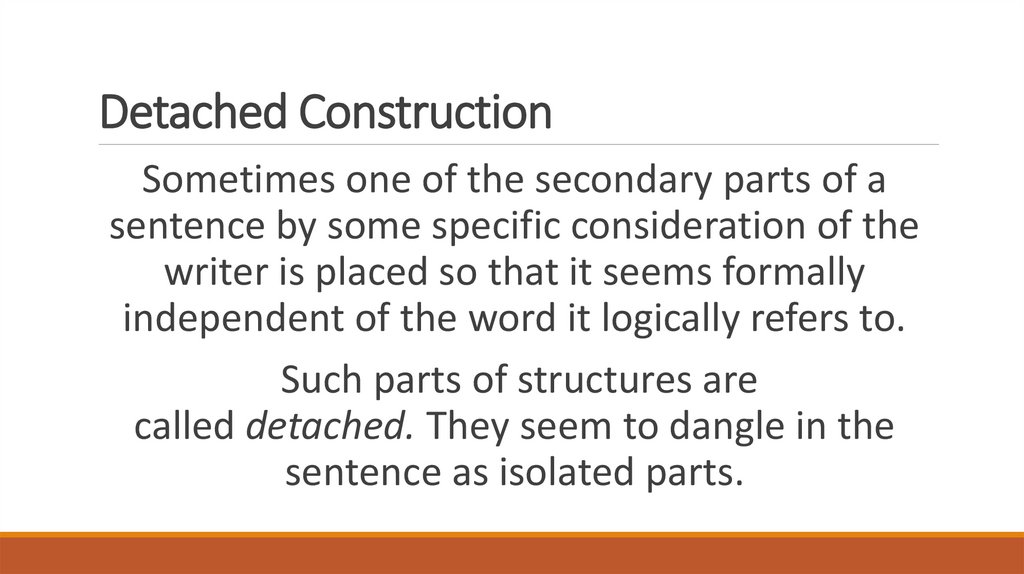
4. Detached Construction
Sometimes one of the secondary parts of asentence by some specific consideration of the
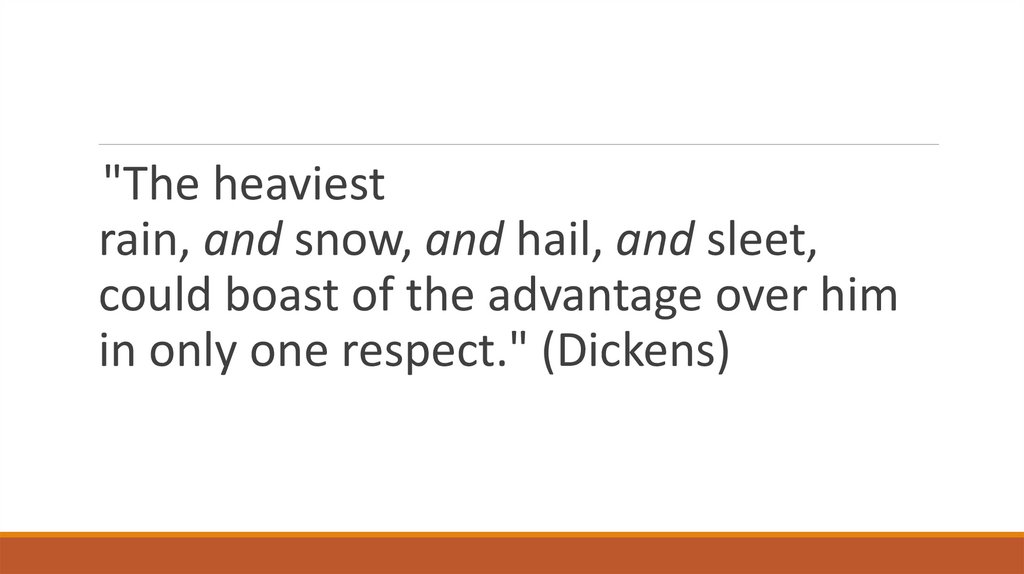
writer is placed so that it seems formally
independent of the word it logically refers to.
Such parts of structures are
called detached. They seem to dangle in the
sentence as isolated parts.
5. Detached Construction
The structural patterns of detachedconstructions have not yet been classified, but
the most noticeable cases are those in which an
attribute or an adverbial modifier is placed not
in immediate proximity to its referent, but in
some other position,
6. Detached Construction
as in the following examples:1) "Steyne rose up, grinding his
teeth, pale, and with fury in his
eyes." (Thackeray)
2) "Sir Pitt came in first, very much
flushed, and rather unsteady in his
gait." (Thackeray)
7. Parallel construction
a device which may be encountered not somuch in the sentence as in the macro-structures
dealt with earlier, namely the SPU and the
paragraph. The necessary condition in parallel
construction is identical, or similar, syntactical
structure in two or more sentences or parts of a
sentence in close succession,
8. Parallel construction
as in:"There were, ..., real silver spoons to stir the tea
with, and real china cups to drink it out
of, and plates of the same to hold the cakes and
toast in." (Dickens)
9. Parallel construction
Parallel constructions are often backed up byrepetition of words (lexical repetition) and
conjunctions and prepositions (polysyndeton).
Pure parallel construction, however, does
not depend on any other kind of repetition but
the repetition of the syntactical design of the
sentence.
10. Parallel construction
Parallel constructions may be partial or complete. Partialparallel arrangement is the repetition of some parts of
successive sentences or clauses, as in:
"It is the mob that labour in your fields and serve in your
houses – that man your navy and recruit your army, – that
have enabled you to defy all the world, and can also defy
you when neglect and calamity have driven them to
despair."
(Byron)
11. Chiasmus (Reversed Parallel Construction)
Chiasmиs belongs to the group of stуlistic dеvices based on the repetitionof a syntactical pattern, but it has a cross order of words аnd phrases. The
structure of two successive sentences or parts of a sentence may be
described as reversed parallel construction, the word-order of one of the
sentences being inverted as compared with that of the other, as in:
"As high as we have mounted in delight
In our dejection do we sink as low." (Wordsworth)
"Down dropped the breeze,
The sails dropped down." (Coleridge)
12. Chiasmus (Reversed Parallel Construction)
Chiasmus is sometimes achieved by a sudden change from active voice to passive or vice versa,for example:
"The register of his burial was signed by the clergyman, the clerk, the undertaker and the chief
mourner. Scrooge signed it. (Dickens)
It must be remembered that chiasmus is a syntactical, not a lexical device, i. e. it is only the
arrangement of the parts of the utterance which constitutes this stylistic device.
13. Repetition
When used as a stylistic device, repetition acquiresquite different functions.
It does not aim at making a direct emotional impact.
On the contrary, the stylistic device of repetition aims
at logical emphasis, an emphasis necessary to fix the
attention of the reader on the key-word of the
utterance.
14. Repetition
For example:"For that was it! Ignorant of the long and stealthy
march of passion, and of the state to which it had
reduced Fleur; ignorant of how Soames had
watched her, ignorant of Fleur's reckless
desperation... – ignorant of all this, everybody felt
aggrieved." (Galsworthy)
15. Repetition
Repetition is classified according tocompositional patterns. If the repeated
word (or phrase) comes at the
beginning of two or more consecutive
sentences, clauses or phrases, we
have anaphora, as in the example
above.
16. Repetition
If the repeated unit is placed at the end ofconsecutive sentences, clauses or phrases, we have
the type of repetition called epiphora, as in:
"I am exactly the man to be placed in a superior
position in such a case as that. I am above the rest of
mankind, in such a case as that. I can act with
philosophy in such a case as that. (Dickens)
17. Repetition
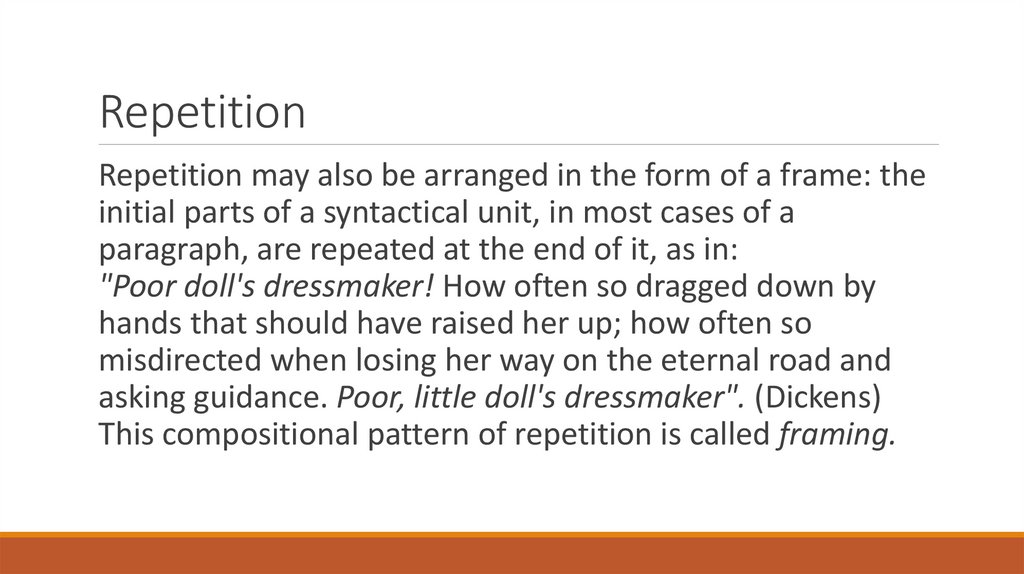
Repetition may also be arranged in the form of a frame: theinitial parts of a syntactical unit, in most cases of a
paragraph, are repeated at the end of it, as in:
"Poor doll's dressmaker! How often so dragged down by
hands that should have raised her up; how often so
misdirected when losing her way on the eternal road and
asking guidance. Poor, little doll's dressmaker". (Dickens)
This compositional pattern of repetition is called framing.
18. Repetition
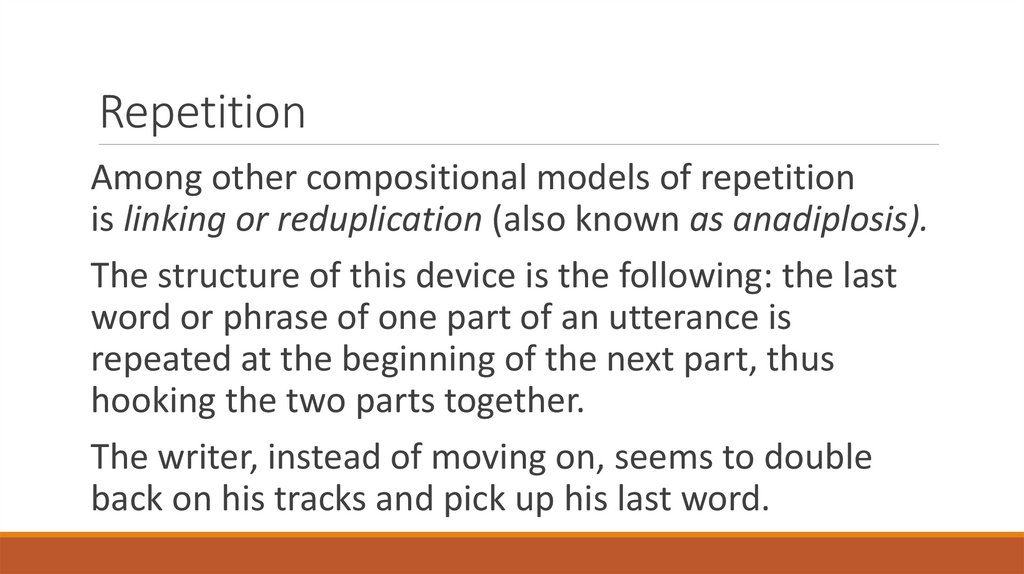
Among other compositional models of repetitionis linking or reduplication (also known as anadiplosis).
The structure of this device is the following: the last
word or phrase of one part of an utterance is
repeated at the beginning of the next part, thus
hooking the two parts together.
The writer, instead of moving on, seems to double
back on his tracks and pick up his last word.
19. Repetition
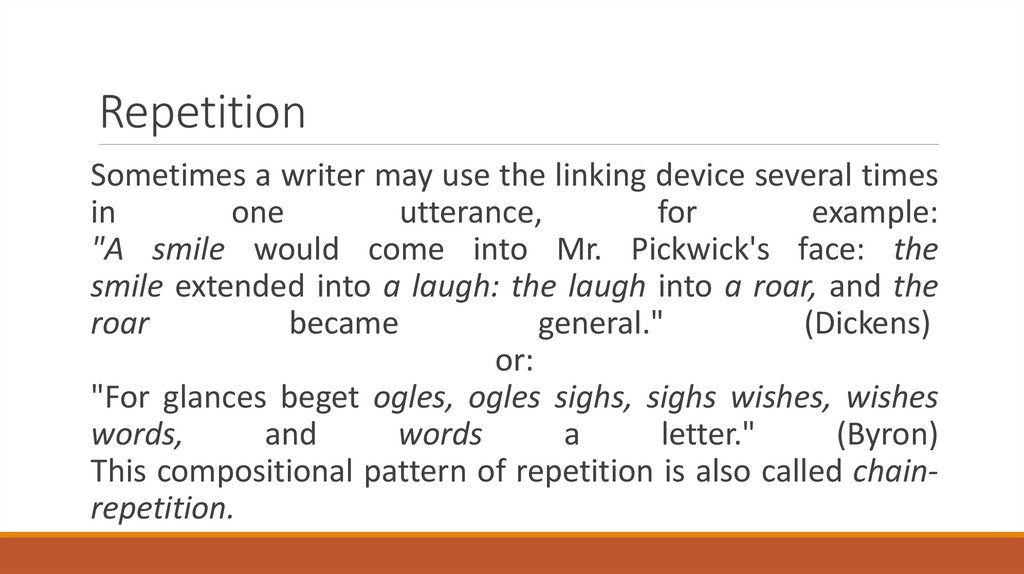
Sometimes a writer may use the linking device several timesin
one
utterance,
for
example:
"A smile would come into Mr. Pickwick's face: the
smile extended into a laugh: the laugh into a roar, and the
roar
became
general."
(Dickens)
or:
"For glances beget ogles, ogles sighs, sighs wishes, wishes
words,
and
words
a
letter."
(Byron)
This compositional pattern of repetition is also called chainrepetition.
20. Repetition
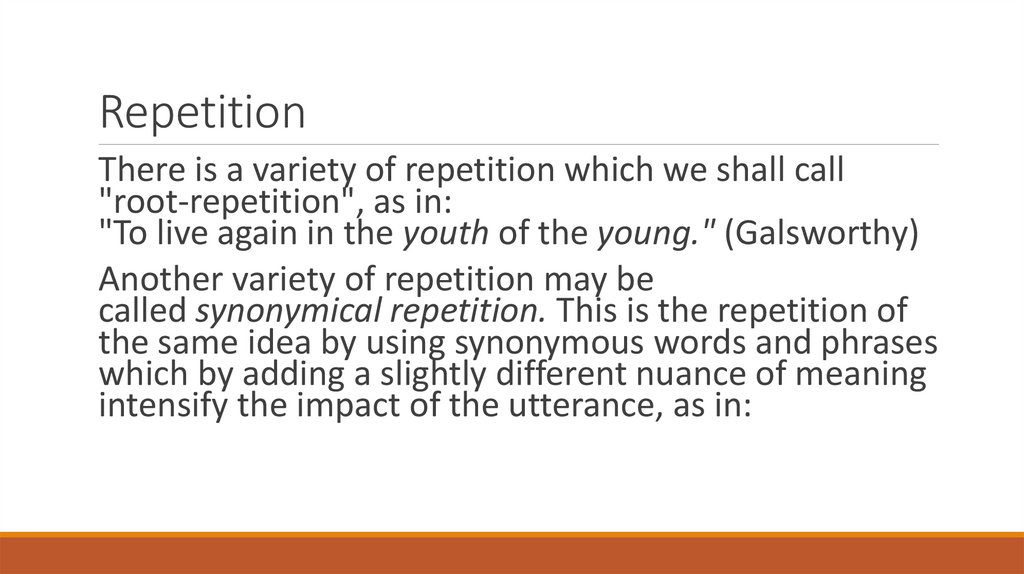
There is a variety of repetition which we shall call"root-repetition", as in:
"To live again in the youth of the young." (Galsworthy)
Another variety of repetition may be
called synonymical repetition. This is the repetition of
the same idea by using synonymous words and phrases
which by adding a slightly different nuance of meaning
intensify the impact of the utterance, as in:
21. Repetition
"...are there not capital punishments sufficient inyour statutes? Is there not blood enough upon
your penal code?" (Byron)
Here the meaning of the words 'capital punishments'
and 'statutes‘ (rules made by a body or institution for
the government of its internal affairs) is repeated in
the next sentence by the contextual synonyms 'blood'
and 'penal code'.
22. Enumeration
a stylistic device by which separate things, objects,phenomena, properties, actions are named one by
one so that they produce a chain, the links of which,
being syntactically in the same position
(homogeneous parts of speech), are forced to display
some kind of semantic homogeneity, remote though
it may seem.
23. Suspense
a compositional device which consists in arranging thematter of a communication in such a way that the less
important, descriptive, subordinate parts are amassed at
the beginning, the main idea being withheld till the end of
the sentence. Thus the reader's attention is held and his
interest kept up, for example:
"Mankind, says a Chinese manuscript, which my friend M.
was obliging enough to read and explain to me, for the first
seventy thousand ages ate their meat raw." (Charles Lamb)
24. Climax (Gradation)
an arrangement, of sentences (or of the homogeneous partsof one sentence) which secures a gradual increase in
significance, importance, or emotional tension in the
utterance, as in:
"It was a lovely city, a beautiful city, a fair city, a veritable gem
of a city."
or in:
"Ne barrier wall, ne river deep and wide,
Ne horrid crags, nor mountains dark and tall
Rise like the rocks that part Hispania's land from
Gaul." (Byron)
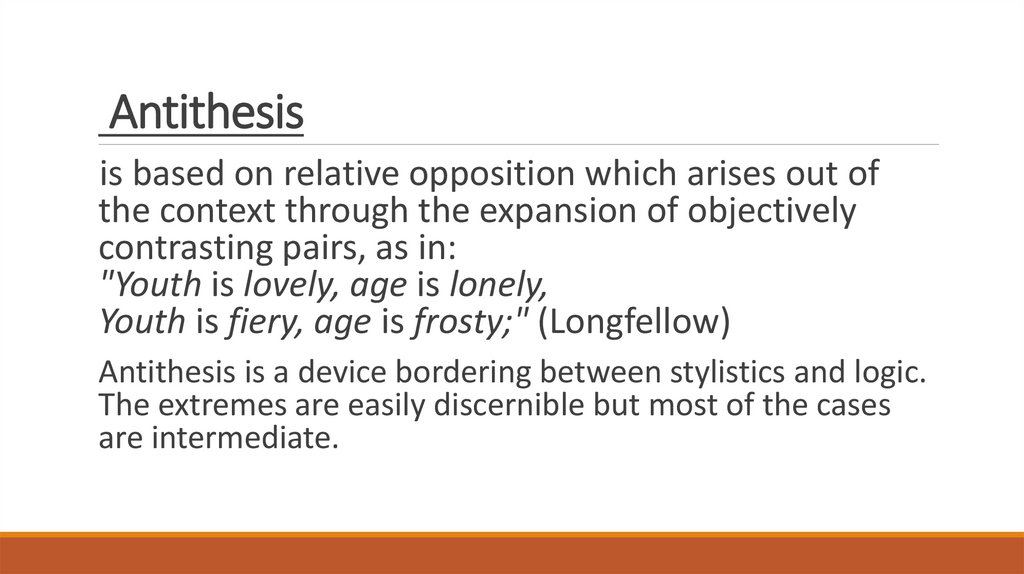
25. Antithesis
is based on relative opposition which arises out ofthe context through the expansion of objectively
contrasting pairs, as in:
"Youth is lovely, age is lonely,
Youth is fiery, age is frosty;" (Longfellow)
Antithesis is a device bordering between stylistics and logic.
The extremes are easily discernible but most of the cases
are intermediate.
26. Asyndeton
connection between parts of asentence or between sentences without
any formal sign; it becomes a stylistic
device if there is a deliberate omission
of the connective where it is generally
expected to be according to the norms
of the literary language.
27.
Here is an example:"Soames turned away; he had an utter
disinclination for talk, like one standing
before an open grave, watching a coffin
slowly lowered." (Galsworthy)
28.
The deliberate omission of the subordinateconjunction because or for makes the
sentence 'he had an utter...' almost entirely
independent. It might be perceived as a
characteristic feature of Soames in general,
but for the comparison beginning
with like, which shows that Soames's mood
was temporary.
29. Polysyndeton
stylistic device of connecting sentences,or phrases, or syntagms, or words by
using connectives (mostly conjunctions
and prepositions) before each
component part, as in:
30.
"The heaviestrain, and snow, and hail, and sleet,
could boast of the advantage over him
in only one respect." (Dickens)