 education
Similar presentations:


The future of learning
1.
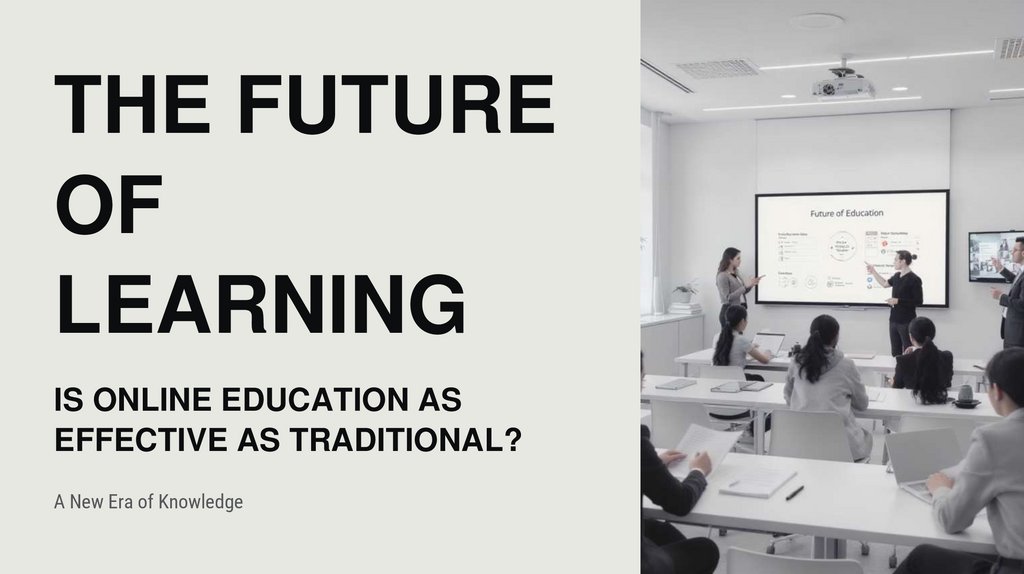
THE FUTUREOF
LEARNING
IS ONLINE EDUCATION AS
EFFECTIVE AS TRADITIONAL?
A New Era of Knowledge
2.
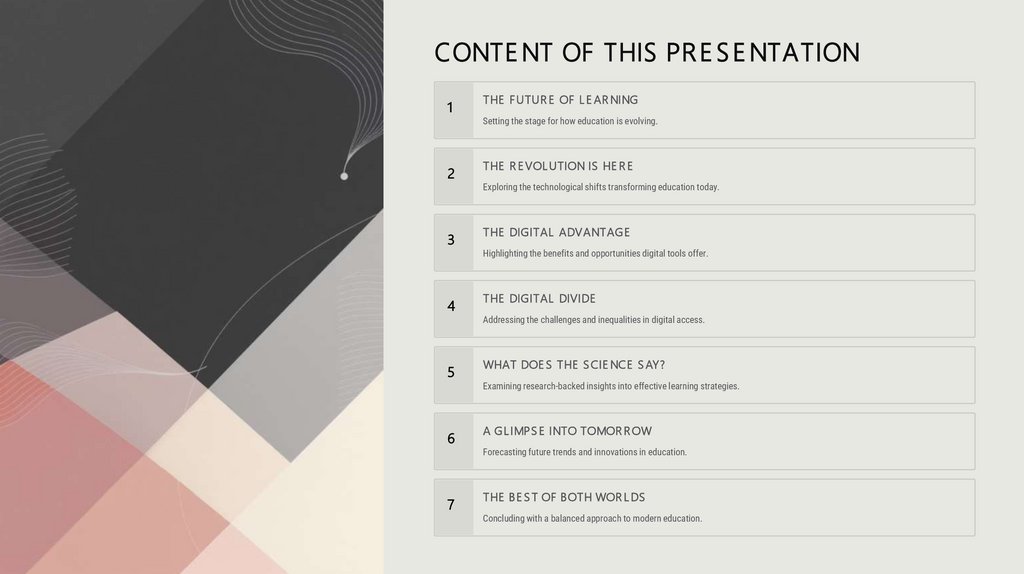
CONTE NT OF THIS PR E S E NTATION1
THE F UTUR E OF L E AR NING
Setting the stage for how education is evolving.
2
THE R E VOL UTION IS HE R E
Exploring the technological shifts transforming education today.
3
THE DIGITAL ADVANTAGE
Highlighting the benefits and opportunities digital tools offer.
4
THE DIGITAL DIVIDE
Addressing the challenges and inequalities in digital access.
5
WHAT DOE S THE S CIE NCE S AY?
Examining research-backed insights into effective learning strategies.
6
A GL IMPS E INTO TOMOR R OW
Forecasting future trends and innovations in education.
7
THE BE S T OF BOTH WOR L DS
Concluding with a balanced approach to modern education.
3.
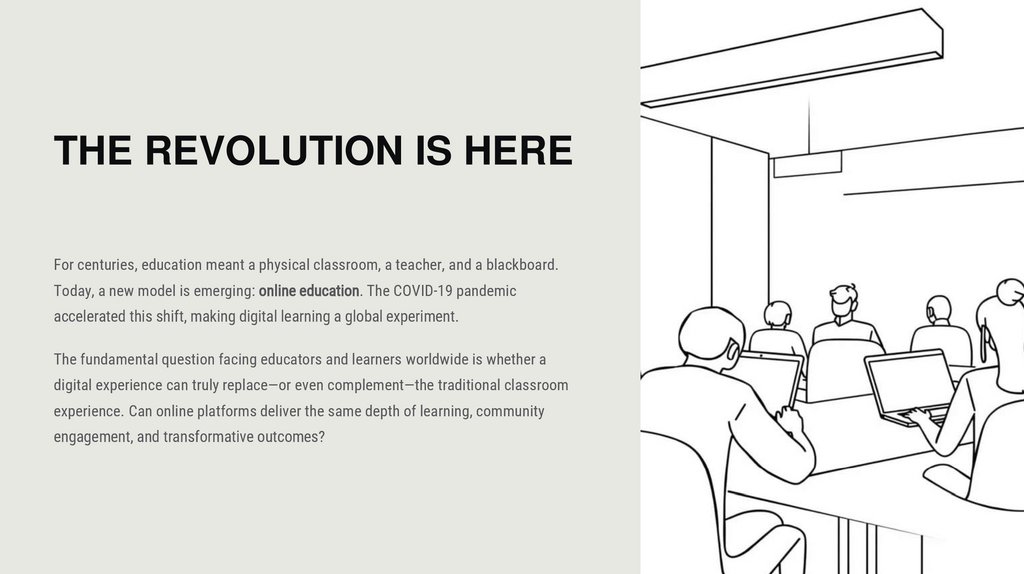
THE REVOLUTION IS HEREFor centuries, education meant a physical classroom, a teacher, and a blackboard.
Today, a new model is emerging: online education. The COVID-19 pandemic
accelerated this shift, making digital learning a global experiment.
The fundamental question facing educators and learners worldwide is whether a
digital experience can truly replace—or even complement—the traditional classroom
experience. Can online platforms deliver the same depth of learning, community
engagement, and transformative outcomes?
4.
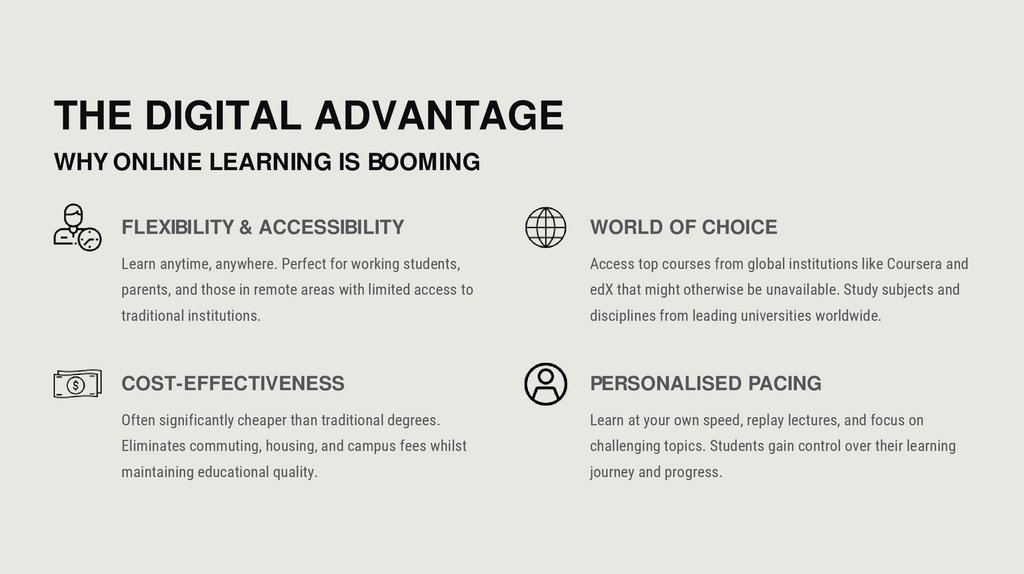
THE DIGITAL ADVANTAGEWHY ONLINE LEARNING IS BOOMING
FLEXIBILITY & ACCESSIBILITY
WORLD OF CHOICE
Learn anytime, anywhere. Perfect for working students,
Access top courses from global institutions like Coursera and
parents, and those in remote areas with limited access to
edX that might otherwise be unavailable. Study subjects and
traditional institutions.
disciplines from leading universities worldwide.
COST-EFFECTIVENESS
PERSONALISED PACING
Often significantly cheaper than traditional degrees.
Learn at your own speed, replay lectures, and focus on
Eliminates commuting, housing, and campus fees whilst
challenging topics. Students gain control over their learning
maintaining educational quality.
journey and progress.
5.
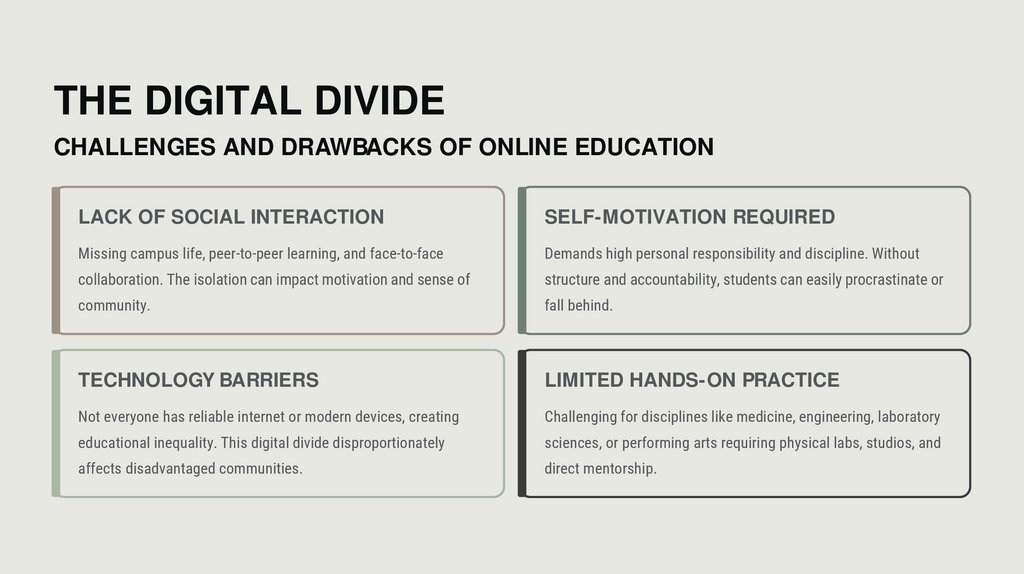
THE DIGITAL DIVIDECHALLENGES AND DRAWBACKS OF ONLINE EDUCATION
LACK OF SOCIAL INTERACTION
SELF-MOTIVATION REQUIRED
Missing campus life, peer-to-peer learning, and face-to-face
Demands high personal responsibility and discipline. Without
collaboration. The isolation can impact motivation and sense of
structure and accountability, students can easily procrastinate or
community.
fall behind.
TECHNOLOGY BARRIERS
LIMITED HANDS-ON PRACTICE
Not everyone has reliable internet or modern devices, creating
Challenging for disciplines like medicine, engineering, laboratory
educational inequality. This digital divide disproportionately
sciences, or performing arts requiring physical labs, studios, and
affects disadvantaged communities.
direct mentorship.
6.
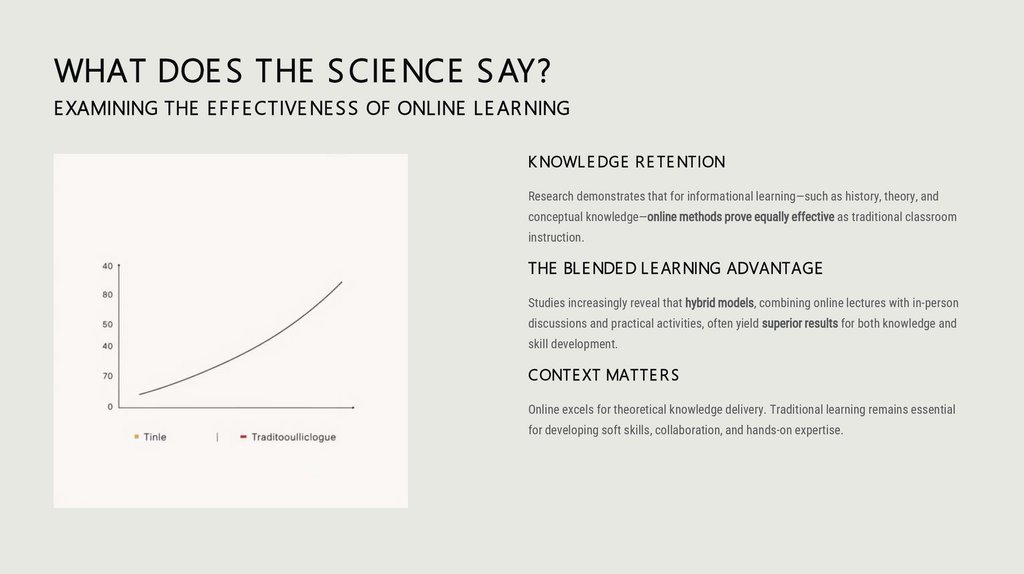
WHAT DOE S THE S CIE NCE S AY?E XAMINING THE E F F E CTIVE NE S S OF ONLINE L E AR NING
K NOWL E DGE R E TE NTION
Research demonstrates that for informational learning—such as history, theory, and
conceptual knowledge—online methods prove equally effective as traditional classroom
instruction.
THE BL E NDE D L E AR NING ADVANTAGE
Studies increasingly reveal that hybrid models, combining online lectures with in-person
discussions and practical activities, often yield superior results for both knowledge and
skill development.
CONTE XT MATTE R S
Online excels for theoretical knowledge delivery. Traditional learning remains essential
for developing soft skills, collaboration, and hands-on expertise.
7.
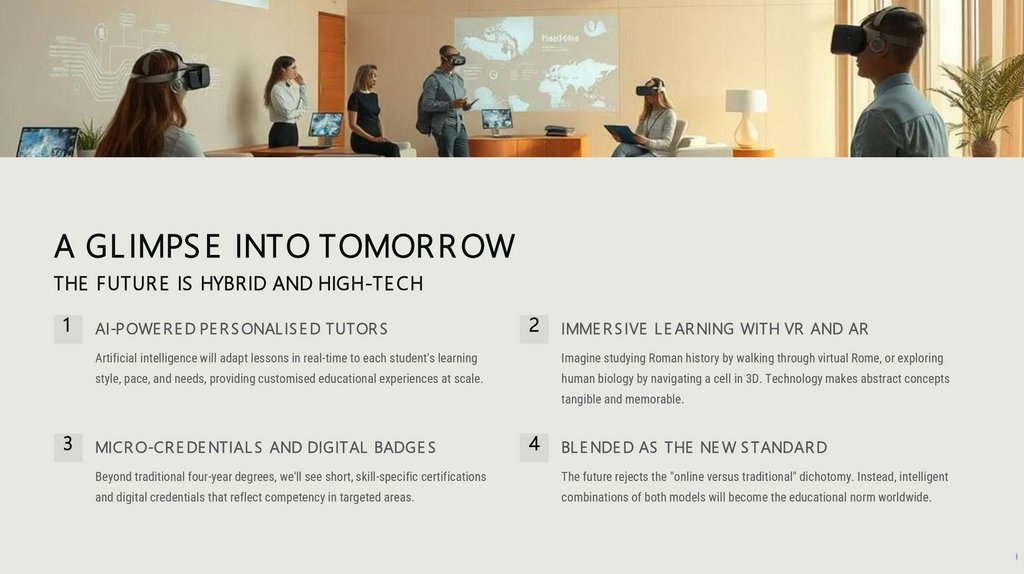
A GL IMPS E INTO TOMOR R OWTHE FUTUR E IS HYBRID AND HIGH-TE CH
1
AI-POWE R E D PE R S ONAL IS E D TUTOR S
2
IMME R S IVE L E AR NING WITH VR AND AR
Artificial intelligence will adapt lessons in real-time to each student's learning
Imagine studying Roman history by walking through virtual Rome, or exploring
style, pace, and needs, providing customised educational experiences at scale.
human biology by navigating a cell in 3D. Technology makes abstract concepts
tangible and memorable.
3
MICR O-CR E DE NTIAL S AND DIGITAL BADGE S
4
BL E NDE D AS THE NE W S TANDAR D
Beyond traditional four-year degrees, we'll see short, skill-specific certifications
The future rejects the "online versus traditional" dichotomy. Instead, intelligent
and digital credentials that reflect competency in targeted areas.
combinations of both models will become the educational norm worldwide.
8.
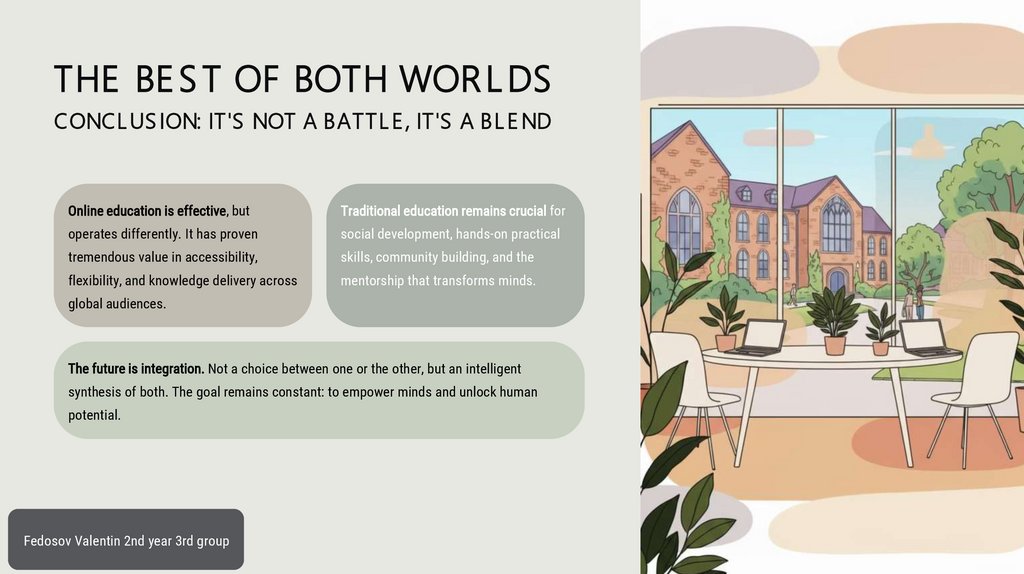
THE BE S T OF BOTH WOR L DSCONCL US ION: IT'S NOT A BATTL E , IT'S A BL E ND
Online education is effective, but
Traditional education remains crucial for
operates differently. It has proven
social development, hands-on practical
tremendous value in accessibility,
skills, community building, and the
flexibility, and knowledge delivery across
mentorship that transforms minds.
global audiences.
The future is integration. Not a choice between one or the other, but an intelligent
synthesis of both. The goal remains constant: to empower minds and unlock human
potential.
Fedosov Valentin 2nd year 3rd group