
 history
Similar presentations:




The Soviet Discourse on the Origin and Class Character of Islam, 1923 - 1933
1.
Nazarbayev University“The Soviet Discourse on the
Origin and Class Character of
Islam, 1923–1933”
By Michael Kemper
Presented by Aisha Temirgaliyeva
2.
Contents1. Summary
2. Arguments
3. Strengths & Weaknesses
4. Methods and Sources
5. Engagement with other scholarship
6. Discussion
3.
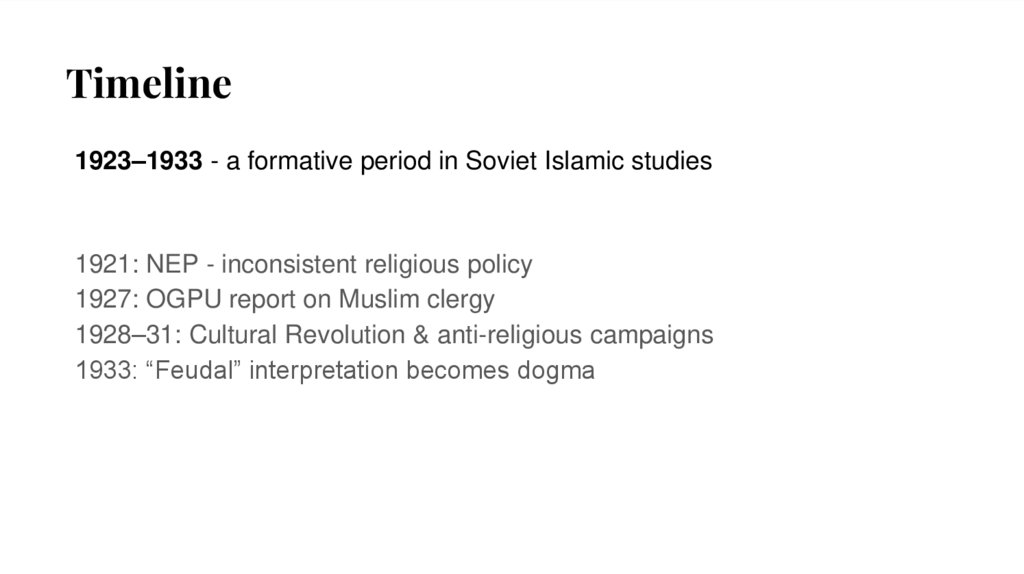
Timeline1923–1933 - a formative period in Soviet Islamic studies
1921: NEP - inconsistent religious policy
1927: OGPU report on Muslim clergy
1928–31: Cultural Revolution & anti-religious campaigns
1933: “Feudal” interpretation becomes dogma
4.
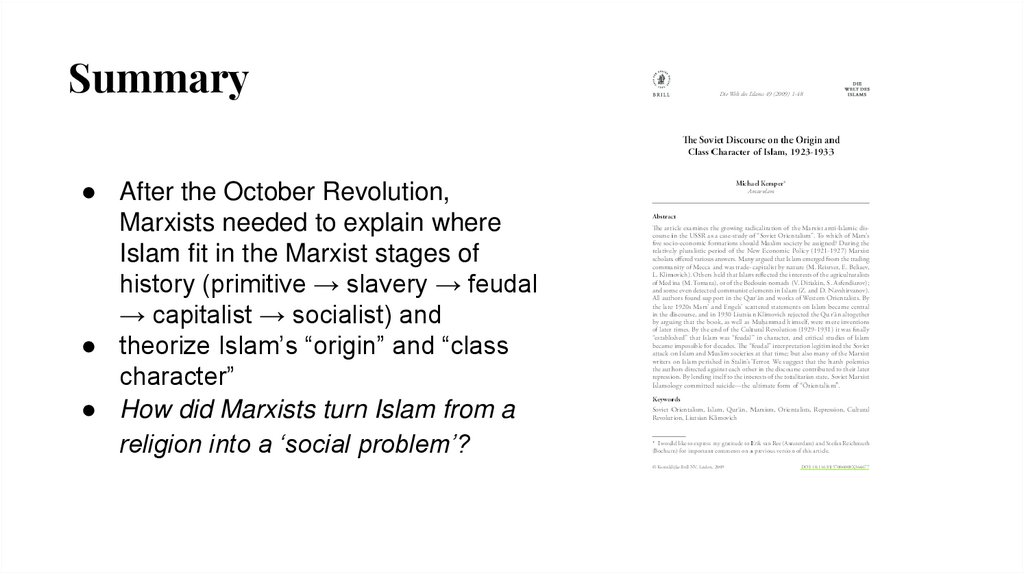
Summary● After the October Revolution,
Marxists needed to explain where
Islam fit in the Marxist stages of
history (primitive → slavery → feudal
→ capitalist → socialist) and
● theorize Islam’s “origin” and “class
character”
● How did Marxists turn Islam from a
religion into a ‘social problem’?
5.
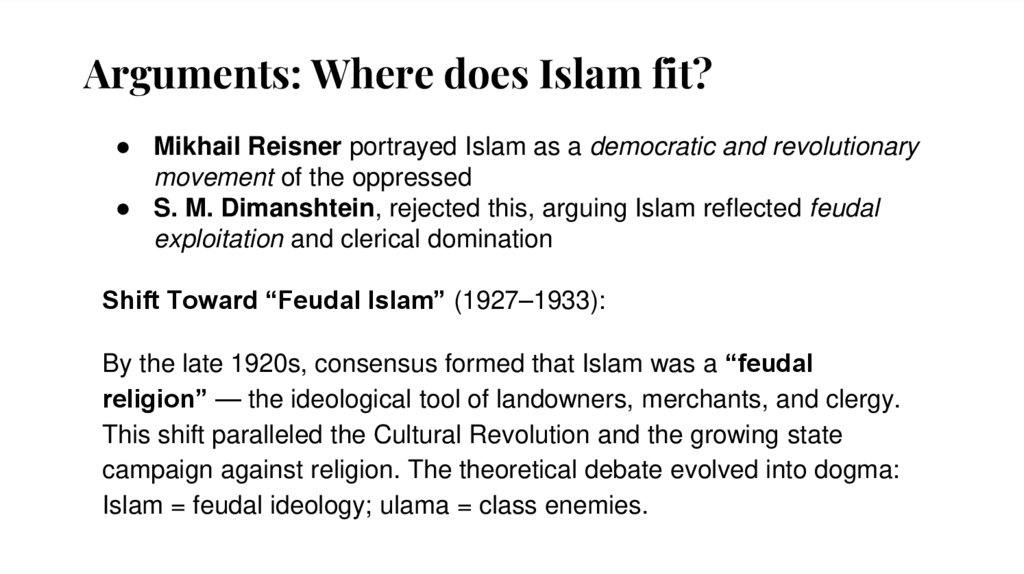
Arguments: Where does Islam fit?● Mikhail Reisner portrayed Islam as a democratic and revolutionary
movement of the oppressed
● S. M. Dimanshtein, rejected this, arguing Islam reflected feudal
exploitation and clerical domination
Shift Toward “Feudal Islam” (1927–1933):
By the late 1920s, consensus formed that Islam was a “feudal
religion” — the ideological tool of landowners, merchants, and clergy.
This shift paralleled the Cultural Revolution and the growing state
campaign against religion. The theoretical debate evolved into dogma:
Islam = feudal ideology; ulama = class enemies.
6.
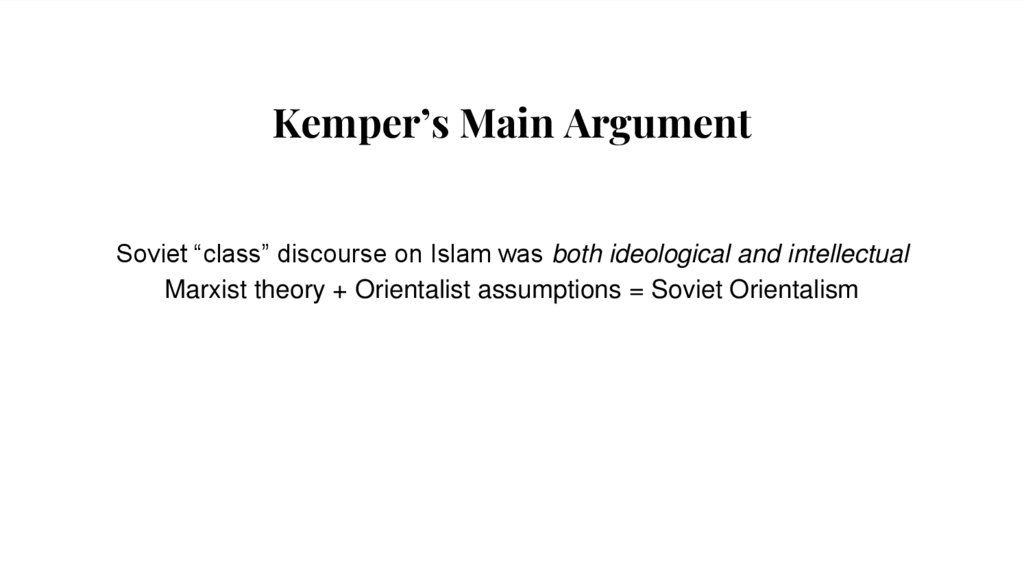
Kemper’s Main ArgumentSoviet “class” discourse on Islam was both ideological and intellectual
Marxist theory + Orientalist assumptions = Soviet Orientalism
7.
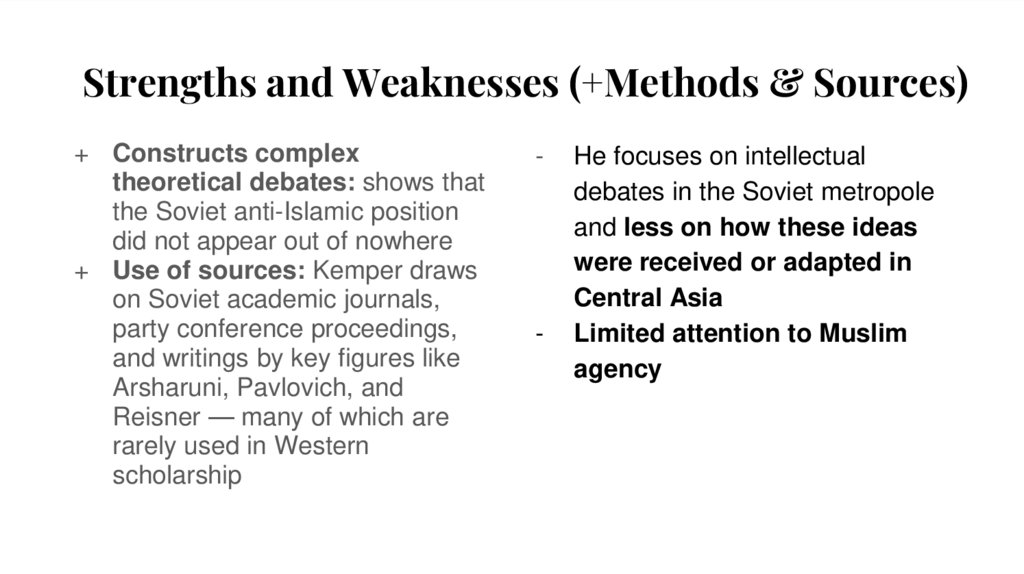
Strengths and Weaknesses (+Methods & Sources)+ Constructs complex
theoretical debates: shows that
the Soviet anti-Islamic position
did not appear out of nowhere
+ Use of sources: Kemper draws
on Soviet academic journals,
party conference proceedings,
and writings by key figures like
Arsharuni, Pavlovich, and
Reisner — many of which are
rarely used in Western
scholarship
-
-
He focuses on intellectual
debates in the Soviet metropole
and less on how these ideas
were received or adapted in
Central Asia
Limited attention to Muslim
agency
8.
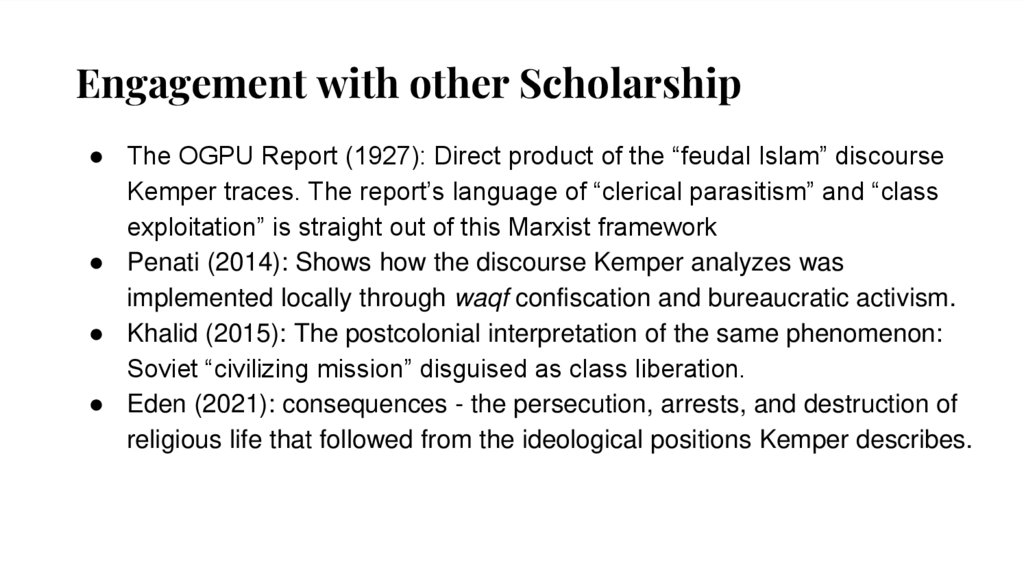
Engagement with other Scholarship● The OGPU Report (1927): Direct product of the “feudal Islam” discourse
Kemper traces. The report’s language of “clerical parasitism” and “class
exploitation” is straight out of this Marxist framework
● Penati (2014): Shows how the discourse Kemper analyzes was
implemented locally through waqf confiscation and bureaucratic activism.
● Khalid (2015): The postcolonial interpretation of the same phenomenon:
Soviet “civilizing mission” disguised as class liberation.
● Eden (2021): consequences - the persecution, arrests, and destruction of
religious life that followed from the ideological positions Kemper describes.
9.
Discussion1. How might Muslim scholars, reformers, or ordinary believers have
responded to this Soviet discourse? Can we find traces of intellectual
resistance or adaptation within this period?
2. Can we assume that the ideological origins of attacks on Islamic institutions
are the “Class Discourse” on Islam? Why?
10.
Bibliography1. Eden, Jeff. God Save the USSR: An Alternative History of Soviet Religiosity.
Oxford: Oxford University Press, 2021.
2. Kemper, Michael. “The Soviet Discourse on the Origin and Class Character of Islam,
1923–1933.” Die Welt des Islams 49, no. 1 (2009): 1–48.
3. Khalid, Adeeb. Islam After Communism: Religion and Politics in Central Asia.
Berkeley: University of California Press, 2014.
4. Penati, Beatrice. “On the Local Origins of the Soviet Attack on ‘Religious’ Waqf in
the Uzbek SSR (1927).” Acta Slavica Iaponica 36 (2015): 39–72.
5. Полномочный представитель ОГПУ в Средней Азии. “Мусульманское
духовенство Средней Азии в 1927 г. (по докладу полномочного представителя
ОГПУ в Средней Азии).” 4 июня 1927 г. Typescript, reproduced in course
materials for Stalinist Central Asia, University of [Your University], 2025.