 english
Similar presentations:








3a. SB. p. 42-43
1.
3a.SB. p. 42-43
2.
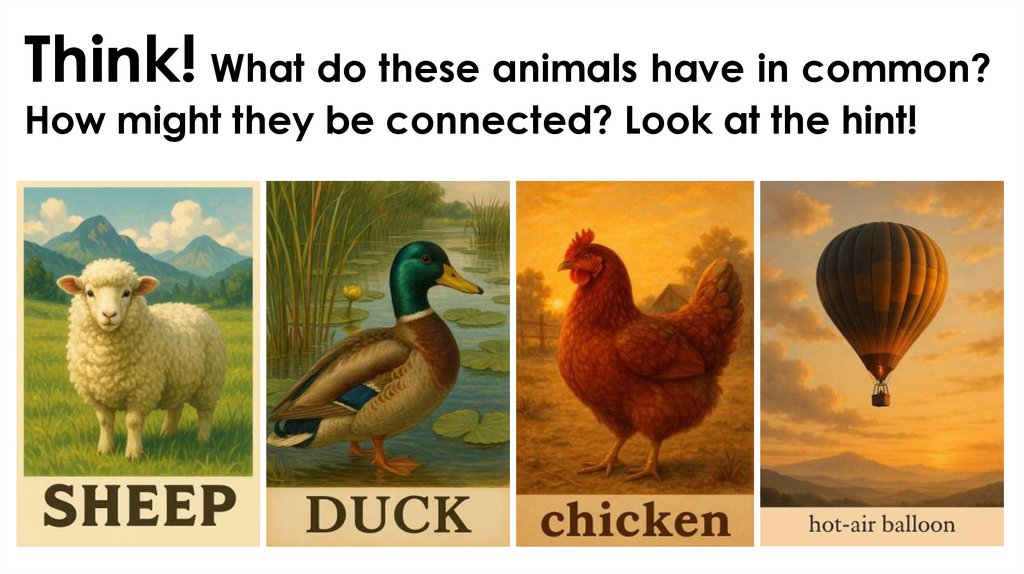
Think! What do these animals have in common?How might they be connected? Look at the hint!
3.
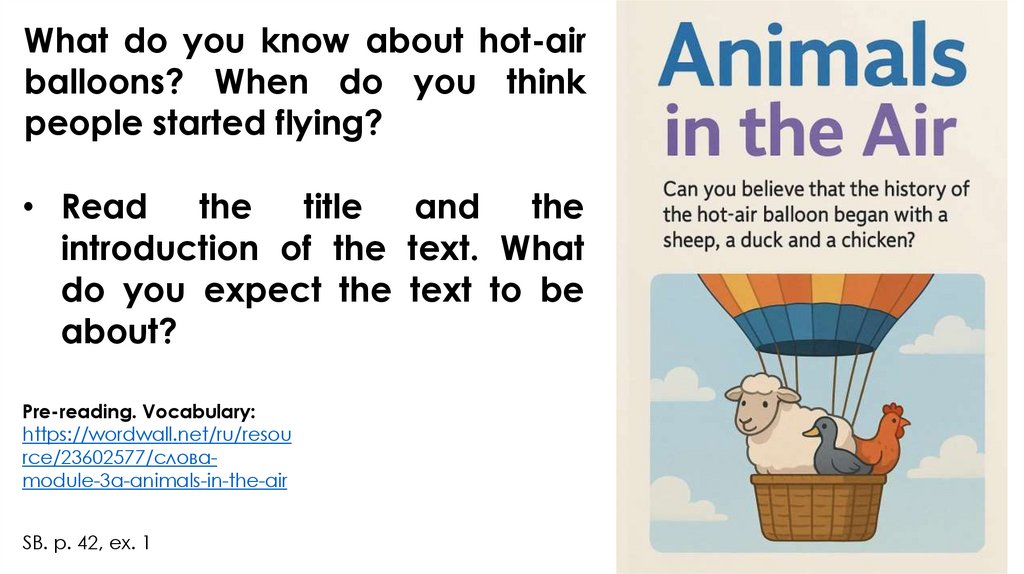
What do you know about hot-airballoons? When do you think
people started flying?
• Read
the
title
and
the
introduction of the text. What
do you expect the text to be
about?
Pre-reading. Vocabulary:
https://wordwall.net/ru/resou
rce/23602577/словаmodule-3a-animals-in-the-air
SB. p. 42, ex. 1
4.
Read the first paragraphand do the task.
https://wordwall.net/ru/r
esource/27441402/anima
ls-in-the-air
SB. p. 42
One day in 1777, Joseph Montgolfier was relaxing in front of the fire with his
laundry drying nearby. After a while, he noticed that one of his shirts had
started to float upwards. The young man was curious about what was
happening, so he threw some small pieces of paper into the fireplace to see if
the same thing happened to them. When he saw them coming out of the
chimney, he came to the conclusion that smoke had the power to lift things
up and carry them through the air. Joseph loved science and wanted to
become an inventor, so he started trying to think of a craft that would be able
to capture smoke and heat and lift people off the ground. Along with his
brother, Jacques, he began performing experiments on something that later
became the first hot-air balloon.
5.
Listen to and read thestory to the end.
Audio:
https://rutube.ru/video/fffcb6e9fc6d30eb509
4793ed7e5a534/?t=131&r=plwd (2:10)
The Montgolfier brothers quickly realised that it was heat and not smoke that had the
power to lift things. On 19th September 1783, they presented their first hot-air balloon,
which was made from paper and cloth. They burned some straw underneath it and
the heat helped the balloon to float. As this was its first trip, the Montgolfier brothers
were too nervous to go up in the balloon themselves. So, instead they put a sheep, a
duck and a chicken in the basket that hung below the balloon for the two-mile
journey.
The new invention was a great success and the animals landed safe and sound. A
huge crowd, including some members of the French Royal Family gathered to watch
the balloon floating high in the sky. Shortly afterwards, the brothers asked the king for
permission to send men up in the balloon. The king agreed, and the first flight
consisting of human passengers took place in Paris on 21st November 1783, with
great success. The balloon reached heights of around 150 metres as it floated over
the Paris rooftops, starting a long tradition of hot-air ballooning.
SB. p. 42
6.
Do the quiz:https://learninga
pps.org/watch?v
=phy2vqnsk25
SB. p. 43, ex. 3
7.
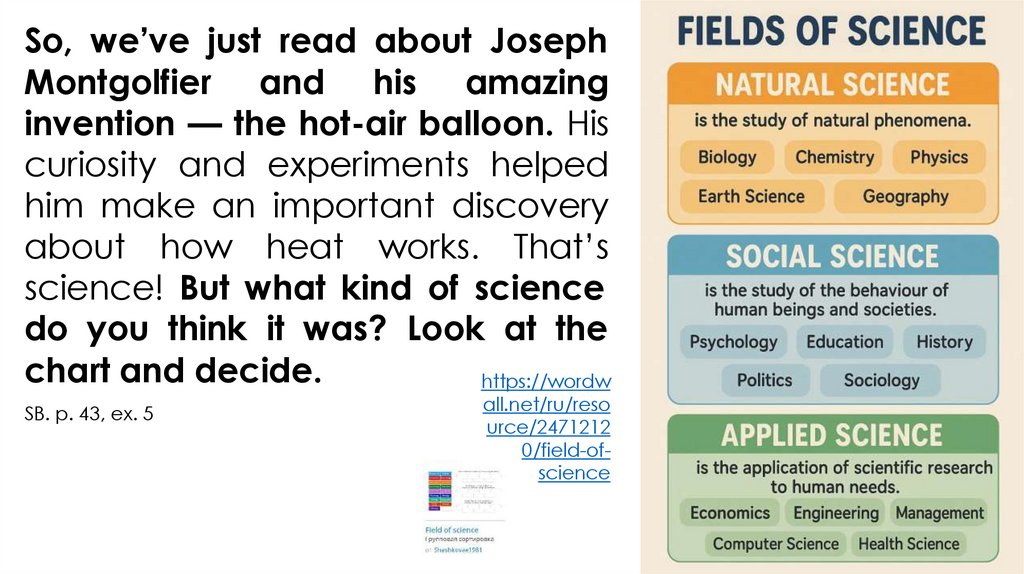
So, we’ve just read about JosephMontgolfier and his amazing
invention — the hot-air balloon. His
curiosity and experiments helped
him make an important discovery
about how heat works. That’s
science! But what kind of science
do you think it was? Look at the
chart and decide.
https://wordw
SB. p. 43, ex. 5
all.net/ru/reso
urce/2471212
0/field-ofscience
8.
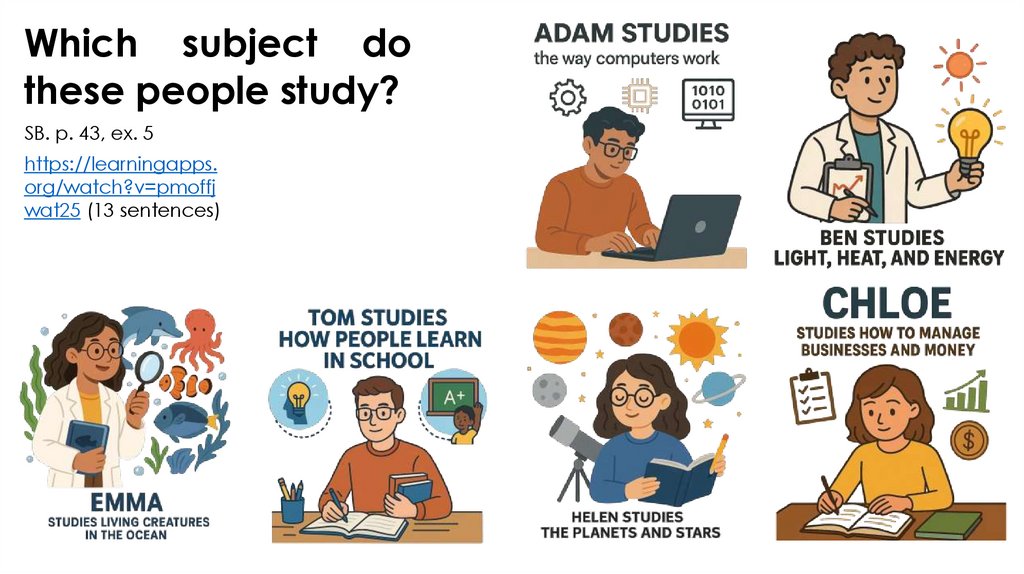
Which subject dothese people study?
SB. p. 43, ex. 5
https://learningapps.
org/watch?v=pmoffj
wat25 (13 sentences)
9.
HWOption 1. Imagine you are one of the
animals — the , the , or the
—
from the first hot-air balloon flight. Write
a short diary entry (6–8 sentences)
describing your amazing journey!
Include:
• what you saw in the sky
• how you felt
• your opinion about the invention
Use at least three words from the text
(lift, experiment, invention, capture,
safe and sound)
Option 2. Choose one famous invention and
write 6–8 sentences about it.
Include:
who invented it
when and where it was invented
what the invention does
which field of science it belongs to
why it is important for people
Example:
The telephone was invented by Alexander
Graham Bell in 1876. It belongs to Applied
Science because it uses technology to help
people communicate.