 english
Similar presentations:




Phonostylistics Lecture 3
1. Phonostylistics Lecture 3
20242. AGENDA
1. Syllable: theories, formation and division2. Word stress
3. Sentence stress
4. English intonation vs Russian intonation structures
5. EFL teacher’s prosodic repertoire
3. 1 What is a syllable?
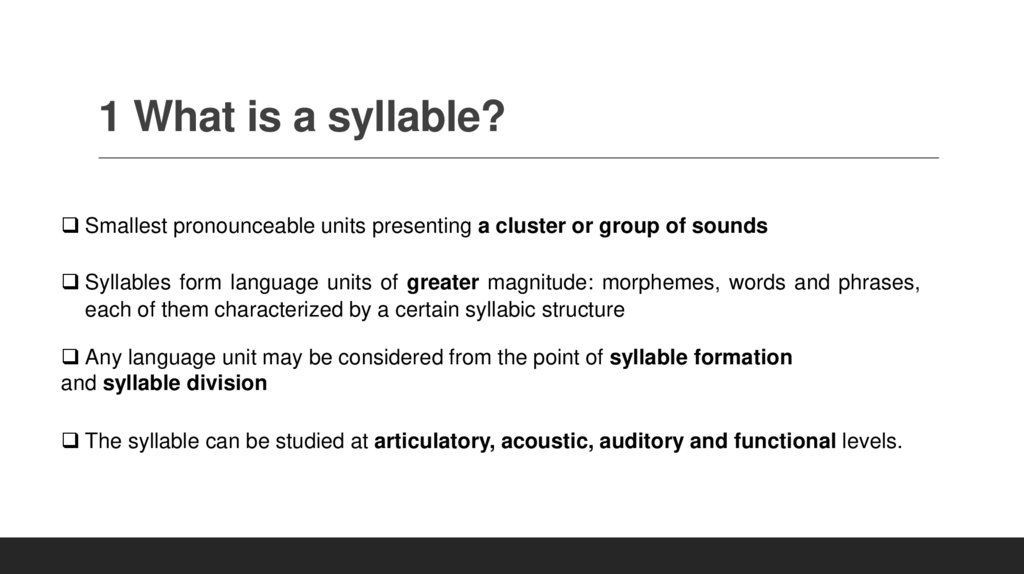
Smallest pronounceable units presenting a cluster or group of soundsSyllables form language units of greater magnitude: morphemes, words and phrases,
each of them characterized by a certain syllabic structure
Any language unit may be considered from the point of syllable formation
and syllable division
The syllable can be studied at articulatory, acoustic, auditory and functional levels.
4. Theories of syllable formation
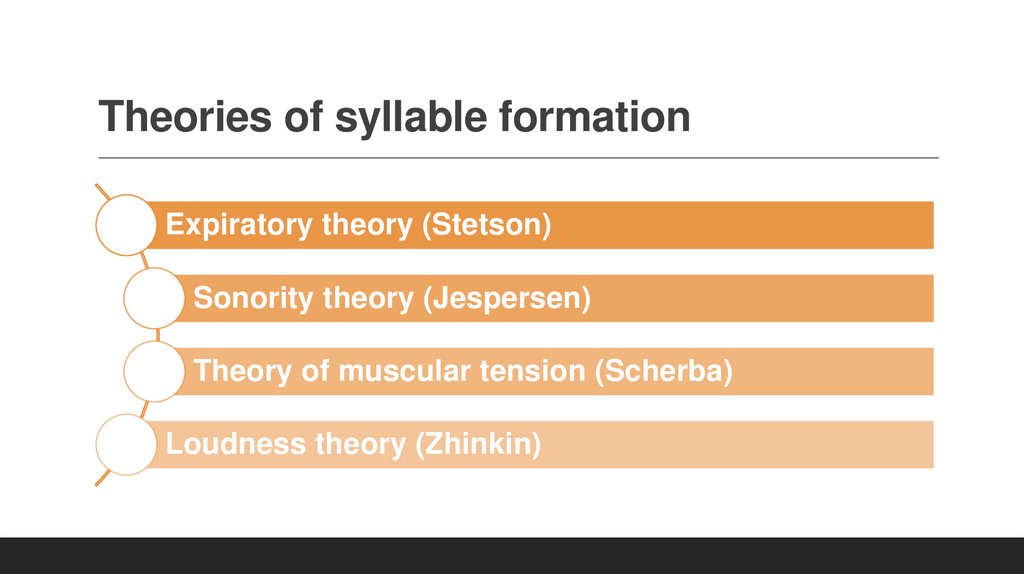
Expiratory theory (Stetson)Sonority theory (Jespersen)
Theory of muscular tension (Scherba)
Loudness theory (Zhinkin)
5. Syllable features
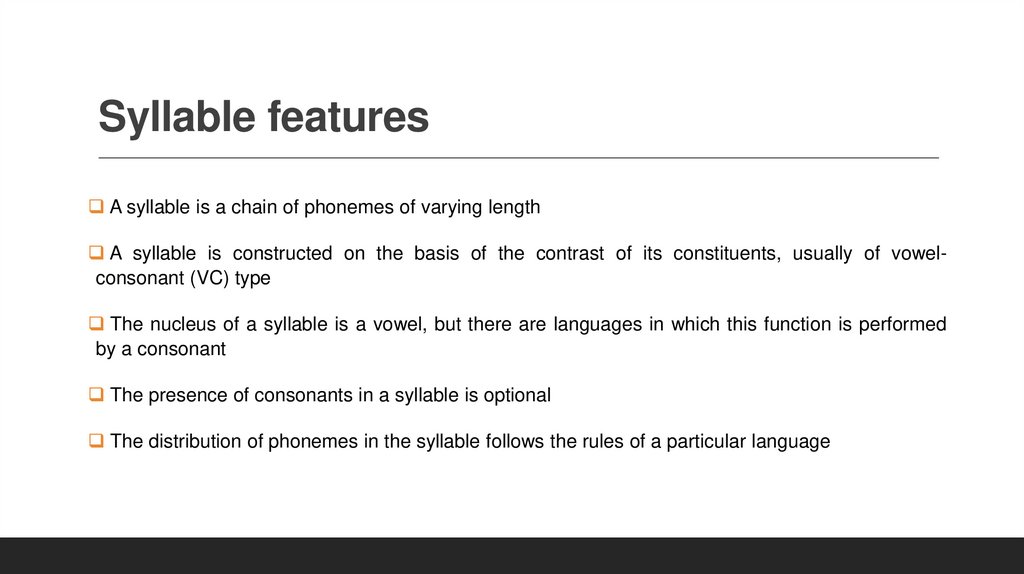
A syllable is a chain of phonemes of varying lengthA syllable is constructed on the basis of the contrast of its constituents, usually of vowelconsonant (VC) type
The nucleus of a syllable is a vowel, but there are languages in which this function is performed
by a consonant
The presence of consonants in a syllable is optional
The distribution of phonemes in the syllable follows the rules of a particular language
6. Syllable: functional characteristics
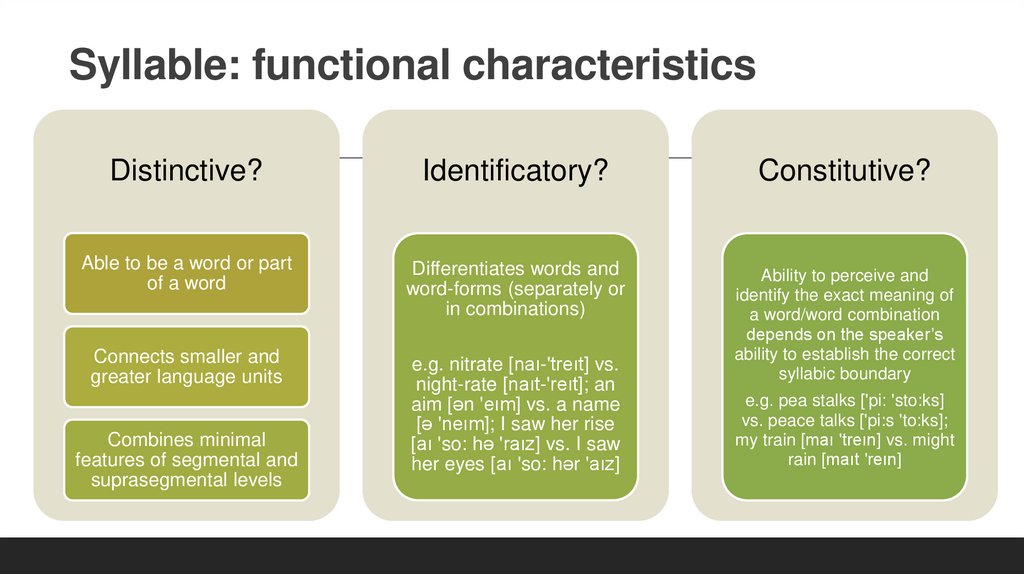
Distinctive?Identificatory?
Constitutive?
Able to be a word or part
of a word
Differentiates words and
word-forms (separately or
in combinations)
Connects smaller and
greater language units
e.g. nitrate [naı-'treıt] vs.
night-rate [naıt-'reıt]; an
aim [ən 'eım] vs. a name
[ə 'neım]; I saw her rise
[aı 'so: hə 'raız] vs. I saw
her eyes [aı 'so: hər 'aız]
Ability to perceive and
identify the exact meaning of
a word/word combination
depends on the speaker’s
ability to establish the correct
syllabic boundary
Combines minimal
features of segmental and
suprasegmental levels
e.g. pea stalks ['pi: 'sto:ks]
vs. peace talks ['pi:s 'to:ks];
my train [maı 'treın] vs. might
rain [maıt 'reın]
7. Syllabic structure: formation
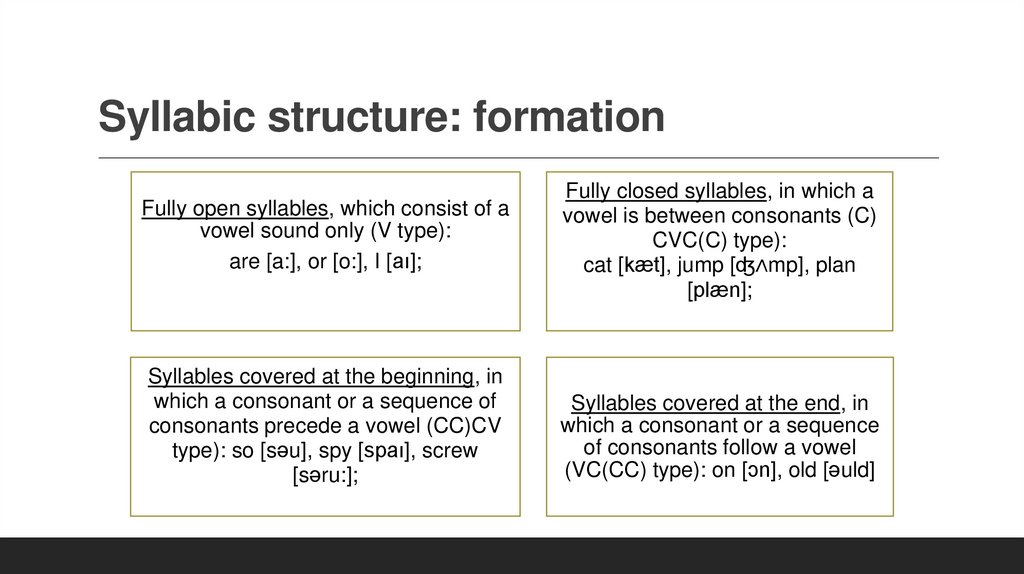
Fully open syllables, which consist of avowel sound only (V type):
are [a:], or [o:], I [aı];
Fully closed syllables, in which a
vowel is between consonants (C)
CVC(C) type):
cat [kæt], jump [ʤ∧mp], plan
[plæn];
Syllables covered at the beginning, in
which a consonant or a sequence of
consonants precede a vowel (CC)CV
type): so [səu], spy [spaı], screw
[səru:];
Syllables covered at the end, in
which a consonant or a sequence
of consonants follow a vowel
(VC(CC) type): on [ɔn], old [əuld]
8.
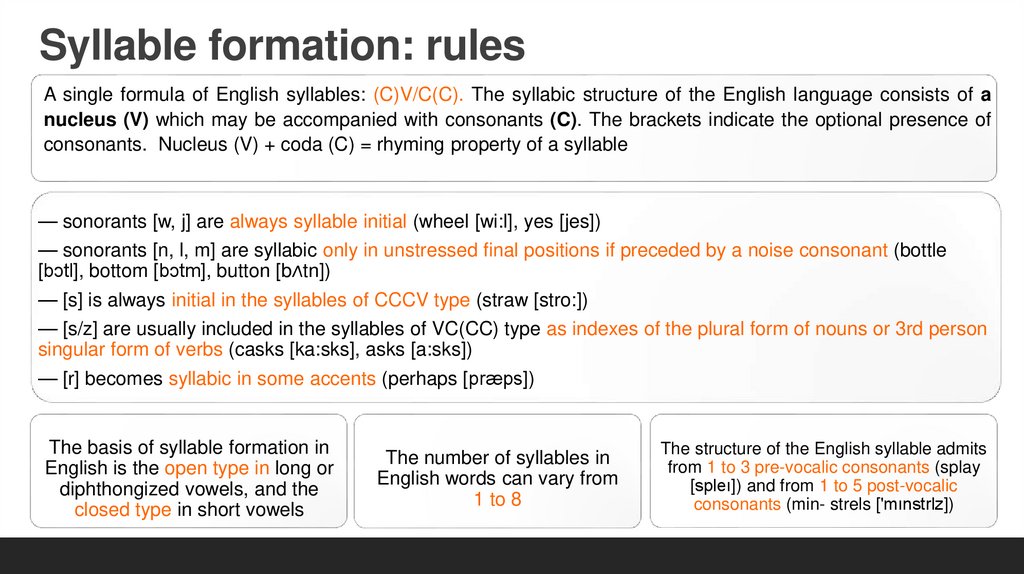
Syllable formation: rulesA single formula of English syllables: (C)V/C(C). The syllabic structure of the English language consists of a
nucleus (V) which may be accompanied with consonants (C). The brackets indicate the optional presence of
consonants. Nucleus (V) + coda (C) = rhyming property of a syllable
— sonorants [w, j] are always syllable initial (wheel [wi:l], yes [jes])
— sonorants [n, l, m] are syllabic only in unstressed final positions if preceded by a noise consonant (bottle
[bɔtl], bottom [bɔtm], button [b∧tn])
— [s] is always initial in the syllables of CCCV type (straw [stro:])
— [s/z] are usually included in the syllables of VC(CC) type as indexes of the plural form of nouns or 3rd person
singular form of verbs (casks [ka:sks], asks [a:sks])
— [r] becomes syllabic in some accents (perhaps [præps])
The basis of syllable formation in
English is the open type in long or
diphthongized vowels, and the
closed type in short vowels
The number of syllables in
English words can vary from
1 to 8
The structure of the English syllable admits
from 1 to 3 pre-vocalic consonants (splay
[spleı]) and from 1 to 5 post-vocalic
consonants (min- strels ['mınstrlz])
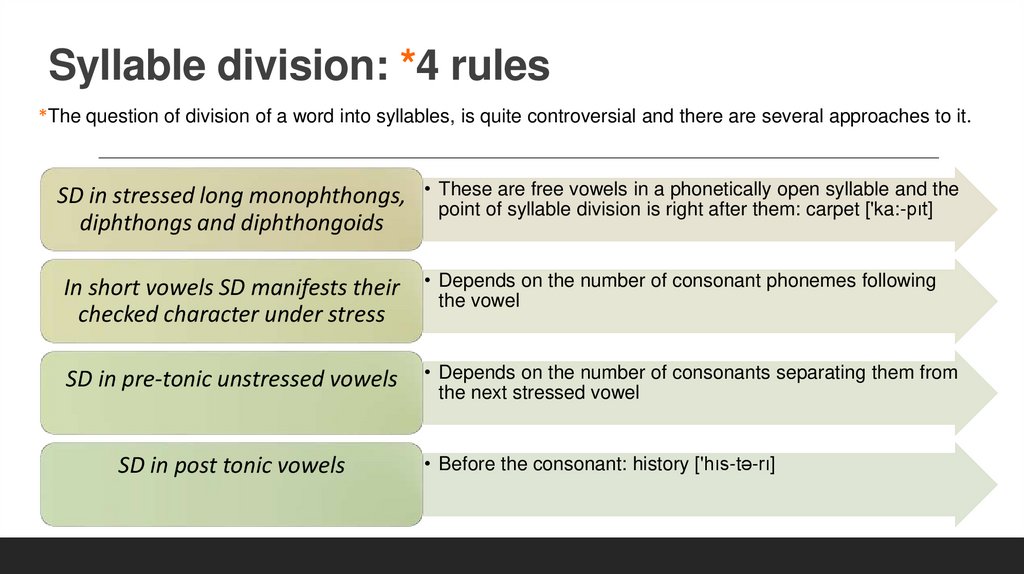
9. Syllable division: *4 rules
*The question of division of a word into syllables, is quite controversial and there are several approaches to it.SD in stressed long monophthongs,
diphthongs and diphthongoids
• These are free vowels in a phonetically open syllable and the
point of syllable division is right after them: carpet ['ka:-pıt]
In short vowels SD manifests their
checked character under stress
• Depends on the number of consonant phonemes following
the vowel
SD in pre-tonic unstressed vowels
• Depends on the number of consonants separating them from
the next stressed vowel
SD in post tonic vowels
• Before the consonant: history ['hıs-tə-rı]
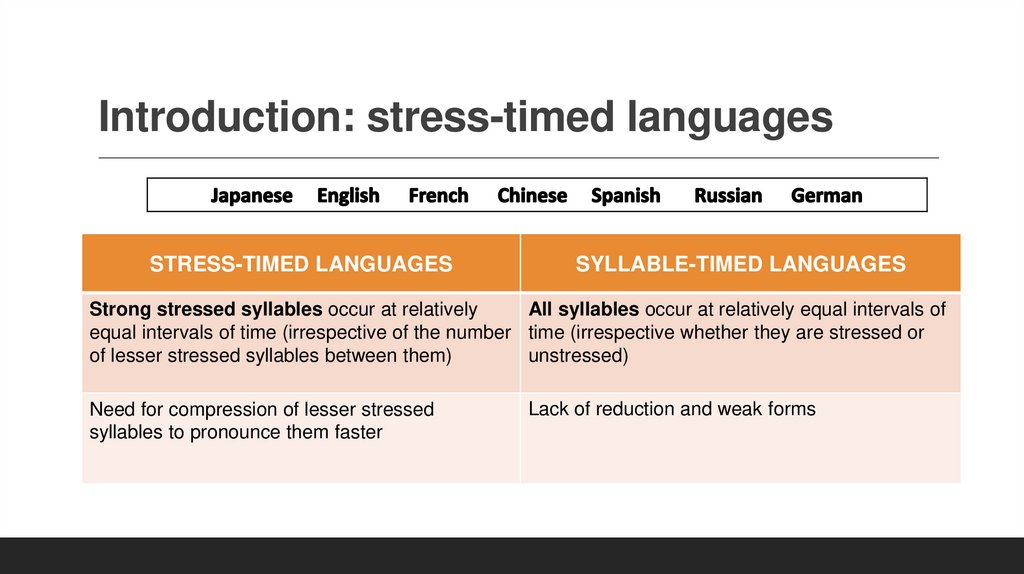
10. Introduction: stress-timed languages
STRESS-TIMED LANGUAGESSYLLABLE-TIMED LANGUAGES
Strong stressed syllables occur at relatively
All syllables occur at relatively equal intervals of
equal intervals of time (irrespective of the number time (irrespective whether they are stressed or
of lesser stressed syllables between them)
unstressed)
Need for compression of lesser stressed
syllables to pronounce them faster
Lack of reduction and weak forms
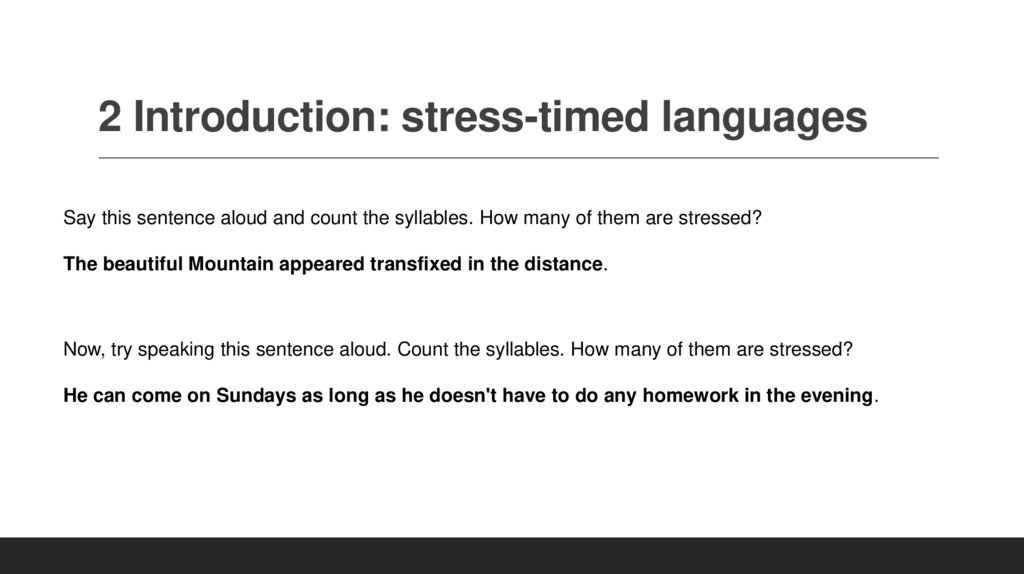
11. 2 Introduction: stress-timed languages
Say this sentence aloud and count the syllables. How many of them are stressed?The beautiful Mountain appeared transfixed in the distance.
Now, try speaking this sentence aloud. Count the syllables. How many of them are stressed?
He can come on Sundays as long as he doesn't have to do any homework in the evening.
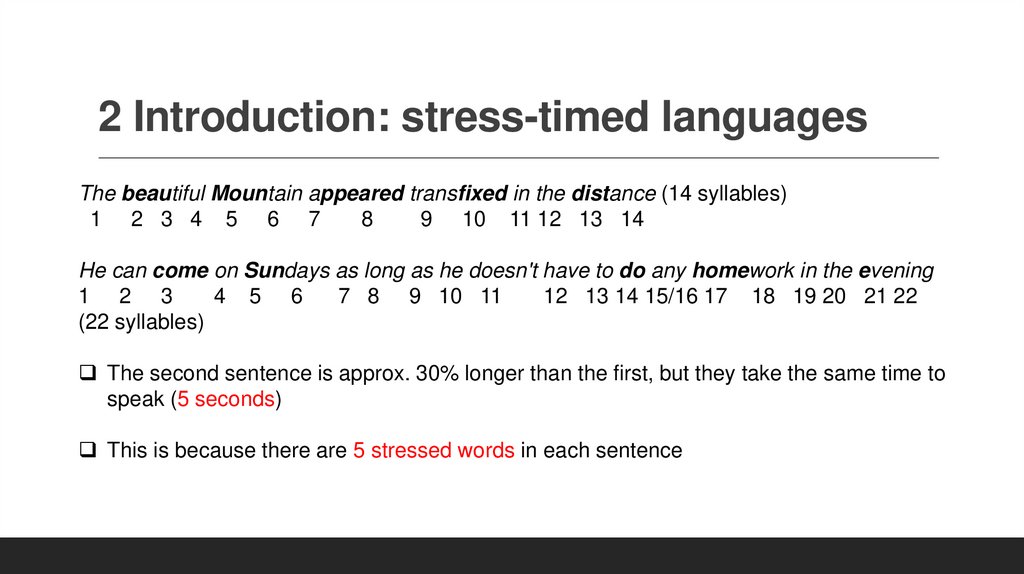
12. 2 Introduction: stress-timed languages
The beautiful Mountain appeared transfixed in the distance (14 syllables)1 2 3 4 5 6 7
8
9 10 11 12 13 14
He can come on Sundays as long as he doesn't have to do any homework in the evening
1 2 3
4 5 6
7 8 9 10 11
12 13 14 15/16 17 18 19 20 21 22
(22 syllables)
The second sentence is approx. 30% longer than the first, but they take the same time to
speak (5 seconds)
This is because there are 5 stressed words in each sentence
13. Nature of stress: definition
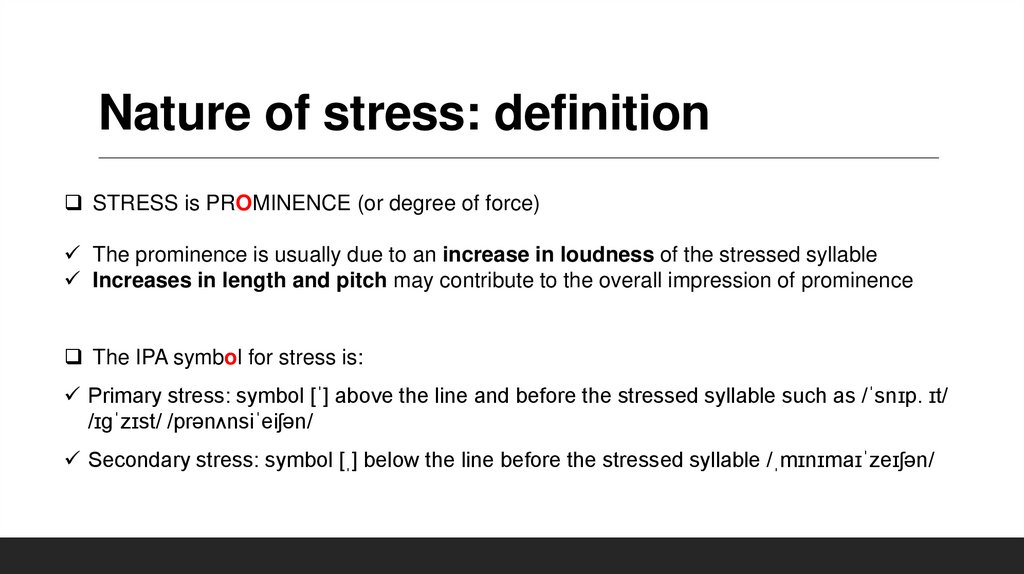
STRESS is PROMINENCE (or degree of force)The prominence is usually due to an increase in loudness of the stressed syllable
Increases in length and pitch may contribute to the overall impression of prominence
The IPA symbol for stress is:
Primary stress: symbol [ˈ] above the line and before the stressed syllable such as /ˈsnɪp. ɪt/
/ɪgˈzɪst/ /prənʌnsiˈeiʃən/
Secondary stress: symbol [ˌ] below the line before the stressed syllable /ˌmɪnɪmaɪˈzeɪʃən/
14. Types of stress: overview
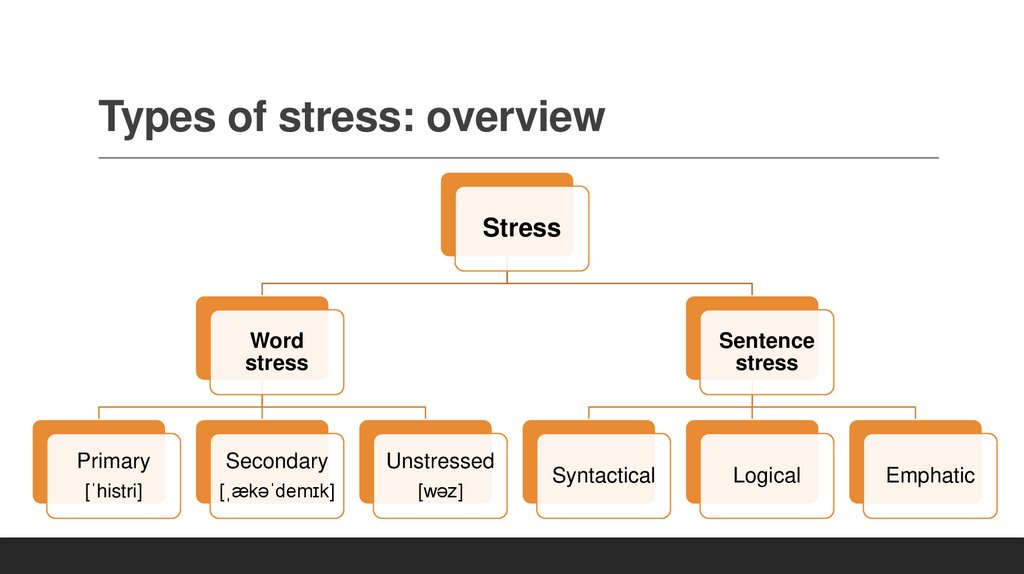
StressWord
stress
Sentence
stress
Primary
Secondary
Unstressed
[ˈhistri]
[ˌækəˈdemɪk]
[wəz]
Syntactical
Logical
Emphatic
15. Placement of word stress
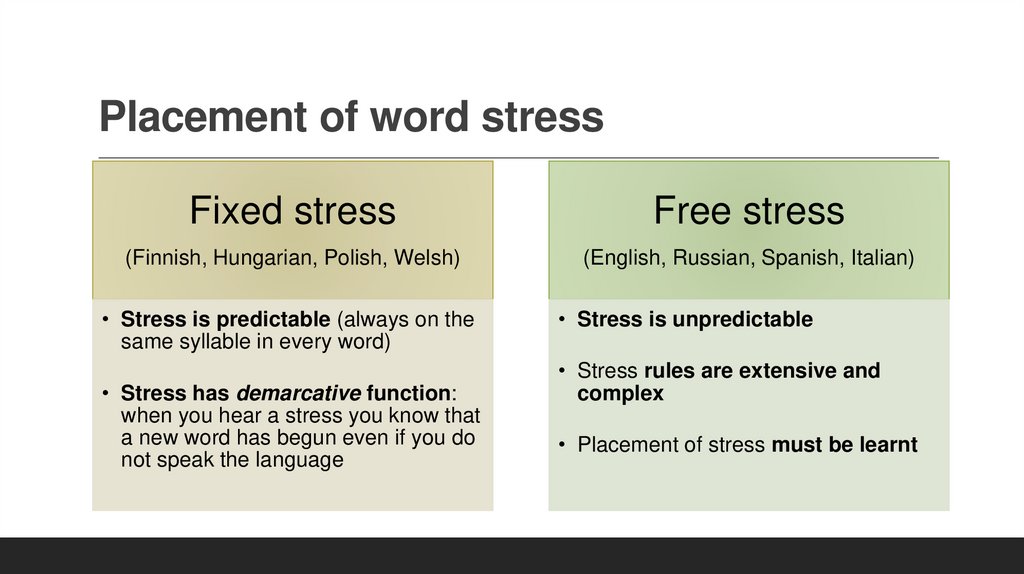
Fixed stressFree stress
(Finnish, Hungarian, Polish, Welsh)
(English, Russian, Spanish, Italian)
• Stress is predictable (always on the
same syllable in every word)
• Stress has demarcative function:
when you hear a stress you know that
a new word has begun even if you do
not speak the language
• Stress is unpredictable
• Stress rules are extensive and
complex
• Placement of stress must be learnt
16.
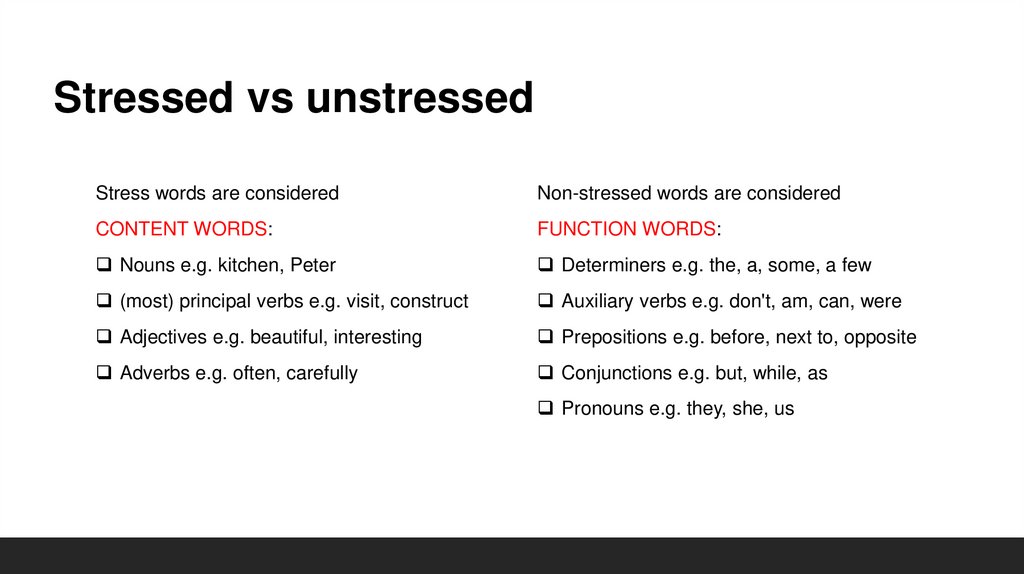
Stressed vs unstressedStress words are considered
Non-stressed words are considered
CONTENT WORDS:
FUNCTION WORDS:
Nouns e.g. kitchen, Peter
Determiners e.g. the, a, some, a few
(most) principal verbs e.g. visit, construct
Auxiliary verbs e.g. don't, am, can, were
Adjectives e.g. beautiful, interesting
Prepositions e.g. before, next to, opposite
Adverbs e.g. often, carefully
Conjunctions e.g. but, while, as
Pronouns e.g. they, she, us
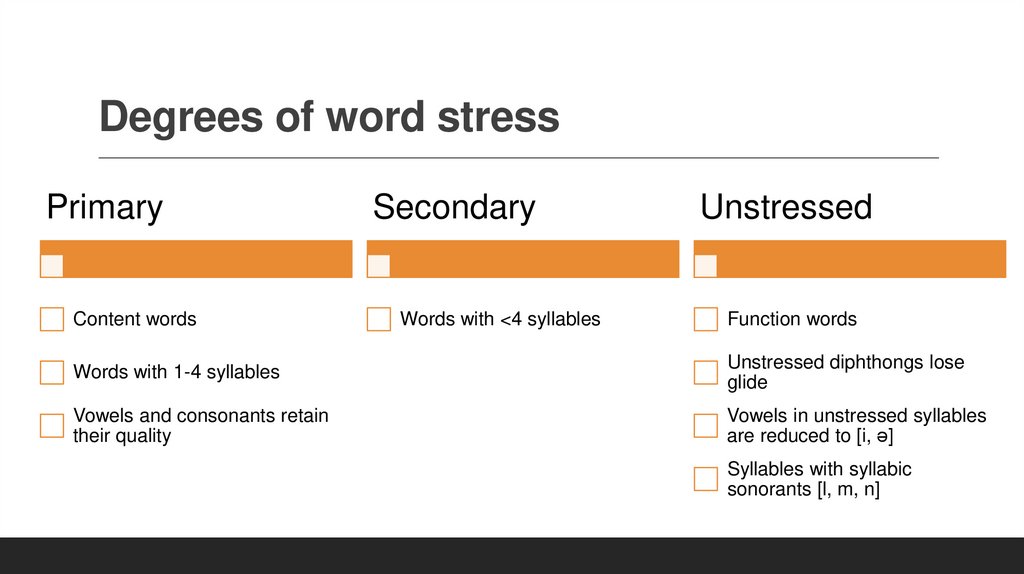
17. Degrees of word stress
PrimaryContent words
Secondary
Words with <4 syllables
Unstressed
Function words
Words with 1-4 syllables
Unstressed diphthongs lose
glide
Vowels and consonants retain
their quality
Vowels in unstressed syllables
are reduced to [i, ə]
Syllables with syllabic
sonorants [l, m, n]
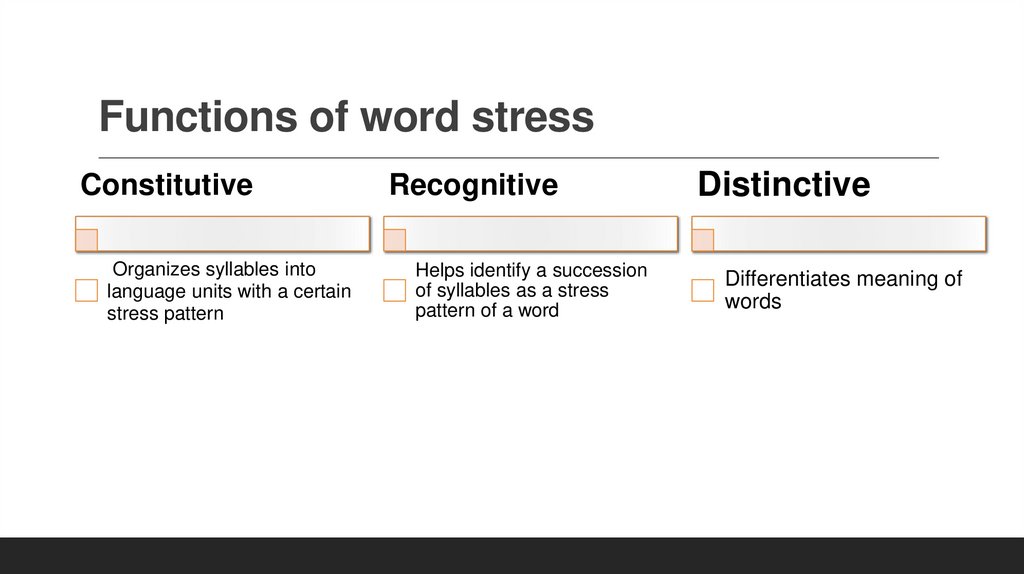
18. Functions of word stress
ConstitutiveOrganizes syllables into
language units with a certain
stress pattern
Recognitive
Helps identify a succession
of syllables as a stress
pattern of a word
Distinctive
Differentiates meaning of
words
19.
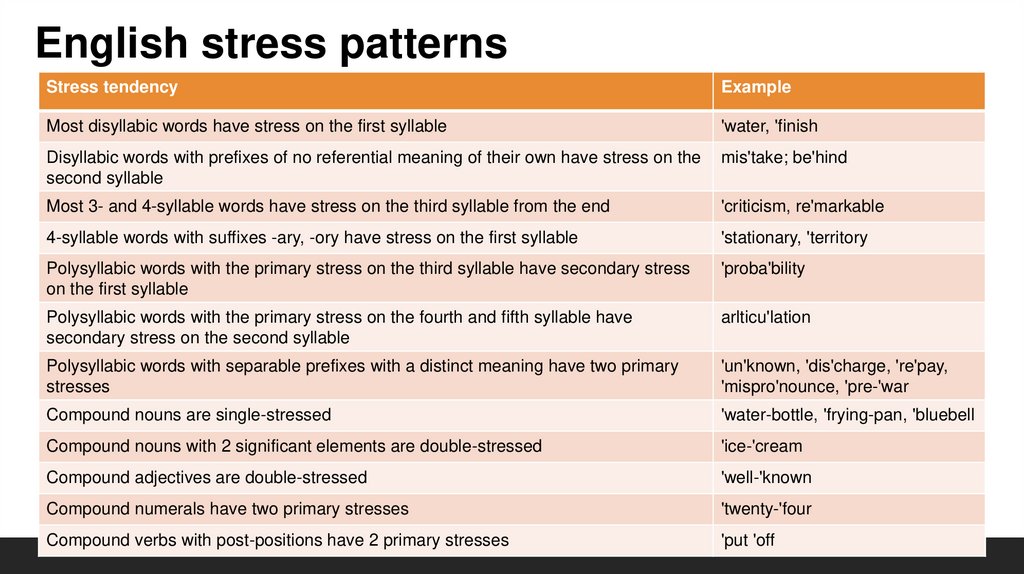
English stress patternsStress tendency
Example
Most disyllabic words have stress on the first syllable
'water, 'finish
Disyllabic words with prefixes of no referential meaning of their own have stress on the
second syllable
mis'take; be'hind
Most 3- and 4-syllable words have stress on the third syllable from the end
'criticism, re'markable
4-syllable words with suffixes -ary, -ory have stress on the first syllable
'stationary, 'territory
Polysyllabic words with the primary stress on the third syllable have secondary stress
on the first syllable
'proba'bility
Polysyllabic words with the primary stress on the fourth and fifth syllable have
secondary stress on the second syllable
arlticu'lation
Polysyllabic words with separable prefixes with a distinct meaning have two primary
stresses
'un'known, 'dis'charge, 're'pay,
'mispro'nounce, 'pre-'war
Compound nouns are single-stressed
'water-bottle, 'frying-pan, 'bluebell
Compound nouns with 2 significant elements are double-stressed
'ice-'cream
Compound adjectives are double-stressed
'well-'known
Compound numerals have two primary stresses
'twenty-'four
Compound verbs with post-positions have 2 primary stresses
'put 'off
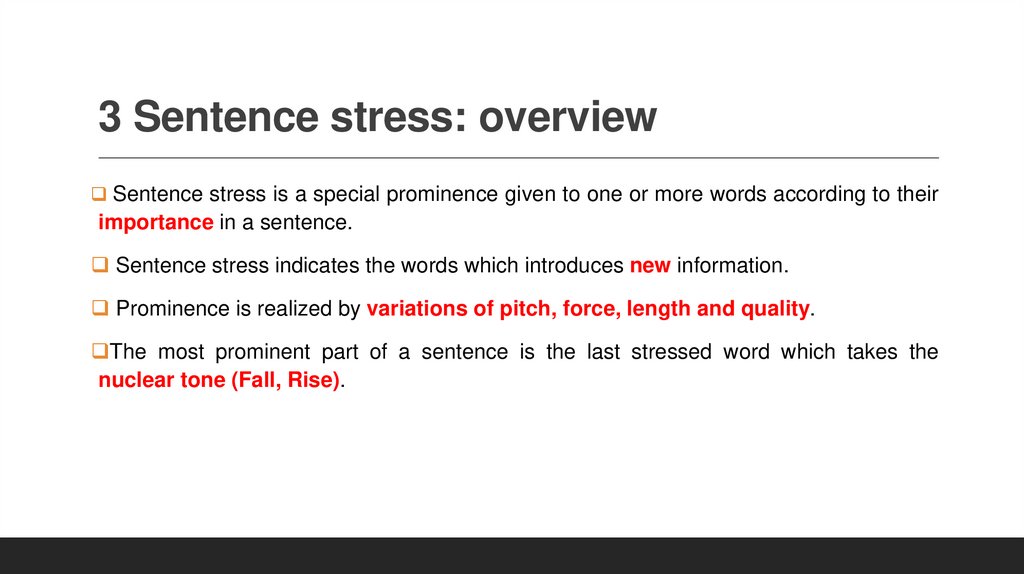
20. 3 Sentence stress: overview
Sentence stress is a special prominence given to one or more words according to theirimportance in a sentence.
Sentence stress indicates the words which introduces new information.
Prominence is realized by variations of pitch, force, length and quality.
The most prominent part of a sentence is the last stressed word which takes the
nuclear tone (Fall, Rise).
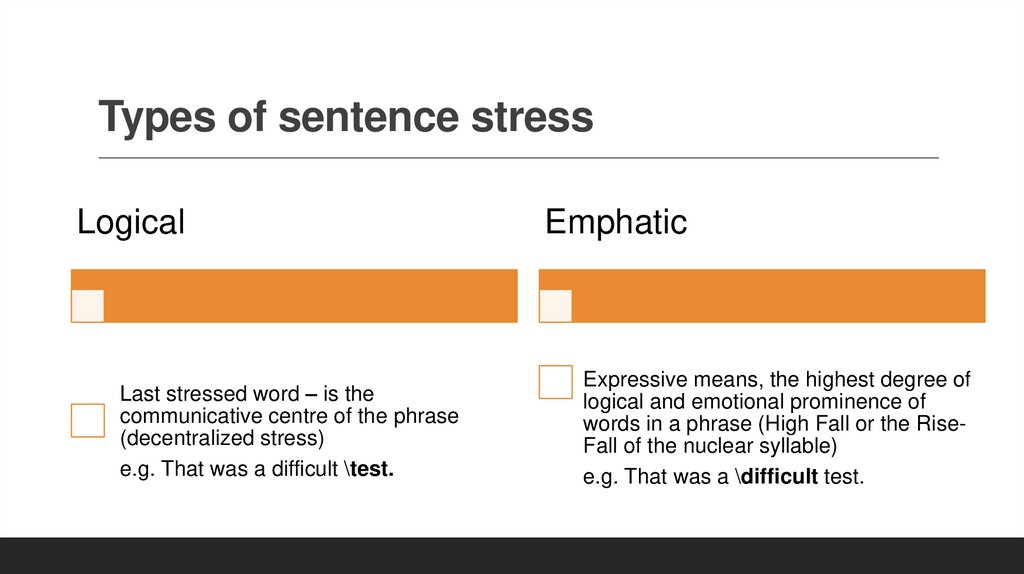
21. Types of sentence stress
LogicalLast stressed word – is the
communicative centre of the phrase
(decentralized stress)
e.g. That was a difficult \test.
Emphatic
Expressive means, the highest degree of
logical and emotional prominence of
words in a phrase (High Fall or the RiseFall of the nuclear syllable)
e.g. That was a \difficult test.
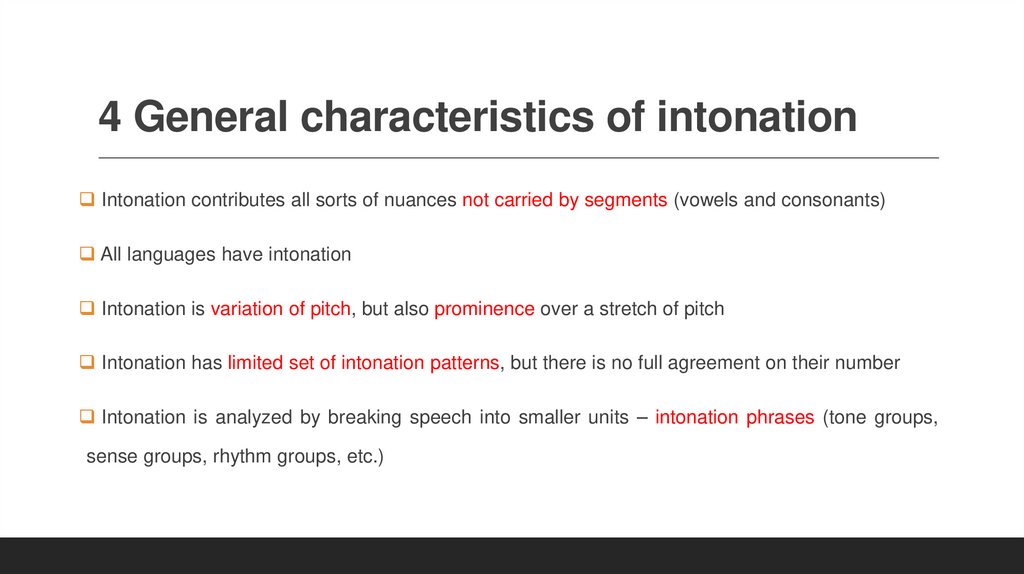
22. 4 General characteristics of intonation
Intonation contributes all sorts of nuances not carried by segments (vowels and consonants)All languages have intonation
Intonation is variation of pitch, but also prominence over a stretch of pitch
Intonation has limited set of intonation patterns, but there is no full agreement on their number
Intonation is analyzed by breaking speech into smaller units – intonation phrases (tone groups,
sense groups, rhythm groups, etc.)
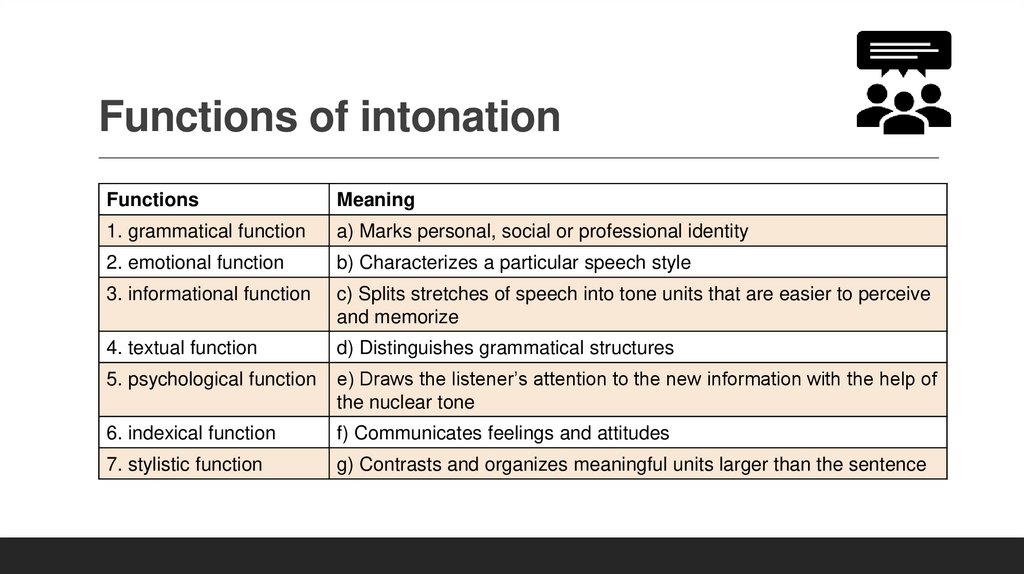
23. Functions of intonation
FunctionsMeaning
1. grammatical function
a) Marks personal, social or professional identity
2. emotional function
b) Characterizes a particular speech style
3. informational function
c) Splits stretches of speech into tone units that are easier to perceive
and memorize
4. textual function
d) Distinguishes grammatical structures
5. psychological function
e) Draws the listener’s attention to the new information with the help of
the nuclear tone
6. indexical function
f) Communicates feelings and attitudes
7. stylistic function
g) Contrasts and organizes meaningful units larger than the sentence
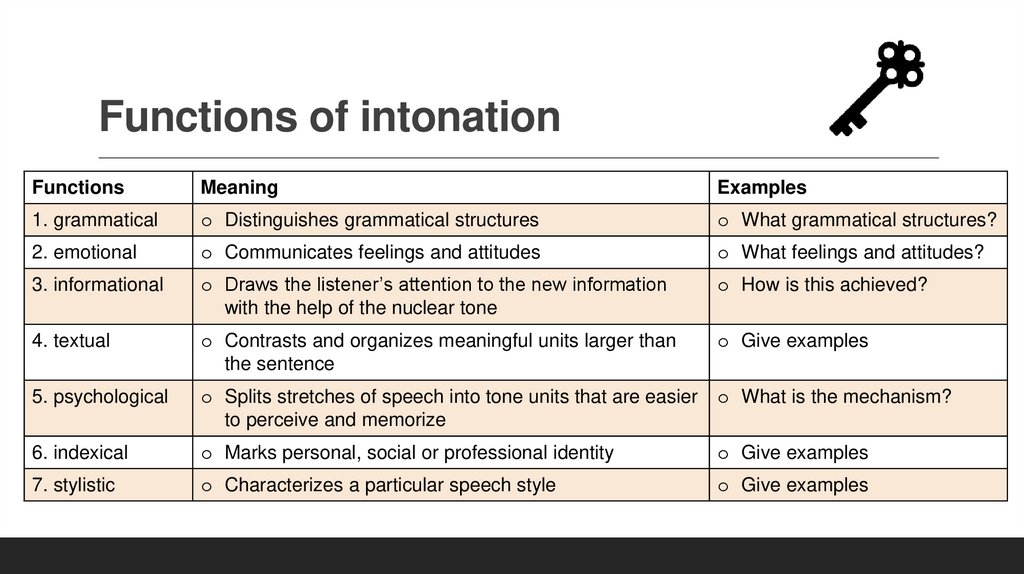
24. Functions of intonation
FunctionsMeaning
Examples
1. grammatical
o Distinguishes grammatical structures
o What grammatical structures?
2. emotional
o Communicates feelings and attitudes
o What feelings and attitudes?
3. informational
o Draws the listener’s attention to the new information
with the help of the nuclear tone
o How is this achieved?
4. textual
o Contrasts and organizes meaningful units larger than
the sentence
o Give examples
5. psychological
o Splits stretches of speech into tone units that are easier
to perceive and memorize
o What is the mechanism?
6. indexical
o Marks personal, social or professional identity
o Give examples
7. stylistic
o Characterizes a particular speech style
o Give examples
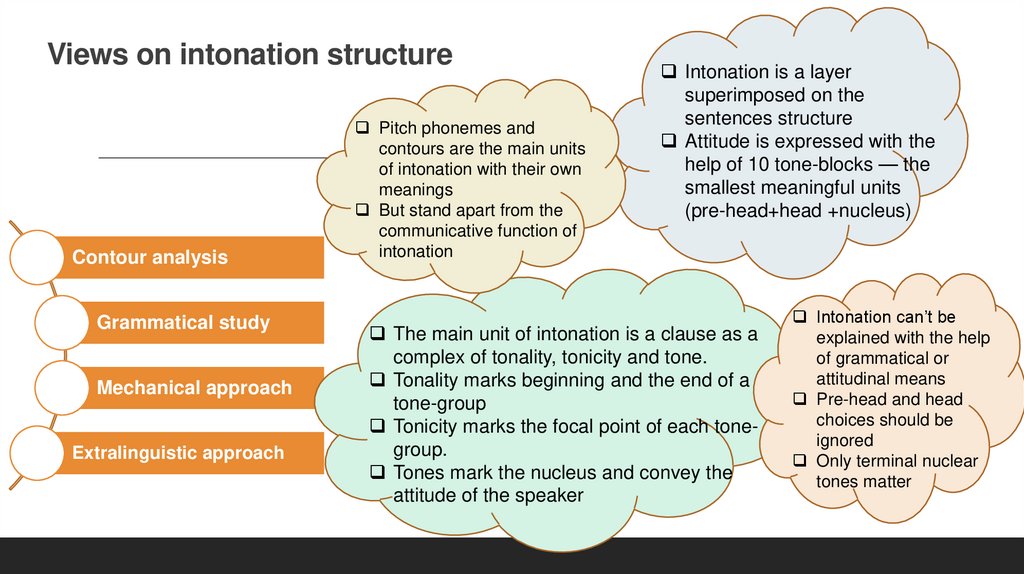
25. Views on intonation structure
Contour analysisGrammatical study
Mechanical approach
Extralinguistic approach
Pitch phonemes and
contours are the main units
of intonation with their own
meanings
But stand apart from the
communicative function of
intonation
Intonation is a layer
superimposed on the
sentences structure
Attitude is expressed with the
help of 10 tone-blocks — the
smallest meaningful units
(pre-head+head +nucleus)
The main unit of intonation is a clause as a
complex of tonality, tonicity and tone.
Tonality marks beginning and the end of a
tone-group
Tonicity marks the focal point of each tonegroup.
Tones mark the nucleus and convey the
attitude of the speaker
Intonation can’t be
explained with the help
of grammatical or
attitudinal means
Pre-head and head
choices should be
ignored
Only terminal nuclear
tones matter
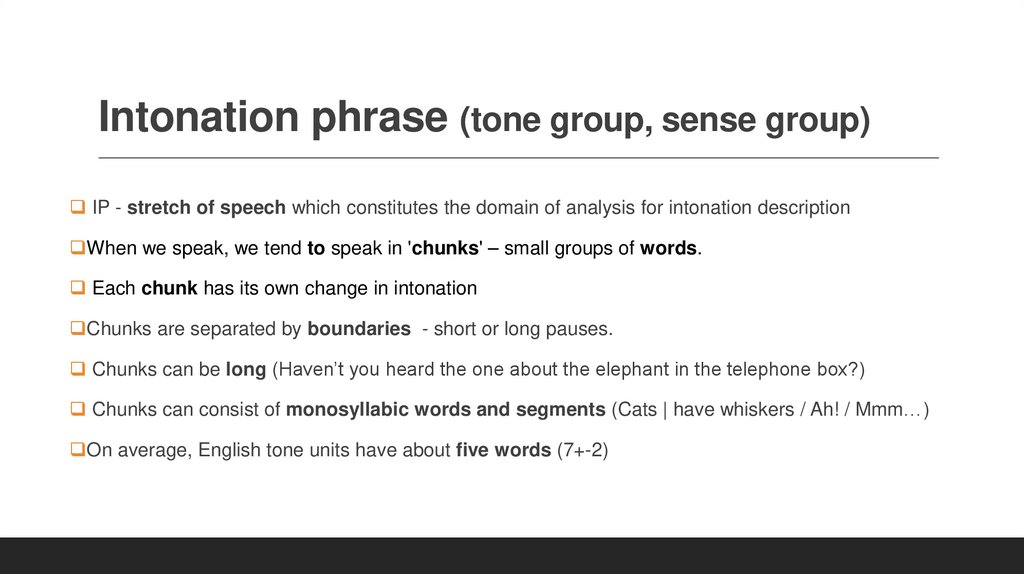
26. Intonation phrase (tone group, sense group)
IP - stretch of speech which constitutes the domain of analysis for intonation descriptionWhen we speak, we tend to speak in 'chunks' – small groups of words.
Each chunk has its own change in intonation
Chunks are separated by boundaries - short or long pauses.
Chunks can be long (Haven’t you heard the one about the elephant in the telephone box?)
Chunks can consist of monosyllabic words and segments (Cats | have whiskers / Ah! / Mmm…)
On average, English tone units have about five words (7+-2)
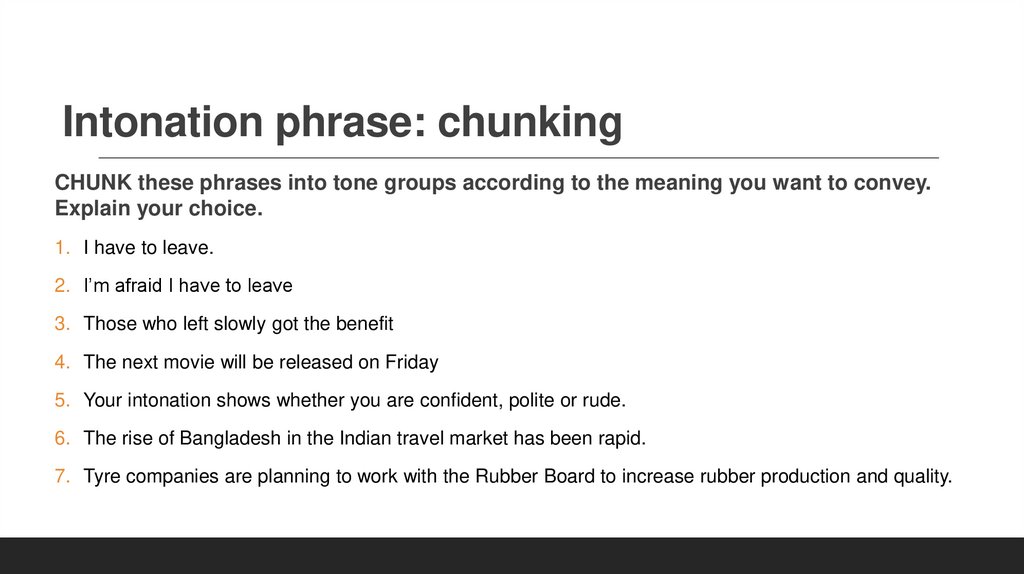
27. Intonation phrase: chunking
CHUNK these phrases into tone groups according to the meaning you want to convey.Explain your choice.
1. I have to leave.
2. I’m afraid I have to leave
3. Those who left slowly got the benefit
4. The next movie will be released on Friday
5. Your intonation shows whether you are confident, polite or rude.
6. The rise of Bangladesh in the Indian travel market has been rapid.
7. Tyre companies are planning to work with the Rubber Board to increase rubber production and quality.
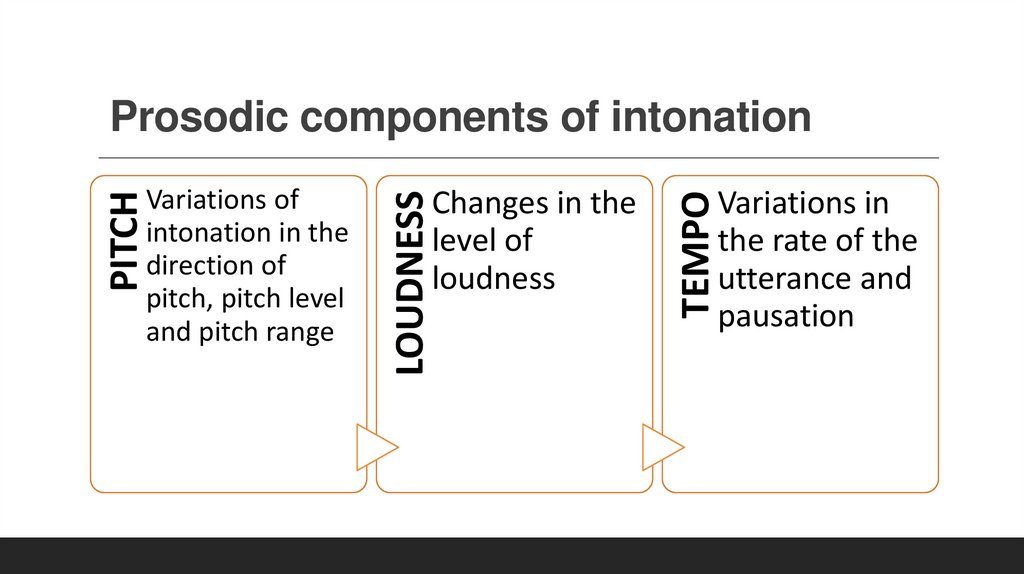
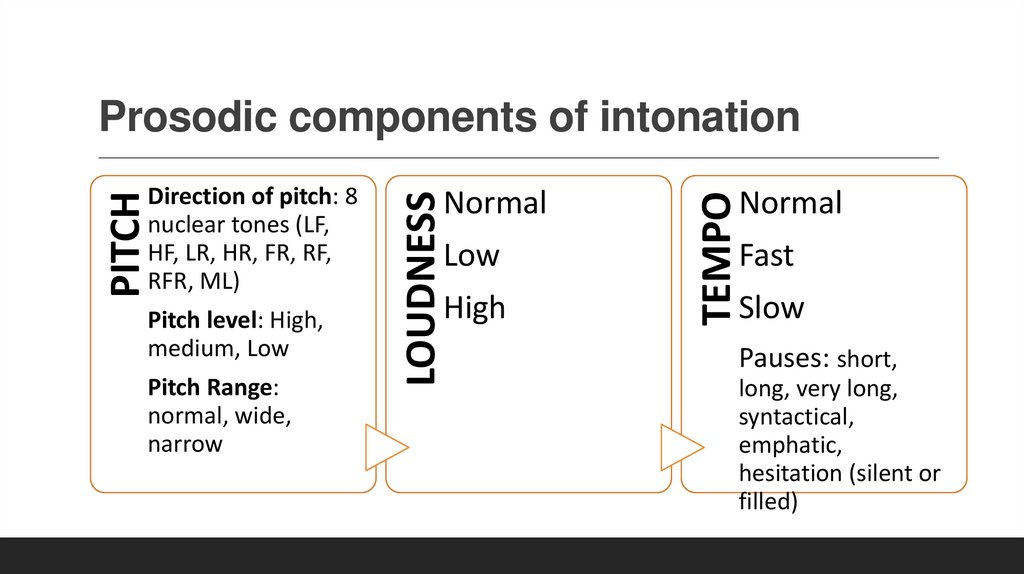
28. Prosodic components of intonation
Variations inthe rate of the
utterance and
pausation
TEMPO
Changes in the
level of
loudness
LOUDNESS
PITCH
Variations of
intonation in the
direction of
pitch, pitch level
and pitch range
29. Prosodic components of intonation
Pitch Range:normal, wide,
narrow
Low
High
Normal
TEMPO
Pitch level: High,
medium, Low
Normal
LOUDNESS
PITCH
Direction of pitch: 8
nuclear tones (LF,
HF, LR, HR, FR, RF,
RFR, ML)
Fast
Slow
Pauses: short,
long, very long,
syntactical,
emphatic,
hesitation (silent or
filled)
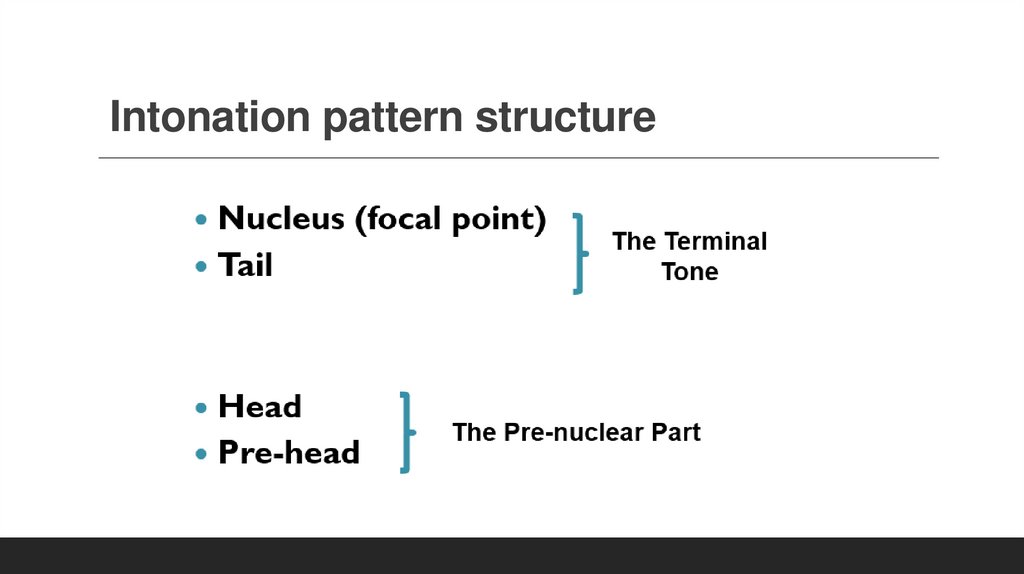
30. Intonation pattern structure
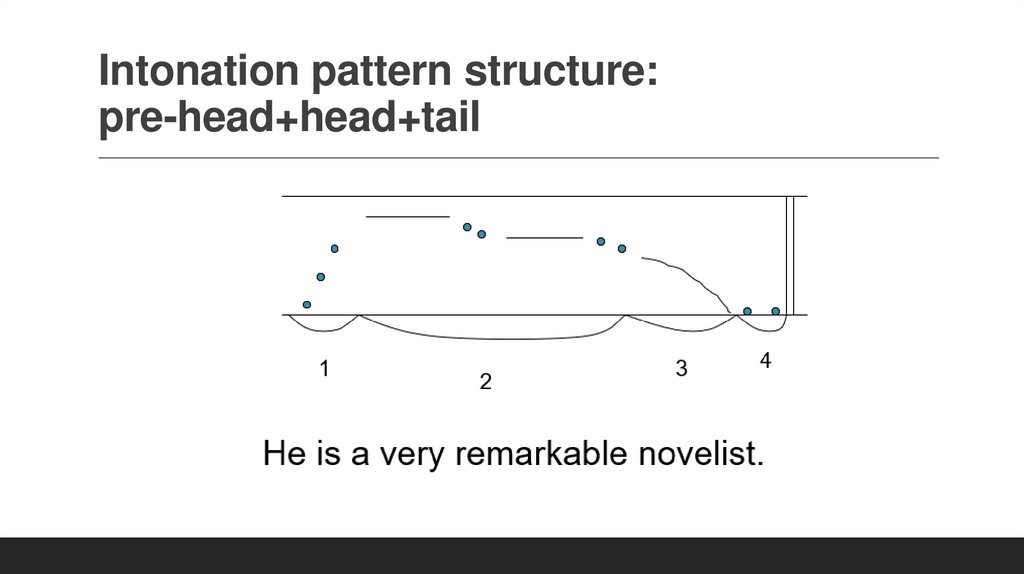
31. Intonation pattern structure: pre-head+head+tail
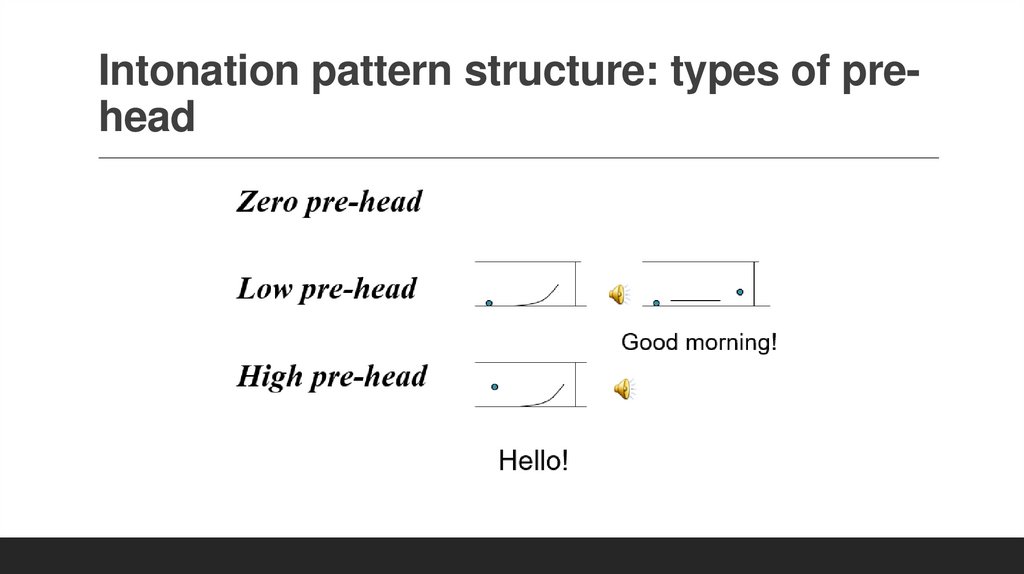
32. Intonation pattern structure: types of pre-head
Intonation pattern structure: types of prehead33. Intonation pattern structure: heads
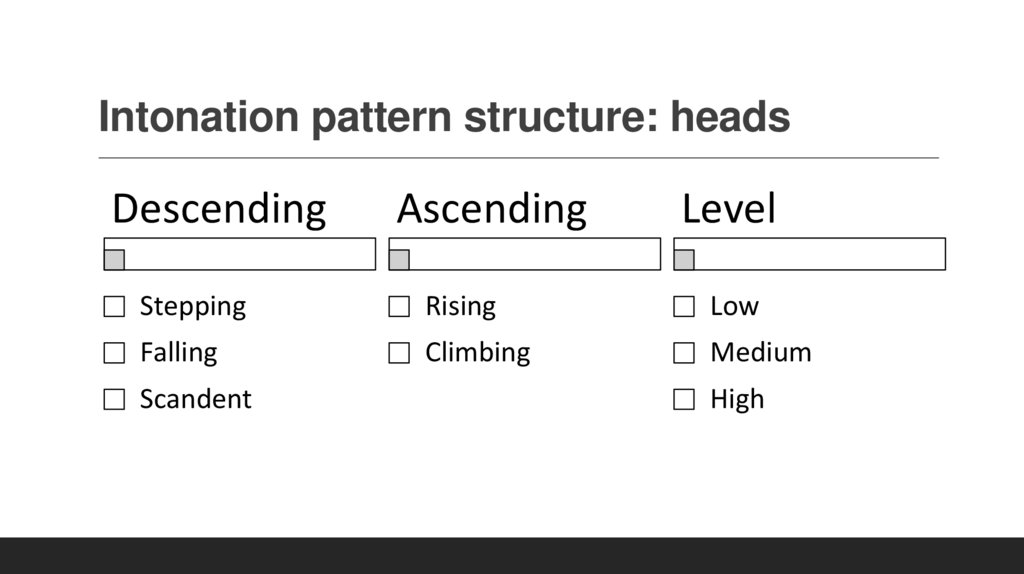
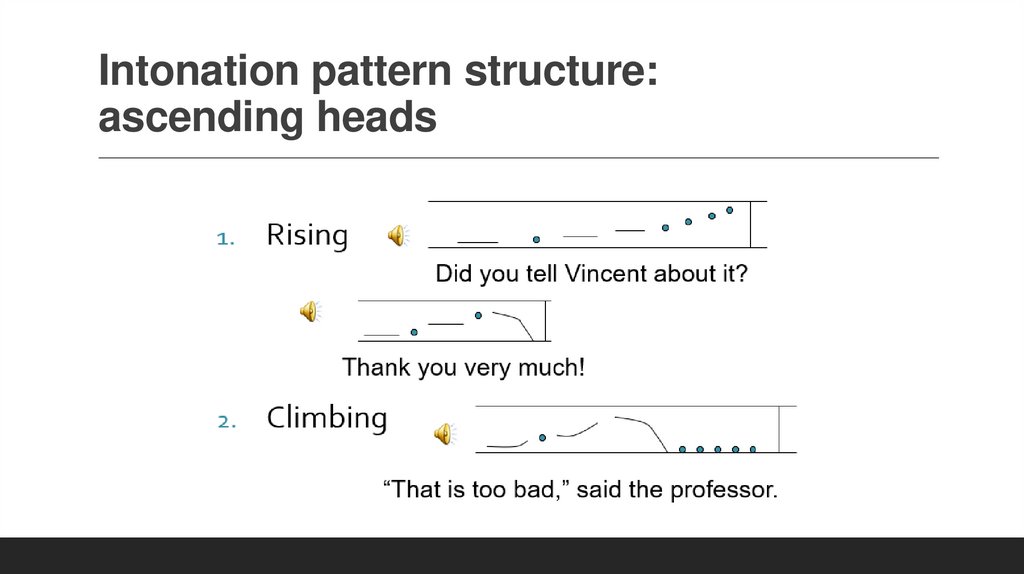
DescendingAscending
Level
Stepping
Rising
Low
Falling
Climbing
Medium
Scandent
High
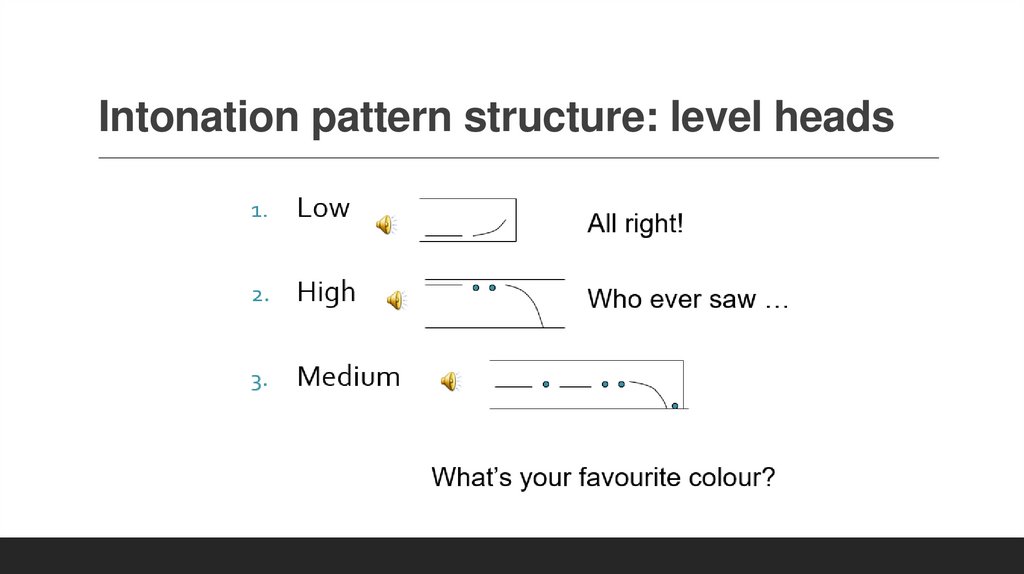
34. Intonation pattern structure: level heads
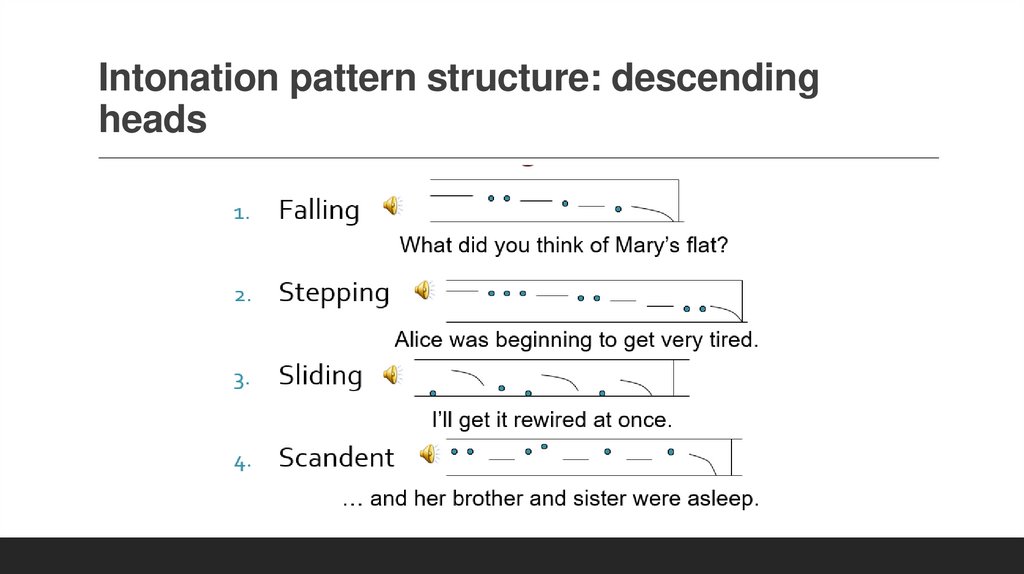
35. Intonation pattern structure: descending heads
36. Intonation pattern structure: descending heads
37. Intonation pattern structure: ascending heads
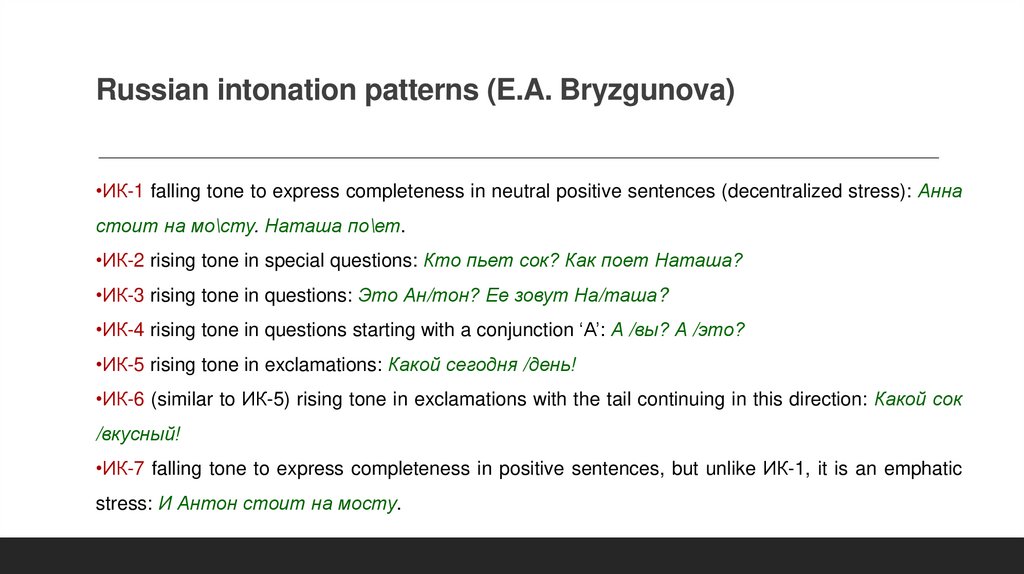
38. Russian intonation patterns (E.A. Bryzgunova)
•ИК-1 falling tone to express completeness in neutral positive sentences (decentralized stress): Аннастоит на мо\сту. Наташа по\ет.
•ИК-2 rising tone in special questions: Кто пьет сок? Как поет Наташа?
•ИК-3 rising tone in questions: Это Ан/тон? Ее зовут На/таша?
•ИК-4 rising tone in questions starting with a conjunction ‘А’: А /вы? А /это?
•ИК-5 rising tone in exclamations: Какой сегодня /день!
•ИК-6 (similar to ИК-5) rising tone in exclamations with the tail continuing in this direction: Какой сок
/вкусный!
•ИК-7 falling tone to express completeness in positive sentences, but unlike ИК-1, it is an emphatic
stress: И Антон стоит на мосту.
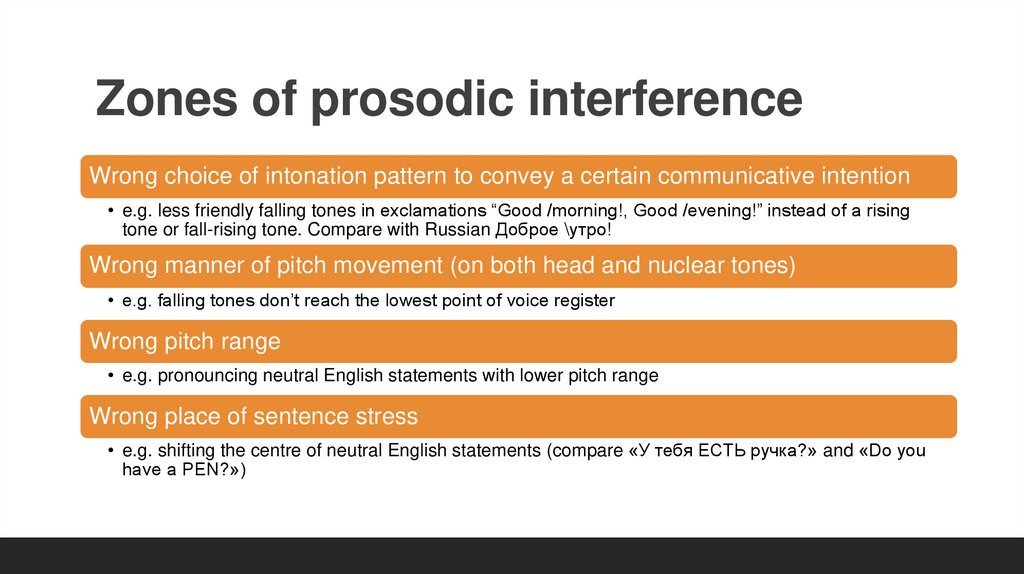
39. Zones of prosodic interference
Wrong choice of intonation pattern to convey a certain communicative intention• e.g. less friendly falling tones in exclamations “Good /morning!, Good /evening!” instead of a rising
tone or fall-rising tone. Compare with Russian Доброе \утро!
Wrong manner of pitch movement (on both head and nuclear tones)
• e.g. falling tones don’t reach the lowest point of voice register
Wrong pitch range
• e.g. pronouncing neutral English statements with lower pitch range
Wrong place of sentence stress
• e.g. shifting the centre of neutral English statements (compare «У тебя ЕСТЬ ручка?» and «Do you
have a PEN?»)
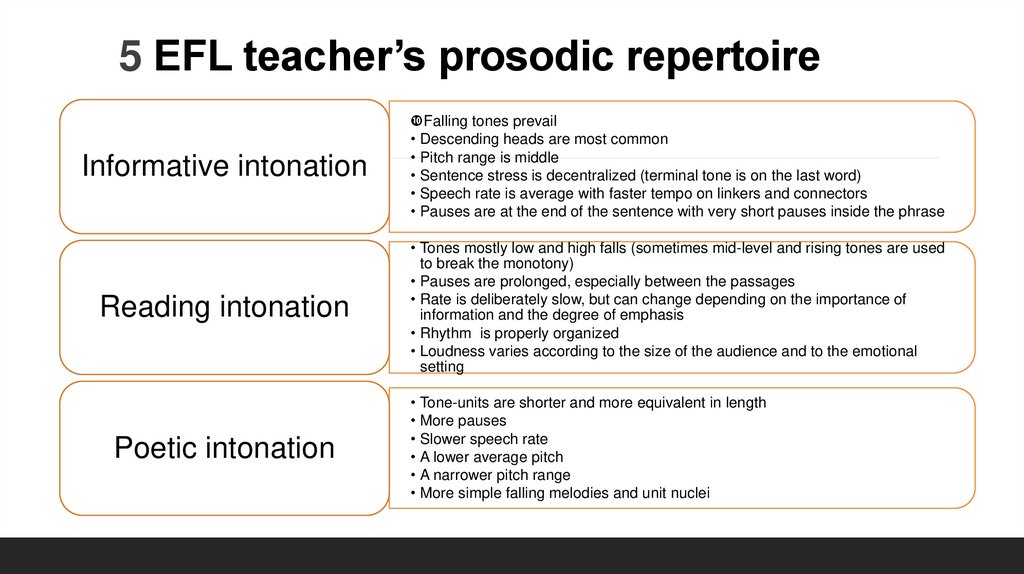
40. 5 EFL teacher’s prosodic repertoire
Informative intonationFalling tones prevail
• Descending heads are most common
• Pitch range is middle
• Sentence stress is decentralized (terminal tone is on the last word)
• Speech rate is average with faster tempo on linkers and connectors
• Pauses are at the end of the sentence with very short pauses inside the phrase
Reading intonation
• Tones mostly low and high falls (sometimes mid-level and rising tones are used
to break the monotony)
• Pauses are prolonged, especially between the passages
• Rate is deliberately slow, but can change depending on the importance of
information and the degree of emphasis
• Rhythm is properly organized
• Loudness varies according to the size of the audience and to the emotional
setting
Poetic intonation
• Tone-units are shorter and more equivalent in length
• More pauses
• Slower speech rate
• A lower average pitch
• A narrower pitch range
• More simple falling melodies and unit nuclei