
Similar presentations:









Anarchists_Propaganda_by_the_Deed_Words (1)
1.
Anarchists in the NineteenthCentury: Propaganda by the Deed
• Name: [Your Name]
• Course: [Course Title]
• University: [University Name]
• Date: [Date]
2.
Introduction• In the late nineteenth century, Europe was
marked by political unrest, economic
hardship, and growing worker movements.
• Anarchism arose as a rejection of both
capitalism and authoritarian government,
calling for complete individual freedom.
• “Propaganda by the deed” emerged as a
strategy to awaken public consciousness
through dramatic, revolutionary acts.
• Its supporters argued that words alone could
3.
Origins of the Idea• The idea originated in Italy and France during
the eighteen seventies, influenced by thinkers
like Mikhail Bakunin and Errico Malatesta.
• They believed that individual acts of courage
could demonstrate resistance and spark
collective uprising.
• “Propaganda by the deed” emphasized the
moral and emotional power of example over
theoretical discussion.
• Early anarchists rejected participation in
4.
Key Events and Examples• One of the first major acts linked to this idea
was the assassination of Tsar Alexander the
Second in eighteen eighty-one in Russia.
• Similar attacks, including bombings and
political assassinations, spread across Europe
and the United States.
• The International Anarchist Congress in
London in eighteen eighty-one officially
recognized direct action as a legitimate form
of struggle.
5.
Philosophical Justification• Supporters of the concept argued that
violence was justified as a response to
systemic injustice and state violence.
• They viewed revolutionary acts as moral
demonstrations of personal and collective
freedom.
• By confronting oppression directly, anarchists
hoped to reveal the cruelty and hypocrisy of
political power.
• However, many within the movement,
6.
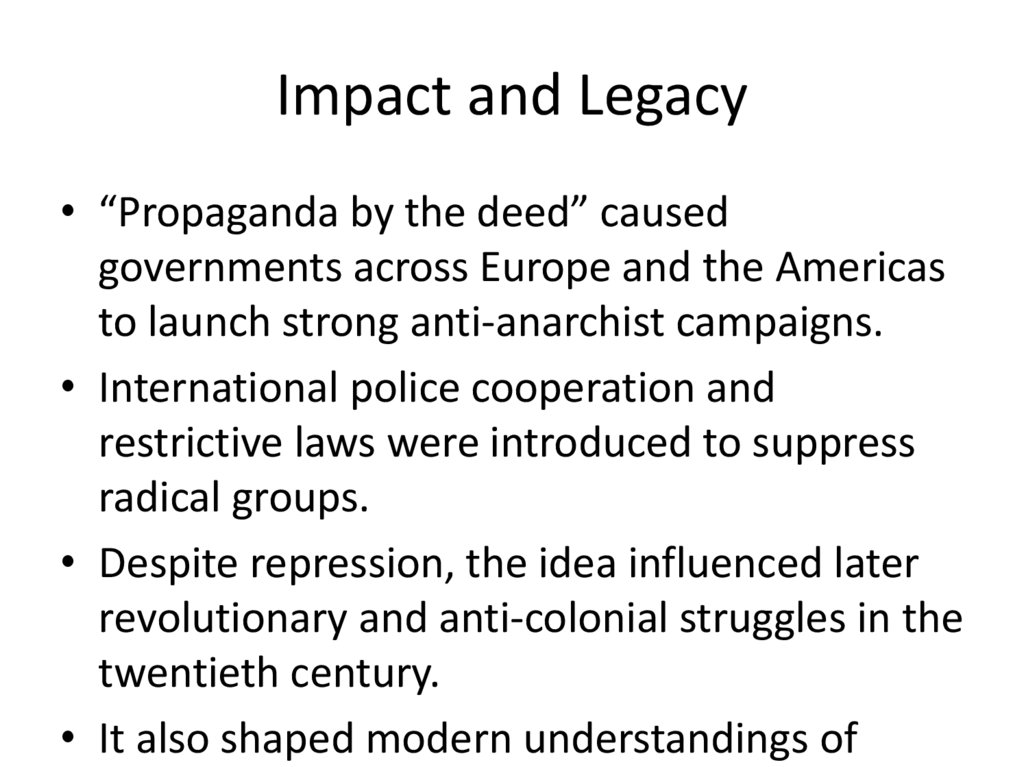
Impact and Legacy• “Propaganda by the deed” caused
governments across Europe and the Americas
to launch strong anti-anarchist campaigns.
• International police cooperation and
restrictive laws were introduced to suppress
radical groups.
• Despite repression, the idea influenced later
revolutionary and anti-colonial struggles in the
twentieth century.
• It also shaped modern understandings of
7.
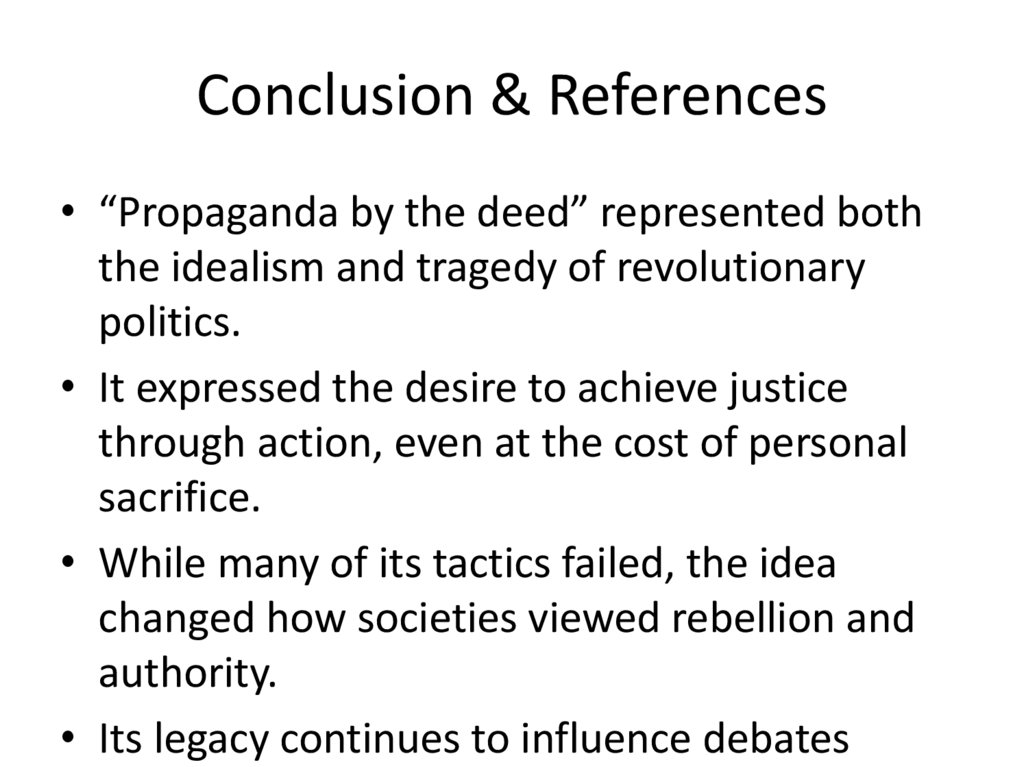
Conclusion & References• “Propaganda by the deed” represented both
the idealism and tragedy of revolutionary
politics.
• It expressed the desire to achieve justice
through action, even at the cost of personal
sacrifice.
• While many of its tactics failed, the idea
changed how societies viewed rebellion and
authority.
• Its legacy continues to influence debates