 english
Similar presentations:







Английские предлоги. Prepositions
1. Prepositions
ПРЕДЛОГИ2.
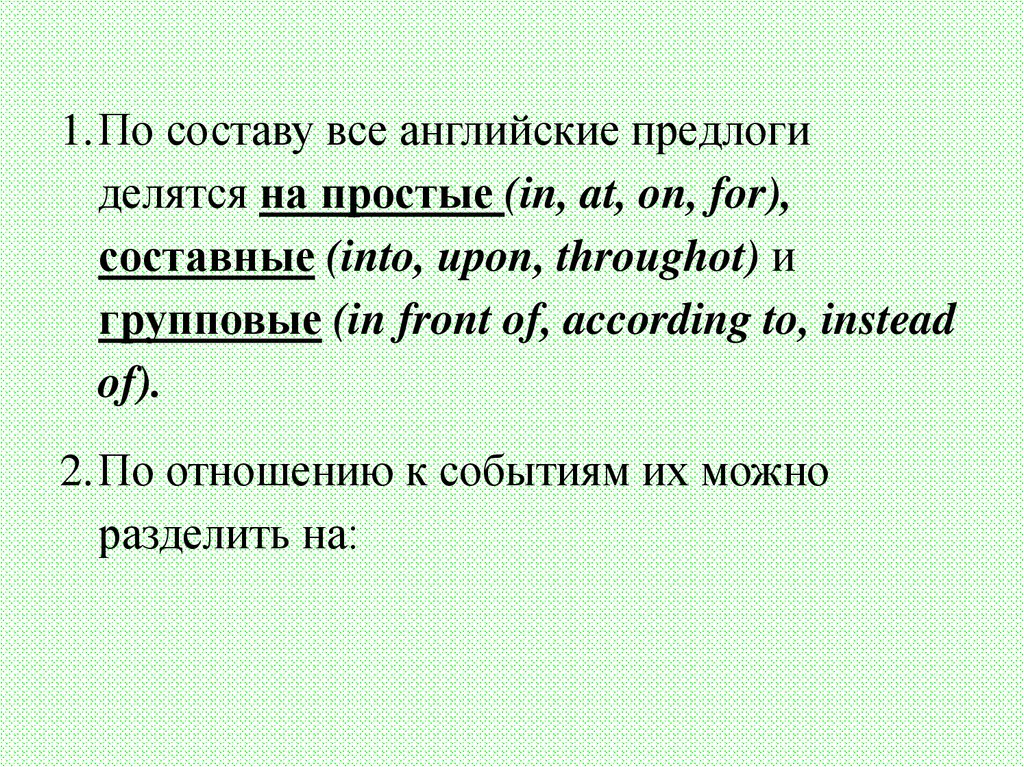
1.По составу все английские предлогиделятся на простые (in, at, on, for),
составные (into, upon, throughot) и
групповые (in front of, according to, instead
of).
2.По отношению к событиям их можно
разделить на:
3.
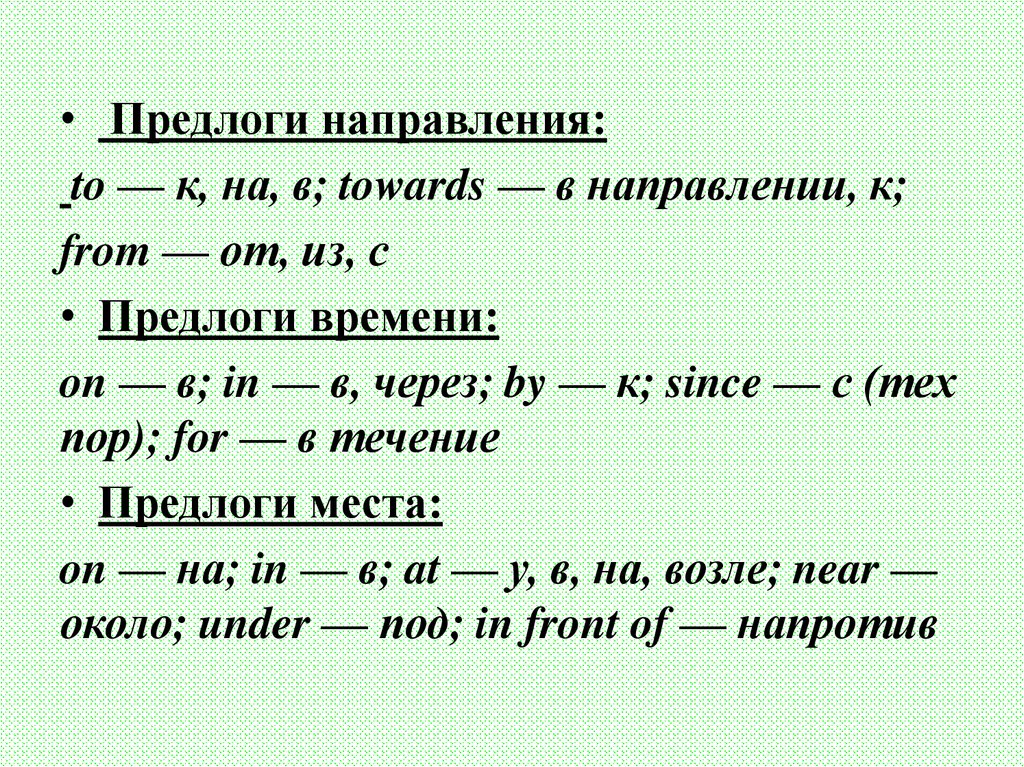
• Предлоги направления:to — к, на, в; towards — в направлении, к;
from — от, из, с
• Предлоги времени:
on — в; in — в, через; by — к; since — с (тех
пор); for — в течение
• Предлоги места:
on — на; in — в; at — у, в, на, возле; near —
около; under — под; in front of — напротив
4.
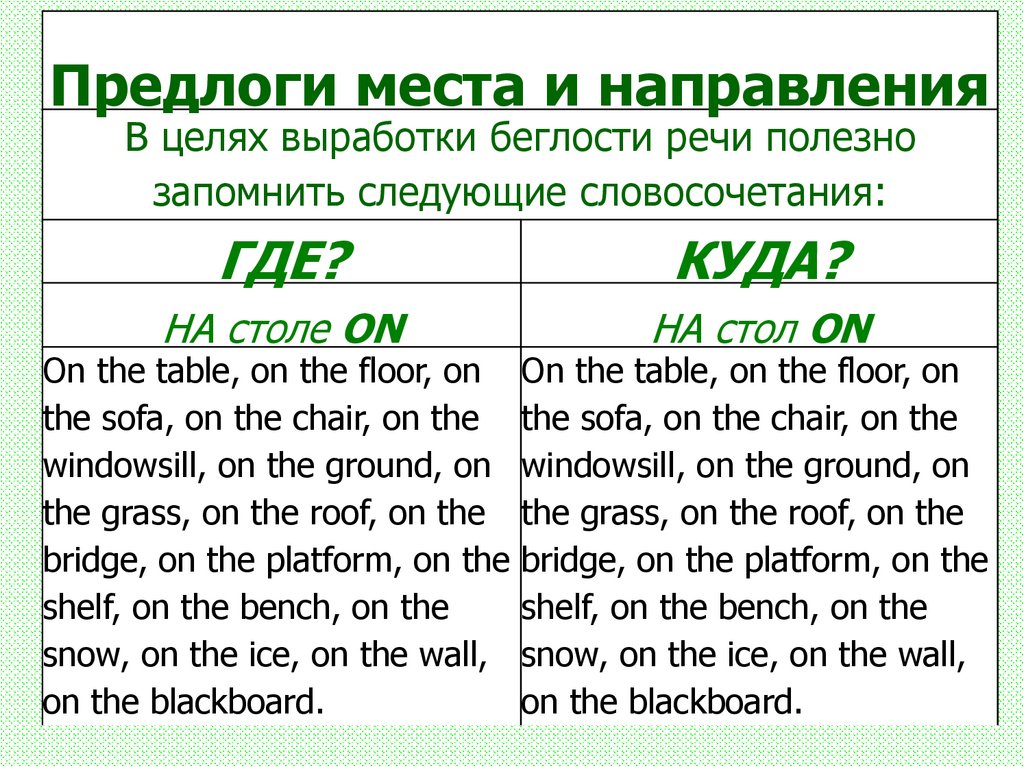
Предлоги места и направленияВ целях выработки беглости речи полезно
запомнить следующие словосочетания:
ГДЕ?
КУДА?
НА столе ON
НА стол ON
On the table, on the floor, on On the table, on the floor, on
the sofa, on the chair, on the the sofa, on the chair, on the
windowsill, on the ground, on windowsill, on the ground, on
the grass, on the roof, on the the grass, on the roof, on the
bridge, on the platform, on the bridge, on the platform, on the
shelf, on the bench, on the
shelf, on the bench, on the
snow, on the ice, on the wall, snow, on the ice, on the wall,
on the blackboard.
on the blackboard.
5.
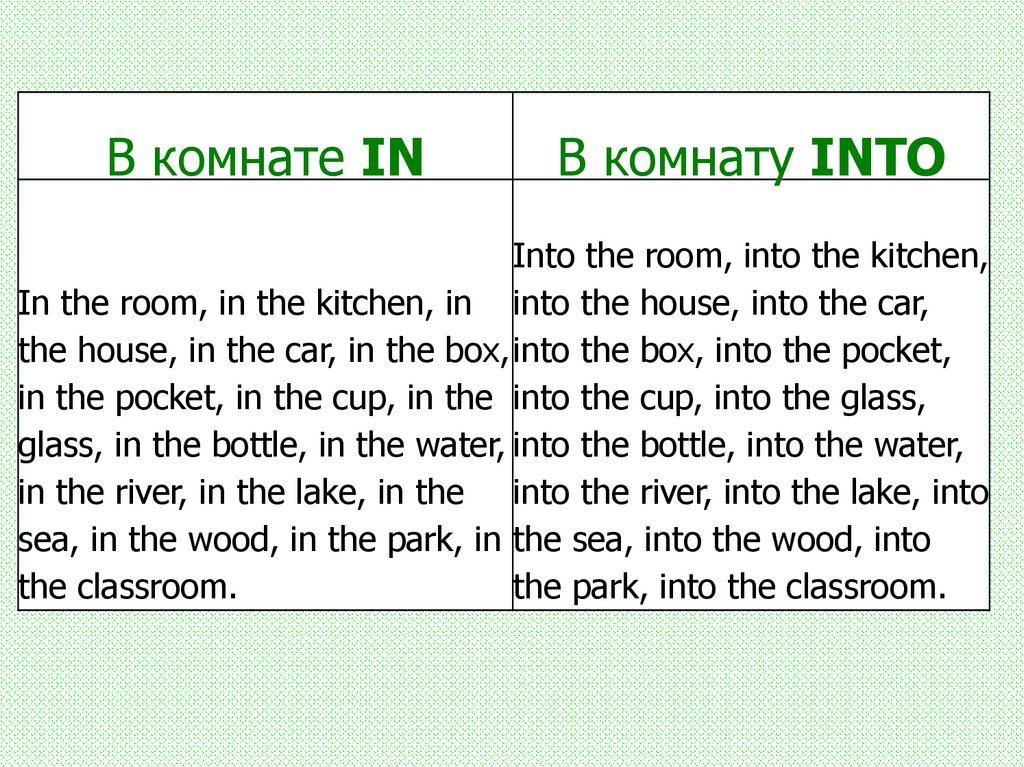
В комнате INВ комнату INTO
Into the room, into the kitchen,
In the room, in the kitchen, in into the house, into the car,
the house, in the car, in the box, into the box, into the pocket,
in the pocket, in the cup, in the into the cup, into the glass,
glass, in the bottle, in the water, into the bottle, into the water,
in the river, in the lake, in the into the river, into the lake, into
sea, in the wood, in the park, in the sea, into the wood, into
the classroom.
the park, into the classroom.
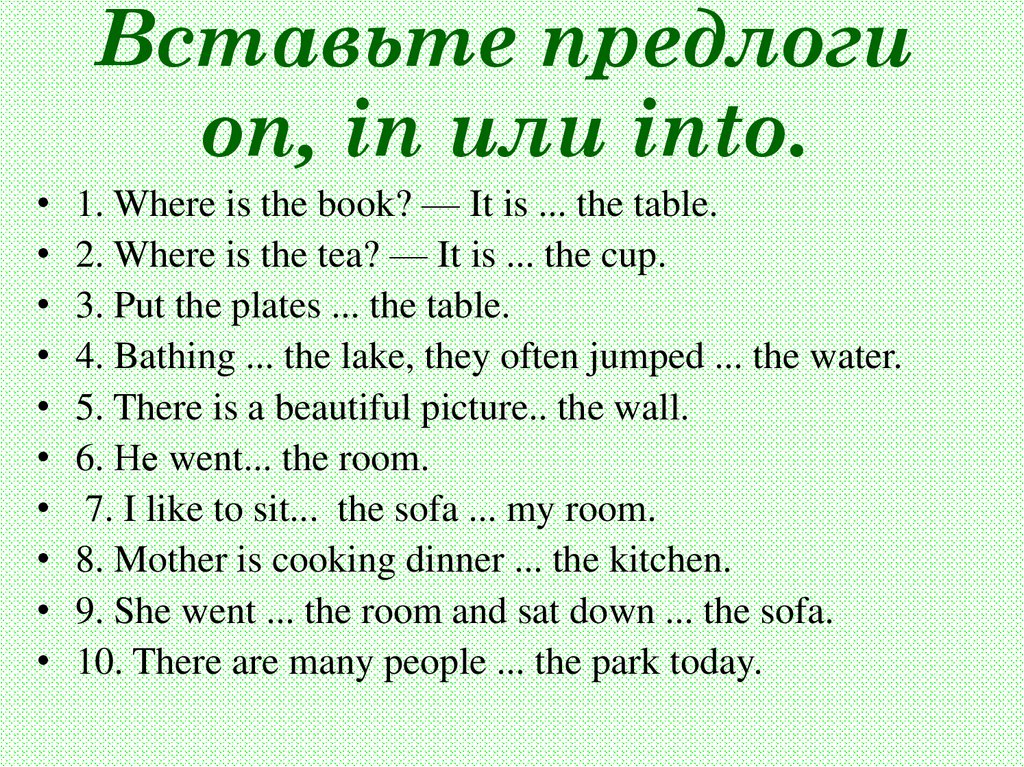
6. Вставьте предлоги on, in или into.
• 1. Where is the book? — It is ... the table.• 2. Where is the tea? — It is ... the cup.
• 3. Put the plates ... the table.
• 4. Bathing ... the lake, they often jumped ... the water.
• 5. There is a beautiful picture.. the wall.
• 6. Не went... the room.
• 7. I like to sit... the sofa ... my room.
• 8. Mother is cooking dinner ... the kitchen.
• 9. She went ... the room and sat down ... the sofa.
• 10. There are many people ... the park today.
7.
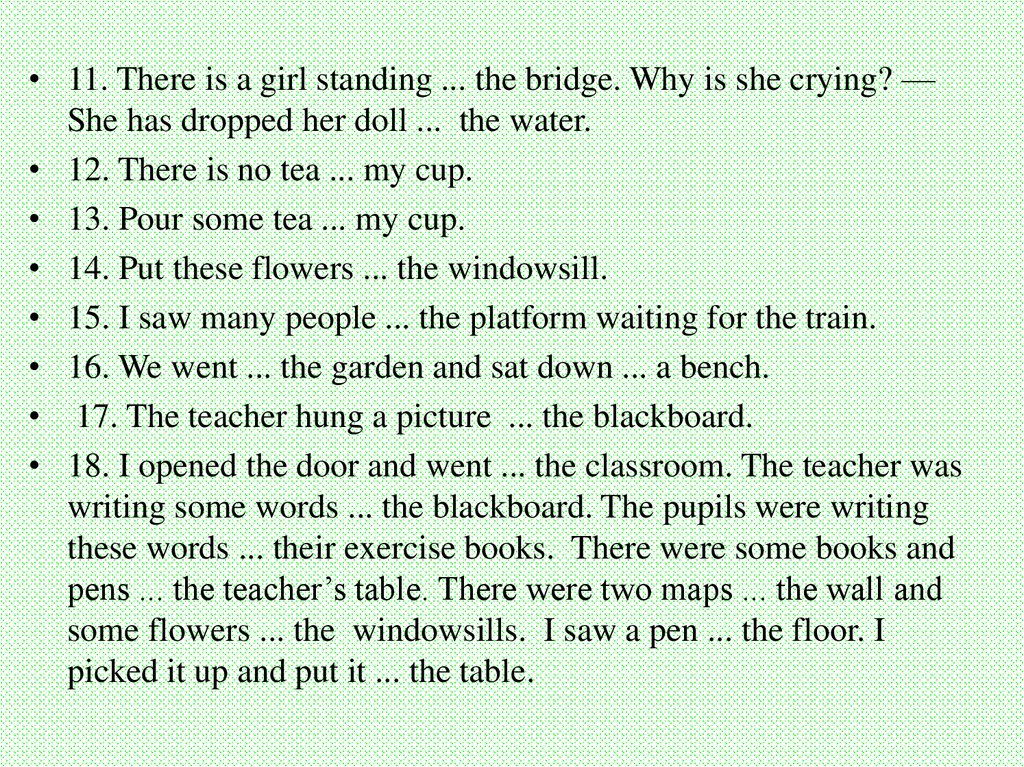
• 11. There is a girl standing ... the bridge. Why is she crying? —She has dropped her doll ... the water.
• 12. There is no tea ... my cup.
• 13. Pour some tea ... my cup.
• 14. Put these flowers ... the windowsill.
• 15. I saw many people ... the platform waiting for the train.
• 16. We went ... the garden and sat down ... a bench.
• 17. The teacher hung a picture ... the blackboard.
• 18. I opened the door and went ... the classroom. The teacher was
writing some words ... the blackboard. The pupils were writing
these words ... their exercise books. There were some books and
pens ... the teacher’s table. There were two maps ... the wall and
some flowers ... the windowsills. I saw a pen ... the floor. I
picked it up and put it ... the table.
8.
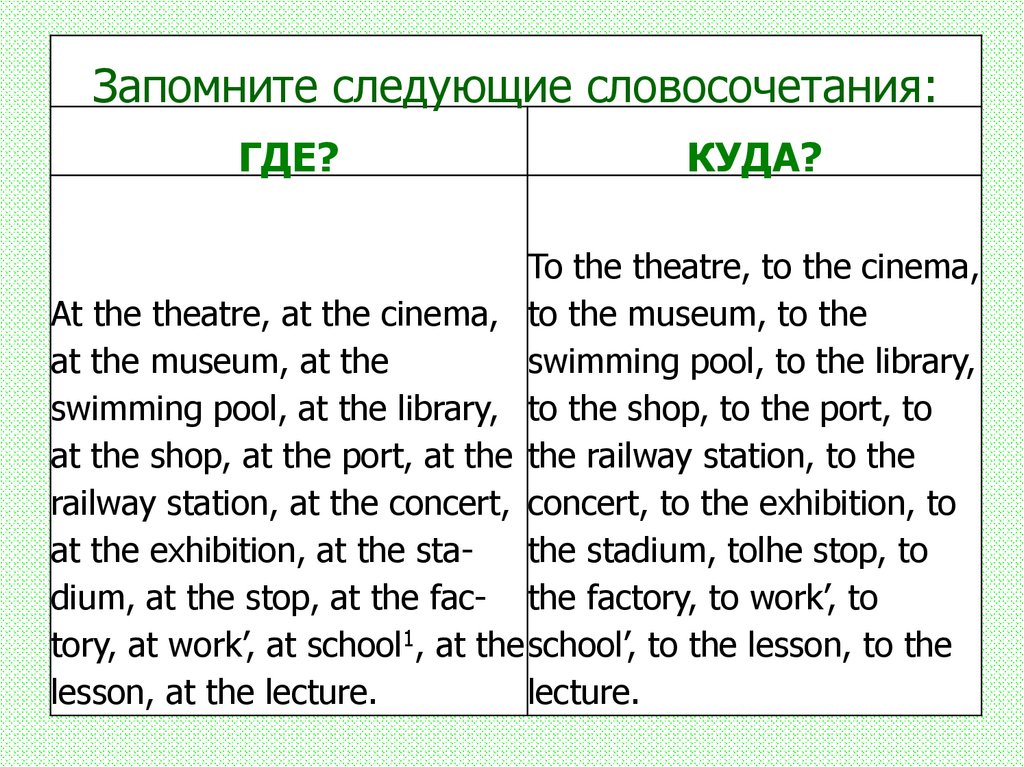
Запомните следующие словосочетания:ГДЕ?
КУДА?
To the theatre, to the cinema,
At the theatre, at the cinema, to the museum, to the
at the museum, at the
swimming pool, to the library,
swimming pool, at the library, to the shop, to the port, to
at the shop, at the port, at the the railway station, to the
railway station, at the concert, concert, to the exhibition, to
at the exhibition, at the stathe stadium, tolhe stop, to
dium, at the stop, at the fac- the factory, to work’, to
tory, at work’, at school1, at the school’, to the lesson, to the
lesson, at the lecture.
lecture.
9.
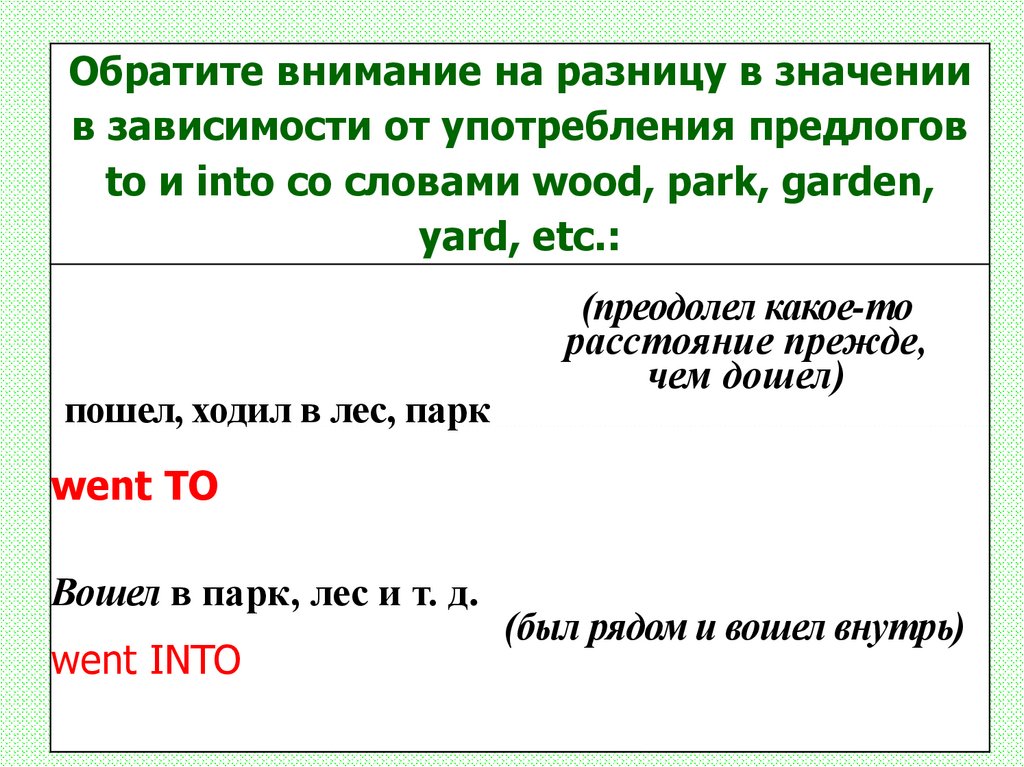
Обратите внимание на разницу в значениив зависимости от употребления предлогов
to и into со словами wood, park, garden,
yard, etc.:
пошел, ходил в лес, парк
(преодолел какое-то
расстояние прежде,
чем дошел)
went ТО
Вошел в парк, лес и т. д.
went INTO
(был рядом и вошел внутрь)
10.
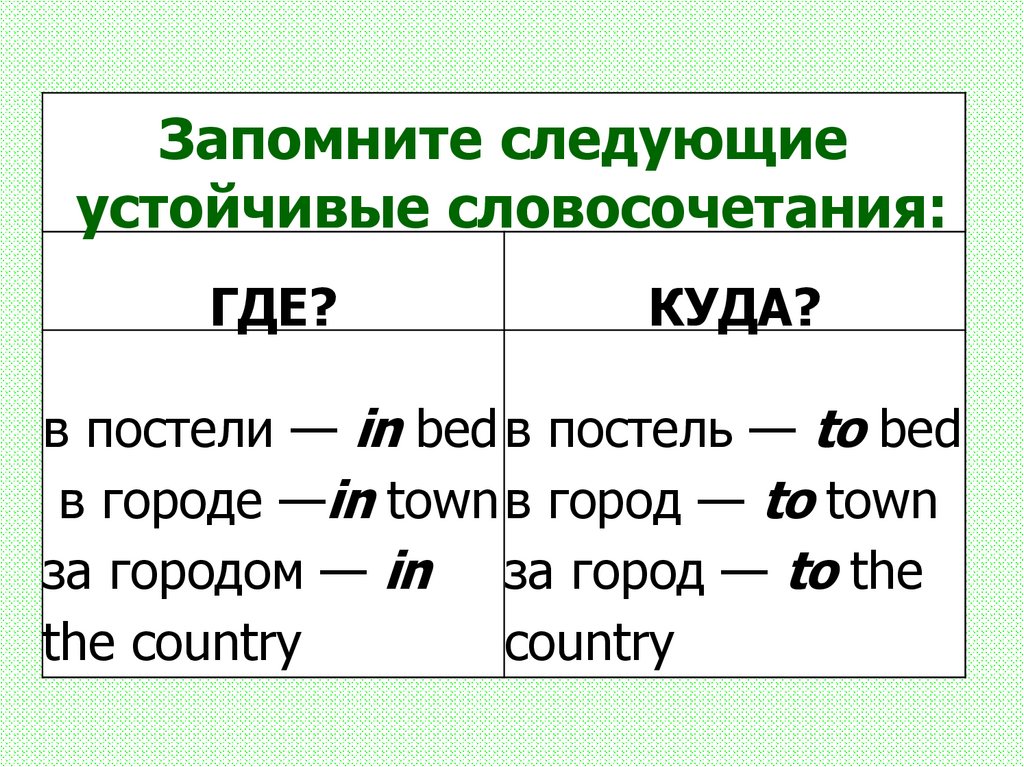
Запомните следующиеустойчивые словосочетания:
ГДЕ?
КУДА?
в постели — in bed в постель — to bed
в городе —in town в город — to town
за городом — in за город — to the
the country
country
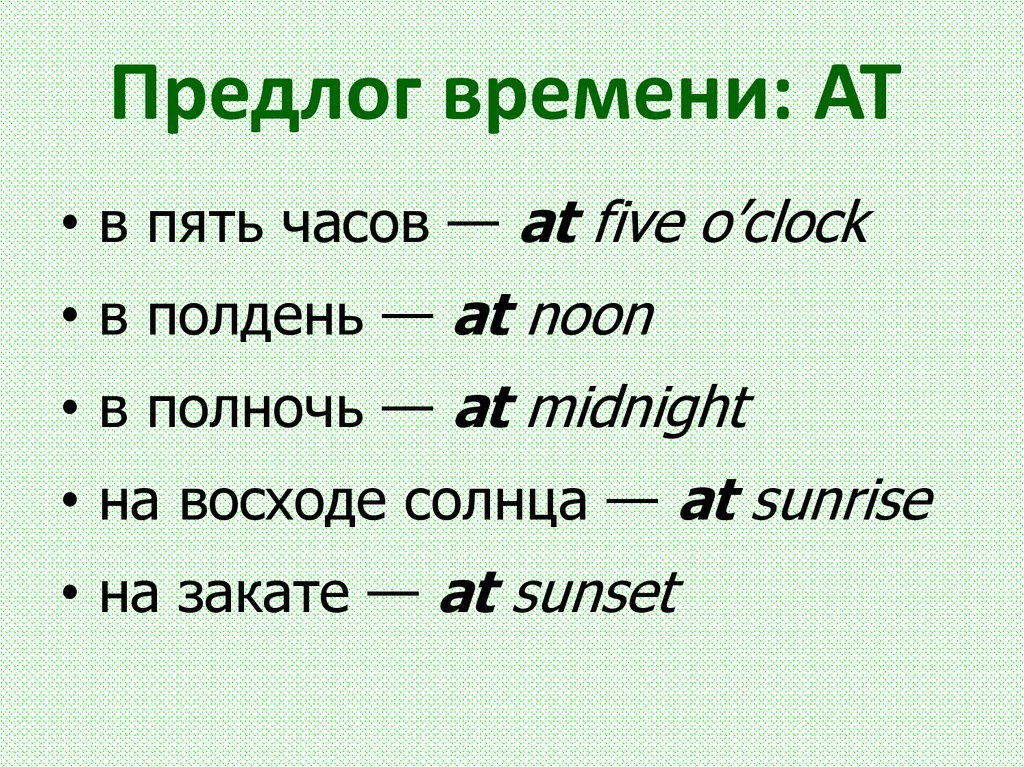
11. Предлог времени: АТ
• в пять часов — at five o’clock• в полдень — at noon
• в полночь — at midnight
• на восходе солнца — at sunrise
• на закате — at sunset
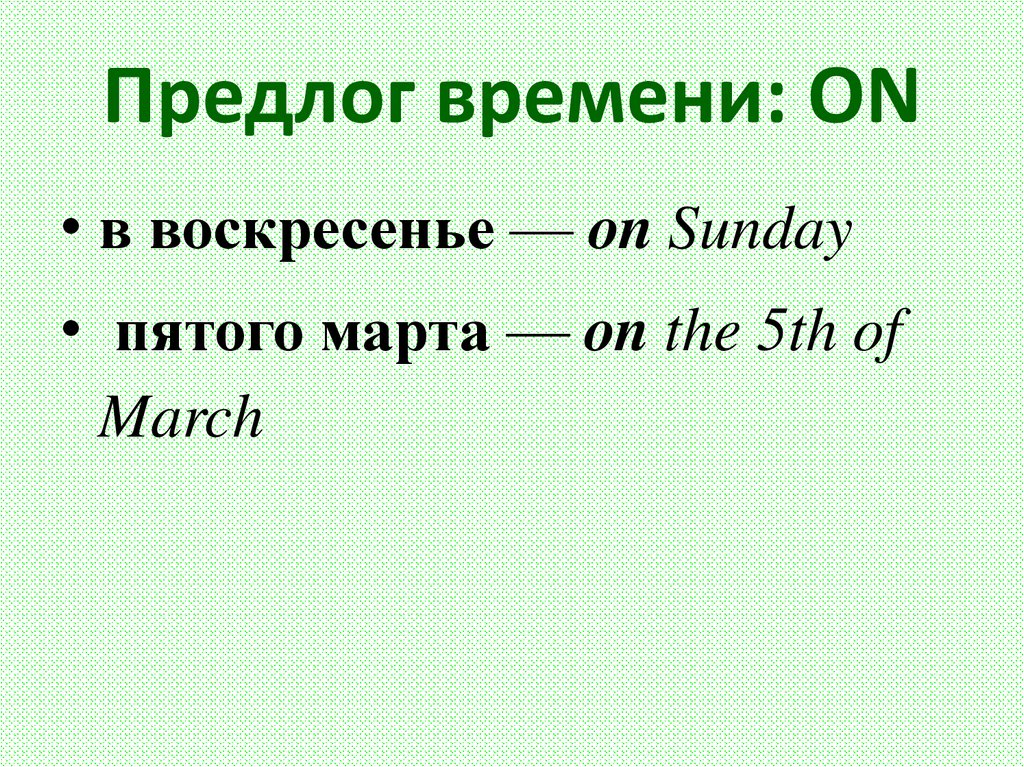
12. Предлог времени: ON
• в воскресенье — on Sunday• пятого марта — on the 5th of
March
13.
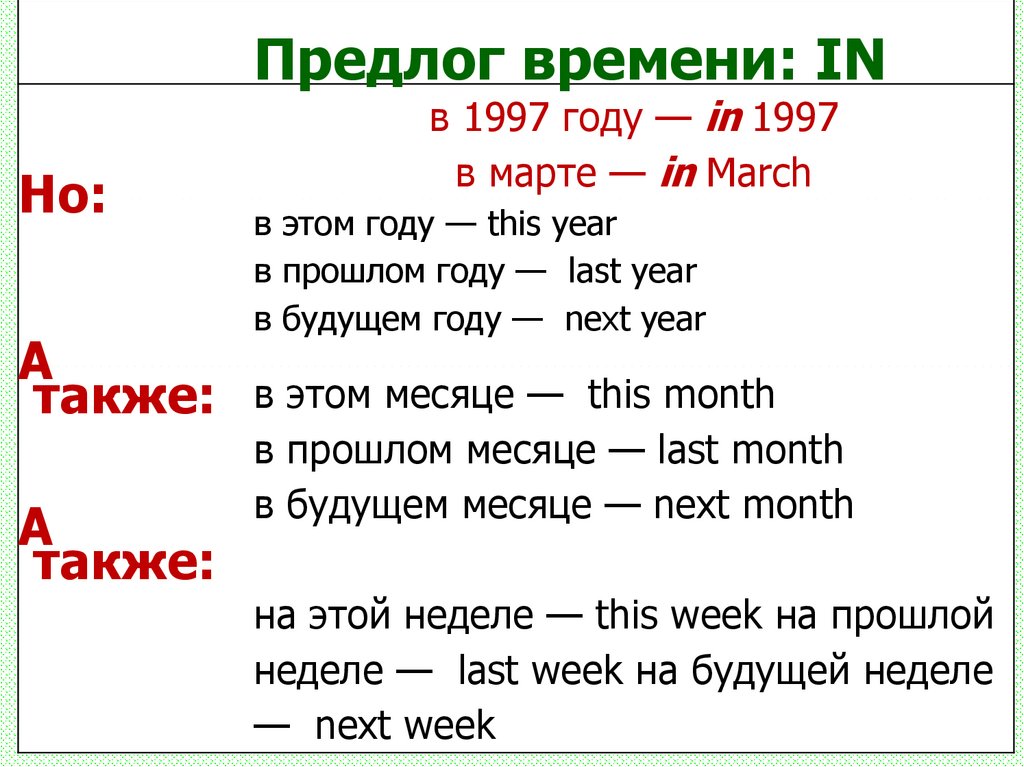
Предлог времени: INНо:
А
также:
А
также:
в 1997 году — in 1997
в марте — in March
в этом году — this year
в прошлом году — last year
в будущем году — next year
в этом месяце — this month
в прошлом месяце — last month
в будущем месяце — next month
на этой неделе — this week на прошлой
неделе — last week на будущей неделе
— next week
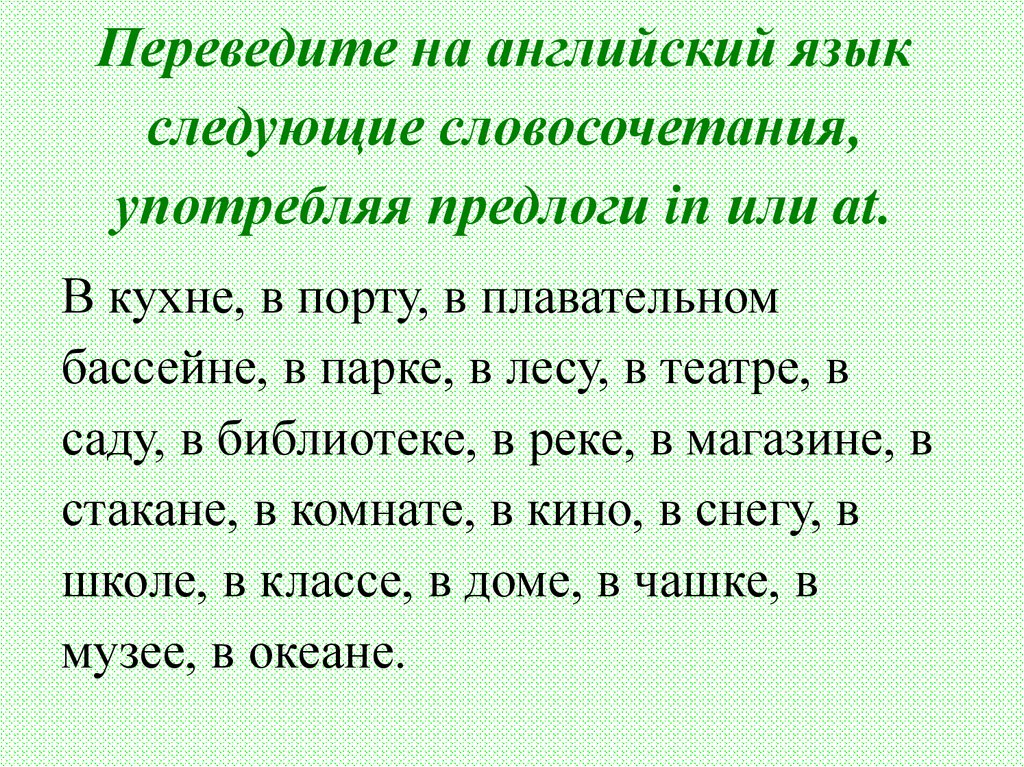
14. Переведите на английский язык следующие словосочетания, употребляя предлоги in или at.
Переведите на английский языкследующие словосочетания,
употребляя предлоги in или at.
В кухне, в порту, в плавательном
бассейне, в парке, в лесу, в театре, в
саду, в библиотеке, в реке, в магазине, в
стакане, в комнате, в кино, в снегу, в
школе, в классе, в доме, в чашке, в
музее, в океане.
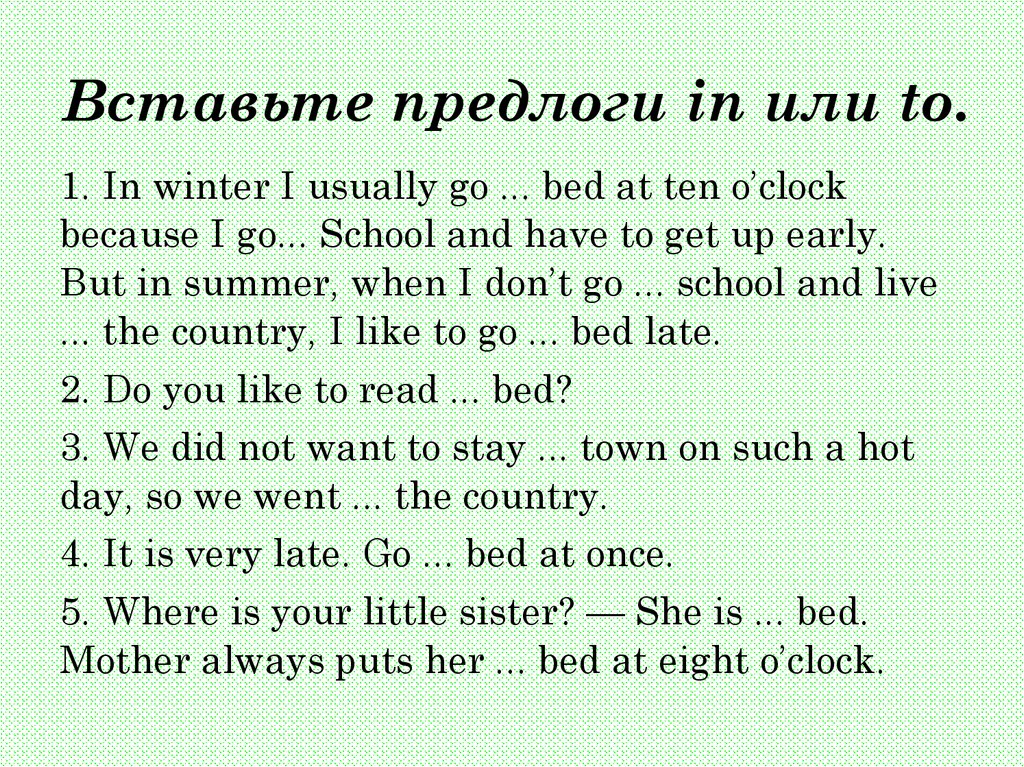
15. Вставьте предлоги in или to.
1. In winter I usually go ... bed at ten o’clockbecause I go... School and have to get up early.
But in summer, when I don’t go ... school and live
... the country, I like to go ... bed late.
2. Do you like to read ... bed?
3. We did not want to stay ... town on such a hot
day, so we went ... the country.
4. It is very late. Go ... bed at once.
5. Where is your little sister? — She is ... bed.
Mother always puts her ... bed at eight o’clock.
16.
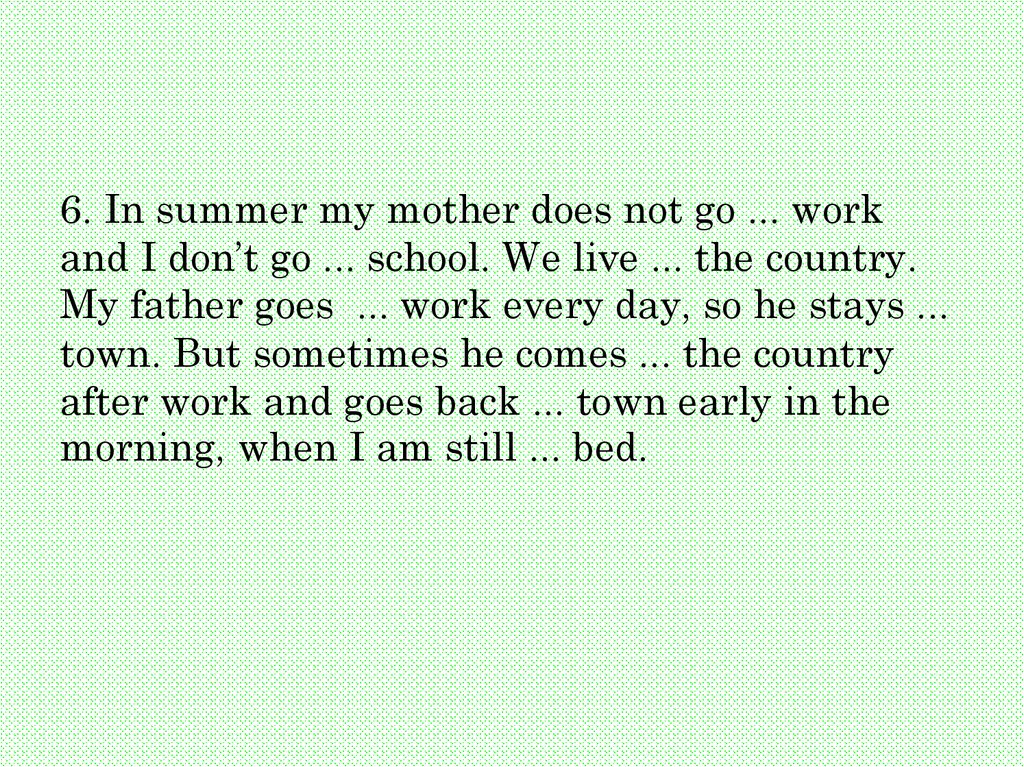
6. In summer my mother does not go ... workand I don’t go ... school. We live ... the country.
My father goes ... work every day, so he stays ...
town. But sometimes he comes ... the country
after work and goes back ... town early in the
morning, when I am still ... bed.
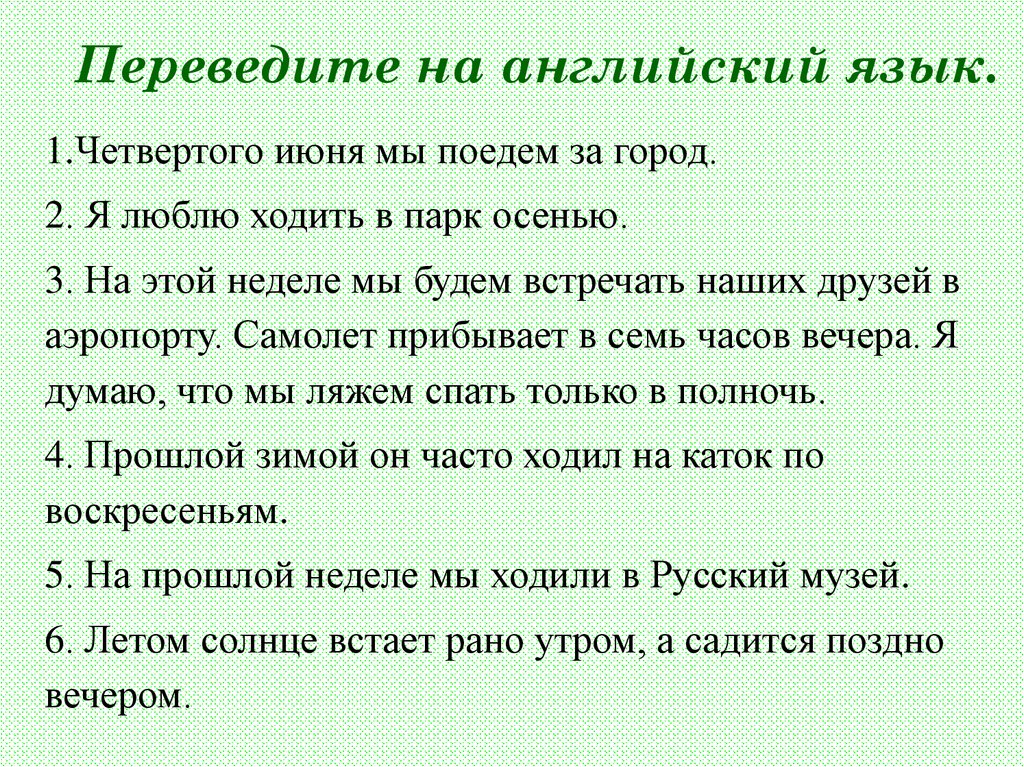
17. Переведите на английский язык.
1.Четвертого июня мы поедем за город.2. Я люблю ходить в парк осенью.
3. На этой неделе мы будем встречать наших друзей в
аэропорту. Самолет прибывает в семь часов вечера. Я
думаю, что мы ляжем спать только в полночь.
4. Прошлой зимой он часто ходил на каток по
воскресеньям.
5. На прошлой неделе мы ходили в Русский музей.
6. Летом солнце встает рано утром, а садится поздно
вечером.
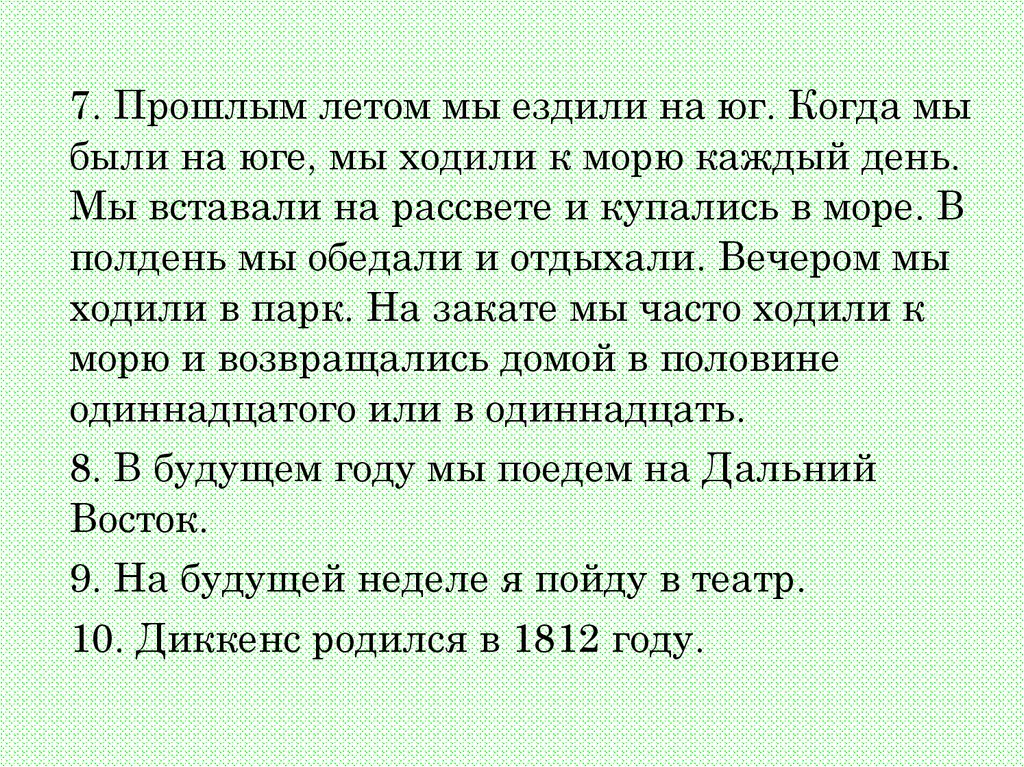
18.
7. Прошлым летом мы ездили на юг. Когда мыбыли на юге, мы ходили к морю каждый день.
Мы вставали на рассвете и купались в море. В
полдень мы обедали и отдыхали. Вечером мы
ходили в парк. На закате мы часто ходили к
морю и возвращались домой в половине
одиннадцатого или в одиннадцать.
8. В будущем году мы поедем на Дальний
Восток.
9. На будущей неделе я пойду в театр.
10. Диккенс родился в 1812 году.
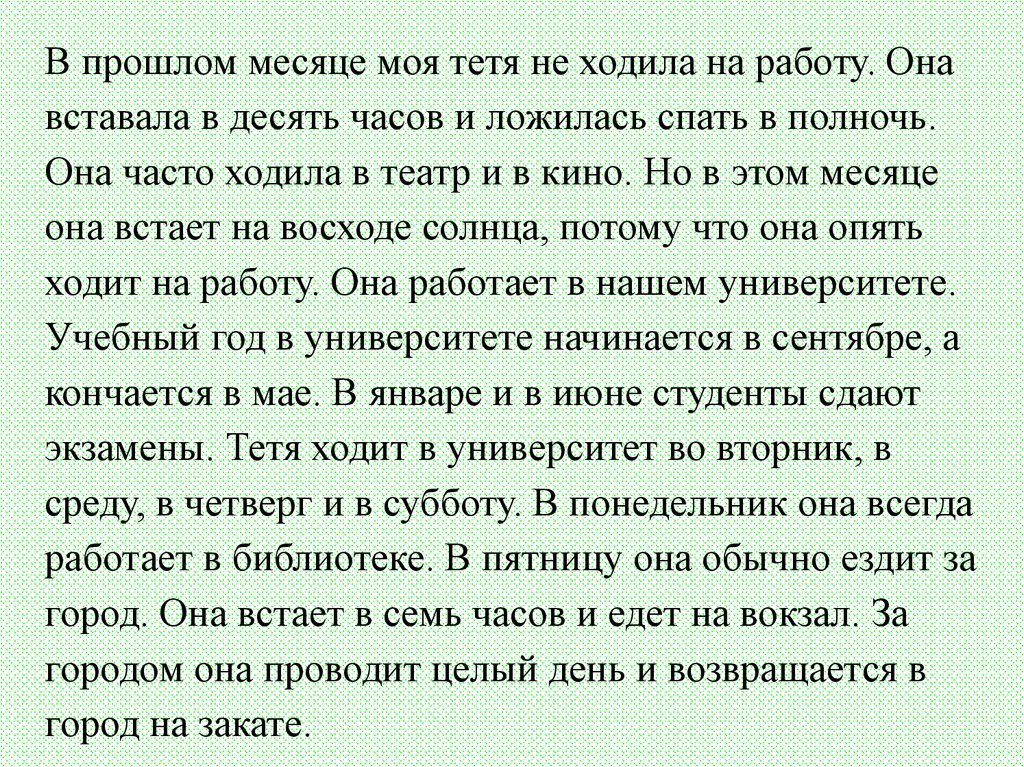
19.
В прошлом месяце моя тетя не ходила на работу. Онавставала в десять часов и ложилась спать в полночь.
Она часто ходила в театр и в кино. Но в этом месяце
она встает на восходе солнца, потому что она опять
ходит на работу. Она работает в нашем университете.
Учебный год в университете начинается в сентябре, а
кончается в мае. В январе и в июне студенты сдают
экзамены. Тетя ходит в университет во вторник, в
среду, в четверг и в субботу. В понедельник она всегда
работает в библиотеке. В пятницу она обычно ездит за
город. Она встает в семь часов и едет на вокзал. За
городом она проводит целый день и возвращается в
город на закате.
20. Источники:
• Голицынский Ю. Б., Голицынская Н. А.«Английский язык. Грамматика. 7 изд.» –
изд. «КАРО». ,2011. - стр. 111-114