 culturology
Similar presentations:








The folklore of India
1.
The folklore ofIndia
2.
The folklore of India comprises the folklore of the nationof India and the Indian subcontinent.
The subcontinent of India contains such a diversity of
ethnic, linguistic, and religious groups that it is difficult
to generalize widely about its folklore. India has 24
officially-recognized languages, and an estimated 1,200
languages in all, including many that do not have written
scripts. Each of these has its own subculture, local
customs, and oral traditions
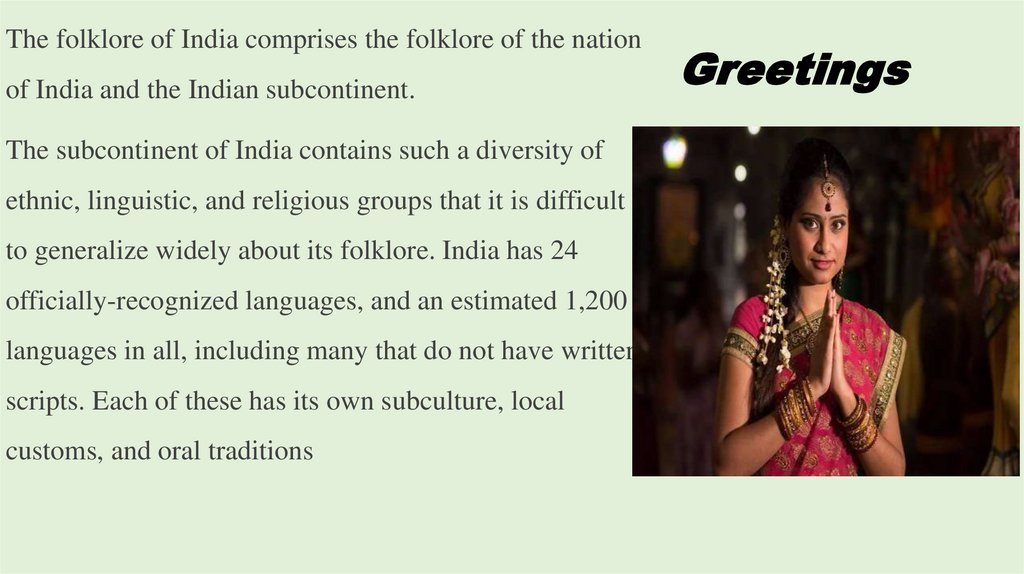
Greetings
3.
Characteristics of the folklore ofIndia
Much of Indian folklore has a religious character, mainly linked to Hinduism,
which is diverse with many local variations.
Local myths explain customs, rituals, and the location of temples, highlighting the
importance of regional differences.
Social stratification and the caste system influence folklore, with lower castes
creating oral traditions that often parody or mimic Sanskrit literature.
The great Indian epics (Ramayana, Mahabharata, Bhagavadgita) originated as
oral traditions, incorporating local legends and community-specific stories.
4.
Characteristics of the folklore ofIndia
These epics became standardized over time, fostering national identity,
but local oral epics preserve regional legends, occupations, and customs.
Local oral epics often serve to legitimize rituals, preserve community
history, and feature heroes from lower castes like farmers, cowherds, or
cobblers.
Heroes in these epics aspire for divinity or material success, reflecting
social mobility and increasing the status of local deities.
5.
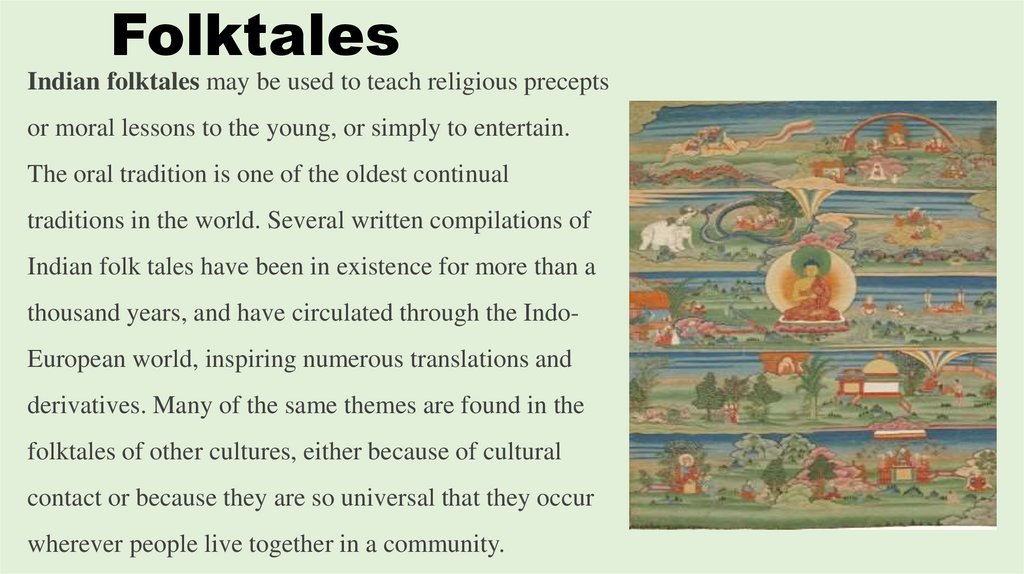
FolktalesIndian folktales may be used to teach religious precepts
or moral lessons to the young, or simply to entertain.
The oral tradition is one of the oldest continual
traditions in the world. Several written compilations of
Indian folk tales have been in existence for more than a
thousand years, and have circulated through the Indo-
European world, inspiring numerous translations and
derivatives. Many of the same themes are found in the
folktales of other cultures, either because of cultural
contact or because they are so universal that they occur
wherever people live together in a community.
6.
The PanchatantraThe Panchatantra is an ancient collection of Sanskrit and Pali animal fables, attributed to Vishnu
Sarma and believed to date back to the 3rd century BCE. It uses stories to teach Hindu
principles of political science (Raja Niti) to princes. The five key principles illustrated are:
• Mitra Bhedha (Loss of Friends)
• Mitra Laabha (Gaining Friends)
• Suhrudbheda (Causing Dissension Between Friends)
• Vigraha (Separation)
• Sandhi (Union)
7.
The HitopadeshaThe Hitopadesha is a collection of Sanskrit animal fables aimed at instructing young
minds in life's philosophy. Its author, identified as Narayana, wrote to promote
moral and responsible behavior through clear moral lessons. Originally compiled in
Sanskrit, it was translated into Persian in the 6th century CE, then into Arabic,
Hebrew, and Greek. The work gained popularity in India, especially during Emperor
Akbar’s reign, who endorsed its translations. An English version was published in
1861. The Hitopadesha influenced many famous fables, including Aesop’s and
Goethe’s stories.
8.
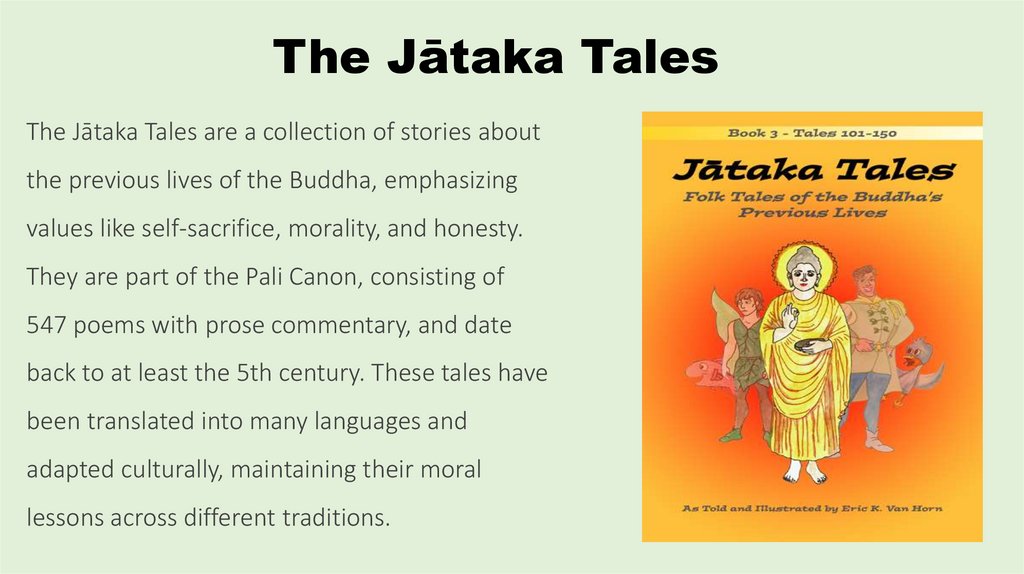
The Jātaka TalesThe Jātaka Tales are a collection of stories about
the previous lives of the Buddha, emphasizing
values like self-sacrifice, morality, and honesty.
They are part of the Pali Canon, consisting of
547 poems with prose commentary, and date
back to at least the 5th century. These tales have
been translated into many languages and
adapted culturally, maintaining their moral
lessons across different traditions.
9.
Folk epicsIndia has a rich tradition of folk epics
and heroic ballads in Sanskrit and
vernacular languages. Notable examples
include the Rajasthani epic of Pabujii,
told by Bhopas, and the Telugu epic The
War of Palnadu, which influenced
regional history. Folk heroes like Beer
Kherwal, Bidu Chandan, Chital Singh
Chatri, and others are popular in local
traditions, often reflecting regional
cultures and beliefs. Oral epics feature
variations and sometimes deify heroes,
blending sacred rituals with social
entertainment
10.
Indian Folk Art TraditionsFolk Painting: Artisans create unique styles capturing clothing and lifestyles;
modern artists replicate ancient styles for markets.
Mughal Paintings: Emerged during the Mughal Empire, influenced by Persian
miniatures, depicting court scenes, Hindu deities, and everyday life.
Tanjore Paintings: From Tamil Nadu, known for rich surface, vivid colors, gold
foil, and semi-precious stones; depict Hindu gods and saints.
Madhubani Painting: From Bihar, traditionally on mud walls, now on cloth and
paper; features nature, Hindu motifs, filled with flowers, animals, and geometric
designs.
Warli Art: Tribal paintings using white on red ochre background; depict rituals,
hunting, farming, and festivals with geometric shapes.
11.
Indian embroideryIndian embroidery features diverse regional styles. Notable types include:
Zardosi: Ornate metal thread embroidery on silk or velvet, often with stones
and beads.
Ari (Hook) Embroidery: Flower motifs created with chain stitching, sequins,
and beads on a stretched fabric.
Kashmiri (Kashida): Inspired by nature, with motifs like flowers and leaves,
using simple stitches such as chain and satin stitch.
Sozni or Dorukha: Skillful embroidery where motifs are visible on both sides
of the fabric, each side with different colors.
Papier Mache Embroidery: Bright, painted-like floral motifs outlined in
black, covering large areas of fabric.
12.
Traditional board gamesMany popular modern board games originate from ancient Indian games.
Chess (Shatranj): Derived from Sanskrit "chaturanga," introduced to Persia
in the 1st century C.E.
Snakes and Ladders: Originated in India as Moksha Patamu, teaching the
consequences of good and bad deeds; ladders symbolized virtues, snakes
symbolized vices.
Pachisi: An ancient Indian game from around 500 B.C.E., considered the
"Royal Game of India," played with colored pawns on a cross-shaped board;
the basis for Parcheesi and Ludo.
These games reflect spiritual teachings and cultural symbols, representing
virtues, vices, and the universe.