










 law
lawSimilar presentations:










Insurance underwriting process. Lecture 2
1. Lecture 2 Insurance underwriting process
Hasan UmarovFinance Department
2. Lecture 2. Learning Outcomes:
• Forming an insurance contract• Understand the material facts and information to the
insurance underwriting process and methods used by
underwriter to obtain them
Lecture 2.
• Explain the significance of moral and physical hazard for
underwriters and how they are manifested
Learning Outcomes:
• Describe the procedures relating to, and significance of
quotations, proposals, policies, cover notes and
certificates of insurance
• Apply the principles concerning the different ways in which
premiums are calculated
Finance Department
2
3. Introduction
Insurance underwriting is the process ofevaluating a risk to determine if the insurance
company will insure it and, if yes, then pricing it.
The underwriting process is critical for any
insurance company to maintain a healthy loss
ratio. It is the core of the business and, along
with investment returns, the main driver behind
the financial performance.
Underwriting can be also viewed as the link between the proposal form and the
policy that comes into existence.
The role of an underwriter involves assessing the risk which people bring to the
pool based on material information / facts. Not all risks will be accepted by the
underwriter due to high likelihood of claims, immorality of risks, etc.
Finance Department
3
4. Forming an insurance contract
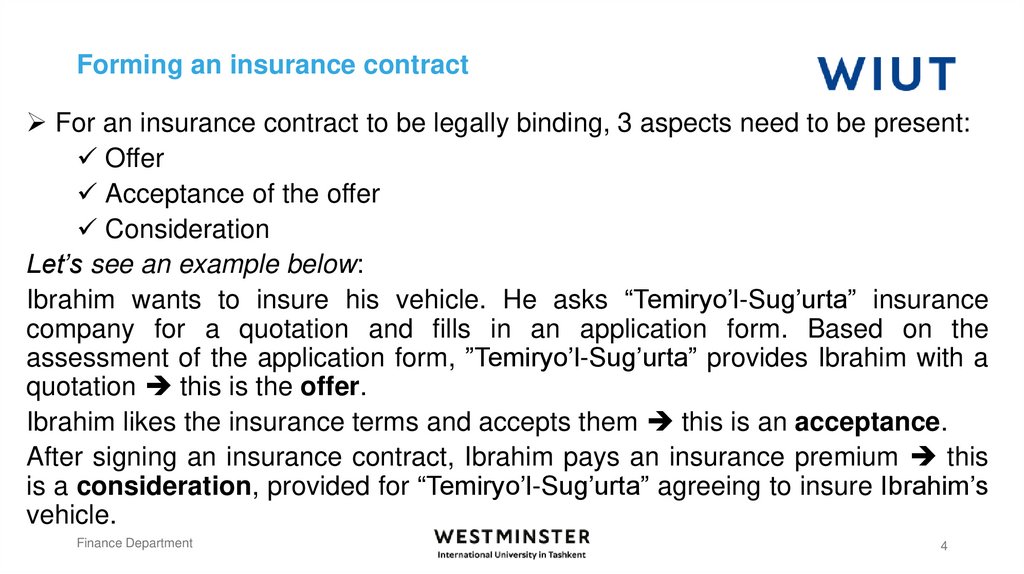
For an insurance contract to be legally binding, 3 aspects need to be present:Offer
Acceptance of the offer
Consideration
Let’s see an example below:
Ibrahim wants to insure his vehicle. He asks “Temiryo’l-Sug’urta” insurance
company for a quotation and fills in an application form. Based on the
assessment of the application form, ”Temiryo’l-Sug’urta” provides Ibrahim with a
quotation this is the offer.
Ibrahim likes the insurance terms and accepts them this is an acceptance.
After signing an insurance contract, Ibrahim pays an insurance premium this
is a consideration, provided for “Temiryo’l-Sug’urta” agreeing to insure Ibrahim’s
vehicle.
Finance Department
4
5. Insurance contract differs from other contracts?
Insurance contract differ from other contracts because an insurance is anintangible product. Most contracts are dealt under the legal principle “caveat
emptor” (“let the buyer beware”).
Insurance contracts, however, are dealt under the legal principle “uberrima
fides” (“utmost good faith”). This imposes on Insured to:
1. Provide all information asked for
2. Disclose facts that are material to the risk
3. Give an additional information relating to the risk
The above principle applies to both parties. Therefore, Insurer should also
provide Insured with all required information relating to risk
Finance Department
5
6. Material information & material facts
Material information & material factsUtmost good faith relies on material information / facts.
The definition of material facts in accordance with the “Marine Insurance Act
1906”: “every circumstance is material which would influence the judgment
of a prudent insurer in fixing the premium or determining whether he will take
the risk”.
It may seem that insurer / underwriter may consider any undisclosed
information as material and reject the claim based on this. Therefore, insurer
should seek for information at the beginning before signing an insurance
contract. Afterwards, any other information would be considered as
irrelevant!
Finance Department
6
7. Material information & material facts
Material information & material factsMaterial information & material facts which must be disclosed include:
special or unusual facts relating to the risk;
any particular concerns, which are leading to the request for insurance;
anything which those concerned with the class of insurance and field of
activity would generally, understand to be something that should be dealt
with when presenting risks of that type.
Finance Department
7
8. Duty of disclosure
Duty of disclosure implies on each party. It starts at the point of negotiatingthe terms of insurance and end when an insurance contract is formed. It may
apply during the life of the policy if there are some amendments of the terms
of insurance / risk conditions (change of sum insured, inclusion of new property,
extension of insured drivers under motor insurance, etc.).
Insurer may insert in the policy terms a continuing requirement to disclose
information by Insured (e.g. on removal of equipment to another location;
extension of business operations under “public liability insurance”, etc.).
Duty of disclosure exists at renewal and in the event of a claim.
Finance Department
8
9. Facts that do not need to be disclosed
facts of law everyone is deemed to know the lawfacts of public knowledge e.g. the war in Ukraine, which may create certain
difficulties in export-import operations
facts that improve the risk e.g. the presence of fire-fighting equipment in
premises proposed for fire insurance
facts where the insurer has waived its rights to certain information e.g. the
proposer indicated in the application form about claims history “see your
records”. However, Insurer does not check its own claims records;
Finance Department
9
10. Facts that do not need to be disclosed
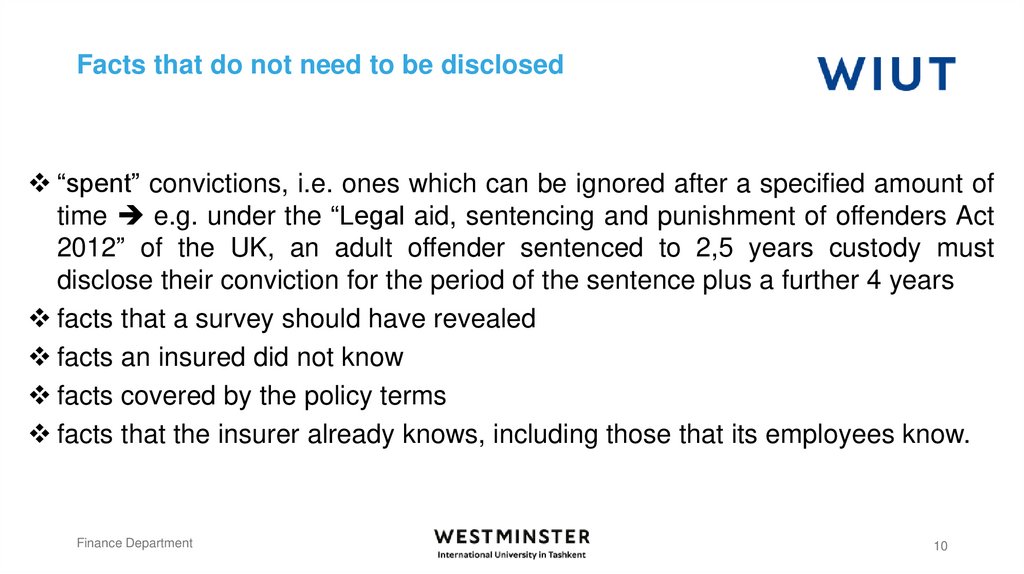
“spent” convictions, i.e. ones which can be ignored after a specified amount oftime e.g. under the “Legal aid, sentencing and punishment of offenders Act
2012” of the UK, an adult offender sentenced to 2,5 years custody must
disclose their conviction for the period of the sentence plus a further 4 years
facts that a survey should have revealed
facts an insured did not know
facts covered by the policy terms
facts that the insurer already knows, including those that its employees know.
Finance Department
10
11.
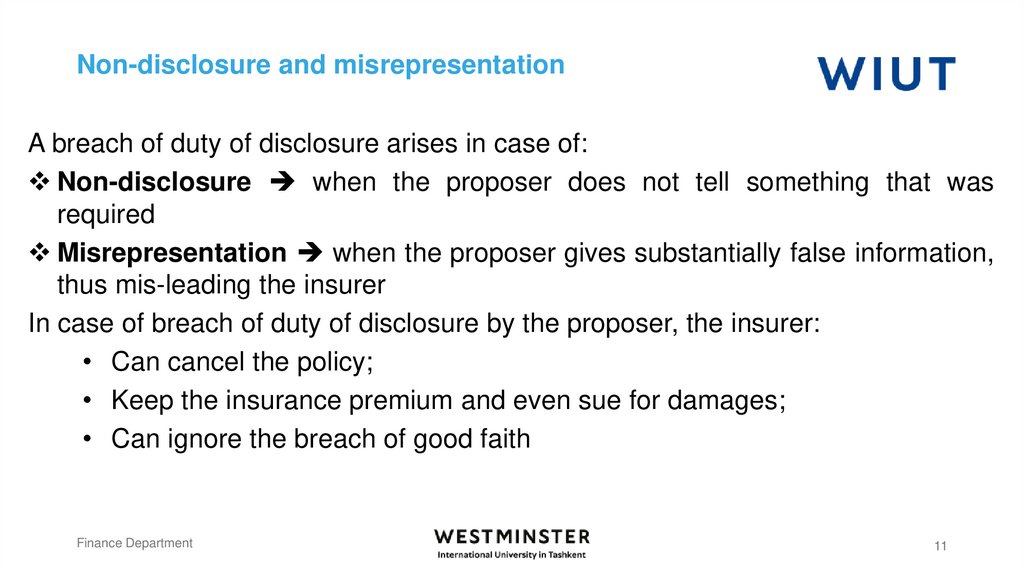
Non-disclosure and misrepresentationA breach of duty of disclosure arises in case of:
Non-disclosure when the proposer does not tell something that was
required
Misrepresentation when the proposer gives substantially false information,
thus mis-leading the insurer
In case of breach of duty of disclosure by the proposer, the insurer:
• Can cancel the policy;
• Keep the insurance premium and even sue for damages;
• Can ignore the breach of good faith
Finance Department
11
12. Physical & moral hazards
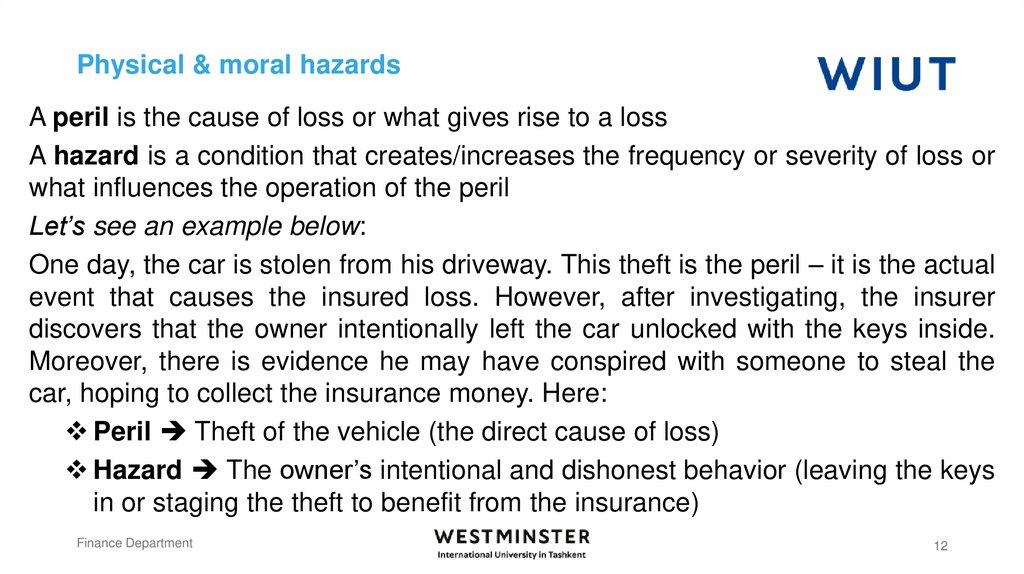
Physical & moral hazardsA peril is the cause of loss or what gives rise to a loss
A hazard is a condition that creates/increases the frequency or severity of loss or
what influences the operation of the peril
Let’s see an example below:
One day, the car is stolen from his driveway. This theft is the peril – it is the actual
event that causes the insured loss. However, after investigating, the insurer
discovers that the owner intentionally left the car unlocked with the keys inside.
Moreover, there is evidence he may have conspired with someone to steal the
car, hoping to collect the insurance money. Here:
Peril Theft of the vehicle (the direct cause of loss)
Hazard The owner’s intentional and dishonest behavior (leaving the keys
in or staging the theft to benefit from the insurance)
Finance Department
12
13. Types of hazards
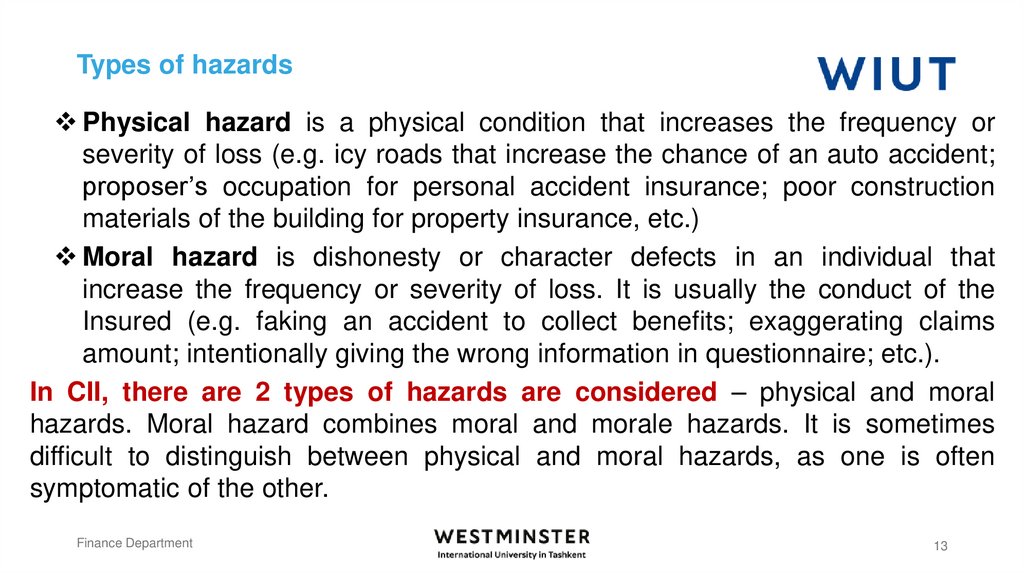
Physical hazard is a physical condition that increases the frequency orseverity of loss (e.g. icy roads that increase the chance of an auto accident;
proposer’s occupation for personal accident insurance; poor construction
materials of the building for property insurance, etc.)
Moral hazard is dishonesty or character defects in an individual that
increase the frequency or severity of loss. It is usually the conduct of the
Insured (e.g. faking an accident to collect benefits; exaggerating claims
amount; intentionally giving the wrong information in questionnaire; etc.).
In CII, there are 2 types of hazards are considered – physical and moral
hazards. Moral hazard combines moral and morale hazards. It is sometimes
difficult to distinguish between physical and moral hazards, as one is often
symptomatic of the other.
Finance Department
13
14. Obtaining material information
There are several ways for underwriter to obtain information:The proposal form
Brokers (used mostly for commercial insurances and they have extensive
knowledge, prepare detailed reports using their own risk surveyors for
underwriters)
Risk surveys (used for large / complex risks), giving full description of the
risk, assessment of the level of risk, a measure of the estimated maximum
loss (EML), which is the maximum the surveyor believes will be the subject of
a loss. Risk surveyors are considered as “eyes and ears” of the underwriter.
Finance Department
14
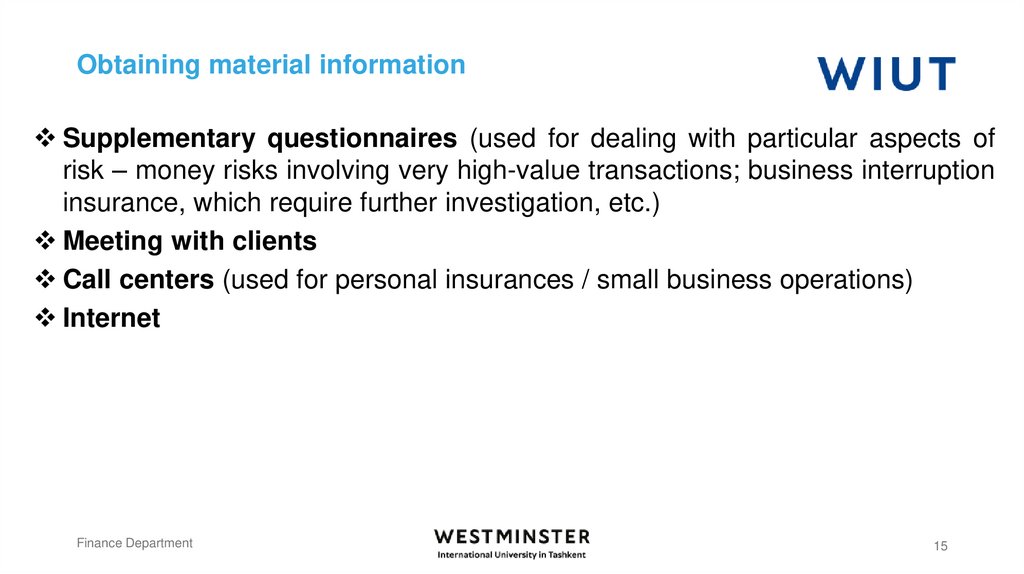
15. Obtaining material information
Supplementary questionnaires (used for dealing with particular aspects ofrisk – money risks involving very high-value transactions; business interruption
insurance, which require further investigation, etc.)
Meeting with clients
Call centers (used for personal insurances / small business operations)
Internet
Finance Department
15
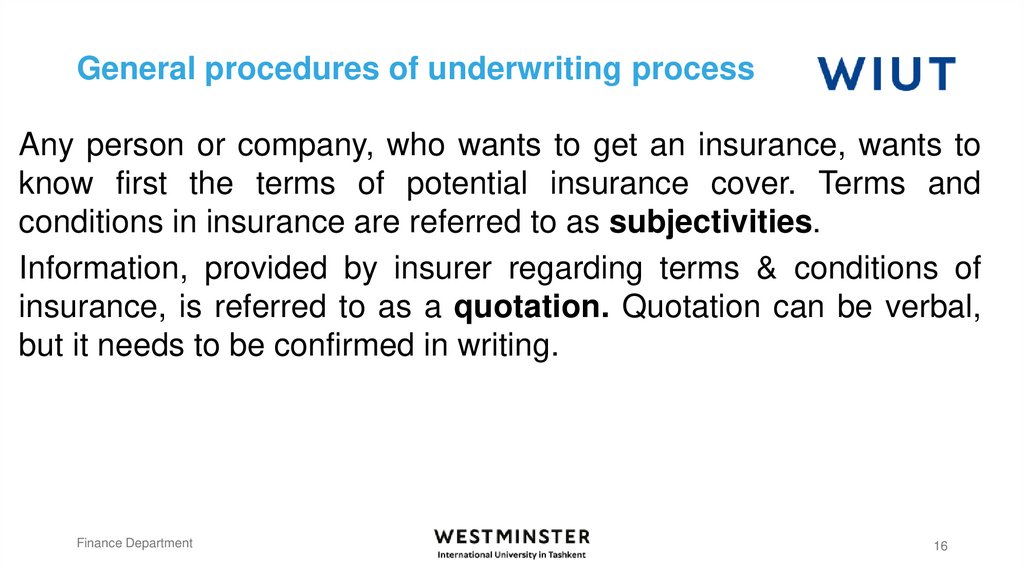
16. General procedures of underwriting process
Any person or company, who wants to get an insurance, wants toknow first the terms of potential insurance cover. Terms and
conditions in insurance are referred to as subjectivities.
Information, provided by insurer regarding terms & conditions of
insurance, is referred to as a quotation. Quotation can be verbal,
but it needs to be confirmed in writing.
Finance Department
16
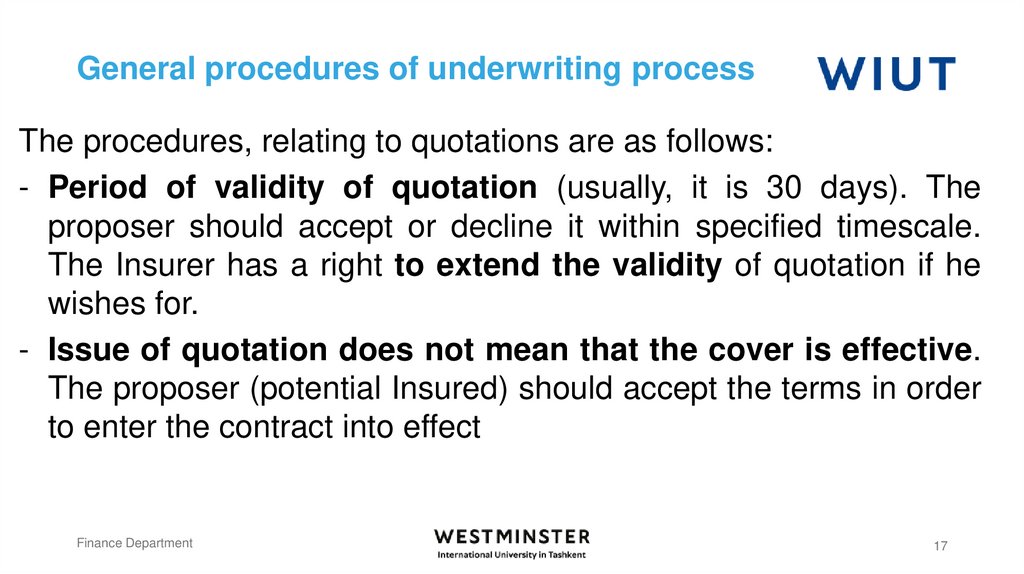
17. General procedures of underwriting process
The procedures, relating to quotations are as follows:- Period of validity of quotation (usually, it is 30 days). The
proposer should accept or decline it within specified timescale.
The Insurer has a right to extend the validity of quotation if he
wishes for.
- Issue of quotation does not mean that the cover is effective.
The proposer (potential Insured) should accept the terms in order
to enter the contract into effect
Finance Department
17
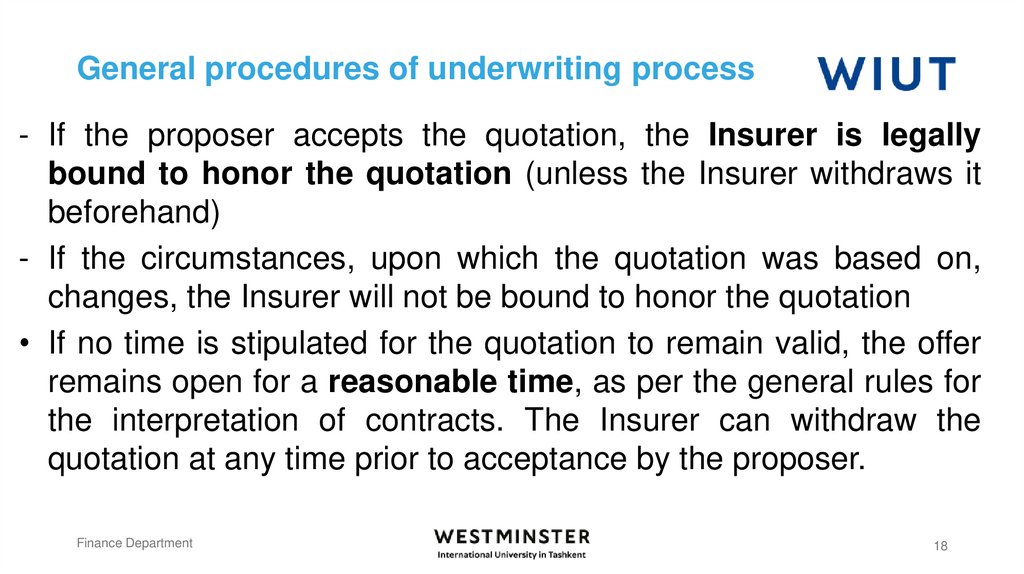
18. General procedures of underwriting process
- If the proposer accepts the quotation, the Insurer is legallybound to honor the quotation (unless the Insurer withdraws it
beforehand)
- If the circumstances, upon which the quotation was based on,
changes, the Insurer will not be bound to honor the quotation
• If no time is stipulated for the quotation to remain valid, the offer
remains open for a reasonable time, as per the general rules for
the interpretation of contracts. The Insurer can withdraw the
quotation at any time prior to acceptance by the proposer.
Finance Department
18
19. Basis for underwriting
- Proposal forms exist for a number of classes of business, but in some areasthey have been superseded by the use of Internet / call centers;
- Proposal forms also contain a declaration – a document, stating that information
supplied by the proposer is true and accurate to the best of the proposer’s
knowledge and belief. It should be signed by the proposer. If the proposer is in
any doubt whether information is material or not, it should be disclosed;
- Internet & AI have revolutionized the way insurers sell certain insurance products
(motor / household insurance in personal insurance or shops, salons, offices
insurance in commercial insurance). It allows Insurers to decrease operational
costs, increase the speed of risk underwriting / claims settlement, etc.
Finance Department
19
20. Basis for underwriting
- In telephone-based quotations, the questions asked must follow a set script;- Both personal and commercial insurances are available via aggregators
(comparison web-sites);
- Proposal forms are not enough for large and complex commercial risks. They
need to be supplemented by insurer surveys, factfinders / questionnaires /
face-to-face meetings, etc.
Finance Department
20
21. Questions in the proposal form
The proposal from consists of general and specific questions.General questions:
• proposer’s name / correspondence address / occupation;
• period of insurance;
• past insurance history: has the proposer been insured before?
Have they had insurance declined? Loss record and claims
experience?
Finance Department
21
22. Questions in the proposal form
Specific questions:• proposer's risk address, e.g. their locality and related risks such
as flood, subsidence, or even theft, malicious damage, riot etc.;
• proposer's age, e.g. higher motor premiums for younger drivers;
• business details, description of the subject matter to be insured,
e.g. description of buildings in commercial property insurance;
• sum insured or limit of liability.
Some general questions might be specific questions in some
classes of insurance.
Finance Department
22
23. Premium calculation
A premium is the amount paid to an insurer in consideration of the insurer agreeingto cover the risk;
One of the tasks of the underwriter is to calculate a suitable, or fair (equitable)
premium. The contribution of the Insured (more precisely, him paying the premium)
should reflect the amount of risk they present and the likelihood of taking money out
of the pool in the event of a claim;
Premiums are usually arrived at by applying a premium rate to a premium base.
This could be reflected in the following formula:
sum insured × rate = premium
In some classes of insurance there is no property to insure and an alternative
exposure measure needs to be identified against which a rate can be applied. E.g.
the wage roll of the insured for EL; turnover for PL; fees earned for PI insurance.
Finance Department
23
24. Premium calculation
The rate could be:• rate per cent (the price in dollars (or in other currency) for each hundred
dollars of exposure) e.g. a rate of 1.5% means an insurer would charge
US$1.50 for every US$100 of exposure;
• rate per mille (the price in dollars for each thousand dollars of exposure)
e.g. a rate of 2.5 per mille means an insurer would charge US$2.50 for every
US$1,000 of exposure
Finance Department
24
25. Premium calculation
An example:IMZO has a turnover of $200m per year. GROSS Insurance offers products for
liability insurance with an indemnity limit of up to $20m at a rate of 0.5 per mille on
turnover. If IMZO wants a higher indemnity limit of $50m and GROSS Insurance has
quoted a rate of 0.7 per mille, what would the premium be for:
1. $20m indemnity?
2. $50m indemnity?
Answer:
1. $100k or (200,000,000 / 1,000) * 0,5
2. $140k or (200,000,000 / 1,000) * 0,7
Finance Department
25
26. Premium calculation
The insurance contract comes into force once the premium is paid. If thepremium is not paid at the acceptance of the proposal, it is implied that the
proposer promises to pay and this promise is sufficient in law to support a valid
contract (in some countries or types of insurances, upfront payment of premium
is necessary to issue the policy).
In Uzbekistan, since September 2024, all insurance contracts come into effect
only when insurance premium is paid and Insurer has issued insurance policy
(one-page document, confirming the start of Insurer’s obligations under
insurance contract).
Finance Department
26
27. Premium calculation
Adjustable premiums In certain cases, the exposure measure is unknown at the start ofthe period of insurance, and all that can be provided is an estimate of what the exposure
measure might be.
The premium is then adjusted up or down depending on whether the actual turnover was
higher or lower than the estimate. The initial premium is referred to as a deposit premium.
Flat premium In other cases, it is practice to charge a flat premium rather than apply a
rate to a premium base.
Methods of collection premiums:
a single upfront payment (by cash, cheque or credit/debit card);
by credit; or
in monthly instalments by direct debit.
Finance Department
27
28. Policies, cover notes and certificates of insurance
PoliciesThe policy contains all the details of the item/exposure insured, the operative perils,
period of cover, exceptions, conditions, the premium and other relevant information.
It is effectively evidence of the contract, and not the contract of insurance itself.
The contract of insurance comes into effect once the insurer has accepted the
insurance proposal, terms have been agreed and the premium has been paid.
Finance Department
28
29. Policy
Finance Department29
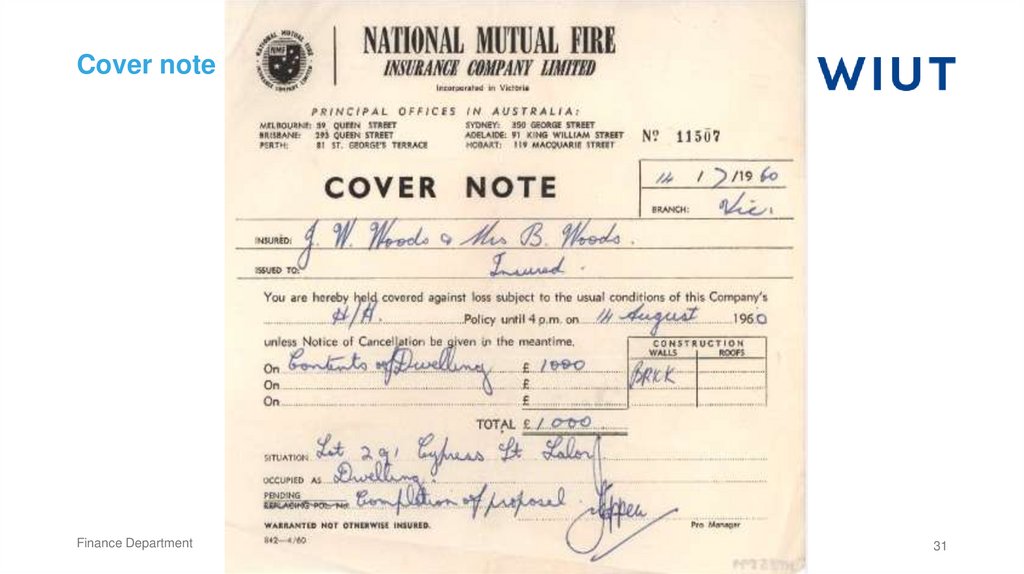
30. Policies, cover notes and certificates of insurance
Cover notesA cover note is essentially a document issued as evidence that insurance has been
granted, pending the issue of a policy or policy amendment document and/or
endorsements. It is temporary and is superseded once the policy and insurance
certificate are issued. Cover notes contain commencement & expiry dates of the
cover, risk-specific information, special terms that apply, etc.
You may need cover note when insurance protection must start immediately (e.g.,
buying a car, taking a loan secured by assets, or shipping goods abroad), but the
insurer needs more time to prepare and finalize the policy document.
Finance Department
30
31. Cover note
Finance Department31
32. Policies, cover notes and certificates of insurance
Certificates of insuranceFor compulsory insurances, it is a legal requirement that a certificate of insurance is
issued to prove a policy is in force. It is evidence that a contract of insurance exists,
and that the policyholder/insured complies with the law.
Contract certainty
Contract certainty is achieved when all the terms are agreed between the insurer
and insured before the start of the contract. It is important in a situation, when a
customer urgently needs a cover and insurer / insurance brokers need to provide
with clear protection and peace of mind.
Finance Department
32
33. Certificates of insurance
Finance Department33
34. Thank you
Finance Department34