 english
Similar presentations:






Second conditional
1.
SECONDCONDITIONAL
2.
if + past, would + infinitive(past = simple or continuous;
would = would, could or might)
We use if + past to talk about an imaginary present or future situation
NOTE: although the verb is in the past, the meaning is present or future.
We use would + infinitive to talk about the result or consequence of that imaginary situation.
If we had a mansion in the country, we’d go there every weekend.
Would you travel around the world if you won the lottery?
3.
if + past, would + infinitiveWhen the if clause comes first, we usually put a comma after it.
When the if clause comes second, we don’t put a comma before it.
If I won the lottery, I’d buy a mansion.
I’d buy a mansion if I won the lottery.
Would/wouldn’t is the same for all persons.
I/you/he/she/it/we/they would/wouldn’t do that if it was possible.
We can often use could / might + infinitive instead of would + infinitive in the main clause.
If you spoke English, you could get a better job.
We might save enough money if we both worked overtime.
4.
if + past, would + infinitiveIn the second conditional, we can use if I/he/she/it were (more formal) instead of if I/he/she/it was (spoken
English).
If I were/was fit, I would run a marathon.
We wouldn’t have any problems if he were/was more reasonable.
But we use were (NOT was) when we give advice with the expression if I were you.
If I were you, I would stay home and rest.
I wouldn’t pay any attention to what he says if I were you.
5.
SECOND conditionalvs
FIRST conditional
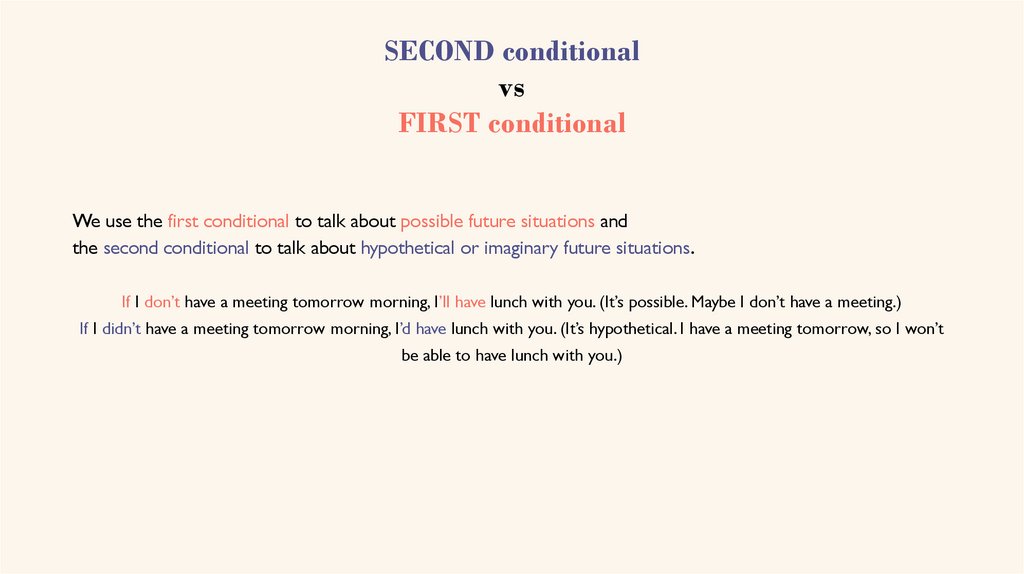
We use the first conditional to talk about possible future situations and
the second conditional to talk about hypothetical or imaginary future situations.
If I don’t have a meeting tomorrow morning, I’ll have lunch with you. (It’s possible. Maybe I don’t have a meeting.)
If I didn’t have a meeting tomorrow morning, I’d have lunch with you. (It’s hypothetical. I have a meeting tomorrow, so I won’t
be able to have lunch with you.)