

 english
Similar presentations:



Household chores
1. Household chores
2. Part Speaking
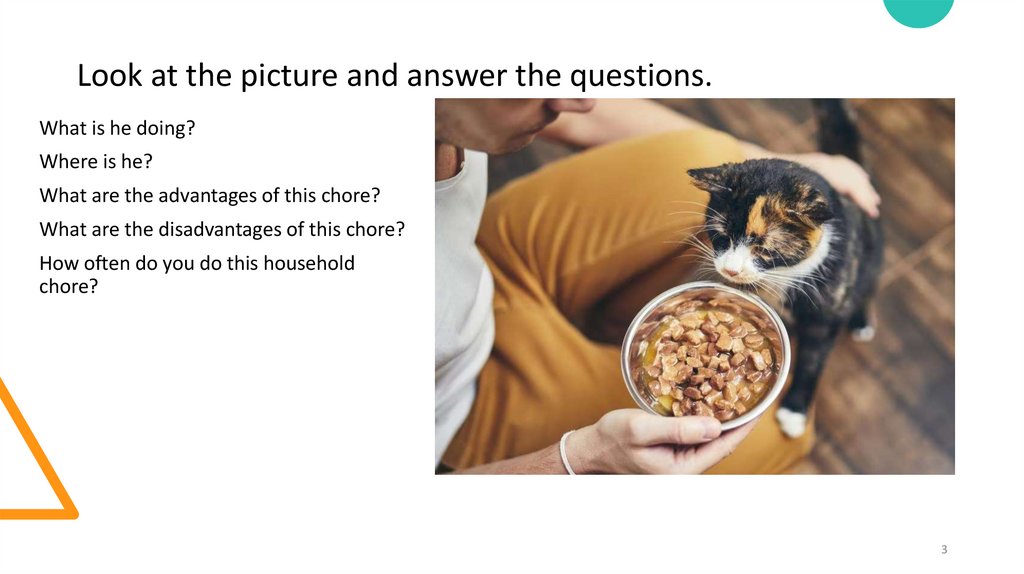
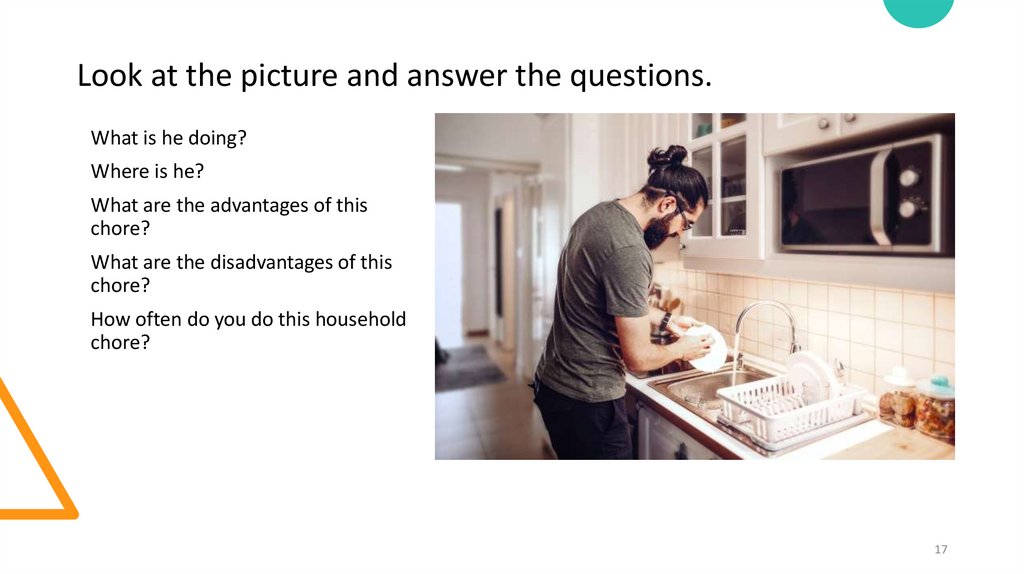
23. Look at the picture and answer the questions.
What is he doing?Where is he?
What are the advantages of this chore?
What are the disadvantages of this chore?
How often do you do this household
chore?
3
4.
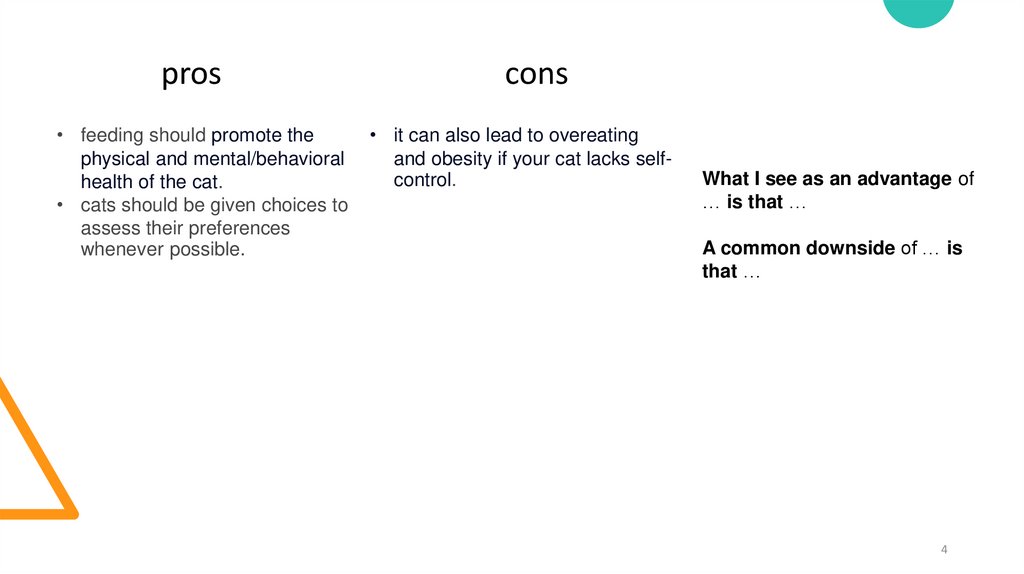
pros• feeding should promote the
physical and mental/behavioral
health of the cat.
• cats should be given choices to
assess their preferences
whenever possible.
cons
• it can also lead to overeating
and obesity if your cat lacks selfcontrol.
What I see as an advantage of
… is that …
A common downside of … is
that …
4
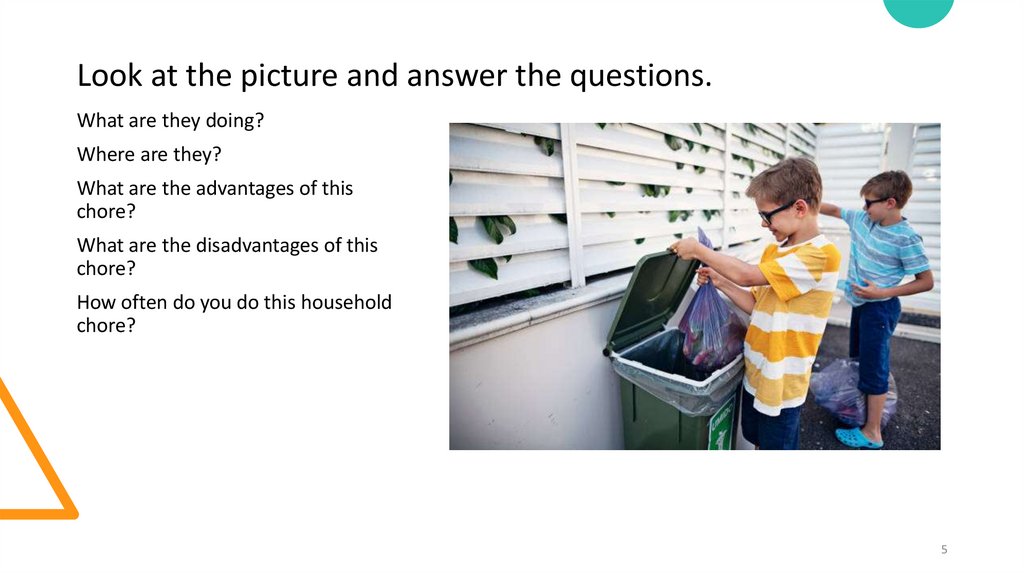
5. Look at the picture and answer the questions.
What are they doing?Where are they?
What are the advantages of this
chore?
What are the disadvantages of this
chore?
How often do you do this household
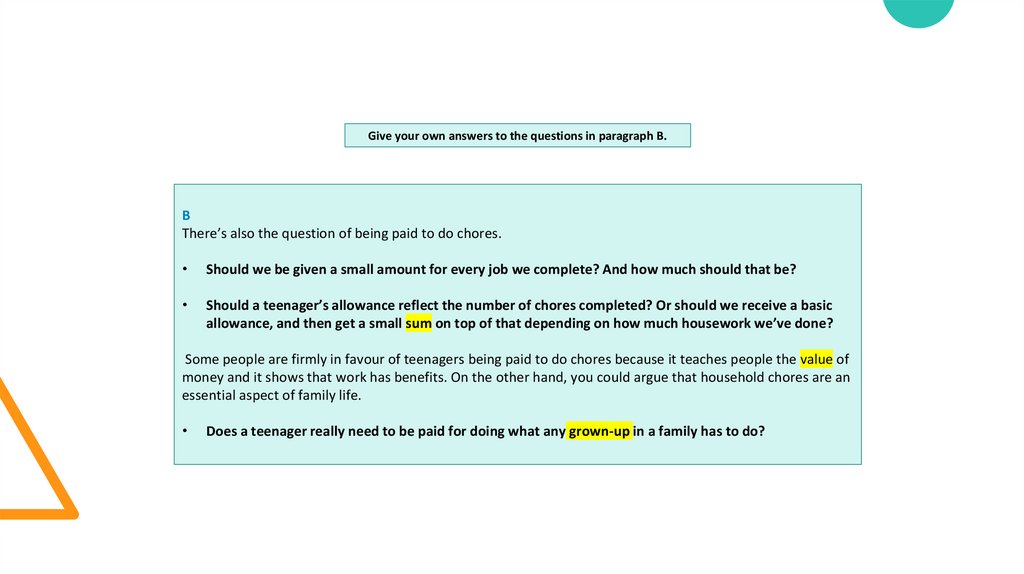
chore?
5
6.
proscons
1) This only keeps the
1) It is harmful for the environment
environment clean but also
as well as for the humans and
saves us from harmful
other living organisms. The
diseases. Three types of
solid waste materials which are
dustbins are installed for
left in the open give out bad
throwing waste. Green-coloured
odour. The breeding grounds
bins are used for throwing liquid
for mosquitoes, flies and other
harmful bacteria.
waste or biodegradable waste.
They are mostly kitchen wastes.
What I see as an advantage of
… is that …
A common downside of … is
that …
6
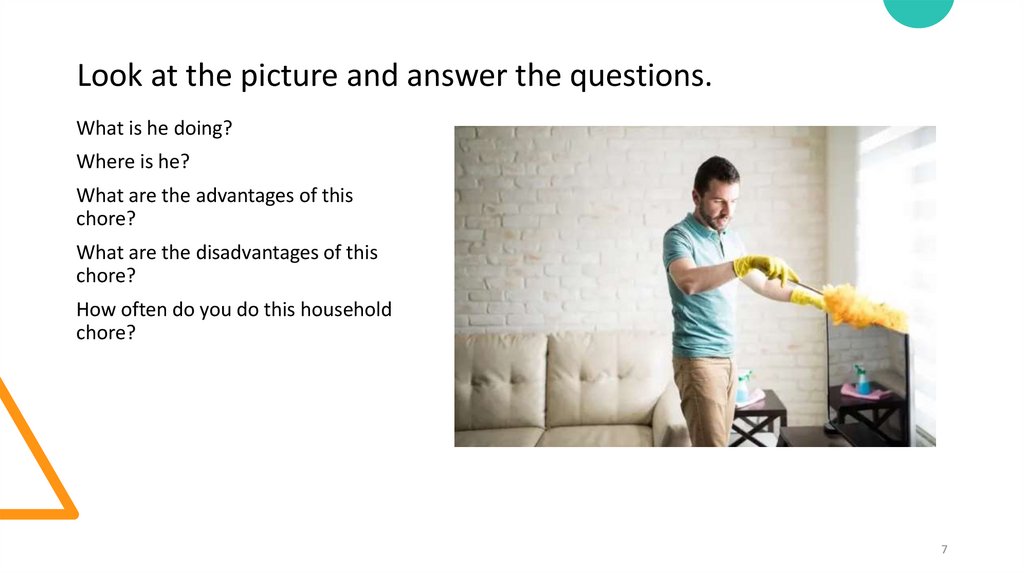
7. Look at the picture and answer the questions.
What is he doing?Where is he?
What are the advantages of this
chore?
What are the disadvantages of this
chore?
How often do you do this household
chore?
7
8.
proscons
1) Dusting and cleaning your
1) One of the risks of dusting is
furniture will help to remove any
using the wrong cleaning
build-up and make it look more
products. Harsh or abrasive
presentable. Additionally, filling
cleaners can damage
any crevices with a dust cloth
your furniture's finish,
especially for delicate
can help to protect your
furniture from dirt, dust, and
other debris. Keep your
furniture in good condition by
filling any crevices with a dust
cloth.
What I see as an advantage of
… is that …
A common downside of … is
that …
8
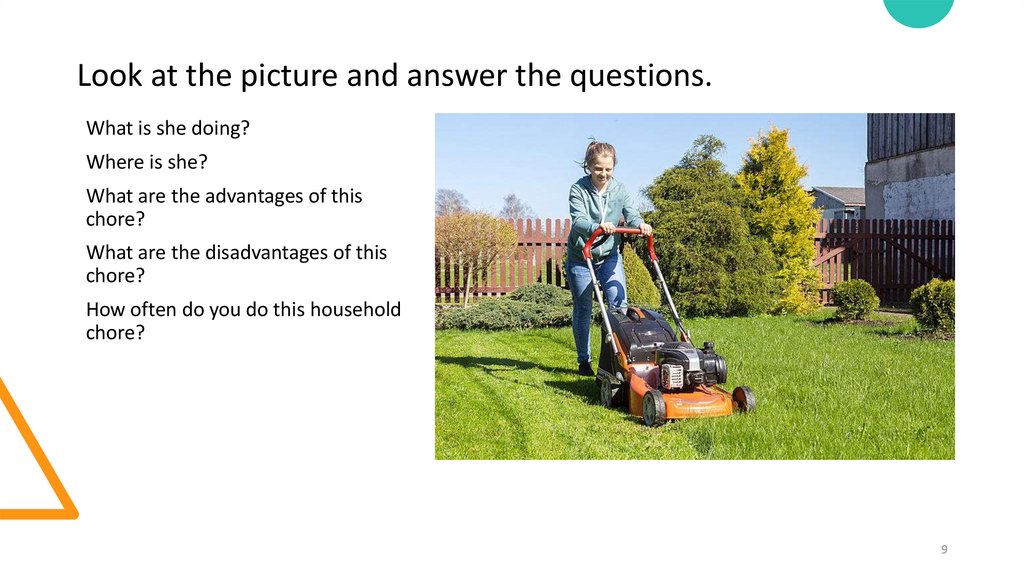
9. Look at the picture and answer the questions.
What is she doing?Where is she?
What are the advantages of this
chore?
What are the disadvantages of this
chore?
How often do you do this household
chore?
9
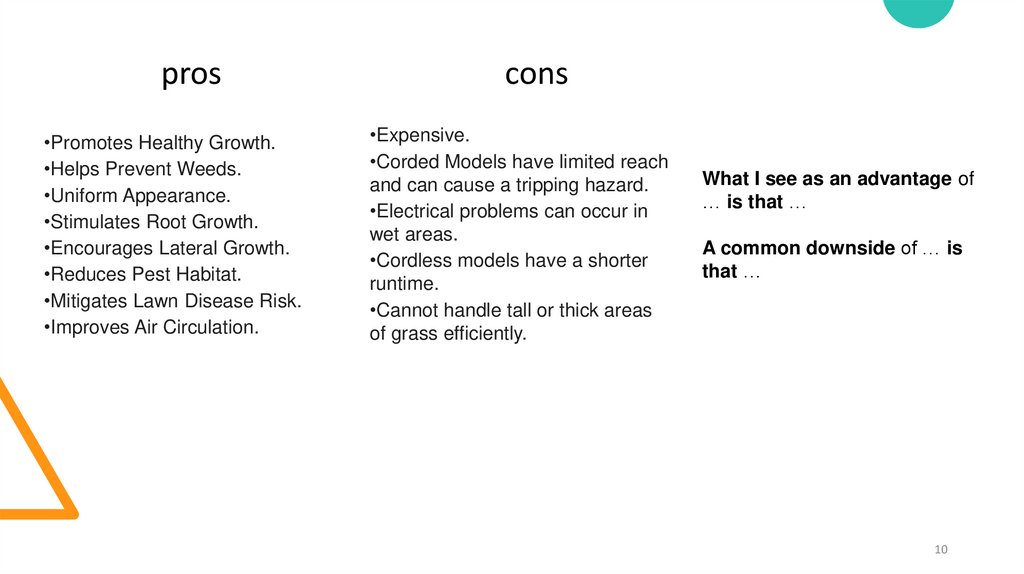
10.
pros•Promotes Healthy Growth.
•Helps Prevent Weeds.
•Uniform Appearance.
•Stimulates Root Growth.
•Encourages Lateral Growth.
•Reduces Pest Habitat.
•Mitigates Lawn Disease Risk.
•Improves Air Circulation.
cons
•Expensive.
•Corded Models have limited reach
and can cause a tripping hazard.
•Electrical problems can occur in
wet areas.
•Cordless models have a shorter
runtime.
•Cannot handle tall or thick areas
of grass efficiently.
What I see as an advantage of
… is that …
A common downside of … is
that …
10
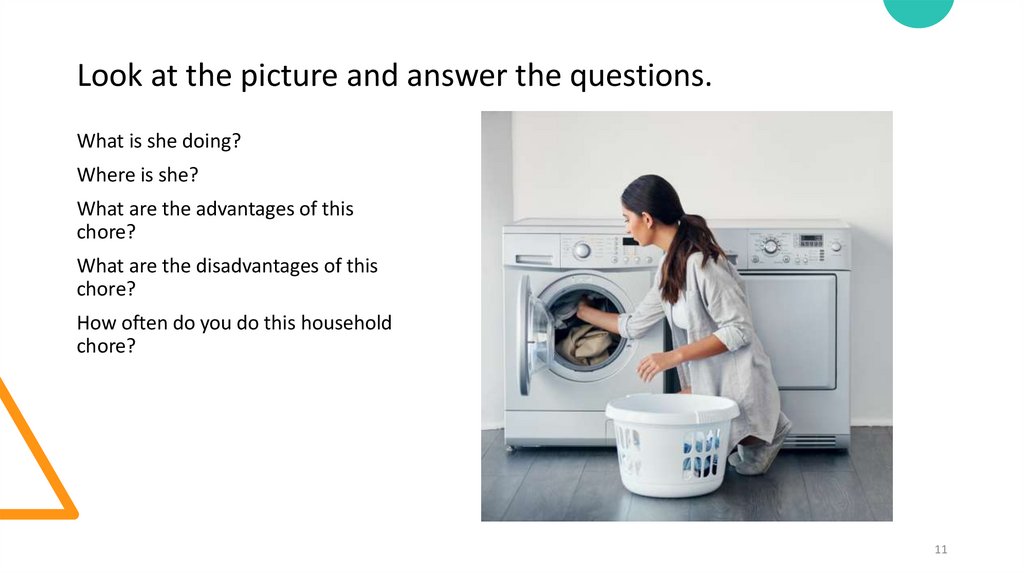
11. Look at the picture and answer the questions.
What is she doing?Where is she?
What are the advantages of this
chore?
What are the disadvantages of this
chore?
How often do you do this household
chore?
11
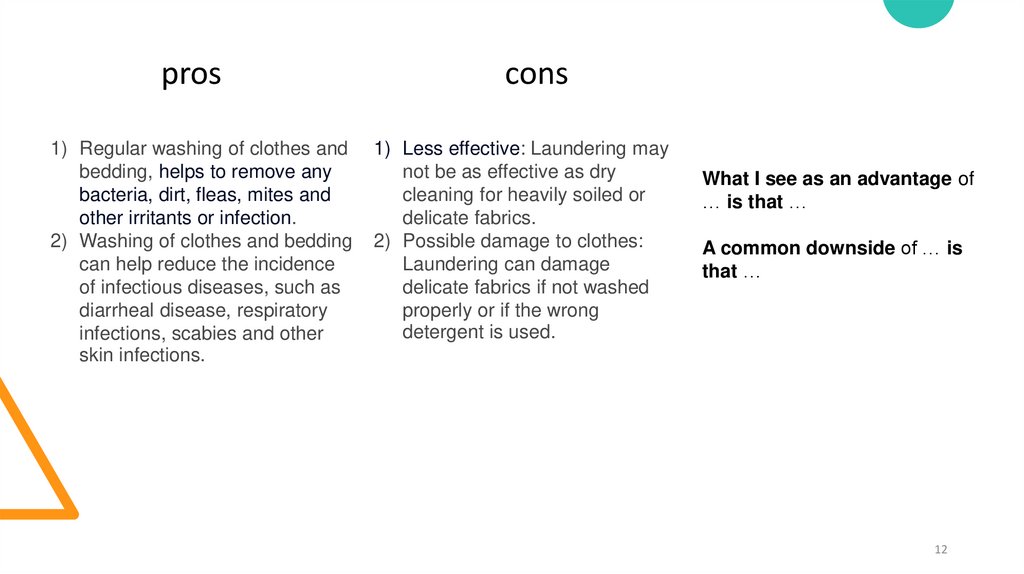
12.
pros1) Regular washing of clothes and
bedding, helps to remove any
bacteria, dirt, fleas, mites and
other irritants or infection.
2) Washing of clothes and bedding
can help reduce the incidence
of infectious diseases, such as
diarrheal disease, respiratory
infections, scabies and other
skin infections.
cons
1) Less effective: Laundering may
not be as effective as dry
cleaning for heavily soiled or
delicate fabrics.
2) Possible damage to clothes:
Laundering can damage
delicate fabrics if not washed
properly or if the wrong
detergent is used.
What I see as an advantage of
… is that …
A common downside of … is
that …
12
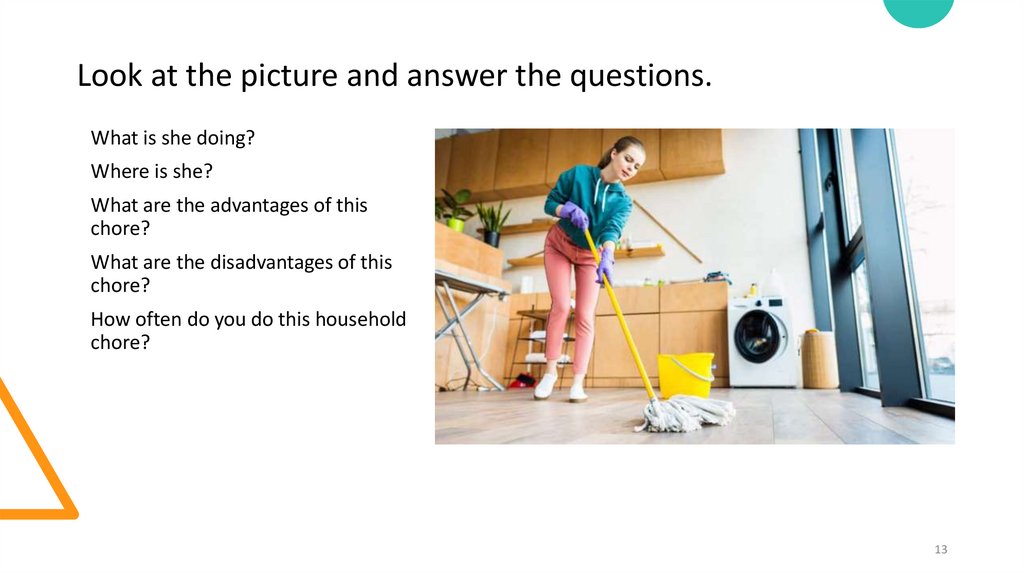
13. Look at the picture and answer the questions.
What is she doing?Where is she?
What are the advantages of this
chore?
What are the disadvantages of this
chore?
How often do you do this household
chore?
13
14.
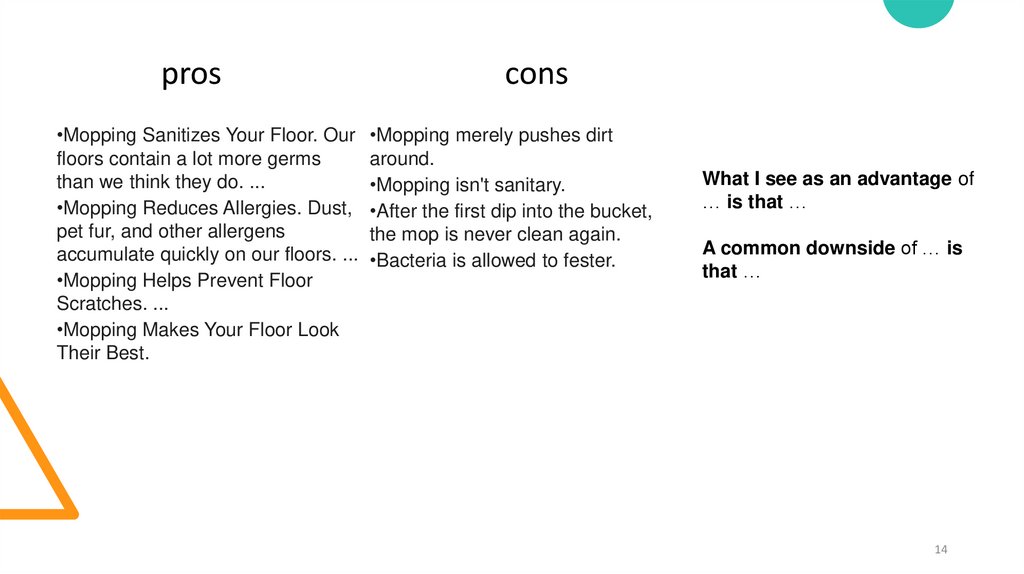
proscons
•Mopping Sanitizes Your Floor. Our •Mopping merely pushes dirt
floors contain a lot more germs
around.
than we think they do. ...
•Mopping isn't sanitary.
•Mopping Reduces Allergies. Dust, •After the first dip into the bucket,
pet fur, and other allergens
the mop is never clean again.
accumulate quickly on our floors. ... •Bacteria is allowed to fester.
•Mopping Helps Prevent Floor
Scratches. ...
•Mopping Makes Your Floor Look
Their Best.
What I see as an advantage of
… is that …
A common downside of … is
that …
14
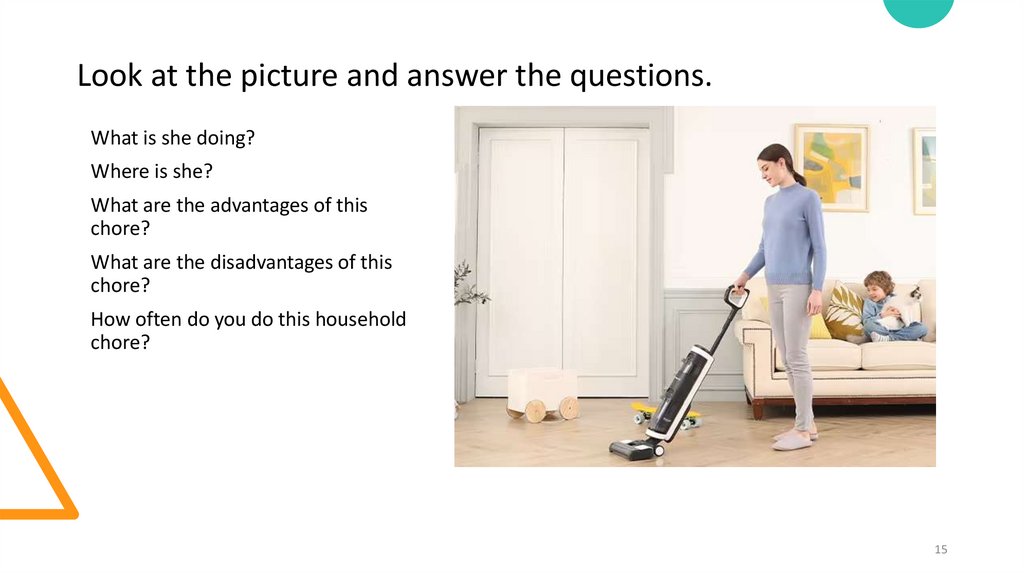
15. Look at the picture and answer the questions.
What is she doing?Where is she?
What are the advantages of this
chore?
What are the disadvantages of this
chore?
How often do you do this household
chore?
15
16.
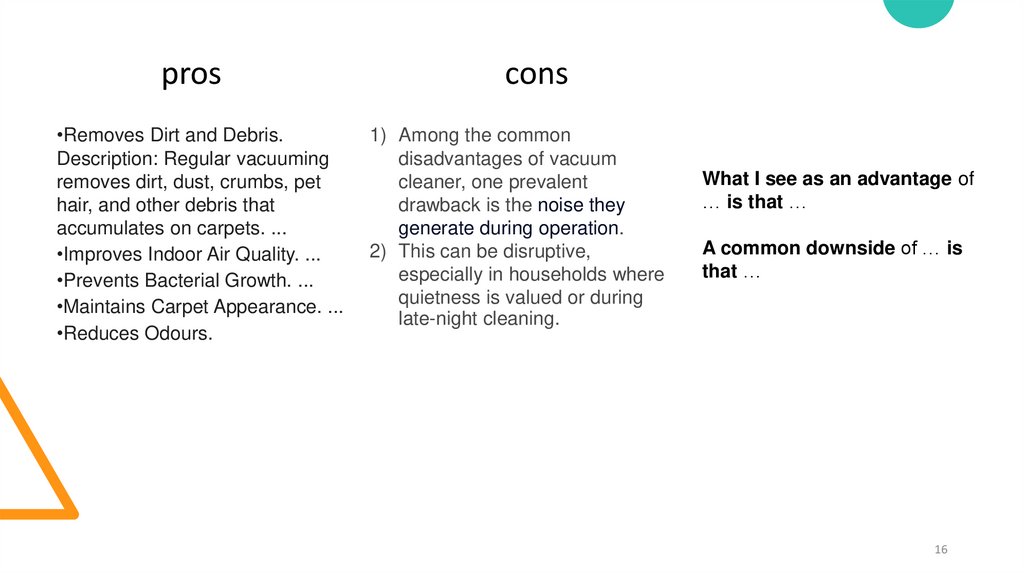
pros•Removes Dirt and Debris.
Description: Regular vacuuming
removes dirt, dust, crumbs, pet
hair, and other debris that
accumulates on carpets. ...
•Improves Indoor Air Quality. ...
•Prevents Bacterial Growth. ...
•Maintains Carpet Appearance. ...
•Reduces Odours.
cons
1) Among the common
disadvantages of vacuum
cleaner, one prevalent
drawback is the noise they
generate during operation.
2) This can be disruptive,
especially in households where
quietness is valued or during
late-night cleaning.
What I see as an advantage of
… is that …
A common downside of … is
that …
16
17. Look at the picture and answer the questions.
What is he doing?Where is he?
What are the advantages of this
chore?
What are the disadvantages of this
chore?
How often do you do this household
chore?
17
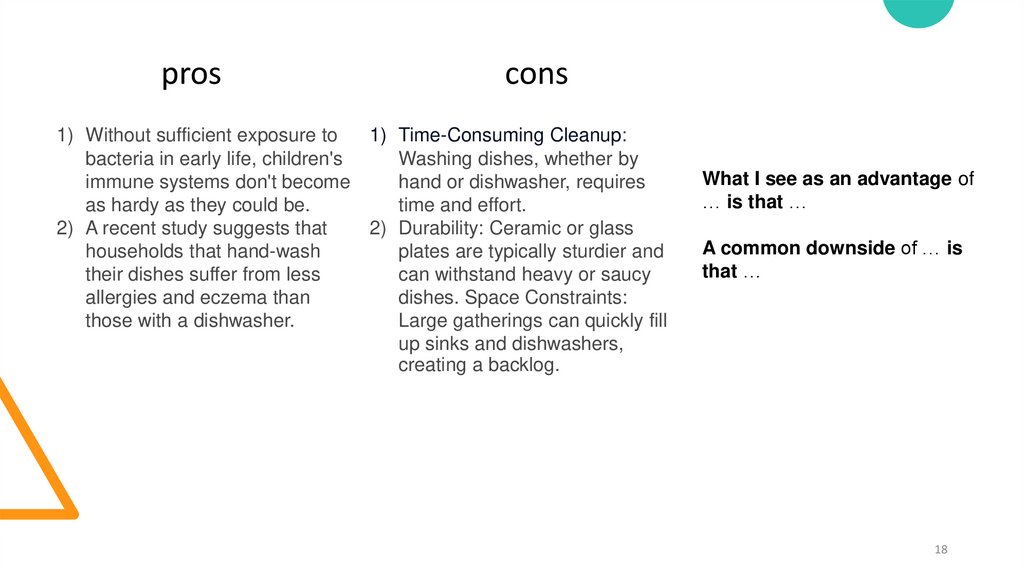
18.
proscons
1) Without sufficient exposure to
1) Time-Consuming Cleanup:
bacteria in early life, children's
Washing dishes, whether by
immune systems don't become
hand or dishwasher, requires
as hardy as they could be.
time and effort.
2) A recent study suggests that
2) Durability: Ceramic or glass
households that hand-wash
plates are typically sturdier and
their dishes suffer from less
can withstand heavy or saucy
allergies and eczema than
dishes. Space Constraints:
those with a dishwasher.
Large gatherings can quickly fill
up sinks and dishwashers,
creating a backlog.
What I see as an advantage of
… is that …
A common downside of … is
that …
18
19.
1) What household chores are you responsible for in your family?2) What housework did you have to do when you were a child?
3) Do you think it is important for children to do jobs around the house? Why/Why
not?
4) Do you think people in your country will do more or less housework in the future?
Why?
5) Should parents pay their children for doing household chores? Why/ why not?
19
20.
1) What is your least favorite household chore?2) Will your parents make you help around the house in the future?
3) Is it a good idea to share household chores and childcare equally between
a couple?
4) What domestic appliances does your family have and what do you use
them for?
5) Do you think people will use robots to do jobs round the house in the
future?
20
21.
1) How have the ways of doing housework changed over the last decades?2) What domestic appliances do you think you couldn’t live without and why?
3) What household chores did people have to do in the past but do not do today?
4) What problems do modern domestic appliances often cause?
5) How do you think the way people do grocery shopping will change in the future?
21
22.
1) What are the most popular chores for children in your country?2) In your opinion what are the disadvantages of making children perform
household chores?
3) Did your parents use to pay you for helping round the house?
4) What motivates children to help their parents with jobs round the house?
How might doing household chores help children in the future?
22
23.
1) What household chores do you like doing and why?2) Is there anything you can’t stand doing?
3) Are there any chores that are considered entirely women’s
responsibility?
4) In your household, who does the most of the housework?
5) Do you think it’s important for children to do jobs around the
house?
6) How much time do people in your country spend doing
household chores?
23
24.
1) Do you feel people in your country have enough time to dohousework?
2) Do house chores vary depending on the place where you live?
3) How often do you pick up your room?
4) Is it important for you to keep your room clean at all times and
why?
5) What chores are teenagers in your country made to do
regularly?
6) What is the most annoying household duty you have ever
done, and why?
7) How have your duties about the house changed since you
were a child?
24
25. Household chores
26.
27.
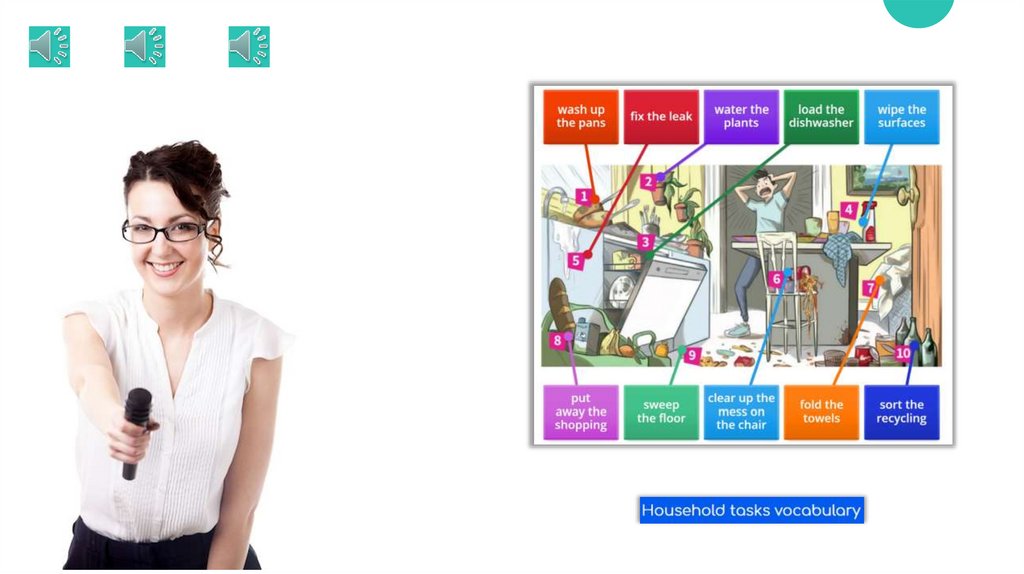
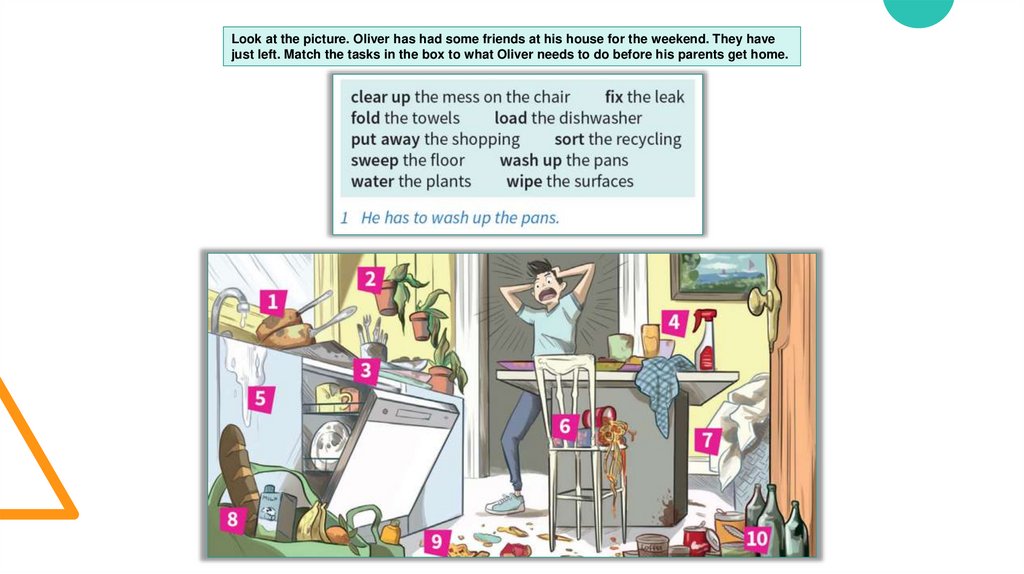
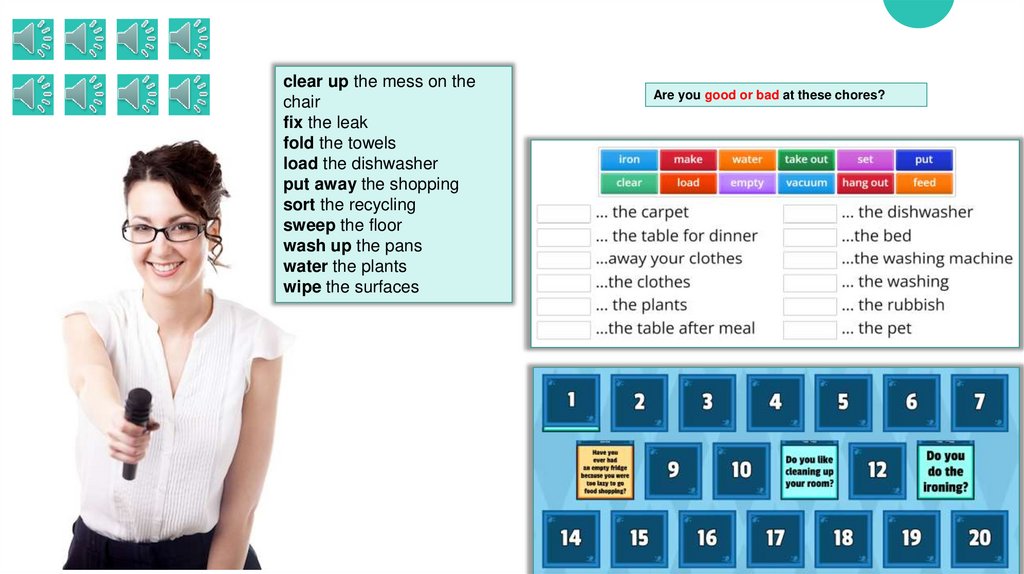
Look at the picture. Oliver has had some friends at his house for the weekend. They havejust left. Match the tasks in the box to what Oliver needs to do before his parents get home.
28.
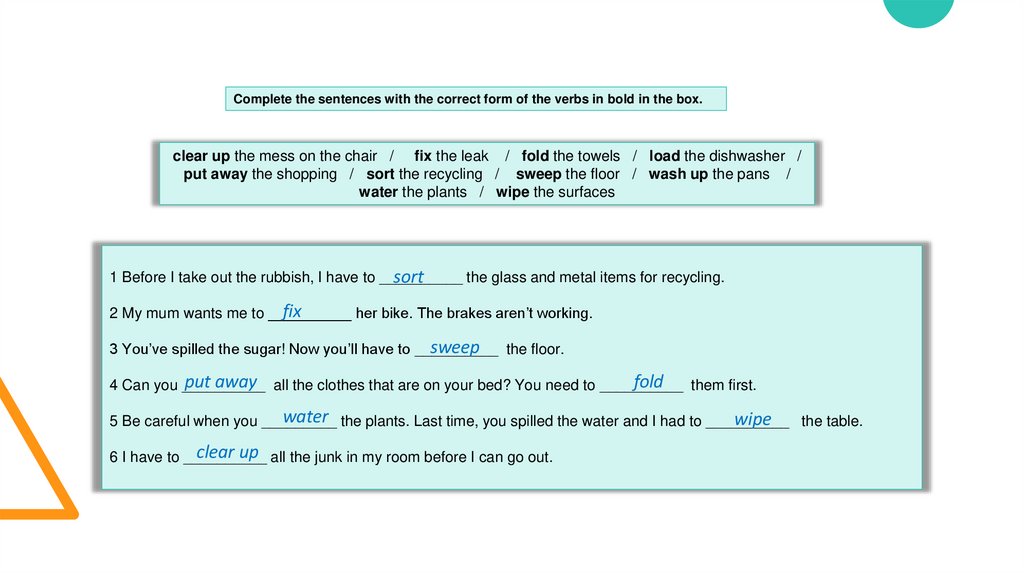
Complete the sentences with the correct form of the verbs in bold in the box.clear up the mess on the chair / fix the leak / fold the towels / load the dishwasher /
put away the shopping / sort the recycling / sweep the floor / wash up the pans /
water the plants / wipe the surfaces
1 Before I take out the rubbish, I have to __________
the glass and metal items for recycling.
sort
fix
2 My mum wants me to __________
her bike. The brakes aren’t working.
sweep the floor.
3 You’ve spilled the sugar! Now you’ll have to __________
put away all the clothes that are on your bed? You need to __________
fold them first.
4 Can you __________
water the plants. Last time, you spilled the water and I had to __________
wipe
5 Be careful when you _________
the table.
clear up all the junk in my room before I can go out.
6 I have to __________
29.
clear up the mess on thechair
fix the leak
fold the towels
load the dishwasher
put away the shopping
sort the recycling
sweep the floor
wash up the pans
water the plants
wipe the surfaces
Are you good or bad at these chores?
30.
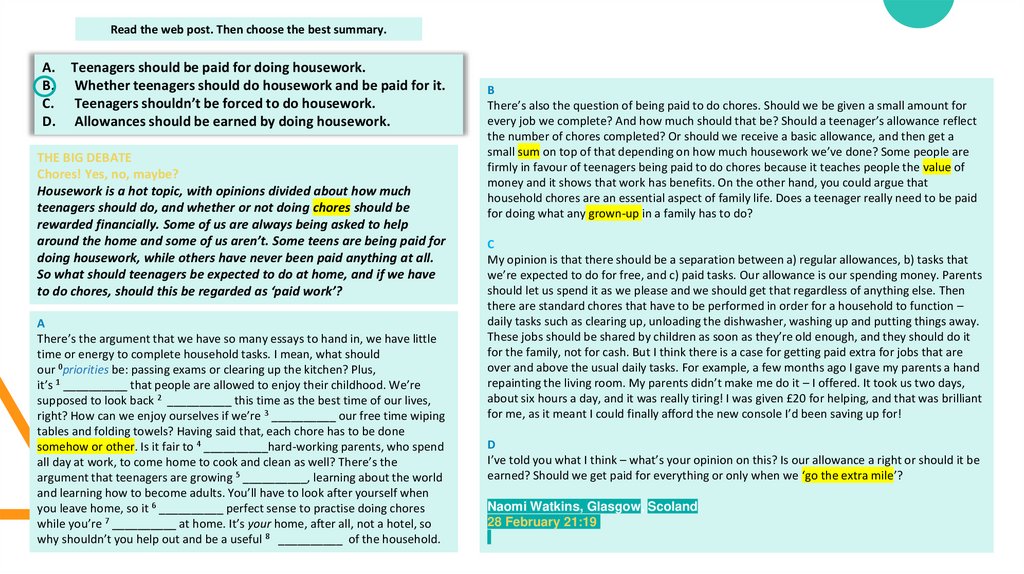
Read the web post. Then choose the best summary.A.
B.
C.
D.
Teenagers should be paid for doing housework.
Whether teenagers should do housework and be paid for it.
Teenagers shouldn’t be forced to do housework.
Allowances should be earned by doing housework.
THE BIG DEBATE
Chores! Yes, no, maybe?
Housework is a hot topic, with opinions divided about how much
teenagers should do, and whether or not doing chores should be
rewarded financially. Some of us are always being asked to help
around the home and some of us aren’t. Some teens are being paid for
doing housework, while others have never been paid anything at all.
So what should teenagers be expected to do at home, and if we have
to do chores, should this be regarded as ‘paid work’?
A
There’s the argument that we have so many essays to hand in, we have little
time or energy to complete household tasks. I mean, what should
our 0priorities be: passing exams or clearing up the kitchen? Plus,
it’s 1 __________ that people are allowed to enjoy their childhood. We’re
supposed to look back 2 __________ this time as the best time of our lives,
right? How can we enjoy ourselves if we’re 3 __________ our free time wiping
tables and folding towels? Having said that, each chore has to be done
somehow or other. Is it fair to 4 __________hard-working parents, who spend
all day at work, to come home to cook and clean as well? There’s the
argument that teenagers are growing 5 __________, learning about the world
and learning how to become adults. You’ll have to look after yourself when
you leave home, so it 6 __________ perfect sense to practise doing chores
while you’re 7 __________ at home. It’s your home, after all, not a hotel, so
why shouldn’t you help out and be a useful 8 __________ of the household.
B
There’s also the question of being paid to do chores. Should we be given a small amount for
every job we complete? And how much should that be? Should a teenager’s allowance reflect
the number of chores completed? Or should we receive a basic allowance, and then get a
small sum on top of that depending on how much housework we’ve done? Some people are
firmly in favour of teenagers being paid to do chores because it teaches people the value of
money and it shows that work has benefits. On the other hand, you could argue that
household chores are an essential aspect of family life. Does a teenager really need to be paid
for doing what any grown-up in a family has to do?
C
My opinion is that there should be a separation between a) regular allowances, b) tasks that
we’re expected to do for free, and c) paid tasks. Our allowance is our spending money. Parents
should let us spend it as we please and we should get that regardless of anything else. Then
there are standard chores that have to be performed in order for a household to function –
daily tasks such as clearing up, unloading the dishwasher, washing up and putting things away.
These jobs should be shared by children as soon as they’re old enough, and they should do it
for the family, not for cash. But I think there is a case for getting paid extra for jobs that are
over and above the usual daily tasks. For example, a few months ago I gave my parents a hand
repainting the living room. My parents didn’t make me do it – I offered. It took us two days,
about six hours a day, and it was really tiring! I was given £20 for helping, and that was brilliant
for me, as it meant I could finally afford the new console I’d been saving up for!
D
I’ve told you what I think – what’s your opinion on this? Is our allowance a right or should it be
earned? Should we get paid for everything or only when we ‘go the extra mile’?
Naomi Watkins, Glasgow, Scoland
28 February 21:19
31.
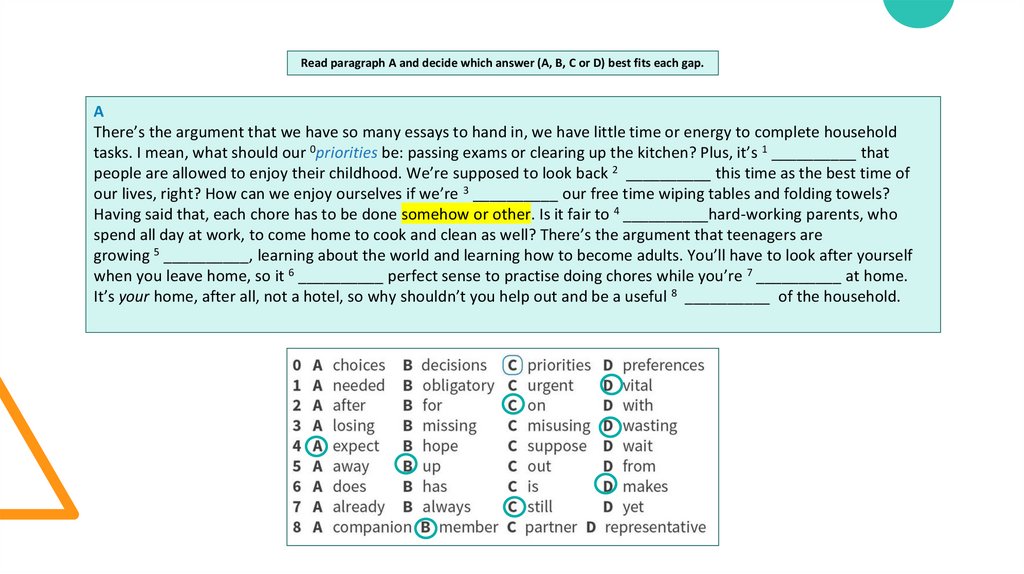
Read paragraph A and decide which answer (A, B, C or D) best fits each gap.A
There’s the argument that we have so many essays to hand in, we have little time or energy to complete household
tasks. I mean, what should our 0priorities be: passing exams or clearing up the kitchen? Plus, it’s 1 __________ that
people are allowed to enjoy their childhood. We’re supposed to look back 2 __________ this time as the best time of
our lives, right? How can we enjoy ourselves if we’re 3 __________ our free time wiping tables and folding towels?
Having said that, each chore has to be done somehow or other. Is it fair to 4 __________hard-working parents, who
spend all day at work, to come home to cook and clean as well? There’s the argument that teenagers are
growing 5 __________, learning about the world and learning how to become adults. You’ll have to look after yourself
when you leave home, so it 6 __________ perfect sense to practise doing chores while you’re 7 __________ at home.
It’s your home, after all, not a hotel, so why shouldn’t you help out and be a useful 8 __________ of the household.
32.
1.2.
3.
4.
What is the writer’s view about whether teenagers should do
housework, and whether or not they should be paid for doing
it?
What kind of task does the writer think should be paid extra?
How old do you think Naomi Watkins is?
Who is her intended audience?
THE BIG DEBATE
Chores! Yes, no, maybe?
Housework is a hot topic, with opinions divided about how much
teenagers should do, and whether or not doing chores should be
rewarded financially. Some of us are always being asked to help
around the home and some of us aren’t. Some teens are being paid for
doing housework, while others have never been paid anything at all.
So what should teenagers be expected to do at home, and if we have
to do chores, should this be regarded as ‘paid work’?
A
There’s the argument that we have so many essays to hand in, we have little
time or energy to complete household tasks. I mean, what should
our 0priorities be: passing exams or clearing up the kitchen? Plus, it’s vital that
people are allowed to enjoy their childhood. We’re supposed to look back on
this time as the best time of our lives, right? How can we enjoy ourselves if
we’re wasting our free time wiping tables and folding towels? Having said that,
each chore has to be done somehow or other. Is it fair to expect hard-working
parents, who spend all day at work, to come home to cook and clean as well?
There’s the argument that teenagers are growing up, learning about the world
and learning how to become adults. You’ll have to look after yourself when
you leave home, so it makes perfect sense to practise doing chores while
you’re still at home. It’s your home, after all, not a hotel, so why shouldn’t you
help out and be a useful member of the household.
Answer the questions.
B
There’s also the question of being paid to do chores. Should we be given a small amount for
every job we complete? And how much should that be? Should a teenager’s allowance reflect
the number of chores completed? Or should we receive a basic allowance, and then get a
small sum on top of that depending on how much housework we’ve done? Some people are
firmly in favour of teenagers being paid to do chores because it teaches people the value of
money and it shows that work has benefits. On the other hand, you could argue that
household chores are an essential aspect of family life. Does a teenager really need to be paid
for doing what any grown-up in a family has to do?
C
My opinion is that there should be a separation between a) regular allowances, b) tasks that
we’re expected to do for free, and c) paid tasks. Our allowance is our spending money. Parents
should let us spend it as we please and we should get that regardless of anything else. Then
there are standard chores that have to be performed in order for a household to function –
daily tasks such as clearing up, unloading the dishwasher, washing up and putting things away.
These jobs should be shared by children as soon as they’re old enough, and they should do it
for the family, not for cash. But I think there is a case for getting paid extra for jobs that are
over and above the usual daily tasks. For example, a few months ago I gave my parents a hand
repainting the living room. My parents didn’t make me do it – I offered. It took us two days,
about six hours a day, and it was really tiring! I was given £20 for helping, and that was brilliant
for me, as it meant I could finally afford the new console I’d been saving up for!
D
I’ve told you what I think – what’s your opinion on this? Is our allowance a right or should it be
earned? Should we get paid for everything or only when we ‘go the extra mile’?
Naomi Watkins, Glasgow, Scoland
28 February 21:19
33.
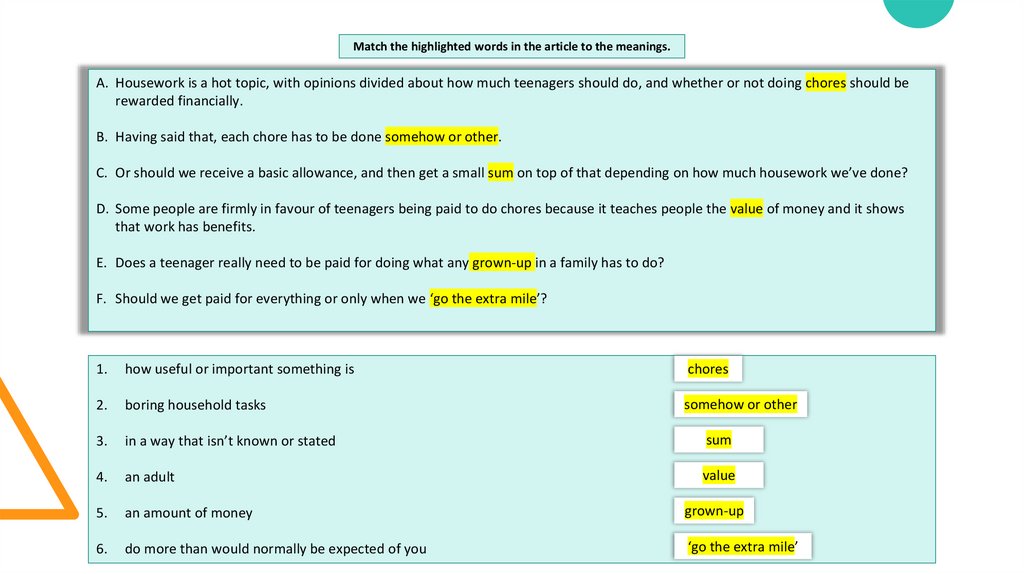
Match the highlighted words in the article to the meanings.A. Housework is a hot topic, with opinions divided about how much teenagers should do, and whether or not doing chores should be
rewarded financially.
B. Having said that, each chore has to be done somehow or other.
C. Or should we receive a basic allowance, and then get a small sum on top of that depending on how much housework we’ve done?
D. Some people are firmly in favour of teenagers being paid to do chores because it teaches people the value of money and it shows
that work has benefits.
E. Does a teenager really need to be paid for doing what any grown-up in a family has to do?
F. Should we get paid for everything or only when we ‘go the extra mile’?
1.
how useful or important something is
chores
2.
boring household tasks
somehow or other
3.
in a way that isn’t known or stated
sum
4.
an adult
value
5.
an amount of money
grown-up
6.
do more than would normally be expected of you
‘go the extra mile’
34.
Give your own answers to the questions in paragraph B.B
There’s also the question of being paid to do chores.
Should we be given a small amount for every job we complete? And how much should that be?
Should a teenager’s allowance reflect the number of chores completed? Or should we receive a basic
allowance, and then get a small sum on top of that depending on how much housework we’ve done?
Some people are firmly in favour of teenagers being paid to do chores because it teaches people the value of
money and it shows that work has benefits. On the other hand, you could argue that household chores are an
essential aspect of family life.
Does a teenager really need to be paid for doing what any grown-up in a family has to do?
35.
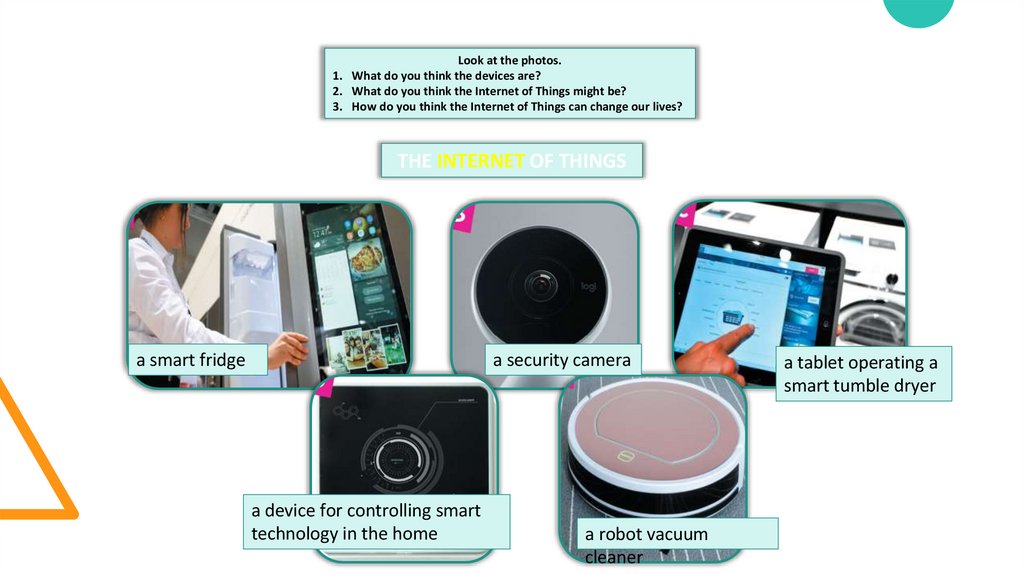
Look at the photos.1. What do you think the devices are?
2. What do you think the Internet of Things might be?
3. How do you think the Internet of Things can change our lives?
THE INTERNET OF THINGS
a smart fridge
a security camera
a device for controlling smart
technology in the home
a robot vacuum
cleaner
a tablet operating a
smart tumble dryer
36.
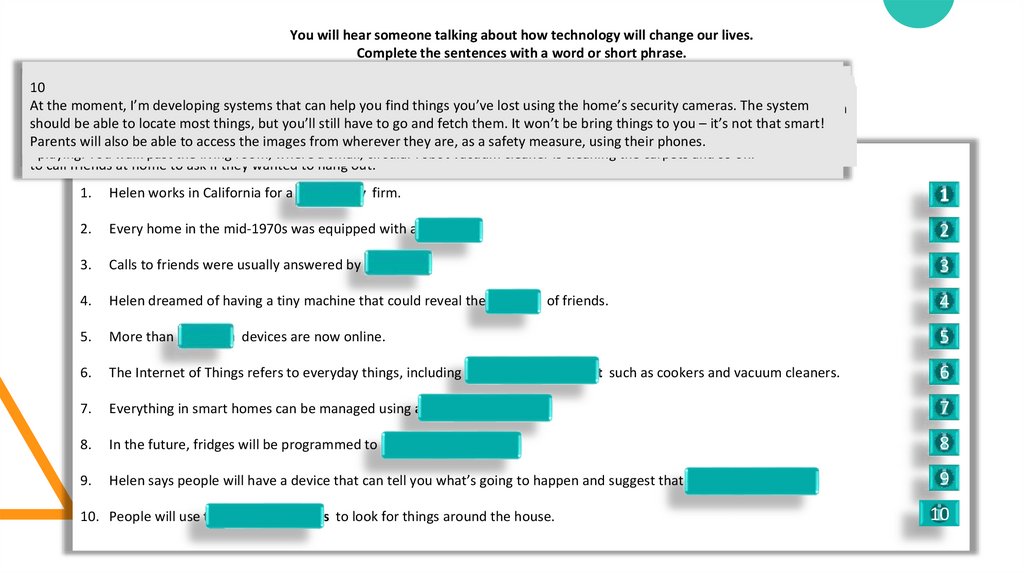
You will hear someone talking about how technology will change our lives.Complete the sentences with a word or short phrase.
234
110
895 often asked how I ended up in this role. I can trace my interest in hardware right back to my childhood in England many years
I’m
More
often
than
not,
get hold
ofsolution
someone’s
mum,
who’dwill
‘No,
sorry,
Tammy
(or whoever
I’d called
…)
Tammy
isn’t
I67started
dreaming
of
awe’d
technological
to
my
boredom.
Isay,
hadchange
one
idea
for
something
that
would
fit in
my
pocket,
like
aatJames
Narrator:
You
willI’m
hear
someone
talking
about
how
technology
our
lives.
Complete
the
sentences
with
ahome
word
or
short
At
the
moment,
developing
systems
that
can
help
find
things
you’ve
lost
using
the
home’s
security
cameras.
The
system
In
homes
of the
future,
the
temperature
will
always
beyou
just
right
because
homes
will
know
what
time
residents
get
onyour
Your
personal
assistant
will
greet
you
as
you
enter
your
room
and
tell
you
things
like,
‘Your
brother
is
already
at
home
and
mum
ago.
In
those
days,
I
used
to
spend
a
lot
of
time
at
the
weekends
and
in
the
holidays
on
my
own,
wondering
where
all
my
friends
Fast-forward
40
years,
and
smartphones
are
everywhere.
The
idea
of
a
device
for
finding
friends
seems,
well,
rather
old-fashioned!
My
job’s
all
about
the
nextabeing
big
digital
revolution:
the…‘Internet
of Things’.
Byevery
2025,
over
75
billion
devices
will
be connected
tolike
the
home,
she’s
withisIt’d
her
cousin.
Can
I take
awould
message?’
That
dreadful
phrase!
I never
left
messages,
because
Iwanted
wanted
todevice
go
out
right
Bond
spy
device.
have
screen
that
display
the
location
of
my
friends
with
a
little
dot
on
a
map.
I
a
This
technology
already
used
in
ultra-modern
smart
homes,
where
aspect
of
the
home
is
controlled
with
a
phone
or
phrase.
should
be
able
to
locate
most
things,
but
you’ll
still
have
to goofsystem
and
fetch
them.
It
won’t
be
bring
things
to
you
– it’s
not
thatand
smart!
different
days,
sosix-thirty
they
will
turn
on
the
heating
or
the
cooling
to suit
users.
Your
fridge
will
never
run
out
ofeight-thirty.’
snacks
drinks
will
be
home
at
to
have
dinner
with
you.
Your
mates
have
arranged
to
play
computer
games
with
you
at
It’ll
were.
This
was
the
mid-1970s,
decades
before
the
invention
the
mobile
and
the
personal
computer
–
or
at
least
decades
before
Already,
over
20
billion
phones,
computers
and
games
consoles
are
connected
to
the
internet.
internet.
We
call
it
the ‘Internet
ofwalk
Things’
because
the home,
majority
of
thejust
devices
online
will
be
everyday
things
by that
I mean
then,
not
wait
for
hours
until
someone
finally
gotdream
home.
this
more
than
anything
– but
it was
pure
fantasy.
Colour
had
only
invented,
never
mind
ajob
pocket-sized
forbut
tablet.
So
for
example,
when
you
into
your
smart
lights
already
been
turned
on and
your– favourite
music
is
Helen:
My
name’s
Helen
Chapman
and
Ionline.
have
my
jobTVatthey
athe
technology
company
in
California.
My
changes
allgadget
the
time,
Parents
will
also
be
able
to
access
the
images
from
wherever
are,
ashave
a been
safety
measure,
using
their
phones.
because
it’ll
be
able
to
order
shopping
also
remind
you
to
tidy
your
room.
these
things
became
affordable!
So
I
couldn’t
text
friends
or
message
them,
but
everyone
had
a
regular
phone
at
home.
So
we
used
vehicles,
and
all
sorts
of
household
equipment,
so
things
like
fridges,
cookers
and
vacuum
cleaners.
friends!
playing.
You walk
past the living
where a small,
circular
robot– The
vacuum
cleaner
is cleaningtothe
and so on.
atfinding
the moment
I’m developing
theroom,
next generation
of smart
devices
that’s
devices
thecarpets
internet.
Internet
ofconnected
Things
to call friends at home to ask if they wanted to hang out.
1.
Helen works in California for a technology firm.
1
2.
Every home in the mid-1970s was equipped with a phone.
2
3.
Calls to friends were usually answered by a mum.
3
4.
Helen dreamed of having a tiny machine that could reveal the location of friends.
4
5.
More than 20 billion devices are now online.
5
6.
The Internet of Things refers to everyday things, including household equipment such as cookers and vacuum cleaners.
6
7.
Everything in smart homes can be managed using a phone or tablet.
7
8.
In the future, fridges will be programmed to order shopping online.
8
9.
Helen says people will have a device that can tell you what’s going to happen and suggest that you tidy your room.
9
10. People will use the home’s cameras to look for things around the house.
10
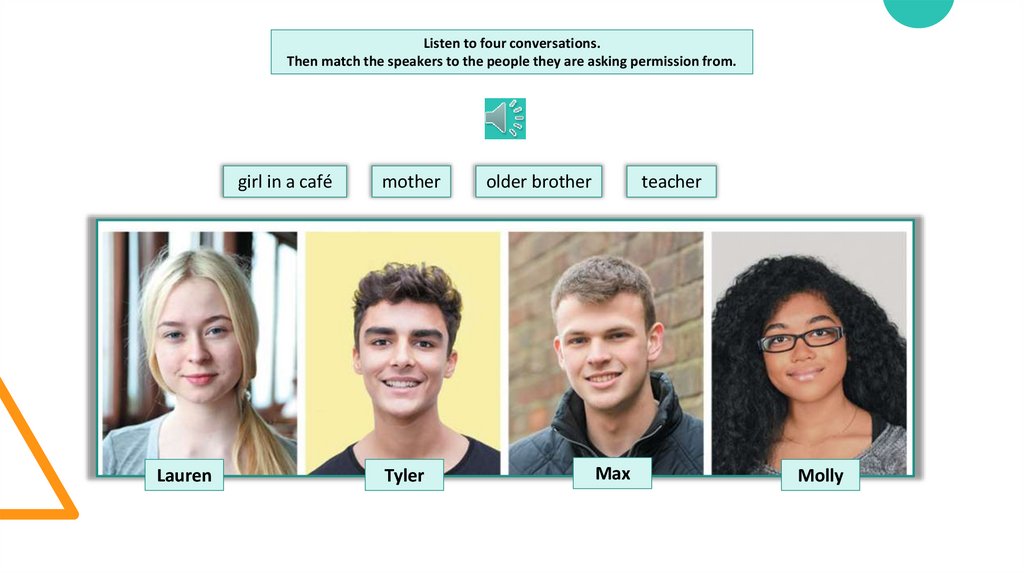
37.
Listen to four conversations.Then match the speakers to the people they are asking permission from.
girl in a café
Lauren
mother
Tyler
older brother
teacher
Max
Molly
38.
Ask the questions. Then listen again and check.1. Who is given permission?
2. Who is not given permission?
3. Molly 1asks
her brother: Do you mind if I use your tablet? What is his response?
Narrator: Conversation
– Lauren
Lauren: Would itWhat
be OK would
if I left? he
I’vesay
answered
all ofgiving
the questions.
if he was
permission?
Teacher: I’m afraid not. Everyone has to stay in the room until the exam has finished.
Narrator: Conversation 2 – Tyler
Tyler: Do you mind if I sit here?
Girl: Go ahead, both of those seats are free.
Tyler: Thanks.
Narrator: Conversation 3 – Max
Max: Am I allowed to stay over at Nick’s on Friday night?
Mother: Sure, as long as you text me when you get there. Last time, we didn’t know where you were and we were really
worried.
Max: I’m sorry. I won’t forget to text you this time.
Narrator: Conversation 4 – Molly
Molly: Do you mind if I use your tablet?
Older brother: Yes, I do.
Molly: But I really want to check something online.
Older brother: I’m sorry, but I’m about to use it myself.
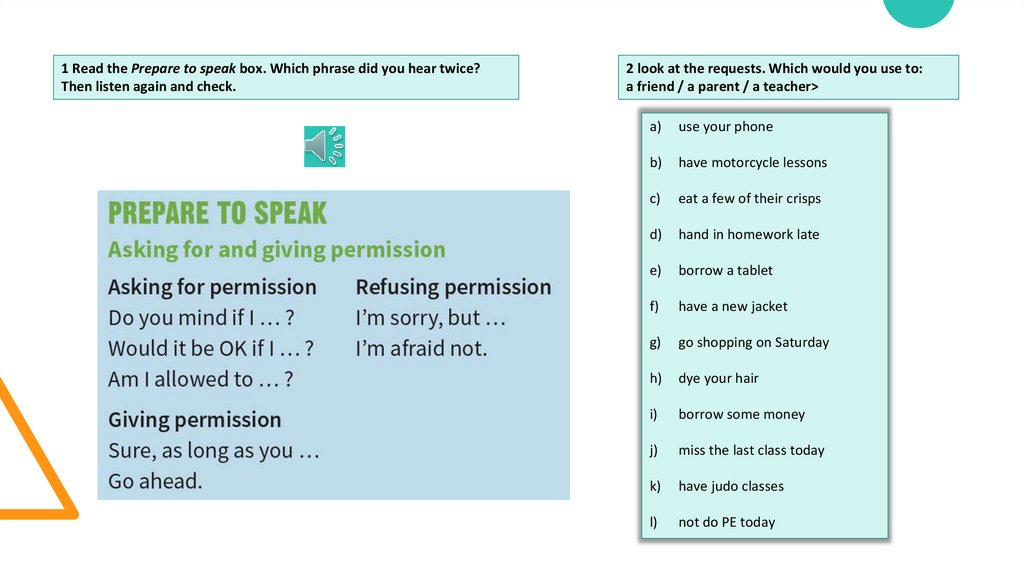
Use your phone.
39.
1 Read the Prepare to speak box. Which phrase did you hear twice?Then listen again and check.
2 look at the requests. Which would you use to:
a friend / a parent / a teacher>
a)
use your phone
b)
have motorcycle lessons
c)
eat a few of their crisps
d)
hand in homework late
e)
borrow a tablet
f)
have a new jacket
g)
go shopping on Saturday
h)
dye your hair
i)
borrow some money
j)
miss the last class today
k)
have judo classes
l)
not do PE today
40.
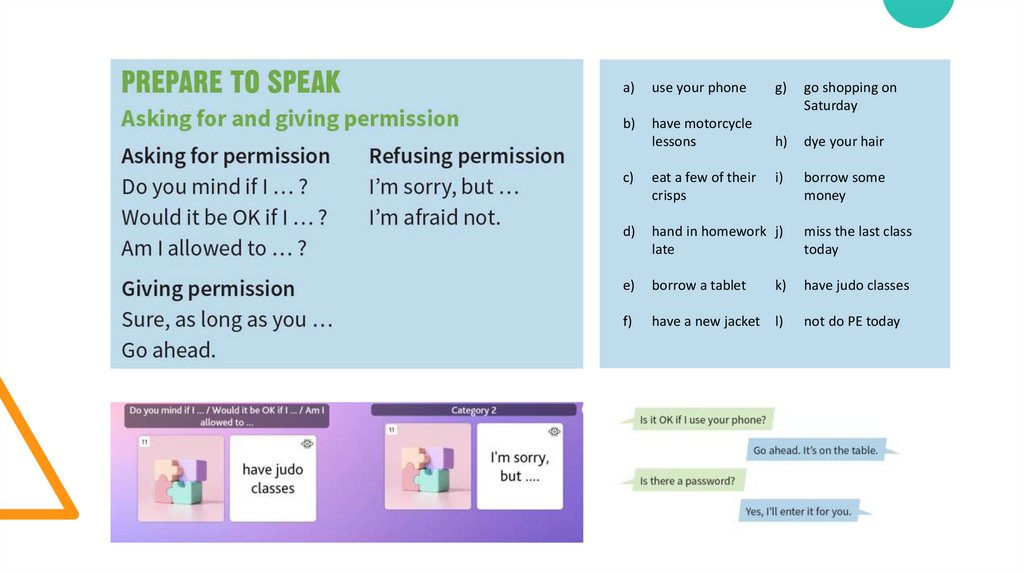
a)use your phone
g)
go shopping on
Saturday
b)
have motorcycle
lessons
h)
dye your hair
i)
borrow some
money
c)
eat a few of their
crisps
d)
hand in homework j)
late
miss the last class
today
e)
borrow a tablet
k)
have judo classes
f)
have a new jacket
l)
not do PE today