 internet
Similar presentations:










The World of Hors es : From Wild Herds to Domes tic Partners
1.
The World of Hors es : F romWild Herds to Domes tic
Partners
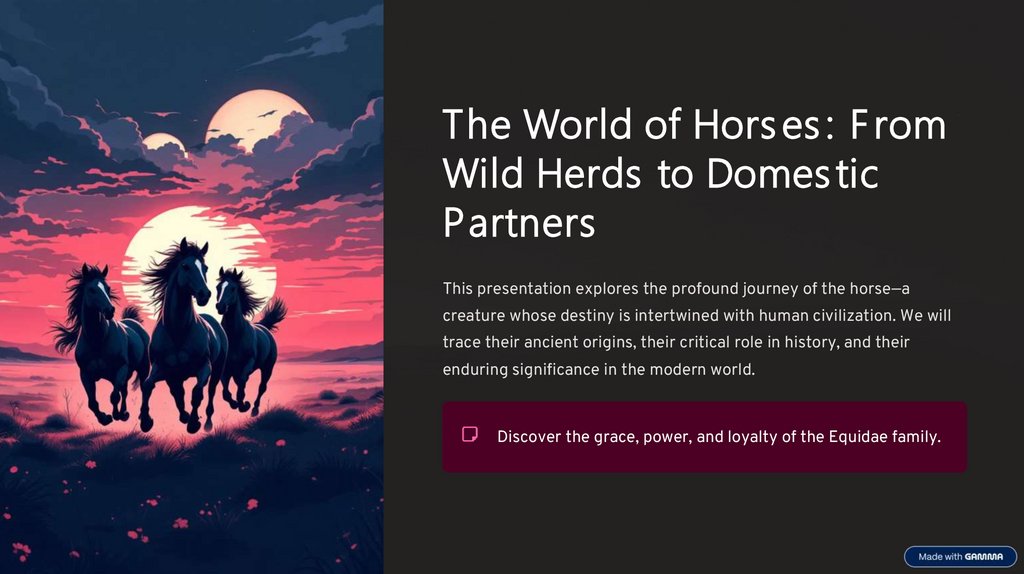
This presentation explores the profound journey of the horse—a
creature whose destiny is intertwined with human civilization. We will
trace their ancient origins, their critical role in history, and their
enduring significance in the modern world.
Discover the grace, power, and loyalty of the Equidae family.
2.
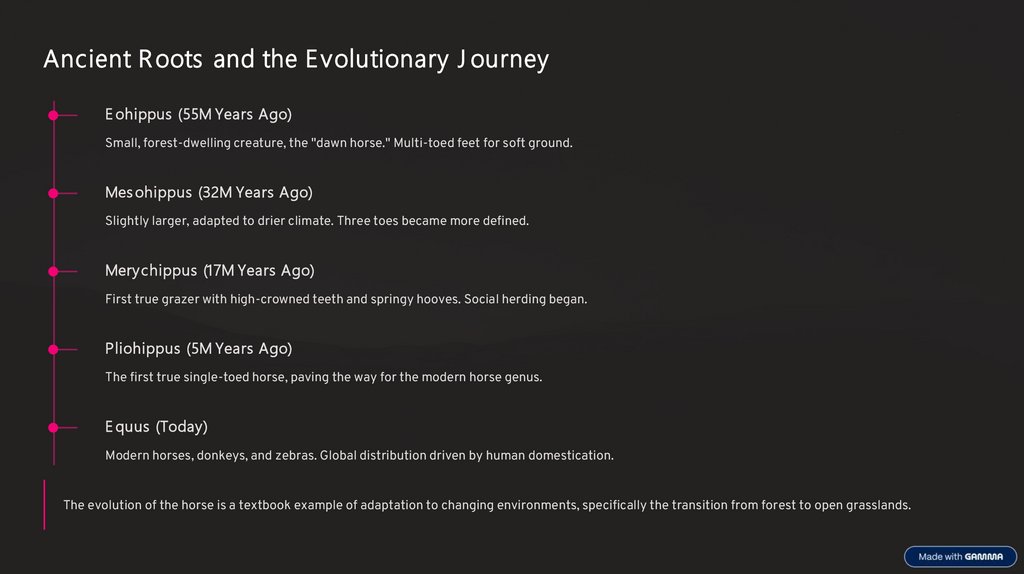
Ancient R oots and the E volutionary J ourneyE ohippus (55M Years Ago)
Small, forest-dwelling creature, the "dawn horse." Multi-toed feet for soft ground.
Mes ohippus (32M Years Ago)
Slightly larger, adapted to drier climate. Three toes became more defined.
Merychippus (17M Years Ago)
First true grazer with high-crowned teeth and springy hooves. Social herding began.
Pliohippus (5M Years Ago)
The first true single-toed horse, paving the way for the modern horse genus.
E quus (Today)
Modern horses, donkeys, and zebras. Global distribution driven by human domestication.
The evolution of the horse is a textbook example of adaptation to changing environments, specifically the transition from forest to open grasslands.
3.
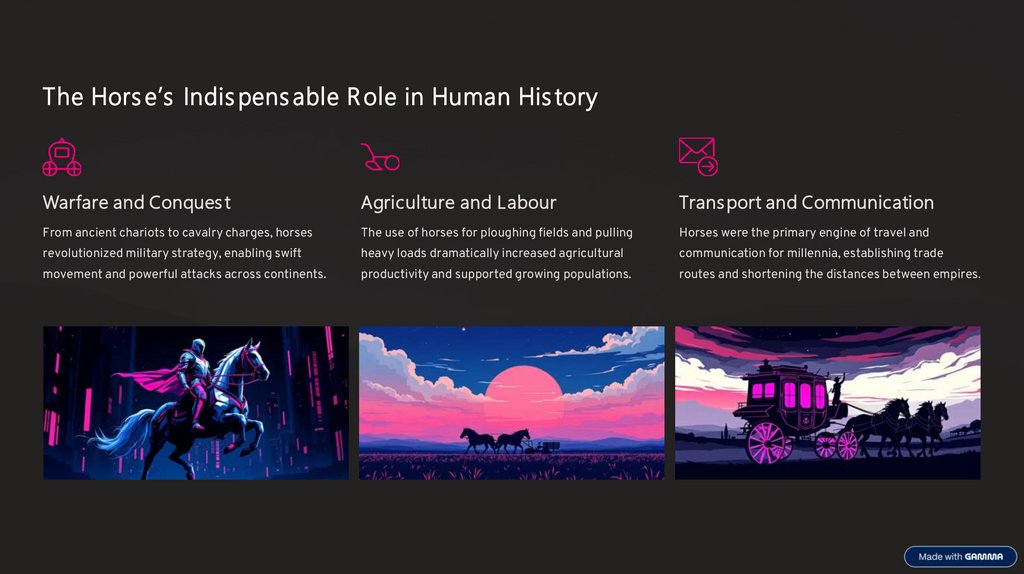
The Hors e’s Indis pens able R ole in Human His toryWarfare and Conques t
Agriculture and Labour
Trans port and Communication
From ancient chariots to cavalry charges, horses
The use of horses for ploughing fields and pulling
Horses were the primary engine of travel and
revolutionized military strategy, enabling swift
heavy loads dramatically increased agricultural
communication for millennia, establishing trade
movement and powerful attacks across continents.
productivity and supported growing populations.
routes and shortening the distances between empires.
4.
A Tapestry of Breeds: Diversity and PurposeThe process of selective breeding over centuries has created hundreds of distinct horse breeds, each optimized for specific
climates, tasks, or athletic pursuits.
Draft Breeds (Heavy)
Light Breeds (Riding)
E.g., Shire, Belgian. Known for immense strength and
E.g., Thoroughbred, Arabian. Bred for speed,
calm temperament, historically used for heavy farm
endurance, and agility. Used primarily for sport,
work and hauling.
racing, and pleasure riding.
Ponies (Small)
Feral/Wild Types
E.g., Shetland, Welsh. Characterized by thick coats,
E.g., Przewalski’s Horse. Represents the ancient,
short legs, and sturdy builds. Excellent for children
undomesticated lineage, essential for genetic
and small-scale work.
diversity studies and conservation.
5.
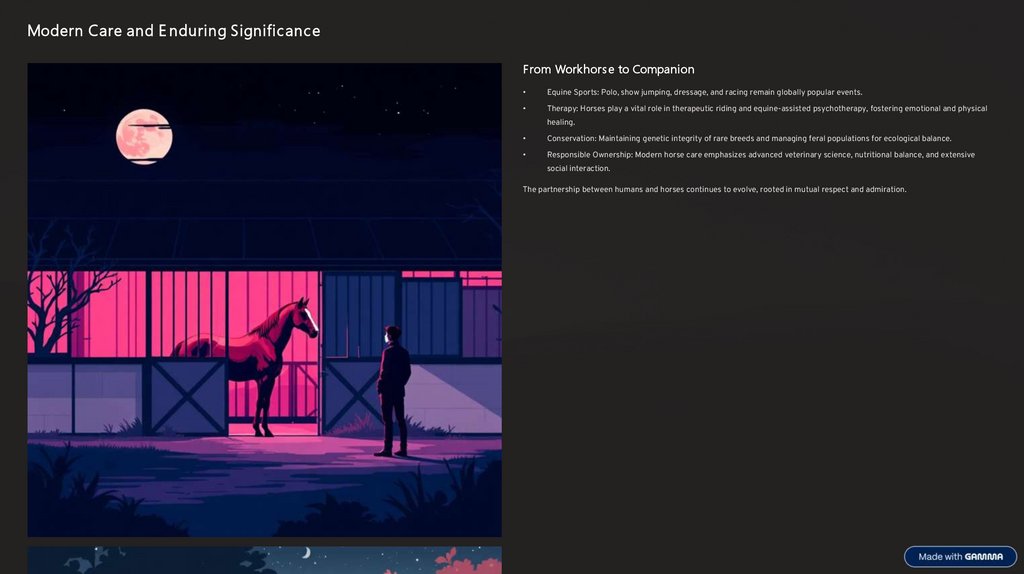
Modern Care and E nduring SignificanceFrom Workhors e to Companion
Equine Sports: Polo, show jumping, dressage, and racing remain globally popular events.
Therapy: Horses play a vital role in therapeutic riding and equine-assisted psychotherapy, fostering emotional and physical
healing.
Conservation: Maintaining genetic integrity of rare breeds and managing feral populations for ecological balance.
Responsible Ownership: Modern horse care emphasizes advanced veterinary science, nutritional balance, and extensive
social interaction.
The partnership between humans and horses continues to evolve, rooted in mutual respect and admiration.