 pedagogy
Similar presentations:









Week 2 & 3 Dr. Nandia Dedeletakis
1. Week 2 & 3
Week 2 & 3Dr. Nandia Dedeletakis
1
2.
Learning to Write EffectiveParagraphs
2
3. PEAL STRUCTURE
WHAT IS A PEAL and what’s it good for?PEAL is a simple and effective way to structure academic paragraphs.
Each paragraph should focus on one main idea, and PEAL helps you
explain and support that idea clearly.
3
4.
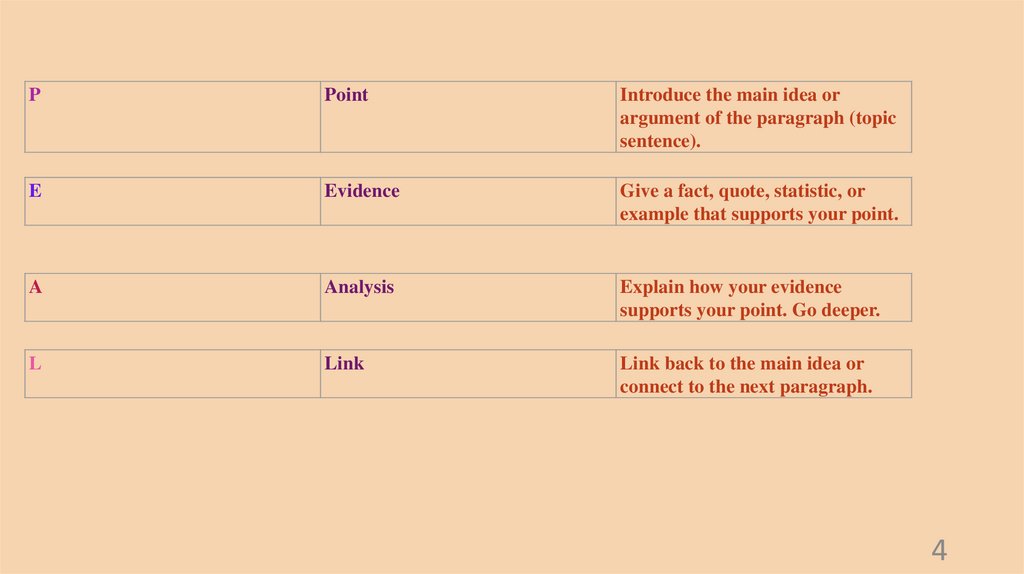
PPoint
Introduce the main idea or
argument of the paragraph (topic
sentence).
E
Evidence
Give a fact, quote, statistic, or
example that supports your point.
A
Analysis
Explain how your evidence
supports your point. Go deeper.
L
Link
Link back to the main idea or
connect to the next paragraph.
4
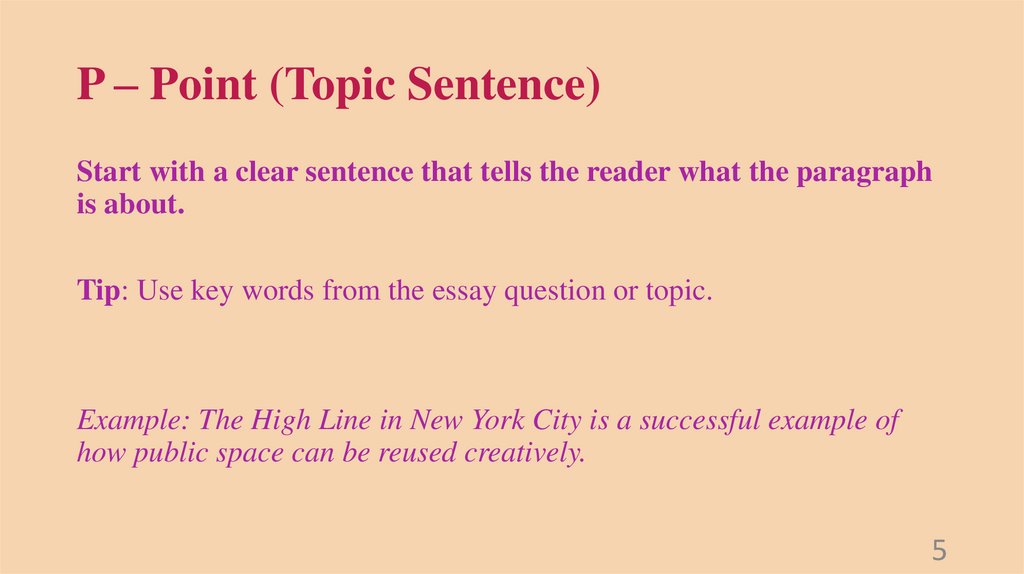
5. P – Point (Topic Sentence)
Start with a clear sentence that tells the reader what the paragraphis about.
Tip: Use key words from the essay question or topic.
Example: The High Line in New York City is a successful example of
how public space can be reused creatively.
5
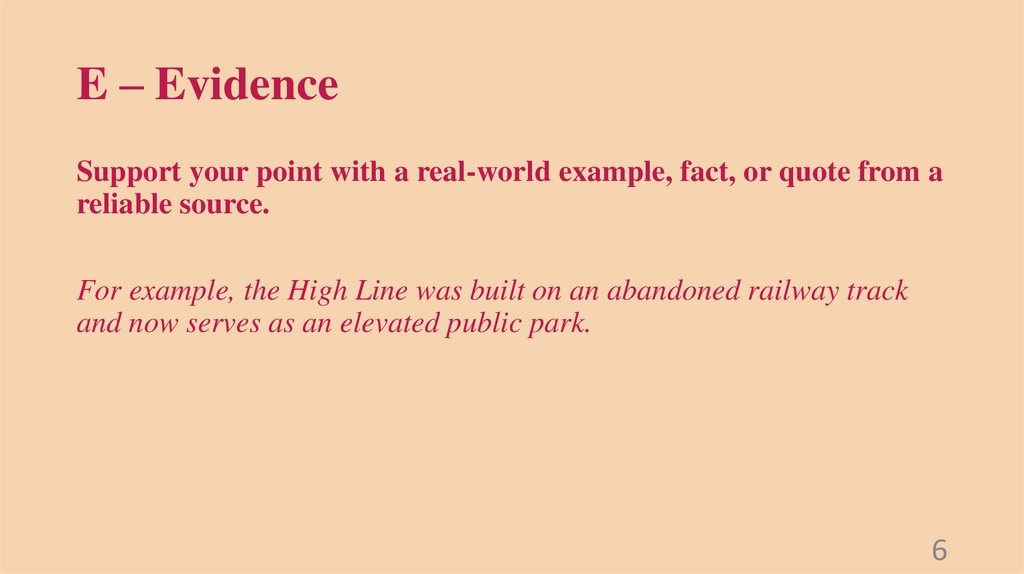
6. E – Evidence
Support your point with a real-world example, fact, or quote from areliable source.
For example, the High Line was built on an abandoned railway track
and now serves as an elevated public park.
6
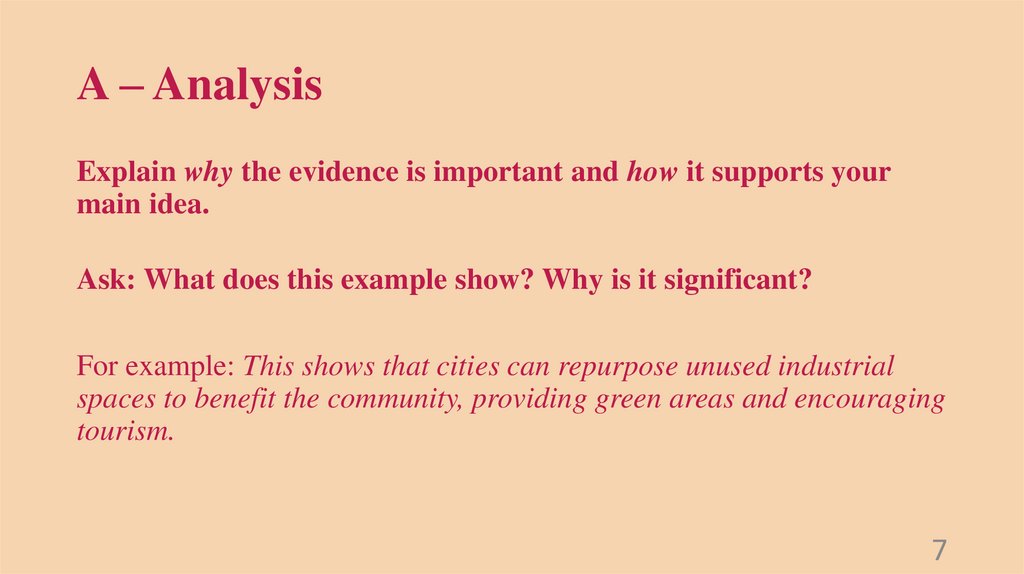
7. A – Analysis
Explain why the evidence is important and how it supports yourmain idea.
Ask: What does this example show? Why is it significant?
For example: This shows that cities can repurpose unused industrial
spaces to benefit the community, providing green areas and encouraging
tourism.
7
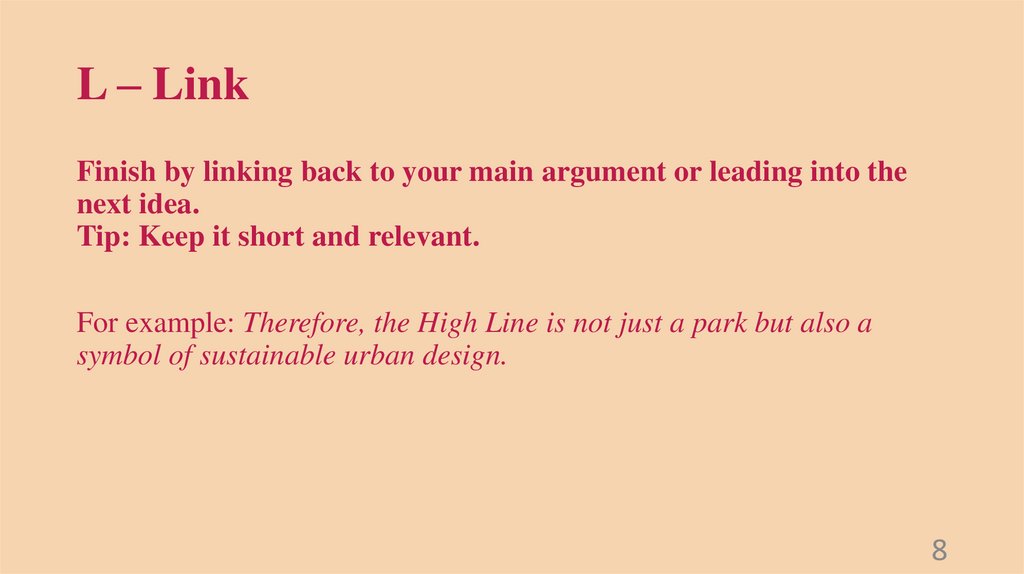
8. L – Link
Finish by linking back to your main argument or leading into thenext idea.
Tip: Keep it short and relevant.
For example: Therefore, the High Line is not just a park but also a
symbol of sustainable urban design.
8
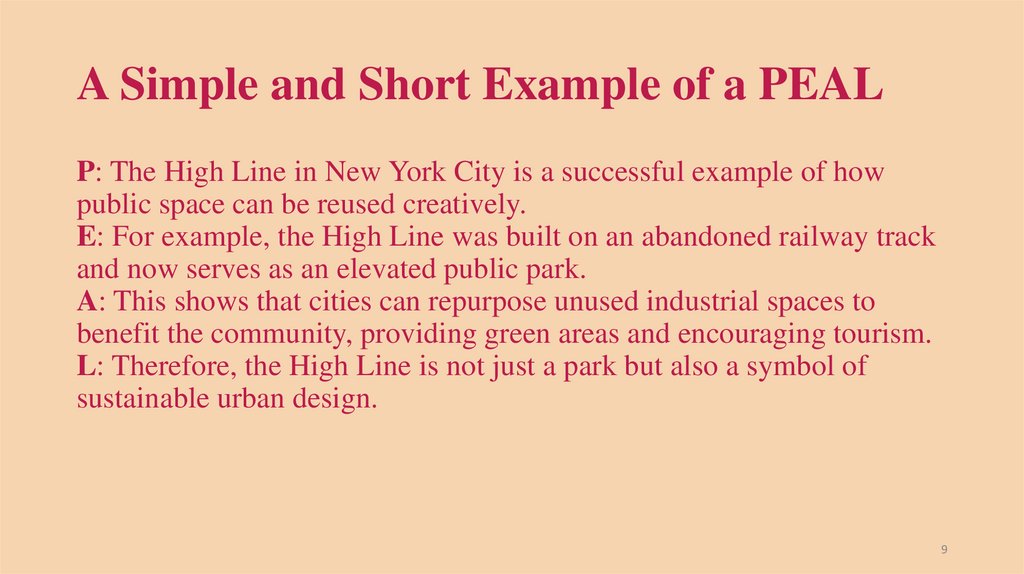
9. A Simple and Short Example of a PEAL
P: The High Line in New York City is a successful example of howpublic space can be reused creatively.
E: For example, the High Line was built on an abandoned railway track
and now serves as an elevated public park.
A: This shows that cities can repurpose unused industrial spaces to
benefit the community, providing green areas and encouraging tourism.
L: Therefore, the High Line is not just a park but also a symbol of
sustainable urban design.
9
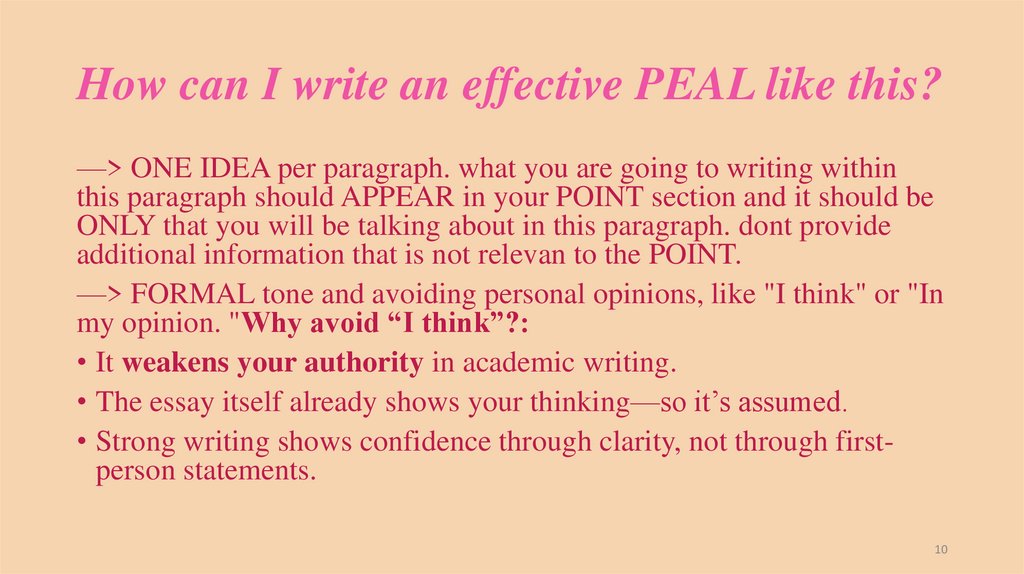
10. How can I write an effective PEAL like this?
—> ONE IDEA per paragraph. what you are going to writing withinthis paragraph should APPEAR in your POINT section and it should be
ONLY that you will be talking about in this paragraph. dont provide
additional information that is not relevan to the POINT.
—> FORMAL tone and avoiding personal opinions, like "I think" or "In
my opinion. "Why avoid “I think”?:
• It weakens your authority in academic writing.
• The essay itself already shows your thinking—so it’s assumed.
• Strong writing shows confidence through clarity, not through firstperson statements.
10
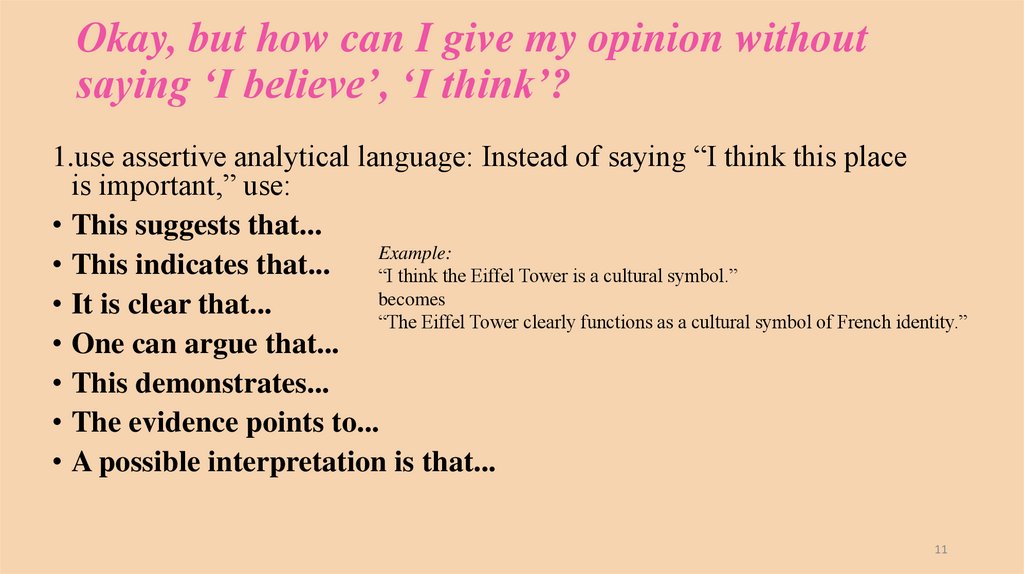
11. Okay, but how can I give my opinion without saying ‘I believe’, ‘I think’?
Okay, but how can I give my opinion withoutsaying ‘I believe’, ‘I think’?
1.use assertive analytical language: Instead of saying “I think this place
is important,” use:
• This suggests that...
Example:
• This indicates that...
“I think the Eiffel Tower is a cultural symbol.”
becomes
• It is clear that...
“The Eiffel Tower clearly functions as a cultural symbol of French identity.”
• One can argue that...
• This demonstrates...
• The evidence points to...
• A possible interpretation is that...
11
12.
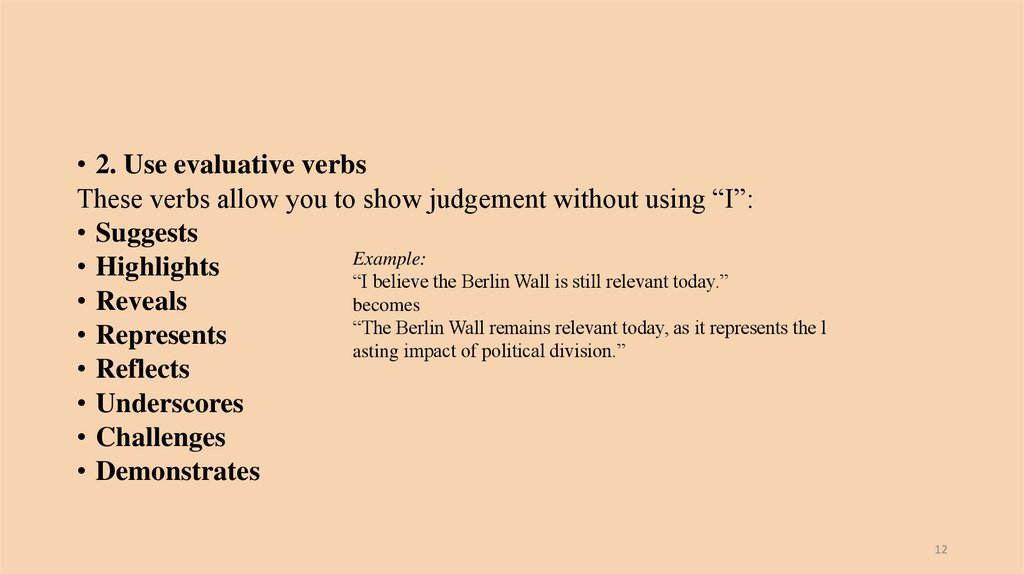
• 2. Use evaluative verbsThese verbs allow you to show judgement without using “I”:
• Suggests
Example:
• Highlights
“I believe the Berlin Wall is still relevant today.”
• Reveals
becomes
“The Berlin Wall remains relevant today, as it represents the l
• Represents
asting impact of political division.”
• Reflects
• Underscores
• Challenges
• Demonstrates
12
13.
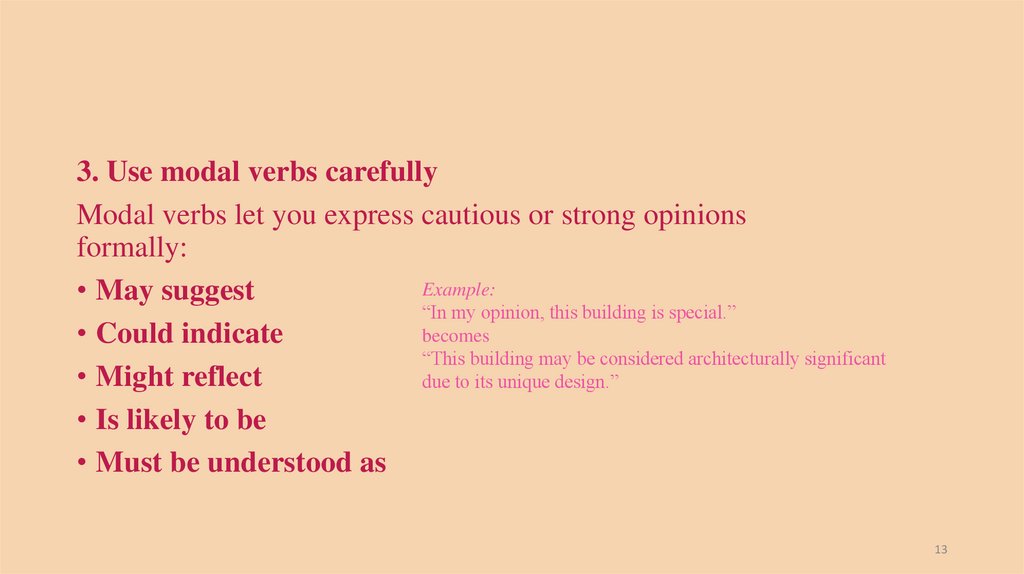
3. Use modal verbs carefullyModal verbs let you express cautious or strong opinions
formally:
Example:
• May suggest
“In my opinion, this building is special.”
becomes
• Could indicate
“This building may be considered architecturally significant
• Might reflect
due to its unique design.”
• Is likely to be
• Must be understood as
13
14.
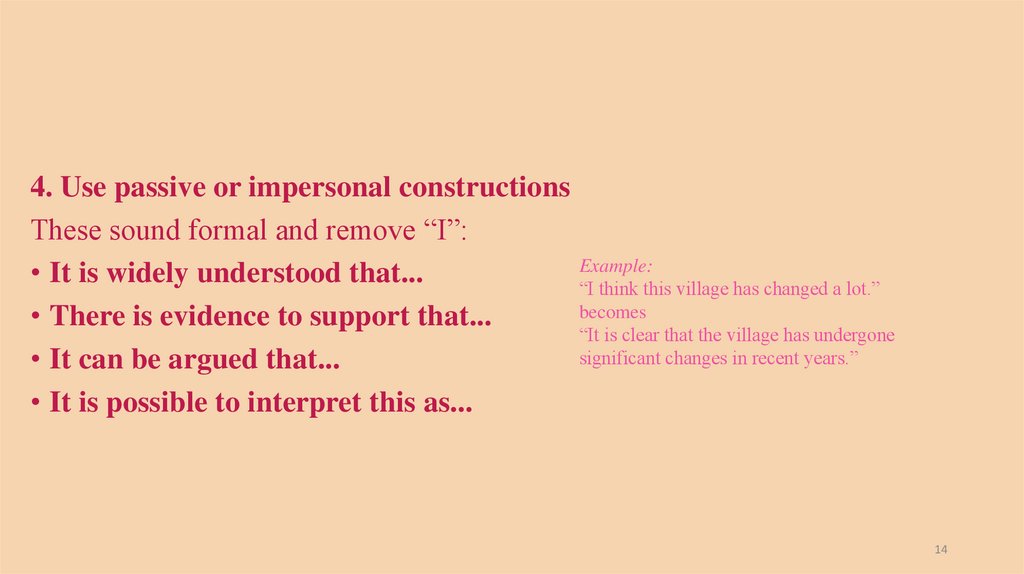
4. Use passive or impersonal constructionsThese sound formal and remove “I”:
Example:
• It is widely understood that...
“I think this village has changed a lot.”
becomes
• There is evidence to support that...
“It is clear that the village has undergone
significant changes in recent years.”
• It can be argued that...
• It is possible to interpret this as...
14
15. Introduction to Expository Writing
1516. What is expository writing?
What is expository writing?It is a piece of writing that explains, describes,
or investigates an idea to inform the reader—
not to persuade or entertain.
16
17. Key features:
• Objective tone• Clear topic sentence (thesis-like)
• Logical structure
• Evidence/examples
• Focused explanation
17
18. Read these 3 short paragraph extracts
Which is expository? What are the clues?A.
I still remember how the street smelled of spices and dust when I was a child.
That street is gone now, replaced with sleek cafes and rental bikes.
B.
Ledra Street in Nicosia is historically significant because it runs through the
UN buffer zone and has evolved from a site of division to one of tourism and
commerce.
C.
The government must do more to protect heritage sites like old churches and
monasteries from destruction due to urban development.
18
19. Writing About Places: What Makes a Good Topic?
First, think of your paragraph. A good expository paragraph on a placeshould:
• Focus on one specific place (not a whole country or region).
• Aim to explain something informative about that place (history,
structure, change, function, cultural meaning, etc.).
• Be something the writer either knows personally, or can research
easily.
19
20. PARIS – Expository paragraph
Paris’s urban design promotes short, sociable daily routines. The city’s twentyarrondissements radiate from the center, the Seine splits Left and Right
Banks, the Métro places most neighborhoods within a few stops, and wide
Haussmann boulevards lead the eye toward landmarks like the Arc de
Triomphe while parks and river quays provide seating, shade, and clear
walking paths. Because transport is frequent and distances are compact,
people can walk or take a quick train, meet friends at cafés clustered along
boulevards, and navigate by predictable numbers and sightlines; green spaces
and riverside paths invite lingering, so everyday errands naturally include
brief social encounters. Taken together, these features show how a city’s
layout—clear districts, reliable transit, legible streets, and welcoming public
spaces—shapes how residents move, meet, and spend time, illustrating the
broader idea that design choices create particular patterns of life.
20
21. In the paragraph you have just read…
1.Show me what parts of the PEAL paragraph you can see in thisparagraph.
2. Strengths of the paragraph?
3.Weaknesses of the paragraph? how can we improve it?
21
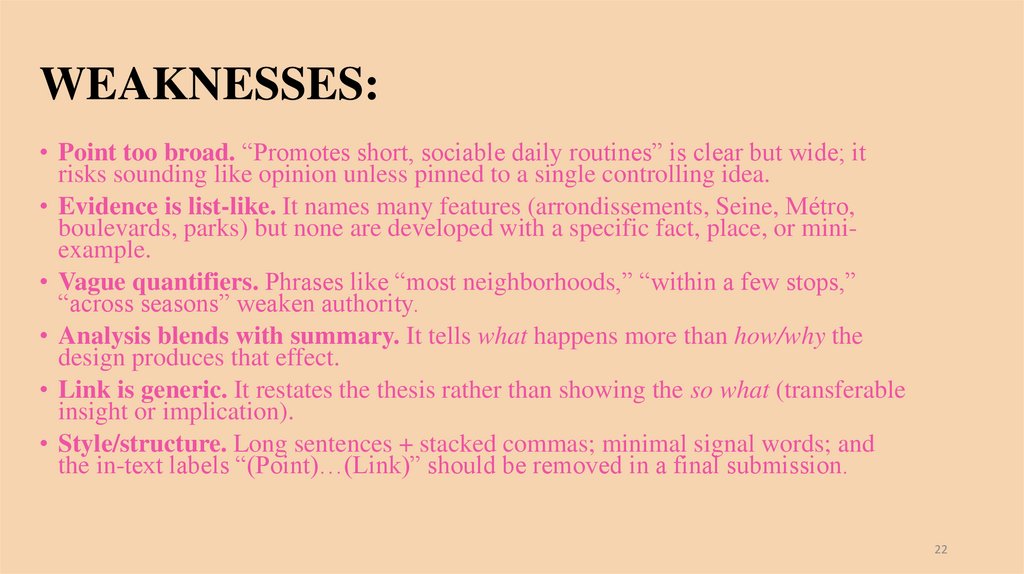
22. WEAKNESSES:
WEAKNESSES:• Point too broad. “Promotes short, sociable daily routines” is clear but wide; it
risks sounding like opinion unless pinned to a single controlling idea.
• Evidence is list-like. It names many features (arrondissements, Seine, Métro,
boulevards, parks) but none are developed with a specific fact, place, or miniexample.
• Vague quantifiers. Phrases like “most neighborhoods,” “within a few stops,”
“across seasons” weaken authority.
• Analysis blends with summary. It tells what happens more than how/why the
design produces that effect.
• Link is generic. It restates the thesis rather than showing the so what (transferable
insight or implication).
• Style/structure. Long sentences + stacked commas; minimal signal words; and
the in-text labels “(Point)…(Link)” should be removed in a final submission.
22
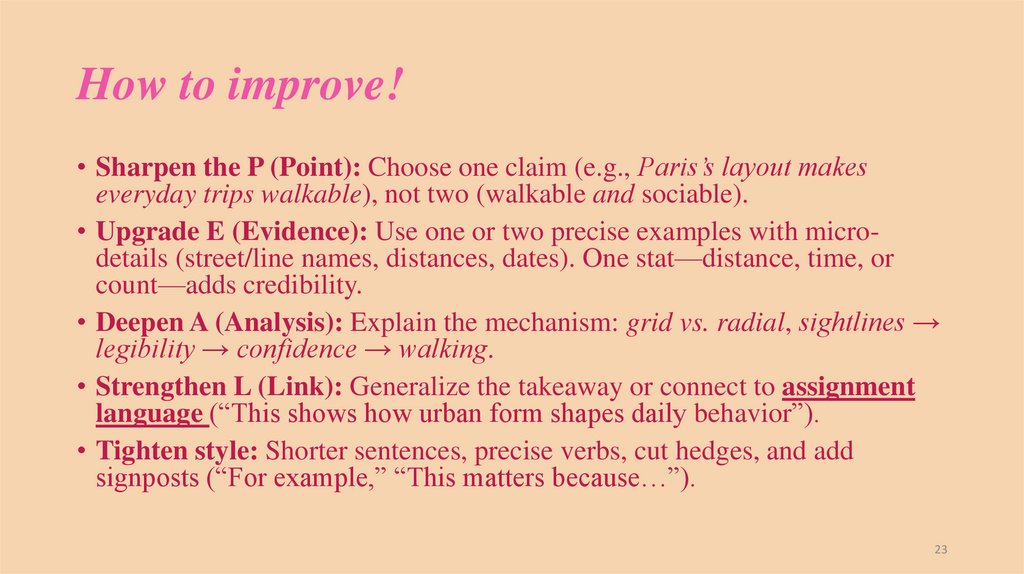
23. How to improve!
• Sharpen the P (Point): Choose one claim (e.g., Paris’s layout makeseveryday trips walkable), not two (walkable and sociable).
• Upgrade E (Evidence): Use one or two precise examples with microdetails (street/line names, distances, dates). One stat—distance, time, or
count—adds credibility.
• Deepen A (Analysis): Explain the mechanism: grid vs. radial, sightlines →
legibility → confidence → walking.
• Strengthen L (Link): Generalize the takeaway or connect to assignment
language (“This shows how urban form shapes daily behavior”).
• Tighten style: Shorter sentences, precise verbs, cut hedges, and add
signposts (“For example,” “This matters because…”).
23
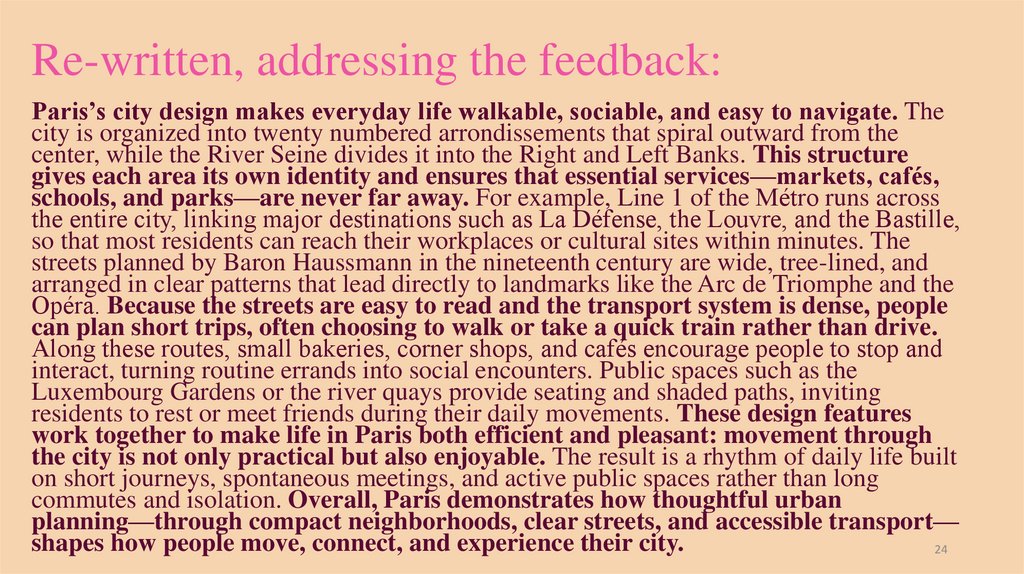
24. Re-written, addressing the feedback:
Re-written, addressing the feedback:Paris’s city design makes everyday life walkable, sociable, and easy to navigate. The
city is organized into twenty numbered arrondissements that spiral outward from the
center, while the River Seine divides it into the Right and Left Banks. This structure
gives each area its own identity and ensures that essential services—markets, cafés,
schools, and parks—are never far away. For example, Line 1 of the Métro runs across
the entire city, linking major destinations such as La Défense, the Louvre, and the Bastille,
so that most residents can reach their workplaces or cultural sites within minutes. The
streets planned by Baron Haussmann in the nineteenth century are wide, tree-lined, and
arranged in clear patterns that lead directly to landmarks like the Arc de Triomphe and the
Opéra. Because the streets are easy to read and the transport system is dense, people
can plan short trips, often choosing to walk or take a quick train rather than drive.
Along these routes, small bakeries, corner shops, and cafés encourage people to stop and
interact, turning routine errands into social encounters. Public spaces such as the
Luxembourg Gardens or the river quays provide seating and shaded paths, inviting
residents to rest or meet friends during their daily movements. These design features
work together to make life in Paris both efficient and pleasant: movement through
the city is not only practical but also enjoyable. The result is a rhythm of daily life built
on short journeys, spontaneous meetings, and active public spaces rather than long
commutes and isolation. Overall, Paris demonstrates how thoughtful urban
planning—through compact neighborhoods, clear streets, and accessible transport—
shapes how people move, connect, and experience their city.
24
25. Now that I know what a good paragraph looks like, how to choose a topic for my expository paragraph?
Now that I know what a good paragraph lookslike, how to choose a topic for my expository
paragraph?
List 5 places you know well and are interested in. Think about its
details: its neighbourhoods, the streets, the nature, the people,
things to do… Write these places down.
Now,
Pick one place. Write non-stop for 2–3 minutes on: “What is
interesting, important, or unique about this place?”
25
26.
Pair-share now, and go through the followingchecklist:
1.Does this sound like an expository
paragraph?
2.Is it focused?
3. What kind of explanation might you give
about this place?
26
27. SO REMEMBER!
WE ARE WRITING TO EXPLAIN, NOT TO TELL A STORY OR TOMAKE AN ARGUMENT.
TONE: Clear, neutral, academic—not emotional or poetic.
27
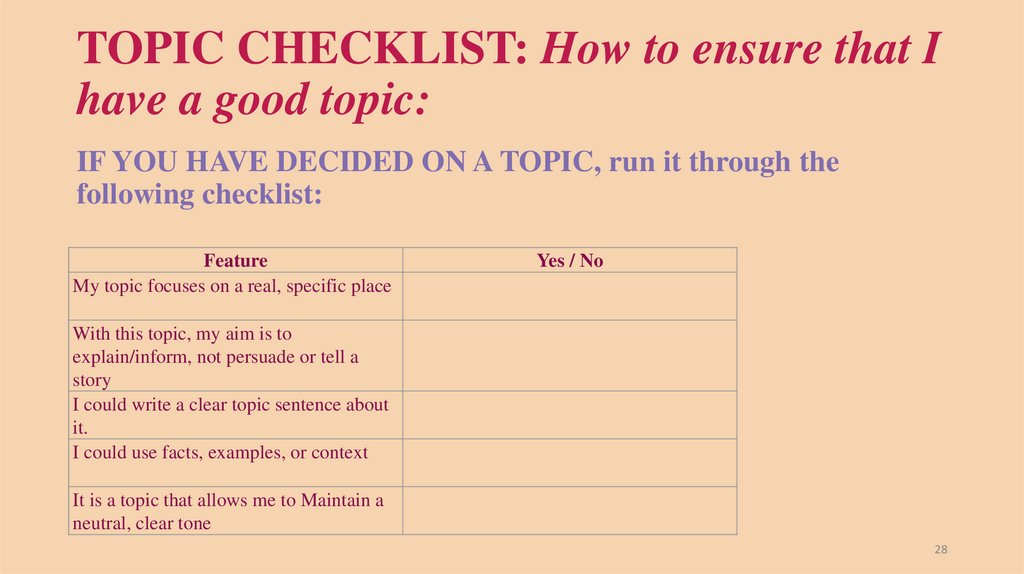
28. TOPIC CHECKLIST: How to ensure that I have a good topic:
IF YOU HAVE DECIDED ON A TOPIC, run it through thefollowing checklist:
Feature
My topic focuses on a real, specific place
Yes / No
With this topic, my aim is to
explain/inform, not persuade or tell a
story
I could write a clear topic sentence about
it.
I could use facts, examples, or context
It is a topic that allows me to Maintain a
neutral, clear tone
28
29. WEEK 3 DEADLINE: SUBMIT ON MOODLE
WEEK 3 DEADLINE: SUBMIT ONMOODLE
You do not need to write an essay. This should only be your topic.
However, keep in mind that this is something that you will have to
turn into a paragraph! So choose something that you have a lot to
write about. Make sure you do lots of research, as the paragraph
will be graded. I will be giving you feedback on the topic, so make
use of it, so that your paragraph turns out as good as possible!
29
30. OK, I’m doing my research and have found great info online. How can I use it?
OK, I’m doing my research and havefound great info online. How can I use it?
BY PARAPHRASING!
Yeah but, how can I PARAPHRASE EFFECTIVELY so that I’m
not stealing the words of others?
30
31. Introduction to Paraphrasing
What is paraphrasing?Paraphrasing means restating someone else’s ideas in your own words
while keeping the original meaning. It shows understanding and helps
avoid plagiarism.
31
32. Good Paraphrasing Should:
Change words and sentence structure• Keep the same meaning
• Use your own voice and style
• Include citation when necessary
32
33. Bad Paraphrasing
Bad Paraphrasing• Simply changing ONLY a few words (e.g., synonyms)
• Copying sentence structure
• Changing meaning or leaving out important ideas
33
34. Strategy for Paraphrasing
1.Read the original text carefully.2.Identify the key idea(s).
3.Cover the text and rewrite it in your own words.
4.Compare your version with the original to check accuracy.
5. Cite the source if needed.
34
35. Exercises
Exercise 1: Spot the Good ParaphraseRead the original and the paraphrase. Decide if it’s good or poor and explain
why.
• Original:
"Climate change threatens coastal communities with rising sea levels and
more frequent storms."
• Paraphrase A:
Rising seas and stronger storms caused by climate change put coastal towns
at risk.
Paraphrase B:
Climate change threatens coasts with higher water and more storms.
35
36. Exercise 2: Rewrite in Your Own Words
Paraphrase each sentence while keeping the same meaning.1.Technology is transforming the way people communicate around the
world.
2.Education gives individuals the tools they need to improve their lives.
3.Reading fiction can increase empathy by allowing readers to
experience different perspectives.
36
37. Exercise 3: Combine and Paraphrase
Read the two sentences and combine them into one paraphrasedsentence.
• The internet provides access to information instantly.
• It also allows people to connect across distances.
37
38. Exercise 4: Paragraph Practice
Read the short paragraph and write a paraphrase in your own words.Original Paragraph:
Social media has changed how people interact. While it helps friends
stay connected, it can also lead to less face-to-face communication.
Researchers suggest balancing online and in-person interactions for
better relationships.
38
39.
What was most difficult aboutparaphrasing?
How can you make sure your
paraphrase stays true to the original
meaning?
39
40. IMPORTANT ANNOUNCEMENT
WEEK 3 DEADLINE: SUBMIT TOPIC FOR EXPOSITORYPARAGRAPH
DEADLINE DATE: SUNDAY 19/10/25, 12:00 pm
Please note that late submissions will not be accepted, so make sure
you submit your topic before the deadline.
40