


 management
Similar presentations:





BAC6018 - Financial Management for Decision Making
1. BAC6018 - Financial Management for Decision Making
Lecture 2 – Introduction to2. Lecture 1: Introduction to Financial Management Learning Outcomes
• Discuss the role of the finance function within a business.• Identify and discuss possible objectives for a business and explain the
shareholder wealth maximisation objective.
• Explain how risk, ethical considerations and the
needs of other stakeholders influence the pursuit of shareholder
wealth maximisation.
• Recognise the difference between shareholder wealth maximisation
and profit maximisation.
• Describe the Agency problem.
• What are Financial Institutions?
3. Definition
Financial management as defined by CIMA is “the management of allthe processes associated with the efficient acquisition and deployment
of both short- and long-term financial resources”.
This involves planning and controlling:
- where funds come from,
- allocating where funds go to and
- controlling whether the funds are being used effectively.
4.
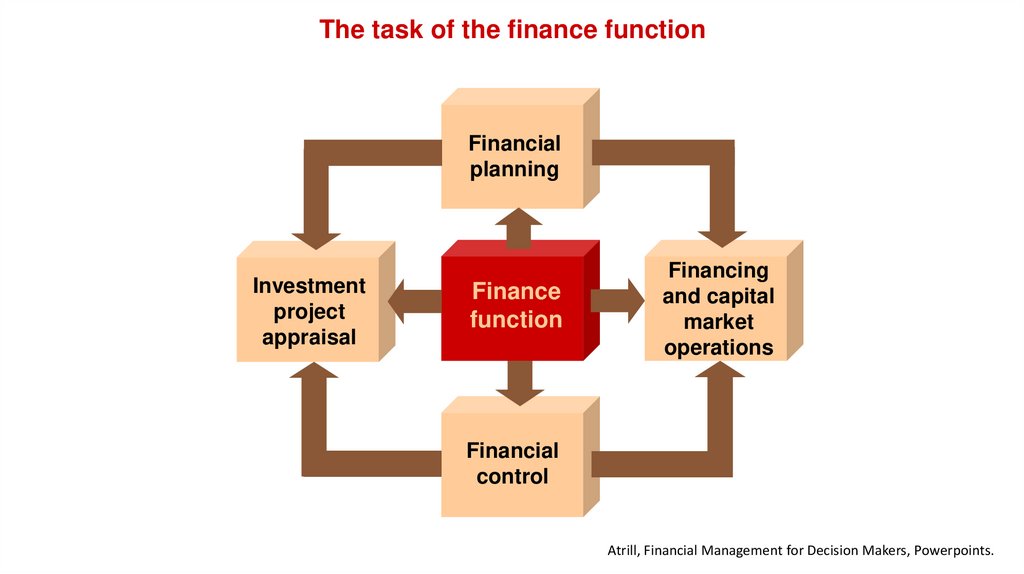
The task of the finance functionFinancial
planning
Investment
project
appraisal
Finance
function
Financing
and capital
market
operations
Financial
control
Atrill, Financial Management for Decision Makers, Powerpoints.
5. The finance function
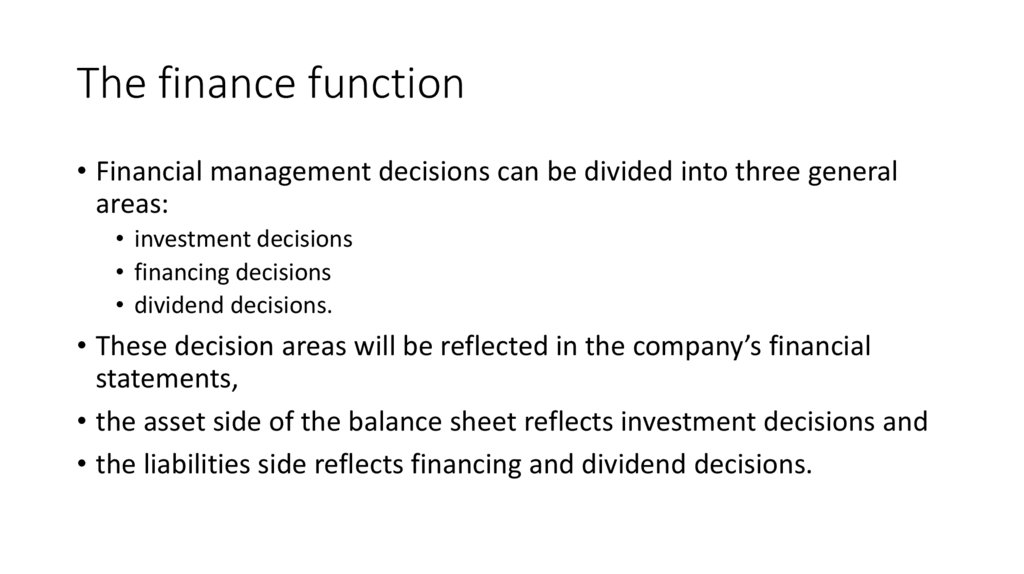
• Financial management decisions can be divided into three generalareas:
• investment decisions
• financing decisions
• dividend decisions.
• These decision areas will be reflected in the company’s financial
statements,
• the asset side of the balance sheet reflects investment decisions and
• the liabilities side reflects financing and dividend decisions.
6. The finance function
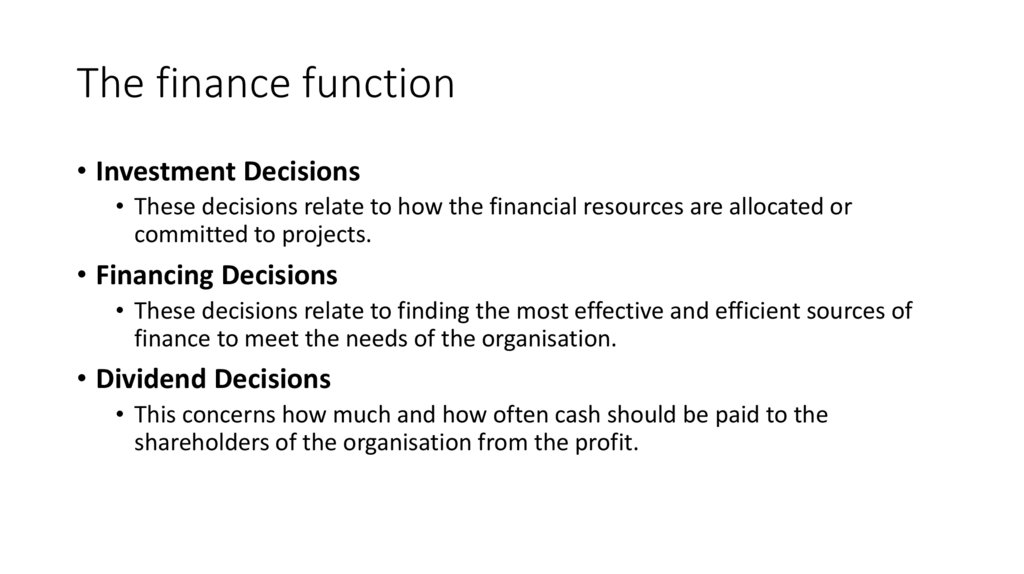
• Investment Decisions• These decisions relate to how the financial resources are allocated or
committed to projects.
• Financing Decisions
• These decisions relate to finding the most effective and efficient sources of
finance to meet the needs of the organisation.
• Dividend Decisions
• This concerns how much and how often cash should be paid to the
shareholders of the organisation from the profit.
7. The assumed objective for a firm
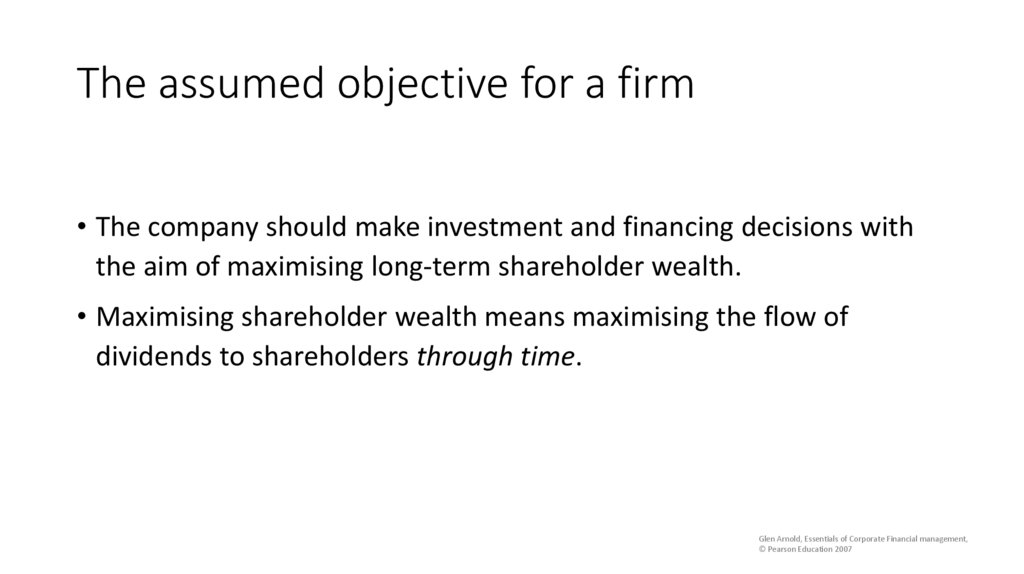
• The company should make investment and financing decisions withthe aim of maximising long-term shareholder wealth.
• Maximising shareholder wealth means maximising the flow of
dividends to shareholders through time.
Glen Arnold, Essentials of Corporate Financial management,
© Pearson Education 2007
8.
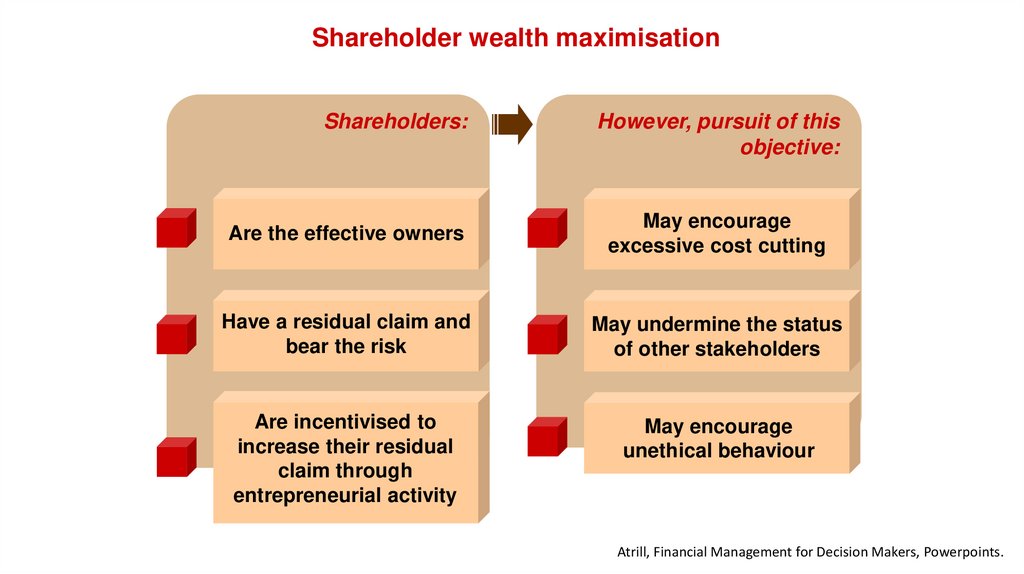
Shareholder wealth maximisationShareholders:
However, pursuit of this
objective:
Are the effective owners
May encourage
excessive cost cutting
Have a residual claim and
bear the risk
May undermine the status
of other stakeholders
Are incentivised to
increase their residual
claim through
entrepreneurial activity
May encourage
unethical behaviour
Atrill, Financial Management for Decision Makers, Powerpoints.
9.
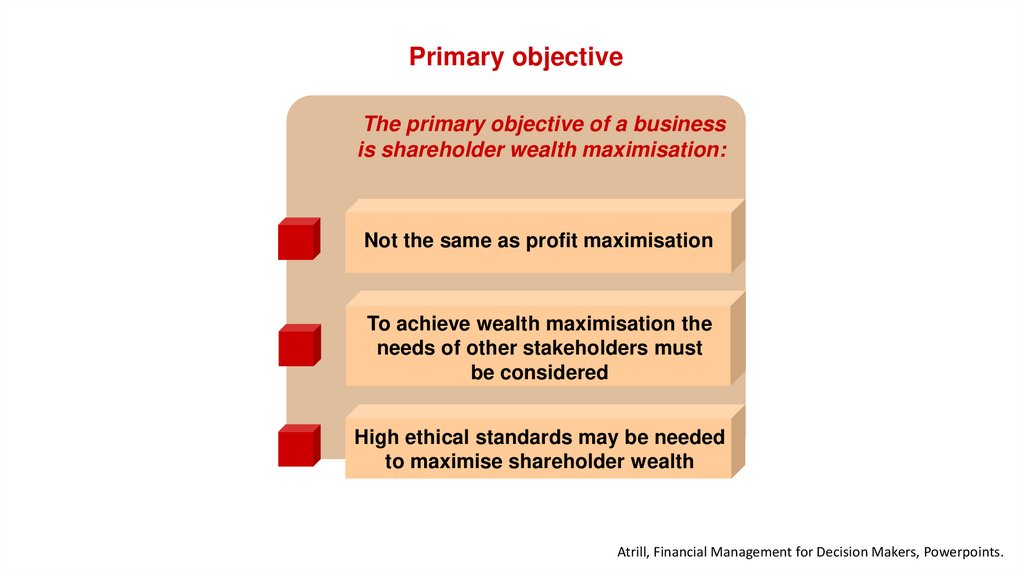
Primary objectiveThe primary objective of a business
is shareholder wealth maximisation:
Not the same as profit maximisation
To achieve wealth maximisation the
needs of other stakeholders must
be considered
High ethical standards may be needed
to maximise shareholder wealth
Atrill, Financial Management for Decision Makers, Powerpoints.
10. Shareholder wealth maximisation
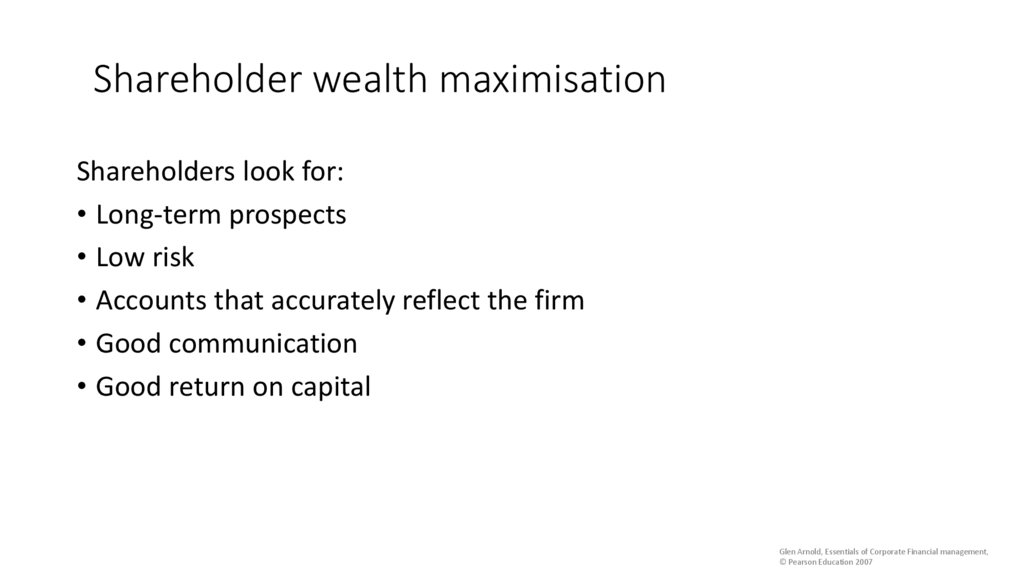
Shareholders look for:• Long-term prospects
• Low risk
• Accounts that accurately reflect the firm
• Good communication
• Good return on capital
Glen Arnold, Essentials of Corporate Financial management,
© Pearson Education 2007
11.
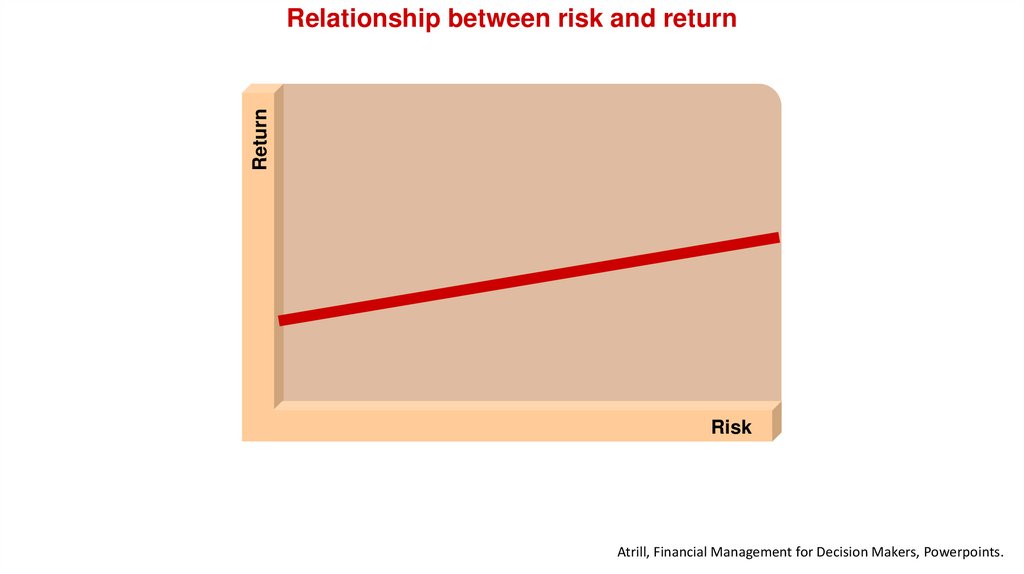
ReturnRelationship between risk and return
Risk
Atrill, Financial Management for Decision Makers, Powerpoints.
12. Accounting Profit maximisation
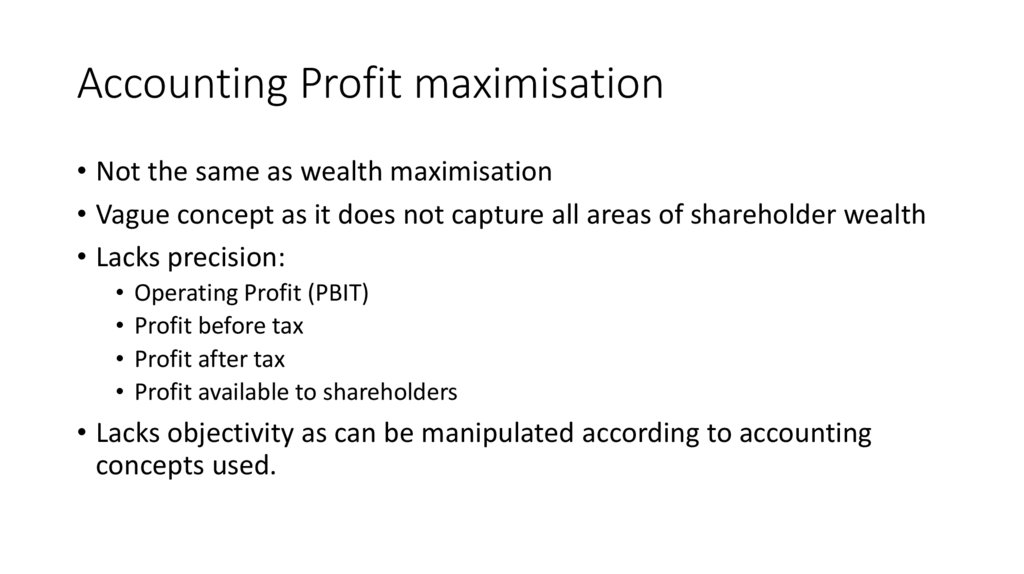
• Not the same as wealth maximisation• Vague concept as it does not capture all areas of shareholder wealth
• Lacks precision:
• Operating Profit (PBIT)
• Profit before tax
• Profit after tax
• Profit available to shareholders
• Lacks objectivity as can be manipulated according to accounting
concepts used.
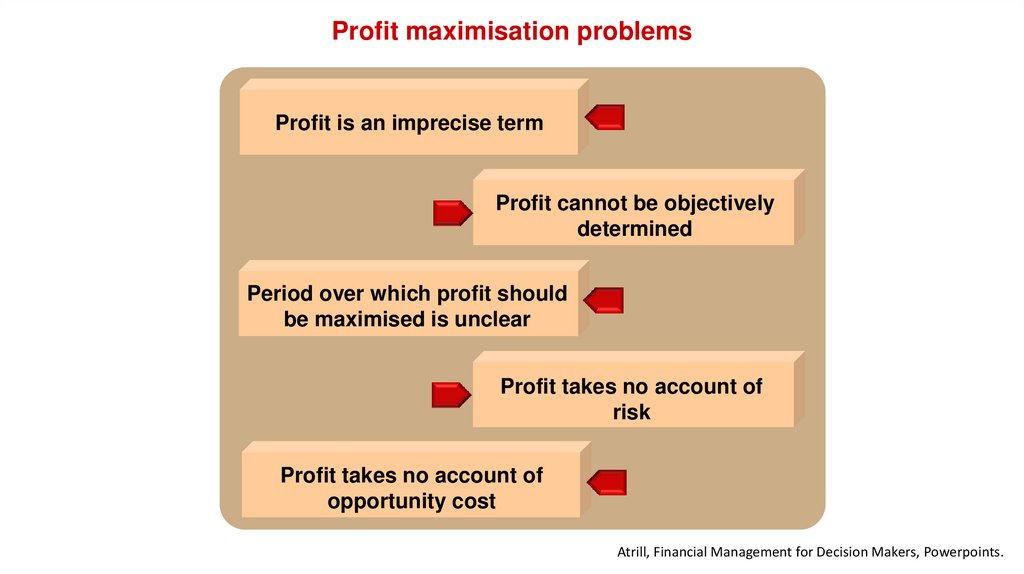
13.
Profit maximisation problemsProfit is an imprecise term
Profit cannot be objectively
determined
Period over which profit should
be maximised is unclear
Profit takes no account of
risk
Profit takes no account of
opportunity cost
Atrill, Financial Management for Decision Makers, Powerpoints.
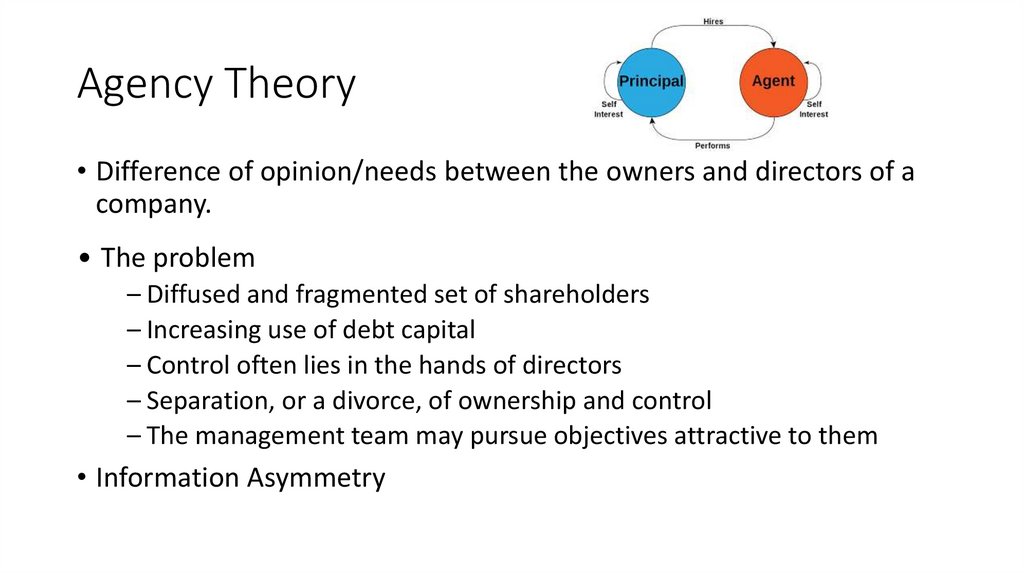
14. Agency Theory
• Difference of opinion/needs between the owners and directors of acompany.
• The problem
– Diffused and fragmented set of shareholders
– Increasing use of debt capital
– Control often lies in the hands of directors
– Separation, or a divorce, of ownership and control
– The management team may pursue objectives attractive to them
• Information Asymmetry
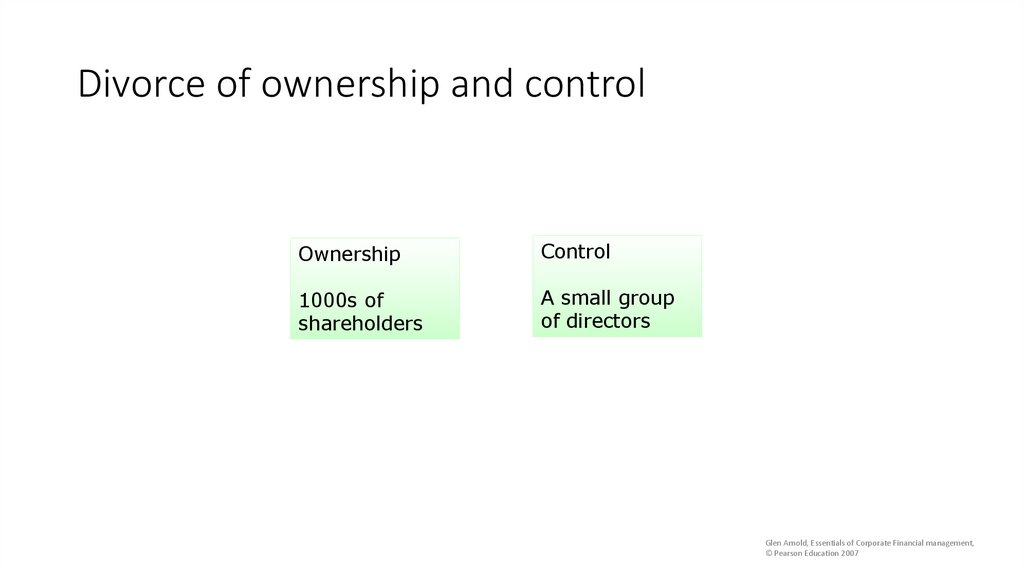
15. Divorce of ownership and control
OwnershipOwnership
Control
1000s 1000s
of
of
shareholders
shareholders
A small group
of directors
Glen Arnold, Essentials of Corporate Financial management,
© Pearson Education 2007
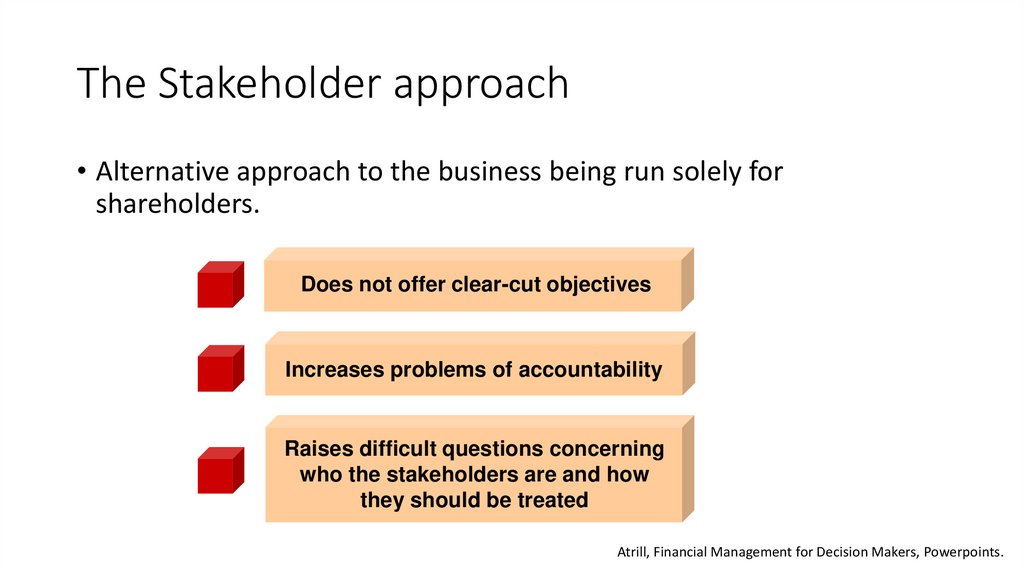
16. The Stakeholder approach
• Alternative approach to the business being run solely forshareholders.
Does not offer clear-cut objectives
Increases problems of accountability
Raises difficult questions concerning
who the stakeholders are and how
they should be treated
Atrill, Financial Management for Decision Makers, Powerpoints.
17. Financial Markets
• How many Financial Markets do you know?• Bond Market
• Share Market
• Money Market
• Foreign Exchange Market
• Derivative and commodity market
18. Financial institutions
• Banks• Building societies
• Insurance companies
19. Conclusion
• The role of the finance function within a business.• Shareholder wealth maximisation vs profit maximisation objectives.
• The Agency problem.
• Financial markets.
20. Post sessional activity
• Read Chapter 1 in the core text book.• Download the seminar questions from Moodle, complete them and
bring your answers to your seminar.