



 english
Similar presentations:










The english gerund: a comprehensive guide for 9th grade
1.
The English Gerund: AComprehensive Guide for
9th Grade
Welcome to this comprehensive guide on the English Gerund, specially
designed for 9th-grade students. Over the next few cards, we'll explore what a
gerund is, how it functions in sentences, and how to master its use for clearer
and more sophisticated English.
2.
What Exactly is a Gerund?Verb + -ing
Noun's Role
Not a Verb!
A gerund is a verb form ending in -ing
It acts like a noun, representing an
It's crucial to remember that despite
that functions as a noun.
action or a process. For example, in
its verb origin, a gerund is not
"Swimming is fun," 'swimming' is the
functioning as a verb in the sentence;
gerund.
it's a noun.
Think of it as giving a name to an action. Instead of saying "to swim is fun," we say "swimming is fun." This allows us to talk about
activities as things or concepts.
3.
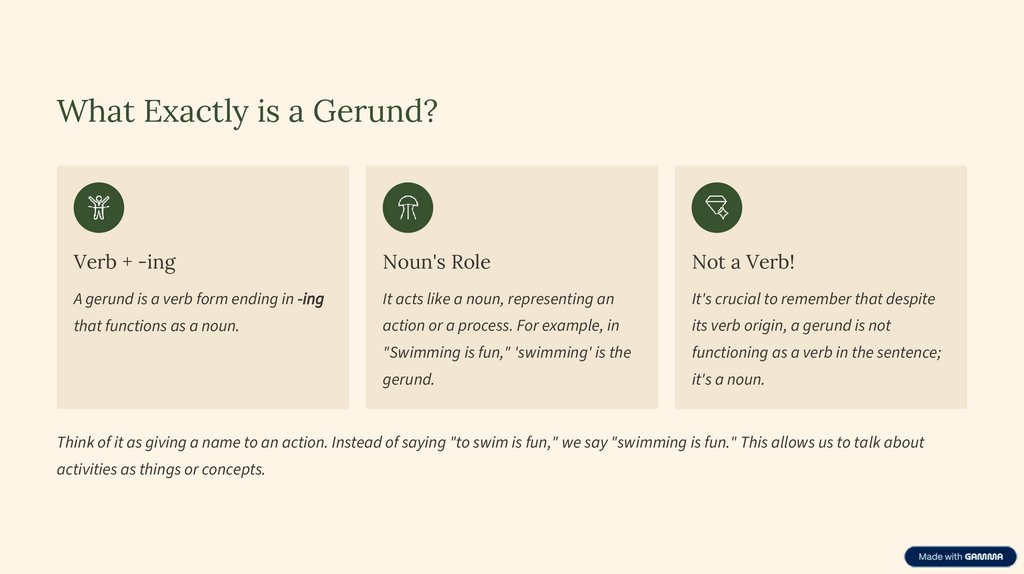
Key Functions of the GerundGerunds are incredibly versatile and can fill several important roles in a sentence, much like any
other noun.
As a Subject
When the gerund is the main actor of the sentence. Example: "Reading helps you learn."
As an Object
Following a verb as its direct object. Example: "I enjoy reading."
After a Preposition
Serving as the object of a preposition. Example: "She is good at singing."
As a Complement
Completing the meaning of a linking verb. Example: "His favorite hobby is painting."
4.
Gerund vs. Present Participle: Spot the DifferenceThe Gerund
The Present Participle
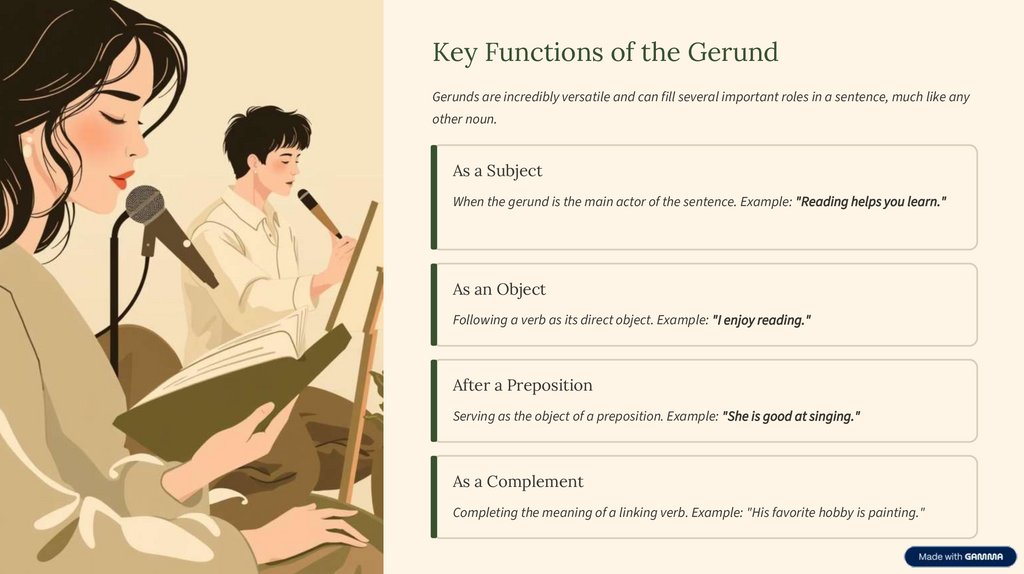
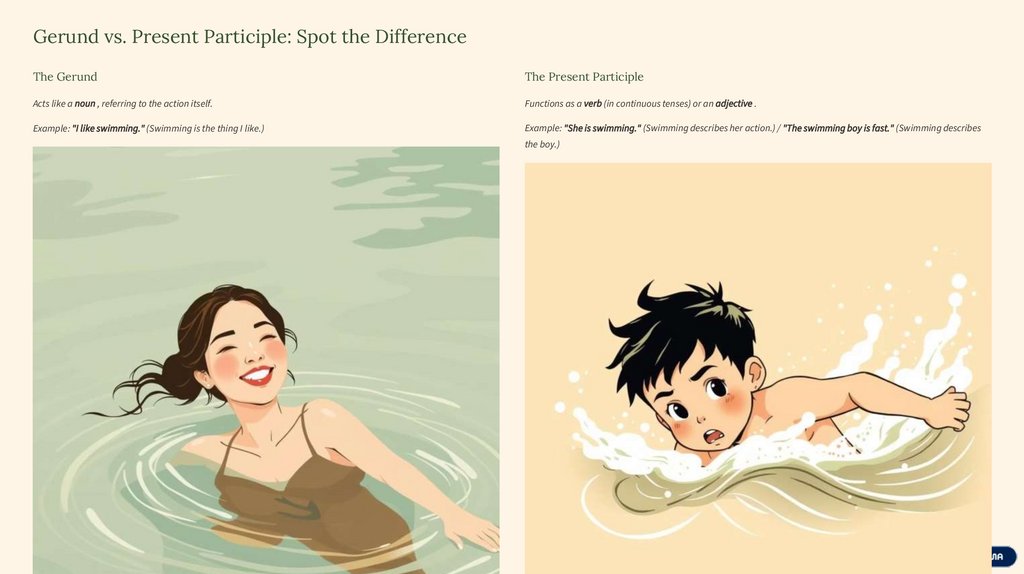
Acts like a noun , referring to the action itself.
Functions as a verb (in continuous tenses) or an adjective .
Example: "I like swimming." (Swimming is the thing I like.)
Example: "She is swimming." (Swimming describes her action.) / "The swimming boy is fast." (Swimming describes
the boy.)
5.
Common Verbs Followed by GerundsMany verbs in English are directly followed by a gerund, never an infinitive. Memorizing these can greatly improve your grammatical accuracy.
Enjoy
"She enjoys dancing."
Avoid
"They avoid talking loudly."
Consider
Practice
"He practices playing."
"He considered moving."
Finish
"I finished reading."
Mind
"Do you mind opening?"
Suggest
"She suggested going out."
Other common verbs include recommend, postpone, miss, admit, deny, and regret . Learning these by heart will make your English sound more
natural.
6.
Gerund vs. Infinitive: The Meaning ShiftWhile both gerunds and infinitives can follow certain verbs, their choice can significantly alter the sentence's meaning.
1
Gerund: Action as a Fact or Process
When you use a gerund, you refer to the action as a general idea or something that
has already happened.
Example: "I stopped smoking." (I quit the habit of smoking.)
2
Infinitive: Purpose or Intention
When you use an infinitive, you indicate the reason or goal behind an action.
Example: "I stopped to smoke." (I paused my current activity specifically to have a
smoke.)
Verbs like stop, remember, forget, and try are notorious for this meaning shift. Always consider the context!
7.
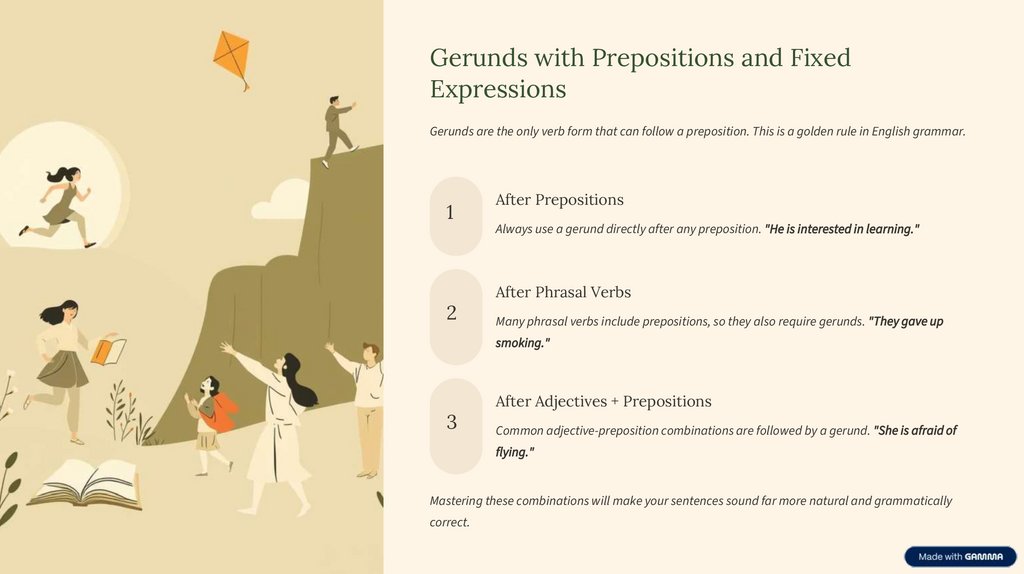
Gerunds with Prepositions and FixedExpressions
Gerunds are the only verb form that can follow a preposition. This is a golden rule in English grammar.
1
2
After Prepositions
Always use a gerund directly after any preposition. "He is interested in learning."
After Phrasal Verbs
Many phrasal verbs include prepositions, so they also require gerunds. "They gave up
smoking."
3
After Adjectives + Prepositions
Common adjective-preposition combinations are followed by a gerund. "She is afraid of
flying."
Mastering these combinations will make your sentences sound far more natural and grammatically
correct.
8.
Rules for Forming the GerundForming the gerund is usually straightforward, but there are a few spelling rules to remember:
General Rule
Add -ing to the base form of the verb. play → playing
Verbs Ending in -e
Drop the -e and add -ing . make → making
Verbs Ending in CVC
If a one-syllable verb ends in a consonant-vowel-consonant
(CVC) pattern with the stress on the last syllable, double the
final consonant before adding -ing . run → running
These rules ensure correct spelling when transforming verbs into gerunds. Practice these patterns to avoid common mistakes!
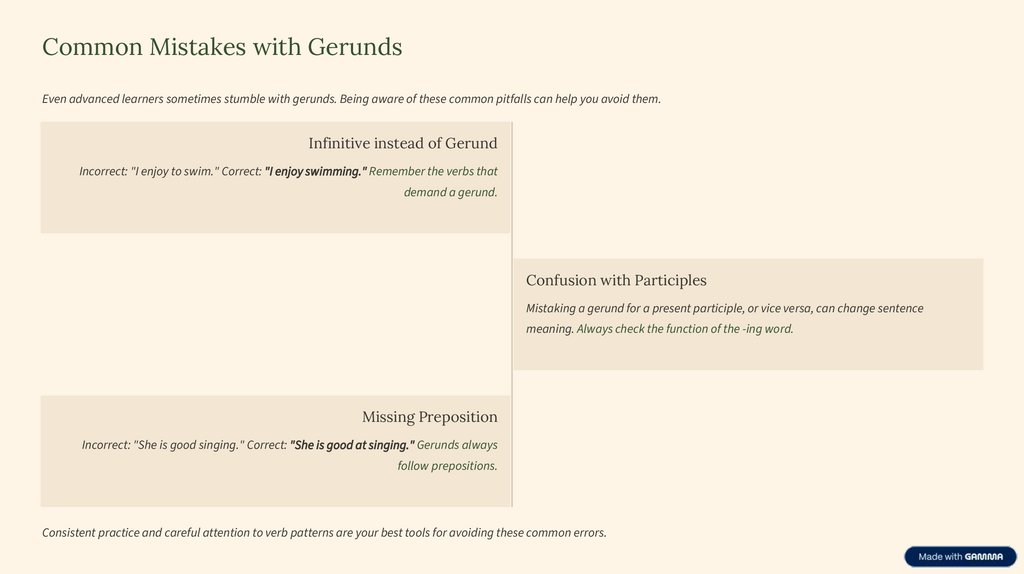
9.
Common Mistakes with GerundsEven advanced learners sometimes stumble with gerunds. Being aware of these common pitfalls can help you avoid them.
Infinitive instead of Gerund
Incorrect: "I enjoy to swim." Correct: "I enjoy swimming." Remember the verbs that
demand a gerund.
Confusion with Participles
Mistaking a gerund for a present participle, or vice versa, can change sentence
meaning. Always check the function of the -ing word.
Missing Preposition
Incorrect: "She is good singing." Correct: "She is good at singing." Gerunds always
follow prepositions.
Consistent practice and careful attention to verb patterns are your best tools for avoiding these common errors.
10.
Conclusion: Why Master the Gerund?Understanding and correctly using gerunds is more than just a grammar exercise; it's a vital skill for
effective communication.
Express Abstract Actions
Gerunds allow you to conceptualize actions as ideas, concepts, or things.
Enhance Speaking & Writing
Correct use elevates the sophistication and clarity of your English.
Practice is Key
Regularly review verb lists and practice constructing sentences with gerunds.
Don't hesitate to ask questions or review examples together! Your journey to mastering English
grammar continues.