 policy
Similar presentations:

The United States of America
1. The United States of America
3. US Political System2. 3. US Political System
1.2.
3.
4.
5.
6.
7.
8.
U.S. Constitution.
The Legislative branch.
The Executive branch.
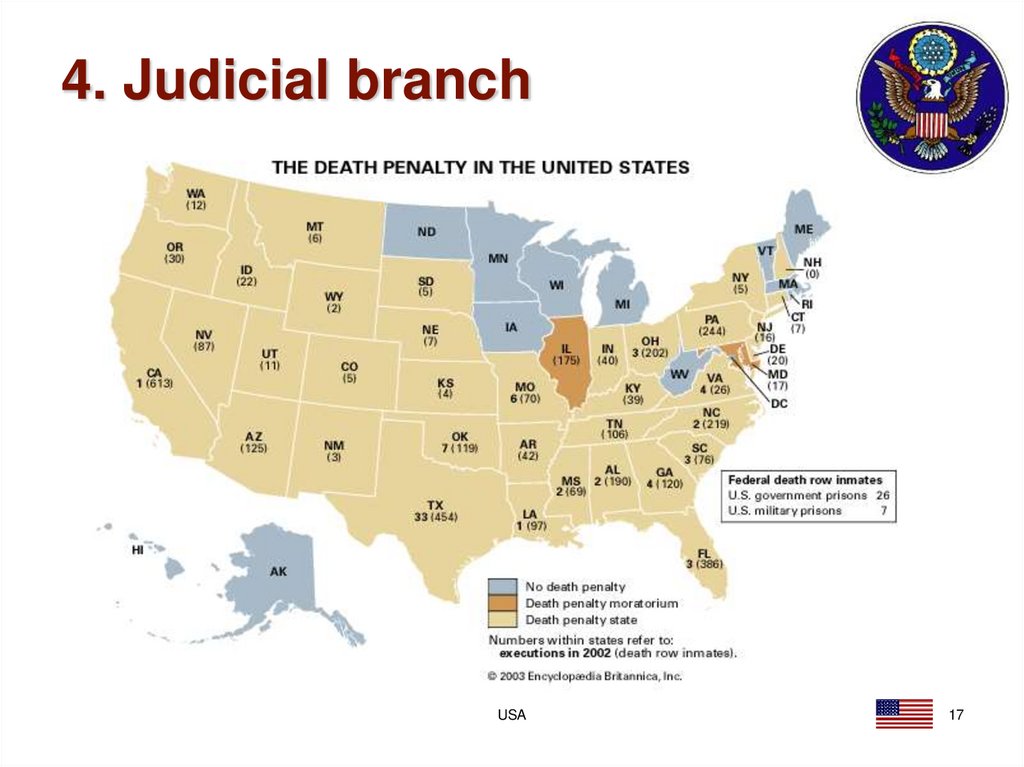
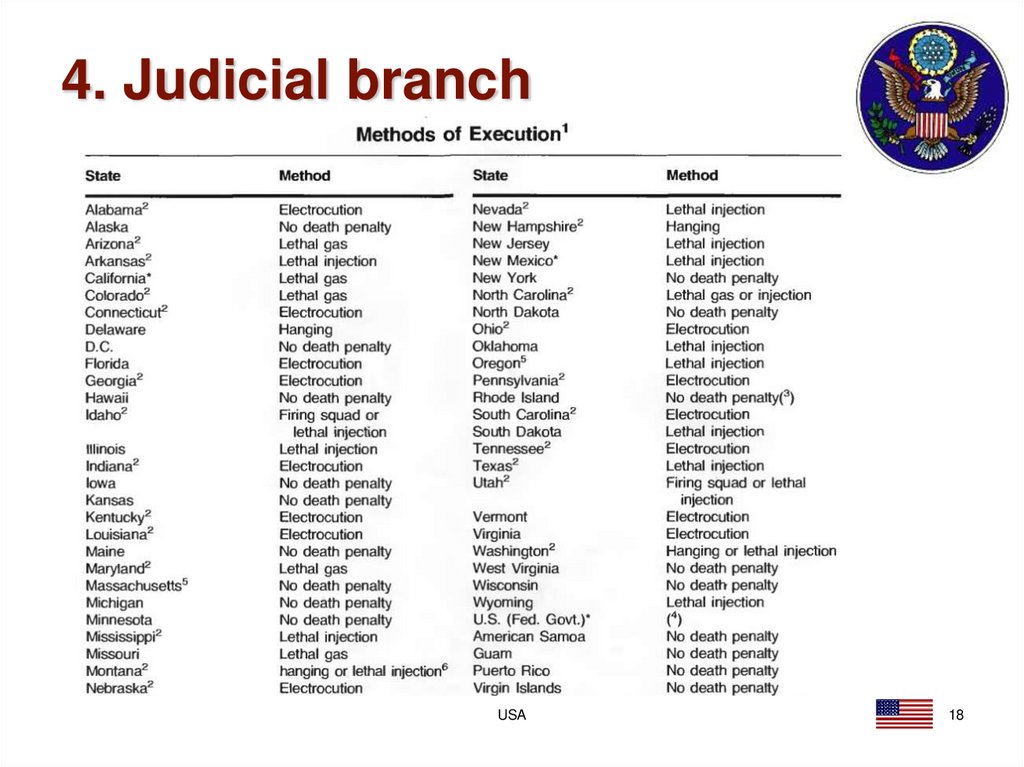
The Judicial branch.
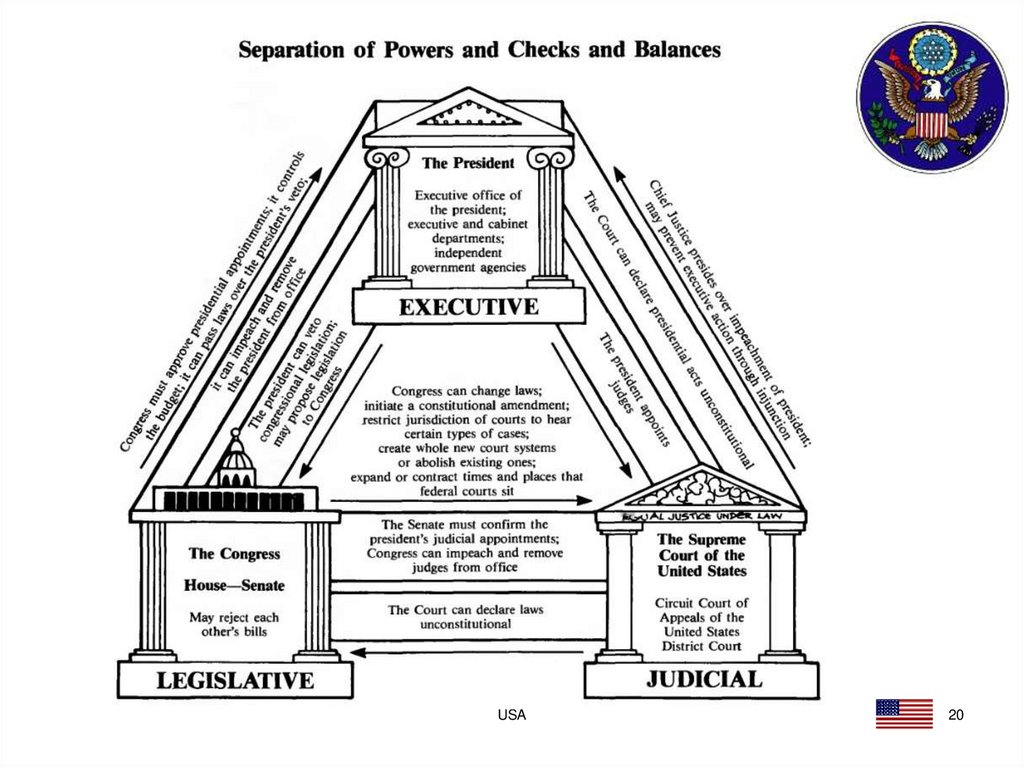
The system of checks and balances.
State and National Government.
Presidential Elections.
Political parties.
USA
2
3. 1. U.S. Constitution
We the people of the United States, in order to form a more perfect union,establish justice, insure domestic tranquility, provide for the common defense,
promote the general welfare, and secure the blessings of liberty to ourselves
and our posterity, do ordain and establish this Constitution for the United
States of America.
The U.S. Constitution is the world’s oldest written national
constitution still in effect:
- ratified on June 21, 1788
- entered into force on March 4, 1789
USA
3
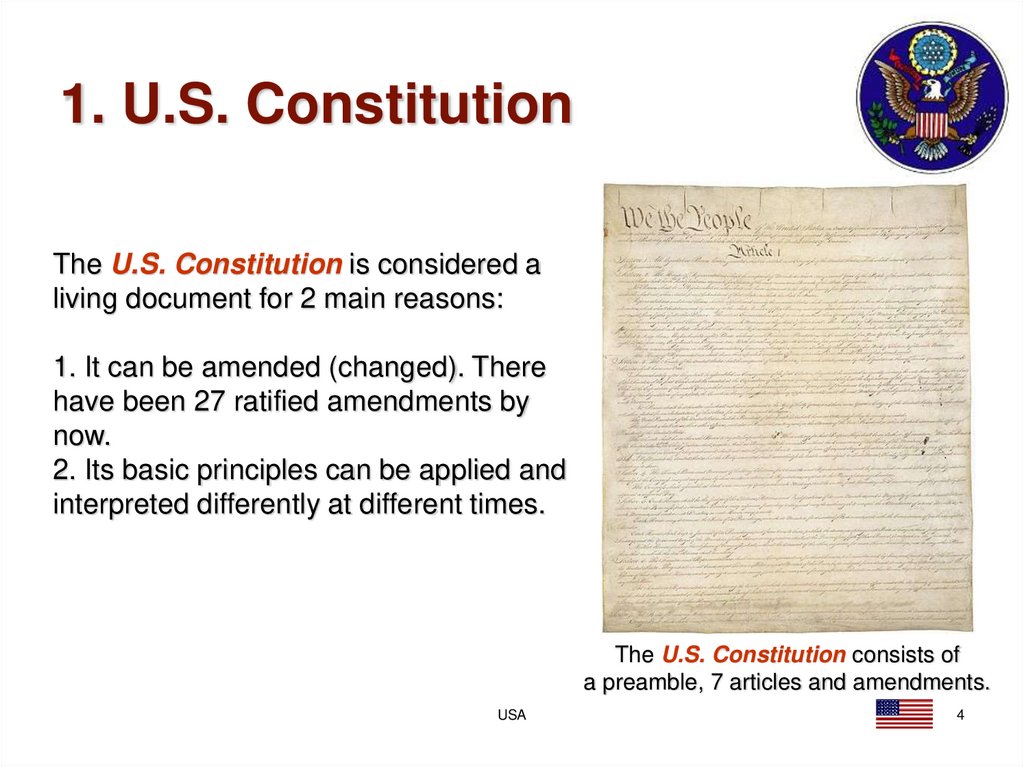
4. 1. U.S. Constitution
The U.S. Constitution is considered aliving document for 2 main reasons:
1. It can be amended (changed). There
have been 27 ratified amendments by
now.
2. Its basic principles can be applied and
interpreted differently at different times.
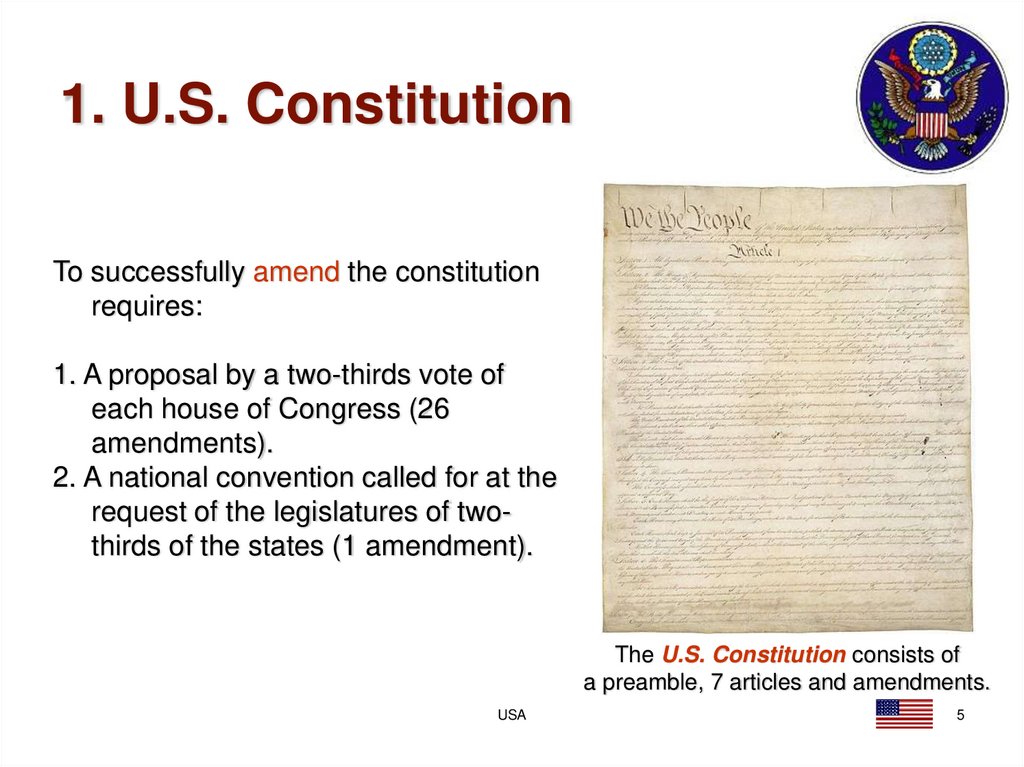
The U.S. Constitution consists of
a preamble, 7 articles and amendments.
USA
4
5. 1. U.S. Constitution
To successfully amend the constitutionrequires:
1. A proposal by a two-thirds vote of
each house of Congress (26
amendments).
2. A national convention called for at the
request of the legislatures of twothirds of the states (1 amendment).
The U.S. Constitution consists of
a preamble, 7 articles and amendments.
USA
5
6. 1. U.S. Constitution
Some of the amendments are:№2. The right to keep and bear arms, 1791
№3. No quartering of soldiers in private houses
during times of peace or war, 1791
№13. Abolition of slavery, except as punishment
for a crime, 1865
№16. Imposition of a federal income tax, 1913
№19. Women’s suffrage (избирательное
право), 1920
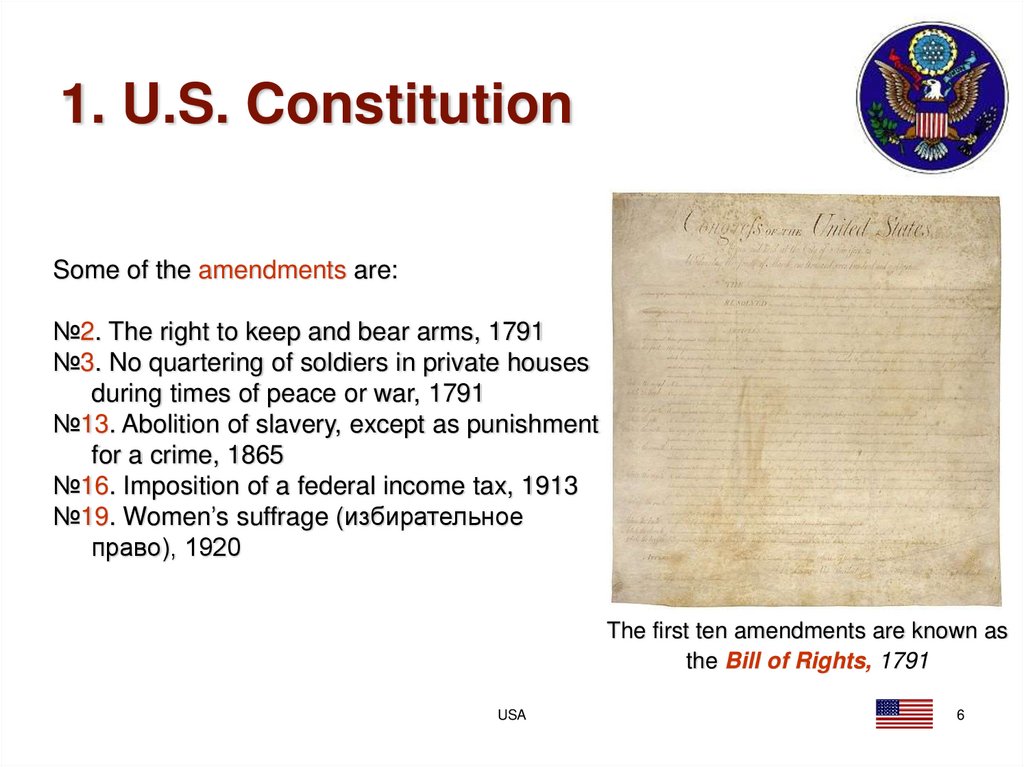
The first ten amendments are known as
the Bill of Rights, 1791
USA
6
7. 1. U.S. Constitution
The principle of limited government is realized through 3 features:1. The federal organization of government (division of powers
between the central government and the states).
2. The separation of powers among different branches of
government.
3. The system of checks and balances.
USA
7
8. 2.The Legislative branch
The functions of the Congress are:1. Make laws.
2. Establish federal courts.
3. Approve the choice of federal
judges and the cabinet.
4. Set taxes.
5. Borrow money.
6. Regulate interstate commerce.
7. Impeach and convict the
president.
8. Declare war.
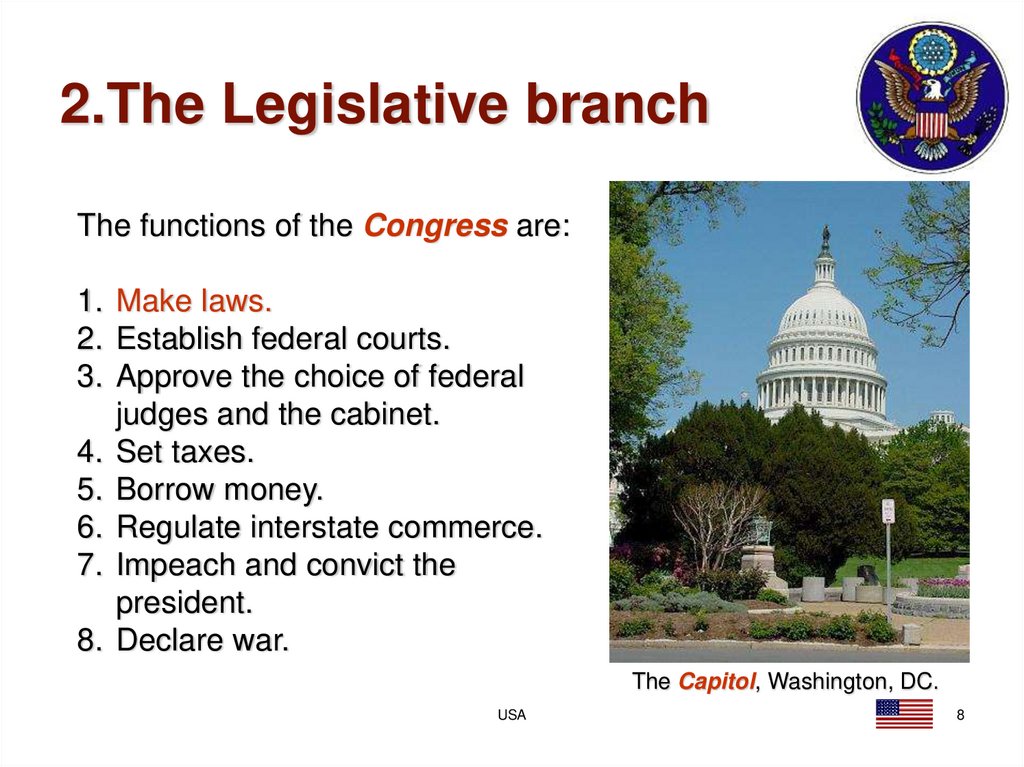
The Capitol, Washington, DC.
USA
8
9. 2.The Legislative branch
The Congress has two houses:The Senate (aka upper house)
The House of Representatives
(aka lower house)
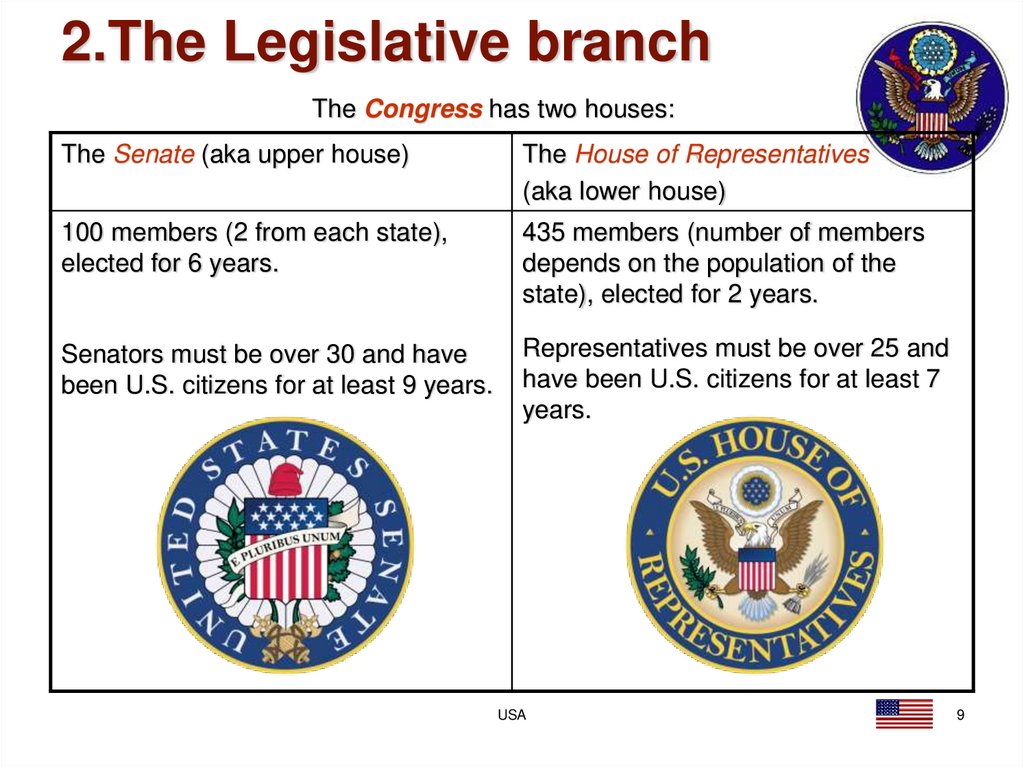
100 members (2 from each state),
elected for 6 years.
435 members (number of members
depends on the population of the
state), elected for 2 years.
Senators must be over 30 and have
been U.S. citizens for at least 9 years.
Representatives must be over 25 and
have been U.S. citizens for at least 7
years.
USA
9
10. 2.The Legislative branch
The Congress has two houses:The Senate (aka upper house)
The House of Representatives
(aka lower house)
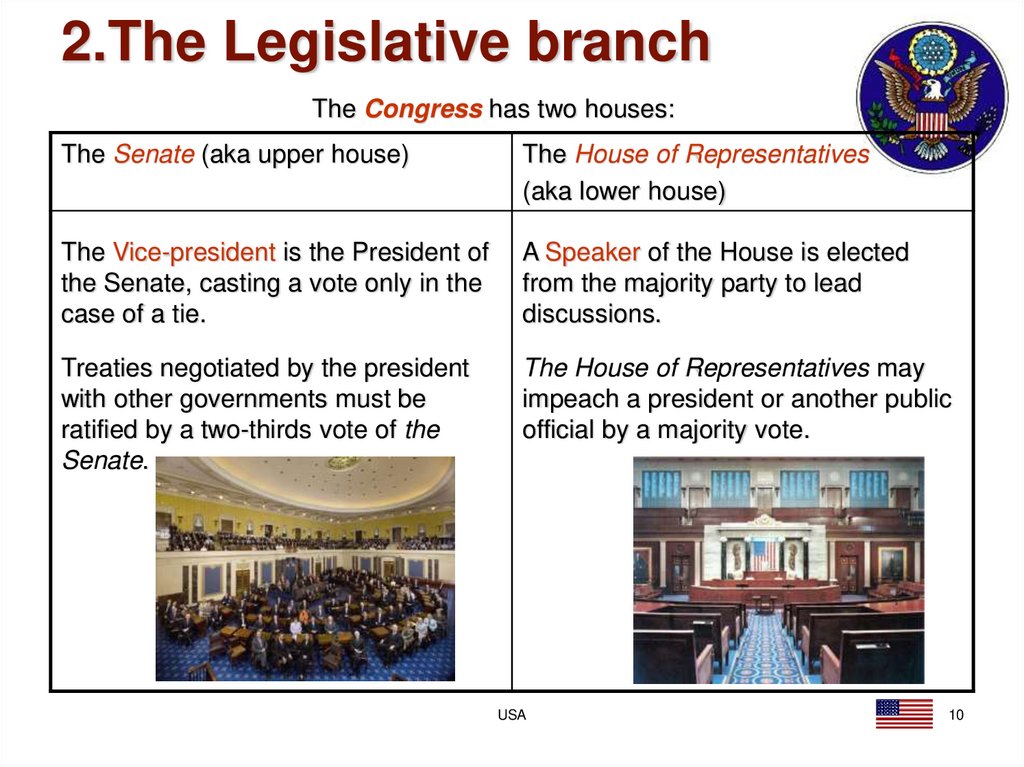
The Vice-president is the President of
the Senate, casting a vote only in the
case of a tie.
A Speaker of the House is elected
from the majority party to lead
discussions.
Treaties negotiated by the president
with other governments must be
ratified by a two-thirds vote of the
Senate.
The House of Representatives may
impeach a president or another public
official by a majority vote.
USA
10
11. 2.The Legislative branch
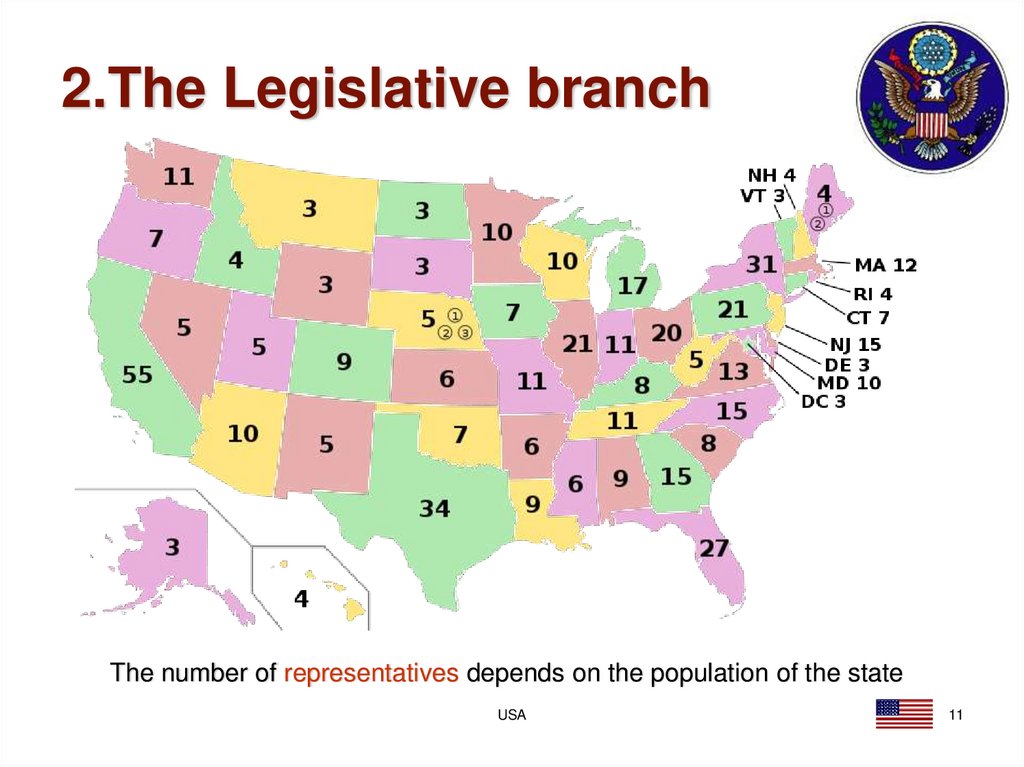
The number of representatives depends on the population of the stateUSA
11
12. 3. Executive branch
The executive branch consists of:1. The President.
2. The Vice-president.
3. The Cabinet.
4. Government departments and
agencies.
The president must be a naturalborn citizen of the United States,
at least 35 years old, and a
resident of the country for at least
14 years.
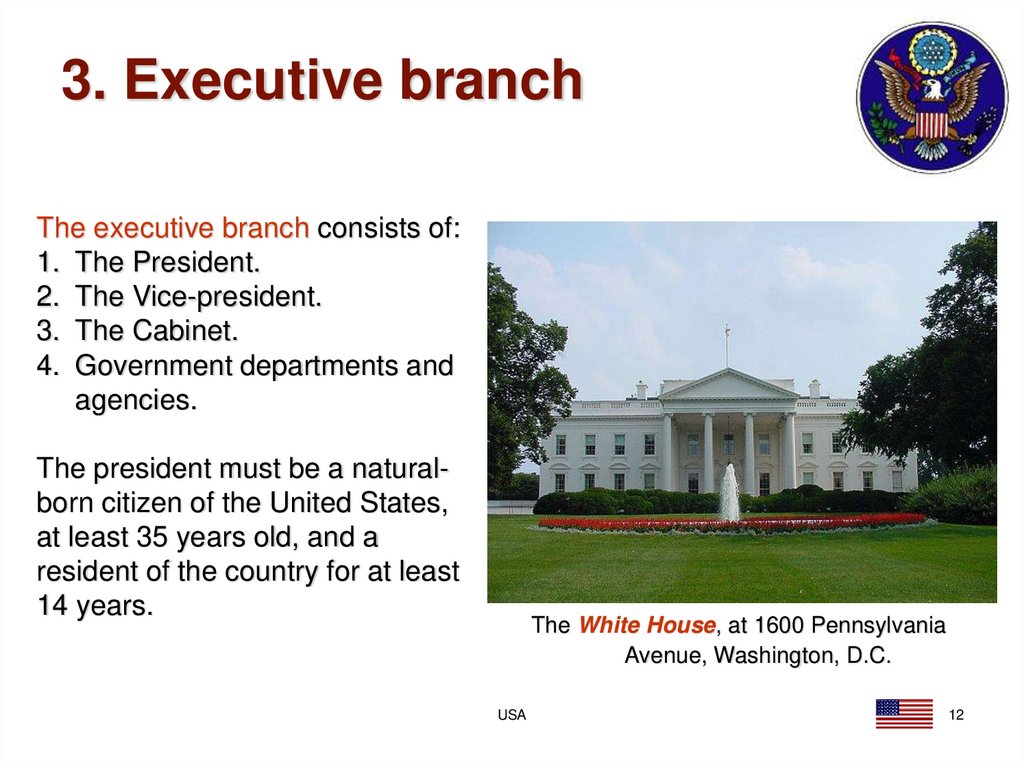
The White House, at 1600 Pennsylvania
Avenue, Washington, D.C.
USA
12
13. 3. Executive branch
The functions of the president:1. Choose the 14 cabinet members who head
departments.
2. Choose who will run as vice president.
3. Appoint federal judges.
4. Choose heads of agencies such as the FBI and CIA.
5. Propose laws, and approve federal laws after
Congress has approved them.
6. Choose US ambassadors to foreign countries.
7. Be responsible for relations with foreign countries.
8. Be commander-in-chief of armed forces.
The functions of the Cabinet:
1. Form the government together with the president.
2. Advise the president on issues related to their
departments.
USA
13
14. 4. Judicial branch
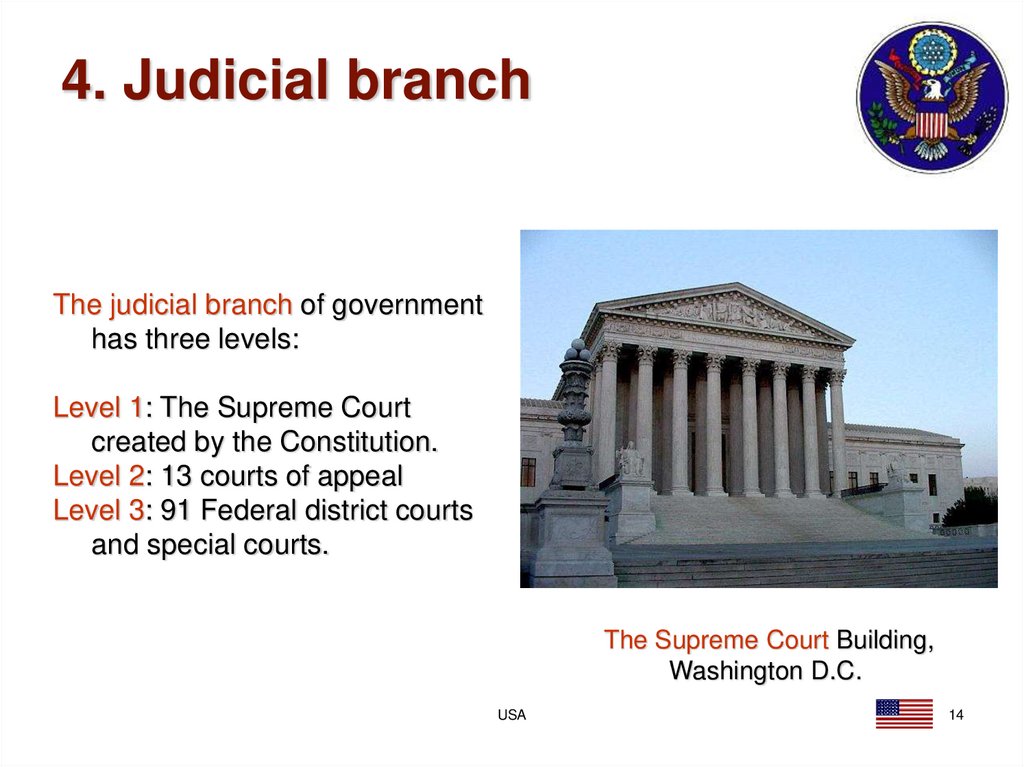
The judicial branch of governmenthas three levels:
Level 1: The Supreme Court
created by the Constitution.
Level 2: 13 courts of appeal
Level 3: 91 Federal district courts
and special courts.
The Supreme Court Building,
Washington D.C.
USA
14
15. 4. Judicial branch
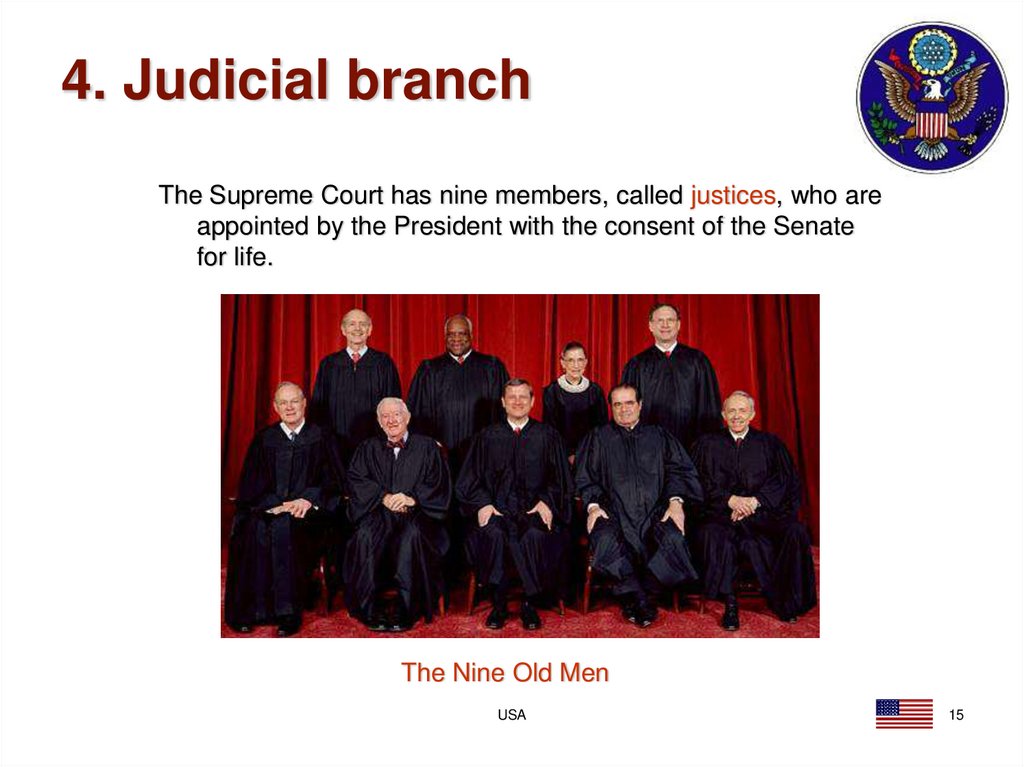
The Supreme Court has nine members, called justices, who areappointed by the President with the consent of the Senate
for life.
The Nine Old Men
USA
15
16. 4. Judicial branch
Three types of cases commonlyreach the Supreme Court:
1. Cases involving litigants of
different states.
2. Cases involving the interpretation
of federal law.
3. Cases involving the interpretation
of the Constitution.
USA
16
17. 4. Judicial branch
USA17
18. 4. Judicial branch
USA18
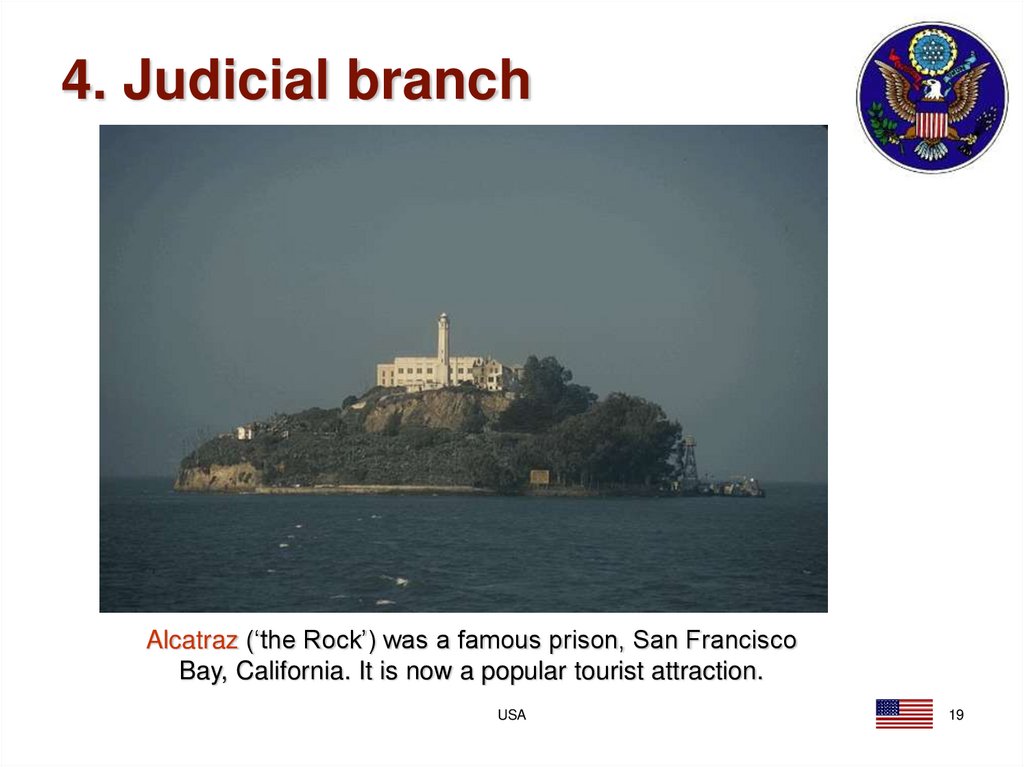
19. 4. Judicial branch
Alcatraz (‘the Rock’) was a famous prison, San FranciscoBay, California. It is now a popular tourist attraction.
USA
19
20.
USA20
21. 6. State and National Government
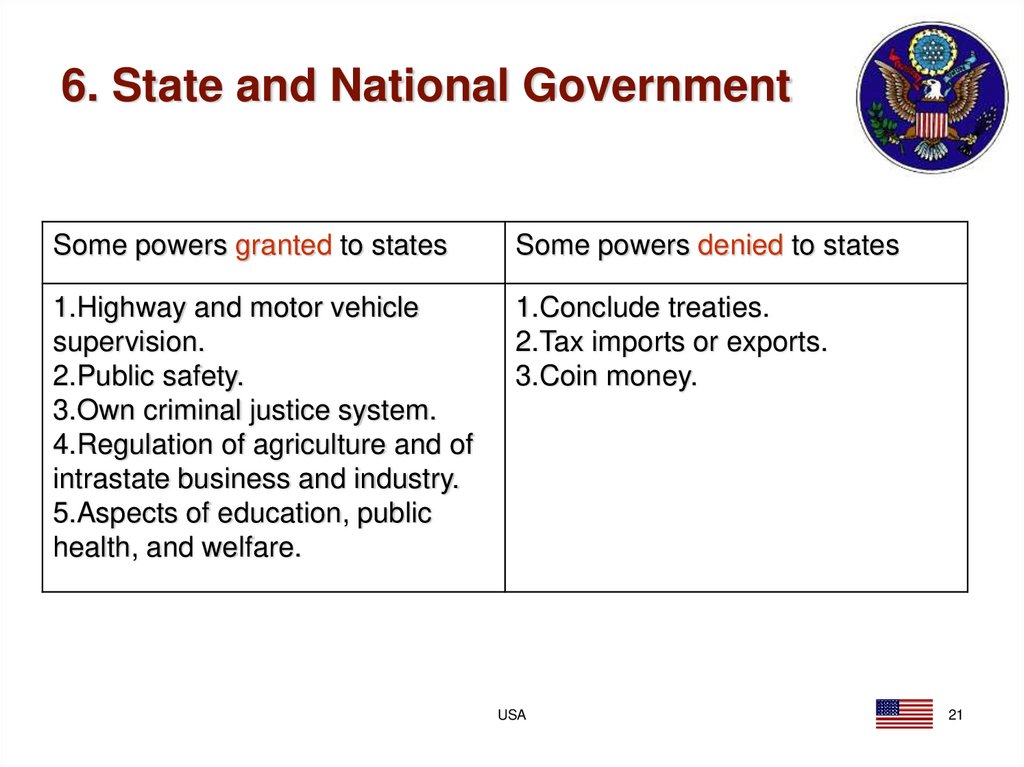
Some powers granted to statesSome powers denied to states
1.Highway and motor vehicle
supervision.
2.Public safety.
3.Own criminal justice system.
4.Regulation of agriculture and of
intrastate business and industry.
5.Aspects of education, public
health, and welfare.
1.Conclude treaties.
2.Tax imports or exports.
3.Coin money.
USA
21
22.
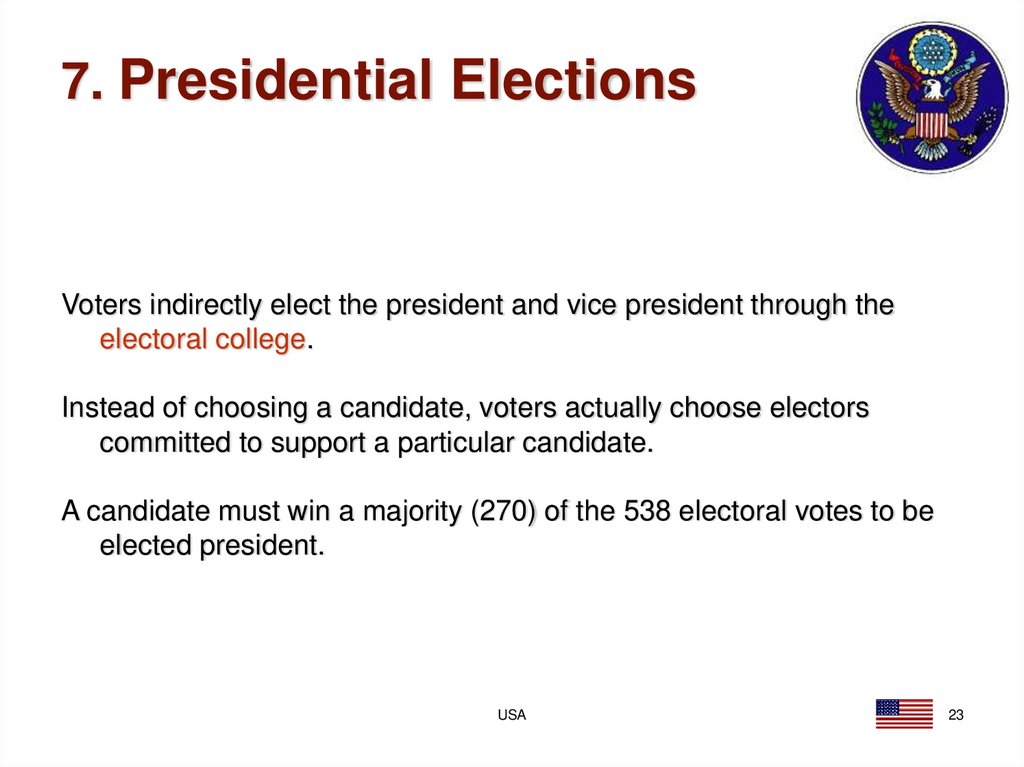
7. Presidential ElectionsVoters indirectly elect the president and vice president through the
electoral college.
Instead of choosing a candidate, voters actually choose electors
committed to support a particular candidate.
A candidate must win a majority (270) of the 538 electoral votes to be
elected president.
USA
23
23. 7. Presidential Elections
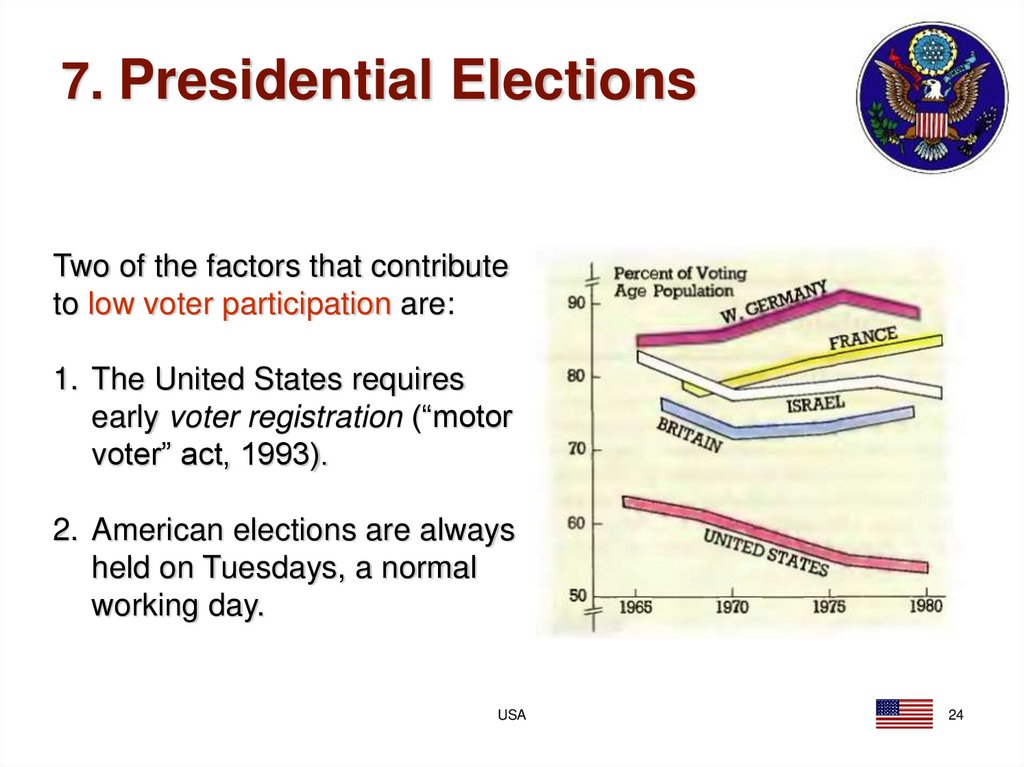
Two of the factors that contributeto low voter participation are:
1. The United States requires
early voter registration (“motor
voter” act, 1993).
2. American elections are always
held on Tuesdays, a normal
working day.
USA
24
24. 7. Presidential Elections
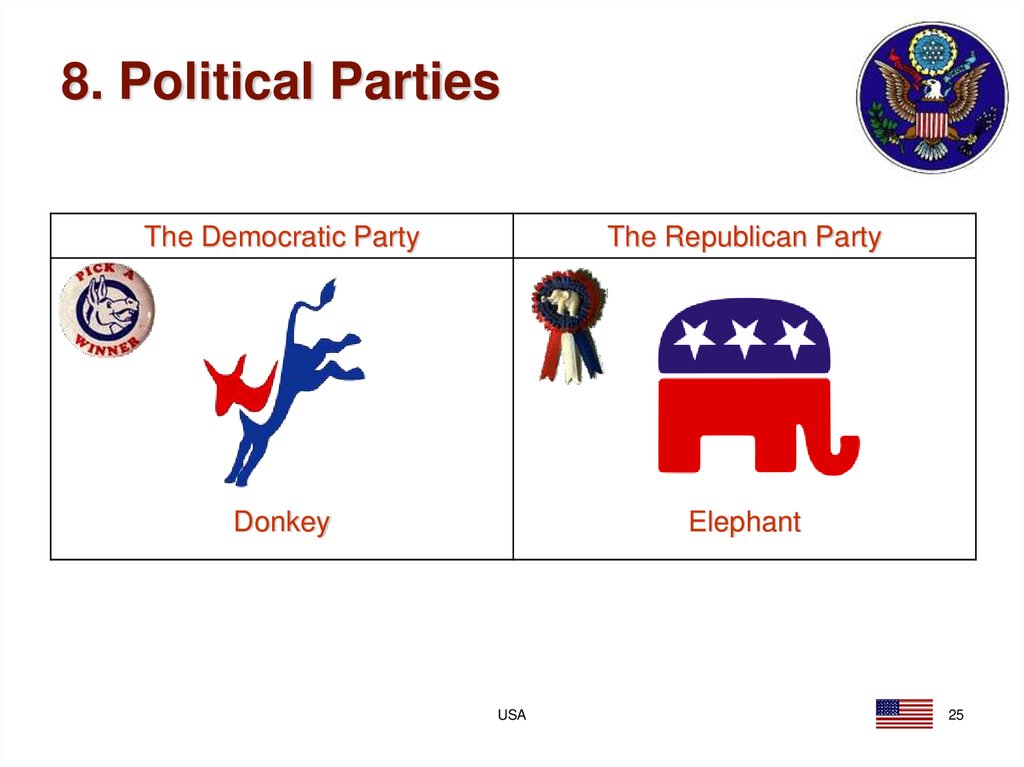
8. Political PartiesThe Democratic Party
The Republican Party
Donkey
Elephant
USA
25
25. 8. Political Parties
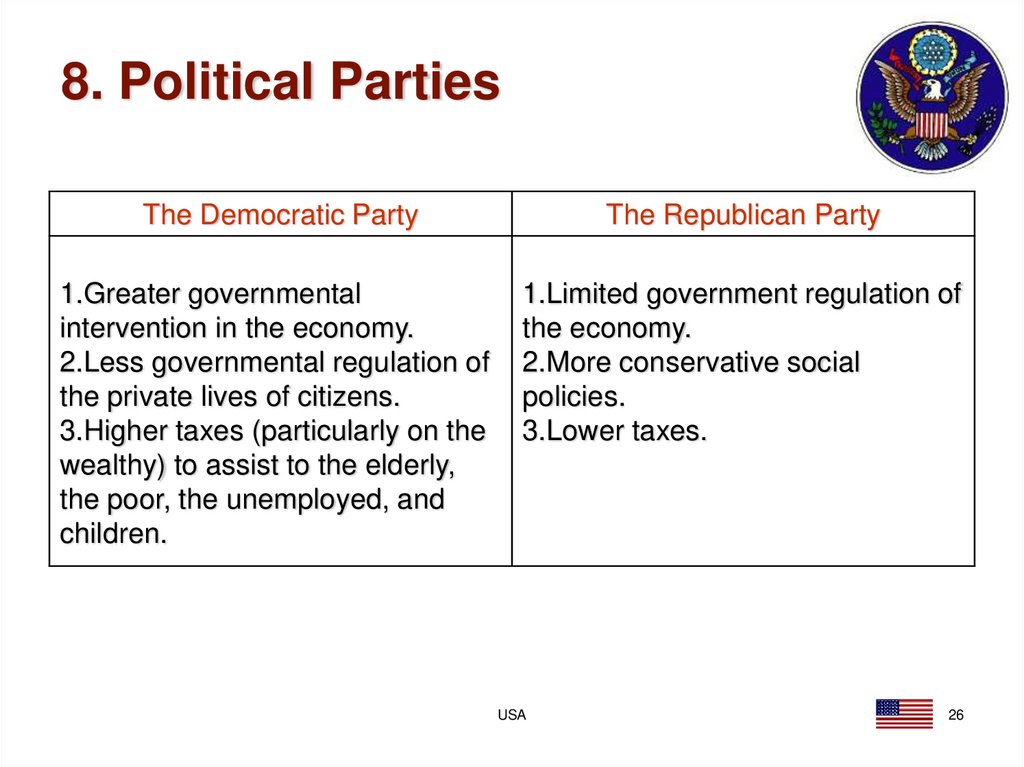
The Democratic PartyThe Republican Party
1.Greater governmental
intervention in the economy.
2.Less governmental regulation of
the private lives of citizens.
3.Higher taxes (particularly on the
wealthy) to assist to the elderly,
the poor, the unemployed, and
children.
1.Limited government regulation of
the economy.
2.More conservative social
policies.
3.Lower taxes.
USA
26
26. 8. Political Parties
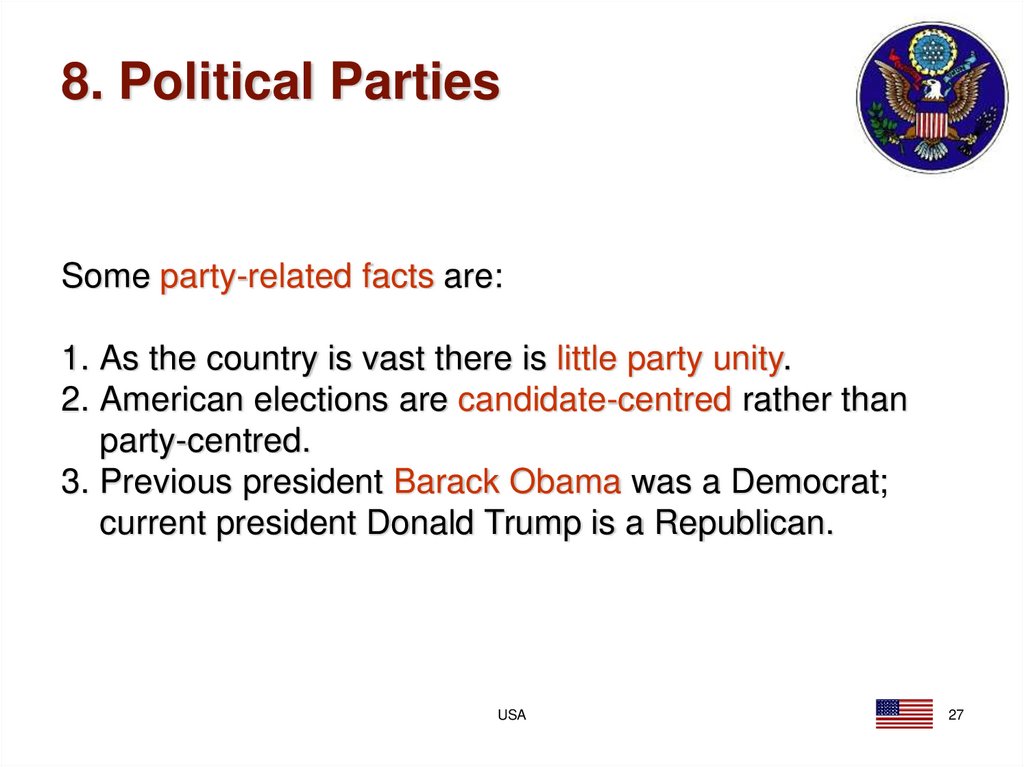
Some party-related facts are:1. As the country is vast there is little party unity.
2. American elections are candidate-centred rather than
party-centred.
3. Previous president Barack Obama was a Democrat;
current president Donald Trump is a Republican.
USA
27