




 english
Similar presentations:



National university of uzbekistan named after mirzo ulugbek faculty of foreign philology department of foreign language and
1. NATIONAL UNIVERSITY OF UZBEKISTAN NAMED AFTER MIRZO ULUGBEK FACULTY OF FOREIGN PHILOLOGY DEPARTMENT OF FOREIGN LANGUAGE AND
LITERATURE1st Lecture: INTRODUCTION TO LEXICOLOGY
PhD teacher: Eshtukhtarova Bibigul Bektoshevna
Tashkent-2024
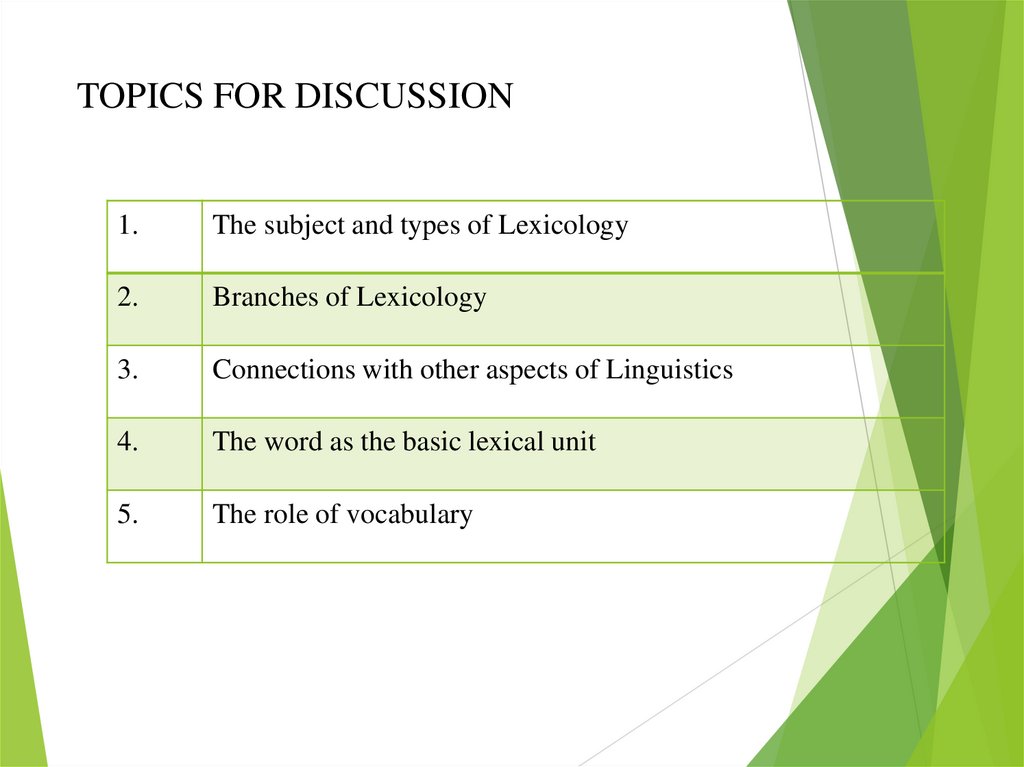
2. TOPICS FOR DISCUSSION
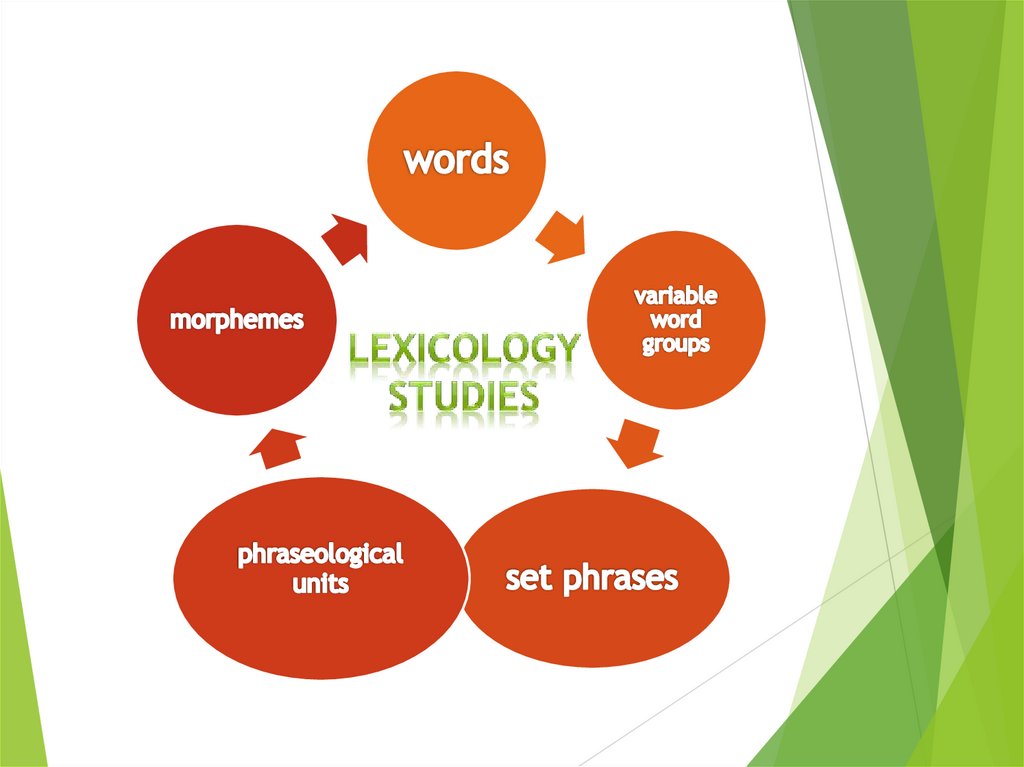
1.The subject and types of Lexicology
2.
Branches of Lexicology
3.
Connections with other aspects of Linguistics
4.
The word as the basic lexical unit
5.
The role of vocabulary
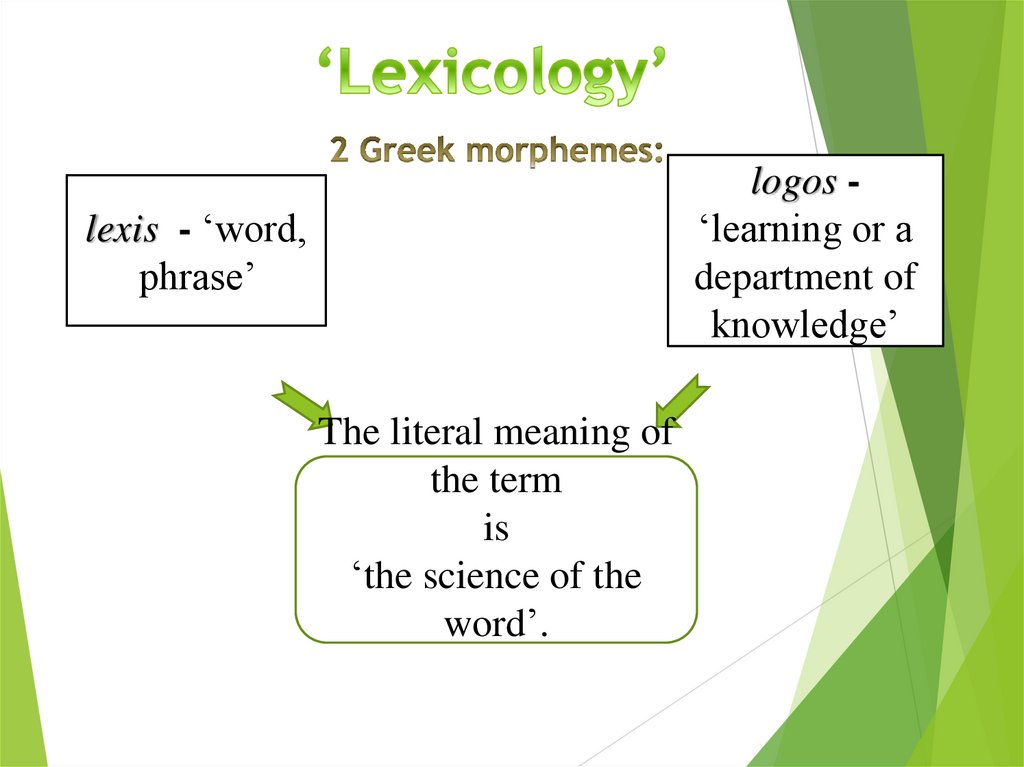
3.
logos ‘learning or adepartment of
knowledge’
lexis - ‘word,
phrase’
The literal meaning of
the term
is
‘the science of the
word’.
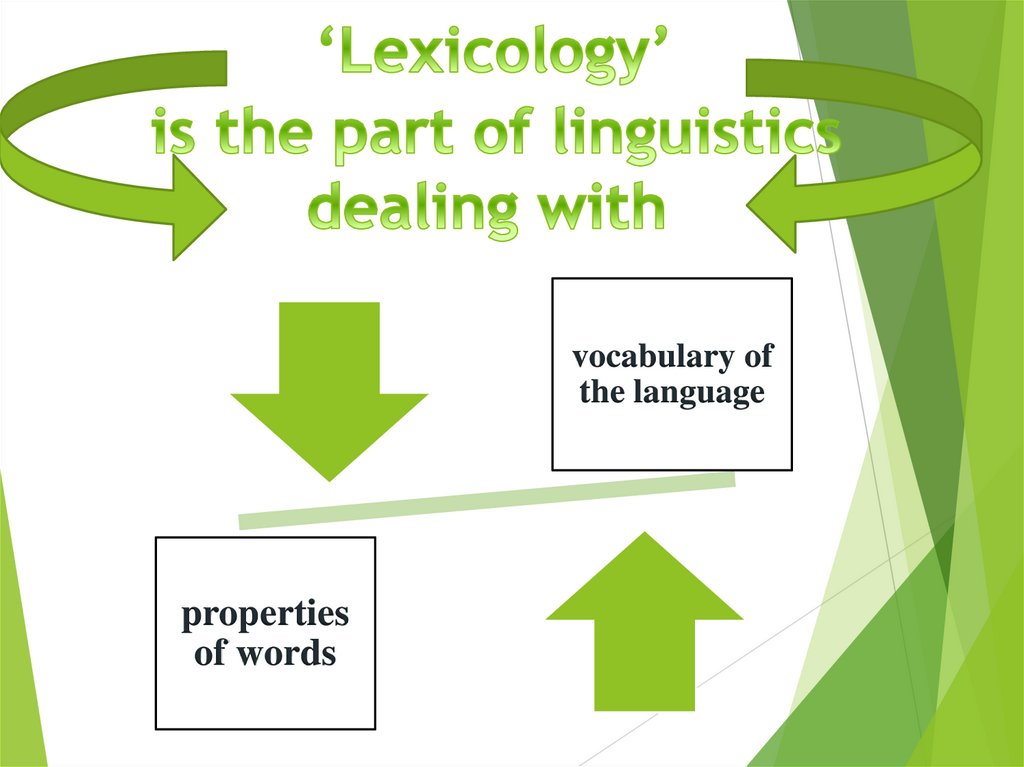
4.
vocabulary ofthe language
properties
of words
5.
6.
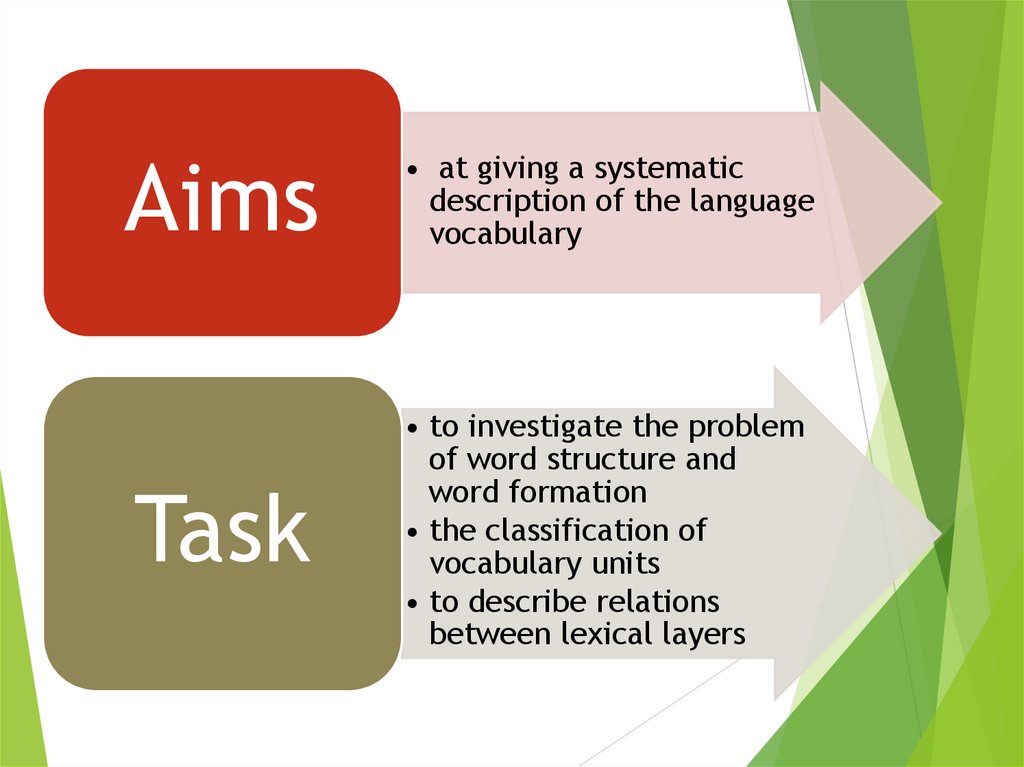
Aims• at giving a systematic
description of the language
vocabulary
Task
• to investigate the problem
of word structure and
word formation
• the classification of
vocabulary units
• to describe relations
between lexical layers
7.
vocabularylexis
word
8.
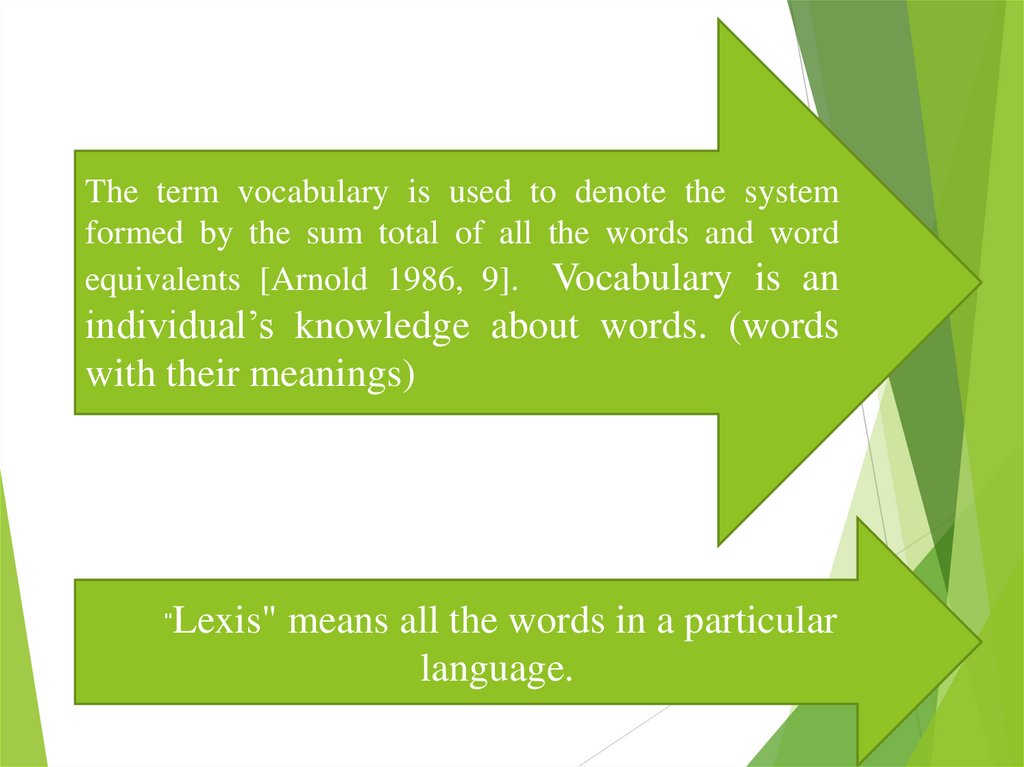
The term vocabulary is used to denote the systemformed by the sum total of all the words and word
equivalents [Arnold 1986, 9]. Vocabulary is an
individual’s knowledge about words. (words
with their meanings)
"Lexis" means all the words in a particular
language.
9.
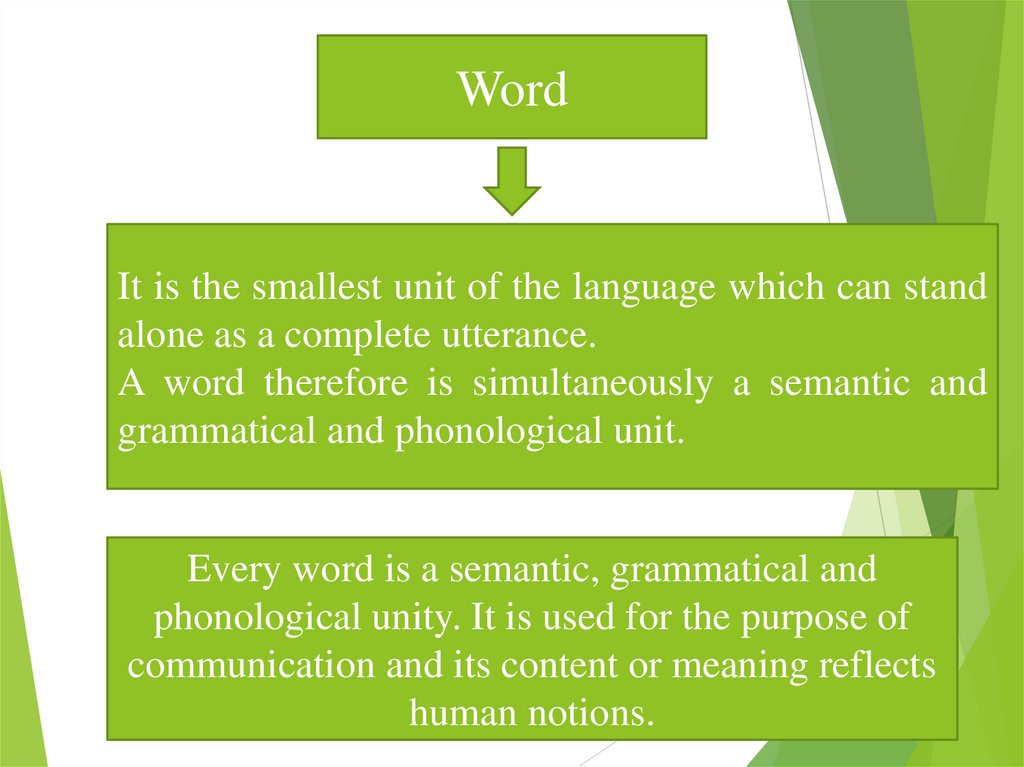
WordIt is the smallest unit of the language which can stand
alone as a complete utterance.
A word therefore is simultaneously a semantic and
grammatical and phonological unit.
Every word is a semantic, grammatical and
phonological unity. It is used for the purpose of
communication and its content or meaning reflects
human notions.
10.
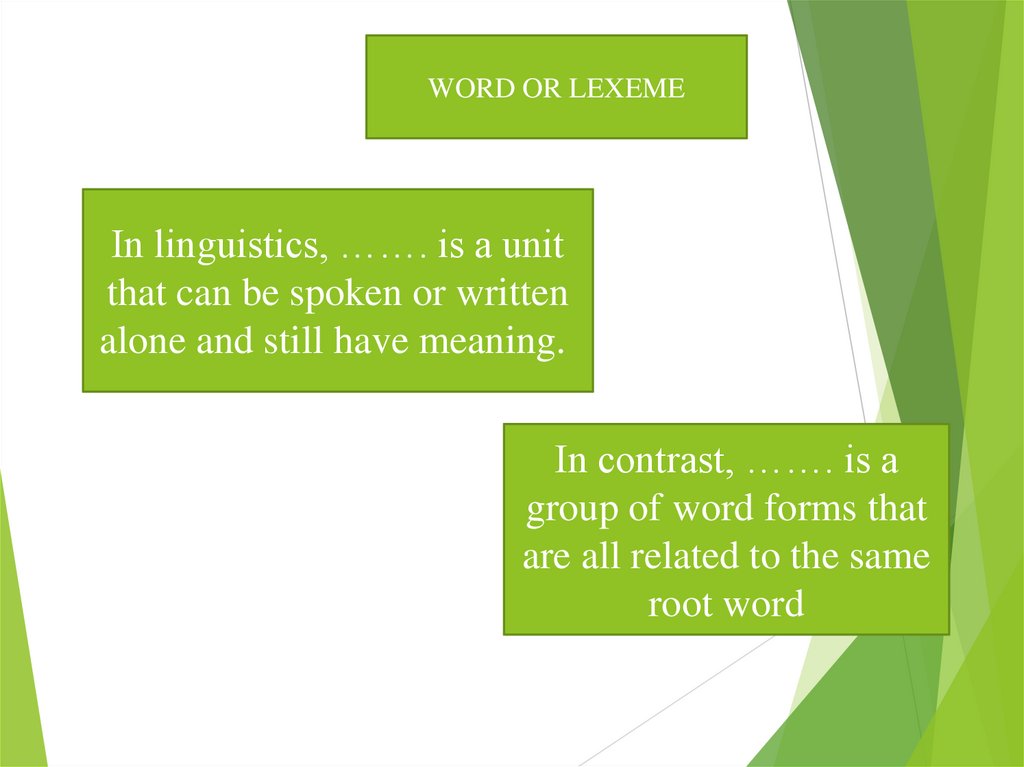
WORD OR LEXEMEIn linguistics, ……. is a unit
that can be spoken or written
alone and still have meaning.
In contrast, ……. is a
group of word forms that
are all related to the same
root word
11.
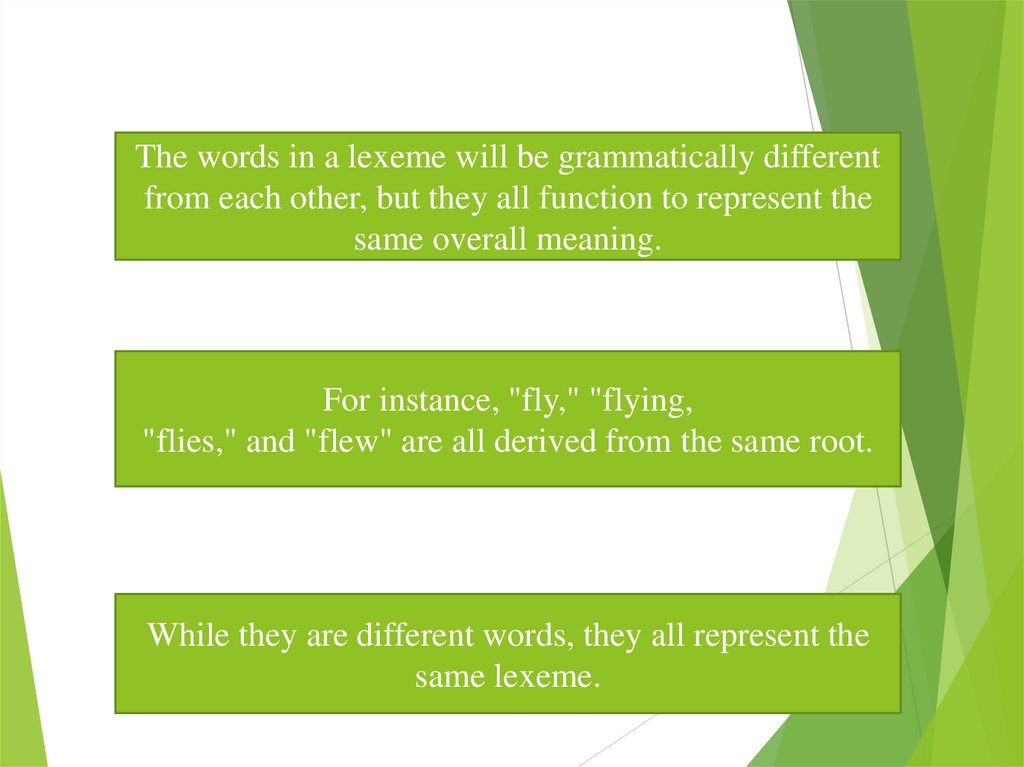
The words in a lexeme will be grammatically differentfrom each other, but they all function to represent the
same overall meaning.
For instance, "fly," "flying,
"flies," and "flew" are all derived from the same root.
While they are different words, they all represent the
same lexeme.
12.
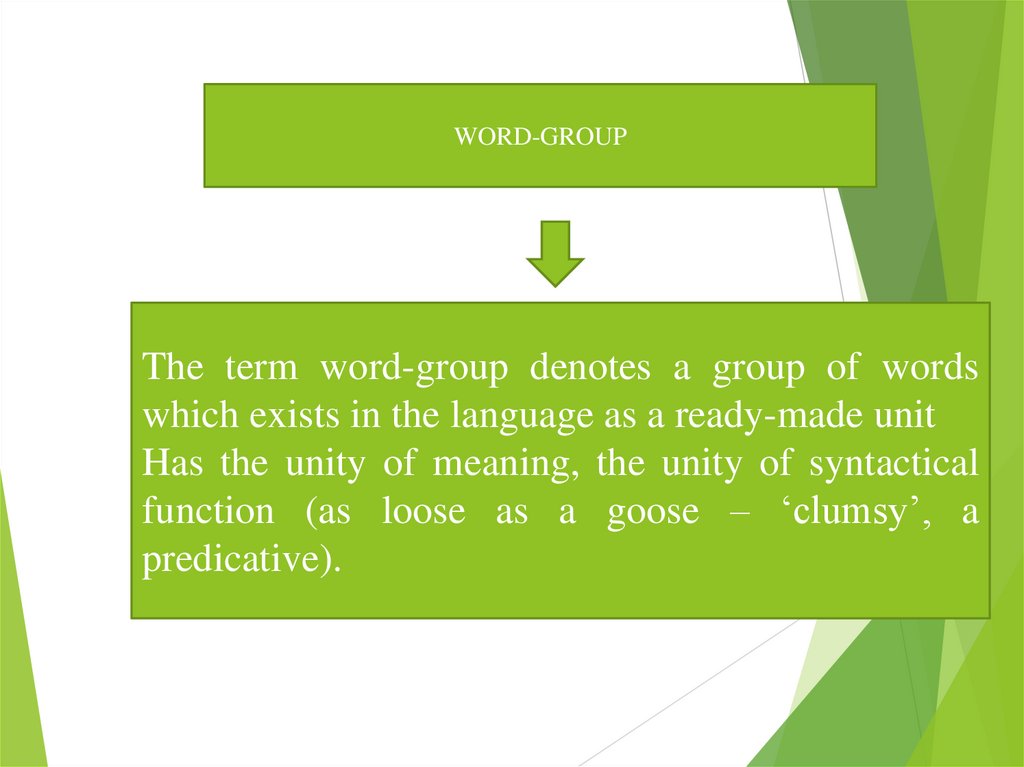
WORD-GROUPThe term word-group denotes a group of words
which exists in the language as a ready-made unit
Has the unity of meaning, the unity of syntactical
function (as loose as a goose – ‘clumsy’, a
predicative).
13.
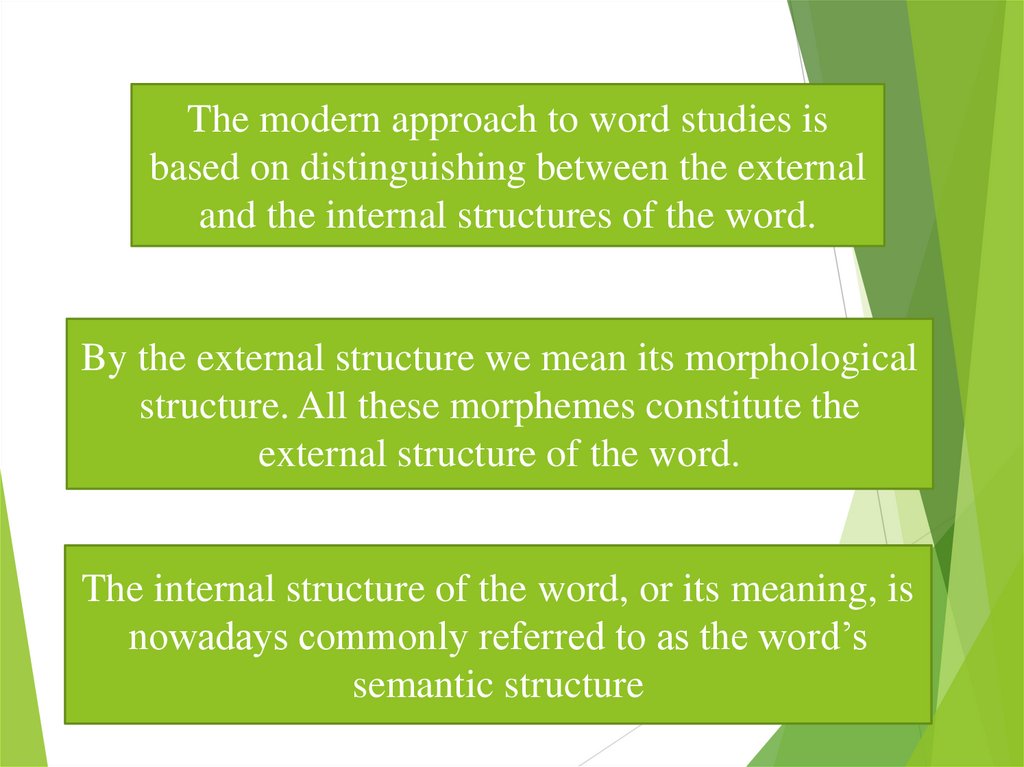
The modern approach to word studies isbased on distinguishing between the external
and the internal structures of the word.
By the external structure we mean its morphological
structure. All these morphemes constitute the
external structure of the word.
The internal structure of the word, or its meaning, is
nowadays commonly referred to as the word’s
semantic structure
14.
15.
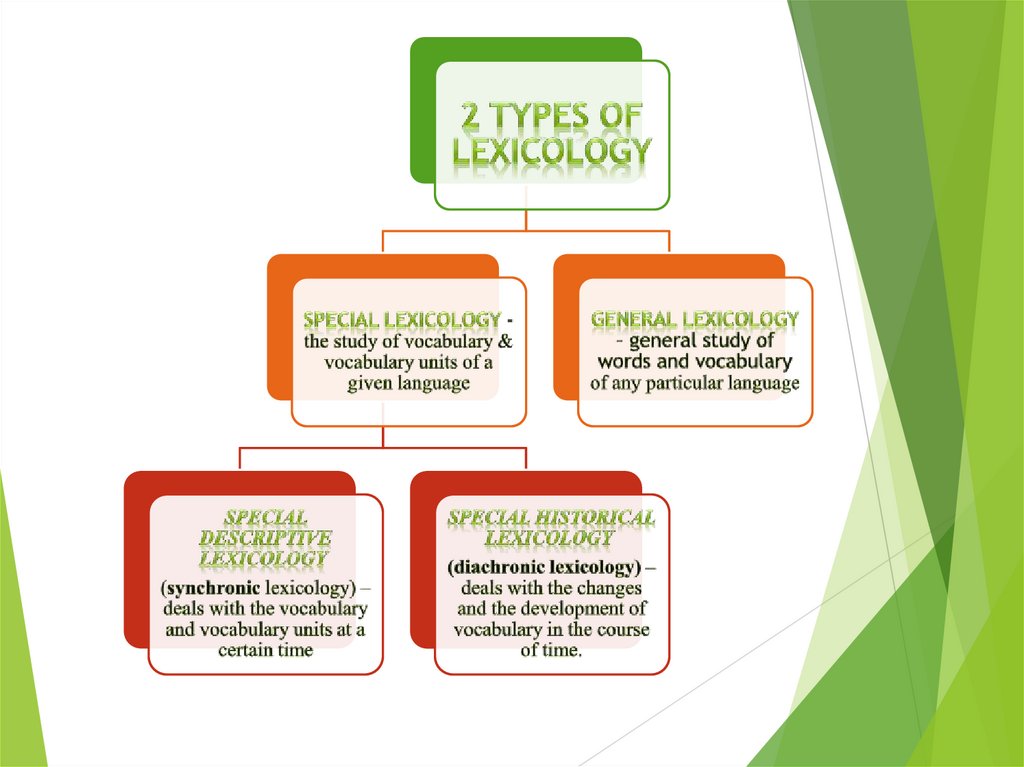
Synchronic approachDiachronic
16.
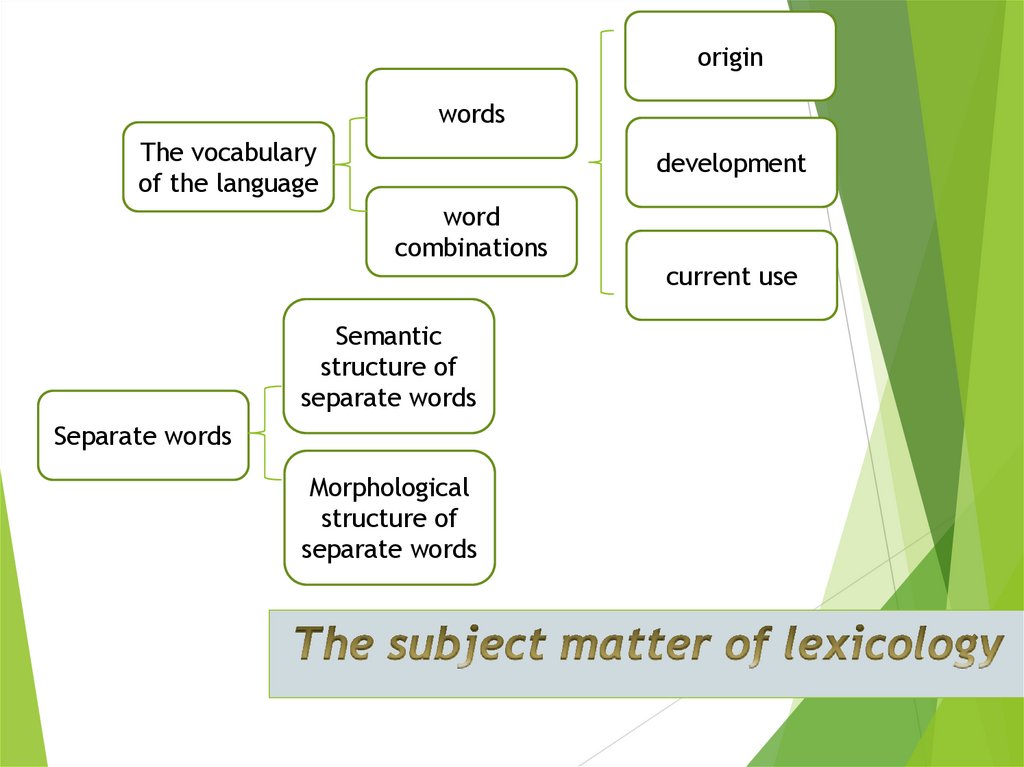
originwords
The vocabulary
of the language
development
word
combinations
Semantic
structure of
separate words
Separate words
Morphological
structure of
separate words
current use
17.
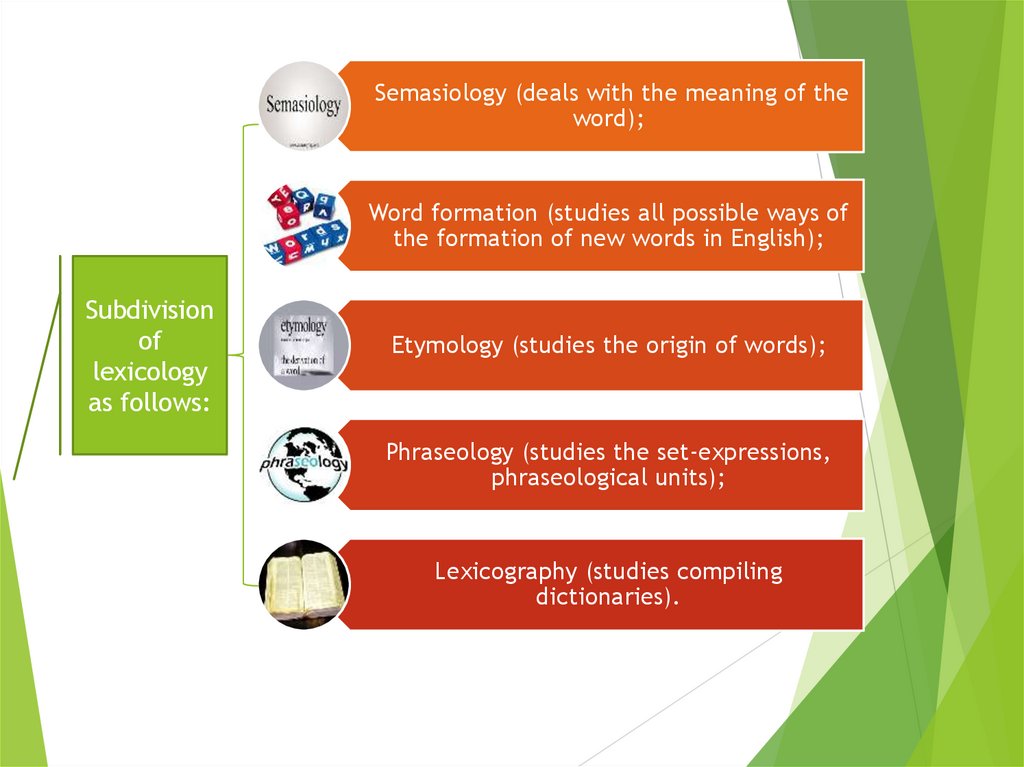
Semasiology (deals with the meaning of theword);
Word formation (studies all possible ways of
the formation of new words in English);
Subdivision
of
lexicology
as follows:
Etymology (studies the origin of words);
Phraseology (studies the set-expressions,
phraseological units);
Lexicography (studies compiling
dictionaries).
18.
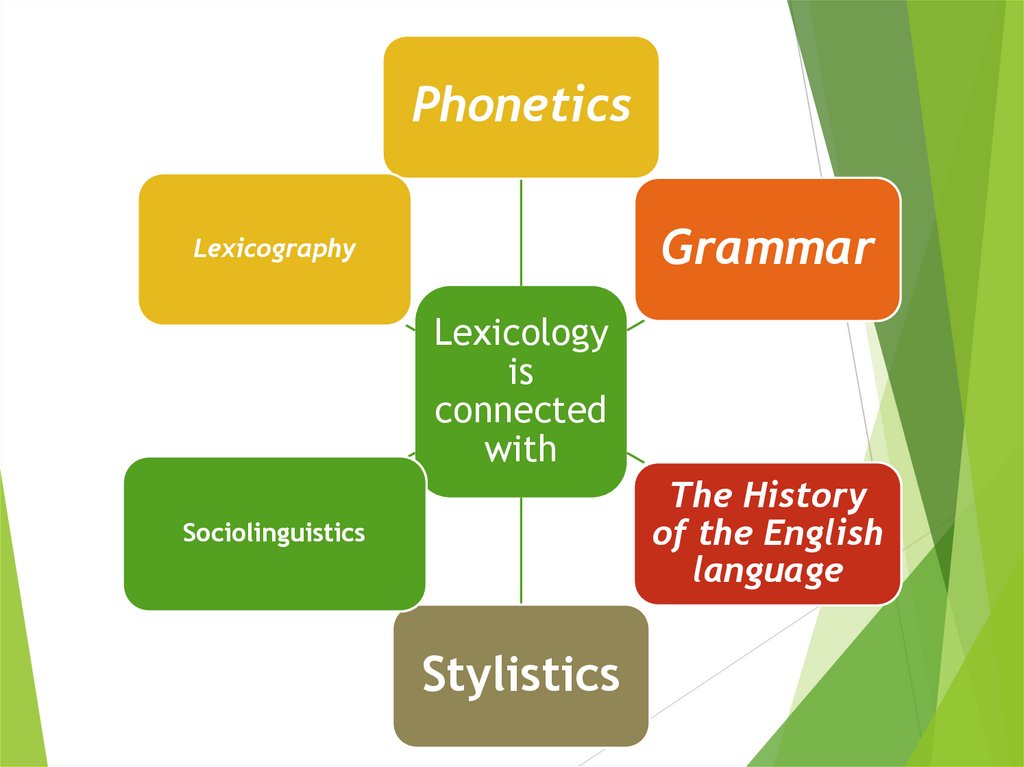
PhoneticsGrammar
Lexicography
Lexicology
is
connected
with
The History
of the English
language
Sociolinguistics
Stylistics
19.
20.
21.
22.
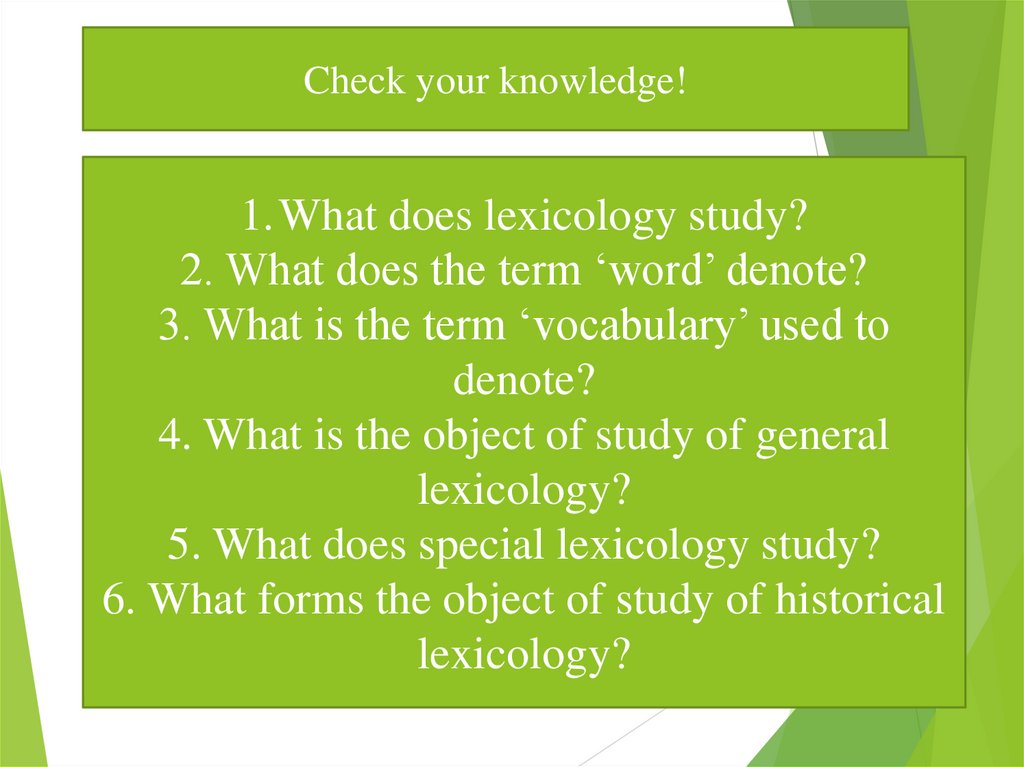
Check your knowledge!1.What does lexicology study?
2. What does the term ‘word’ denote?
3. What is the term ‘vocabulary’ used to
denote?
4. What is the object of study of general
lexicology?
5. What does special lexicology study?
6. What forms the object of study of historical
lexicology?
23.
7. What does descriptive lexicology deal with?8. What branches of linguistics does lexicology
have close ties with?
9. What is the literal meaning of the term
‘synchronic’ which is Greek by origin?
10. What does the diachronic approach concern
with?
11. What is the external structure of the word
irresistible? What is the internal structure?