 literature
Similar presentations:



Action in fiction
1. Week 5, Tuesday 16 September: Setting
WEEK 5,TUESDAY 16
SEPTEMBER:
SETTING
2. wHAT IS THE SETTING?
WHAT IS THESETTING?
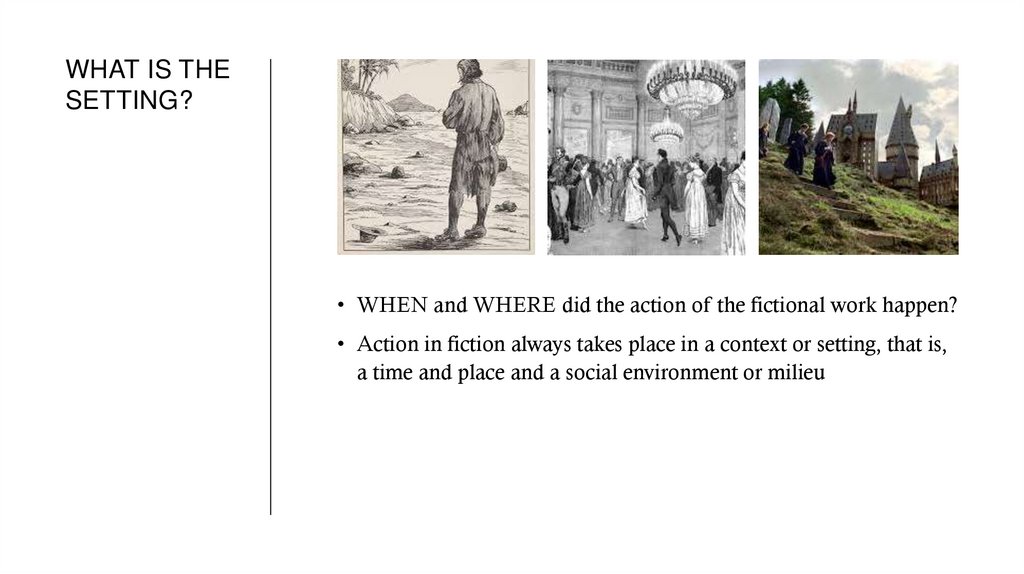
• WHEN and WHERE did the action of the fictional work happen?
• Action in fiction always takes place in a context or setting, that is,
a time and place and a social environment or milieu
3. TEMPORAL AND PHYSICAL SETTING
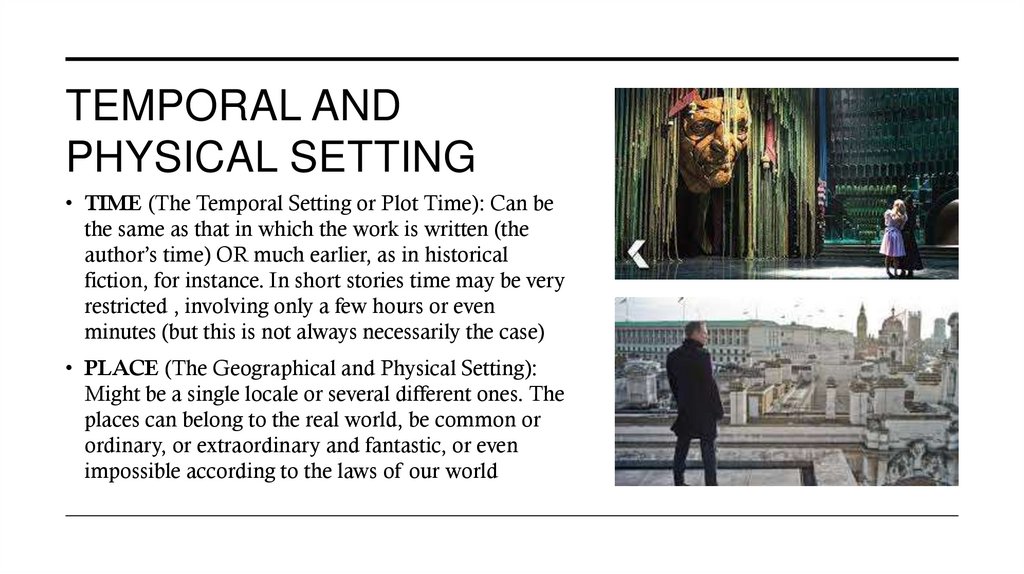
• TIME (The Temporal Setting or Plot Time): Can bethe same as that in which the work is written (the
author’s time) OR much earlier, as in historical
fiction, for instance. In short stories time may be very
restricted , involving only a few hours or even
minutes (but this is not always necessarily the case)
• PLACE (The Geographical and Physical Setting):
Might be a single locale or several different ones. The
places can belong to the real world, be common or
ordinary, or extraordinary and fantastic, or even
impossible according to the laws of our world
4. General and particular settings
GENERAL ANDPARTICULAR
SETTINGS
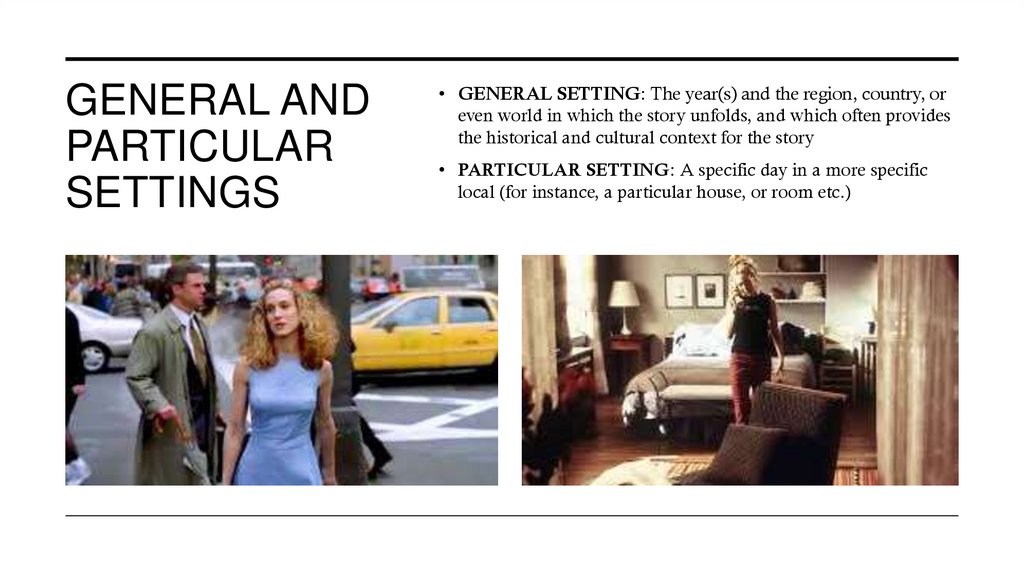
• GENERAL SETTING: The year(s) and the region, country, or
even world in which the story unfolds, and which often provides
the historical and cultural context for the story
• PARTICULAR SETTING: A specific day in a more specific
local (for instance, a particular house, or room etc.)
5. Functions of setting
FUNCTIONS OFSETTING
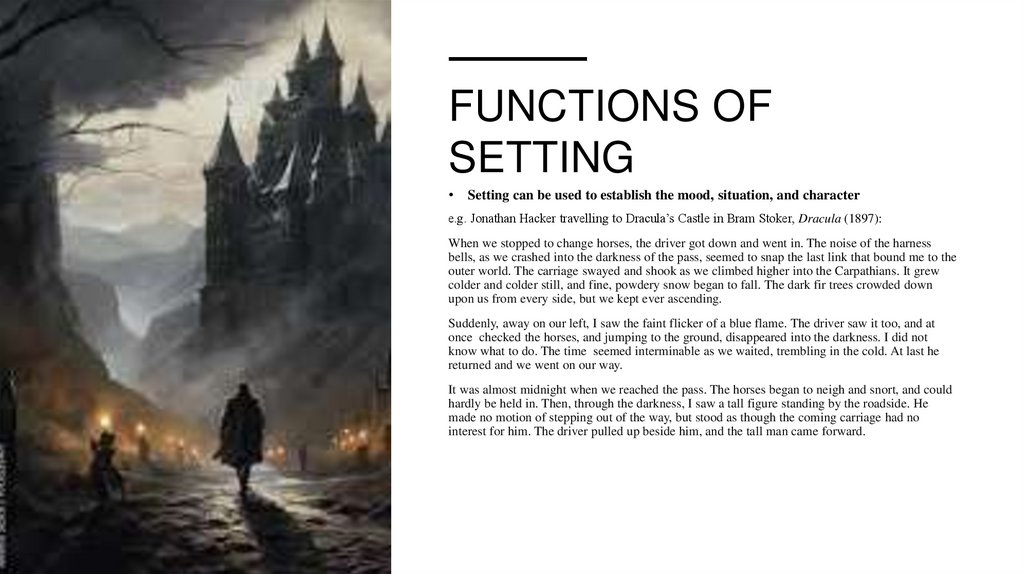
Setting can be used to establish the mood, situation, and character
e.g. Jonathan Hacker travelling to Dracula’s Castle in Bram Stoker, Dracula (1897):
When we stopped to change horses, the driver got down and went in. The noise of the harness
bells, as we crashed into the darkness of the pass, seemed to snap the last link that bound me to the
outer world. The carriage swayed and shook as we climbed higher into the Carpathians. It grew
colder and colder still, and fine, powdery snow began to fall. The dark fir trees crowded down
upon us from every side, but we kept ever ascending.
Suddenly, away on our left, I saw the faint flicker of a blue flame. The driver saw it too, and at
once checked the horses, and jumping to the ground, disappeared into the darkness. I did not
know what to do. The time seemed interminable as we waited, trembling in the cold. At last he
returned and we went on our way.
It was almost midnight when we reached the pass. The horses began to neigh and snort, and could
hardly be held in. Then, through the darkness, I saw a tall figure standing by the roadside. He
made no motion of stepping out of the way, but stood as though the coming carriage had no
interest for him. The driver pulled up beside him, and the tall man came forward.
6.
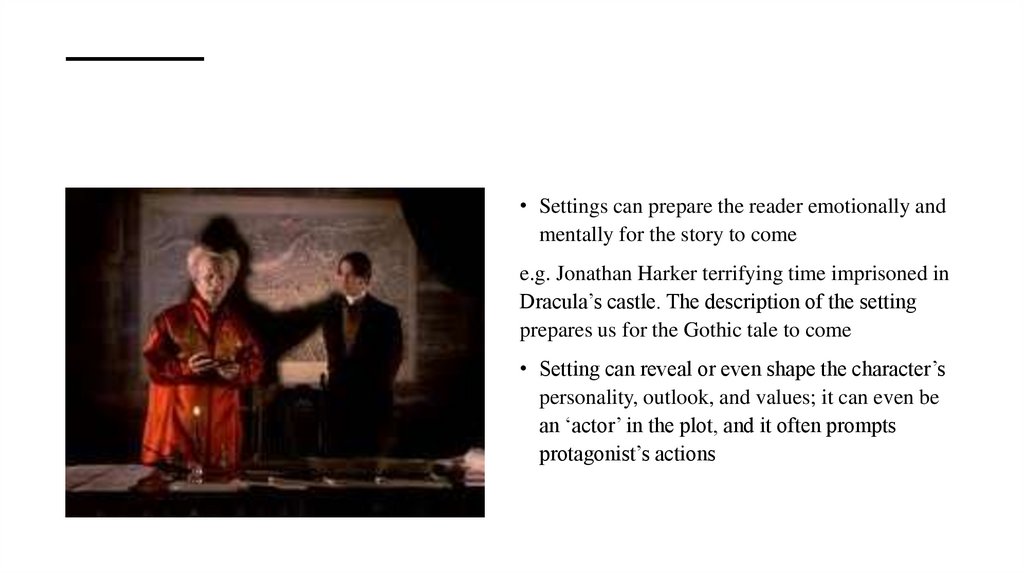
• Settings can prepare the reader emotionally andmentally for the story to come
e.g. Jonathan Harker terrifying time imprisoned in
Dracula’s castle. The description of the setting
prepares us for the Gothic tale to come
• Setting can reveal or even shape the character’s
personality, outlook, and values; it can even be
an ‘actor’ in the plot, and it often prompts
protagonist’s actions
7. Setting as Protagonist in plot
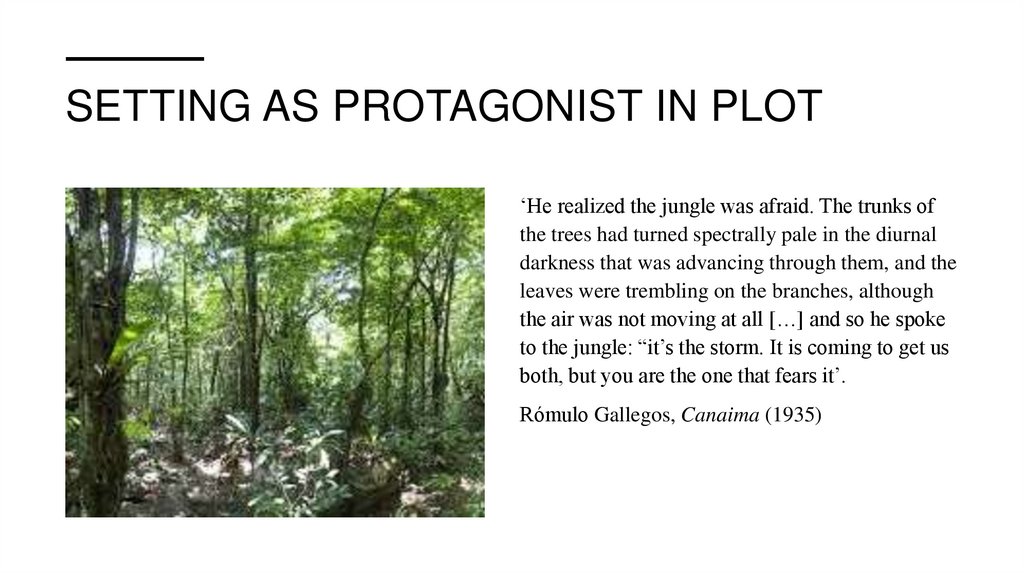
SETTING AS PROTAGONIST IN PLOT‘He realized the jungle was afraid. The trunks of
the trees had turned spectrally pale in the diurnal
darkness that was advancing through them, and the
leaves were trembling on the branches, although
the air was not moving at all […] and so he spoke
to the jungle: “it’s the storm. It is coming to get us
both, but you are the one that fears it’.
Rómulo Gallegos, Canaima (1935)
8. Vague and vivid setting
VAGUE AND VIVIDSETTING
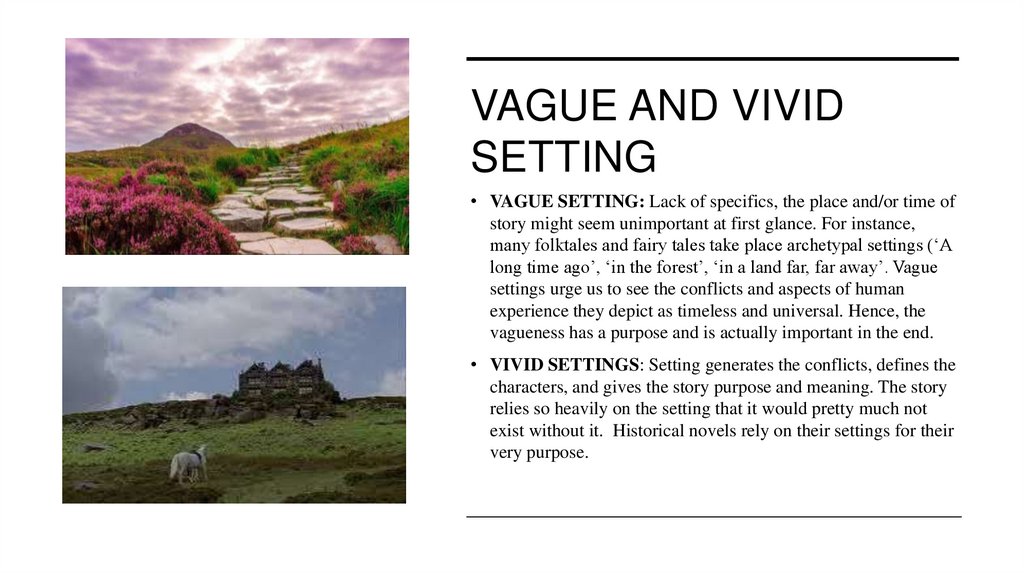
• VAGUE SETTING: Lack of specifics, the place and/or time of
story might seem unimportant at first glance. For instance,
many folktales and fairy tales take place archetypal settings (‘A
long time ago’, ‘in the forest’, ‘in a land far, far away’. Vague
settings urge us to see the conflicts and aspects of human
experience they depict as timeless and universal. Hence, the
vagueness has a purpose and is actually important in the end.
• VIVID SETTINGS: Setting generates the conflicts, defines the
characters, and gives the story purpose and meaning. The story
relies so heavily on the setting that it would pretty much not
exist without it. Historical novels rely on their settings for their
very purpose.
9. Traditional expectations of time and space
TRADITIONALEXPECTATIONS OF TIME
•AND
The effectsSPACE
and meanings evoked by settings depend on our
traditional association with particular times, places, and even
weather conditions
e.g. In the passage describing Harker’s arrival to Dracula’s castle we
have mentions of midnight, snow, darkness, cold, forests etc. all of
which forebode that something bad and scary is about to happen.
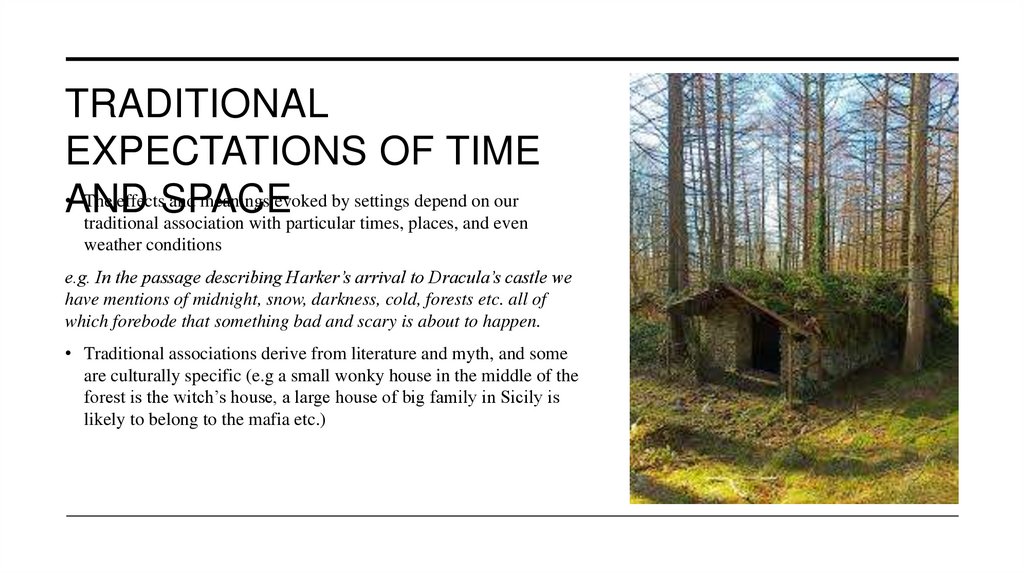
• Traditional associations derive from literature and myth, and some
are culturally specific (e.g a small wonky house in the middle of the
forest is the witch’s house, a large house of big family in Sicily is
likely to belong to the mafia etc.)
10. Chronotope
CHRONOTOPEA term taken over by Mikhail Bakhtin from 1920s
science to describe the manner in which literature
represents time and space. It refers to the intrinsic
connectedness of temporal and spatial relationships in
literature. In different kinds of writing there are differing
chronotopes, by which changing historical conceptions of
time and space are realised.
The Chronotope and Setting are closely related but not
exactly the same thing. Bakthin uses the chronotope to
analyze how certain narrative forms organize the time
and space in culturally significant ways:
The road in Epic: A space of journey and adventure
over long time spans
The castle in Gothic fiction: an isolated space where
time is suspended and haunted by the past
11. Ernest Hemingway, ‘Hills Like White Elephants’
ERNEST HEMINGWAY,‘HILLS LIKE WHITE
ELEPHANTS’
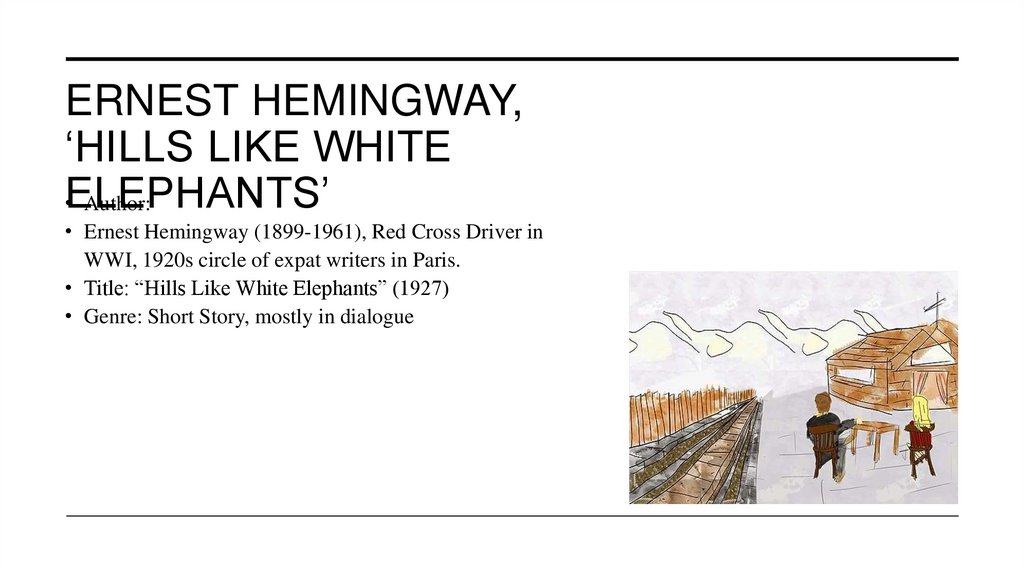
• Author:
• Ernest Hemingway (1899-1961), Red Cross Driver in
WWI, 1920s circle of expat writers in Paris.
• Title: “Hills Like White Elephants” (1927)
• Genre: Short Story, mostly in dialogue
12.
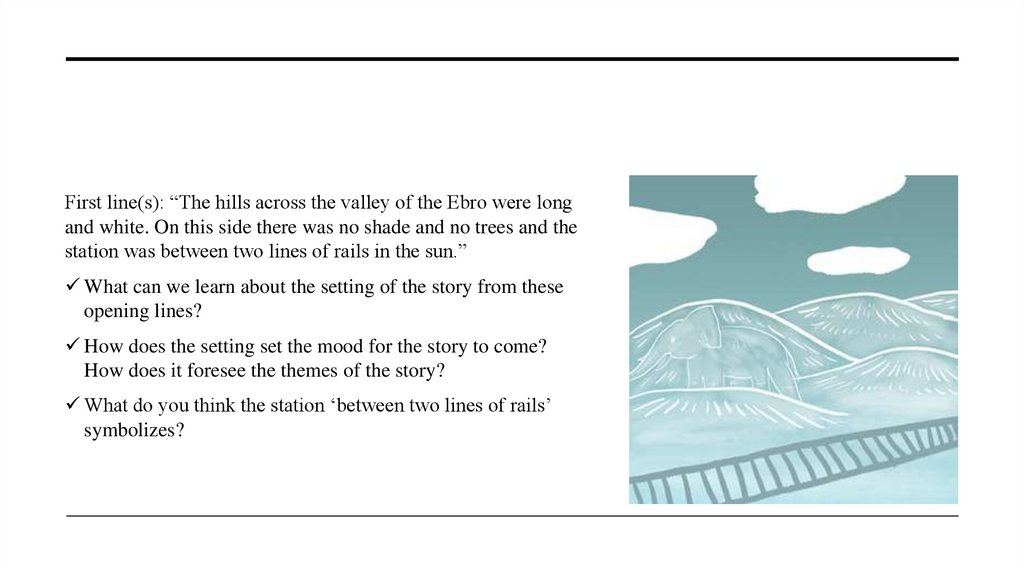
First line(s): “The hills across the valley of the Ebro were longand white. On this side there was no shade and no trees and the
station was between two lines of rails in the sun.”
What can we learn about the setting of the story from these
opening lines?
How does the setting set the mood for the story to come?
How does it foresee the themes of the story?
What do you think the station ‘between two lines of rails’
symbolizes?