

 policy
Similar presentations:






David Easton’s political system theory and the limitations of political analysis
1. David Easton’s political system theory and the limitations of political analysis
DAVID EASTON’S POLITICAL SYSTEMTHEORY AND THE LIMITATIONS OF
POLITICAL ANALYSIS
MAFTUNA KHASANOVA
AZIZA SOLIEVA
KHONDAMIR ULUGBEKOV
2. Overview of David Easton (1917-2014)
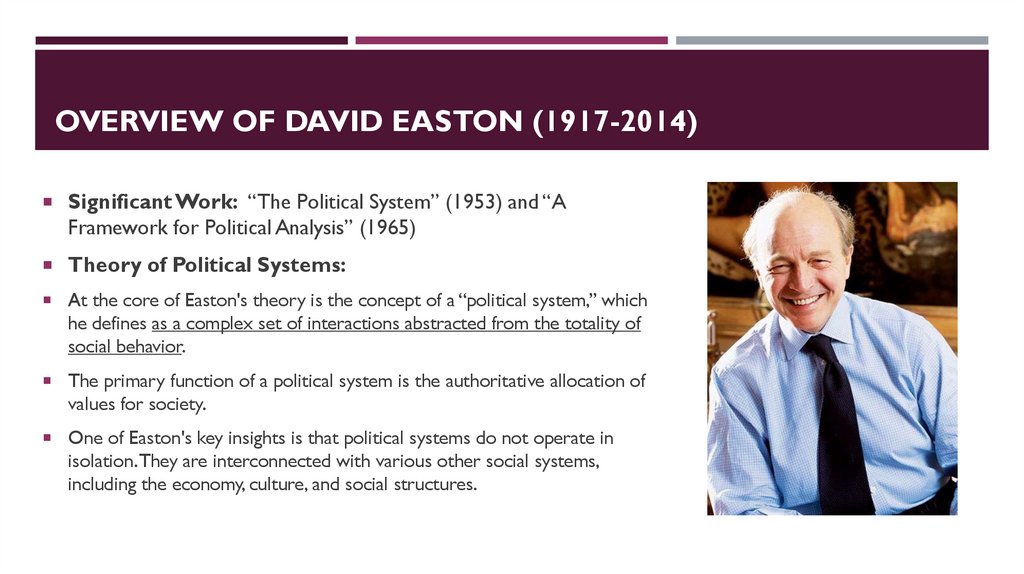
OVERVIEW OF DAVID EASTON (1917-2014)Significant Work: “The Political System” (1953) and “A
Framework for Political Analysis” (1965)
Theory of Political Systems:
At the core of Easton's theory is the concept of a “political system,” which
he defines as a complex set of interactions abstracted from the totality of
social behavior.
The primary function of a political system is the authoritative allocation of
values for society.
One of Easton's key insights is that political systems do not operate in
isolation. They are interconnected with various other social systems,
including the economy, culture, and social structures.
3. Easton's Political System Model
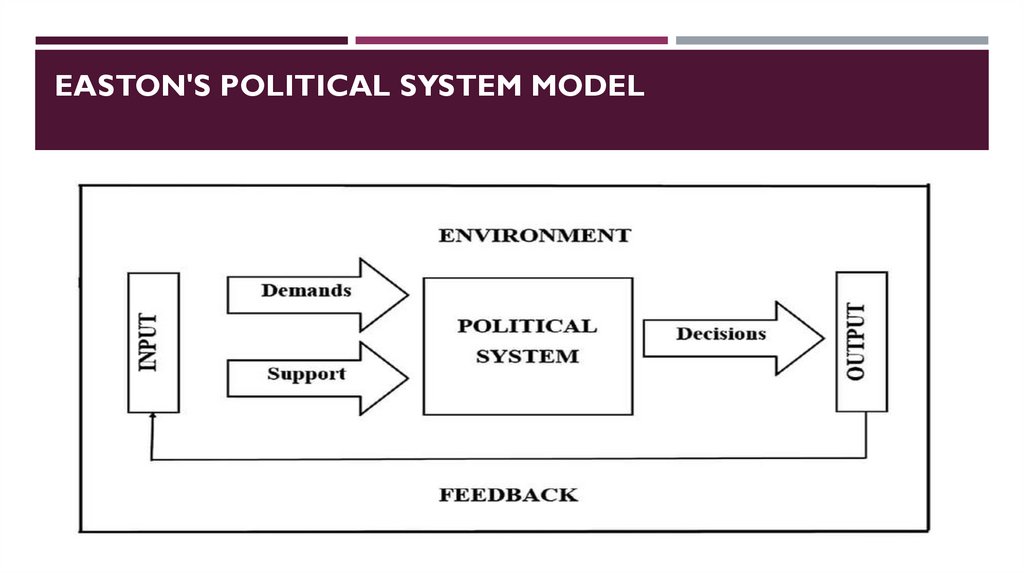
EASTON'S POLITICAL SYSTEM MODEL4. Detailed overview and explanation
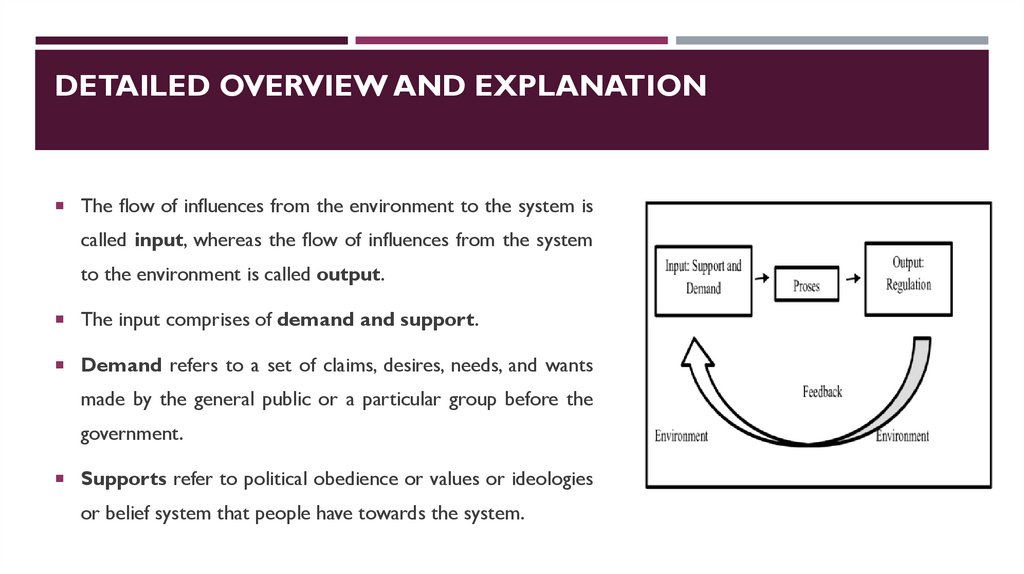
DETAILED OVERVIEW AND EXPLANATIONThe flow of influences from the environment to the system is
called input, whereas the flow of influences from the system
to the environment is called output.
The input comprises of demand and support.
Demand refers to a set of claims, desires, needs, and wants
made by the general public or a particular group before the
government.
Supports refer to political obedience or values or ideologies
or belief system that people have towards the system.
5. Types of Demands and Supports
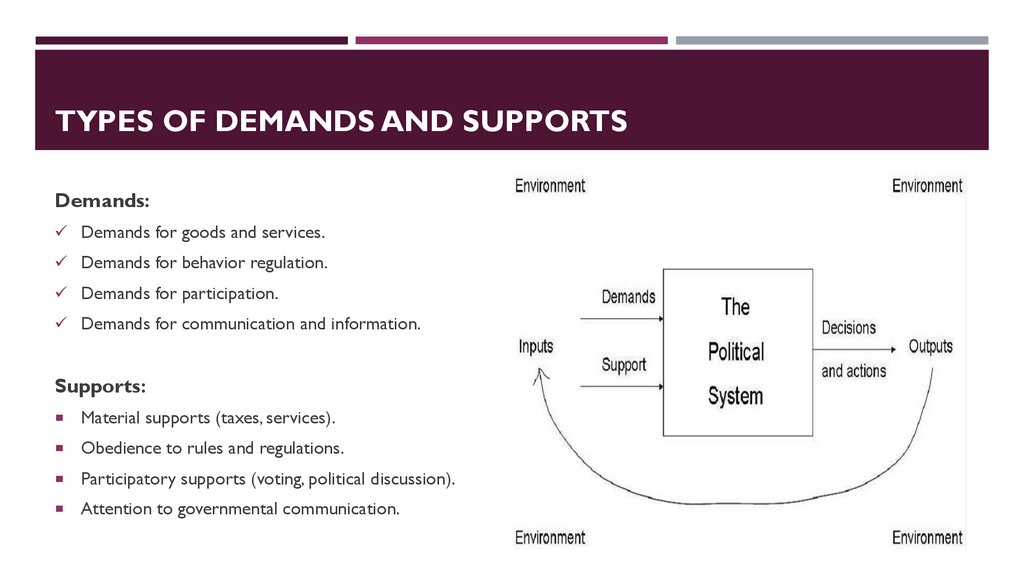
TYPES OF DEMANDS AND SUPPORTSDemands:
Demands for goods and services.
Demands for behavior regulation.
Demands for participation.
Demands for communication and information.
Supports:
Material supports (taxes, services).
Obedience to rules and regulations.
Participatory supports (voting, political discussion).
Attention to governmental communication.
6. Feedback and Environment of the Political System
FEEDBACK AND ENVIRONMENT OF THE POLITICAL SYSTEMFeedback in David Easton's Political System:
Feedback refers to the information and reactions that the system receives from its environment.
Positive feedback amplifies or reinforces the system's current state or behavior.
Negative feedback corrects or dampens the system's behavior, helping it to maintain equilibrium.
Environment of the Political System:
It encompasses both intra-societal and extra-societal elements.
Intra-societal components include elements within the society itself, such as the economy, culture, social structure,
and individual personalities.
Extra-societal components are systems that exist outside a given society, such as the international political system and
international economic systems.
7. David Easton's political system
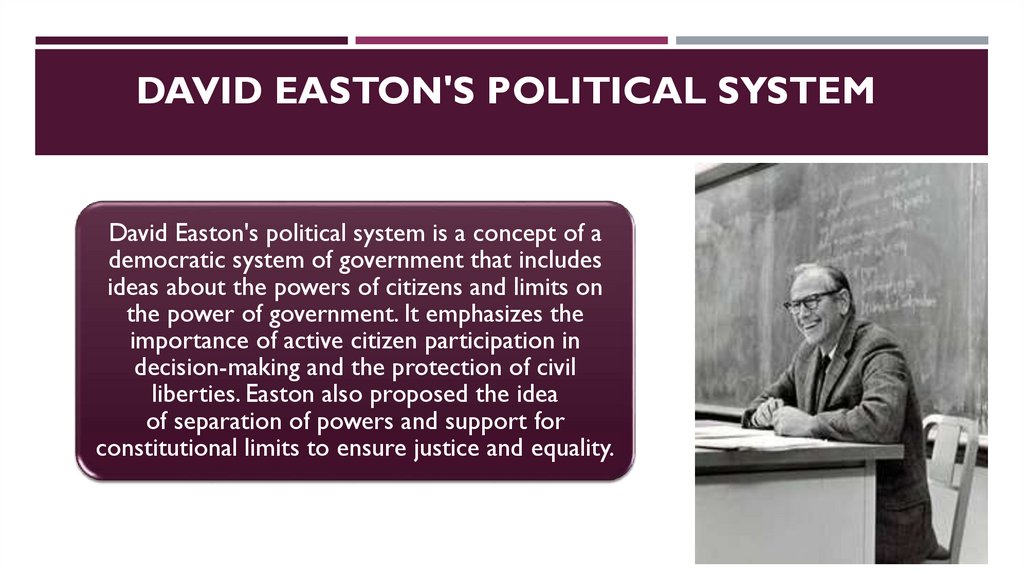
DAVID EASTON'S POLITICAL SYSTEMDavid Easton's political system is a concept of a
democratic system of government that includes
ideas about the powers of citizens and limits on
the power of government. It emphasizes the
importance of active citizen participation in
decision-making and the protection of civil
liberties. Easton also proposed the idea
of separation of powers and support for
constitutional limits to ensure justice and equality.
8. Key aspects of Easton’s political system
KEY ASPECTS OF EASTON’S POLITICAL SYSTEMDemocracy
Civil Liberties
Separation of powers
Constitutional restrictions
Active civic participation
9. Political events cannot be predicted accurately
POLITICAL EVENTS CANNOT BE PREDICTED ACCURATELYDavid Easton's limit of political analysis is the idea that
political analysis is limited in its ability to predict specific political
events and actions.
- Easton argued that political processes are too complex and
depend on many factors to be accurately predicted.
10. David Easton's limit of political analysis
DAVID EASTON'S LIMIT OF POLITICAL ANALYSISEaston emphasized that political decisions and actions depend
on a wide range of factors, including cultural, social, economic
and historical aspects. Because of this complexity, he argued that
political analysis can provide a general idea of trends, but cannot
provide accurate predictions about specific events.
11. To conclude…
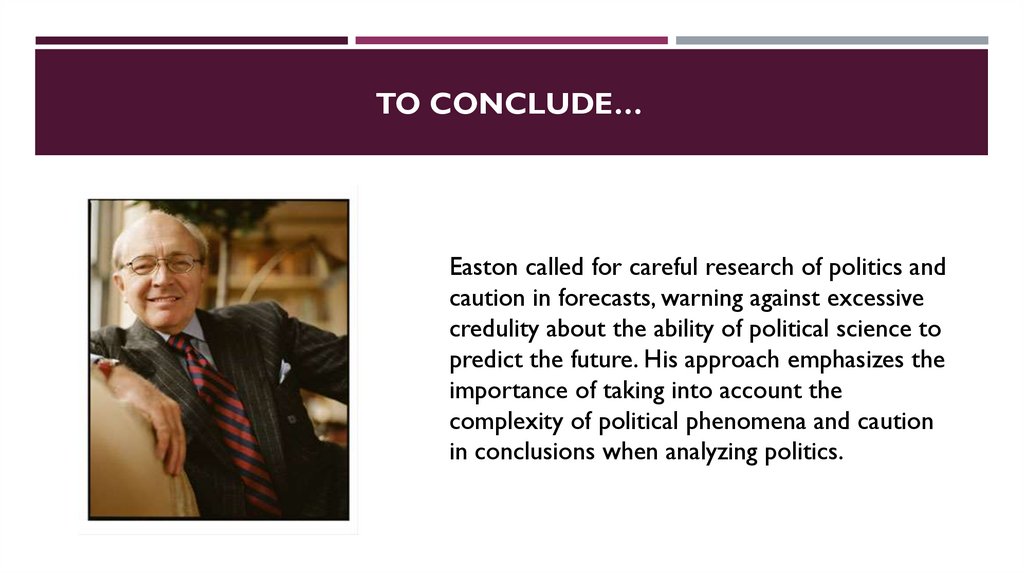
TO CONCLUDE…Easton called for careful research of politics and
caution in forecasts, warning against excessive
credulity about the ability of political science to
predict the future. His approach emphasizes the
importance of taking into account the
complexity of political phenomena and caution
in conclusions when analyzing politics.