
 english
Similar presentations:

Unit 1 writing lesson student's version
1.
CAEWRITING PART 2
FORMAL LETTER
english.teacher_irina
2.
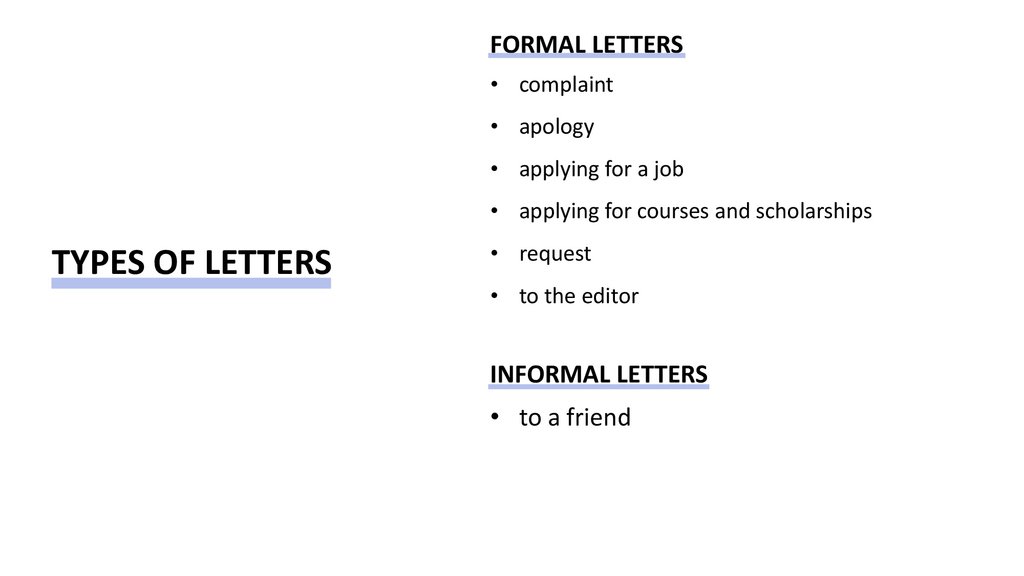
FORMAL LETTERS• complaint
• apology
• applying for a job
• applying for courses and scholarships
TYPES OF LETTERS
• request
• to the editor
INFORMAL LETTERS
• to a friend
3.
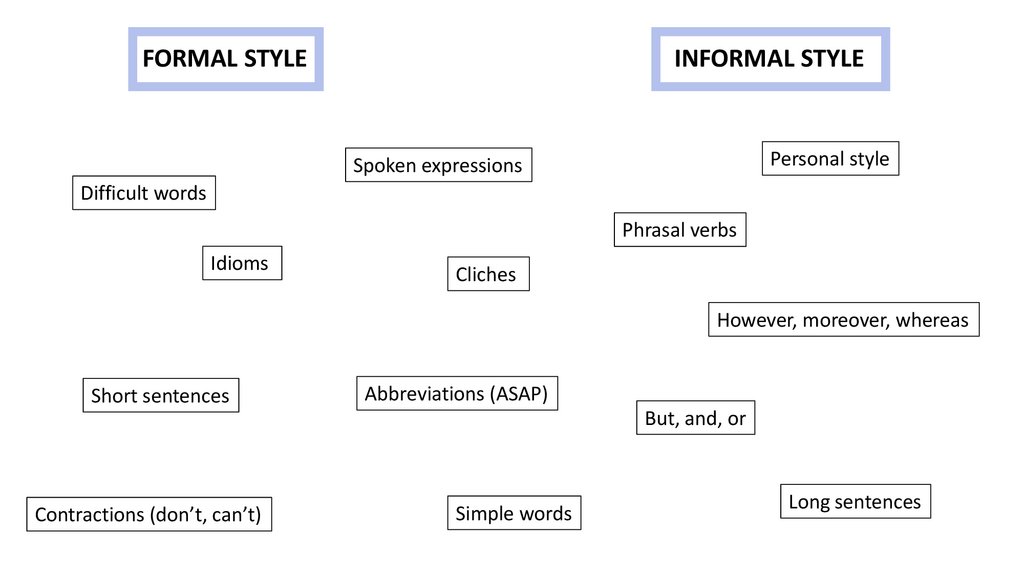
FORMAL STYLEINFORMAL STYLE
Personal style
Spoken expressions
Difficult words
Phrasal verbs
Idioms
Cliches
However, moreover, whereas
Short sentences
Abbreviations (ASAP)
But, and, or
Contractions (don’t, can’t)
Simple words
Long sentences
4.
FORMALINFORMAL
Dear Sir or Madam,
Dear Mr. Smith,
Dear John,
Yours faithfully,
Best wishes,
Yours sincerely,
Lots of love,
See you soon,
Best regards,
5.
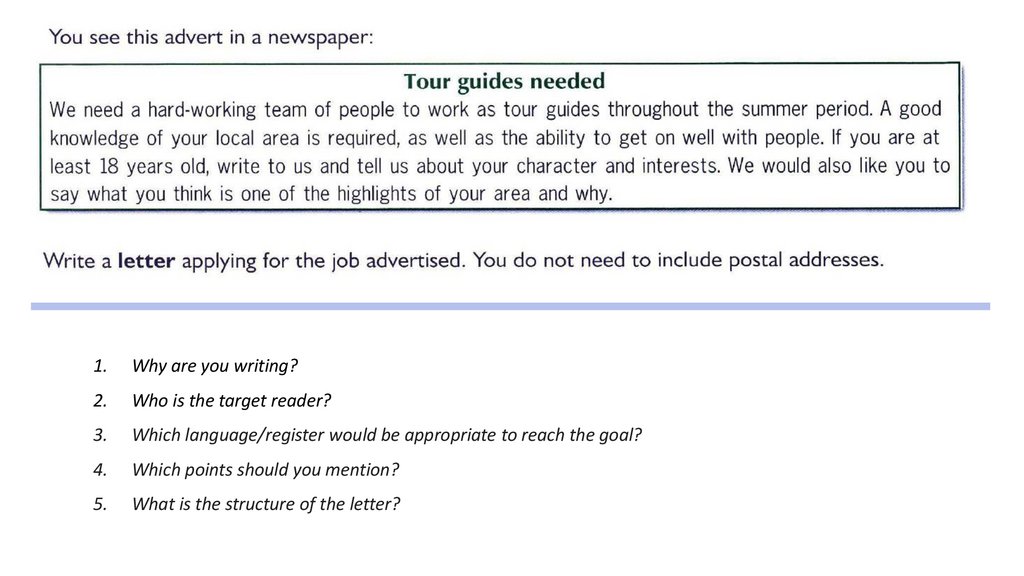
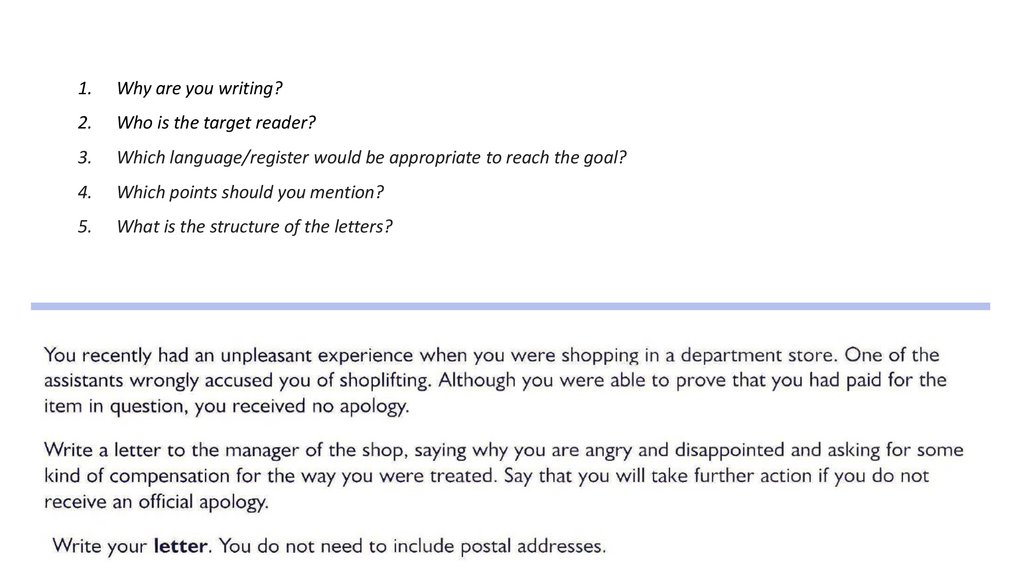
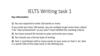
1.Why are you writing?
2.
Who is the target reader?
3.
Which language/register would be appropriate to reach the goal?
4.
Which points should you mention?
5.
What is the structure of the letter?
6.
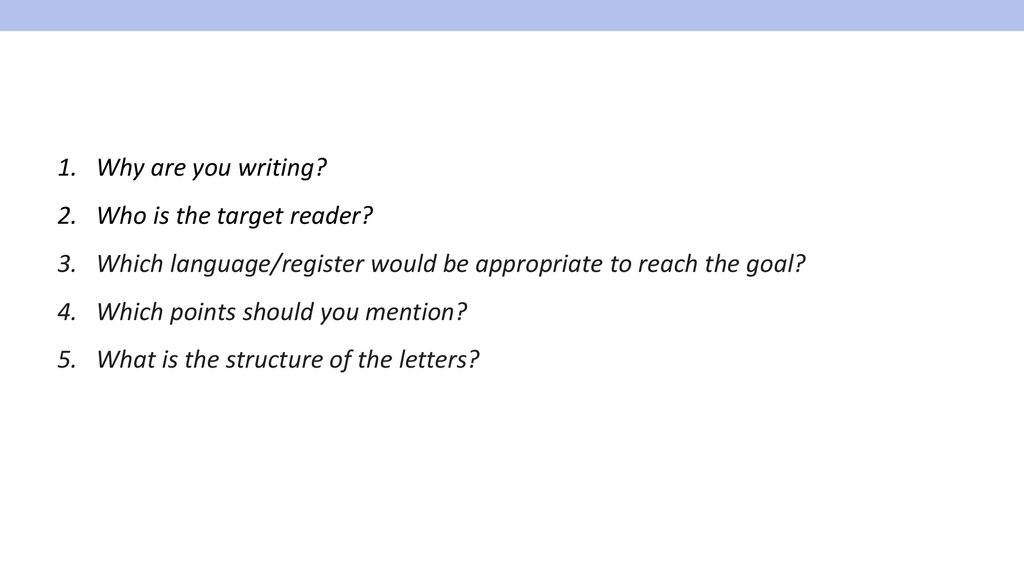
1.Why are you writing?
2.
Who is the target reader?
3.
Which language/register would be appropriate to reach the goal?
4.
Which points should you mention?
5.
What is the structure of the letters?
7.
1. Why are you writing?2. Who is the target reader?
3. Which language/register would be appropriate to reach the goal?
4. Which points should you mention?
5. What is the structure of the letters?
8.
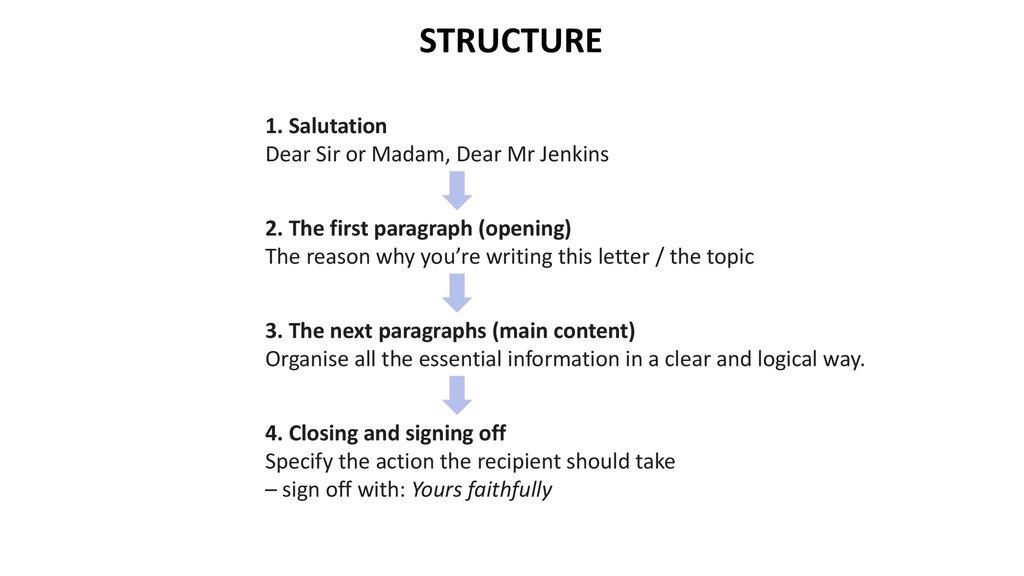
STRUCTURE1. Salutation
Dear Sir or Madam, Dear Mr Jenkins
2. The first paragraph (opening)
The reason why you’re writing this letter / the topic
3. The next paragraphs (main content)
Organise all the essential information in a clear and logical way.
4. Closing and signing off
Specify the action the recipient should take
– sign off with: Yours faithfully
9.
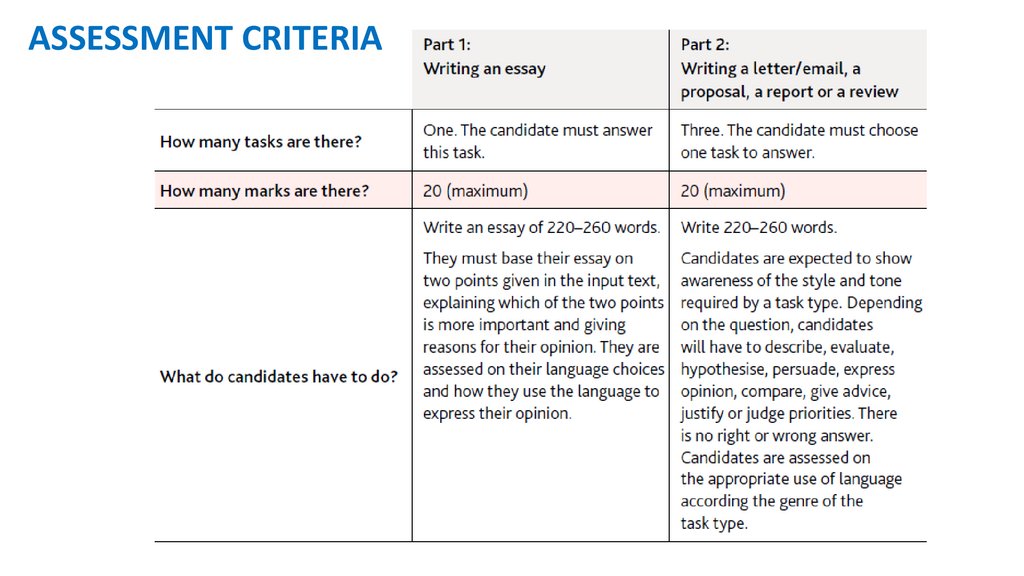
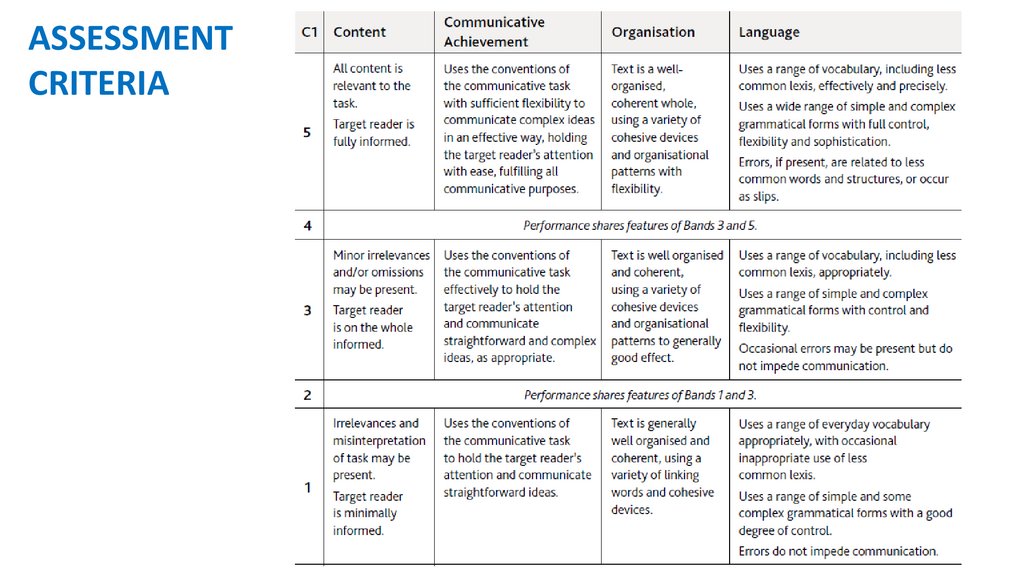
ASSESSMENT CRITERIA10.
ASSESSMENTCRITERIA
11.
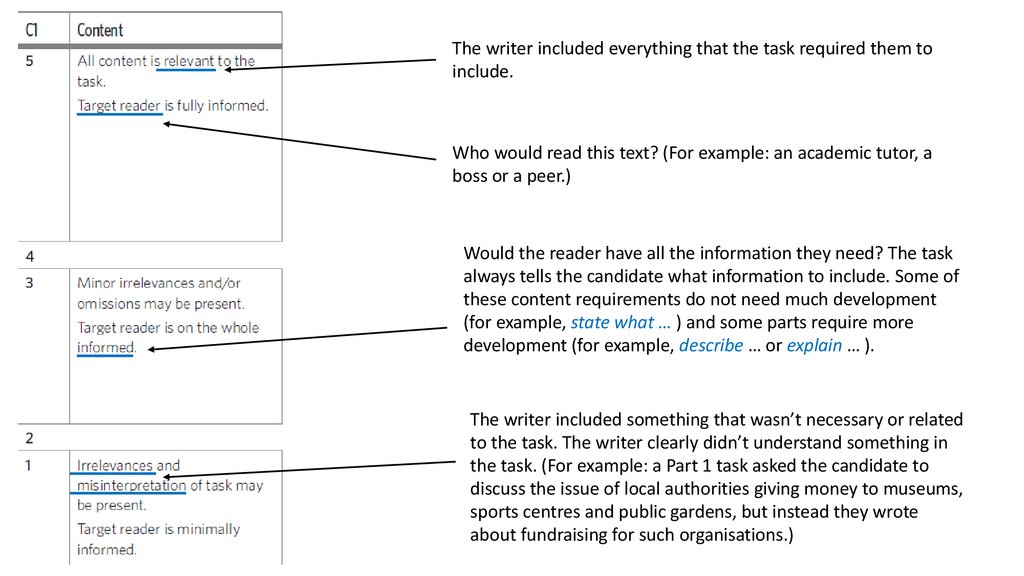
The writer included everything that the task required them toinclude.
Who would read this text? (For example: an academic tutor, a
boss or a peer.)
Would the reader have all the information they need? The task
always tells the candidate what information to include. Some of
these content requirements do not need much development
(for example, state what … ) and some parts require more
development (for example, describe … or explain … ).
The writer included something that wasn’t necessary or related
to the task. The writer clearly didn’t understand something in
the task. (For example: a Part 1 task asked the candidate to
discuss the issue of local authorities giving money to museums,
sports centres and public gardens, but instead they wrote
about fundraising for such organisations.)
12.
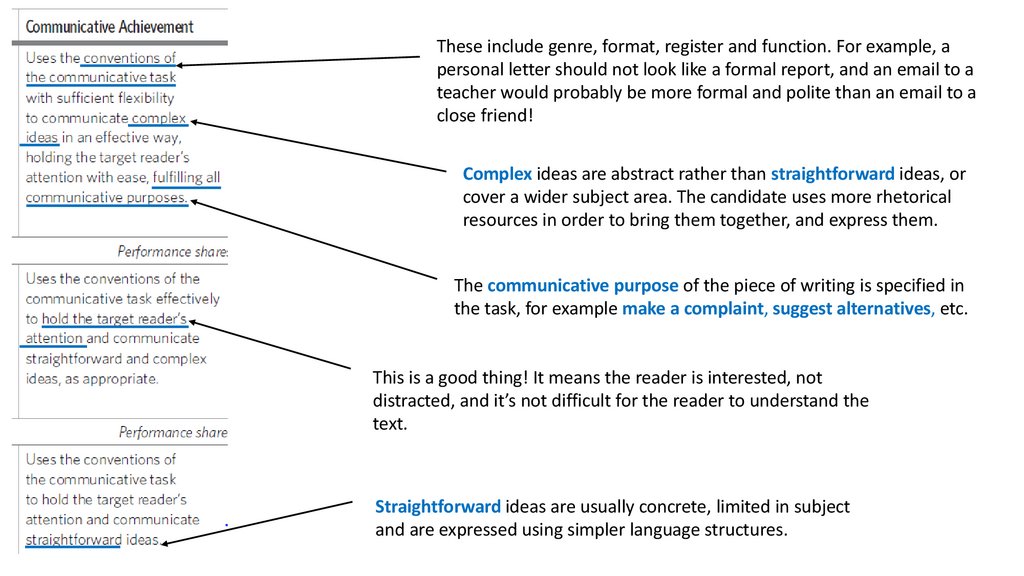
These include genre, format, register and function. For example, apersonal letter should not look like a formal report, and an email to a
teacher would probably be more formal and polite than an email to a
close friend!
Complex ideas are abstract rather than straightforward ideas, or
cover a wider subject area. The candidate uses more rhetorical
resources in order to bring them together, and express them.
The communicative purpose of the piece of writing is specified in
the task, for example make a complaint, suggest alternatives, etc.
This is a good thing! It means the reader is interested, not
distracted, and it’s not difficult for the reader to understand the
text.
Straightforward ideas are usually concrete, limited in subject
and are expressed using simpler language structures.
13.
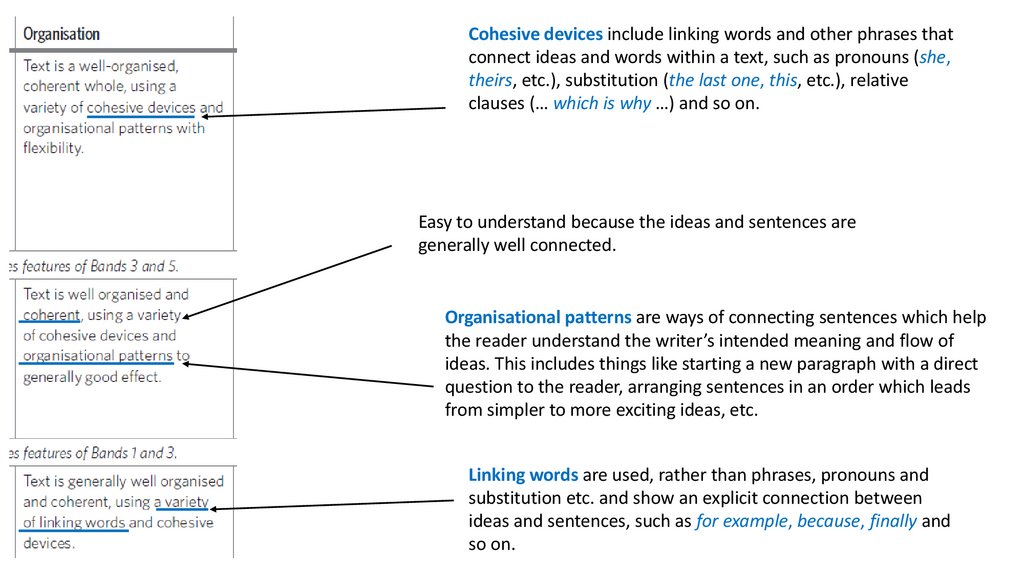
Cohesive devices include linking words and other phrases thatconnect ideas and words within a text, such as pronouns (she,
theirs, etc.), substitution (the last one, this, etc.), relative
clauses (… which is why …) and so on.
Easy to understand because the ideas and sentences are
generally well connected.
Organisational patterns are ways of connecting sentences which help
the reader understand the writer’s intended meaning and flow of
ideas. This includes things like starting a new paragraph with a direct
question to the reader, arranging sentences in an order which leads
from simpler to more exciting ideas, etc.
Linking words are used, rather than phrases, pronouns and
substitution etc. and show an explicit connection between
ideas and sentences, such as for example, because, finally and
so on.
14.
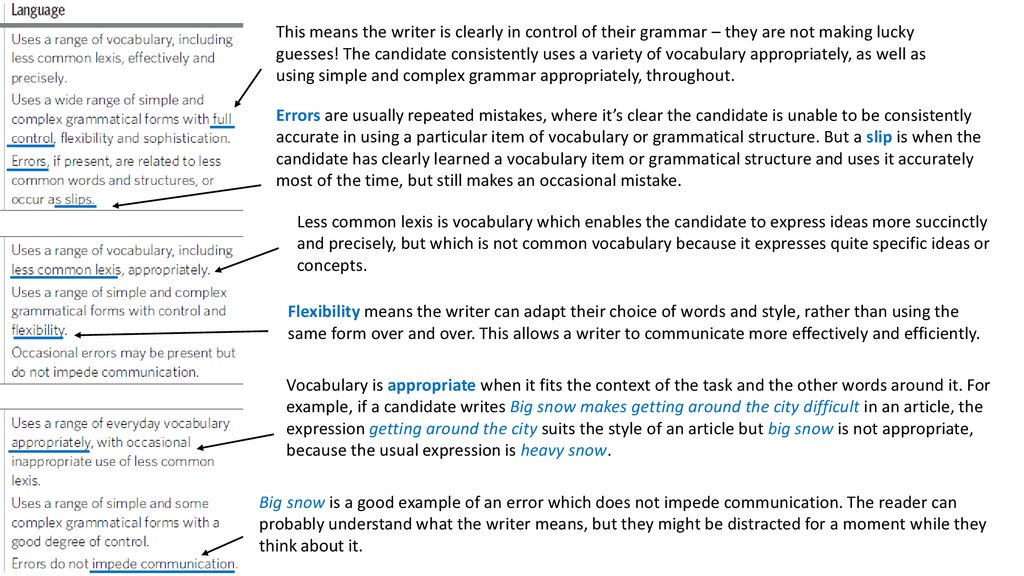
This means the writer is clearly in control of their grammar – they are not making luckyguesses! The candidate consistently uses a variety of vocabulary appropriately, as well as
using simple and complex grammar appropriately, throughout.
Errors are usually repeated mistakes, where it’s clear the candidate is unable to be consistently
accurate in using a particular item of vocabulary or grammatical structure. But a slip is when the
candidate has clearly learned a vocabulary item or grammatical structure and uses it accurately
most of the time, but still makes an occasional mistake.
Less common lexis is vocabulary which enables the candidate to express ideas more succinctly
and precisely, but which is not common vocabulary because it expresses quite specific ideas or
concepts.
Flexibility means the writer can adapt their choice of words and style, rather than using the
same form over and over. This allows a writer to communicate more effectively and efficiently.
Vocabulary is appropriate when it fits the context of the task and the other words around it. For
example, if a candidate writes Big snow makes getting around the city difficult in an article, the
expression getting around the city suits the style of an article but big snow is not appropriate,
because the usual expression is heavy snow.
Big snow is a good example of an error which does not impede communication. The reader can
probably understand what the writer means, but they might be distracted for a moment while they
think about it.